Giant Donut Discs® – April 2010
2. 4. 2010 | Rubriky: Articles,Giant Donut Discs
[by Ken Hunt, London] April and another month in music rolls around and brings ten snapshots of what got played oodles. This divine bumper pack of GDDs comes courtesy of Broadlahn, David Lindley & Wally Ingram, Fred Astaire, Reem Kelani, Rajan Spolia, the Grateful Dead, Bonnie Dobson, Peerie Willie Johnson, Abida Parveen and Mac Rebennack.
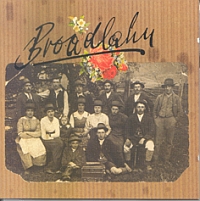 Bua von Muata Natur – Broadlahn
The Graz-based Austrian folk fusion group Broadlahn was founded in 1982 and took their name from the dialect word Broadlahn which means a wide avalanche as well as being the name of an area of alpine pasture in Austria’s Upper Styria region. Bua von Muata Natur is a setting of the Beatles’ song Mother Nature’s Son from Broadlahn’s first album. (Bua is a southern idiom for son or boy.)
It opens with the sound of metal being whetted as a rhythm track. Scythe rhythm is a trick worthy of Tom Waits – and nifty trick enough for that wonderful Bavarian folk-punk band Hundsbuam (meaning the mildly pejorative ‘Dog Boys’ or ‘Sons of Curs’) to have employed it too. Broadlahn’s setting of the lyrics works really well and the performance really brings out the melody’s charms. I happened to be planting raspberry canes and Broadlahn’s version of the Lennon/McCartney song from The White Album sprang into my mind and kept popping up the whole month like a rabbit after my tasties. From Broadlahn (The Fab Records 1990 (GDCD 4009, 1993)
More information about Broadlahn at www.broadlahn.at
When A Guy Gets Boobs – David Lindley y Wally Ingram
In simple statements are great truths revealed. This paean to male sagginess begins with a mellow, flowing introduction that could go in any number of directions. The direction it goes in is John Lee Hooker-wards, though that vibe only really kicks in once Lindley finishes his taxim-like overture and starts singing about Mr Puffy’s expanding set of new glories.
The song even has a Homer Simpson-esque ‘renunciation’ of fattening foodstuffs that in the spirit of Homer you just know will never happen. Maybe it was the product of Stilton, water biscuits and port before climbing the wooden hill to Bedfordshire. Maybe it was brought on by thinking about Bollywood playback, Lisbeth Scott and Avatar, followed by the UK film critic Mark Kermode’s rebranding Avatar as Dances With Smurfs. But in a hypnagogic state I dreamed a dream of David Lindley singing When A Guy Gets Boobs in Springfield and the world was a happier place.
A plea to Mr Groening. If there were any justice in the world a canary-coloured Lindley will guest in The Simpsons singing When A Guy Gets Boobs. From Live In Europe! (No label name, no number, 2004) available from www.davidlindley.com
Let’s Face The Music And Dance – Fred Astaire
Fred Astaire (1899-1987) is a much underestimated singer. His top hat, tails and cane unfairly overshadowed his vocal prowess in his lifetime. He delivers Let’s Face The Music And Dance from the 1936 RKO picture Follow the Fleet with great nuance, style and glamour. It’s one of those songs, the lyrics of which define a time and are also timeless. Came the war, those lyrics came freighted with additional meaning. That is the timelessness of Irving Berlin’s song. I heard the song on the BBC. It lodged and stayed and as it wasn’t on the Fred Astaire anthology that I have you get no discographical recommendation.
Yafa! – Reem Kelani
Before The Last Chance, an anthology of eight songs about Israel and Palestine” on themes of Shoah and Nakbah – the ‘Holocaust’ and ‘Catastrophe’ of Jew and Palestinian – I regret to say that the Palestinian singer, musician and broadcaster, Reem Kelani’s music had passed me by. As had her name. It also appears in some places as Riim Yusuf Kilani.
Yafa! (‘Jaffa!’ as in the ancient port) is her setting of words by the poet Mahmoud Salim al-Hout (1917-1998). It is a threnody for a bygone time in the city of the title, in a place that seems as if it was a paradise in comparison with the Hell it is now.
Zoe Rahman’s piano accompaniment is languid and brooding. The pairing of voice and piano is powerful stuff. The track originally appeared on Reem Kelani’s Sprinting Gazelle – Palestinian Songs from the Motherland and the Diaspora. From The Last Chance (Fuse Records CFCD 008, 2010)
For more information, see www.reemkelani.com
It’s Still Raining – Rajan Spolia
This is the Punjab-born, British-based guitarist Rajan Spolia at his inspiring best. He lists it as a Nash/Goffin/King composition. However, it is more in the spirit of a ragamala – a ‘garland of ragas’ – than a medley. Spolia conjures ‘I Can See Clearly Now’ out of some Beatle-esque phrasing. But that is just part of this marvellous piece of music. The man is long overdue wider recognition. The sheer invention and fluidity of his playing is remarkable. From More Than Words: Snake Music (Chapter IV) (Hard World HWCD008, 2010)
Go to www.rajanspolia.co.uk for more information
Dark Star/El Paso/Dark Star – Grateful Dead
In November 1971 the Grateful Dead arrived at the Municipal Auditorium and Convention Center in Austin, Texas. The band was in a process of regeneration, thanks to the recruitment of their new keyboardist Keith Godchaux. The other players were Jerry Garcia on lead electric guitar and vocals, Bill Kreutzman on kit drums, Phil Lesh on electric bass guitar and vocals and Bob Weir on rhythm guitar and vocals. (Ron ‘Pigpen’ McKernan was increasingly out of action and recruiting another keyboardist was a far-sighted move.) Godchaux had learned the core repertoire from the vantage point of an admirer of the band’s music. This recording of the band’s signature space anthem, recorded by Rex Jackson, finds Godchaux straining at the leash, egging the band on with piano filigrees and fills.
Ten minutes or so into the performance, Weir suggests, feints or cues them into a segue and a couple of minutes later they slide into Marty Robbins’ cowboy-film-in-song El Paso. A masterful transition. Weir sings his cowboy song, visits the cantina, does his business, doffs his Stetson, gets shot (“dreadfully wrong”) and within five minutes, Garcia and Lesh remind the band that they are back in modern-day Texas. They return to Dark Star space via a worm hole through atonalism and jor-like, unmetered rhythmicality before breaking out of the ‘darkness’ into the full glare of what they call Dark Star here but which is more like uncharted space. From Road Trips – Austin 11.15.71 (Grateful Dead Productions GRA2-6014, 2010)
Stay With Me Tonight – Bonnie Dobson
Bonnie Dobson recorded this female take on the Stones’ Let’s Spend The Night Together in 1983. Annie Graham, Gerry Hale and Richard Lee of Telephone Bill and The Smooth Operators accompany her on this archival recording that had vanished until now. She is sassy and inviting and a great little character actress on this one. From Looking Back (Biber 76831, 2010)
Margaret’s Waltz – Aly Bain and Peerie Willie Johnson
 ‘Peerie’ Willie Johnson (1927-2007) was a Shetland-based guitarist who thanks to the curvature of the globe – and the absence of land masses – was able to enjoy faraway radio stations on the other side of the Atlantic. How strange is geography! Certainly, far stranger than geography teachers ever taught me. Still stranger, Johnson was posted to the main Royal Air Force base on the Shetland Islands soon into the Second World War. That was where my bandsman father was posted as the full-time (as in, excused any form of military activity whatsoever) clarinettist, saxophonist and arranger for the base’s dance band. Apparently Johnson used to sit in with the band. If he did he must have sat in with my father.
I wrote Peerie Willie Johnson’s obituary in The Guardian and I am writing his entry for a Supplement for the Oxford Dictionary of National Biography. That is why I have been cramming his music again. This sweet fiddle and guitar waltz, originally on Aly Bain’s The First Album, does not capture the fire of Peerie Willie Johnson. It captures the smoulder. It reminds me of the tale told about Jean Ritchie and Doc Watson. Doc Watson, one of the all-time greats of guitar, hadn’t cut loose when accompanying her. She was puzzled. He told her that he had played what was necessary. That is what happens here. By the way, since you have been so patient and haven’t asked, ‘peerie’ is a Scots idiom for ‘small’, ‘little’. Like ‘wee’. His tradition lives on. From Willie’s World (Greentrax CDTRX309, 2007)
Isho Jannat Zameen Te Le Aaya Ae – Abida Parveen
A good friend turned me on to this album by the Sindhi Pakistani Sufi singer Abida Parveen, presented by the poet-lyricist Gulzar. Based on Punjabi folklore, the star-crossed tale of Heer and Ranjha attributed to Waris Shah unfolds. The meeting is a fortuitous one.
“Kohl [a darkening cosmetic] lines the top of her eyelids
Like Punjab sits atop Hind [India]
Those eyebrows arch arrow-straight
Like words line the sheaf of books.”
The accompaniments blend ancient and modern. The sound palette for Isho Jannat Zameen Te Le Aaya Ae includes bansuri (bamboo flute), rebab (short-necked fretless lute), dholak (double-headed barrel drum) and tabla, electric bass guitar and keyboards. What really, truly sings out is Abida Parveen’s voice. From Heer By Abida (Times Music TDIGH 016C, 2004)
I Walk On Guilded Splinters – Dr. John
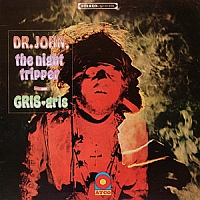 The Last Song you hear tonight should be this one. I Walk On Guilded Splinters – that is the way they spell ‘gilded’ on this anthology, topping ambiguity with ambiguity – originally appeared on Dr. John’s album Gris-gris in 1968. The vibe, the winds, the beats and the backing voices cook up something very deep and slightly disturbing. You do not have to know what Mac Rebennack is singing about or the ingredients he is throwing into the cauldron to intuit that he has been places you never will see or possibly never will want to see. From The Dr. John Anthology – Mos’ Scocious (Rhino 8122-71450-2, 1993)