Giant Donut Discs® – August 2010
16. 8. 2010 | Rubriky: Articles,Giant Donut Discs
[by Ken Hunt, London] More boffo music from the rain-soaked rock, as ever reflecting work streams and passions. Lisa Knapp, John B. Spencer, Béla Fleck, Zakir Hussain and Edgar Meyer, Ökrös with Ági Szalóki, Element of Crime, Toots and the Maytals, Miles Davis, Pentangle, Asha Bhosle and R.D. Burman, and the Kronos Quartet with Alim & Fargana Qasimov are the month’s turn-ons.
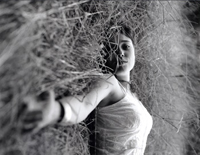 Blacksmith – Lisa Knapp
Lisa Knapp is a singer whose passion and gift are astonishing. The Blacksmith is a traditional song that seems to have been with me my entire journey into traditional English music. It has a wondrous melody and it tells a story to wonder at and weep over. Its lyrics capture the bewilderment of love found and love lost better than nearly any other song in the folk or popular canon.
Knapp first heard The Blacksmith as sung by Shirley Collins. In an unpublished part of an interview that she did with me for R2‘s article to celebrate Shirley Collins’ 75th birthday in August 2010, Knapp said, “When I first heard her – The Sweet Primeroses was probably the first one I heard – I’d never heard anything like it. Her voice was so unique. For me, it was like fresh air, so sparklingly unique and really inspiring. She made me want to sing folk music. There’s no mistaking her. You know it’s her. I liked that. I like that in people. She really did just sing the song. She never over-exercises in her singing style. It’s so clearly her.”
The version on this album is remixed by Youth. The mix is remarkable. (But how I would love to listen to how it sounded before!) Yet it is Knapp’s voice that hooks and reels the listener in. From Wild And Undaunted (Ear To The Ground Records ETTGCD001, 2006)
Alone Together – John B. Spencer
This is one of John Spencer’s more acerbic songs but he delivers his barbs in such a low-key way. “When the smile on your face don’t touch your eyes”, “When we make love to be polite” and “All our friends sit on the fence/While we crack jokes at each other’s expense” are examples of Alone Together’s wit and observational powers from. “It’s my version of Breaking Up Is Hard To Do,” is how John describes it on this album.
A lover of words, John had a droll and deadpan sense of humour. Mordant to the end, when John’s coffin was carried in for his final send-off, he had the fruits of the allotment on top rather than the usual scentless roses and bland chrysanths. Goonishly, amongst the veg were sticks of rhubarb. John had had time to consider his final send-off and that visual gag made me laugh out loud as he waltzed in. We were there to remember, not to forget.
I’ve probably got Alone Together somewhere on a demo cassette with him playing his Telecaster and singing with bloody budgie twittering as his chick chorus. (Honest!) As we say in London, loverly man, loverly song. From Left Hand of Love (Round Tower Music RTM CD 82, 1996) (Keeping it in the family, there’s also his sons’ up-tempo version on Fast Lane Roogalator (Irregular Records IRR056, 2004).)
More memories of John B. Spencer at http://kenhunt.doruzka.com/index.php/john-b-spencer-1944-2002/
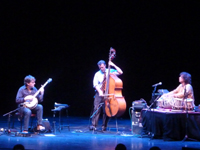 Bahar – Béla Fleck, Zakir Hussain and Edgar Meyer
Over the course of July 2010, for me three bands raised the spectre of Shakti – the benchmark of excellence in matters Indo-jazz.
The first was The Shin’s live Black Sea Fire musical extravaganza at Tanz&FolkFest Rudolstadt because of its adoring embrace of the compositions of John McLaughlin (even though they were more Inner Mounting Flame than Shakti).
Next, there was an Indo-jazz masterpiece called Raga Bop Trio from Steve Smith, George Brooks and Prasanna.
The third was the wondrous Béla Fleck, Zakir Hussain and Edgar Meyer concert at the Barbican. This composition unveils a whole new world in which banjo (Fleck), double-bass (Mayer) and tabla (Hussain) do things together that have never been done before, creating worlds of melody that mesmerise. The picture is from the trio’s London concert (c) Swing 51 Archives. From The Melody of Rhythm (E1 Entertainment KOC-CD-2024, 2010)
Cigánykesemes: Si e dracu suparatu, Az ördög megsértödött, Ungureste rar; Cigánycsárdás; Csingerálás – Gypsy tunes: Lament, Slow Hungarian, Gypsy csardas, Fast csardas – Ökrös
Presciently, the Hungarian traditional powerhouse Ökrös calls on the powerful and plangent voice of Ágnes Szalóki here. She sings the heart out of the opening part of this medley, sings it unaccompanied, before the band joins in. Later you hear some of her other voices.
If you only listen to ten albums of Hungarian folk music your whole life, try and find this revelation. The melodic, rhythmic and time changes on this track alone are an instant conduit to Hungarian music. You probably won’t find it in any shop. ABT produced albums so exquisite in so many ways – artwork, calligraphy and, of course, music – that most are out-of-print. Mind you, if you go truffling in Budapest, you might find the odd ABT CD in some small record shop.
Much of music is theatre. The painter Maggi Hambling distilled a great truth in a couple of sentences in 2009 (in the London edition of Time Out). “You only need to see a shark in a tank once, whereas you can go back and look at a Rembrandt self-portrait thousands of times.” Like art of the greatest kind, this is something Rembrandt-like, worthy of revisiting again and again. From Bonchida, Háromszor – Bonchida, Times Three (ABT005, 1998)
Kaffee und Karin – Element of Crime
It’s hard to explain the literary uplift that Element of Crime delivers to anyone that can’t understand German. They are German chanson personified. Just like people who don’t understand French listen to the chansons of Brel, Brassens and Gainsbourg and melt, maybe one day soon people will listen to Element of Crime and melt to Sven Regener’s voice and lyrics.
The title translates as ‘Coffee and Karin’. Its backdrop is a bistro or café scene. After coffee and beer comes talk, “Deinen Namen hab ich vergessen/Deine Nummer fällt mir nicht ein/Einen Ring hab ich niemals besessen/Und einsam will ich nicht sein” – “I’ve forgotten your name/Your name doesn’t occur to me/I’ve never owned a ring/And I don’t want to be alone.” Sheer Brel. A tip-off from Pankow’s Jürgen Ehle. From Immer Da Wo Du Bist Bin Ich Nie (Universal 2713646, 2009)
Pressure Drop – Toots and the Maytals
Toots Hibbert sings the heart out of the song. The Maytals play it unrelentingly as if it were a looped track done in real time. This version is just the blueprint of other things that came. A reggae song for all time. Did I ever tell you about the time I interviewed Toots? From Funky Kingston Island CCD 9330, undated)
It’s About That Time/Sanctuary – Miles Davis
I only ever saw Miles Davis once and it was at the Isle of Wight Festival on 29 August 1970. The line-up was Davis on trumpet, Gary Bartz on saxes, Chick Corea on electric piano, Keith Jarrett on organ, Dave Holland on basses, John DeJohnette on drums and Airto Moreira on percussion. (Making it the first time I ever saw Airto live.) What a phenomenal line-up.
Listening to It’s About That Time forty years on, I marvel at my receptiveness to what was very strange and angular then. It launched my interest in Miles Davis’ music. Oh, and the drugs did work. From Isle of Wight, part of Miles Davis: The Complete Columbia Album Collection (Columbia Legacy 88697524922, 2009)
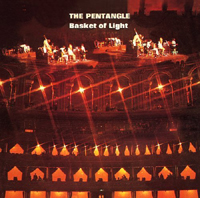 Light Flight – Pentangle
Lavinia Blackwall of Trembling Bells prompted the inclusion of this track. Her merely mentioning it opened a sluice gate of memories. High amongst them were memories of the BBC television series Take Three Girls in the original series of which the actresses Liza Goddard, Susan Jameson and Angela Down played the three girls. Pentangle (only Americans ever called them ‘The Pentangle’) supplied this opening credit music (and sundry incidental music). In his big, two-issue Rolling Stone interview in 1972, the Grateful Dead’s Jerry Garcia name-checked Pentangle and that felt good in a moderately patriotic, steady-on-Carruthers way.
Terry Cox plays trap drums, Bert Jansch and John Renbourn guitars and Danny Thompson double-bass. Jacqui McShee soars (and multi-tracks vocals) over Light Flight’s driving instrumental track. If you want to listen to what went before what is now called ‘acid folk’, ‘psych-folk’, ‘wyrd folk’ or, heavens open and wash the folk infidels away, ‘folktronica’, this consummate piece of folk-jazz or jazz-folk musicianship will really, really help. Such a groove! Ah, strange folk-jazz pleasures. From Basket of Light (Transatlantic TRA 205, 1969 and Sanctuary CMRCD207, 2001)
Qashlarin Kamandir – Kronos Quartet with Alim & Fargana Qasimov
“Your eyebrows are bow-like/Your eyebrows are bow-like and your gaze is stunning/Your words are sweeter than honey and sugar/Please, come to me, sweetheart, you are my flirtatious beauty.” People pay me to listen to such musical sorcery! From Music of Central Asia Vol. 8 – Rainbow (Smithsonian Folkways SFW CD 40527, 2010)
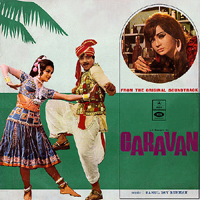 Piya Tu Ab Aaja – Asha Bhosle and Rahul Dev Burman
R.D. Burman had a stack of compositional tricks. It is a sad truth that Mother Nature isn’t always up to the job and Mother Nature’s son has to help out. In film Foley artists are the people that craft the sound effects from sticks of celery and buckets of stones and water. R.D. Burman did his own sound effects (that ol’ Listerine bottle is a classic) but frequently when he was putting together tracks in the studio he relied on the talents of his right-hand man, the multi-instrumentalist Manohari Singh. Born in Calcutta on 8 March 1931, Singh died in Mumbai on 13 July 2010. I cannot remember an LP sleeve (certainly not this one) that ever credited the session or side musicians. Pretty hard and fast as rules go, the credits give the playback singers and the music director/lyricist. Singh was a major asset on the R.D. Burman team. The saxophone interjections on this track are marvellous, if brief. That was one of Burman’s tricks. Leave them expecting more. From Teesri Manzil and Caravan (Saregama CDF 120017, undated)