Giant Donut Discs ® – August 2012
24. 8. 2012 | Rubriky: Articles,Giant Donut Discs
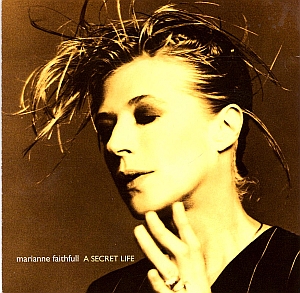 [by Ken Hunt, London] Nightingales serenade and sing us back home. In between come Hedy West, Joni Mitchell, Marianne Faithfull, Chavela Vargas, Radhika Mohan Maitra and Mike Seeger. This is, to some extent, a confluence of memories, dreams, reflections and applied coincidence inspired by Marianne Faithfull and her 2007 book (with David Dalton) entitled memories, dreams & reflections.
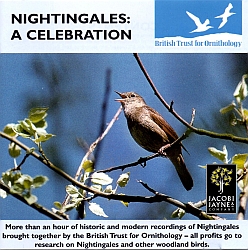 Londonderry Air – Beatrice Harrison
This is a famous and historical recording. The cellist Beatrice Harrison discovered that when she played in her garden in Oxted in Surrey her local nightingale would sing along. The nightingale was a wild bird. It wasn’t caged like a canary and recorded as it sang – as had previously been the case with recordings of wild bird song. This recording made on 3 May 1927 captured one of their musical conversations. The booklet notes state: “She eventually persuaded Lord Reith [of the BBC] that this was worth broadcasting. These BBC broadcasts started in 1924 and carried on for 12 years until she moved.” The Londonderry Air is also known as Danny Boy.
“Let memory of mortgages, loans and property sales/Dissolve into the cries of nightingales…” as was said twenty years after this recording was made. From Nightingales: A Celebration (British Trust for Ornithology ISBN 0 903793 91 1, undated [circa 1997])
 Love In The Afternoon –Marianne Faithfull
This choice came out of a highly enjoyable conversation with the Folker and more photographer Ingo Nordhofen. He and I relaxed under a canopy in the shade at a music festival, toasted our hosts Regina and Rainer and chatted over a couple of drinks in that taking-a-break-from-work-before-returning-to-work way. The conversation turned to Marianne Faithfull and a performance of hers not too far from Weimar that we had both attended. That conversation set in train thoughts that led to picking this song by Angelo Badalamenti and Marianne Faithfull.
Unlike the romantic comedy of the same name from 1957 featuring Gary Cooper, Audrey Hepburn and Maurice Chevalier, this is an altogether different kind of affair going on. The emotional fulcrum changes as the narrative unfolds. By the second verse she is singing, “Don’t fall in love with me/Too much to lose.”
All this plopped on top of writing articles about Little Feat for R2 and Bass Guitar Magazine – their September and November 2012 issues – and that line of Lowell George’s getting conjured: “Of all the things I had to do/I had to fall in love” in Cold, Cold, Cold. And the deliciousness of thinking about the power to resist in its song manifestations. Futility and ambiguity are lovely bedfellows. From A Secret Life (Island CID8036, 1995)
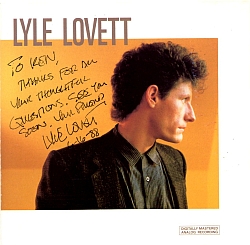 You Can’t Resist It – Lyle Lovett
One thing, well, led to another when thinking about resisting, wearing thin or being worn thin or beaten down. I connected Marianne Faithfull’s Love In The Afternoon and Lyle Lovett’s You Can’t Resist It. John Goin plays lead electric guitar and Roseanne Cash sings backing vocals on this song.
Next thing I knew the Summer 2012 issue of Penguin Eggs was on the doormat and the cover article was Roddy Campbell’s interview with Lyle Lovett. Catch him right and Lyle Lovett is one of the best interviews in the music business. Studied journalism and all that. Campbell captures him in top form and Lovett is really illuminating about songcraft’s strange little ways.
Anyway, I got to remembering Lyle Lovett and an interview we did in June 1988. I left that interview to head off to one of the music critic’s least favourite tasks – the slog of transcribing the interview. Next thing I knew I had Lyle rushing down the stairs after me pointing me out to his manager. Panicky memories of a Zigzag colleague being forced to wipe the interview that he had just done with a rock bigwig flashed through my head. Lyle calmed me and told me he only wanted to introduce me to his manager and explained that I had extracted all sorts of things from him that he had not intended to talk about.
But I never revealed the sinless pleasures of the lad from Klein, Texas talking about watching Star Trek in German in some foreign hotel with a German dictionary. Nor the kindnesses bestowed on my 13-year-old son, when we went to see him at Woburn Abbey opening for Dire Straits on 20 June 1992. I left my lad in the secure backstage, green room area, guarded over by security while I worked, and with access to unlimited, juices, soft drinks and barbeque. When Lyle and I returned from watching Was (Not Was), there was Tom was sitting chatting over, no doubt, his umpteenth plate of food and umpteenth juice or soft drink to John Illsley and his parents. From Lyle Lovett (MCA Records/Curb MCAD-5748, 1986)
You’ve Changed – Joni Mitchell
A frivolous thought entered my head. It occurred in a dream. I woke and wrote it down. What would Joni Mitchell do with her hands if she didn’t have a cigarette and/or a paint brush in her hands?
Wayne Shorter is the featured saxophonist on this track, a song by Bill Carey and Carl Fischer in an orchestrated arrangement. From Both Sides Now – or, as I would prefer from the CD spine, Both Sides Now – Reprise (Reprise 9362 47620 2, 2000)
For The Roses – Joni Mitchell
Again one thing leads to another. Dreaming about Joni Mitchell is like dreaming in the English manner after an evening of Stilton, water biscuits and port. Very moreish and pleasantly hallucinogenic.
This is not a standard tale about success or the worship or brickbats that some encounter. There are many ways that a musician – actor, poet, author, continued overleaf – might respond. “I heard it in the wind last night/It sounded like applause.” I wish more people would cover it. It remains one of the finest expositions on pros and contras of fame and success and money I have ever heard. From For The Roses (Elektra/Asylum 7559-60624-2, 1972)
Bageshree – Pandit Radhika Mohan Maitra
Pandit Radhika Mohan Maitra (1917-1981) is a musician known more by association and reputation than the music he made in his lifetime. This is a recording of the sarod maestro made in 1957 with a young Shankar Ghosh accompanying on tabla.
His playing style has a bedrock of rabab ang – rabab style, the rebab being the sarod’s folk predecessor – learned from his first guru Md. Amir Khan and a dhrupad-based style of playing combining vina and sursringar forms from studying with Dabir Khan and studying sitar with Enayat Khan. I came to him from backtracking from his disciple, the sarod maestro Buddhadev Dasgupta. Eventually, some old recordings came into my possession and they illuminated my understanding of Buddhadev Dasgupta’s performance style.
After listening to this excellent performance of the late night raga much more about Buddhadev Dasgupta’s distinctiveness made sense. This recording follows the pattern of alap, jor and slow and fast gat compositions. From Moments (Bihaan Music CD-BMC-74, 2005)
Go to http://www.raga.com/interviews/210int1.html to read Ira Landgarten’s marvellous interview with Buddhadev Dasgupta that goes into his relationship with his guru.
More information about Bihaan Music’s exceedingly interesting catalogue of the subcontinent’s music is here: http://www.bihaanmusic.com
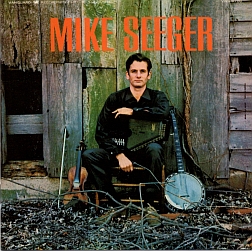 Waterbound – Mike Seeger
Mike Seeger (1933-2009) made a considerable number of albums, but this was his solo debut and for far too long it was out-of-print in both its US and UK editions (for Vanguard and Fontana respectively). This particular song is “a Virginia play-party piece with melodic reminiscences of Golden Slippers and Skip To My Lou”, according to D.K. Wilgus’ original sleeve notes from 1964.
John Crosby describes it in the reissue’s notes as “a mid-tempo song with a haunting vocal over the rhythmic drone on a strummed dulcimer accompaniment.”
That’s more or less my job done for me. But for saying that the recording has a delightful atmosphere and a real sense of wood, as in acoustic music, and microphone to it. It is also one of the reissues of 2012 thus far.
“The old man’s mad [angry] and I don’t care/The old man’s mad and I don’t care/ The old man’s mad and I don’t care/So long as I get his daughter…!” From Mike Seeger (Vanguard VCD 79150, 2012)
Tony Russell’s obituary ‘Mike Seeger: Versatile singer and multi-instrumentalist at the heart of the US folk music revival’ from The Guardian of Monday 10 August 2009 is at http://www.guardian.co.uk/music/2009/aug/10/obituary-mike-seeger
Ken Hunt’s obituary ‘Mike Seeger: Folk musician who influenced Bob Dylan and the Grateful Dead’ from The Independent of Saturday 22 August 2009 is at http://www.independent.co.uk/news/obituaries/mike-seeger-folk-musician-who-influenced-bob-dylan-and-the-grateful-dead-1775851.html
La Llorona – Chavela Vargas
La Llorana (‘The Woman That Weeps’) comes from Julie Taymor’s film about the Mexican artist and muse Frida Kahlo. Chavela Vargas (1919-2012) appears in the film as Death and sings this song. Dulces suenos, Chavelita. From the film Frida (2002)
I read several obituries of Chavela Vargas. The one I liked best was from an anonymous fellow hack at http://www.telegraph.co.uk/news/obituaries/culture-obituaries/music-obituaries/9456735/Chavela-Vargas.html
Bury Me Not On The Lone Prairie – Hedy West
If I ever were to feel that I had tired of Hedy West, I know that I shall be hovering over, and looking down on my own lifeless husk. Hedy West (1938-2005) was one of the most transformative interpreters of the Anglo-American folk condition. This is another song about one of the signature events in anyone’s life: death.
Bury Me Not On The Lone Prairie comes from her debut solo LP, Hedy West accompanying herself on the 5-string banjo (1963). She accompanies herself on banjo. There is nothing affected about her delivery, nothing extraneous by way of ornamentation, nothing out of place in the arrangement. Even in death, there are twists going on in this song. I am proud that Ace Records asked me to write the CD booklet notes for this reissue of her first two solo albums. Ace also squeezed three never-issued tracks onto this single-CD release.
All these decades later Hedy West remains a lodestone. From Hedy West accompanying herself on the 5-string banjo plus Hedy West Volume 2 (Vanguard Masters VCD 79124, 2012)
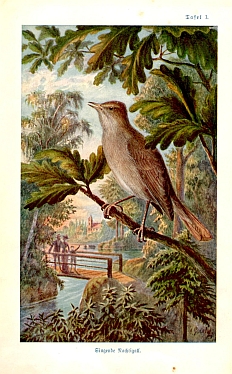 Singing Nightingales and RAF Bombers
This is a very famous recording. The BBC recorded it on the night of 19 May 1942 from the same wood as the Londonderry Air that begins this month’s Giant Donut Discs. The original intention was to broadcast the Oxted wood recording live. It begins in sylvan peace but then gradually a distant growl approaches. That growl was the engines of Royal Air Force (RAF) bombers – Wellingtons and Lancasters – on their way to bomb Germany. The notes say the target was Mannheim. It is a phenomenal piece of history. The recording engineer realised that German radio operatives would get forewarning that a raid was being mounted and pulled the live broadcast. The land-line preserved the recording, however. Eleven of the raid’s 197 bombers failed to return.
The illustration of the nightingale is from Leopold Scheidt’s Vögel unserer Heimat (‘Birds of our homeland’) published in 1902 – a gift given to me in July 2012 from the library of Harry Frank (1928-2012). I started reading the book deep in the heart of Thuringia (Thüringen) and as I did memories of this recording me came flooding back to me.
A triangulation occurred with Down by the Riverside, the old gospel song that includes the line, “Ain’t gonna study war no more…” From Nightingales: A Celebration (British Trust for Ornithology ISBN 0 903793 91 1, undated [circa 1997])
The copyright of all images lies with the respective photographers, companies and image-makers.