CD reviews
 [by Ken Hunt, London] With any selection of new Richard Thompson songs, there’s no knowing in whose company and in what straits listeners will be plunged. There might be a long-awaited cheap-suited estate agent or the borderline apocalyptic. 13 Rivers opens with the one of his finest recent songs, The Storm Won’t Come. He sings in bible-bashing fashion: “I am longing for a storm to blow through town/Blow these sad old buildings down/Fire to burn what fire may/Rain to wash it all away.”
Things soon curdling and souring splendidly. By the third track, Her Love Was Meant For Me, he jabs a middle finger up at that bugbear of his about lazy journalism banging on about doom-and-gloom. (At the beginning of my writing career, he took me aside and put me straight.) He sings, “Armageddon’s in the mirror/And her love was meant for me.”
Bones of Gilead is Thompsonian-strength cryptic. “What’s my name? Just call me Micah/Micah like the Bible says…” he sings in character to chunky electric guitar. Possibly he watched Margaret Atwood’s hugely popular The Handmaid’s Tale. There Gilead is the dystopian theocracy that succeeds the United States of America. Working out the possibilities of Thompson’s pepper-sprayed allusions is part of the fun, however fanciful they might be. “In my cloud/Of illusion” from My Rock, My Rope could be glancing off the anonymous early Christian mystic’s text The Cloud of Unknowing. (Or not.) Religious allusions abound in any case. In the ninth track You Can’t Reach Me there comes reprise-like: “…The war and Armageddon and shit.”‘ In Shaking the Gates – though Shaking The Gates Of Heaven Of Heaven should be the fuller title, Thompson sings, “I falter at heaven’s gate” – maybe with a wink to Michael Cimino’s 1980 film epic of mixed fortunes.
The track sequencing of 13 Rivers is a taste of perfection. It is an antidote to streaming tracks and moving on to the next thing. As Suzanne Vega said in an interview (with Andrew Williams) in July (Metro, 17 July 2018, 16): “An album is an art form in and of itself. Whenever I release a collection of songs I think of them as an album even though I know hardly anyone consumes them in that way. It’s a narrative. We used to spend a lot of time sequencing them and figuring out the spaces in between the songs. It was fun to plan that into the experience for the listener.” Well, Richard Thompson must have had a whale of a time with 13 Rivers.
As I have said elsewhere, it is criminal how good 13 Rivers. That’s why this thrilling piece of work is destined to be one of the albums of 2018. No place for cheap-suited estate agents, though. Maybe another time.
Richard Thompson 13 Rivers Proper Records
www.proper-records.co.uk
www.richardthompson-music.com
7. 8. 2018 |
read more...
 [by Ken Hunt, London] Much of Shelter was composed, if not conceived, in the relative seclusion of a cottage on the North Yorkshire Moors. Its accent is on self-written songs. Like the songs here, the artwork photos capture rural English scenes, Roman antiquities – as if reflecting her Florence (Firenze) birthplace (and the song Roman Holiday) – and, as with the visual backdrop to A Tree Grows In Brooklyn, a smidgeon of citified ways. Conjuring a sense of solitude and her classical music training, the seventh track is an adaptation of the English composer Henry Purcell’s O Solitude to her plain-speaking guitar and Jordan Hunt’s violin accompaniment. Tapping into another sort of (defiant) loneliness, the Everly Brothers’ Long Time Gone (“…when I leave, I’ll be a long time gone…”) is emboldened with melodic embellishments.
Shelter is a collection of emotionally intelligent songs in which half-rhyme and no rhyme tussle like princes vying for the free-verse crown. There are flashes of the melodicism and verbal dexterity of Joni Mitchell (‘Never been a puritan/Never liked their wine much‘), Judee Sill (without the darkness) and even a twinkle of Kate & Anna McGarrigle (on Roman Holiday).
 O Solitude, My Sweetest Choice! is particularly choice. Hers is Purcell’s setting of Katherine Philips’ translation of Antoine Girard de Saint-Amant’s La Solitude – both were dead before Purcell reached six years of age. . (The first time I saw her sing, as part of Explorations: The Sound of Nonesuch Records – Session Four at London’s Guildhall School of Music & Drama in May 2014 – a precursor to the Kronos Quartet’s Folk Songs project, she included There’s Not A Swain in Purcell’s setting of John Fletcher’s words.)
Shelter, though, is hers and hers alone. Olivia Chaney’s making hay and the sun’s going to shine a long, long time.
Olivia Chaney Shelter Nonesuch Records
www.nonesuch.com
www.oliviachaney.com
The image of Olivia Chaney and Annie Briggs is © Ken Hunt/Swing 51 Archives. On 11 October 2017 I introduced Olivia to Annie for a truly memorable day. We walked and talked at Kew Gardens until the light and wine ran out.
7. 8. 2018 |
read more...
 [by Ken Hunt, London] This is an adapted article, based on a joint interview with Zoe and Idris Rahman that we did yards away from the Royal Festival Hall on London’s Southbank in 2008 for Jazzwise (a magazine I’ve written for since January 2001). The focus was the newly released Where Rivers Meet.
O, River also titled O nodi re opens Zoe and Idris Rahman’s Where Rivers Meet. It starts with a water ripple of piano. A consolidating flourish with shake-rattle percussion begins to purl beneath it. A reed takes up the watery melody. Melodic consolidations follow and the piano playing takes on a percussive guise – more cimbalom-like than santoor-like though. Then the sluice gates open and the ensemble pitches headlong into the melody. O, River ebbs and flows like a tidal river. It is flowing water the way Smetana’s Vlatava is flowing water.
It all fits. After all, river imagery is the fish and rice – or dhal (lentils) – of Bengali and Bangladeshi poetry. The river provides the staples of musical, lyrical and philosophical images. Watery journeys too feed the region’s music. For example, lives separated by currents and death reach an apogee of river imagery in the R.D. Burman composition Nadeer Paare Uthchhe Dhonwa (‘On the Other Side of the River, Smoke is Rising’) – a composition revisited by Asha Bhosle on the Grammy-nominated Kronos Quartet project You’ve Stolen My Heart. Yet the brother-and-sister team’s style touchstone for Where Rivers Meet isn’t disguised Baul messages to the Cosmos or the steady rowing rhythms of bhatiali – as Bengal’s boatmen songs are known. Their meeting of rivers isn’t muddied jazz eddies pouring into some make-believe Sea of Bengal or into a Sargasso Sea of mishmash world music. That is because, even though many of the cultural touchstones on the album are Bengali, the dominant style touchstone is jazz. What Where Rivers Meet is, is a confluence of the Ganga – Ganges in anna-and-farthing old money – and the Thames.
Bengali is one of the world’s greatest literary languages. It is concentrated in present-day Bengal and Bangladesh yet also flows outwards into diaspora forms. Its literary giant of twentieth-century history was and remains Rabindranath Tagore who won the Nobel Prize for Literature in 1913. It is also a region of enormous musical diversity and vigour. These include the region’s tribal and folk music traditions and the music of the Bauls – a tradition drenched in philosophical twists, obfuscation and triple meanings. (Baul lyricism irrigated the poetry of the likes of Tagore, The Band, Bob Dylan and Allen Ginsburg.) In the world of Hindustani art music certain Bengali names are bywords for musical excellence internationally. Take Ali Akbar Khan, Ravi Shankar, Nikhil Banerjee and Pannalal Ghosh for starters. Bengalis also rank high in annals of worldwide popular music. In terms of cultural penetration, what is now termed Bollywood music exceeds everything apart from rap, having long outstripped reggae or rock. Indian film also has long had a portmanteau job description, that of ‘music director’, encompassing composer-arranger, musician-session organiser – with illustrious names such as R.D. Burman, S.D. Burman and Hemanta Kumar Mukhopadhyay (accounting for him becoming plain Hemant Kumar in Bombay). No wonder then that Where Rivers Meet taps into both the lyricism and inspiration of both Hemant Kumar and Tagore.
 Bengali music cross-fertilizes in many ways. Zoe – the pianist and, yes, there’s no umlaut (or diaeresis, meaning the two dots over a character) over the e – and Idris – the reedman – are of mixed Bengali-English bloodlines. Their Bengal-born father Mizan Ur Rahman (Zoe: “People in England, ‘obviously’ because it’s too difficult, called him Zan.”) had studied at universities in Calcutta, Dhaka and Karachi before being offered a post-graduate scholarship in English literature at Sydney University, arriving in Australia in 1962. Their Yorkshire-born mother Rita had emigrated to New Zealand as a girl in 1951 and had moved to Sydney in 1959. She was studying medicine when they met in March 1962 and they married there in 1965 and settled that year in England. In 1970 the couple and their Lancashire-born daughter Sophie put down roots in Chichester in West Sussex – which was where Zoe and Idris were born that decade.
At home they spoke English. “Otherwise we might know a bit more!” Zoe chimes in merrily. “Our Bengali is very, very basic,” confirms her brother. She continues, “We just spoke English at home. We’re very English really. He would say the odd word to us – if he wanted us to eat or leave the house quickly.” Both explode into laughter. “That’s when Bengali would come out.” It is a fitting side-tale to Where Rivers Meet that William Radice provides the translations to four of the five tracks with lyrics. He is the author of Teach Yourself Bengali – that Teach Yourself… series of self-improvement self-tutors came in mlok skvrnitý or fire salamander yellow-and-black dust jackets that would be familiar to a cpuple of generations in Britain. The Rahman siblings’ tales about how many chapters they have cracked varies too frequently to need another update to feed the fire. The fifth translation is by their father who appears on two of Where Rivers Meet‘s tracks as Mizan Rahman.
In mixed-race or mixed-nationality homes the music on the radiogram and its successors tends to ping-pong between the various cultures. I ask if their father used to listen to his music with their mother. “No,” replies Idris before they both collapse into laughter at the mere thought. Composure regained, he replies, “Maybe she wasn’t a fan, I don’t know.” “No, we do,” says his sister. “She didn’t like it.” The party line disintegrates immediately into guffaws. Shaming the devil, he says, “She didn’t like it. He used to sing while he was walking around the house, doing the washing-up and stuff – and she didn’t like that much either. That’s where we know some of these songs from actually. He used to sing bits of these songs while he was chopping onions and whatever. Doing this album was the first time we’ve actually heard these songs properly. But we knew them quite well from him singing them – in fact we knew them ‘wrong’ from him singing them. He sings them all wrong and out of time.” This causes two siblings to lose it completely. “It was really interesting to hear the proper versions,” he eventually recovers.
The first promise of what might come in a Where Rivers Meet sense was Muchhe Jaoa Dinguli, a discovery from fossicking through their father’s music collection. Its title means, their father comes to the rescue, ‘Days That Have Passed’ or ‘Days Gone By’ from the 1958 film Lukochuri (‘Hide-and-Seek’). “On my last album Melting Pot,” says Zoe, “there’s a track, which is my dad’s all-time favourite track, called Muchhe Jaoa Dinguli. That was the first time we’d done a Bengali song. I transferred a lot of old tapes to CD while [our father] was in hospital. He wanted something to listen to. On that cassette there were some other Hemant Kumar songs. They are such great tunes that you just want to play them.”
The Melting Pot (2005) version of the composition was her first overtly Bengali foray and, importantly, it also includes her brother Idris playing clarinet. Muchhe Jaoa Dinguli entered the Zoe Rahman Trio’s repertoire – the trio being Oli Hayhurst on double-bass and Gene Calderazzo on drums, both of whom play on Where Rivers Meet – and it also appears on their Live (2007) with Idris again guesting. (Live is a gig-sale album with deep currents that also draw on inspirations such as Joanne Brackeen, Dollar Brand/Abdullah Ibrahim and Phineas Newborn.) But that Muchhe Jaoa Dinguli was the latch-lifter.
“Where Rivers Meet started off with our dad’s cassettes or whatever,” clarifies Idris. “Not really a record collection. Just a few tapes. Basically the same tapes he’s been listening to for around 50 years! He’s still got them. Some old classics that he’s listened to since he was probably at school! Then it broadened out a little with experiences we had since starting the project and meeting people. The tracks with [vocalist] Arnob – which are Betrayed [‘Amar har kala korlam re’] and Stream of Joy [‘Anondo dhara’] – he taught those to us when we were in Bangladesh in 2006.” “We went over specially to record,” explains Zoe, “because we knew we were going to make this album. We went back the year after, the March of 2007, on a British Council trip.”
“Some of the other ones,” adds Zoe, “were taught to us by our cousins on our first trip to Bangladesh in ’86. One was Abar elo je sondhya [‘We’ll Surely Meet Again’]. We were taught to sing its little verse and had to perform it! At a party. My mum got a bit fed up because we were going round to all the relatives – and there were, like, 300 relatives – so we’d have a big party, the place would fill and we got up, got a harmonium and sang that song. They knew we couldn’t speak Bengali and that’s why we chose Abar elo je sondhya’.”
One of the joys of the material, says Idris, is the tunefulness of the source material. “The melodies are pretty amazing. They’re long and have interesting structures. We tried out playing some of them in our own sort of way and they worked very well. It was basically playing the tunes. We haven’t done a lot to them. We tried not to modify them too much from what they are in the original song form. They’re quite strange because of the lyrical content. The number of bars is quite odd sometimes. The vibe of the music is really beautiful. It’s very simple, melodically simple, but.”
He leaves a pregnant pause that his big sister exploits. “The violinist, Samy Bishai, did a gig with us recently and he found the melodies quite hard to learn. They don’t go where you expect them to go. The phrase length has odd measures because of the lyrics. And also rhythmically. Idris spoke about our Dad singing it in the kitchen and it being rhythmically wrong. It’s because the emphasis is in a different place. It sounds like it’s in a different place and actually is! When we heard Dad singing it you’d imagine the first beat of the bar to be in a certain place but when you heard the original and figured it out it was in a completely different place. I like those structures. A lot of the tunes are in a kind of 6/8 feel, but you’d hear the first beat of the bar actually where beat 2 is. The one that gets everyone is Tumi ele onek. Track 5.”
Asked about adapting the cadences of Bengali speech and song to the piano, Idris, the true sibling, answers, “There are quartertones and things that aren’t possible on piano. There are a lot of inflexions in-between the syllables. You can do it on the clarinet to a certain extent.” “I wish you could on the piano,” says his sister in classic sibling word-in-edgeways style. “But that’s partly why it is an album of piano and clarinet. The melody is the most important thing on this particular album. And staying true to the original sounds. You can only really achieve that on clarinet. You can’t get that subtlety on the piano. There is piano on the originals of a lot of these tracks. So, interestingly when we played it with [tabla player and percussionist] Kuljit Bhamra when we went round to his place, he immediately said that, for him, piano and clarinet is a certain sound that he recognises in that old film music. They did have piano and clarinet.”
The thing that has to be stressed is that while the source material is profoundly Bengali, Where Rivers Meet is profoundly jazz in orientation. And the concluding Tagore composition Do You Wish To Forget (‘Purano sei’) – with its feints at ‘Auld Lang Syne’ – is just a perfect bridge between cultures. One of the most inspiring and inspirational personal turn-ons of 2008 has been discovering the Rahman Siblings, whether Idris Rahman playing with the clarinettist Arun Ghosh or exploring Zoe Rahman’s back-catalogue. Not everybody gets to board the train at the first station. Zoe Rahman’s music and musicianship eluded me before Where Rivers Meet and now I cannot imagine my soundscape without her pianistic insights on and into life. Save future blushes and get aboard the train sooner rather than later. There are worlds I know I have yet to discover in Where Rivers Meet. There is no higher praise.
With special thanks to Mizan Ur Rahman. And the kismet of bumping into Hannah Vlček of the RVW Trust at the official unveiling of the Vaughan Williams Memorial Library and the ripples that meeting led to. Such was the demand after I reviewed Live in Jazzwise that Zoe Rahman Trio (Live) received a pukka release in 2009.
http://www.zoerahman.com/
http://www.jazzwisemagazine.com/
11. 2. 2018 |
read more...
 [by Ken Hunt, London] These are five influential LPs of Indian classical music that captured the imagination of listeners in the early years of the post-war boom.
Ali Akbar Khan Music of India – Morning And Evening Râgas (His Master’s Voice ALPC 2, stereo, 1955)
Brother-in-law to Ravi Shankar, the musician Yehudi Menuhin considered the greatest on the planet, Ali Akbar Khan played sarod. In his celebrated jugalbandis (duets) with Shankar, this short-necked lute played the male role in conversations with the sitar’s female voice. Menuhin had met them in 1952 and was so enraptured that he finagled this album’s New York session – the first microgroove long-player dedicated to a principal Indian soloist. Menuhin is literally its master of ceremonies. With it a musical consciousness-raising began.
 Bismillah Khan Raga Todi and Mishra Thumri (EALP 1254, 1961, reissued as Saregama CDNF 150647, 2005)
George Harrison’s love of India’s musical traditions never abated. In the 1960s he attended Rory McEwen’s invitation-only mehfil (cushion) concerts in London’s Tregunter Road and he was still turning up at recitals, some very small, more or less till the end of his life. One artist’s London recitals you could be pretty sure to see him at were Bismillah Khan’s. Khan played the shehnai, the double-reeded ’emperor’s flute’ (shehnai). This was his debut long-player.
M.S. Subbulakshmi The Sounds Of Subbulakshmi (World Pacific WP 1440 mono and WPS 21440 stereo, 1967, out-of-print)
The majority of musicians and listeners stuck to the northern or Hindustani music system. One who embraced the wonders of the Karnatic system was Jimi Hendrix. At the time of his death alongside the standard Ravi Shankars in his record collection he had this sublime female vocalist – most probably this, her World Pacific debut. M.S. Subbulakshmi was, is and shall ever remain a prime benchmark of the Karnatic vocal artistry.
Various artists The Anthology Of Indian Music Volume One (World Pacific WD 6200 mono, WDS 26200 stereo, 1967, out-of-print)
The Californian World Pacific label was the launch pad for many of the era’s greatest Indian musicians and was the mother-lode for Byrds and Beatles alike. This arm-and-a-leg expensive triple-LP package straddles the north-south divide with performances by Ravi Shankar, Ali Akbar Khan, the southern vina (fretted stringed instrument) maverick Balachander and others. After Ravi Shankar, the critics’ crush and the hippies’ craze, this boxed set formed of vital part of the upgrading of people’s education.
Various artists Drums Of North And South India (World Pacific WP 1437 mono, WPS 21437, 1966, out-of-print)
“The most comprehensive record of traditional Indian drumming ever recorded” included Alla Rakha, Chatur Lal, Ramabhadran and Sivaraman (the southern representatives) and Kanai Dutta. The Grateful Dead’s Tom Constanten and Phil Lesh turned the band’s drummers Mickey Hart and Bill Kreutzmann onto this crash course in five-, ten-, eleven-, twelve- and sixteen-matra (beat) tâlas (rhythm cycles). Both studied with Shankar’s tabla player, Alla Rakha. On the sublime Fillmore West 1969 – The Complete Recordings (Grateful Dead Productions DECD291, 2005, out-of-print) Hart and Kreutzmann even recite bols (rhythm mnemonics) as route maps during one drum duet.
29. 8. 2017 |
read more...
 [by Ken Hunt, London] One of the most life-changing discoveries of my life was being handed a linguistic skeleton key in the spring of 1971. Turning 20 working in the print on the German-Danish border, every day it was Hochdeutsch to management and Plattdütsch or Low German to nearly everybody else. Plattdütsch is a working-class language that straddles the Schleswig-Holstein boundary between Germany and Denmark. It enables its speakers to hold a form of bilingual conversation as far west as Flanders and into Scots-speaking Scotland. It represents a whole world of cultural intergrades rarely spoken of. Koen, Hartwin and Ward Dhoore, collectively the brothers Trio Dhoore (sometimes with Elene Leibbrand calling at festivals), epitomise that in their music-making, too.
Belgium’s Trio Dhoore has a sound palette picked from the colours from the bigger Low Countries, so to speak. They draw on tradition-based musical strands from Brabant (by which I understand Flemish Brabant or Vlaams-Brabant), Flanders and Central France. Their rise has been heartening. By 2015 their outreach had extended to the Rudolstadt Festival (where I first wrote about them) and festivals in Canada and on to Sidmouth Folk Week and English Folk Expo in 2016.
 Their instrumentation is hurdy-gurdy (Koen D.), diatonic accordion (Hartwin D.) and guitar and mandolin (Ward D.) and instrumental dance music is their strong suit. This album contains three Flemish-language songs. Notably Wat Voorafging (What went before) – a kind of travellers’ tale – and Eb & Vloed (Ebb and flood) – about the abandoned, now-archaeological fishing community of Walraversijde in West Flanders, close to Ostend. Good additions to their canon, they function as more than time-out interludes during dance sets. At the risk of typecasting them, Trio Dhoore is a simply marvellous Western European folk dance band.
Trio Dhoore Momentum Appel Records tv2
http://triodhoore.com
13. 12. 2016 |
read more...
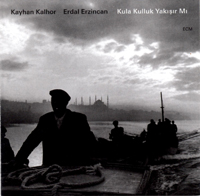
[by Ken Hunt, London] “How unseemly it is to follow anyone slavishly,” was ECM’s press release’s free (one suspects) translation for the title track in 2013. Performing Muhlis Akarsu’s Kula Kulluk Yakýîir Mı therefore could be perceived as a pointed choice since he died in a firebombing in 1993 aged 45 or so. He belonged to the Alevćlik (Alevi) sect. Within Islam, Alevism is seen as a Turkish- slash Turkish-diaspora-based Shia sect retaining Sufi colourings. Furthermore, Alevism espouses poetry, music and dance.
Erdal Erzincan plays the bağlama – the long-necked lute or saz anglicised as baglama while Kayhan Kalhor is the project’s kamancheh (spike fiddle) player. As sometimes occurs with ECM releases in my specific areas of expertise or experience, this album misses the
trick of failing to contextualise such magnificent music. Exhibit 1 for the prosecution is the lack of information about the four-section medley of “traditionals” called Intertwining Melodies, given that the musicians are Iranian (Kalhor) and Anatolian (Erzincan).
Further suspicions might be fed by ECM’s seemingly slavish art-direction house style. It extols image over text and here it sidesteps a deliberate cultural positioning. For example, the sleeve artwork is a monochrome Bosporus (by photographer: Ara Güler) in full ECM art-direction conformity. Here design does a disservice to a remarkable improvised music.
This duo’s drawing attention to what many Muslims would perceive as unorthodoxy is a testimony of the duo’s musical nonconformity and philosophical surefootedness.
Captured live by Bursa Uğur Mumcu Sahnesi in February 2011, what these two musicians achieve on their joint flight paths of the kemancheh and baglama, with the rise and fall of the melodic lines, is nothing short of stupendous. Quibbles aside, musically it is one of the finest collaborations ECM has ever brought together. Masterful stuff. Kula Kulluk Yakışir Mı (ECM Records ECM 2181, 2013)
This is an expanded version of a review that appeared in the December 2013 issue of UK-based monthly magazine Jazzwise.
30. 11. 2015 |
read more...
 [by Ken Hunt, London] Back in New York, Seeger enthused about what he had seen and heard. Broadside, a publication with a tiny circulation – using, as Cunningham recalled, a hand-cranked mimeo machine “we had inherited when the American Labor Party branch closed in our neighbourhood” – became a vital conduit for song. Originally published fortnightly, very soon monthly, topicality was a major goal. It published its first issue in February 1962 and folded in 1988. By comparison Sing was launched on May Day 1954 and Sing Out! had first appeared in 1950. Unlike Sing Out! or Sing, Broadside did not interleaf traditional songs with its songs of struggle, diatribes on themes of social justice or political squibs. However imprecisely or colloquially some dubbed this latter category ‘folksongs’ – much to the exasperation of the folklorists and the outrage of armchair scholars who took the fight to numerous letters columns – Broadside‘s first issue carried the slogan “A handful of songs about our times” beneath its name.
Many froze not only the fleeting moment but the urgency of the search for the three-chord trick or, in some cases, that elusive third chord. Many strove to out-Dylan Dylan too. Union solidarity songs figured prominently, such as Hazard, Kentucky which appears on Phil Ochs’ The Broadside Tapes 1 and El Teatro Campesino’s El Picket Sign on The Best of Broadside. There again Ochs also sang the gloriously throwaway and irreverent Christine Keeler based on the Profumo episode – as was Matt McGinn’s Christine delivered by the Broadside Singers with Tom Paxton and Pete Seeger. Yet sprinkled through the pages of those early issues were songs that got a life, so to speak, and took on lives of their own. Songs like Janis Ian’s Society’s Child, Seeger’s Waist Deep In The Big Muddy, Bonnie Dobson’s Morning Dew and Nina Simone’s Mississippi Goddam spread like wildfire. “These songs were springing from the Civil Rights movement and from the burgeoning opposition to the Vietnam War,” Cunningham wrote.
Broadside was known in Britain by repute at least even if few ever saw a copy over its entire lifespan. Like Sing Out! and Little Sandy Review, it had a reputation way beyond the meagre quantities that got into Collet’s or elsewhere. Pete Frame, later the co-founder of Zigzag, picked up Broadside “as assiduously as [he] could” but Martin Carthy, for example, has no memory of ever seeing a copy. “What happened,” remembers Frame, “was that the record shop – Collet’s – at 70 New Oxford Street used to get them in sporadically but not on a regular basis. They used to get all these various folk music magazines from various places. Such as Sing Out!, Broadside and a different Broadside that was published from Boston. I used to buy them when and as I could find them. Broadside never got there that regularly. I also had those Broadside records. I certainly got the original of the one with Blind Boy Grunt.”
Frame hits it on the head. The main reason why people remember Broadside was that farcical alias. Blind Boy Grunt was Bob Dylan. Bell-wether or scapegoat by turn, completists collected Dylan’s every fart, belch and stomach grumble, as perhaps only jazz zealots had ever pursued their quarry before him. Blind Boy Grunt had three tracks on the Broadside Ballads, Vol. 1, released in 1963. The Broadside link would soon stretch to Dylan’s singing on Vanguard’s Newport Broadside (Topical Songs) – a wily remora of a title – and Broadside’s We Shall Overcome and the much later Broadside Reunion.
Less difficult to get hold of than the magazine itself was Oak Publications’ “songs of our time from the pages of Broadside magazine” anthology. “I also got an omnibus edition of Broadside,” Frame recollects. “It was pages from the magazine with something like 88 different songs. That came out in 1964, with illustrations by Suze Rotolo – Dylan’s girlfriend – and people like that. You would have a song per page. Or a song every two pages, like Train A-Travelin’ by Bob Dylan that came out of Broadside #23 – that had an illustration by Suze Rotolo. It was a typical early song by Dylan. It’s got Paths of Victory by Dylan, Mississippi Goddam by Nina Simone, With God On Our Side, and stuff by Phil Ochs, Tom Paxton and so on. It also had a long introduction with pictures of these guys and little notes about them.” Unbelievably by today’s information overload standards, back then the sum of the knowledge about many American performers was little more than the potted biog or puff on the back of an EP or LP.
Broadside was primarily a domestic phenomenon. Songs such as Thom Parrott’s Pinkville Helicopter, Matt Jones and Elaine Laron’s Hell, No, I Ain’t Gonna Go and Seeger’s Ballad of the Fort Hood Three remind how Vietnam overshadowed American society. Seeger’s Waist Deep In The Big Muddy on the other hand transcends the period and the particular to become a timeless anti-militarist song, up there with John B. Spencer’s Acceptable Losses and Robert Wyatt’s Shipbuilding. Quite reasonably, Broadside mostly saw life through an American prism. Yet commonalities abounded. The characters on the identity parade looked similar when Malvina Reynolds sang The Faucets Are Dripping about decaying properties and exploitative landlords in New York and Stan Kelly sang Fred Dallas’ Greedy Landlord about slum landlords in Rachman’s London or Paddy Ryan’s The Man That Waters The Workers’ Beer about short-measuring and exploitation. Exchanges occurred freely. The Glasgow Song Guild’s Ding Dong Dollar on the Broadside set was also printed in a C.N.D. songbook. Songs by Woody Guthrie, Lee Hays and Pete Seeger, Irwin Silber and Jim Garland appeared in the Y.C.N.D.’s Songs of Hope and Survival songbook.
Even though Broadside published a smattering of topical songs from European and Canadian songwriters, songs such as Wolf Biermann’s Soldat and Das Familienbad, Buffy Sainte-Marie’s Welcome, Welcome Emigrante and Matt McGinn’s Go Limp, it never meant as much in Britain, Europe or, a hunch, Canada as it did at home. “I don’t think Broadside had the same sort of meaning over here,” Rosselson concedes. “There was a very strong British equivalent over here, which was clearly much more interesting to British songwriters than the American version. My memory is that it didn’t have that big an impact here but over there Broadside was, in a way, the beginning of the protest movement over there.”
Seeger with trademark perspicacity, though he would probably pooh-pooh such a ‘compliment’, saw something important in 1961. It was the power of song, a vision at variance with what became the cult of the songwriter. He wanted songs put into circulation, maybe that one good that is in everybody, maybe more, and he wanted songs sung and shared. In the liner notes to his 1964 album I Can See A New Day Henrietta Yurchenco wrote, “About fifteen years ago, Les Rice, a shy farmer and ironwork craftsman from Newburgh, New York, wrote the Banks of Marble, a song which was taken up quickly throughout the English-speaking world. For many years he was silent. When Broadside began publication in 1962, Pete Seeger urged his friend and neighbour to start composing again. I Can See A New Day was Rice’s contribution to the new topical folk-song periodical.” Typical Seeger. “I really urge singers,” he told me in 1993, “to think of themselves not as a singer whose business it is to make people listen and applaud. Think of yourself as a singer who will show people what a great song you have and encourage them that they can sing it too – long after you’re gone. Not to say, ‘Oh, I must get them to buy my record.’ Or get them to buy this or that.”
They say in their lifetime the average citizen gets to make fifteen or so crosses on the ballot paper. The Best of Broadside contains scores of blueprints about how to register other sorts of vote. There are still countless themes of social justice waiting to be turned into song. How could the Labour Party’s ho-ho-ho ‘freedom of information’ proposals not incite a new batch of sceptics and their songs so long as fears about the absolute basics – food, water, air and health – are secondary to profit. As long as the boa constrictor of multinational business can pleasantly massage and lull so many people into a false feeling of security about genetically modified food and other environmental issues, warning bells must ring.
Once upon a time, small, cheaply produced folk rags like Broadside and Sing informed through song, reminded people about the benefits of solidarity. Nowadays when so much that is politically radical or looking to alternatives, whether in China, Britain or wherever, has switched to the Internet, there might be the suspicion that topical song’s time is past. During February and March 2001 under the collective title of The Magnificent 7, Robb Johnson, Attila the Stockbroker, Barb Jungr, Des De Moor, Tom Robinson, Phillip Jeays and Leon Rosselson did a seven-week season of “contemporary English chanson”. So called because, as Leon Rosselson explains, “it’s a broader category and these songs are definitely not American and may have a European influence, particularly French, and like the French chanson they are word-based, literate, intelligent and that sort of thing.” It would have thrilled Pete Seeger. Chronicling the march of political and topical song, the centre for political song at the Glasgow Caledonian University is archiving the past. The need still remains for new topical songs. The need remains to chronicle the past. Song remains one of the most effective ways yet devised by the human mind to express opinions. The Best of Broadside is more than American history.
In 1963 when Phil Ochs wrote the Ballad of William Worthy about a reporter whose U.S. passport was revoked after going to Cuba, would he have imagined the Cuban embargo still going on in 2013 and what should have been history still retaining its point and pertinence?
12. 5. 2013 |
read more...
 [by Ken Hunt, London] Originally written on the eve of London’s post-Valentine Peace March on 15 February 2003, this with little taken out or added.
Ace’s catalogue is a growing and contracting – call it pulsating – reminder to reinforce why I decided to specialise and limit my listening and writing habits for sanity’s sake.
6 It Was Just A Dream – Big Bill Broonzy with Albert Ammons
on Spirituals To Swing (169/71-2)
I was raised on jazz, swing jazz in particular, by my saxophone-tooting/toting father. Semi-pro at 14, he actively fought the Musicians’ Union last-ditch fuckwit prohibition of semi-pro musicians. I get cross when music journalists pick big-box sets as their best-ofs – and I’ve done it – as if forgetting that most punters only get to put them on Christmas, Diwali or birthday lists. But this one transports me back to memories of my dad with its Benny Goodman, Golden Gate Quartet, Count Basie, Sonny Terry, Joe Turner and Big Bill Broonzy. I adore the way Broonzy turns adversity into humour in this 1938 tale. Wryness is such a powerful weapon.
7 She Used To Want A Ballerina into Helpless – Buffy Sainte-Marie
on She Used To Want A Ballerina (VMD 79311-2)
An imaginary segue. In the 1960s the inside front page of Melody Maker used to have a drop-column Fontana ‘advertorial’. One week it talked about Buffy Sainte-Marie. Within a fortnight I had heard her in a listening booth at HMV in Sutton. With this cred I was able to hold a sensible conversation in Wimbledon with two girls in the year above from the neighbouring grammar school in Mitcham to ours.
In a listening booth in the record shop at the foot of Wimbledon Hill, we listened to folk music. They, prettier than I, did what I would never have dared do, they went up to the counter and asked for a Johnny Cash LP to listen to… Thank you folk music.
Thank you Buffy Sainte-Marie.
8 Pack Up Your Sorrows – Mimi and Richard Fariña
on The Complete Vanguard Years (Vanguard 3VCD 200)
I first heard this song on Judy Collins’ Fifth Album (1965) and in the great tradition of record-buyers and folk-traditionalists I went in search of the original. It took some while back then in an age when tracking down a record often took years. Also because it reminds me of my old Kamerad Michael Kleff who now edits Folker.
9 Long Time Gone – Everly Brothers
on Songs Our Daddy Taught Us (CDCHM 75)
into Try A Little Tenderness – Otis Redding
on It’s Not Sentimental (CDSXE 041)
The numerate and argus-eyed will recognise this as beastly horridness. Two of the most influential acts in my musical development. Warner’s period Everly Brothers were the first pop act to mean anything to me. Harmony became my lodestar until modally based melody and rhythm cycles tore up the old rule book. Long Time Gone gets me every time. Otis Redding turned this old song into a musical necessity. Here’s a catch. Bing Crosby covered Tenderness in 1933 and an old anthology of his told a different tale of tenderness extended that frequently runs through my head when I listen to Otis Redding’s version. Harry Woods, its author, had a wooden leg. One time, tempers flared in a speakeasy and Woods used his leg to batter the opposition in the ensuing brawl. Isn’t it wonderful how a song can accommodate contradictory interpretations?
10 Howl (For Carl Solomon) – Alan Ginsberg
on Howl And Other Poems (FCD 7713)
Howl was like having your head ripped off, your cranium scooped out and everything put back the right way. It was the start of something so almighty it was revelatory. I met and interviewed Ginsy several times and he was delightful, sharp, waspish and, above all, interested.
Kronos’s David Harrington told me that just before they did Howl in New York, Ginsberg turned to him in the wings and radiating naughtiness chuckled how he couldn’t believe he was going to say “cocksucker” at Carnegie Hall.
I told the story to Phil Lesh, who himself toyed with setting Howl to music, and he pissed himself. Name-drop moi?
Actually, my source is the Ginsberg boxed set, Holy Soul Jelly Roll. But I do have the Ace signed vinyl.
http://www.acerecords.co.uk/
16. 4. 2012 |
read more...
[by Ken Hunt, London] Originally written on the eve of London’s post-Valentine Peace March on 15 February 2003 with little taken out or added.
Ace’s catalogue is a reminder why I decided to specialise and limit my listening but especially writing habits for sanity’s sake. Not all the people I wrote about in this piece are still alive, notably Ali Akbar Khan, one of my hugest musical influences.
 1 Bass Strings – Country Joe and the Fish
on Electric Music For The Mind And Body – VMD 79244-2
Bass Strings bottles the essence of psychedelic music, a microcosm beside the cosmos of the Dead’s Dark Star>St. Stephen>The Eleven. Compare the first version [on The Collected Country Joe & The Fish 1965-1970 – VCD 111] and this little beauty for insights galore into the creative process and why the righteously psychedelised mind passeth all understanding.
Joe McDonald is an excellent raconteur. Last time we met, gardeners both, we warmed up by exchanging recommendations about varieties of tomatoes, potatoes and basil, moved into environmental issues and launched a first-rate interview. Since his death, I usually think of the writer John Platt (1952-2001) when I listen to this masterpiece of an album.
2 Samson & Delilah (If I Had My Way) – Reverend Gary Davis
on Live At Newport – VCD 79588-2
A metaphor for life that has nothing to do with the biblical in my case.
3 Bilashkani Todi – Ravi Shankar and Ali Akbar Khan
on The Master Musicians Of India – PR20 1078-2
Chosen because I have known the work of these two musicians for longer than I haven’t, because I have known them as individuals for decades and because there was fire in their bellies when they used to play together, as here, before the shit hit the fan. (Do not cue Little Feat.)
[ADD JPEG KD_2000] 4 Om Shameo Shiva Shameo – Kadri Gopalnath
on Gem Tones – CDORBD 097
Kadri Golpanath is a saxophone colossus. What Ben Mandelson achieved with this album is nothing short of spectacular. When I compiled the second edition of The Rough Guide to India, this track was a first choice. But licensing – nothing to do with GlobeStyle – tripped me up.
5 Gonna Lay Down My Sword And Shield – Joseph Spence
on Gospel At Newport – 77014-2
Raptures of the deep from Joseph Spence, the musician whose singing with the Pinder Family introduced me to what they call World Music now. That first encounter with The Real Bahamas at Collet’s in London’s New Oxford Street, courtesy of Hans Fried, was the first stepping stone to me writing about it.
I never got to meet Spence but I got to know Jody Stecher and Peter Siegel who recorded that album. Peter took me and my daughter to the spot by the Brooklyn Bridge where Spence stood when he was over for Newport though.
Writing this on the eve of London’s post-Valentine Peace March on 15 February 2003, “Ain’t going to study war no more” rarely sounded sweeter or more needed.
http://www.acerecords.co.uk/
2. 4. 2012 |
read more...
 [by Ken Hunt, London] It’s 2001. You open the paper at an article about the underground strike. Par for the course, the same old politicians are lip-synching the party line. Substitute the specific till the capitalist or metropolitanist becomes local to you. The London Underground is being turned into another public-private partnership. The workers are striking about compulsory redundancies, fears over safety, etc. You get incensed. Another sodding disruption. Another sodding protest. Another sodding privatisation gussied up, as London’s transport commissioner Bob Kiley – remember him, New Yorkers? – decries, to generate “the least expensive product or service at the highest price.” Wasn’t that a time when songs would have flowed about the Tory Party ripping apart the national rail system and Labour chuffing along complacently behind them toking on their exhaust fumes?
Rewind to the early 1960s. Phil Ochs, the Greenwich Village voice, is riding the New York subway heading to the office of Broadside magazine to deliver some hot new tidbit. He and Malvina Reynolds are the most prolific of the so-called Broadsiders. Both are forever rattling off songs to meet the needs of the hour. Having studied journalism at Ohio State, Ochs is avidly reading the New York Times on his way to the Upper West Side. A couple of news items have hotwired his creative juices.
Sis Cunningham, who co-edited Broadside with her husband George Friesen, recalled Ochs in their autobiography Red Dust and Broadsides: “Phil would come around and say, ‘I’ve got seven new songs.’ We’d say, ‘What! Seven new songs?’ So he said, ‘Yeah.’ And Gordon would ask him, ‘Well, where do you get all your material?’ He’d say, ‘Well, I get it out of the newspapers and out of Newsweek. I wrote two of them on my way up here on the subway from the Village.'” Broadside took topicality hot-off-the-subway but, broadmindedly, even took songs on which the ink was already dry. Confusingly, in a frenzy of parallel evolution, three Broadsides emerged around the same period in New York, Boston and Los Angeles. New York’s is the one to which Smithsonian Folkways has dedicated a five-CD, spiral-bound, slip-cased set called Best of Broadside 1962-1988: Anthems of the American Underground From the Pages of Broadside Magazine.
When folk music first began brainwashing my generation’s minds during the mid 1960s, for several years it would have been hard to disembarrass lots of us of the notion that there was anyone in the whole wide world of folk who wasn’t at least vaguely lefty. As naive, as patently absurd as that now sounds, droves subscribed to this particular form of less-than-mass delusion. It stood to reason that anyone with a folk bone in his or her body had to hold some sort of suspect leftish or suspiciously bohemian views. Aside from the weekly music rags, Melody Maker and suchlike, the low-circulation folk magazines – many, in the language of The League of Gentlemen, local rags for local people – that were sold in the folk clubs and specialist shops, did little to disabuse about the well-known Communist conspiracy. Sing and its fellow travellers over here, the market leader Sing Out! and the more recherché Broadside over there reinforced such views. Here later folk pulpit pamphleteers – Karl Dallas’ name looms especially large – kept the red flag flying. That said, the first half of the 1960s saw a variety of magazines operating in the general folk field in Britain including Ballads & Songs, Folk Music, Folk Scene and Spin and not all had political agendas.
Broadside was neither unique nor the first, but its back pages remain a frozen barometer of its times and the folk condition. Even by the homespun standards of the day, Broadside had the feel of the parish pump about it. Clippings from newspapers and magazines provided further insights and raised eyebrows. Electricity had probably never played a major part in the production process and, had a fly formed an attachment to drying cow gum, it would have become immortalized in print for ever more. Broadside had that manual typewriter, pre-photocopier look to it that song folios like Anti-Fascist Songs of the Almanac Singers had had in the 1940s. “I remember the appearance of it,” recalls Gill Cook, who was not a huge fan of the magazine although Collets, the shop she managed, went out of its way to stock as representative a selection of the domestic and international folk magazines as it could. “Broadside was very badly laid out. It was political and I’d really rather gone off that stuff. The best one was Sing Out! There were always one or two political things in Sing Out! but they didn’t thrust it up your nose as much as Broadside. Sing was more local; there would be a few things about ‘foreign music’ but not very often.”
What really counted in Broadside was the songs. The finest were champagne drunk from a chipped enamel mug. Regular contributors included Bob Dylan, Peter La Farge, Tom Paxton and variously combined Broadside Singers. They would come into the office and sing or send tapes and lyrics on spec which would be transcribed and published in the magazine’s pages. Before Fast Folk was a twinkle in its parents’ eyes, Broadside had an archive of performances and some saw releases on the Broadside imprint of Moe Asch’s Folkways label.
In the early 1950s both the British and American folk scenes had formed a commensal relationship. In Britain many American musicians were little more than names with hearsay reputations – who had actually ever heard the Almanac Singers back then? – but others, names like those of Pete Seeger, the Weavers, Josh White, Big Bill Broonzy and Alan Lomax shone like beacons. In an era of L.s.d. currency restrictions and limited opportunities to travel abroad, even Woody Guthrie was best known, and often better appreciated, through Ramblin’ Jack Elliot. It was far from one way traffic though. Ewan MacColl and Bert Lloyd began to seed ideas in the American folkie consciousness from 1956 with The English and Scottish Popular Ballads series released on Riverside. Without getting jingoistic, it is a fact that Britain re-energised America’s songwriting movement that had flagged during the years of McCarthyist and McCarranist oppression.
During the 1950s the US authorities had simultaneously held back the red tide and had fun preventing Pete Seeger from travelling abroad. Argus-eyed red-busters, amateur and professional, had kept watch on Seeger, the other former members of the Weavers and their kind. (In 1968 in a post-McCarthyist lapse of judgement Broadside paraded soi-disant Dylanologist Alan Weberman’s arse-clenchingly sinister “Bob Dylan: What his songs really say” exposés, literally with added trashcan gleanings.) With consummate understatement in her Lonesome Traveler – The Life of Lee Hays Doris Willens remarked, “Controversy stuck to the Weavers like a tar baby”. In 1955 Seeger had been called before the House Un-American Activities Committee and had been sentenced to gaol for contempt of court. The dawning of a new decade brought permission for Seeger to visit Britain. “Khrushchev’s Songbird” had previously toured in 1959 with Jack Elliot but he arrived in the autumn of 1961 with his wife Toshi and daughter Tinya – and promptly discovered something which excited him enormously. He encountered a song movement of unsuspected proportions and vigour. Sometimes under the influence of France’s literary chanson movement, sometimes motivated by dialect or occupation, sometimes channelling political ideas, writers such as Johnny Handle, Stan Kelly and Leon Rosselson were spearheading a new song movement. “These Americans came over,” remembers Rosselson, “and heard me perform, and other people, at some event and I remember how impressed they were by the fact that there were these topical, as they would call them, songs being written over here. There was no equivalent over there. This is way before ‘Protest’ started. The British song of that time that came out of C.N.D., the leftwing political and folk worlds predated the songs in Broadside and the songs they published there. I think it was because they’d heard these songs over here that they decided that they ought to have a magazine that could be a platform for those sort of songs in America.”
To be continued…
More information at http://www.folkways.si.edu/explore_folkways/BestBroadside.aspx
4. 12. 2011 |
read more...
Older articles »