CD reviews
 [by Ken Hunt, London] Whilst writing the essay about the history of Call of the Valley back in those days when the internet was in its infancy and before mobile phones, it took months to obtain the right phone number for G.N. Joshi – or one that worked. The way things sometimes go, I finally made direct contact only to learn that he had died days before.
G.N. Joshi (6 April 1909-22 September 1994) wrote three books in total, beginning in the late 1970s with his Marathi-language account of his life Swar Gangechya Teeri – he translated it as ‘On The Banks of Swara-Ganga’ – and explained that in the title the Ganga (Ganges) stands as “the sacred River of Melody”.
He used the material contained in his Marathi autobiography to create a new work. Namely, his fascinating English-language autobiography Down Melody Lane. Read it if you have any interest in the Indian subcontinent’s music.
Down Melody Lane Orient Longman, Hyderabad, ISBN 0 86131 482 4 (1984)
See also http://downmelodylane.in from which the image of G.N. Joshi is taken.
5. 6. 2009 |
read more...
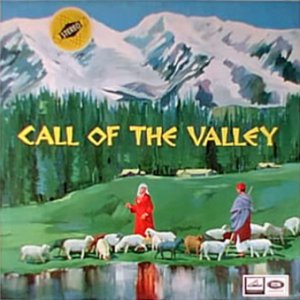 [by Ken Hunt, London] Key works that open doors to reveal unsuspected possibilities are fewer and farther between than press releases and other fictions would lead us to believe. On the basis that a little hyperbole goes a long way, glib judgements get bandied around with frightening frequency and lightning strike effect. For many people Call of the Valley opened up the skies, was a revelation. Its impact could be likened to revealing a new colour in the spectrum, for it was directly responsible for bringing Hindustani classical music – as Northern Indian classical music is known – to new audiences all around the globe. Its three soloists would go on to internationally acclaimed careers. But all that lay in the future. For countless listeners the first time they would hear the consummate musicianship of Shivkumar Sharma, Brijbushan Kabra and Hariprasad Chaurasia would be this record.
Shivkumar Sharma, Brijbushan Kabra and Hariprasad Chaurasia were all aged about 30 when they convened to make Call of the Valley. Shivkumar Sharma, who had made his first solo album in 1960, had worked to raise the status of the santoor to that of a respected classical concert instrument. A trapezoid-shaped member of the hammer dulcimer family, his santoor is modified to bear 87 strings arranged in 29 triplets of strings, each triplet tuned to the same note. The strings are struck with two mallets called qalam made of a hardwood such as walnut. In his native Jammu and Kashmir, where it is used to accompany a regional music called sufiana mausiqi or its poetic counterpart called sufiana kalaam, the santoor has 100 strings, albeit differently configured. Although its Persian relative, the santur, has long associations with Persian and Iranian classical music, Shivkumar Sharma’s decision to elevate such a lowly folk instrument to the concert platform was viewed as folly in conservative quarters.
Call of the Valley, in the opinion of Shivkumar Sharma and many other people, was responsible for establishing and popularising the instrument in Hindustani classical circles. It would decisively silence the critics. In 1967, however, it was an altogether different story. Brijbushan Kabra’s instrument was the guitar, another instrument that was having to prove itself because of its non-classical and western associations. Hariprasad Chaurasia was in the process of establishing himself as a flautist. His choice of the bansuri, a bamboo transverse flute, presented other problems. The flute is not just popular, it is of religious significance to the Hindu faith. In the 1960s memories of the flute virtuoso Pannalal Ghosh – he died in 1960 – were fresh. Hariprasad Chaurasia had to brave and convince the conservative wing of Hindustani music. The success of this album would place all three musicians on the musical map.
In 1967 the concept behind Call of the Valley broke new ground. While staying true to Hindustani tradition, it also captured a freshness and a timelessness. Conceived as a suite, Call of the Valley wove a story about a day in the life of two lovers in Kashmir. Santoor, guitar and flute were the voices that told the story. Underlying the tale was something that was as simple as it was radical. Shivkumar Sharma’s proposal was to make use of one of the basic organisational principles of the Indian raga – or rāg – system. The raga – “that which colours the mind” is a poetic description often applied – is the melodic heart of Indian music. For centuries music theoreticians have classified ragas in various ways, associating them with a particular season or time of the day according to their characteristics and mood. Talking to me in April 1987 Shivkumar Sharma sketched how this relationship works: “For early morning we have a raga that expresses a particular mood. In the daytime different ragas are played. They’re connected with Nature. How do you feel when the sun rises? You have a particular feeling when you see full moonlight. You react to Nature in different ways. Our ragas are connected with that and each raga expresses a different mood.”
“You know,” he reflected looking back on the project in June 1994, “when I was asked to do this recording and I thought about its theme, I wanted to have classically based ragas and convey them through a story. What I thought was we should weave a story around these rāgs as we had a time period that started with sunrise and afternoon through to evening and late evening and all that. I had one sketch in mind. I thought about a story and I discussed it with Mr. G.N. Joshi. I told him how I wanted to project the story.”
Classics are not magicked out of the ether and Shivkumar Sharma’s fantasia needed further definition and substance. But G.N. Joshi, the writer of the original sleeve notes, intuitively grasped the concept and gave the budding project the green light. “When I thought of this idea, when I thought of these two characters, one male and one female, and of Nature, I felt I should have a few more instruments. Naturally when I thought about it, I thought about my friends Hariprasad Chaurasia and Brijbushan Kabra, because if you want to create music together it is essential that you know the person, know the musician personally. We were friends. I naturally thought of them. I felt the guitar could express the mood of a male character, the santoor of a female character. The flute could express what Nature is and what a person feels about natural surroundings. When I talked to them they liked the idea very much. We knew we could work together very easily.
“We arrived at the whole synopsis of the story, so to speak, and how to proceed. We started with Rāg Ahir Bhairav and then Nat Bhairav and then there was a composition in Rāg Piloo. After Piloo we had Bhoop and then there was some composition based on Des. The last one was Pahadi, based on a folk song. After we were clear about all these ragas and compositions and how we would proceed and how each instrument would be involved in that, when the whole thing was ready, I again had discussions with Mr. G.N. Joshi and explained to him how I conceived this idea, how I felt about it. He explained the whole thing – which was the sleeve notes – the story about how a shepherd’s day goes and what each instrument was conveying.”
G.N. Joshi’s very presence at the sessions was a kind of validation. He would become the de facto producer of the album – albeit uncredited – as Shivkumar Sharma explains: “He was in charge of the recording section [at the Gramophone Company of India in Bombay]. I don’t know the terminology and what exactly his designation was but he was in charge. He used to be responsible for getting all these recordings done. He used to be responsible for engaging the musicians, getting the recordings done. He was the producer of that recording, a kind of producer.”
Because he was a key player in this Kashmiri drama, it is useful to capture a flavour of how respected G.N. Joshi was. Born in 1909, Govindrao Joshi was a singer. In 1930, as he wrote in Down Memory Lane, his account of a career in music, he received an invitation to broadcast from a Bombay radio station. The broadcast took place on New Year’s Day, 1931 and was well received. Which was how he came to record for HMV (His Master’s Voice), one of the names that the Gramophone Company of India traded under in those days. His setting of N.G. Deshpande’s Marathi poem Sheel (‘The Whistle’) – G.N. Joshi’ mother tongue was Marathi – proved particularly popular in Maharashtra. More recording sessions followed. By 1936 Joshi’s reputation could sustain a four-month tour of British East Africa, including Kenya, Uganda, Tanganyika and Zanzibar. Yet, like the dutiful son that he was, parallel with his singing career he had gone about getting himself pukka qualifications. In due course he was practising law. But music was his first love and he jumped at an offer to work full time as a recording executive for HMV in Bombay. He started on the first day of June 1938.
It was a post he would hold for 34 years. During that time G.N. Joshi would preside over many of the most historic sessions in Indian classical music. Call of the Valley was but one of the seminal sessions he helped to shape. At one extreme he would record a variety of important Marathi actor-singers whose work, he tells, was the living embodiment of literary high-browism. At another, more humdrum extreme, he was responsible for recording politicians’ speeches, singer-propagandists extolling the alcohol prohibition in force in the early 1950s, and government exhortations to open small savings accounts. Visionaries, and G.N. Joshi was one, also have to deal with the mundane. More relevantly, he was also personally responsible for a catalogue of magnificent artistry. Among the legendary vocalists he recorded were Ustad Bade Ghulam Ali Khan and his brother Ustad Barakat Ali Khan, Pandit Omkarnath Thakur, D.V. Paluskar, Ustad Amir Khan, Dr. Kumar Gandharva, Surashri Kesarbai Kerkar, Begum Akhtar and Pandit Bhimsen Joshi. He also preserved the work of masters such as Pannalal Ghosh, the multi-instrumentalist Ustad Allauddin Khan and his son, the sarod virtuoso Ustad Ali Akbar Khan, the tabla maestros Ustad Amir Hussain Khan, Ustad Ahmad Jan Tirakhwa and Ustad Alla Rakha, and the sitar virtuoso Ustad Vilayat Khan. By preserving many of Hindustani music’s most colourful vocalists and instrumentalists G.N. Joshi helped to shape and shade the future appreciation of Indian music. He was present at a pivotal time in Hindustani music. The old master-pupil tradition of handing on knowledge was under severe pressure and in decline. The World of Indian Arts will be forever in his debt.
Not for nothing then was Shivkumar Sharma delighted to have G.N. Joshi’s blessing. “This was a very novel idea at that time,” Shivkumar Sharma remarked. “Nobody had tried in Indian classical music a theme like that, trying to express a story-like theme. Mr. Joshi was himself a musician. It was very important that he could understand what we were doing.
“Normally what happens is that if a person is working with a record company he is not knowing music. It’s difficult to work or get things done together. If he happens to be a musician – like Mr. Joshi was – things can be very easy. We could understand each other and work things out together. He knew many great musicians like Ustad Bade Ghulam Ali Khansahib, Ustad Amir Khan and Pandit Omkarnath Thakur because he had been involved with all the recordings of HMV in those days.”
Their session with G.N. Joshi took place over the course of one night in HMV’s studio in Bombay. In addition to the three main voices of guitar, flute and santoor, Manikrao Popatkar played tabla. Typically for the period the original LP credits were incomplete. Shivkumar Sharma was able to clarify some things from memory. “Rijh Ram played pakhawaj [a two-headed barrel drum] as well as swarmandal. There were some other effects – bells and small effects – that were made by some musician from HMV.” (The latter’s name has gone unremembered.) “We did two or three days’ rehearsal together. Of course, everything was not fixed. We just fixed the compositions in the ragas and for the rest of it we just had tentative ideas of the timings. The recording was done in one day. We went in the studio in the evening and we worked till next morning. I don’t think we had to repeat many things or that there were cuts in the recording. We finished it in one session.”
Call of the Valley clearly found a commercial as well as an aesthetic niche because, unusually, the Gramophone Company of India never let it drop from the catalogue. A colleague at the company’s London office told me it even turned up in CD counterfeiting raids in Britain in 1994 – an accolade of the backhanded sort for a classical recording. Part of its appeal lay in the ease with which it engaged the listener, irrespective of their cultural background. “In India itself many people who were not interested in Indian classical music at all, they got interested in Indian classical music after listening to this record. Then they started listening to other things also. The same thing happened in America and in many of the European countries which I came to know later on when I used to go on tour. Many people even now meet me and tell me that they had not been exposed to Indian classical music, were never interested in it before but after listening to Call of the Valley they got interested and were attracted to these sounds.”
For time out of mind people have suspended critical judgement and emptied their minds to chant somebody else’s First Law of Self-promotion. Law or mantra, it goes, ‘The latest is the best.’ Consequently so much that is insubstantial gets hailed as an instant classic in the compulsion to laud the new to the skies. Call of the Valley was a historic landmark in the popularisation of Hindustani classical music. A benchmark of excellence, time has shown how important and how innovative its vision was. Call of the Valley has truly earned its status of classic. ‘Classic’ is a much abused word but it applies to Call of the Valley.
A version of this essay – and its first part – appeared in 1995 with the dedication: “For G.N. Joshi for Ustad Amir Khan’s Marwa, Call of the Valley and others yet to discover, my father Leslie Lloyd Hunt who put me on the path of music, for my uncle Alec Frederick Hunt who acquainted me with the correlation of culture, history and politics, and for Shivkumar Sharma for opening so many minds.”
1. 6. 2009 |
read more...
 [by Ken Hunt after G.N. Joshi] Picture a hamlet, as G.N. Joshi wrote in the original sleeve notes to Call of the Valley, nestling in the shelter of a Kashmiri valley. The story begins as sunrise approaches. Guitar signals dawn’s arrival. Santoor, the very epitome of the Kashmiri soundscape, joins in to play the early morning râg Ahir Bhairav, the first movement of the suite.
Swarmandal – a zither-like instrument – ripples usher in the second movement, Nat Bhairav. The day advances. The sun begins its climb with Joshi imagining Kashmir’s scenic splendour. Set to ektāl, tāl or taal meaning a rhythmic cycle, in this case one of 12 beats, the scene takes on colour and form. The sun’s rays dance off snowy peaks, their perpetual snow contrasting with the greenery of the wooded lower slopes. Birds sing and dart among the chinars, the Oriental plane closely associated with Kashmir. A mountain stream purls. Sheep and cattle graze. Bees make honey. It is a scene of bucolic bliss, of Mother Nature in all Her glory.
Rāg Piloo, the third movement, is set in teentâl, a 16-beat tāl. Freeze-framed like a sequence of ragamala images, the noted Northern Indian style of miniature painting, a girl is cautiously making her way to see her beloved, fearful of being spied. He feigns anger at her being late but melts, unable to sustain his teasing. Guitar takes his voice, santoor hers and the lovers lose themselves in talk. Like lovers do. Flute warns that something wrong – Joshi imagined that she detected prying eyes. She flees, promising a rendezvous that evening. Love’s labours thwarted, he remains to dwell on events and kismet.
With dusk sheep and cattle plod their way down from the alpine pastures. The faithful are gathering for prayer. Conch, mridang (a drum) and bells set the scene. The lover, hopeful that his prayers will be answered, is tense with anticipation. That devotional mood is reflected by the movement’s raga – Bhoop set in jhaptāl (a 10-beat tāl), performed dhrupad fashion, dhrupad being an austere, measured, devotional style of singing.
The couple make their way independently to the tryst outside the hamlet. Rāg Des in dadratāl (6 beats) plays. Des conjures images of the countryside. (Des or Desh means country.) They meet and walk towards the lake in the cool evening air talking now in their normal voices since there is little likelihood of eavesdroppers. It is a romantic atmosphere. The moon is mirrored in the lake’s placid waters and all is well with the world.
The moon is out. The final movement, rāg Pahadi in kaharwa (8 beats), becomes their moonlight sonata. It expresses that moment when time stands still. Joshi pictured it as them finding a dhony (or tony, a small sailing boat), gliding off and reaching celestial heights. Lost in the moment, lost in the stars, they hope that it never ends. The rest can be left to your imagination.
1. 6. 2009 |
read more...
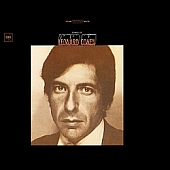 [by Ken Hunt, London] On its release Cohen’s Songs Of Leonard Cohen (1967) was more than a strained-voice recapitulation of what we already knew through Judy Collins, the song interpreter who had done so much to introduce the Canadian songwriter on her In My Life (1966) and Wildflowers (1967). Cohen’s delivery on his debut’s ten-song album was so much more world-weary, more experienced, more laconic, more droll. (Listen to Teachers and One Of Us Cannot be Wrong for serious drollery, the sort of humorous insight that bedded any number of muses). His voice would never match Collins’s dexterity, so he made a virtue of his limitations. On his Suzanne, So Long, Marianne and Sisters Of Mercy, Cohen seemed experienced in sensuous ways that would have made Judy Collins or Pete Seeger blush. Cohen seemed removed from Seeger’s world of impassioned politics, but that was a blinkered take on things (as his second album Songs From A Room revealed). Two hitherto unreleased bonus tracks – Store Room and Blessed Is The Memory – outtakes from the album’s John Hammond-produced sessions round off the original album. They add little great insight beyond the editorial process but they are welcome.
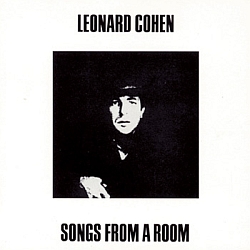 Though Anthony DeCurtis’s three accompanying essays don’t make the link, Leonard Norman Cohen, born in September 1934, was a child and graduate of the Canadian socialist and communist youth movement. Cohen’s dipping into The People’s Songbook (1948) with The Partisan on Songs From A Room (1969) made his politicised past explicit. Bird On The Wire, Story Of lsaac (introduced by Collins on her folk-rock masterpiece Who Knows Where The Time Goes?) and Seems So Long Ago, Nancy were and remain in an altogether different league. The album’s bonus tracks, Like A Bird – an earlier version of Bird On The Wire – and Nothing To One – ditto, You Know Who I Am – are both recordings produced by David Crosby in May 1968.
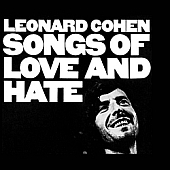 The cover artwork of Songs Of Love And Hate (1971) seemed stark and spare even by Cohen’s standards. White characters on a black background. At its black heart was Dress Rehearsal Rag – a different sort of Hesitation Blues and a jewel-like monstrosity of the story-teller’s art dealing with doing away with yourself. Or not. When Cohen released his own version of Dress Rehearsal Rag, the Velvet Underground had a head start when it came to morbidity – the whip-hand on bleak, so to speak – and Collins had premiered the song as long ago as In My Life, but Cohen’s take on suicide shone. Joan Of Arc and Famous Blue Overcoat also appear here. The bonus track is a 1968 try-out of Dress Rehearsal Rag in a band arrangement including drums (the instrument of choice for eschewal on Cohen albums) and a flowing mandolin.
The eye-popping chapter and verse of the story of Leonard Cohen getting rooked ran and ran in the press during 2005 and 2006 as the trial against his former business manager unfurled. Millions went walkies while he sat and contemplated on a Zen Buddhist retreat in sunny southern California. Cohen’s back-catalogue has long deserved a caring reissue of the Columbia Legacy kind. If Cohen’s financial misfortune played any part in prompting the reissue of these first three albums of his then that is, without a whiff of Schadenfreude, our good luck. Three lustrous albums.
Songs Of Leonard Cohen Columbia Legacy 88697 04742 2 (2007)
Songs From A Room Columbia Legacy 88697 04740 2 (2007)
Songs Of Love And Hate Columbia Legacy 88697 04741 2 (2007)
This review first appeared in fRoots issue 292 (October 2007).
16. 4. 2009 |
read more...
 [by Ken Hunt, London] Lest we forget, Hungary was directly responsible for the ultimate Fall of the Berlin Wall in 1989 and, likewise, lest we forget, Hungary’s strong and vibrant folk and roots music scenes have had a huge influence on Europe’s folk and world music scenes for longer still. My first brushes with Hungarian music came through having my ears turned and recalibrated by LPs on the Soviet-era state record company Hungaroton and UK releases on Joe Boyd’s Hannibal label. Things have got continually better. With musicians of the calibre of Szilvia Bognár in the vanguard of developments and consolidations, it is no wonder that Hungary’s roots music scene is in such fine fettle. Szilvia Bognár’s Semmicske énekek is what Hungary sounds like right now and it is spectacular.
Alas I am still biding my time until see Bognár perform as a headlining soloist. As a singer I have seen her perform live with the Budapest-based band Makám (and here on Semmicske énekek Hegyen s földön/Mountains and Valleys carries Makám-esque echoes) and as part of the miraculous trio with Ágnes Herczku and Ági Szalóki fronting the Szájról Szájra (‘From mouth to mouth’) project. Bognár belongs to that select pantheon of singers everyone should strive to listen to before the Grim Reaper scythes each and every one of us down. Or, put it this way, if I were in a lifeboat on an ocean or even Lake Balaton after a cultural shipwreck and got my pick of choice singers to be shipwrecked with, Szilvi would be singing her lungs out.
 Semmicske énekek/Ditties is her follow-up to her luminescent 2006 album Ének őrzi az időt/Songs preserve the heartbeat of time. They are works within an impressive continuity of creativity. Once again Zoltán Kovács is the composer-arranger for Semmicske énekek‘s music. The instrumental palette is little changed with a blend of contemporary and traditional instruments. Saxophone, shepherd’s flute (furulya), oud, guitars, gadulka (Bulgarian spike fiddle), kaval, violin and percussion of various kinds all feature. Her Szájról Szájra companions – the Agneses Herczku & Szalóki – join her on three tracks. The ones in question are Te kislány/Little Girl, De jó együtt/How Fine It Is Together and Szemünk-lelkünk/Our Eyes And Souls, while Szalóki adds vocals on Ádil hullám/The Waves of [the River] Volga.
Although born in 1977, Szilvia Bognár brings the wealth of generations of experience of her art, art beyond her years. Her voice, tone and timbre on Semmicske énekek brings new sense and meaning to the word ‘natural’. There are all manner of layered qualities to her voice as she sings of love, sings farewell to the figurative bride, sings for the jilted and lovelorn. For example, there is the lonesome plaintiveness to Este van/Evening Has Come that Péter Bede’s saxophone and István Pál’s violin subtly underpin. When you hear her sing Ága-boga/The Flowers of the Wreath you know you are as much in the world of sublime expressiveness as the world of folkloric symbol. Similarly, when she and János Gerzson’s oud raise Hungarian shades of the Ottoman Empire on the Bulgarian folk song, Zaljubih/Mother, I Fell In Love the wedding match is perfect, not forced. And when she sings the jilted woman’s song Kék szivárvány/Blue Rainbow she brings desolation and bewilderment to bear on a tale of betrayal. It is reminiscent of why Shirley Collins’ depiction of The Blacksmith likewise reveals the high art in folk poetry.
 Semmicske énekek – ‘Ditties’ just doesn’t work as a translation for high art in small or ‘low’ songs – is a masterpiece, not merely one of the year’s masterpieces. It is hard to communicate just how wondrous an instrument Bognár’s voice is. Her voice is totally under the skin of what we call folk music. When she first gave me her handmade business card, it stated her profession as ‘népdalénekes‘ or ‘folksinger’ and nothing I have ever heard from her lips has ever warranted revising that job description of hers. Hungarian folksong comes no better than this.
Semmicske énekek/Ditties Gryllus GCD 081, 2008 and Ének őrzi az időt/Songs preserve the heartbeat of time Gryllus GCD 057, 2006
Further information: www.kalaka.hu and www.bognarszilvia.hu
22. 3. 2009 |
read more...

“I have seen fear and convenience/I have never glimpsed romance.”
[by Ken Hunt, London] Thao Nguyen’s We Brave Bee Stings And All, produced by Tucker Martine (The Decemberists, Mudhoney and Sufjan Stevens), is one of those fine vehicles that hurtle down the turnpike causing the listener to do a double take or three. On a casual listening or initially you’ll get carried along with a banjo-driven song like Swimming Pools without taking in the lyrical context. But then a line like “We splash our eyes with chemicals” drops like bait. And in introducing ideas of The Beauty Myth kind, it plants a tiny barb securely in your mouth before reeling you in.
Instrumentally and vocally, The Get Down Stay Down – Frank Stewart on guitars, piano and organ, Adam Thompson on bass, piano and a beastie called marxaphone and Willis Thompson on kit drums and percussion – support her voice, guitar, banjo and piano well. (Everyone has a jolly good time clapping hands.) What raises the music above the sum of those parts is the interesting, unprepossessing colour instrumentation. A couple of examples should suffice. Steve Moore’s swirling trombone on Fear And Convenience or Wayne Horowitz’s Hammond B3 on Travel may not be virtuosic performances – that is not the point of their presence – but the trombone powers up Fear And Convenience and the Hammond B3 has a comfy safety net feel to it the way Garth Hudson’s solid chordal playing made it clear that in his hands everything was safe in The Band’s Music From Big Pink arrangements.
 The backstory goes something like this. Thao Nguyen – evidently of Vietnamese stock -took up the guitar around the age of twelve. She began playing in a high school band and writing songs. Her debut release, an EP called Like The Linen (2005), appeared while she was at college in Williamsburg whilst she was attending William & Mary College. She gigged and kept on writing songs. Down the line she came to the attention of the drolly-named Kill Rock Stars. It led to her appearing on the label’s anthology Sound The Hare Heard (2006). Each singer-songwriter, regardless of how well known – or not – they were, was rationed to one performance. Thao Nguyen’s contribution was Feet Asleep (also on We Brave Bee Stings And All). Feet Asleep appeared alongside Sufjan Stevens’ Adlai Stevenson, Laura Veirs’ Cast A Hook At Me and Simone White’s The American War. And then she began recording We Brave Bee Stings And All.
Don’t be deceived by the name. If you go in search of overt Vietnamese influences, you’ll search in vain. This is music from a United States that gets elbowed out of too many commentaries. This is American music that some call folk or country or folk-rock though it actually is planted firmly in the singer-song tilth. The wit of Thao’s lyrics in Bag of Hammers and Big Kid Table – the stand-out tracks for me right now – and the lyrics’ and the music’s examination of the American condition elevate it above its milieu. Meaning, there are too many songs on the planet lacking originality of any kind and we get afflicted with them. Thao Nguyen is a worthy baton carrier in the tradition of Victoria Williams. Williams’ takes on the world in song are similarly marvellously, refreshingly quirky. Odd insights, as in insights of the odd kind, shoal on We Brave Bee Stings And All too, suggesting a similar promise to the one that Williams’ breakthrough work suggested. Goodness knows where Thao Nguyen’s music is going to go when she really kicks in. We’ll be there to follow it though.
Thao We Brave Bee Stings And All (Kill Rock Stars KRS481 (2008).
Kill Rock Stars’ website is a one-stop shop for connecting with Thao’s activities: www.killrockstars.com
21. 2. 2008 |
read more...
 [by Ken Hunt, London] Lal Waterson, who died in September 1998 aged 55, was a founding member of the Watersons, the Hull-based folk group. Elaine, to use her proper name, was the youngest of the three siblings that eventually lent their name to one of the English Folk Revival’s most influential and utterly inimitable voice-based groups. People called her the Quiet One. And there was a sliver of truth to that. Leastways while her defences were up and she was sounding you out, getting your measure. Still, without getting into the realms of cod-psychology about youngest children and their chatterbox tendencies, she had few problems when it came to talking, just difficulties whilst under the spotlight and getting asked to talk about herself and her songs. Lal Waterson was a very visual songwriter. She wrote as she saw things and what she wrote often rode roughshod over the rules of song or poetic form. She kept her cards close to her chest when talking about what she was revealing – or hiding – in her songs.
How prolific Lal Waterson was as a songwriter is open to speculation. Her brother Mike, with whom she made Bright Phoebus (1972) with an assortment of England’s finest including Martin Carthy, Bob Davenport, Tim Hart, Ashley Hutchings, Dave Mattacks, Maddy Prior, Richard Thompson and Norma Waterson in tow, summed it up nicely. She would bring a song to him to get his feedback and comments. Then off she would go and return with an entirely different song. Rather than tweaking a rhyme or allowing a seeded idea to germinate, she would cultivate yet another song while claiming it to still be the same original song. It was rather like getting three songs for the price of one. Or would have been if he had logged all three.
In 1996 Topic put out Lal and her son Oliver Knight’s Once In A Blue Moon. The posthumously released A Bed of Roses (1999) followed. Save for archived (if not too grandiose a word) paper and demo tapes, that was that. Oh, and the Shining Bright compilation of 2002. In which a cast of notables revisited the Bright Phoebus material or went into other territory, such as Norma Waterson interpreting the very personal recollections within Song for Thirza, a song about the woman who helped raise them after the death of their parents. “You were brought from the work house to live with us,” it begins. Lal’s own singing of Song for Thirza captured as an early 1970s demo would wait in the wings until its appearance on the Watersons’ retrospective boxed set Mighty River of Song in 2003. Jo Freya revisits the song on Lal in a wholly touching way, in one that makes the specific universal in a way I would never have imagined possible from knowing or talking to Lal, Mike or Norma. That is Art with a capital A.
The Lal Waterson Project boasts an illustrious assembly that draws on the No Master’s Co-operative, of which Lal was an early collective member. Aside from Jo Freya (vocals, tenor and soprano saxophones), Lal draws on the talents and experience of Chumbawamba’s Jude Abbott (vocals, trumpet), Coope, Boyes & Simpson’s Jim Boyes (voice, acoustic and electric guitars), Chumbawamba’s Neil Ferguson (vocals, bass and acoustic guitars), the Old Swan Band and Jo Freya’s sister Fi Fraser (vocals, electric violin, alto sax, clarinet), the Sex Patels’ Harry Hamer (cajon, tabla) and The Poozies’ Mary Macmaster (vocals, acoustic and electric harp). (Macmaster’s harp on Flight of the Pelican is a marvel.) To which should be added the string quartet of Sarah Matthews and Bella Hardy on violins, Rachel Lawrence on viola and Gill Redmond on cello that boosts the elegiac Migrating Bird, the album’s concluding song.
Jo Freya herself worked with Lal Waterson, guesting on both Lal Waterson and Oliver Knight albums. The most memorable of her contributions appeared on Altisidora on Once In A Blue Moon – an intertwined voice and clarinet dance that is both a peak in empathetic communication and a short-listed desert island disc. Having worked with Lal undoubtedly helps Lal‘s overall success, but, for me, the reason why Jo Freya’s Lal Waterson Project works so especially well boils down to two things. When it comes to the material already in the public domain, the Project avoids the temptation to stick to the material’s ‘stock’ arrangements. Nothing warmed over, nothing réchauffé in the French. Midnight Feast gets a backbeat – admittedly not a big step for Humankind. Yet even though Party Games draws on the familiar Bed of Roses arrangement that Freya and trombonist Alice Kinloch worked up, here it is a springboard, not a replication. As far as I am concerned, the main reason for the Project’s success is down to timbre.
When singing solo – as opposed to singing with the family firm – Lal sang in her natural register, expressing things in her own, everyday voice and own idiomatic Yorkshire English. Jo Freya’s natural timbre matches Lal’s speaking and singing voice beautifully. Yet interestingly, while certain flattened vowels in The Bird are pure Lal, the vowels surfacing in May Butterfly are Jo Freya’s and clearly out of county or indeed Riding.
The thing is this: Lal’s songs were like nobody else’s in my experience. Gleaning local or private knowledge helped you glimpse pinpricks of light in the rolling fog. When she or Jo Freya sing “Spent all last night in Wilson’s Arms” in her song Wilson’s Arms, then it helps to know a bit about Yorkshire geography and moorland. And toping topography. The Wilson’s Arms was a pub up the road from where she lived – everywhere is up the road from Robin Hood’s Bay – but there again the printed lyrics blow – give away – the sung pun. When in Flight of the Pelican talk turns to the pelican, it helps to know that Lal Waterson served time as a heraldic artist in her youth and was well aware of the pelican’s self-sacrificing and caring, heraldic symbolism. Heraldry hones the cutting edge in this song despising Thatcherite values. Likewise Some Old Salty recalls the jive and bop of the Humber riverboat cruises of the 1950s. Still, what is there not to get when Bath Time and its evocation of parenthood, bath and bed time? Jo Freya knows these things and that is why, in my opinion, her interpretations really get under the skin of Lal’s idiosyncratic missives masquerading as songs and cast them in new light. A masterpiece of re-examination of a true original.
Ken Hunt is responsible for Lal Waterson’s entry in the Oxford Dictionary of National Biography and the fulsome biographical and song notes in the booklet accompanying the Watersons’ Mighty River of Song.
Lal No Masters Co-operative Ltd NMCD27 (2007) For more information visit /a>- http://www.nomasters.co.uk/
8. 10. 2007 |
read more...
 [by Ken Hunt, London] Their marital relationship hitting the buffers by the beginning of the next decade was years away when Richard and Linda Thompson made these live recordings. Hindsight of that nature adds nothing to the frissons that In Concert 1975 delivers. After all, living a year of your life in no way compares to the way a year or three gets ‘telescoped’ for the purposes of biography. And in any case between 1974 and 1982 the couple released a sequence of jointly credited duo albums that count amongst the finest to come out of Britain during the period in terms of songcraft and performance. This is them at their peak, though they were soon to duck out of this life to pursue other, non-musical paths in a Sufi community.
When John Wood recorded this material for Island at concerts in Oxford, Swindon and Norwich in November 1975, Richard and Linda Thompson were promoting their third album Pour Down Like Silver – the second of two albums released in 1975. They were on a roll and were an act that had my highest respect, if not always my hard-won shekels. Back then, I had to choose continually between the live experience and the artefact. It was one or the other, in other words. ‘Keep music live’ might have been the Musicians’ Union car sticker in my father’s car but what it meant for me was fiddling the tube fare in order to get to the club or venue and also walking a few miles before and after the gig. Every gig attended meant the week’s penury. England swang like pendulums do. Or whatever that American fellow said.
The band on In Concert 1975, in addition to the Thompsons – Linda on vocals, Richard on guitar and vocals -, consists of John Kirkpatrick on Anglo-concertina, accordion and vocals, Dave Mattacks on drums and Dave Pegg on bass guitar. I have no clear memory of seeing this line-up at this point, though, as their I Want To See The Bright Lights Tonight (1974), Hokey Pokey (1975) and Pour Down Like Silver (1975) were part of the period’s sound palette, I presume I did. Those three albums provide In Concert 1975‘s core repertoire with such material as Hard Luck Stories, Jet Plane In A Rocking Chair, Hokey Pokey (The Ice Cream Song), Streets of Paradise and For Shame Of Doing Wrong. Adding the Morris Medley comes across as a bit token, but given the personnel at their disposal it is no surprise that the instrumentalists revisit something from the 1972 Morris On project. Far better is the Fairport flashback with Thompson and Dave Swarbrick’s Now Be Thankful.
These fifteen tracks date from a period when musical frissons abounded – as opposed to personal frictions during contract fulfilment appearances when the couple’s unhappiness was manifest on stage. In Concert 1975 is a new artefact, nothing revamped, not one of those bonus track-enhanced affairs that come with this year’s copyright year on them, yet never quite date by year what came before. Having said that, two cuts on In Concert 1975 – Calvary Cross and It’ll Be Me – are identified as having previously appeared on Richard Thompson’s 1967-1976 anthology (guitar, vocal) and as “alternative mixes”. They are specifically identified as performances from the Oxford Polytechnic gig from 27 November 1975; nothing else here gets that precision. The album sticker calls this release, “Their complete 1975 live show with encores” – though it is in fact a composite concert, so to speak, and when it came to encores the Thompsons’ gigs drew on a big pool of covers., one of their great attractions because you never knew what they were going to let rip with at the end of the evening.
Vocally, Richard Thompson’s singing voice has a way to go. It lacks the muscularity of his later solo work, though Streets of Paradise has pre-echoes of how his voice would develop. Still, he did have Linda Thompson singing her heart out on stuff like A Heart Needs A Home or For Shame Of Doing Wrong. But even in its comparative frailty, for example, when supporting Linda’s lead vocal on For Shame Of Doing Wrong, Richard’s shadowing vocal is opening doors by the song’s mid-point. And then his string bending gets under way.
Night Comes In, at nearly eleven minutes, is still, for my money, Richard Thompson’s finest, clearest-eyed, Sufi-inflected song. Its clarity, at the risk of sounding a paradox, is its opaqueness. Where other of their so-called Sufi-period songs used Rumi-inspired imagery – such as the reed – Night Comes In uses images of the Beloved, wine and dance, permitting multi-levelled interpretation. Thompson’s guitar revels in its frrreedom to expand, like a child allowed out on the swings and roundabouts, playing truant from parental supervision. Philosophically speaking, its Judeo-Christian counterpart is Calvary Cross, the longest performance. It hits the 14-minute mark here, with Kirkpatrick’s squeezebox doing folk things that had never been heard in a rock context before. Mattacks’ drumming is clear metrically yet the beat is never the big deal. He underscores Thompson’s lead melody line. Together, Mattacks and Pegg complement Thompson wordless vocal lines, accenting syllables, adding accents, building tensions. The parts are so entwined, intertwined and intuitively of one that Calvary Cross repays repeated listenings, just to tease out what individuals are playing and doing.
This, though, is an album of vocal and instrumental togetherness. Amongst the finest song performances are Hank Williams’ Why Don’t You Love Me (Like You Used To Do). Ostensibly it’s a vehicle for Linda Thompson’s vocals. Yet it parallels when David Lindley accompanies Jackson Browne instrumentally. Voice and guitar combine to tell a story. The couple’s concerts had made a trademark of going into covers territory when encore time came around. Like here with Buck Owens’ Together Again or the choicest example here, Glen D. Hardin’s song Things You Gave Me. But I could be wrong about it being the choicest example. I’ve been wrong before. And I’ll be wrong again.
�
14. 9. 2007 |
read more...

[by Ken Hunt, London] The Stephen Stills who put down this session on 26 April 1968 was hardly between jobs – even if he was between Buffalo Springfield and Crosby, Stills & Nash. On the album’s skimpy notes, Stills writes, “I was at a Judy Collins session in New York in 1968, and when she was finished, I peeled off a few hundreds for the engineer so I could make a tape of my new songs.” Which Judy Collins session? Not the Who Knows Where The Time Goes surely, because it would be churlish beyond belief not to be explicit about that.
1968 was the year that Judy Collins put out Who Knows Where The Time Goes, one of the finest albums she ever made. Stills contributed acoustic and electric guitar or electric bass to all but one of its nine tracks. He was in the company of a handpicked assembly of some of the West Coast’s finest session musicians. It additionally comprised James Burton on electric guitar, Buddy Emmons on pedal steel, Michael Sahl and Van Dyke Parks on keyboards with a rhythm section of Chris Etheridge on electric bass, and James Gordon on drums. Collins and Stills were tangled up in romance, a relationship that ultimately fed their creative energies more than anything else. Two of the new songs Stills put down pointed unequivocally to the passion she had aroused in him – Judy and Suite: Judy Blue Eyes. (And, yes, she had blue eyes.)
Here Stills is alone with his acoustic guitar, apart from the final track, running through reference versions of songs. Along the way the tape was misplaced and thought lost forever. Hindsight tells which Just Roll Tape demos made it through or how they grew. Some of the dozen songs in the session became core items in the repertoires of Crosby, Stills & Nash and his parallel solo career. The thirteenth track, the undated (presuming the notes dissemble) Treetop Flyer, on which Stills double-tracks guitar and dobro doesn’t really fit, but it is by far the strongest performance vocally.
It is hard to be absolute about Just Roll Tape but to these ears the essential vibe of the main twelve recordings communicates something unusual. For a start, the tracks aren’t concert artefacts or after-hours song sessions. Next, they aren’t song-publishing demos, like, say, Dylan’s Witmark recordings in pursuit of covers, or an individual bringing new material to a band with, say, spoken interjections highlighting chord changes. Just Roll Tape is a different species of try-out. This is Stills putting down reference versions of himself for himself. We are eavesdropping on something very private. And, that, assuming the premise to be correct, is intriguing in itself. (What passes as contextual information in the packaging regrettably adds not a jot, if you like, to the ‘debate’.)
Anyway, surely the major joy to be had from any archival release of this nature is what light it sheds on the act’s creative development. Under the spotlight, it has to said most of Stills’ performances wilt beside the familiar versions and star-backed interpretations. But that’s applying the wrong sort of criteria to Just Roll Tape.
Some of these songs deservedly shrivelled and died. Not even a die-hard herpetologist would applaud Dreaming Of Snakes – though dream analysts might have a warm, damp moment. On the other hand, Judy is just wet. But So Begins The Task shines and reveals itself as one of his songs most open to interpretation and one of the least appreciated. On his first solo album Stephen Stills (1970), Black Queen was a solo vessel with a nicely lubricated captain. Here it follows a very similar bluesy musical arrangement, thankfully without Jose Cuervo’s input. Compare sobriety and intoxication and the tequila’d Stephen Stills version wins out, however.
Of all the songs, five stand out for pointing to what happened later. Change Partners – to emerge on Stills’ second solo album – points to all sorts of all sorts. Suite: Judy Blue Eyes, Helplessly Hoping and Wooden Ships – co-written with David Crosby and Jefferson Airplane’s Paul Kantner – are all well advanced, just waiting to have David Crosby and Graham Nash drop in their vocal parts. Unlike Know You’ve Got To Run which is a creative cul-de-sac. And all the better for that. Because that is what the creative process is also about: the winnowings.
Just Roll Tape is like going potholing, entering an unknown cavern and finding a wall of cave paintings. Nobody is going to say that that bison, elk or tree frog depiction is going to win the Royal Academy award but we’re going to keep talking about them, long after the latest greatest thing has faded and died. Historically speaking, Just Roll Tape is of great interest. Musically speaking, he was doing better accompanying Judy Collins, however.
Just Roll Tape Eyewall/Rhino 8122-79979-1 (2007)
�
12. 8. 2007 |
read more...

[by Ken Hunt, London] The Grateful Dead were a band that polarised opinion. How you took them over the course of their 30-year lifespan probably got entrenched. Mind you, given the band’s archival revelations, the present tense ‘take’ still seems pertinent, even all these years after their linchpin Jerry Garcia’s death in August 1995 and the band’s subsequent folding that year.
Their Three From The Vault captures the band playing on the second date of a string of concerts at the Capitol Theatre, Port Chester, New York State. The date was 19 February 1971 and the band had just undergone another of its periodic personnel changes. The night before they had been six. This night was their first gig without their second drummer. Mickey Hart would return to the fold in October 1974, having licked his wounds and recovered from the karmic shock of discovering that his father, the band’s absconding manager, had systematically burnt them, embezzling them of thousands upon thousands of dollars. The exact sum never got established. Such is the nature of such fraud, a damn bad show, as I was saying to that Sting fellow only the other night over the Port and Stilton before I woke up.
So, on 19 February a quintet comprising Jerry Garcia on electric guitar and vocals, Bill Kreutzmann handling all the drum parts, Phil Lesh on electric bass and vocals, Ron ‘Pigpen’ McKernan on keyboards, vocals and harmonica and Bob Weir on rhythm and slide guitar and vocals took the stage. It was a suitably chastened band, just as shocked as Hart – an innocent party in the debâcle of naivety. Deep in the merde, they had the pressing need to recover a semblance of normalcy and soldier on. There are times, for example, during Bird Song when it is possible for listeners to project and gaze into Garcia’s world-weary, hurting eyes. The main point, however, is that they were on their mettle and playing for their lives and the band’s very existence. And that is no hi-falutin talk. They were playing on the brink. Plus, they were on the East Coast. In 1971, six years into the band’s existence, they were intent on expanding their audience eastwards. Out of San Francisco, out of California, into a new Promised Land. It would only be 1972 that they really tried to crack the European market, for example.
Three From The Vault resurrects a series of multi-track archival releases planned in the early 1990s, but put on hold. The first, One From The Vault appeared in 1991. The next year the series petered out with the inventively titled Two From The Vault. The numerical titling scheme collapsed. Later archival multi-track releases – as distinct from Dead archivist Dick Latvala’s numerically sequenced Dick’s Picks thirty or so volumes – got more imaginative titles. Hundred Year Hall (1995), Nightfall of Diamonds (2001) and Steppin’ Out (2002) are examples. Three From The Vault was prepared for release, then got sidelined for no better reason that mankind being awfully good, as the US folk music merchant and poet Carl Sandburg put it, forgettery.
Three From The Vault opens with a couple of true noodles. The first is a cartoonish The Merry-Go-Round Broke Down – try the English folk band Pyewackett’s thought-out Looney Tune version on their The Man in the Moon Drinks Claret (1983) for comparison – followed by Garcia exercising the fingers with Mendelssohn’s Spring Song. As ever with these vignettes, the band falls in behind him. It is often overlooked how much music of whatever provenance this band jiggled and juggled. Their musical appetites ran the gamut from Henry Cowell to the Pinder Family, Elmore James to Chuck Berry, Alla Rakha to Bill Monroe, the Carter Family to Ol’ Igor Stravinsky at this point. Musical omnivores, in other words. The first proper piece is Truckin’ – their lyricist Robert Hunter’s contribution to their mythology – from the previous year’s masterpiece, American Beauty. Truckin’ reveals the band at its loose-limbed, boogie-vibe best, getting the groove and ridin’ it to kingdom come.
What Three From The Vault also reveals is a whole catalogue of superior songs, yet to be unleashed on the world in any commercially released form. The band was a powerhouse of new material that explored mythic American themes – what would be tagged ‘Americana’ nowadays. As Gary Lambert’s excellent contextual booklet notes point out, the band premiered seven new songs on the first two nights of their Capitol Theatre engagement. They aren’t necessarily finished. Most lyrics are there, but still being rolled around the mouth to see how they taste. In the case of Greatest Story Ever Told, due to get its pukka airing on Weir’s Ace the next year, John Barlow’s lyrics are incomplete. Such insights in themselves may not be great in the scheme of things, yet, for me, the pinprick flashes of illumination they cascade cast telltale light on the creative process.
Aside from such new unveilings as Loser, Playing In The Band, Greatest Story and Wharf Rat, there is the funk of the band in its blues and dirty r’n’b phase – courtesy of Pigpen. Here, he is in fine filthy form on the band’s own Easy Wind off 1969’s Workingman’s Dead, their mangling of the Young Rascals’ popster hit Good Lovin’ and Howlin’ Wolf’s Smokestack Lightnin’. Good Lovin’ in particular shows what an asset he was to the band. As a vocalist, he was one of the white r’n’b greats, extolling the discipline and freedoms of blues improvisations. Up there with Steve Winwood yet far earthier. When the guitars kick in, Garcia’s effect-pedal solo and Weir’s duck-into-the-spaces-between Garcia-and-Lesh rhythm guitar are set up by Pigpen’s spontaneous bluesy wordsmithery. Then Kreutzmann’s drums rise in the mix, Lesh’s bass rises to support the drums and the whole damn thing swells and soars to the home-run lyrics “I was feelin’/So bad/Asked my friend the doctor/’Bout what I had.” The one and only Pigpen. In the studio the finish would have been a re-take. Here you get what happened. Like I said, the one and only Pigpen.
But why the ESP Shows? Well, Dr Stanley Krippner from the Dream Lab – forgive the colloquialism – at Brooklyn’s Maimonides Hospital had images projected for the audience to beam telepathically from the Capitol Theatre to the Dream Laboratory. The Dead as a footnote in the wacky world of psychological journalry.
Three From The Vault Grateful Dead Productions 8122-79983-1 (2007)
2. 7. 2007 |
read more...
« Later articles
Older articles »