Giant Donut Discs
[by Ken Hunt, London] This column brings together Najma Akhtar, Iva Bittová & Čikori, The Byrds, DAgADAnA, Dillard & Clark, Dick Gaughan, Rhiannon Giddens, Kaia Kater, Eddie Reader and Wilson & Swarbrick.
From February 2018 another source of information is https://twitter.com/KenHunt01
 Both Sides The Tweed – Dick Gaugham
As somebody whose entire adult life has been lived as a bilingual European of unknown parentage, let alone bloodlines, I chose European as an identity. I believe the absolute folly of Brexit will haunt my grandchildren and their grandchildren. The only way to reform the European Union’s many and various failings was to remain part of the European Union.
In January 2014 I talked to Dick Gaughan about Scotland’s the proposed succession from the United Kingdom then in the offing. The referendum on Scottish independence took place that September and the vote was to remain. The River Tweed was the historic boundary between Scotland and England. A key sentiment in the song is “Let friendship and honour unite/And flourish on both sides of the Tweed”.
He expounded on the subject for R2, “What I understand that song to be saying is pretty much in line with where Scots in general ;are at the moment that is, trying to combat this idea that somehow or another seeking independence for Scotland is an exception. Because it’s not. It’s far from it. Of course, the Brits have a vested interest in pushing the line that it’s all anti-English. To be quite honest, it’s crap. It’s nothing to do with England, nothing at all: it’s to do with the United Kingdom and Scotland’s relationship with the rest of the United Kingdom.
“I think that ‘Both Sides The Tweed’ is in line with contemporary thinking within Scotland. Although it’s 30-odd years since I resurrected it as a song, edited with my amendments to it, the reason I leapt on the song even back then was it was a counter to the racism I had felt on both sides of ;the border. I had experienced anti-Scots feeling in England and I’d experienced anti-English feeling in Scotland. I thought this is not the way. There is more to it than that. It is not about Scotland being anti-English or England being anti-Scottish.
“There is something much more fundamental than that which is a nation’s self-sense of itself, how we view the rest of the world and how we relate to the rest of the world. That has to be free of prejudice. Otherwise why bother? If the only thing you’ve got in your favour is to be anti-something, then you’ve got nothing in your favour at all.”
The EU referendum took place in the United Kingdom and Gibraltar in June 2016. Scotland voted to remain. It was something repeated over and over at the Rudolstadt Festival 2017, at which Scotland was the regional theme. I kept harkening back to Dick Gaughan at Tanz&FolkFest Rudolstadt. And recalled one year sitting outside the Hotel Adler on the market square (Am Markt) at a table with him, Ian Telfer and John Jones of the Oysterband, drinking a beer and shootin’ the breeze. He recorded this song on his 1981 masterpiece Handful of Earth (Topic PSCD419) but the version I gravitate to is Gaughan’s director solo live version from that festival’s 1993 live album.
A note: At the Edinburgh Folk Festival in 1993 I was interviewing Archie, Cilla and Ray Fisher for a Sing Out! article. Gaughan was performing there with Clan Alba. At one point he took me aside and warned me about people hearing my accent if I went into some pubs in the city.
From Tanz & Folkfest Rudolstadt ’93 (RUCD 93-1, 1993)
Through The Morning, Through The Night – Dillard & Clark
One day a very long time ago in Bethlehem – an old expression goes – I breezed into Collet’s at its 70 New Oxford Street address. It was a folk record shop upstairs (and a jazz emporium in the cellar). On the ground floor behind the counter was a grizzled man who became a lifelong friend. His name was Hans Fried. It must have been 1968 because he played me the first album by Dillard & Clark called The Fantastic Expedition of Dillard & Clark. It had only just come out. Dillard & Clark were the early Byrd Gene Clark and the bluegrass banjo player Doug Dillard of the Dillards.
Through The Morning, Through The Night was the title song of their second LP which came out the next year. They shone and were gone. I met Clark in London – about year before his death. Backstage at Dingwalls in Camden Lock we talked about sitting down and scheduling an interview when he came back the following year. He died in May 1991 and Dillard in May 2012. I never met Dillard. Alison Krauss and Robert Plant covered Polly and Through the Morning, Through the Night on Raising Sand (2007). Both were fine interpretations. I don’t think anybody ever bothered to capitalise on that windfall of interest with a proper reissue. Goodness knows, the A&M Mobile Fidelity edition missed many tricks. From The Fantastic Expedition Of Dillard & Clark/Through The Morning Through The Night (A&M Mobile Fidelity MFCD 791, [undated])
Saint Elizabeth – Kaia Kater
The Canadian singer and musician opened for Rhiannon Giddens on her Farewell Highway tour in Britain at the end of 2017. This was the concluding song of her set. It was a song so beguiling on first pass that she has me craning forward to make of sense of what it is about.
I like the rough edges of the recording. One day she is going to commit this marvellous song to a better recording. Get it now before in this version because rough edges often tend to be chamfered away. From Nine Pin (Mavens Music KKH19-11, 2016)
So You Want To Be A Rock ‘N’ Roll Star – The Byrds
Younger Than Yesterday was the Byrds’ fourth LP album. It was released in 1967. Co-written by Jim McGuinn and Chris Hillman, the song gained traction as an American rock anthem. At this point they were Jim McGuinn on lead guitar and vocals, David Crosby on rhythm guitar and vocals, Chris Hillman on electric bass and vocals and Michael Clarke on drums.
While it’s been said its musical main hook is McGuinn’s 12-string Rickenbacker riff, for me two other elements which outshone anything else were Hillman’s unrelenting bassline and session musician Hugh Masekela’s soaring trumpet. Between electric bass and brass they keep the song’s body and soul together.
The reason it came back to prey on my mind was the death of the South African trumpet and flugelhorn player, Hugh Masekela on 23 January 2018, coupled with a commission to write an obituary of him for February 2018. I started pulling out things from my library shelves.
So You Want To Be A Rock ‘N’ Roll Star is one of the Byrds’ most anthologised, most heard songs. Logging in at under two minutes and ten seconds, it squashes in a lot about fame, whipped up fame at that cynicism. Apparently the screaming girls were recorded in Bournemouth on England’s South Coast. No reason to throw that in, apart from it adding a spurious English element. From The Byrds (Columbia/Legacy 46773, 1990)
 A w Tomu Sadu – DAgADAnA
Daga Gregorowicz (vocals, electronika) and Dana Vynnytska (vocals, piano) are a duo I first came across in 2016 when Meridian 68 first came out in Poland in 2016. The Jaro edition keeps the music but changes the packaging, dropping the Polish content of the booklet’s text. Musically they blend Polish and Ukrainian cultural and mixed music elements often with a experimental daring unlike anyone else. Here they just sing. A w Tomu Sadu (In That Orchard) is a Slav, apparently specifically Ukrainian ritual song from Myropil in Romaniv Raion in Ukraine’s Zhytomyr Oblast – oblast just means region or district but with a post-Soviet bureaucratic overlay. From Meridian 68 (Jaro 4339-2 [undated])
https://www.jaro.de/artists/dagadana/
The Love We Almost Had – Rhiannon Giddens
Writing about a song of Rhiannon Giddens for my next RPM column of political song in RnR, I allowed myself the indulgence of leaving Freedom Highway to continue playing. This song was a fixture in her Freedom Highway Tour that I had caught at Milton Keynes and reviewed for that same magazine. Why fight the inevitable? This is a touching tale worth telling.
“The way you almost held my hand, dear
The time you kissed my cheek
The words that never left your lips, love
But I heard week after week.”
From Freedom Highway (Nonesuch 7559-79396-1, 2017)
PS At The Purchaser’s Option is my RPM column’s choice for March/April 2018. http://www.rock-n-reel.co.uk
https://www.youtube.com/watch?v=hpmE5m8AW6U
Black Is The Colour – Najma Akhtar
Najma Akhtar first entered my consciousness with the release of her astounding Qareeb in 1988. I reviewed it in Folk Roots and at its launch we spoke for the first time. A special friendship started that day. She later has performed, perhaps most famously, with Robert Plant and Jimmy Page on their 1994 album, No Quarter. She came to my 65th birthday bash with her mother who for the longest while I have cheekily called Oor Najma’s Mum.
This track is from her impending Five Rivers. This traditional song – Black Is the Colour (of My True Love’s Hair) – has by its very nature been around for a fair while. The litany of people who have recorded it is lengthy. Early American folkies such as John Jacob Niles and Burl Ives recorded it in the 1940s. Later it was sung by Pete Seeger, Joan Baez, Cara Dillon, Christy Moore and so on.
Najma Akhtar’s original take on the song with a post-folk rock sensibility is provides food for thought. Her vocals are quite unlike any other version or interpretation I have ever heard. I shall be writing more about this project. She is back in form. From a “private sample” of Five Rivers (Promo 2018)
http://www.najmaakhtar.com/
Jamie Come Try Me – Eddie Reader
For decades, January 25 has meant some musical input, cheer and reflection from Robert Burns. Jamie Come Try Me is definitely on the good cheer side of the fence and Eddie Reader’s version here has long been the one of my absolute favourite interpretations. It is one of Burns’ slyest pieces of mischief.
He takes the part of a woman angling for a man by the name of Jamie. Coquettish in an extreme in the original, Eddie Reader sings it like a dream. Perfect Burns Night fare. From The Songs of Robert Burns – Deluxe Edition (Rough Trade RTRADCDX097, 2008)
 Red Rose Medley – Wilson & Swarbrick
This is another song that brings back memories of Dave Swarbrick and me laughing like drains. It was one of two tracks he played me in 2010 while we doing an interview at upstairs in his home in Coventry. (The other was Alistair Hulett’s Among Proddy Dogs and Papes.)The interview’s main focus was his wondrous raison d’être (2010). It had taken him from 2002 to 2010 to put together and the craft was astonishing. Even when he was promoting himself, he couldn’t resist talking about his project with Jason Wilson.
This song combines Robert Burns and Bob Marley. As I write this on my ‘to do’ list is going to the Swarb! It Suits Him Well memorial gig at the Nettlebed Folk Club in Oxfordshire. From Lion Rampant (Shirty Records SHIRTY4, 2014)
PS I am now going to plug a website and internet resource I believe to be one of the finest on the planet in terms of covering folk music. Please, please check out Reinhard Zierke’s Mainly Norfolk website. https://mainlynorfolk.info/swarb/records/lionrampant.html
A Paper Cone – Iva Bittová & Čikori
I don’t write many lyrics but I wrote A Paper Cone (of Cherries). Writing song lyrics is like sending children out into the world and never knowing what they do or are up to. In June 2017 I finally got to see Iva Bittová & Čikori perform this song of ours in Castle Courtyard, Ethno Port Poznań in the Polish city of Poznań. Proud father. From At Home (Pavian, PM0100-2, 2016)
https://www.bittova.com/diskografie-zobraz.php?id=40
The copyright of all images lies with the respective photographers, companies and image-makers. The Dick Gaughan interview material and the Dick Gaughan from his Twickfolk gig at 9 November 2014 in Twickenham © Ken Hunt/Swing 51 Archives.
10. 2. 2018 |
read more...
 [by Ken Hunt, London] This column brings together Maniucha Bikont and Ksawery Wójcinski, Jackson Browne, Olivia Chaney, Tracy Chapman, B.J. Cole/Emily Burridge, Crosby, Stills, Nash & Young, Sandy Denny, Johnny Hallyday, Helena Matuszewska & Marta Sołek and, take a deep breath, Lars Moller & Aarhus Jazz Orchestra featuring The Danish Sinfonietta & Abhijit Banerjee. Now exhale. Apologies for the reminiscing so much.
Waxwing – Olivia Chaney
One Wednesday this October gone, Olivia Chaney and I met at Kew Gardens station. We had been writing to each other because we had a friend staying with us whose singing and artistry had been a real influence on her. On her collaboration with the Decemberists called Queen of Hearts (2017), she sings a song from the repertoire of Anne Briggs. That was the impetus to me asking whether she fancied meeting Anne. I had a hunch they might enjoy meeting.
And that was why the three of us spent an excellent day at the botanical gardens at Kew walking and talking until dusk approached and the temperature began to drop. We adjourned wisely to the Tap On The Line, the pub at the station exit on the Kew Gardens side. There we continued talking, sharing ideas and making connections until past nightfall.
Waxwing is a song by Alasdair Roberts, arranged by Chaney, on her debut solo album, The Longest River. “Waxwing, waxwing, what do you bring/From the frozen north?/Waxwing, waxwing, we’ve been waiting on you.” The song and its subject matter have a number of personal resonances foe me. One time in Robin Hood’s Bay on the Yorkshire coast with Lal Waterson and her husband George Knight, as we crested the top of the steep hill from the pub, I heard birds calling. They caused me to train my ears to pinpoint the source of the unfamiliar voice. They were waxwings in all their elegant winter finery. I referred to that incident in the article about Lal Waterson with a rara avis link.
Alasdair Roberts’ song also has references to amber – “I bring the amber that I have gathered/On the northern seashore…” and “We have no need, no need of your amber,/Likewise your gold and your jewels…” Those lines wafted me back to exploring Prague in the early 1990s and Václavské náměstí. Back then Wenceslas Square had many Cold War hangovers. One was Polish shop selling amber jewellery. From The Longest River (Nonesuch 7559-79562-7, 2015)
Epilogue: Mumbai Footprints – Lars Møller & Aarhus Jazz Orchestra feat. The Danish Sinfonietta & Abhijit Banerjee
This track is unique on this Danish-Indian album as it is the sole performance that doesn’t feature the primary Indian soloist, the violinist Kala Ramnath. Its launch pad is Lars Møller taking on the jazz saxophonist Wayne Shorter’s composition Footprints from Adam’s Apple (1966). It is a composition that has figured periodically in Møller’s career. The combination of Abhijit Banerjee’s tabla and Jonas Johansen’s kit drums underpins the performance rhythmically. The soloist on electric guitar is Thor Madsen and his playing is simply divine. It’s not the most obvious track to choose, I confess. From Glow of Benares (Dacapo Records 8.226115, 2017)
Stand By Me – Tracy Chapman
This song appears on the remastered Greatest Hits album in a live version from The Late Show with David Letterman recorded on 16 April 2015. It is a solo version of the Ben E. King, Jerry Leiber and Mike Stoller song. Just electric guitar and voice. It distills the sound that turned my head about her.
When her eponymous debut album appeared in 1982 was released I reviewed it for Folk Roots and I have a dim memory of reviewing her major London show at the Royal Albert Hall for the same magazine. Too many decades of writing and too much auto-erase after reviewing to remember. (How many times have heard my words quoted as if for the first time of hearing them?) Tracy Chapman’s interpretation is lower-key than John Lennon’s but it is also moreish. From Greatest Hits (Elektra 081227950132, 2015)
Goniony – Helena Matuszewska & Marta Sołek
 This is the opening track of Helena Matuszewska (right) and Marta Sołek’s interdisciplinary instrumental work, Projekt.Kolberg. The surname in the title is a reference to Poland’s celebrated ethnographer Oskar Kolberg (1814-1890), one of the folklorists of the Slav lands who shone light on the riches of their homelands. The album fell into my lap through an introduction to Marta Sołek one bright June day in 2016 in the Imperial Castle in Poznań, the palace popularly called Zamek.
The chain of events that led up to that meeting had begun at the Colours of Ostrava in the Czech Republic in July 2014. I had an invitation to attend the festival – one of Europe’s greatest music festivals – and that led to doing a bit more public speaking than originally touted because I wound up talking to Emilíana Torrini and 9Bach as part of the festival. Unbeknownst to me it proved to be one of the most life-changing festivals of my time on the planet. Not merely for the music and the festival but especially for the people I got to know there. One, for example, was the Canadian writer Paul Wilson whose life was entwined with Czechoslovakia’s punk-tinged rock group, the Plastic People of the Universe. On our hotel terrace in Ostrava over successive nights a bunch of us, festival directors, agents, musicians and writers met after the festival. We drank wine or whatever and drank deep of music and poetry. One night, though how it came about exactly is lost, Wilson and I talked about raga and the Plastic People of the Universe.
Bear with me, I’m getting to the point. Another of the people I first met at Colours of Ostrava was the Polish man-about-town Mateusz Dobrowolski. Two years later we met again at Ethno Port Poznań. He introduced me to Marta. She gave me this album. I listened to some of it that night after the festival and couldn’t believe my ears.
Goniony translates as Chased. On it Helena plays the suka, Poland’s unique fiddle bowed and played upright, using fingernail technique. Marta fiddle and cello. The melody is gorgeous, a folk dance the delivery of which is like something out of an Early Music repertoire. From Projekt.Kolberg (Karrot Kommando KK80, 2015)
Almost Cut My Hair – Crosby, Stills, Nash & Young
Steve Silberman in the booklet notes to this 3CD anthology of the work of David Crosby says how this track (which originally appeared on the band’s 1970 Déjà Vu LP) “can seem like hippie kitsch now”. It’s a good line. Administrations and regimes come and go but some take longer to go and outlive several lifetimes. Choosing this piece of “paranoia and defiance” (referring to Crosby’s delivery) fitted. I got a heavy cold for Christmas, my winter haircut trim went wrong. And this song kept playing in my head over and over.
Crosby for all his faults, many and various, has been a consistent influence beginning with the Byrds but via this outfit and his solo album If I Could Only Remember My Name… through to the present. Plus Crosby is a dream interviewee, experience has taught me. From Voyage (Atlantic/Rhino 8122-77628-2, 2006)
Out of the Blue No 2 – B.J. Cole/Emily Burridge
An introduction from the Canadian singer and songwriter Bonnie Dobson whose curious ears seldom do other than amaze me. She amazes me because I thought I listened to a fair amount of music. This is a composition by Emily Burridge. It opens this duo album of pedal steel and cello duets. The artwork says this is a “limited edition”. Its music is quite outside the norm. Other pieces are house arrangements of Satie, Purcell and Copland. From Into The Blue – Duets for pedal steel guitar and cello (BJEM01, 2015)
Lives In The Balance – Jackson Browne
This song of Jackson Browne’s has been around for a fair few years and down the decades I have written a fair few words about it. It is about “secret wars” and coffers filled. The band here is Browne, Althea Mills and Chavonne Stewart on vocals. The rest of the band is Bob Glaub on bass, Greg Leisz and Val McCallum on guitars, Mauricio Lewak on drums and Jeff Young on keyboards. A refreshing take on a song, the relevance of which has not diminished in the slightest. From The Road East – Live In Japan (Inside Recordings SICX 30050, 2017)
Oj borom, borom – Maniucha Bikont and Ksawery Wójciński
This was another tip-off. It is the nature of festivals that sometimes it is impossible to get to see even one’s prepared or proposed short list of acts appearing at a festival. Maniucha Bikont (vocals) and Ksawery Wójciński (bass, vocals) were not on my short list at Ethno Port Poznań for 2017 but that was more to do with fitting in work-related matters with essential socialising and interviewing for a 2018 article in fRoots.
When I am anywhere, regardless where, regardless how familiar or new a place is, I rely on people pointing me in the ‘right direction’ and at Poznań a friend I first met in 2016 called Wojciech Mania worked his magic at expanding my scant Polish education. I had missed the Bikont and Wójciński performance for some reason. At Wojtek’s recommendation, I bought this sumptuously packaged artefact released on the same label that put out Helena Matuszewska and Marta Sołek’s album mentioned above.
Musically speaking, the song, the album’s title track, knocked my socks off. The sonorities are astounding. “Through woods and birch forests a drunken boy is coming.” is how it opens. How it finishes is a story for another time. Plus I would like to think that something has been lost in translation. From Oj borom, borom… (Wodzirej ISBN 978-83-947498-0-4, 2017)
The Pond And The Stream (demo version) – Sandy Denny
Associations. Thinking about Anne Briggs and Olivia Chaney brings me back to this song of Sandy Denny’s about Annie. Never had the privilege to meet Denny, though I saw her perform on numerous occasions with Fairport Convention and Fotheringay.
This song also wafts me back to conversations with Dave Swarbrick about Sandy Denny. Swarbrick died in June 2016 and his voice is still in my head. He and I had laughed like drains together throughout a friendship that had lasted decades. I visited him while he was in hospital. At this point he couldn’t speak. He wrote, “How’s it going to end” on a scrap of paper. I scribbled, “Busby Berkeley.” He cracked up.
Back to Sandy Denny. Additionally, Phil Smee’s design and artwork summons the spirit of Alfons Mucha so nicely. It hits the spot. From The Notes And The Words – A Collection of Demos and Rarities (Island Records/Universal 371 246-9, 2012)
Noir C’est Noir – Johnny Hallyday
Rest in peace, Johnny Hallyday, born Jean-Philippe Léo Smet (1943-2017). Although this French version of Los Bravos’ hit Black Is Black isn’t exactly restful, it also reminds me of a long-running conversation with the English political songwriter Robb Johnson. The track reminds me of hitchhiking through France in the late 1960s and early 1970s. There would come a point during the midday heat when lifts dried up. Drivers were taking a break from the road and grabbing lunch. It was a cue to find a place to get a diabolo menthe (a soft drink made of peppermint cordial and lemonade) and some bread and cheese. Many of these bistros and bars had a jukebox. They provided a world of Aphrodite’s Child singing Rain And Tears, the Byrds doing Lady Friend and dozens of 45s by Johnny Hallyday and Françoise Hardy. This song was one of Hallyday’s from that period of my life, from a time when the kindness of strangers made such a lifelong impression on me.
Carla Bruni wrote a memory of Hallyday in The Observer, a UK Sunday broadsheet. Of all the things I read about him after his death, it was the one that stuck out, partly because she was communicating from a point of having got to know him privately. “One day, six or seven years ago, when my husband [the former French president, Nicolas Sarkozy] was still in office, Johnny invited me to sing with him for a TV show. I was so thrilled to be asked. We sang this very beautiful song called Quelque chose de Tennessee, about Tennessee Williams. There is a talking part at the beginning, which I did. And then he started singing, and really it was like a storm coming into the studio. He was not so young then, and not so well, but his strength was completely intact. His voice actually got better as he got older, it was lower and had more blues in it – it was like a burning forest fire. It was a magical experience.”
Rester vivant (Stayin’ alive). From La Génération perdue (1966) and elsewhere.
Read the whole piece from 17 December 2017 at www.theguardian.com/music/2017/dec/17/carla-bruni-remembers-johnny-hallyday-observer-obituaries-2017
The copyright of all images lies with the respective photographers, companies and image-makers.
31. 12. 2017 |
read more...
 [by Ken Hunt, Venice and London] So much has been happening that it would be very hard and very boring to explain, let alone to know where to start. This column began and was concluded in London. Much of it was written during time in Venice on the outermost fringe of Cannaregio, a quiet part of the sestiere (as Venetian districts are called) remote enough to be away from the hustle and bustle of the tourist traipses. This assortment of music comprises a scattering of work, ancient and modern, from Judy Collins, Dick Connette, Bob and Ron Copper, Marlene Dietrich, Christy Moore, Severija, Sutari, Traffic, Marry Waterson & David A. Jaycock and Yorkston Thorne Khan.
Plane Wreck At Los Gatos (Deportee) – Judy Collins
[ Elektra Records released a first-rate, somewhat pricey, three-LP boxed set Woody Guthrie: Library of Congress Recordings in 1964. I only held a copy in my hand when Vicki Nadsady was bequeathed me Marsha Necheles’ battered copy. Marsha was one of founder editors of Folkscene magazine out in California, which I wrote for.
Even around the time of his death in 1967, many listeners knew Guthrie’s music through interpretations from the likes of Jack Elliott, Cisco Houston and the Weavers. All these years later I am no longer aware when my actual Woody Guthrie revelation occurred. What is clear is that Judy Collins’ version of the song called Deportee swept me away. It appeared on her 1964 on Judy Collins #3 LP, the one with Jim Marshall’s startling photographic portrait of her.
Unfamiliar with Spanish, one word flummoxed. It was “Jesus” pronounced Spanish fashion! It remains one of the great tales of social injustice. Its relevance has only increased in these troubled times. The song now conjures a concatenation of extended images spawned by dog-whistle nationalistic policies and politics. They might be White Australia and Australian detention centres on Manus Island and Nauru, the wall policies of Viktor Orbán and Donald Trump. And on and on and on. From Woody Guthrie – The Tribute Concerts (Bear Family BCD17329, 2017)
Ride On – Christy Moore
Christy Moore’s favoured form of communication is the concert. On The Road has 24 tracks from 17, mainly Irish venues from Derry’s Forum to Dublin’s Vicar Street (with ‘appearances’ at Glasgow’s Barrowland and London’s Royal Festival Hall. Just love this song-story and Declan Sinnott’s electric guitar touches the parts other accompaniments generally miss. Sinnott’s guitar playing has a rare empathy. From On The Road (Sony Music 889885493842, 2017)
A Kulnę – Sutari
Founded in 2012, Kasia Kapela, Basia Songin and Zosia Zembrrzuska, collectively Sutari, are exploring the Polish counterpart of a Lithuanian multipart song form known as sutartinės. (Sutartinės derives from the word sutarti which means ‘to be in concordance’, ‘to agree with’.) It is a cross-cultural, two- and three-voiced style of polyphony unique to the Baltic region and vocal folk music. The singers tracked old recordings down held in the Polish Radio archives and also in the notations of Polish ethnographer, folklorist and composer Oscar Kolberg (1814-1890). That is not to suggest that Sutari make unaccompanied vocal music. Fiddle is prominent on this track.
A Kulnę means ‘Roll the wreath’ (“I will roll the wreath in the street/Where have all my suitors gone”) set to one of their own melodies and a folk tune from Mazovia (Mazowsze in Polish), a region in mid-north-eastern Poland. They sing five verses from different regions to this. It is a declaration of female independence. One verse says, “I loved a boy once and I was fine/I will love seven more for one is not enough.” Another, “I won’t go home before dawn/I have no baby crying after me.”
Bernhard Hanneken put them on Rudolstadt Festival’s bill this year. They proved popular. To get into their second concert I had wave my staff pass – Access All Areas with oomph – and sit behind heavy theatre drapes three metres from the mixing desk but I luxuriated in their sound. It was probably the worst seat in the house but I had got in. And they sounded so good and worth all wait and hassle to get into the building. From Osty (Unzipped Fly Records UFCD 011, 2017)
Song For Thirza – Yorkston Thorne Khan
 James Yorkston explained the beginnings of Yorkston Thorne Khan in the notes to the album on which Song For Thirza appears. In 2011 he was sitting in his dressing room at a festival in Cowgate, Edinburgh playing his guitar when there was a knock on the door. It was Suhail Yusuf Khan. He asked if Yorkston minded if he joined him. He had his sarangi with him and while they talked he took it out of its case and started accompanying Yorkston’s guitar impromptu. It led to the Scots musician asked the Delhi-based musician if he fancied joining him on stage that evening. They winged the evening. They had a chance to reprise the experience later that year at a festival the novelist Ian Rankin was curating in Aberfeldy and the sponsor paid for Khan’s air flight.
Things progressed and double-bassist Jon Thorne who had been part of Yorkston’s jigsaw puzzle since 2009, as did the Irish singer Lisa O’Neill (who also sings on Song For Thirza) joined them. For a while they were going to be a Yorkston Thorne Khan O’Neill. Part of Everything Sacred album bears witness to that.
This song is by Lal Waterson. It entered my life while writing the book that accompanied the Watersons’ 4CD/1DVD anthology Mighty River of Song for Topic Records. It was a demo that had survived and it was from Lal’s son Oliver (younger brother to Marry) that James Yorkston heard it. It is a fond tribute to Thirza, the woman “brought from the workhouse” who helped raise the three Waterson siblings after their parents’ deaths. It is poignant. I never thought I would hear anyone who wasn’t the family sing it and do it justice. Yorkston Thorne Khan do. From Everything Sacred (Domino Recording Co WIGCD367, 2016).
The song is also available in its original version on Lal & Mike Waterson’s expanded Bright Phoebus – Songs by Lal & Mike Waterson (Domino REWIGCD102X, 2017)
No Face, No Name, No Number – Traffic
Traffic were a vital part of my musical education and development. This song, written by Steve Winwood and Jim Capaldi, set new standards of lyricism. It is quite unlike the tracks that surround it or the other music they were performing or recording. It has majesty with a church-like melody.
In September the living person I had literally known the longest, my friend John Howard Meakings (1949-2017) died. This was a piece of music he and I had listened to a great deal together. Two months later I found myself listening to Traffic as research for a commission. That would have tickled John. From Mr Fantasy (Island IMCD 264 546496-2, 1968 (sic))
Orphée in Opelousas – Dick Connette
Clocking “Written and arranged by Dick Connette” on the album cover seemed like a sure-fire guarantee of promise about to be tasted. With Sonya Cohen, Connette was a mainspring of Last Forever, a folk band that Joe Boyd introduced me to. He handed me the good stuff and I was hooked, honey. Later Connette produced and played on Loudon Wainwright III’s High Wide & Handsome: The Charlie Poole Project.
Too Sad For The Public did not disappoint. Connette’s featured singers realising this here vision are Ana Egge, Rachelle Garniez, Gabriel Kahane and Suzzy Roche. Among the album’s accompanists are Erik Friedlander (Liberty City features his “soulfully psychedelic cello”), Rayna Gellert (whose old-timey fiddle on Black River Falls is taste personified) and Chaim Tannenbaum (on harmonica). Running through the project, resurfacing three times is Jaco Pastorius’ Liberty City. That is pretty interesting in itself, without getting into its gratuitous Czechoslovak references or backslapping on a Czech-English website.
Connette himself sings Orphée in Opelousas. It is a retelling in which, to bend Lord Buckley’s The Nazz, Orpheus stomps on Louisiana terra. Quirky and visionary in ways few albums ever are, handsomely packaged, too, this whole album is one of my 10 of 2017. It is decidedly obscure but will repay diligence in tracking it down over and over again. From Too Sad For The Public – Vol 1 – Oysters Ice Cream Lemonade (Storysound Records 161-020, 2017)
Zu Asche, Zu Staub (Psycho Nikoros) – Severija
Television drama doesn’t figure hugely in my life, leastways compared to many people I know. Babylon Berlin is an exception.* Set primarily in Berlin in the aftermath of the Great War, in two series it has built a world of damaged and war-warped people with flawed characters. It depicts their struggles to make it through in the capital’s dog-eat-dog society in 1929. Corruption and vice is rife. Poverty is everywhere. Political factions of all stripes are jockeying for power. War veterans are treated like heroes or like scum – with much of the differing treatment of them divided along military rank or class lines. Then there is the wild life, the demi-monde of sexual frankness, unconventional sexualities and exploitation.
This song Zu Asche, Zu Staub (To ashes, to dust) made an immediate impact. It appears in varying arrangements throughout the two series, but its appearance in the second episode of the first series in a Moka Efti club showpiece is truly moving. It breaks down to a drum-led, choreographed dance floor number at one point. About its singer Severija Janušauskaitė I know little. Beyond her being a Lithuanian actor with a trail of small and silver screen work behind her, that is. She holds the attention. Playing a second cabaret role (this time set in France) in the second series she also delivers a performance of Vaskresenje. This Russian rendition of Gloomy Sunday and its dénouement (it does happen in France, after all) are a small screen masterpiece.
The soundtrack includes a number of cuts from The Bryan Ferry Orchestra, with Ferry fulfilling an on-screen role as louche as his press typecast him for. If they help lead people to Severija (Severija Janušauskaitė) all the better. From Babylon Berlin (Music from the Original TV Series) (BMG 538349170, 2017)
 Ich bin von Kopf bis Fuss auf Liebe eingestellt– Marlene Dietrich
Watching Babylon Berlin fed another passion. Most likely anyone who does translations won’t be able to switch off comparing the original dialogue with the subtitles in translation as they come up. Chunks of the original, especially the working-class dialogue is played out in Berlin dialect or period slang. Finding an equivalent of equal fluency and fluidity in English wouldn’t be possible. Say, it were put into London slang (and I do not mean Cockney) and period slang. That wouldn’t work for the United States. So, how the translator negotiated the shoals was fascinating.
Mulling over those issues set in train brought back thoughts of adapting lyrics for another language. Ich bin von Kopf bis Fuss auf Liebe eingestellt here is the version from the Josef von Sternberg-directed film Der blaue Engel (The blue angel). Premiered in April 1930 at the Gloria-Palast on Berlin’s Kurfürstendamm, it took Marlene Dietrich to new places and helped launch her to international stardom. (It was shot in a German- and an English-language version.) By contrast Falling In Love Again is a pale shadow of its German counterpart. The ‘lost’ third verse is a celebration of female sexuality and the joys of physical loving. And that is yet another reason it is the version which calls me home.
The original Gloria-Palast was across the way from the Gedächtniskirche. Both got turned to rubble and ruins during bombing during the Second World War. In the case of the Gloria-Palast thirteen years after the Berlin premiere of Der blaue Engel.
From Bei uns um die Gedächtniskirche rum. (edel 0014532TLR, 1996) and Die blonde Engel – Die Retrospektive EMI Electrola 7243 5 35567 2 7, 2001)
Spencer The Rover – Bob and Ron Copper
I first heard Spencer the Rover sung by Shirley Collins on her 1967 LP The Sweet Primeroses, with her sister Dolly accompanying on her (rented) flute-organ. (Primerose is a variant of primrose.) This song above all of the songs on that album set me on a voyage of discovery. This album, recorded by Peter Kennedy and released originally in 1963, was an important step. A friend of mine was after it and I tracked it down in the second-hand records at Collett’s in New Oxford Street in London. Instead of keeping it, I passed it to him, but not before listening to it.
It led to me making the trip to Rottingdean in Sussex to hear Bob and Ron Copper. They were the first source or traditional singers I had ever seen perform. And it being those days, Ron Copper was propping the bar with a pint glass in his hands. I fell into conversation. I was hooked. And I began exploring music and musical roots with a new vision.
Years later I was with Bob Copper and his son, John, doing some interviews over a few ales when John Copper got a phone call saying there had been an accident in New York City. A plane had crashed into a skyscraper. A little later John got a second phone call. Another plane had crashed into a skyscraper. When I arrived at Brighton railway station there was a wait for the next train. I adjourned to a local pub to kill time, read and write till the train’s departure. The television was on. An unholy silence descended on the pub. Anyone who came in talking was hushed. Numbly I missed train after train. The date was September 11, 2001. From Traditional Songs from Rottingdean (Fledg’ling records FLED 3097, 2014)
Death Had Quicker Wings Than Love – Marry Waterson & David A. Jaycock
This little piece of thought-provoking perfection was sparked by Marry Waterson seeing a tombstone in the Old St. Stephen’s Church graveyard in Fylingdales, near Robin Hood’s Bay in Yorkshire. The inscription read “Death Had Quicker Wings Than Love” and is a translation via the Rev. John Wesley from the writings of Gregory of Nazianzus.
The album is produced Portishead’s Adrian Utley. On this particular track Waterson sings, Jaycock plays acoustic guitar, Moog and bowed guitar, Emma Smith violin and viola, Utley electric guitar and Kathryn Williams adds harmony vocals. I love its otherness. Its last words are, “A faithful maid lies here/a lover true, sincere.” From Death Had Quicker Wings Than Love (One Little Indian TPLP1419, 2017)
The copyright of all images lies with the respective photographers, companies and image-makers. The solo image of James Yorkston is © Ken Hunt/Swing 51 Archives.
* Since rules need exceptions, Detectorists (BBC Four) is another. Much of portent could be read into its everyday story of metal detecting. With (creator) Mackenzie Crook and Toby Jones in the lead roles, it blends a superb evocation of the English countryside, a nothing-happens-quickly approach and characters who banter about their dreams, hopes and troubles in life.
[An update (19 December 2017)… On reflection, gogglebox drama actually figured more prominently because Jed Mercurio’s Line of Duty (BBC One), with the can’t-take-my-eyes-offa you Thandie Newton as DCI Roz Huntley, and the penultimate series of Game of Thrones (HBO), a few hiccups aside (notably the cost-cutting Cave of Convenience scene), were pretty darn enthralling.]
11. 12. 2017 |
read more...
 [by Ken Hunt, London] This month’s collection is a mixture of project-related listening and music listened to just for pleasure. In the latter case that doesn’t happen too often. On 5 July 2015 Shirley Collins celebrated her 80th birthday in London as All in the Downs but I was working in Germany on that date (see below). The assortment includes The 31st of February, Shirley Collins, Bert Jansch, Led Zeppelin, Mita Nag, Brian McNeill, Samira, Scotty Stoneman, Trollmusikken and Rhiannon Giddens
An occasional reminder. Giant Donut Discs is a bequest column. The singer Pete Bellamy granted Ken Hunt, the author’s Swing 51 magazine the concept and column. It was a variation on an idea by the UK-based radio broadcaster, Roy Plomley (pronounced Plum’lee). The BBC Home Service first broadcast Desert Island Discs in January 1942 and it is now hosted by BBC Radio 4. The essence is that each programme a guest (usually
one) is stranded on an imaginary desert island. They choose eight pieces of music, originally gramophone records, to take with them. Since several libations were involved in our discussion – and it was after a gig – Pete and I went for two over the eight.
Bonny Cuckoo – Shirley Collins
This vinyl EP containing two versions of The Bonny Cuckoo and Bonny Labouring Boy (one each unaccompanied, one each with her banjo accompaniment) was “commercially released for the first time to celebrate her 80th birthday”. They come from a BBC transcription disc acetate dated 20 October 1957 in David Tibet’s possession.
Although I had heard and sung English folksongs in, I imagine, Cecil Sharp arrangements for schools before I was eleven, Shirley Collins was the Masonic handshake, my introduction to the mysteries of England’s folkways with her EP Heroes in love. Dated 1963 I bought my own copy in 1967, having been listening to a friend’s copy. Her music has irrigated my musical and political consciousness down the decades ever since. From The Bonny Cuckoo EP (Fledg’ling WING 1003, 2015)
Robin Denselow’s review of the bash, ‘All in the Downs review – a memorable Shirley Collins celebration’ is at
http://www.theguardian.com/music/2015/jul/06/all-in-the-downs-rev iew-a-memorable-shirley-collins-celebration
To discover more, do go to shirleycollins.co.uk.
A Nickel’s Worth of Benny’s Help – The 31st of February
This track comes from a most exceptional collection of Vanguard obscurities. Most of the groups on it were little more than names in the index of rock for me. The 31st of February made one album for the label. After the event, they are perhaps best known as a footnote in the Allman Brothers
story. From Follow Me Down – Vanguard’s Lost Psychedelic Era 1966-1970 (Ace/Vanguard VCD 78149, 2015)

 Trollmusikken
It was a blazingly hot Sunday afternoon when Trollmusikken took the stage at the Neumarkt at Tanz&FolkFest 2015. For the record it was 5 July 2015. For the festival programme I had already written about them and there was a genuine frisson about their two appearances as part of the Norway selection of musicians attending the festival. Perhaps, a frisson only in my noggin.
I had written, “Trollmusikken … is not a consort but the name for a concert of four individual artists from Norway. Rare musical instruments from the Nordic lands provide the common ground, one which for centuries – until some 50 years ago – had led solitary lives. Silje Hegg presents the sea flute (sjøfløyte) and the willow flute (seljefløyte) [Note: she would also play the ‘snow flute’ as she announced it in English but there are too many snø variations to bluff the fløyte suffix] Geir Egil Larsen’s instrument is the bukkehorn (goat or ram horn), but also various flutes and the meråkerklarinett (the reeded shepherd’s clarinet from Meråker, a parish situated ;north-east of Trondheim and close to the Swedish border) Ingvild Lie plays the Norwegian dulcimer, the langeleik; and Tom Willy Rustad is a one-man orkestret playing jew’s harp, cister (cittern), guitar, double-bass, seljefløyte and an accordion of his own design. An impossibly brilliant musical alliance quite unlike anything all but very few will ever have seen or heard.”
It was the kind of concert of ethnic music instruments as I have seldom seen in my life. That it was a collection of instruments from Norway helped. It was the epitome of why live music goes to places that recordings never can. It is music in the moment.
Black Water Side – Bert Jansch
Bert Jansch first made real sense for me with his Jack Orion album, his third LP for Transatlantic. This particular track has coloured my mind for a long time. When the time came around for the album to be reissued I was able to claim first dibs on writing its CD booklet notes.
The album brought back memories galore. It was the
first time Bert Jansch made complete sense to me. That was in 1966. It especially brought back memories linking Bert Jansch and Annie Briggs. That was how I approached writing the notes, given that I was asked to write in a personal vein. From Jack Orion (Sanctuary TRACD 143, 2015)
Marwa – Mita Nag
Mita Nag, the notes to this release explain, is “the sixth generation musician of the Nag Family of instrumentalists hailing from the Vishnupur School of Music, Bengal”. This isn’t the best recorded album of anybody’s career but it captures the sitarist playing like a dream. Her
playing is expressive and is richly rounded with nuances. Sandip Banerjee accompanies on tabla on this live recording. No specific recording information is provided for this excellent performance but it was the only recording I had in the collection. I was already researching for the Darbar Festival
in September because listening properly takes time. From Twilight (Bihaan Music, 2004)
No Gods And Precious Few Heroes – Brian McNeill
Part of a longer-term, seemingly never-ending listening project. This song of Brian McNeill’s context is a favourite. “To hell with the heather and the glen.” he wrote in 1995. And with the Neverendum that masquerades as the Scottish Referendum, this is song to make the listener think. No bad thing. Till Death us do part. From No Gods (Greentrax CDTRAX 098, 1995)
 Ouine Roh: longue version – Samira
In November 2003 David Harrington and I worked in Paris on what became a short list for Kronos Quartet’s You’ve Stolen My Heart album. We spent many a happy hour over a few days doing some truly intense listening to dozens of R.D. Burman compositions. The album it grew into was a joint Kronos and Asha Bhosle project. Kronos was also rehearsing for a concert at Théâtre de la Ville.
One day Alexandra du Bois (whose string quartet An eye for an eye makes the whole world blind was on the bill) joined us to walk along the Seine to the Institut du monde arabe. The conversation touched on R.D. Burman periodically but it was more about bouncing off and firing off one another’s ideas. At other times I strolled across the bridge to Latin Quarter alone, nipping into somewhere to sit and write when the need arose. Aside from Burman, Arab music of various sorts was running through my head and fingers. I picked up a second-hand copy of Ysabel Saïah’s biography Oum Kalsoum (Éditions Denoël, 1985) in Gibert Jeune at Place Saint-Michel and then this chance find of Samira’s in the basement of a shop along the Boulevard Saint-Michel.
The skimpy biographical notes said that Samira was an Algerian-born singer, aged 19 at the time of this maxi-single’s release in 2001. At the age of three she had first seen Parisian skies – it said ‘sun’ but that’s the French and poetic licence for you. She had grown up in the 19th Arrondissement and had started writing songs while still at school. This particular version – one of three on the EP – supplies all sorts of suggestions about ingredients that fed into the song, including Maghrebi music and perhaps Egyptian film music and TLC’s Waterfalls. It is a wonderful take on contemporary French music, though not necessarily typical of the 19th Arrondissement. Between the Théâtre de la Ville in the 3rd Arrondissement and that arrondissement (district) there is short distance that belongs to a sliver of the tenth. What happened to her? From long version of Ouine Roh (Warners 0927 43948 2 – WE 1101, 2001)
White Summer/Black Mountain Side – Led Zeppelin
A radio broadcast of an instrumental piece, apparently recorded and broadcast live “for the Playhouse Theatre over Radio One show” on 27 June 1969. A piece of listening for research purposes – see above – and a reminder of Jimmy Page’s listening habits back in the day, back when Davey Graham and Bert Jansch were influencing him. From the four-CD Led Zeppelin (Atlantic 7567 82144-5, 1990)
 Listen To The Mockingbird – Scotty Stoneman
If there ever was a fiddler even approximating Scotty Stoneman then their playing never came to my attention. Raw, intense and extreme. This album originally appeared on Sierra Briar. The editors of Folkscene, Marsha Necheles and Vicki Nadsady, organised a review copy of this album to be sent to me. It was transformative. Its music gave me chances to recalibrate fiddle playing. And Stoneman’s music had gone to places which informed so many other musicians’ sensibilities. Musicians such as Jerry Garcia, Richard Greene and Peter Rowan to name but three.
Scotty Stoneman was in a class of one. Madcap inventions. It was recorded at the Cobblestone Club in North Hollywood and the Ash Grove in Hollywood. The Kentucky Colonels accompany him – they being Clarence While, Roland White, Billy Ray Lathum and Roger Bush.
For anyone interested in ornithological matters, during this piece the ensemble dives headlong into the thicket and shows that a bird in the bush is worth two in the hand. Little wren, whippoorwill and a woodpecker is just part of their avian trophies. Love this performance to bits. From Live In L.A.! (Rural Rhythm RHY 1017, 2002)
 Tomorrow Is My Turn – Rhiannon Giddens
I have seen Rhiannon Giddens on stage in various contexts and concert situations. But the disparate nature of her Tomorrow Is My Turn threw me. I couldn’t work out its unifying themes or master plan. Seeing her perform this Charles Aznavour/Marcel Stellman/Yves Stéphane song live in Rudolstadt’s Heine-Park swung open the door to the album.
The song was part of the Philips (record label) phase of Nina Simone’s recording career. Giddens writes in the notes, “I saw a video from 1968 of Nina Simone’s performance in London and it became the linchpin of this entire project.” The original is called L’amour C’est Comme Un Jour’ (Life’s like a day). But it was seeing her perform this song live that cracked the album’s code after listening to the album umpteen times, persevering in the knowledge that my time hadn’t come, rather than the oft-touted premise that if you listen to something frequently enough [continued page 77]. From Tomorrow Is My Turn (Nonesuch 7559-79563-1, 2015)
The copyright of all images lies with the respective photographers, companies and image-makers. The images of Rhiannon Giddens and Trollmusikken are © Ken Hunt/Swing 51 Archives.
15. 12. 2015 |
read more...
 [by Ken Hunt, London] This month’s collection is a mixture of project-related listening and, that luxury, music listened to just for pleasure. In the latter case that doesn’t happen too often. Rojda, Little Feat, Martin Simpson, Andy Cutting & Nancy Kerr, Peggy Seeger, Scarlett O’ & ‘the little big band’, Jackson Browne & David Lindley, Jyotsna Srikanth, The Young Tradition, Kirsty MacColl and Tritonus.
Saliho Û Nûrê – Rojda
 It is part of my life plan at least once a year to be introduced to new musical epiphanies, not just musical experiences – true, life-changing epiphanies. It doesn’t happen every year. 2015 seems as if potentially it has already produced one. I listened – as in really, really listened – to Rojda as part of research for a project, TFF Rudolstadt 2015. She was a completely blank canvas, an unknown musical quantity to me. Nevertheless, her music immediately intrigued immensely. Immensely. Her combination of passion, emotional delivery and technique blew me away.
Rojda Aykoç is a Kurdish singer from Turkey’s South-eastern Anatolia Region. Born in 1978, she sings Kurdish art music with a remarkable gift for melismatic richness, tempo and intonation. I had never encountered her before. But, as it were, willed to find. I first touched upon Kurdish music through its German diaspora while writing my entry for the Germany chapter for the final Rough Guide to World Music (2009) and in 2014 in a little Austrian town on the banks of the Danube called Krems an der Donau at the annual Festival Glatt&Verkehrt I encountered Nishtiman. They caused me to recalibrate Kurdish art music. When does one’s musical education ever end? Well, personally I hope never.
After studying music in Istanbul and making music in public, professional capacities (for example, with the band, Koma Gulen Xerzan), Rojda Aykoç turned solo in 2006. In February 2010 she fell foul of the Turkish authorities. They arrested and sentenced her for singing a Kurdish folk song, holding her as having spread “propaganda for an illegal organisation”. Saliho Û Nûrêthough appears here purely on musical grounds. The English counterpart of the Kurdish and Turkish notes is eccentric or idiomatic and I feel as if I would be walking on quicksand too much were I drawing on them. Above all else it was the singing and music on Kezî to which I responded. And Saliho Û Nûrê (Saliho and Nûrê [two names]) in particular. From Kezî (MIR no number, no barcode, undated [2014])
More at http://www.rojda.biz and kommuzik.net, www.mirmultimedia.de
Spanish Moon – Little Feat
Reading my good mate Joel McIvor’s obituary of the bass player and songwriter Louis Johnson got me thinking. Johnson was one of the finest and most heard bass players in popular music. His playing can be heard on recordings by the Brothers Johnson, George Benson, Paul McCartney, Aretha Franklin and, most particularly of all, Michael Jackson. It got me thinking about Little Feat’s Spanish Moon. On that song how Kenny Gradney set – and sets up – the sinewy-ness and underlying menace of that song so brilliantly from the get-go and the remains throughout the song’s unfolding.
Kenny Gradney explained its origins to me in an interview in June 2012 for the McIvor-edited Bass Player. “[Little Feat percussionist] Sam Clayton, myself and Freddie [White] [youngest son of Maurice White and Verdine White from Earth, Wind & Fire] were in the rehearsal room that we had on Cahuenga [Boulevard] and we were jamming. We were jamming this groove and in walked [Little Feat guitarist] Lowell [George] and [says] ‘Don’t stop!’ [Little Feat keyboardist] Billy [Payne] walks in and turns on a tape recorder and Lowell started singing that song verbatim while we were just grooving along. That’s where that song came from.”
For me, Spanish Moon is a little bit of Brecht/Weill with funk. If you only want to listen to one Lowell George-era Little Feat album, try this one, From Feats Don’t Fail Me Now (Warner Brothers 7599-27284-2, 1974)
Joel McIvor’s obituary of Louis Johnson from The Guardian of Monday, 25 May 2015 is here: http://www.theguardian.com/music/2015/may/24/louis-johnson
Toy Soldiers – Simpson • Cutting • Kerr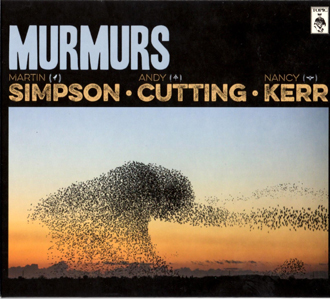
The buzz preceding Murmurs from the UK-based trio of Martin Simpson, Andy Cutting & Nancy Kerr made it one of the most eagerly awaited releases of 2015 in the Hunt household. One of the themes that occurs is that of wildlife and the natural world. Both are long-lived passions of Martin Simpson’s. The album title is a cross-reference to Graham Catley’s cover photograph of a murmuration of starlings. Starling flocks in flight have the appearance of solid air in motion, weaving and swooping in their many thousands.
Martin Simpson and I have had dozens of conversations about birds over the thirty years-plus that we have known each other. Toy Soldiers dwells on a subject dear to our hearts. Namely, the whole slaughter of birds reared specifically for sport in the British Isles. There are not merely the game birds that are beaten and driven out of cover in order to be blasted out of the skies but also the so-called vermin corvids and raptors, the carcasses of which used to be hung as warning trophies using fences as makeshirt or semi-permanent gibbets all over the British countryside in the good old days This was before the warnings in Rachel Carson’s Silent Spring (1962) bit home and agriculturists did want they liked in and to the countryside. In a lovely turn of phrase in Toy Soldiers, Simpson dubs this practice “gamekeeper’s Calvary”. The song’s title refers to pheasants. The notes widen the subject to bring in the Tory government’s increased subsidy for maintaining grouse moors. From Murmurs (Topic TSCD591, 2015)
More about Andy Cutting at http://www.andy-cutting.co.uk/, about Nancy Kerr at http://nancykerr.co.uk/and about Martin Simpson at http://www.martinsimpson.com/
Do You Believe in Me? – Peggy Seeger
This song by Peter Berryman & Lou Berryman was as if made for Peggy Seeger’s mouth. The lyric is full of twists and bubbles along at a fair old pace. It has sequences when it becomes a bugger of a tongue-twister and a test of breath control techniques. Peggy negotiates its intricacies brilliantly. From Everything Changes (Signet Music SM1, 2015)
More at http://www.peggyseeger.com/
Das muß ein Stück vom Himmel sein – Scarlett O’ & ‘the little big band’
This is a song by Werner Richard Heymann (1896-1961). It was Scarlett O’, formerly Scarlett Seeboldt of the East German folk group Wacholder, who introduced me to his writing and life what seems like a very long time ago. She has one of the most lustrous, most limber voices ever to have come out of Germany, whether either side or reunified.
This song appeared in the 1931 Ufa film Der Kongreß tanzt (the English-language title of which is The Congress Dances). Ufa was the Potsdam-based Universum Film AG film company. (Potsdam is situated to the west of Berlin and is the site of a museum dedicated to Ufa’s film-making legacy and history.) The film was made in three versions – a German, English and French one – with Ufa playing for high stakes in a deliberate drive to counter the supremacy of Hollywood on the international market.
Just love this song. That must be a little bit of heaven, as the song sings. Couldn’t get it out of my head. I spontaneously wrote the title line in a guest book in an idyllic place in Hohenwarte in East Germany. One of those communities in a valley miles away from anywhere of any size. A place where you wake up and maybe twenty species of birds are singing, where slowworms are basking in the early morning sun when you do the morning’s composting, and you click your ruby slippers and hope there are a few of the last Knupperkirschen (Germany’s to-die-for cherries) ripe and within reach. Das muß echt [genuinely] ein Stück vom Himmel sein. From Das muß ein Stück vom Himmel sein (Duophon 01 89 3, 2000)
More in German and English at http://www.scarlett-o.de/
Love Is Strange/Stay – Jackson Browne & David Lindley
There are a small number of musicians I am willing to cross continents to see perform. Naming them would be churlish. Without question is David Lindley. Lindley has never failed to bowl me over. I have seen him sound check as a guest and in two run-throughs nail a style. (In the case in mind he needed one, the band needed two.) I have seen him turn a major technological mishap into an opportunity for a display of prestidigitation while a complete desk reboot went on. I’ve known David Lindley since the early 1980s as a friend. His music only continues to inspire me on varying levels.
It was through David that I got to meet Jackson. Each meeting, always a rare thing. A rare thing in another sense of rare. Just love this performance. Jackson: “Hey, David.” “Yeah, mon?’ “How d’you call your lover?” Dave: “My what?” […] “Hey momma, cumovahere/Say hallo to Elvis./Like to meet Elvis? I know Elvis/A friend of mine.” It gets more complicated.
I want this blasting out at my funeral. I want it to bring smiles to faces the way it was with John B. Spencer’s coffin. When it was brought in for his humanist service, atop it was rhubarb and sundry allotment produce. When ‘he’ arrived, it prompted me to cry out Goonishly, ‘Rhubarb, rhubarb!’ John and I had talked at length about funereal generalities but the rhubarb was a surprise sprung and one I loved. People burst spontaneously into laughter. Which would have tickled John. Hard to imagine a funeral without a stick or two of rhubarb on a coffin now. From Love Is Strange (Inside Recordings INR5111-0, 2010)
Ecstasy – Jyotsna Srikanth
It was a beautiful early summer’s day in May around noon. Warm in an early English summer’s way – a pleasant 18-20 Centigrade. Driving along beside the Mogador sewage treatment plant with the window down (not something recommended during high summer with the wind in the wrong direction), a nightingale burst into song. A few seconds later a second one started singing and its song fit marvellously well into Karnatic violinist Jyotsna Srikanth’s Ecstasy. It’s a moment I shall treasure. Maybe it should have been a bulbul but a nightingale can do as a substitute in Britain. The bulbul is popularly viewed as the nightingale of India. And, yes, it is a cliché. Still in that moment it was more than a mismatch or a fleeting connect between a nightingale, a kinda take on Ewan MacColl’s Dirty Old Town and Jyotsna Srikanth’s South Indian violin. From Bangalore Dreams (Theme Music USR0006, 2015)
More at http://www.indianviolin.eu/Jyotsna.html
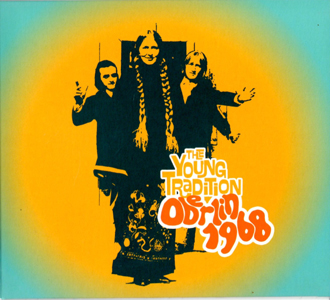 Byker Hill – The Young Tradition
Peter Bellamy, Heather Wood and Royston Wood were the Young Tradition. They were a force of nature and quite unlike any other unaccompanied folk harmony group of the late 1960s. (And, yes, I saw them live.) One of the underreported aspects of their music-making was the concision of their songs. The Oberlin College, Ohio recordings ram that home.
In the studio it was generally a case of brace and deliver. On stage a song might barely fluctuate in length within a narrow range of seconds. Self-indulgence lasted very few bars. One of the side-performance issues here is how little the Young Tradition deviated from that norm. This song reinforces that. Byker Hill was a song that Martin Carthy with Dave Swarbrick also earmarked as theirs. Byker Hill was perhaps the song when I realised that utterly different arrangements made complete and utter sense when it came to the English folk canon. No preference, one over the other. This song was a major part of my folk education. This album pinpoints how they communicated. Heather Wood adds a neat Janis Joplin shanty aside in the CD booklet notes. From Oberlin 1968 (Fledg’ling FLED3094, 2013)
More at http://www.thebeesknees.com/category/the-young-tradition/
In These Shoes? – Kirsty MacColl
I was just sitting there, minding my own business, writing and proofing copy in The Angel & Crown on that pedestrian side-lane leading up to church – whatever it’s called – in Richmond Upon Thames. (“Built in 1547, our building has been part of the Richmond landscape for centuries. Once a Post Office, then a sweet shop, it’s been a Fuller’s pub since 1876.”) All of a sudden, this song swamped my consciousness and I had to stop work and start listening. It made me feel hyper-alive. I stopped writing.
During her time Kirsty MacColl (1959-2000) was one of the truly most memorable singers ever to emerge from the UK’s fractured music scenes. Listening to song, as if out of the blue, floored me. From Tropical Brainstorm (Instinct Records INS557-2, 2001)
 Zur blawen Entten – Tritonus
Across Europe there is a myriad of musical realms in which contemporary takes on tradition-based folk musics are commonplace. Many are barely known outside their home patches, their regional cultural borders or national boundaries. Many acts – part-time or semi-professional – stay local by choice. Through decades of working at Tanz&FolkFest Rudolstadt, it has been a privilege to experience at first hand scores of regional folk acts from Belgium to Ukraine, Sardinia to Sweden that never reached British shores.
Yet despite coming with a family tree stretching back to the mid-1970s, to my shame neither hide nor hair of the Swiss folk group, Tritonus ever registered. On the strength of the genuinely exciting urbanus they are a force to be reckoned with. Zur blawen Entten (‘At the blue ducks’) derives from a Zurich inn name and the prospect of drinking in a place by that name is like a glass brimming over. It is a Zwiefacher, a dance from the Alpine Lands that switches between 3/4 and 2/4. From urbanus (Zytglogge ZYT 4966, 2015)
More at http://www.tritonus.ch// in German, English, French and Italian.
The copyright of all images lies with the respective photographers, companies and image-makers.
30. 5. 2015 |
read more...
 [by Ken Hunt, London and Prague] This month’s selection anticipates two December deaths: my father Leslie Lloyd Hunt (1912-1995) and Lubomír Dorůžka (1924-2013), the father of my co-host on this website’s father. In my father’s case it is through Acker Bilk’s most famous vehicle. Among others providing the music are Amira Medunjanin, Vlasta Grycová, Robert Plant and the Sensational Space Shifters, the Incredible String Band, Kala Ramnath and Ali Akbar Khan, Martin & Eliza Carthy, Commander Cody And His Lost Planet Airmen and Acker Bilk.
Eleno Kerko – Amira Medunjanin
Amira’s debut album Rosa, released in 2004, set many listeners on personal quests of discovery. The promise of Amira was wholly vindicated by the edgy music she revealed at her London debut opening for Taraf de Haďdouks in June
2007. The places that musical discoveries can transport us to are surely some of the best available to the human mind. Silk & Stone reveals that the Bosnian singer has also been on further quest of personal discovery.
It is her fifth album under her own name. After Rosa, she added three further albums of unerring and enduring quality to her catalogue. A small point. 2009’s Zumra (‘Emerald’), was jointly credited to Amira Medunjanin and the accordionist Merima Ključo.
A digression… Merima subsequently fetched up in a trio called Checkpoint KBK with David Krakauer and Iva Bittová. They had a song called Kino Laterna in their repertoire. (Listened to a studio recording of the song only night.) The lyrics I wrote for it were directly inspired by Lubo Dorůžka, Prague’s Kino Lucerna and Czechoslovakia’s anti-fascist potapky (‘great crested grebes’). 2014 found me absorbed in Wolfgang Beyer and Monica Ladurner’s history of the anti-fascist, swing jazz-inspired youth movements during the Nazi occupations, Im Swing gegen den Gleichschritt (‘With Swing against the Goosestep’) (Residenz Verlag, 2011). In it Lubo features as a direct witness. Forgive the digression.
Amira Medunjanin is a vocalist that I would travel across Europe to see perform live. The Macedonian song Elena Kerko (‘Helen, Darling’) is the album’s opening track and it is a perfect opening gambit. It bottles the essence of what she does, combining traditional and jazz elements. Much of that is down to Bojan Z’s cascading, jazz-tinged piano part. Bojan Z(ulfikarpašić)’s piano is what brings this project to fruition more than any of the other instrumental elements – namely double-bass, oud, kanun and guitar. Silk & Stone is a complete and utter masterpiece. From Silk & Stone (World Village 450029, 2014)
Maria Panna krmí díťátko – Vlasta Grycová
There is an elegiac quality to this tale which translates as ‘Virgin [Lady] Mary feeds the baby’. It is a Christmas carol associated with Moravian Slovakia. This version is an abridged, four-verse version and misses out some of the stable creatures that come to visit the infant Jesus. The cat visits but not the little dog or the hen. In the extended version the last verse states, “Play, violin, don’t make us cry/Tydli, tidli, tidli, Baby Jesus.”
The melody has the deceptive simplicity of great folk art. From Antologie moravské lidové hudby – Čas adventu a Vánoc (Indies MAM 515-2, 2012)
 Embrace Another Fall – Robert Plant and the Sensational Space Shifters
As someone who never fell for the blandishments of Led Zeppelin, much of Robert Plant’s back catalogue has remained a closed book. Before going to Colours of Ostrava I had hoped to listen to an advance copy of lullaby and. THE CEASELESS ROAR by way of preparation. Things happen and it didn’t happen. Maybe for the better because it made for a blank canvas. As it turned out, experiencing the rapture of the audience – and ‘rapture’ isn’t too strong a word – helped. The audience adored Robert Plant and the Sensational Space Shifters and that was something to cherish.
Of all the tracks on the album, this one hit the most buttons. The vibe of the song, its shifts of mood and dynamics are downright extraordinary. Part of its appeal is the soundscape that the Sensational Space Shifters and the guesting Julie Murphy create on the album. She sings a verse about the rumoured death of a lark on the mountain from the Welsh-language song Marwnad yr Ehedydd (‘The Lark’s Death’). Murphy’s interjection works really well, adding a new layer to the studio recording.
The Kronos Quartet played in the Dvořákova síň at the Rudolfinum in Prague on 13 November. The day before the concert the Kronos’ first violinist David Harrington and I met for one of our periodic chinwags and catch-ups. He talked about finally meeting Robert Plant for the first time fairly recently. Nonesuch’s label head Bob Hurwitz had brought them together. It was a good meeting of musicians from very different backgrounds but with commonalities they never touched on. From lullaby and… THE CEASELESS ROAR (Nonesuch Records 7559-79537-3, 2014)
Smoke Shovelling Song – Incredible String Band
Reflecting on the death of Clive Palmer, a founder member of the Incredible String Band, on 23 November 2014, all manner of memories flowed through my head. He was a decisive figurehead in acid-folk – but then he had blundered into being one of Scotland’s earliest busts for LSD in December 1966. This isn’t one of the dishes he brought to the table. It is a song by his ISB cohort Robin Williamson. But, for me, it was their very different, very varied voices that combined to create something that resonates across the generations. From Incredible String Band (Fledg’ling FLED 3076, 2010)
Rāg Durga – Ali Akbar Khan
I count myself fortunate that, while religions of several stripes have increasingly surrounded me, never to have had religion in my life in any sense beyond the academic has shaped me more. That said, there are elements of theoretical Hinduism that have engaged. Several years ago I was at Harballabh Sangeet Sammelan – the mid-winter music festival held in Jalandhar City. The festival has been held in an unbroken annual sequence since its founding in 1875. The image on the left gives an idea of its architecture and that image is its temple dedicated to Durga Ma.
Historically, She was known locally in Punjabi as Devi Talāb, literally the ‘Goddess of the Pool’, as the Sanskrit scholar Dr Ashok Upadhyay explained to me. In Hindu iconography Durga is depicted with ten arms and generally is riding a dawōn, a sacred big cat, depicted as either a tigress or a lioness. Outside one wayside temple in the country, it was a tigress. She represents the warrior aspect of the Divine Mother. She is the Inaccessible, the Invincible, the Goddess “who can redeem in situations of utmost distress”. A deity to warm to.
This was the song and the performance my head sang when I walked across the lake to the temple dedicated to Her. I count myself wholly blessed to have known Ali Akbar Khansahib as well as I got to know him and to have got to speak to him about the everyday, not only music. Kavi Alexander of Water Lily Acoustics captured something special in these recordings. He had a rare empathy for sound and sonorities. From Indian Architexture (Water Lily Acoustics WLA-ES-20-SACD, 2001)
Bonny Moorhen – Martin & Eliza Carthy
It is September 2010 and Martin Carthy and I are standing on the banks of the upper tidal Thames at Isleworth Ait in Middlesex, close to Mill Plat where the Duke of Northumberland River joins the Thames. It is one of my favourite places on the planet. It is low tide and a plethora of water fowl and general birdlife is going about its business, feeding on the mud and gravel banks of the ait – as a river island or eyot is known hereabouts. Among the waterfowl are coot (Fulica atra ) and moorhen (Gallinula chloropus). Watching them triggers a conversation about a song that Carthy is ruminating upon. Its figurative ‘hero’ is a sort of moorhen of another feather – the game bird known alternatively as the black grouse (Tetrao tetrix). He speaks eagerly about this song he is working on and its political nature.
Eventually it appears on one of the supreme albums of 2014. Its emergence is an indication of how long a song may gestate with him. From The Moral of the Elephant (Topic TSCD587, 2014)
 Rāg Maru Bihag – Kala Ramnath
The violinist Kala Ramnath is unquestionably one of the great voices of Hindustani violinistics. In late November 2014 she stayed with us in London – London being a staging post on her trip between San Francisco and Mumbai. She had a new violin with her, one that she had taken collection of this June gone. The Chicago-based luthier Vladek Stopka had made it. It would have been an affront not to listen to its voice. The decay on its sound was a marvel and, well, one thing led to another led to another. We started working on something, firing ideas off each other. It reached the point where we had to rewind and start recording the proceedings.
I had the pleasure of seeing this recording of Rāg Maru Bihag unfurl in the Landestheater at Tanz&FolkFest Rudolstadt in July 2010. Abhijit Banerjee accompanied her so sweetly on tabla at both of her superlative appearances at the festival. In this performance she references two people whose presence in her life so soundly affected her music. She includes a composition by her guru Pandit Jasraj and one, again in Maru Bihag, by Prabha Atre, with whom she studied. Her Maru Bihag is an interpretation to take to the grave. Love it to pieces.
The accompanying photo was taken by Sushil Sidhu, my brother-in-law-to-be, at this performance in the town theatre. It is one of my absolute favourite portraits of her. It captures the same look of concentration she had on her face and we shared as time ceased to exist in any measurable form. From Magic Kamancheh (NoEthno 1015-19, 2014)
 Turn It Up – Robert Plant and the Sensational Space Shifters
Their 2014 debut, lullaby and… THE CEASELESS ROAR was unquestionably my most played album release of 2014. This track has a marvellous brittle quality to it in places. It reminds me of some of the sonorities Tom Waits plays with on his recordings. Especially the percussion. It refers to Charley Patton in the opening line and that is fine by me.
“Turn it up…”
From lullaby and… THE CEASELESS ROAR (Nonesuch Records 7559-79537-3, 2014)
Down To Seeds And Stems Again – Commander Cody And His Lost Planet Airmen
George Frame, aka the Good Commander, and I go way back. We first met in 1979 to do an interview for Dark Star, one of the post ZigZag, second-wave of UK music magazines. By the end of the interview only their ivory-tickler George and I were capable of still taking part in an interview. We bonded.
This was one of the Airmen’s finest original songs of break-up, despair and the end-game of intoxication. In this version it is not the dawg that dies but the narrator’s ant-farm. Heartbreak dogged them that sort of way. Takes me right back to my country roots. From Live From Armadillo World Headquarters 1973 and The Capitol Theatre 1975 (SPV 49922 2CD, 2007)
 Stranger On The Shore – Acker Bilk
My father played Albert system clarinet – rather than the better known Boehm system clarinet. It meant he transposed when he played. He was a highly gifted musician whose career as a full-time musician was stymied because his parents couldn’t rustle up the guinea – twenty-one shillings – for his entry to the Guildhall. He had passed its theory, sight-reading and playing entrance examinations. Plus he could busk and play by ear. At the age of 14 he became a gigging musician in dance bands, played throughout the Second World War as a Royal Air Force bandsman. Came so-called peace time, he played semi-professionally in dance band. He did that until Parkinson’s stopped him holding down the pads four or five years before his death.
My father warmed up on clarinet with two pieces in particular. One was the top-range and tricky fingering of Artie Shaw’s Concerto For Clarinet and the other was Bilk’s Stranger On The Shore. And that’s why this is here. Neither was a doddle for Albert system clarinet.
Acker means ‘mate’ in Somerset dialect.
The copyright of all images lies with the respective photographers, companies and image-makers. The image of Kala Ramnath is © Sush Sidhu/Swing 51 Archives. The photograph of the Durga mandir and Liam Tyson and Robert Plant are © Ken Hunt/Swing 51 Archives. The publicity photograph of Leslie Hunt circa 1926-28 bears the imprint by the Robert M. Barr studio of Denmark Hill, London, S.E.5 on the rear © Swing 51 Archives
30. 11. 2014 |
read more...
 [by Ken Hunt, London] Two months rolled into one, thanks to the aftermath of travelling and delivering copy. The choices refect work, death and making associations. The musical scatter cushions include Kishore Kumar, Carlos Paredes, Kavita Shah, Olga Bell, Abhishek Raghururam… And more.
 Dil Aisa Kisi Ne Mera Toda – Kishore Kumar
13 October 2014 marked the 27th death anniversary of one of Bollywood’s greatest male vocalists, Kishore Kumar. Dil aisa kisi ne. is a song from a relatively unknown Bollywood composer called Shyamlal Mitra. Kishore Kumar won the Best Male Playback Singer for this song at the 1976 Filmfare Awards and its lyricist Shyamalal Babu Rai, known professionally as Indeevar, Best Lyricist in the same awards. It is from the film Amanush which apparently translates as ‘English: Inhuman’. Surely with a title like that it deserves to appear on playlists. From Amanush (1975)
Siddhivinaayakam – Mandolin U. Srinivas
U. Srinivas – latterly increasingly rendered Shrinivas – died on 19 September 2014. Born on 28 February 1969 in Palakolin in Andhra Pradesh’s West Godavari District, he was a child prodigy in the classic South Indian sense. One of the great differences was he did not burn out young. Unlike too many child musicians in Karnatic music. What he did with a solid-body electric mandolin was exquisite. This is a composition by the pre-eminent Hindu saint-composer Dikshitkar. It says everything you need to know about Srinivas.
The piece was recorded on 26 July 1995 at Real World Studios with K. Murugaboopathi on mridangam (double-headed, barrel-shaped hand drum) and E.M. Subramaniam on ghatam (tuned clay pot). My obituary of Srinivas appears in the Winter 2014 issue (Issue #64) of the Canadian folk magazine Penguin Eggs. From Mandolin U Srinivas (WOMAD WSCCD003, 1995)
Further information about the magazine is at: http://www.penguineggs.ab.ca/
Paper Planes – Kavita Shah
The M.I.A. track from her 2007 album Kala (‘Art’). The album this track comes from ranks as one of the most daring and ambitious works of 2014.
Kavita Shah interprets a highly interesting body of work. Joni Mitchell’s Little Green gets a kora (African harp) passage intervention. Her recognition and reworking of this M.I.A. song gets my wholehearted approval. From Visions (Naïve NJ 624811, 2014)
Further information about Kavita Shah is at: http://www.kavitashahmusic.com/
 Canção Verdes Anos – Carlos Paredes
Listening to a private recording graciously provided by Jackson Browne from a concert in The Hague at which Carlos Varela joined Browne on stage, I was struck by the sound of Varela’s guitar. It reminded me of Carlos Paredes. It sent me off on a Paredes listening jag. Canção Verdes Anos (‘Song of the Green Years’) was the the performance that wound up on repeat over and over again.
Carlos Paredes (1925-2004) was an integral feature in a line of master musicians known in idiomatic Portuguese as a casa. It means a “case” – a usage with similarities in English. It means someone unique or someone who is their own man. (Maybe even theiur own ‘person’ nowadays.) He extended the range, voice and dynamics of the guitarra portuguesa or Portuguese guitar. He took it to new places. Paredes’ style was also shaped by his development of his so-called Coimbra guitar. It was a bigger, richer-voiced instrument than the usual, twelve-string Lisbon model.
This particular composition appeared in director Paulo Rocha’s 1963 film Os Verdes Anos (‘The Green Years’). The Kronos Quartet included it on their Kronos Caravan album (2000), a project for which I wrote the notes. It was a thoroughly exciting ride, with ideas flying to and fro. Canção Verdes Anos was a piece of music that David Harrington identified. I have a memory of David telling me that he obtained approval for arranging the track from Paredes in person.
From guitarra portuguesa (EMI 0 777748674 2 9, 1987)
 Jogkauns – Prabha Atre
The remarkable, truly remarkable concert that Prabha Atre gave at the Darbar Festival was called ‘Best Then, Better Now: The Legendary Prabha Atre’. It sounded like a neat line. Still, something niggled about the line’s originality. That niggle was answered after reading the advertising poster for Timberland at a bus stop. It said, of course, ‘Best Then. Better Now’. (A short history of advertising slogans is now declined…)
 I had waited many years to see Prabha Atre sing and she did not disappoint in any way. She brought an originality of delivery to her performance that was commanding and arresting. My review of her concert appears in the Winter 2014 issue of Pulse. From Amrut Prabha (Times Music TDICL 154P, 2007)
Jungle Drum – Emilíana Torrini
Listened to this song a lot while gaining a measure of the Icelandic singer-songwriter Emilíana Torrini’s songwriting. Of course, the homework counted for little because that’s the way it goes in the ‘grand scheme’ of preparation. From a Rough Trade promo single [undated])
 Perm Krai– Olga Bell
Every so often I pick up magazines that ordinarily I wouldn’t read. I do it deliberately because I get asked by several European music festivals about musicians. Born in Moscow and raised in Alaska, Olga Bell is a musician operating out of New York. An article about Olga Bell’s music in a freebie music magazine struck me that hers was a music I should listen to. From Krai (One Little Indian
TPLP1236CD, 2014)
Further information about Olga Bell is at: http://bellinspace.tumblr.com/
Dolphins – Eddi Reader
Eddi Reader did better with this song in live situations but her interpretation of this song just uplifts. How she bends the song to fit her voice and fit Tim Buckley’s vocal delivery. This is definitely something based on Tim Buckley’s version rather than its composer, Fred Neil.
I wouldn’t want to imagine how Britain’s music scene would sound without Eddi Reader. She is a continual source of joy and inspiration. From Mirmama (RCA 74321 15865 2, 1992)
 Viriboni – Abhishek Raghururam
This performance opens the Karnatic vocalist Abhishek Raghururam’s double-CD concert souvenir from a concert he gave at Sringeri Math, T Nagar Chennai on the last day of December 2010. His name had come out of a discussion about names to watch out for. India is a big place and keeping on top of names to note is a never-ending adventure. Live in London at the Darbar Festival he lived up to the praise that preceded him. From December Season 2010 (CDW274AD, 2011)
Enjoy Yourself (It’s Later Than You Think) – Marvellous singers and players
The actor Toby Jones takes the lead role as Neil Baldwin (who also appears as himself providing historical and personal insights) in Peter Bowker’s uplifting BBC drama Marvellous. Televised on 25 September 2014, it had a recurring musical theme in this song. The playwright in a blog for the BBC (link below) explains, “We have a chorus in the form of a choir and ukulele orchestra that, to reflect the inclusive nature of the film, is a combination of three choirs including one from Hanley – the M.Y. Inter Theatre Choir – for adults with disabilities. The choir itself I invented and called the Neil Baldwin Orchestra. At first they stand alone as a chorus but they are slowly integrated into the story and then the fictional Neil actually joins their ranks.”
The refrain sings this way:
“Enjoy yourself, it’s later than you think
Enjoy yourself, while you’re still in the pink
The years go by, as quickly as a wink
Enjoy yourself, enjoy yourself, it’s later than you think…”
An absolute earworm of a song (with added “the worms crawl in, the worms crawl out…” segue possibilities). The original Enjoy Yourself (It’s Later than You Think) by Carl Sigman with lyrics by Herb Magidson was sung by, amongst others, Guy Lombardo and His Royal Canadians, Doris Day, Prince Buster and The Specials. From the television drama Marvellous (2014)
The copyright of all images lies with the respective photographers, companies and image-makers. The photograph of Jackson Browne of unknown date is from the Swing 51 Archives by Jessica Karman. The image of Prabha Atre with a blue sky behind her is © Ken Hunt/Swing 51 Archives. The other image of her and that of Abhishek Raghururam are © Santosh Sidhu/Swing 51 Archives.
31. 10. 2014 |
read more...
 [by Ken Hunt, London] A good deal of music this month came out following up new musical experiences gained over the summer. There was also prepping interviews and anticipating 2014’s annual Darbar Festival, then about to take place between 18 and 21 September. (Before that festival there is generally a good measure of music to listen to by way of preparation or homework to be done. Much of this month’s selections sprang from attending Colours of Ostrava. This month Jackson Browne, The Pogues, June Tabor & Oysterband, Velvet Underground, Ganesh-Kumaresh, Shirley Collins and Steve Ashley, Lo Còr De La Plana, Jackson Browne & Graham Nash, Alla Rakha and Aruna Sairam are in attendance. But there are many more discoveries waiting in the wings.
This column was updated on 30 November 2014.
 Take It Easy → Our Lady of the Well – Jackson Browne
Of all Jackson Browne’s studio recordings, the transition of Take It Easy – the song that soon helped to make him famous (courtesy of the Eagles covering it on their debut album) into Our Lady of the Well remains an abiding favourite. The pedal steel guitar of Sneaky Pete Kleinow flows underneath Take It Easy and then forms the structural bridge into Our Lady of the Well.
Decades before I managed to get to California, there was a certain something about the LP cover illustration and picturing Jackson Browne sitting there in the shade of that courtyard. The horticulture got me. California lived up to expectations From For Everyman (Asylum 243 003, 1973)
 An update – at his concert at the Royal Albert Hall on 25 November 2014 Jackson Browne played these two compositions as a transition.
Thousands Are Sailing – The Pogues
“Did the old songs taunt or cheer you/
And did they still make you cry?/
Did you count the months and years?/
Or did your teardrops quickly dry?”
I interviewed Phil Chevron, the man who composed this song, once and I interviewed Christy Moore about Phil Chevron once. For some peculiar reason I recall Phil Chevron and me chatting in the late 1980s in Hammersmith Palais – of Clash immortalisation-through-song fame, though it was a venue that my father had also played. The gig had some Christy Moore connection. It’s all a blur now. Unlike this song. From If I Should Fall From Grace With God (WEA 2292-44493-2, 1987)
Adam Sweeting’s obituary of Phil Chevron from the Guardian is here: http://www.theguardian.com/music/2013/oct/09/philip-chevron
Love Will Tear Us Apart – June Tabor & Oysterband
 Joy Division did little for me, quite likely because I was listening to very different music at the time and it is the nature of a music critic’s life that there is never enough time to get in all the listening that he or she wants to do. What brought this song – and performance – back into material that I wanted to revisit was twofold. June Tabor & Oysterband performed at TFF Rudolstadt 2014 this July, though I wasn’t there. Second, the Belgian music journalist Annik Honoré died on 3 July 2014 at the age of 56. In her case the word ‘muse’ was frequently bandied about in the context of Joy Division’s Ian Curtis writing these words. Although Joy Division was marginal in my musical worldview, down the years enough of the mudslinging, arguments and counter-denials about Honoré did seep into my consciousness.
Ian Curtis died in May 1980 and Love Will Tear Us Apart subsequently became something of a hit. This version bottles its essence. The closing verse sings this way: “You cry out in your sleep all my failings exposed/And there’s a taste in my mouth as desperation takes hold/Just that something so good just can’t function no more.”. Ragged Kingdom didn’t put me on the path to Joy Division but it did introduce me to the value of a really excellent and dark song. From Ragged Kingdom (Topic Records TSCD585, 2011)
June Tabor and John Jones talk about Ragged Kingdom here. Check out https://www.youtube.com/watch?v=J4_573-Lxdc
Pale Blue Eyes – Velvet Underground
Lou Reed’s poeticising of human frailty and carnal desire in song was something truly special. Amid the column inches after his death on 27 October 2013 the gentle, wistful song asked to be played. It is from the Velvet Underground’s third, self-titled album, released in 1969, and the first to be made without John Cale. It’s a habit of that goes back to the early 1990s to play Velvet Underground music either in Prague or on returning from the city. Or before going, as in this case. Not from the pre-expanded edition set of their third album. From the boxed set The Velvet Underground (Polydor 31452 7887-2, 1995)
 Gabhira Nottal – Ganesh-Kumaresh
This is a recording from the Karnatic violin duo Ganesh-Kumaresh from Darbar Festival in London in 2009. It fades out but gives a good impression of the sound the brothers make. I happened to be in the audience for this concert. Aside from their music-making, what struck me was the enthusiasm and energy of their responsiveness that they showed when they attended other musicians’ concerts. This recording captures their musical energy. From Ethno Port Poznań 2014 (Centrum Kultury Zamek CK ZAMEK 009, 2014)
The Ethno Port Poznań festival’s website for 2014 (in English) is located round about here: http://www.zamek.poznan.pl/news,en,394,3198.html
Honour Bright – Shirley Collins and Steve Ashley
I did my first interviews of many interviews with the Sussex folksinger Shirley Collins in 1979. At one point she used an idiom that I hadn’t heard before. It was honour bright. It is a dated expression and means ‘on my honour’ though I took it to mean something it along the lines of ‘Scout’s honour’.
I had no idea – and she didn’t illuminate much – that it was the title of a song by her first husband. After her first husband, Austin John Marshall’s death on 3 November 2013 in Manhattan, Honour Bright was one of the pieces of music I played to nudge memories of him whilst I was writing his obituary for The Independent. It is the first track on the fourth disc of the Shirley Collins boxed set. It is now out of print. Alas. It is such a labour of love. And just to correct an omission, the uncredited Alan Lomax interview material about Shirley in it is mine. From Within Sound (Fledg’ling NEST 5001, 2002)
Ken Hunt’s obituary of Austin John Marshall from the Independent is here: http://www.independent.co.uk/news/obituaries/austin-john-marshall-graphic-artist-record-producer-and-songwriter-who-played-a-key-role-in-the-folk-revival-of-the-1960s-9094365.html
 Nòste País – Lo Còr De La Plana
Lo Còr De La Plana is a group that has never failed to exceed my expectations and hopes for them on the occasions I have seen them perform live in Germany, England and the Czech Republic. They lift my heart no matter what the subject matter. And some of it gets pretty dark whether about relationships breaking up, Satan in Marselha (Marseilles), arming the police, crime syndicate stuff, you get the picture. That may have something to do with understanding so imperfectly what they are singing about but the spirit communicates. They sing in Occitan, an ancient language, the homeland of which straddles modern-day France, Spain, Italy and Monaco. If I am correct, Lo Còr De La Plana translates as ‘the heart of [Marselha’s] La Plaine [neighbourhood or quarter]’. In a manner of speaking more heart than ‘choir’ – or to lapse into French more cur than chur. At Colours of Ostrava they delivered one of the festival’s most outstanding performances. And this album reinforces why they are a band beyond description.
At Ostrava I broke a long-standing, personal rule (concerning two left feet) and danced in public. My excuse was that it was a circle dance with scores of people in each circle. And there were several separate ring dances going on in the tented Drive Stage enclosure. You never know when you’ll have another chance to dance, so I danced. On one hand was a beautiful Polish woman and the other a beautiful Czech or Slovak woman. (My Czech is too primitive to know whether I am hearing Czech or Slovak.) It was the spirit of the festival and Còr De La Plana that got me. Colours of Ostrava is a festival I can only recommend. From Marcha! (Buda Musique 2799095, undated [2012])
Crow On The Cradle – Jackson Browne & Graham Nash
This stylish cover of Sydney Carter’s song really buggered his relationship with the Inland Revenue. Its influx of royalties convinced the taxman that his annual income had shifted up a gear. And nobody on a moderate income relishes having to dissuade said authorities that they have got the wrong end of the stick. Disabusing can take years. David Lindley’s violin on a track is marvellous. It is a song that Browne and Lindley would return to.
From No Nukes (Elektra/Asylum 7559-60592-2, 1979)
Intermission – Alla Rakha
In the LP sleeve notes to Gandhi, Richard Attenborough writes, “To be greeted by a thick blanket of snow – many of them witnessing such a sight for the first time ever – a group of India’s most distinguished musicians arrived in England in the second week of January this year [1982]. They had come to record the music that Ravi Shankar had written for Gandhi.” The contingent that performs on the Indian part of the film soundtrack includes the sarodist Aashish Khan, the sarodist Sultan Khan, the vocalist Lakshmi Shankar and the tabla maestro Alla Rakha. It is an aberration in my opinion that this soundtrack has never been reissued.
One of the decisive scenes is the re-enactment of General Dyer’s wholesale slaughter of men, women and children at the Sikh holy temple at Amritsar. After the massacre there is an interlude of quiet reflection before the “intermission”. The screen is black and a tabla strikes up. The playing is unmistakably that of Alla Rakha. Fluent and articulate, it is consummate piece of Hindustani rhythmicality. It is a piece that Ravi Shankar could have at most suggested taal (rhythm cycle) and laya (tempo) building brick terms. Rather than composing in detail, I would suggest.
It was Alla Rakha and his tabla fluency which opened the Hindustani treasure cave for me. Not voice, not sitar, sarod or any instrument of melody. To hear, to intuitively understand that rhythmicality was down to my musician father teaching me how notto count time signatures but instead to feel them and when the ‘one’ was arriving. Then to be in the presence of Alla Rakhaji‘s rhythmic sophistication and muscularity meant entering a new realm of music. I went through the door and when I returned I was never the same.
This choice was brought on by Richard Attenborough’s death. It is an exquisite piece of mythopoetic fiction. That’s mythopoetic in its original sense of making myths. To which I would add in Attenborough’s case the nurturing of myths. The Indian government paid handsomely for this propaganda film. It was money well spent by the Indian government. It became the standard history. So many figures were ‘disappeared’ or maginalised. Take Jinnah on the Pakistani side of Self-rule’s history or Ambedkar on the Indian side of the border.
In the 1982 Academy Awards Ravi Shankar and George Fenton lost out to John Williams’ E.T. for Best Original Score. So far, not re-released. Bizarre. I volunteer to write its reissue’s CD booklet notes… From Gandhi – Music From The Original Motion Picture Soundtrack (RCA ABl1-4557, 1982)
 Kalinga Nardhnam – Aruna Sairam
Of the living Karnatic vocalists – male or female – Aruna Sairam (also rendered Sayeeram especially in Francophone territories) is the musician whose music I play and revel in the most often. For me, her music is an essential part of a healthy and balanced musical diet. I can no longer imagine what it might be like, never to have listened – or experienced live – Aruna’s singing. At Colours of Ostrava I found myself extolling her virtues and explaining how mesmerising a performer and interpreter she is for the director of another European festival. Kalinga Nardhnam became the central plank of an impromptu thesis on the inexpressible joys of Aruna Sairam’s vocal artistry.
When it came to specifying a piece of music which demonstrates what sets her apart, I instinctively and immediately chose her interpretation of this thillana. I described how in it she sings of the time that the Boy Krishna trounced the multi-headed serpent-demon Kalinga by dancing on its head. TLest this episode sound arcane. Kalinga (Kālingā) is another name for Kaliya (Kāliyā). For lovers of popular culture, the original cover artwork of Aerosmith’s Nine Lives (Columbia, 1997) transmogrified Krishna’s head into, well, a cat’s. Sacred Hindu imagery spoiled by a moggy, so to speak. I digress.
Talking about Aruna Sairam’s phenomenal gift led to a craving to re-experience her singing this spectacular piece of sacred music. So I tracked down a commercial recording and ordered the Amultham label’s Yamuna Nathikarayil. From Yamuna Nathikarayil (Amutham AM 5230, 2007)
PS Then on 31 August 2014 something wonderful concerning Aruna Sairam occurred. But that’s a story for another time…
The photograph of Jackson Browne is copyright unknown, credited to Jessica Karman. The June Tabor and the Oysterband shot is © Judith Burrows. The live photo of Aruna Sairam is © Santosh Sidhu/Swing 51 Archives. The copyright of the other images lies with their respective photographers, companies and image-makers.
30. 8. 2014 |
read more...
 [by Ken Hunt, London] Several of these listening selections came about thanks to travelling in the Czech Republic and Austria and meeting an extraordinary bunch of people, some of whom became new friends. The gathering here comprises Nishtiman, John Barry (featuring John Leach as soloist), Grateful Dead, Tommy McCarthy, Bonnie Dobson & Her Boys, Geirr Tveitt, Ado Abdelmasih, Aziz Günel and Ibrahim Aksim, Iva Bittová & Vladamír Václavek and CSNY.
This month’s Giant Donut Discs is in memory of the jazz critic Jack Massarik, my fellow Jazzwise scribe and sometime tour guide to jazz spots in Soho (after the Jazzwise writers’ Christmas get-togethers). I learned that Jack had died on 13 July 2015 while I was out East. Jack was a very good egg.

Nishtiman – Nishtiman
Nishtiman plays Kurdish folk-flavoured art music. The songs are in a variety of Kurdish regional voices. The details would be a list that neither I nor you the reader, would grasp without speaking Kurdish. As a title, the word is emblematic of Kurdistan. Nishtiman signifies ‘homeland’ (though the word’s German translation Heimat captures nuances that ‘homeland’ doesn’t). The world’s largest stateless nation, the fictive Kurdistan straddles Iran, Iraq, Syria and Turkey and, in terms of geopolitical status, it comes with varying degrees of autonomy and external support. The septet is a mixture of Kurds from Iran, Iraq and Turkey, augmented with two France-based musicians – the percussionist Robin Vassy and double-bass player Leila Renault – who provide the timbral lift at the lower end. The project’s artistic director and percussionist Hussein Zahawy has pulled together musicians who reflect back aspects of the Kurdish diaspora, regional styles and dialects. Sohrab Pournazeri sings and plays tambur or tanbur (long-necked lute) and kamancheh (spike fiddle). Ertan Tekin plays zurna (shawm). Goran Kamil plays oud (lute). Maryam Ebrahimpour sings.
Listening to Nishtiman, it occurred that all Kurdish music ever to cross my path had had a diaspora or expat dimension. (For example, music from The Kamkars.) This music is neither ‘purist’ nor folkloristic in its approach. It is folk-inflected, light classical Kurdish music for today with a solid underpinning with bass and percussion to propel it. It is an adventure.
Nishtiman was the second to last act on the final night of the 2014 edition of Glatt&Verkehrt, the long-running Austrian festival based in Krems an der Donau in the Wachau district – an hour’s rail journey from Vienna along the Danube (Donau). At the festival I didn’t get them. However, the performance did prime me for the recording. It all fell into place back in Britain reviewing this album for fRoots. Loved to be disabused. From Kurdistan – Nishtiman (Accords Croisés AC 150, 2014)
Opening theme to The Ipcress File – John Barry and John Leach
Sidney J. Furie’s spy film The Ipcress File (1965) was a big shift away from the malarkey and high jinks of the James Bond films. While the opening credits roll and Michael Caine’s character Harry Palmer is in the kitchen making coffee and generally starting his day. John Barry’s theme plays over the opening credits. The music has a modern jazz feel but it has an unusual sound to it central to its impact. This is the cimbalom, the large Hungarian member of the hammer dulcimer family. The musician playing it was John Leach. It never even crossed my pretty little teenage head what the instrument delivering that distinctive sound was at that time. It was just an interesting and unusual sound. With hindsight it was probably the first time I heard the instrument. Reading the excellent obituary of him in the Daily Telegraph rekindled my curiosity.
The IPCRESS File (1962) was Len Deighton’s first spy novel and it was a revelation. The word in the title stood for ‘Induction of Psycho-neuroses by Conditioned Reflex under strESS’. To steal an anachronism from David Lindley, it had a putting-wires-into-your-brain vibe. Deighton’s Horse Under Water (1963) and Funeral in Berlin (1964) followed and I read both in them all in their Penguin paperback editions.
The music in context is here: https://www.youtube.com/watch?v=pBCqP7R42K0
From The Ipcress File – Special Edition (2006)
John Leach’s obituary from the Daily Telegraph of Saturday 12 July 2014 is here: http://www.telegraph.co.uk/news/obituaries/10962261/John-Leach-ob ituary.html
 New Speedway Boogie – Grateful Dead
Over the course of the summer many things kismet caused me to rethink my relationship with the Dead’s Workingman’s Dead album from 1970. The album marked a profound change in the Dead’s songwriting, for, with it, their lyricist Robert Hunter revealed new levels of achievement and songcraft. The songs were like nothing on the previous albums and the lyrics were in another realm compared to those revealed on Aoxomoxoa and Live/Dead (the US release of which included song lyrics for the first time).
New Speedway Boogie is a prime example of the Hunter/Garcia song parttnerships’s new style. Its launch-pad was the debacle that was the Altamont Speedway Free Festival held on 6 December 1969. It is strewn with lines that sound like proverbs or old saws. A favourite verse is, “Now I don’t know but I been told/it’s hard to run with the weight of gold/Other hand I heard it said/it’s just as hard with the weight of lead.” Apparently the Dead first performed the song on 20 December 1969 at the Fillmore Auditorium in San Francisco, an indication of the creativity and speed of productivity that typified the Workingman’s Dead period. The cover, a group shot including Robert Hunter (far left, standing), is a product of the Alton Kelly/Stanley Mouse studio. Alas, my (uncredited) obituary of Alton Kelly for The Times is now behind a paywall. From Workingman’s Dead (Rhino R2-74401-F, 2001)
Further information about Stanley Mouse is at: http://http://www.mousestudios.com/
Down That Road – Tommy McCarthy
The opening track from Tommy McCarthy’s debut album. This was listening material in anticipation of his next album. Thomas McCarthy is the Traveller singer that gives me the strongest hope of this culture blossoming into thisncentury. He is the real thing – as best I can judge it. Apart from that he is a fab singer. As this piece illustrates. From Round Top Wagon (ITCD 0012, 2010)
I Got Stung – Bonnie Dobson & Her Boys
This is the album to which I have returned to over and over again all year. Bonnie Dobson is a song interpreter and a songwriter to whom I have returned for more years than I care to put a year on. From Take Me For A Walk In The Morning Dew (Hornbeam Recordings HBR003, 2014)
Hundrad Hardingtonar, Opus 151 – Geirr Tveitt
Hundrad Hardingtonar, Opus 151 by the Norwegian composer Geirr Tveitt (1908-1981) was a curiosity purchase in a charity shop in Richmond upon Thames. I had never heard of him but Norway’s Hardangar folk fiddle tradition is a long-standing interest of mine, dating back originally to the curiosity of seeing the cover artwork of the LP Folk Music of Norway (Topic 12TS351, 1977). Tveitt’s suite of tunes associated with the Norway’s famed folk violin with sympathetic strings is a wondrous example of mining a folk tradition and refashioning that musical ore for classical purposes. From Suites Nos. 1 and 4 (NAXOS 8.55078, 2001)
B’Utho – The priests Ado Abdelmasih, Aziz Günel and Ibrahim Aksim
 This particular piece of Christian liturgical music belongs to what may well be a bygone era of tolerance in Syria. Its inclusion in this month’s selection of music is, no apology, occasioned by the UnIslamic State and its decision to reinvent the region’s culture.
From Syrian Orthodox Church – Tradition of Tur Abdin in Mesopotamia (UNESCO/Auvidis D 8075, 1998)
Sirka v Louži – Iva Bittová & Vladamír Václavek
Bílé inferno – ‘white inferno’ in Czech. Co-credited to Vladamír Václavek, it is one of Iva Bittová’s milestone albums. Every home should have one. At Colours of Ostrava in July 2014, just thinking about her, ideas flowed through my head. She’s that sort of gal. The plan was that I was going to do a ten-minute or so talk about an aspect of contemporary Eastern European music. Namely, writing odd lyrics for her – mainly in English but also sometimes in Czech – and how that came about.
For me, the image of the ‘white inferno’ is a key one. She remains one of my handful of ‘total musicians’ – a concept I shan’t expand upon here. One nice thing about Sirka v Louži is that Vladamír Václavek wound up on the composing side of a set of lyrics of mine called Paper Cone of Cherries that Iva set to music. How good can is life get? Very. From Bílé inferno (Indies Records MAM055-2, 1997)
 The Lee Shore – CSNY
This track is from a 40-track 3-CD, one DVD set curated by Graham Nash and Joel Bernstein. What they have produce is a mix-and-match fantasy set. It combines electric and acoustic sets, with or without accompanists. (The accompanists are Tim Drummond on electric bass, Russell Kunkel on drums and Joe Lala on percussion.) The material is presented in solo, duo, trio and quartet permutations and come from Crosby, Stills, Nash & Young gigs in Landover, MD, Chicago IL and Hampstead, NY and Wembley in England in August 1974, augmented by recordings from a benefit gig in San Francisco in December 1974. The bonus DVD adds eight tracks from Landover and Wembley.
This boxed set had accompanied me to Austria so that I could finish listening to its music, watch the DVD and knock out the review. Sitting tip-tapping on the keyboard in an apartment looking over Vienna’s Praterstrasse at the end of July 2014, occasionally I would look out at the plane trees outside while collecting or re-shaping my thoughts. At around certain times of the morning one or two black redstarts would arrive to feed in the time canopy. The Rotschwanz (Phoenicurus ochruros) is a seasonal visitor in Britain and only knew its German-language name. But I watched it and that flycatcher is now twinned with this song of Pacific sailing in my head. Which means nothing to you, but helped fix The Lee Shore in my head this month. From CSNY 1974 (CSNY/Rhino 8122796035, 2014)
Jane Cornwall’s tribute to Jack Massarik entitled ‘A passionate jazzman’ appeared in the Evening Standard of Wednesday 26 July 2014. It appears here: http://www.standard.co.uk/news/london/a-passionate-jazzman-jack-massarik-obituary-9608559.html
Jane is another fellow Jazzwise scribe and, like Jack, a contributor to the Evening Standard.
The copyright of all images lies with the respective photographers, companies and image-makers. The photographs of Nishtiman at Glatt&Verkehrt are © Ken Hunt/Swing 51 Archives.
31. 7. 2014 |
read more...
 [by Ken Hunt, London] Bob Dylan, Bonnie Dobson, Pavla Milcová, Salamakannel, SANS, Kronos Quartet, Ray Fisher, Zakir Hussain with Adnan Sami, Jenna And Bethany Reid and the Incredible String Band.
 Like A Rolling Stone – Bob Dylan
This performance is a portal to, or a portent of Dylan’s mutable identities to come. It is one of the most pivotal songs in his canon. No matter how frequently or infrequently I listen to this particular recording, it loiters menacingly in the shadows of my mind. Commentators talk about the impact of the first Beatles film – A Hard Day’s Night – in 1964. Other people clearly saw something that I didn’t. For me however, it is pretty much impossible to communicate the impact of Like A Rolling Stone at the time of release in 1965. I splashed out on a second-hand mono copy of the LP in a record shop in Wimbledon.
 One reason spurring on revisiting this album was the sale of Dylan’s manuscript lyrics, handwritten at the Roger Smith Hotel in Washington D.C. – with sundry try-outs, rhyming prompts, ideas and doodles. It fetched USD 2.045 million in June 2014 at Sotheby’s. How many people were prompted to play this track as a consequence of the publicity?
Years ago this website’s co-host, Petr Dorůžka was in my former writing room and saw the LP sleeve propped up on a shelf it. He commented on its impact on him and we bonded anew in that moment. From Highway 61 Revisited (Columbia 512351 6, 2003)
Winter’s Going – Bonnie Dobson
Songs that spring surprises are always to be cherished. This song of Bonnie Dobson’s is a track from her come-back album (as it will inevitably be described). It is an album that continues to floor me. It is unsettling and that is intended as high praise. From one of my most favourite and most played albums of 2014. From Take Me For A Walk In The Morning Dew (Hornbeam Recordings HBR003, 2014)
 Červené Jablíčko – Pavla Milcová
Červené Jablíčko – meaning ‘Little Red Apple’ – is an arrangement of a Czech folksong in a very different, folk-rock treatment. Pavla Milcová had a way with Czech and Moravian folksongs. This arrangement added strings and percussion in new ways to what was essentially the folk-rock process. Her voice was arresting. I apologise for not keeping up with what she did later. I’ll explain.
Life is littered with regrets. At one point I compiled a musical introduction to the music of the newly established Czech Republic. (Czechoslovakia split into the Czech and Slovak Republics in January 2003.) This track was part of it – Track 2. Foolishly I believed that the anthology had something going for it artistically and, given the popularity of Prague in particular as a tourist destination, commercially. Nothing I had ever encountered in the record shops made any attempt to capture the essence of the Czech music that had fired me up so much. It was to be my psaníčko (love-letter) to the other music of the Czech Republic that had spun my head.
If any record company is interested in the project, please get in contact. From Apollo 14 (BMG (Czech Republic) 82876539272, 2003)
Käin Minä Kaunista Kangasta Myöten – Salamakannel
This is spin-off listening from writing about another act – SANS – for an article in fRoots. It was part of my listening preparation for doing an interview with the four members of SANS. The Finnish ensemble Salamakannel was part of a huge blossoming of Finnish folk arts – or so it seemed to me from the distance of London. The same names appeared on different releases in varying contexts. It’s a great little sing-along with Jussei Ala-Kuha’s chunky mandolin chords. Andrew Cronshaw produced.
Recorded in February 1992, this sounds like the sort of number that should be revisited for concert performances. From Koivunrunkorakkautta (Amigo AMFCD 2005-2, undated [1992])
Omenankukka – SANS
In July 2011 four loosely connected musicians met to rehearse for Finland’s Kaustisen kansanmusiikkijuhlat – one of the nation’s premier music festivals. They were the UK-based Armenian ‘apricot pipe’ or duduk player Tigran Aleksanyan, the UK expat, Australia-based reedman, Ian Blake the UK-based string-and-wind multi-instrumentalist Andrew Cronshaw and the Finnish vocalist Sanna Kurki-Suonio (who sings on Käin Minä Kaunista Kangasta Myöten, the track above this).
SANS’ Live was recorded on their December 2013 tour of Flanders. Its second track begins with a statement of the Southern English folksong Searching for Lambs as an instrumental overture to the Finnish lament Omenonkukka (Apple Blossom). Listening to Omenonkukka, while its notes and its melodic sequences may well be fixed, that leaves plenty of room for expansion and expression. They are not traditional or hereditary musicians. They are doing something that is totally engaging and ear opening. From SANS’ Live (Cloud Valley Music CV2014, 2014)
Tusen Tankar – Kronos Quartet
This elegiac piece opens A Thousand Thoughts and the translation of its title is where the album title comes from. Kronos had it from the Swedish folk group Triakel and they had Tusen Tankar from the Swedish traditional singer, Thyra Karlsson of Östersund, Jämtland.
For me, the album it comes from is the ensemble’s Kronos Caravan for another decade. Incidentally, Kronos Caravan (2000), for which I wrote the booklet notes, is reissued in its entirety as part of Kronos Explorer Series (Nonesuch 536951-2, 2014)
From A Thousand Thoughts (Nonesuch 7559795573, 2014)
When Fortune Turns the Wheel – Ray Fisher
Ray Fisher was one of the folksingers whose musicianship transformed my appreciation of Scottish folksong. Her singing was a giant leap-forward for my consciousness. So much more fell into place through talking to her. She was a gracious and generous provider and dispenser of knowledge and skills.
I had been writing about her – and Bert Jansch – for the January 2015 tranche of new entries for the Oxford Dictionary of National Biography. But barely a day goes by when her voice doesn’t sound in my inner ear. One of my greatest influences. This piece of music first appeared in 1982, in my opinion her finest album. From Willie’s Lady (Folk-Legacy Records CD-91, 2006)
 Durga – Zakir Hussain with Adnan Sami
Adnan Sami went on to far greater things financially speaking. Encountering his playing by chance on a television programme – I have a dim memory that he was still at school at the time – prompted me to write about him for the El Cerrito-based magazine Keyboard in which I had a long-running London news column. This album was the first time I tracked him down on record. It has the tabla maestro Zakir Hussain as the headliner yet the show is Adnan Sami’s and Hussain is his gracious, supportive self. Durga is one of my all-time favourite ragas, a bonfire of the vanities of a rāg to which I continually return for illumination. The duo’s live recording of Durga is delightful and of unstated provenance.
It would have been impossible to tell what direction Adnan Sami’s career would take. This parcel of joy, licensed from EMI Pakistan, largely slipped through the cracks. From The One And Only Zakir Hussain With Adnan Sami (Serengeti Sirocco SIR CD 054, 1990)
Marching – Jenna And Bethany Reid
Escape is song suite about Jan Baalsrud and the Shetland Bus. To quote from the album information: “The Shetland Bus was the name given to a secret operation between Shetland and German-occupied Norway between 1941-45 (sic). These missions did not go over land, but also the North Sea. With no lights and at constant risk of discovery by German aircraft and patrol boats, crossings were made during winter under coverage of darkness.” Phil Goodlad’s narration (words by Martyn McLaughlin) binds the narrative.
Bethany and Jenna Reid play fiddle and their playing is a continual source of inspiration. The dynamic of the piece explodes with contributions from James Lindsay (double-bass), Iain Sandilands (percussion) and James Thomson (flute and pipes). It’s erratic or churlish to pluck out a plum from this pie. The suite is a masterpiece ever heard hundreds of miles from its Norwegian and Shetlander home turf. From Escape Lofoten Records LOFCCD001, 2010)

 A Very Cellular Song – The Incredible String Band
This is one of those songs that educated my teenage listening years. It is a pinnacle of Mike Heron’s songcraft and cultural thievery. I mean the latter in a wholly positive way. One time around the time of Elektra’s release of The Hangman’s Beautiful Daughter in March 1968 I was in Collet’s record shop in New Oxford Street in London. It was a place where a good part of my musical education occurred. I was hungry for new musical experiences. Hans Fried who worked behind the counter insouciantly played me The Real Bahamas. It changed my life and future.
One non-musical thing about Hangman’s also struck me. That was the blue of the sky in the cover image (of the UK edition). A similar blue is in the backdrop of a photograph of single hollyhock flower and Japanese maple from our garden. From The Hangman’s Beautiful Daughter (Fledg’ling FLED 3078, 2010)
The copyright of all images lies with the respective photographers, companies and image-makers. The photograph of the common hollyhock Alcea rosea © Ken Hunt/Swing 51 Archives
30. 6. 2014 |
read more...
Older articles »