Giant Donut Discs
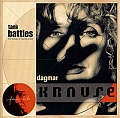 [by Ken Hunt, London] The Giant Donut Discs® column in Swing 51 brought together a wide range of talent and one of the finest was Dagmar Krause. The bumper double issue 13/14 included a lengthy interview with her, but also her current list of Donuts. In the spirit of her choices back then, this “patchy list” as she called it (“Seems fine to us,” was appended in 1989), had next to no additional information; in that spirit there are no subsequent annotations. That feels right because hers is a no-nonsense approach to music.
Industrial Drums – Anthony Moore
Model of Kindness – Peter Blegvad
Crusoe’s Landing – Cassiber
Tierra Humeda – Amparo Ochoa
By Julio Solórzano 
Strange Fruit – Billie Holiday
Respect – Aretha Franklin
Stitch Goes The Needle – Sally Potter
By Lindsay Cooper
Suite No. 3 Kuhle Wampe – Hanns Eisler
The German Requiem – Brahms
© 1989, rejuvenated 2011 Swing 51
23. 3. 2011 |
read more...
 [by Ken Hunt, London] Life is rarely dull on the treasured island. More travellers’ tales, aka GDDs, from the faraway island – about love and deception, wading birds, coming on and vamoosing, work, tall trees in Kashmir, church bells and science fiction-inspired escapes. Bert Jansch, Lo Cor De La Plana, Carolina Chocolate Drops/Luminescent Orchestrii, Paul Kantner, Drewo, Gayathri Rajapur, Fairport and Shivkumar Sharma supply the music this month. By the way, the tally is not a miscount. Bert Jansch supplies two tracks.
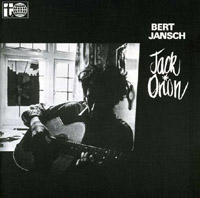 Jack Orion – Bert Jansch
The LP jacket for Jack Orion, Bert Jansch’s third solo album for Transatlantic, had a simple elegance. The front cover had a shadowy portrait of Jansch playing his acoustic guitar taken by Brian Shuel, the folk photographer of the period. In 1966 the norm was for UK record sleeves to be laminated. Instead of the beetle-back sheen that lamination brought, Jack Orion‘s finish was matt black. Like a blackboard. On the rear of the sleeve there was a reversed out, white out of black image of the eponymous hero-fiddler of the title song.
On went the album and for the first time Bert Jansch made total sense. The first two albums – Bert Jansch and It Don’t Bother Me had been very good in parts but this time the album worked as a coherent whole. Jack Orion is a tale of seduction and deception and Jansch and John Renbourn’s guitars combine magically to propel it along. Jack Orion is a fiddler who can fiddle fish from salt water. He is also a bit of a charmer. The lady of high renown certainly falls for him and asks him to visit her at daybreak. Naturally, he needs to build up his strength with a little rest and is ably assisted in this by his servant Tom who sings and fiddles him to sleep, promising to wake him in time for his tryst. Tom then pops along to the countess while his master sleeps. Things start unravelling when the lady asks Jack Orion if he is returning to taste more of her love. Well, you’d be confused, too. Gripping stuff then and gripping stuff still. From Jack Orion (Castle Music CMRCD304, 2001)
Hit ‘Em Up Style – Carolina Chocolate Drops/Luminescent Orchestrii
According to the press release, at the Folk Alliance bash in Memphis, Tennessee, Sxip Shirey of the New York-based Romanian punk Gypsy band, the Luminescent Orchestrii spotted the Carolina Chocolate Drops’ Rhiannon Giddens clocking them and called her over. This is the more permanent upshot of the invitation. What a combination for this line-up of the Drops to go out on a parting gift! There is a wide-cast wit and a humour to this performance. Plus any recording that goes out on almost an Earl Okin-style mouth trumpet flourish is deserving of your ear time. Such a shame it’s only an EP. A version of the song appeared on the Drops’ Genuine Negro Jig (2010). From Carolina Chocolate Drops/Luminescent Orchestrii (Nonesuch 7559 79779-9, 2011)
 Have You Seen The Stars Tonite – Paul Kantner/Jefferson Starship
Have You Seen The Stars Tonite is full-throttle science fiction set to the San Francisco Sound of 1970. The performance is fantabulous, one of those budget-no-option, let’s-roll-tape parties that bottled a fragrance of the Bay Area music scene for posterity. David Crosby (who gets the compositional co-credit with Paul Kantner), Jerry Garcia and Mickey Hart throw in musical shapes to enhance and nudge on Paul Kantner and Grace Slick’s vision.
What got me on its vinyl release was its sound and that still remains. The piano is especially important in the mix. It should have been Nicky Hopkins: it sure sounds like him. It is Grace Slick. And her playing still sends me. Have You Seen The Stars Tonite – still no question mark – is a mini-SF saga all on its own. Pun intended. From the expanded Blows Against The Empire (RCA/Legacy 82876 67974 2, 2005)
Oj zajdy, zajdy ty misiacu na tu poru – Drewo
It wasn’t the best interview I’ve ever done. Petr Dorůžka and I did it as a double-hander. We were both mesmerised by this wonderful, traditional Ukrainian polyphony that had come to TFF Rudolstadt. It was village music with extraordinary potency with wonderful upsweeps at the end of a line – much in, say, the Bulgarian style from the Pirin Mountains. But when experiencing it in the flesh it was its own thing and it sounded heady. Their unaccompanied singing was transfixing. Petr and I met several of the Drewo ladies for an interview. It soon became apparent that no matter which language their profundities about Ukrainian folksong were going to be translated into, all the nuances were going to be lost in a sea of blandness. In that Slav language pivot sort of way that Czech can be, Petr began offering suggestions for translating Ukrainian words.
This song, the CD booklet notes explain, translates as ‘Oh moon hide your light’. Its tiered vocals are high-ringing. At times, they have the fluency of the Watersons – a comparison not lightly given – in the ways the voices interlock and interweave. Even though the Drewo was slightly short of this album’s line-up, recorded at Hendrix Studio, Lublin in Poland in July 2001, the ensemble still flew. Mariana Sadovska, a major facilitator of this recording, be praised. From Budemo wesnu spiwaty/Song Tree (SEiAK 001, 2003)
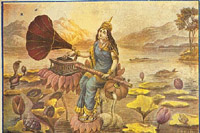 Kruti: Hatna Raga – Gayathri Rajapur
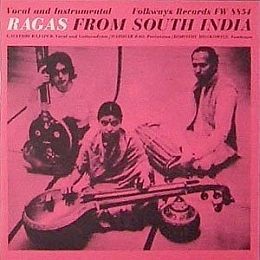
The gottuvadyam is a South Indian vina – in this context, a vina of stick zither-style construction (rather than the generic word for ‘stringed instrument’) – played with a slide. At the time of this recording’s release in 1967 it was indomitably obscure and, as with many Folkways releases, I have no recollection of encountering it in either Collet’s or Dobell’s – the two London record shops that might just have occasionally stocked it. Besides, Folkways albums came at a premium price beyond my pocket.
In fact, outside the subcontinent, Budalur Krishnamurti Shastri (Śastri) had introduced the gottuvadyam with a performance of Ganesha Kumara on Alain Daniélou’s Anthologie de la Musique Classique de L’Inde as early as 1955. Supported by UNESCO and the International Music Council, this, the world’s first microgroove long-playing anthology of the subcontinent’s two classical systems, was a 3-LP set originally issued in France. Even its UK edition had long gone by the time I was in a position to explore its contents. The first complete set I saw was at the beginning of the CD era when record collectors began dumping their vinyl, enabling me to pick up the original Ducretet Thomson trilogy for a few pounds. It is currently available on CD as Auvidis D 8270 (1997).
But all this is after the event. It was only seeing the instrument played that revelations came. The musician that supplied the epiphanies was was Ravikiran and he used the term chitra vina (‘beautiful vina’) in preference to gottuvadyam. Chitra vina was later adopted as its official name. The South Indian vocal virtuoso M.S. Subbulakshmi, Ravikiran told me, gave her blessing to the change.
Gayathri Rajapur’s performance here is a lengthy instrumental examination (within the constraints of one half of one side of an LP) of an unspecified kriti (now the standardised spelling, rather than kruti) by Muttuswami Dikshitar, one of the Holy trinity of saint-composers of South India. Joseph Byrd’s booklet notes state her to be 25 at the time and that she had studied with Krishnamurti Shastri. Bingo! The Budalur part of the name is a Karnatic musician naming convention. It is a prefix adding a place name – in his case a village in Thanjavur District, Tamil Nadu. Apart from the inherent quality of her performance, Gayathri Rajapur joined up further dots in the chitra vina picture. Incidentally, 1967 was also the year of Chitravina Ravikiran’s birth. (Chitravina Ravikiran is an example of another naming convention with the addition of the musician’s instrument.)
Whether you call it chitra vina or gottuvadyam, believe you me it is one of the instruments that you really must listen to before you die. The charming image is of Saraswati, the Hindu Goddess of learning, music and the arts, from the era of the gramophone and retrievable sound. From Ragas from South India (Folkways FW 8854, 1967)
Ragas from South India is currently available from www.folkways.si.edu
The Festival Bell – Fairport
Festival Bell, Fairport’s first studio album since 2007, takes its name from the Fairport Convention Festival Bell that hangs in the parish church of Saint Mary’s in the Oxfordshire village of Cropredy, the home of Fairport’s annual festival held each August. This song is by the band’s Chris Leslie and it tells the story of the church tower and how it and a new sister bell completed the tower’s peal, tied in with local history and the festival now named Fairport’s Cropredy Convention.
“A church is one of those places which is a centre of its community – like a pub or post office – so, to me, the Fairport Festival Bell celebrates the special relationship between we in Fairport and the whole of Cropredy village,” says their violinist Ric Sanders of the bell’s significance.
“The Festival Bell is such an honour,” continues Chris Leslie. To have the festival and the band celebrated in something that will be around for hundreds of years into the future is indeed a lovely thing. As I wrote in the song –
‘Every act that takes the stage,
All the music that is played
Is cast into a symbol in the old church tower.'”
[Lyrics quoted courtesy of Chris Leslie/Westbury Music Ltd]
Talking to Little Feat’s Bill Payne back-stage at the 2010 festival, he found the whole Festival Bell tale something more than special. My sentiments exactly. The wait for this album has been totally worthwhile. From Festival Bell (Matty Grooves MGCD050, 2011)
Mi parletz pas de trabalhar – Lo Còr De La Plana
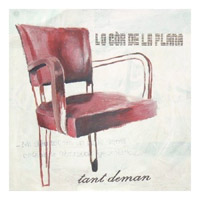 Lo Còr De La Plana sing close harmony. They are a sextet from Marseille’s La Plaine district (hence La Plana), are intent in perpetuating the Occitan tradition, and they are the most exciting, tradition-based polyphonic ensemble to come my way, like the old Carlsberg beer adverts used to say, probably since Les Charbonniers de l’Enfer – the Coalminers from Hell – from Quebec in 2003. They are one of those acts that you get within twenty seconds or they will never get you. They have a similar foot-stomping rhythmicality to Satan’s little shovelers but they augment that with frame drums – bendir and tamburello. Mi parletz pas de trabalhar is layered Occitan rap with a bass drum kick and handclaps. In theory, it is simplicity itself. In practice, it transcends. It reminds me of the elation experienced when first listening to Genoese trallalero singing. The title translates as ‘Don’t tell me about working’. To upend that, don’t tell me how many hours they had to put in since their founding in 2001 to make this sound so intricate and natural.
The album cover is of a chair short of a couple of legs. It links with the Occitan-language album title. ‘Tant deman’ is an idiom, meaning ‘maybe tomorrow’. It is a bit like the Spanish mañana but vaguer still, as in stalling the rent payment. From Tant Deman (Buda Musique 3017530, 2007)
Hear this piece of delightfulness at www.myspace.com/locordelaplana
Santoor 2 and Santoor 1 – Shivkumar Sharma
Shivkumar Sharma’s Santoor 2 and Santoor 1 opens the first disc of this 18-CD boxed set encompassing his career with HMV India and its successors from 1955 to 1998. I had no expectation of ever listening to much of this material. Most especially these two tracks from the 1955 film Jhanak Jhanak Payal Baje, originally released on 78 rpm back in the days of shellac. There is a marvellous redolence about Shivji‘s performances. Musically, they sound Kashmiri to me. They evoke images of the chinar – the plane tree species linked with the Hindu Goddess, Bhawani, a deity worshipped in, and particularly associated with Kashmir. There is a stirring rhythmicality to Shivkumar Sharma’s santoor playing summoning folk dance rhythms on Santoor 2 while Santoor 1 (the order in which they appear in the programming) is more complex, more inspired by folk melody. A revelation, musically and historically. From My Music – The Saregama Years (Saregama CDNF 150932-949, 2009)
Avocet – Bert Jansch
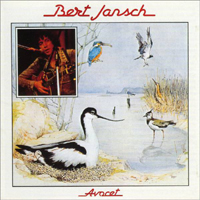
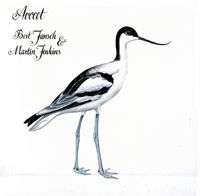 Bert Jansch’s studio album Avocet first appeared in Denmark in 1978, co-credited to Martin Jenkins. Ex-Libris’s classy image of the black-and-white wading bird had an elegiac quality – unlike the somewhat cluttered artwork for the UK imprint that appeared the next year on Charisma. The Pied Avocet, to give it its fuller name, had been adopted as the emblem of Britain’s Royal Society for the Protection of Birds. It symbolised the return of an endangered species and the effectiveness of conservation. Jansch constructed a cycle of instrumental compositions named after native bird species. For the record, the others were the lapwing, bittern, kingfisher, osprey and kittiwake. The cycle sounds more like a titular one than any attempt to capture the attributes of the birds themselves.
The album was a major return while Avocet the composition is one of Bert’s major artistic statement – major in terms of length (at almost 18 minutes) and, more tellingly, in terms of the sweep of its vision. Here Bert is accompanied by the remarkable Martin Jenkins on mandocello and violin and Danny Thompson on bass. The piece flows beautifully. According to Colin Harper’s first-rate CD booklet notes, the piece, under the working title of The Cuckoo (its launch-pad was the traditional song of the same name), had been in development and in Bert’s repertoire since 1977 at least. Peter Abrahamsen of Ex-Libris heard The Cuckoo and heard its potential, duly organising studio time for Bert. It granted him time to refine and develop an album’s worth of material. Avocet was recorded in Copenhagen in February 1978. Incidentally, phrases within the recorded version of Avocet echo melodic phrases in Jack Orion‘s short instrumental The Gardener.
Bert Jansch had been somewhat erratic as a performer. To put it delicately, it was impossible to predict what state he could be in on stage. With Avocet he bounced back. It remains one of his finest albums. It augared a return to form. From Avocet (Castle Music CMQCD763, 2003)
The image of Paul Kantner from November 2009 is © Santosh Sidhu/Swing 51 Archives. The copyright of all other images lies with the respective photographers, companies and image-makers.
Small print
Unless otherwise stated, all interview material is original and copyright Ken Hunt. The interviews with Ric Sanders and Chris Leslie were done in February 2011.
7. 3. 2011 |
read more...
[by Ken Hunt, London] More travellers’ tales, aka GDDs, from the faraway island – this time from Bryan MacLean, June Tabor, The Everly Brothers, June Tabor, The United States of America, Eddie Reader, The McPeake Family, Clara Rockmore, Shujaat Khan, Artie Shaw and Christy Moore with Declan Sinnott. The strangest thing happened this month. Just like the S.S. Politician going down off Eriskay in the Outer Hebrides in 1941 and the 1949 Ealing comedy Whisky Galore, all these bottles of single malt whisky washed ashore in time for Burns’ Night. Nobody was more surprised than me…
Old Man – Bryan MacLean
Bryan MacLean’s songs were one of the multifarious delights that made up Love’s Forever Changes, one of the great visionary albums of 1967. It is a work that I have never stopped revisiting. MacLean’s solo version of the song was recorded the year before. There is so much air in his version and not only because it is just voice and acoustic guitar or because it lacks the orchestrations of Love’s take on the song. MacLean (1946-1998) was not a hugely prolific songwriter, it seemed at the time. But what emerged was quality.
A post-Love solo contract with Elektra Records fell through, though he carried on writing and went on to produce a whole canon of Christian devotional songs; apparently only one recording project was of studio quality and this was issued posthumously. The ifyoubelievein anthology of music recorded between 1966 and 1982 has notes from MacLean himself and David Fricke. From ifyoubelievein (Sundazed SC 11051, 1997) More at http://www.bryanmaclean.us/
 Finisterre – June Tabor
This sea-themed programme, then lacking its final title, debuted as part of the seventieth anniversary celebrations of Topic Records at the Queen Elizabeth Hall (QEH) on 18 September 2009. It was clearly going to undergo change. For a start, its suite of songs and recitations was too long for a single CD. Ian Telfer’s Finisterre is one of the pieces that survived the transitions and repertoire re-balancings. On Ashore, as at the concert, June Tabor is joined by Andy Cutting on diatonic accordion, Mark Emerson on violin and viola, Tim Harries on double-bass and Huw Warren on piano.
She first recorded Finisterre on her and the Oyster Band’s jointly billed Freedom and Rain (1990). It was the valedictory piece at the QEH concert. It is now ‘promoted’ to both the suite’s opener and song and performance. It’s strong enough to merit its new position. Its slow rolling arrangement conjuring the rise and fall of waves in motion sets the suite up marvellously. The strength of her rendition says everything about why she is one of the finest song interpreters ever to have emerged from England’s Folk Revival.
PS Quite why the men from the ministry scuppered Finisterre and replaced it with FitzRoy in 2002 baffles me. Finisterre has a Land’s End mystery to it. To rename it with something that looks like a literal (typo for our US readers) or a character from a ropey novel by Walter Scott is bureaucratic folly. It does now mean that the song’s opening declaration “Farewell Finisterre…” has an added poignancy. From Ashore (Topic TSCD577, 2011)
More information at www.topicrecords.co.uk
I Wonder If I Care As Much – The Everly Brothers
The first time popular music became mine made and made any real sense to me was when I heard my older cousins’ Everly Brothers singles. Hitherto pop music was all Doris Day, Max Bygraves, Sputniks or Bachelors patterned wallpaper. A great deal to do with clicking with the Everlys was the way Don and Phil Everly’s voices blended and interwove. Roots is my all-time favourite album of theirs. Lenny Waronker’s production brought out something which I hadn’t heard in their earlier material like Wake Up Little Susie, All I Have To Do Is Dream or Bye Bye Love.
This song, credited to Don Everly, is the only original on the album. It sits beside material from, amongst others, Glen Campbell, Merle Haggard, Ron Elliott and Randy Newman. The piece starts with an attention-grabbing whooshing electric guitar over a simple but effective rhythm line on electric bass. There were no musician credits on the original LP in 1968 or on the undated Warner Archives CD reissue; it could possibly be Ron Elliott of the Beau Brummels on electric guitar. The song lasts for less than three minutes but they cram a lot into its elegant minimalist arrangement. From Roots (Warner Brothers 7599 26927-2, undated CD reissue)
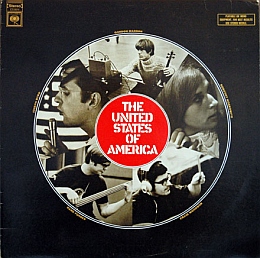 Love Song For The Dead Ché – The United States of America
Reading Pat Long’s mention of The United States of America in the Guardian‘s obituary of Broadcast’s Trish Keenan prompted this Giant Donut Disc. The United States of America were Joseph Byrd on electronic gizmos, electric harpsichord, organ, calliope and piano, lead vocalist Dorothy Moskowitz, Gordon Marron on electric violin and ring modulator, Rand Forbes on electric bass and Craig Woodson on electric drums and percussion. In 1968 the music they made was unlike anything I had heard.
 Love Song For The Dead Ché is under three-and-a-half minutes in length. In mood and style it contrasted with the album’s other material like their cheeky sound-collage The American Way of Love, harder driving material like The Garden of Earthly Delights or the social satire of I Won’t Leave My Wooden Wife For You, Sugar. Love Song For The Dead Ché is quieter, more meditative. At the time there was only one Ché in the news but this song’s wistfulness maintains an ambiguity.
Moskowitz, it struck me, was unfairly underrated in an underrated band best-known in western Europe for I Won’t Leave My Wooden Wife For You, Sugar’s appearance on CBS’ seemingly ubiquitous, budget-priced sampler The Rock Machine Turns You On, released in Britain and the Netherlands (at least) in 1968. Sundazed’s expanded edition of the original album reinforces how innovative the band was. It also includes hitherto unreleased material. For example, the gagaku-inspired Osamu’s Birthday and the Columbia audition recording of The Garden of Earthly Delights. The Sundazed edition has notes by Joseph Byrd and includes an interview with Dorothy Moskowitz. Still, the gentle threnody of Love Song For The Dead Ché is the one I plumped for.
After the United States of America, Moskowitz worked with Joe McDonald on his Paris Sessions. Much, much later I discovered in my exploration of the gottuvadyam or chitra vina that she had played tanpura (string drone) on Gayathri Rajapur’s Ragas from South India (Folkways FW 8854, 1967). There is always so much more to learn. From The United States of America (Sundazed 11114, 2004)
Perfect and Ae Fond Kiss – Eddie Reader
As I dip the quill into the container of octopus ink, it is Burns Night 2011 – 25 January 2011. Tonight, when I have finished the day’s writing, I shall raise a dram in memory of Robert Burns (1759-1796). It has been a custom every Burns Night to savour his words and to reflect on the blessings of friendship, love and loss. I generally conjoin Burns and a line from Hilaire Belloc in that finest of causes. His aphoristic line rings down the years: “There’s nothing worth the wear of winning, but laughter and the love of friends.” For many years I believed it was a line of Burns’ in fact.
Of all the many recorded interpretations of Burns’ material that I have listened to, none has given me greater pleasure or cause to imbibe his poetry than Eddie Reader Sings The Songs The Songs of Robert Burns (2003). However, tonight, with the spirit of Burns loitering and accosting, something less studio, something looser and a little more rowdy is called for. This one fit the bill. Eddi Reader sings and plays guitar, Boo Hewerdine dittos, Graham Henderson is on things squeezed, blown and strummed and sings, Christine Hanson is on cello and vocals, Colin Reid is on guitar and John McCusker plays fiddle and whistle on this live album.
This performance captures the exuberance of Reader’s old Fairground Attraction hit, contrasted with Burns’ hymn to unrequited love. Her introduction to Perfect, placing it in a Glasgow setting, is lovely. After she’s sung it she goes into a spoken introduction for Ae Fond Kiss (Scots for One Fond Kiss). It is literary history told in an amusing way and it grants an impossible new stratum of meaning to the word unrequited. The object of Burns’ unconsummated longings warded off his pleas for a naughty though by way of compensation Burns did manage to get her maid doubly with child. Twins were in the poet’s genes. The great joy with these two songs is Reader’s acrobatic voice. Oh what a voice! On Burns Night it’s within the spirit of the rules to cheat and pick two performances. From Live: London, UK 05.06.03 (Kufala KUF 0039, 2003)
McLeod’s Reel – The McPeake Family
This was first released in 1963. The great Bill Leader recorded this album the previous year. For me, it bottles the essence of home-made music, music made when a family is sitting around and ‘having a play’. The tune may now be familiar as hell but Bill captured something rough, ready and, most importantly, perfect with this performance. From Wild Mountain Thyme (Topic Records TSCD583, 2009)
 Kaddish – Clara Rockmore
Lev Sergeyevich Termen, better known as Leon Theremin in the West, has a fascinatingly complex story I shall leave to others to tell. The instrument named after him that he bequeathed the world is as simple as its voice is rich. If he ever had a finer acolyte than Clara Rockmore (1911-98) to carry forward his musical message, please disabuse me. During the early 1990s, there was talk and budget to work on a project with her. I volunteered to write the notes on the spot. It never happened, unfortunately. This recording with Nadia Reisenberg on piano is of a piece by Ravel. It reveals a wondrous command of slow-tempo theremin. Plus the piano is like a light shower of raindrops through which the theremin shines. She bent soundwaves so deliciously. From Clara Rockmore’s Lost Theremin Album (Bridge 9208, 2006)
You can watch a rare video of Ravel’s Habanera with Clara Rockmore and Nadia Reisenberg here: www.youtube.com
Bilaskhani Todi – Shujaat Khan
This is a sprawling canvas of a performance, a full-scale depiction of Bilas Khan’s variant of the morning raga Todi. Shujaat Khan’s brushwork teems with detail. Bilas Khan, to whom this piece is attributed (hence the name), was the son of the myth-draped master musician Miyan Tansen of the court of the Mughal emperor Akbar (ruled 1556 to 1605). Bilas Khan had certain difficulties when succeeding his father. He won the position of successor to his father’s musical lineage through the simple expedient of playing music so poignant that his father’s corpse moved. Or so the legend goes. Shujaat Khan also had a hard act to follow. His father, with whom he sometimes had a fraught relationship, was the sitar maestro Vilayat Khan. An unenviable task for a sitarist. Let’s not go down the leafy lane to the Land of Comparative Cod Psychology, however.
This performance, assisted by Samir Chatterjee on tabla, lasts over an hour. It is definitely a canvas to return to periodically. Mainly because it is one that you know you haven’t taken in completely and viewing it from a different perspective in time always pays dividends. It was recorded in June 1995 in New York City with Lyle Wachovsky producing. It is one of my absolute favourite Shujaat Khan interpretations. From Shujaat Khan – Sitar (India Archive Music IAM CD 1046, 2001)
Concerto For Clarinet – Artie Shaw
Recorded in December 1940, this is one of the five to ten pieces of music that I have listened to the most in my life. I grew up with it. Its presence dominated my childhood as no other piece of music did. We had it on a 78 rpm single and I played it on the wind-up gramophone over and over. Johnny Guarnieri’s boogie-woogie piano and Nick Fatool’s drumming were buzzes. But best of all was Artie Shaw’s high-soaring clarinet. Clarinet was a constant in my childhood and youth because my father played clarinet and alto. Before going out to gig he would warm up in front of the mirror. He would routine some current hit from the radio or sight-read something from the pile of sheet music on alto sax and clarinet. He’d adjust the reeds, perhaps shave a sliver off the Selmer reed and when he was satisfied with his embouchure and the reeds, he would turn to Concerto For Clarinet. At some stage he had transposed it for his instrument but he never bothered with the sheet music. He would play the clarinet solo from the last minute and ten seconds of the record. Artie Shaw scales the heights with some serious harmonics by the end, all of which my father negotiated adroitly. All and all, a very reinforcing experience for a young mind.
When my friend Bernhard Hanneken was compiling the outstanding collection of single-reed instrument music from which this comes – an anthology going from A.K.C. Natarajan and Naftule Brandwein to Benny Goodman (since you ask, Verbunkos from Bartók’s Contrasts) and Eugène Delouch – Artie Shaw’s name came up. I was enough of a zealot to have Shaw’s autobiography, The Trouble With Cinderella – An Outline of Identity (1955) and with a headful of childhood memories, which other piece was I going to argue for? It was a foregone conclusion. Bernhard’s anthology is simply amazing, a work of extraordinary disquisition groaning like a treasure galleon with unexpected riches. From Magic Clarinet – The Single-Reed Instruments I, Disc 2 (NoEthno 1005/6/7, 2010)
More information at www.noethno.de
 No Time For Love
 – Christy Moore with Declan Sinnott
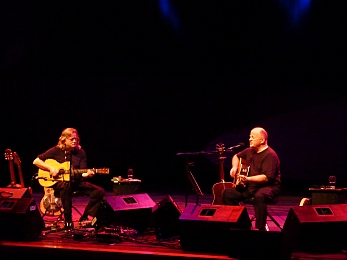
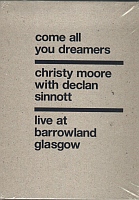
Just to prove that it is possible to adapt to modern times this version of Jack Warshaw’s song is from one of those new filmmabobs. Roy Bailey brought the song to a wider audience on his 1982 album Hard Times on Fuse. However, No Time For Love entered my life that same year with its appearance on Moving Hearts’ self-titled debut album.
It’s not a tidy song. It is a jumble of ideas. Some of the ideas work. Some lines don’t sing well and could ‘wrong-throat’ a singer. Sometimes the lyrics change, as here. “The sound of the siren’s the cry of the morning.” is a fine rock’n’roll exit line for this energy-filled song. With sirens going off in Cairo’s Tahrir Square as I write, it is very much a time for love.
The song suited Moving Hearts – which both Christy Moore and Declan Sinnott were members of – on many levels. But what sends this particular rendition into a different space is Declan Sinnott. His electric guitar playing is nimble, sinuous and altogether splendid. He soars away, leaving Christy Moore to perspire and thrash and bash the living bejesus out of the old acoustic. From the DVD Come All You Dreamers – Live at Barrowland, Glasgow (no number, 2009)
For more about the lads go to www.christymoore.com
There is also an interesting piece on the Dublin-based graphic design studio Swollen’s website concerning the spec and design of the DVD’s packaging at www.swollen.ie/index.php?/christy-moore-live-at-barrowland/
The image of Declan Sinnott (left) and Christy Moore is © Santosh Sidhu/Swing 51 Archives. The copyright of all other images lies with the respective photographers, companies and image-makers.
6. 2. 2011 |
read more...
 [by Ken Hunt, London] Winter draws on in London but on the fictitious tropical island the sun is shining. Helping to banish gloom this month is a rather fine selection of music. Ladies and gentlemen, boys and girls, this month’s haul of traveller’s tales embraces Martin Simpson, Ella Ward, Yardbirds, Shashank, Don Van Vliet, David Lindley & El Rayo-X, Rickie Lee Jones, Swamy Haridhos & Party, Cyril Tawney and Anne Briggs.
 The Swastika Song – Martin Simpson
I never lived through a European war. Many people I loved and love did. I only knew the survivors. I have lived and worked with people of many nationalities who did survive wars. Some were fascist. Some were unrepentant and boasted. I’ve also lived with, and spoken to people who have lived under totalitarian regimes, sometimes more than once in their lives. I have heard tales from survivors and survivors’ children that will haunt me to my grey cells run dry. Martin Simpson’s song brings it all back home and to mind. “Don’t say it can’t happen/Say it can’t happen here.” A potent song. From FAF Tracks (while available, exclusively with fRoots issue 331/332, January/February 2011)
www.frootsmag.com
On The Banks of Red Roses – Ella Ward
Jean Ritchie and her husband George Pickow made this recording of Ella Ward, “a pretty young Edinburgh housewife and mother of two children” on a research jag funded by a Fulbright scholarship that sent them the Britain and Eire in late 1952. According to Ritchie’s booklet notes to the CD reissue, Ella Ward had learned the song from the School of Scottish Studies folklorist Hamish Henderson. It’s a song about woman’s love betrayed. Unto death. Ella Ward’s singing captures the narrative beautifully from being easily led astray to blind devotion, culminating in being stabbed to death and tumbled into a prepared grave. Oh, the power of traditional song! From Field Trip (Greenhays GR726, 2001)
 Hamsadhwani – Shashank
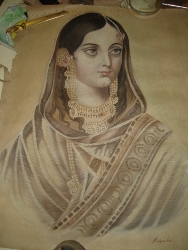
Hamsadhwani is a South Indian ragâm of great portability. In Shashank’s hands it flies. It is a ragām grounded in the natural world. Nature is, after all, a principal source of inspiration for human creativity. Whilst listening to this interpretation and thinking about swans, Raghuvir Mulgaonkar’s oils on paper portrait of a swan-necked woman popped into my head. The painting is called Untitled II. Mulgaonkar, who died in 1976, was an astonishingly prolific artist. Of him it was said he was “The artist whose brush never dried”. In this case, a related image flew in: that of the swan whose feathers never get wet. Shashank Subramanyam’s bamboo flute interpretation is a feast for the ears and the intellect. From Enchanting Hamsadhwani (Bamboo Records unnumbered, undated)
Evil Hearted You – Yardbirds
Between 1965 and 1968 The Yardbirds grew into one of Britain’s finest rock bands. For people who didn’t experience them at the time, their posthumous relationship probably was down to them having a succession of musicians who occupied that bloomin’ lead guitar chair – Eric Clapton, Jeff Beck and Jimmy Page – and what they did next. For anyone who experienced them at the time, a huge part of their appeal was the originality of their material, effects and tonal colours on their singles. The Graham Gouldman song Evil Hearted You was one such single.
This version, however, is a recording made for the BBC around August 1965. (The notes give only month and year.) Keith Relf’s voice is supple. Jim McCarty on drums and Chris Dreja on rhythm guitar support well. Paul Samwell Smith’s electric bass run is close to the single’s but not slavish. Beck is playing superlative guitar.
Above all, The Yardbirds have come to remind me of an old writer friend of mine, Comstock Lode‘s editor, John Platt (1952-2001). In 1983 the book he co-wrote with Jim McCarty and Chris Dreja about The Yardbirds was published. When I walk by Eel Pie Island at Twickerham, Platt – it was schoolboy surname stuff but we enjoyed it – often enters my thoughts. He wrote about the Eel Pie scene as well. Plus, as I write, there are posters up in town for The Yardbirds (featuring McCarty and Dreja) playing The Live Room at Twickenham Stadium on Friday 25th March 2011. From Yardbirds On Air (Band Of Joy BOJCC 200, 1991)
Philip Hoare’s obituary of John Platt of Wednesday, 23 May 2001 is at www.independent.co.uk/news/obituaries/john-platt-729142.html
Plus www.theyardbirds.com
 Fallin’ Ditch – Don Van Vliet
When Don Van Vliet died on 17 December 2010, there was an outpouring of obituaries. They concentrated on his time as Captain Beefheart. The coverage was pretty much predictable and it pretty much concentrated on his recordings, especially – and totally understandably – on Troutmask Replica (1969). It was one of those records that changes lives or divides minds. It is also one of those take-time-to-know-her-love’s-not-an-overnight-thing things. It had spent years in my head and it was good.
I learned that Don Van Vliet was attending the opening of his Waddington Galleries exhibition, held between 3-26 April 1986 in London’s Cork Street. A quick transatlantic call to my editor Mike Farrace at Pulse! secured a commission. As an upshot I got to spend several hours at the gallery opening with Don Van Vliet, prior to doing an interview the next day. What struck me was how approachable, open and forthcoming he was. Nothing whatsoever like the reputation that had preceded him.
This recitation appears on the limited edition CD with the book published for a later exhibition. It was a travelling exhibition that peregrinated from Bielefeld in Germany (27 November 1993-16 January 1994) to Odense in Denmark (11 February-10 April 1994) and then to Brighton on England’s South Coast (3 September-13 November 1994). It and its other recitations capture his speaking voice, though it has aged slightly from the one I listened to in 1986.
Fallin’ Ditch opens, “When I get lonesome the wind begin t’moan/When I trip fallin’ ditch/Somebody wanna throw the dirt right down.” It’s a song lyric in itself. I reviewed the book in Mojo. PS: the Pulse! interview never happened but I had enough contemporaneous notes and quotes from him to write an article. From Stand Up To Be Discontinued in Don Van Vliet (Cantz Verlag Ostfildern, ISBN 3-9801320-3-X, 1993)
Autumn Leaves – Rickie Lee Jones
You think that wonderful song Chuck E.’s In Love in such a stripped back performance with only Rob Wasserman on bass is going to clinch it. Then she does Autumn Leaves, again with Wasserman. From Naked Songs (Reprise 9362-45950-2, 1995)
Mushika Vahana – Swamy Haridhos & Party
Over several decades I have listened to many recordings of bhajans – Hindu hymns – but Bengt Berger’s recording at Gita Govinda Hall in Bombay on 1 January 1968 capturing the South Indian-style of worship is one I count as one of the greatest and most natural I have ever heard. There is a real sense of presence and congregation as no other recording of this kind I have ever heard captures. It is articulate musically and radiates a presence. Mushika Vahana is but one example. Muthunathan Bhagvatar accompanies on harmonium, P.S. Devarajan on mridangam, K.V. Ramani on tabla and K. Shivakumar on violin. I would go so far as to say that anybody with an interest in Indo-Pakistani culture, religiosity or music should try to listen to this album. No caveats, quibbles or qualifying remarks. From Classical Bhajans (Country & Eastern CE14, 2010)
 Papa Was A Rolling Stone – David Lindley & El Rayo-X
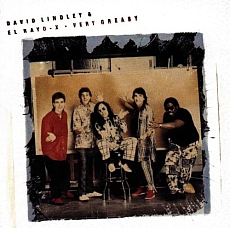
It was towards the end of 2010. Gliding through Chinatown (just south of Shaftesbury Avenue and Soho), my esteemed colleague Tony Russell and I walked past Lee Ho Fook’s of Werewolves of London fame. You know those lines of Warren Zevon’s? “I saw a werewolf with a Chinese menu in his hand/Walking through the streets of Soho in the rain/He was looking for a place called Lee Ho Fook’s/Going to get himself a big dish of beef chow mein.” Well, Lee Ho Fook’s is gone now and the new restaurant no longer has that joyously fading sign in its window about Warren Zevon, Lee Ho Fook and Werewolves of London. Or indeed any sign about a piece of Anglo-American special friendship history. Dastards despoiling cultural history, say the grumblers. I digress because I can and got an Ordinary Certificate in Digression.
Anyway, that walk along Gerrard Street planted the seed of an urge to revisit Very Greasy‘s extraordinary rendition. But Werewolves got elbowed out by the track that precedes it. Papa Was A Rolling Stone has a nasty, dirty sound. In an interview with Richard Grulla in the December 1988 issue of Guitar World, it is mentioned that Lindley got his sound from a Supro lap steel through a Howard Dumble amp on both Papa and Werewolves. Probably true but Lindley is the Q-Ship of guitars and amps. (That’s an original line so credit me if you really must steal.) Play it soft, play it loud, the Lindley and El Rayo-X’s rendition of the James Brown soul hit genuinely adds new dimensions to the familiar song. Lindley, Jorge Calderón, Walfredo Reyes, Ray Woodbury and Wm ‘Smitty’ Smith are the X-Boys. From the Linda Ronstadt-produced Very Greasy (Elektra 960 768-2, 1988)
As Soon As This Pub Closes – Cyril Tawney
Cyril Tawney (1930-2005) was the sort of chap you could lose a day or three with. He was a marvellous raconteur and wit, by turn, droll, deadpan and erudite. He is best known for his own songs – such as Five Foot Flirt, Lean And Unwashed Tiffy and Sammy’s Bar – and his West Country traditional folksong repertoire. Sometimes, however, other writers’ songs snuck into his repertoire. This song is one by Alex Glasgow (1935-2001). It is a comical revolutionary song and Cyril sings it well. It is not just comical, it is heavily ironical. In a perverse sort of way, it deserves to be sung as a shaming song, which is how I receive it from Cyril. It deserves to be far more widely sung and not just in the run-up to closing time. From The Song Goes On (ADA Recordings ADA108CD, 2007)
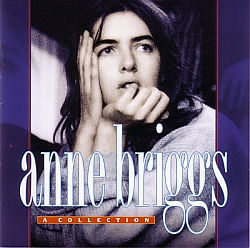
 The Snow It Melts The Soonest – Anne Briggs
“Oh, the snow it melts the soonest when the winds begin to sing,” is how it begins. Anne Briggs remains a huge inspiration and mystery to succeeding generations. She just got it right. This is one of her signature songs. It is a layered one about love set firmly in the natural world. Its seasonal movements and references to wild life reflect her passions for Nature. She sings it unaccompanied, three seasons (autumn isn’t mentioned) distilled into four verses.
The image here is of a wild plant called pellitory of the wall (Parietaria officinalis) beside the Thames at Old Isleworth, Middlesex. It likes walls and, unless you have an eye for botany, it looks pretty nondescript. Anne and I have walked the upper stretches of the tidal Thames, an area rich in plant diversity. Rivers are wildlife highways and natives mix with all manner of species from other places and continents. The snow part-melted and this pellitory of the wall emerged. It was Annie who first identified the plant for me. From Anne Briggs – A Collection (Topic Records TSCD504, 1999)
The pellitory of the wall image is © 2011 Ken Hunt/Swing 51 Archives. The copyright of all other images lies with the respective photographers, companies and image-makers.
10. 1. 2011 |
read more...
[by Aparna Banerji, Jalandhar City] My delightful 10 this month are Canned Heat, Aarti Ankalikar, Raghubir Yadav and Bahdwai Village Mandali, Javed Ali and Chinmayi, Satinder Sartaaj, Farida Khanum, Silk Route, Udit Narayan and Alka Yagnik, Pandit Hariprasad Chaurasia and, lastly, Pandit Birju Maharaj, Kavita Subramanium and Madhuri Dixit.
 On The Road Again – Canned Heat
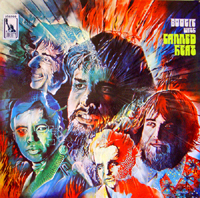
Much of the trickle of American popular music I have fell in my lap by default. Except for the few glitzy pop icons that MTV and Channel V introduced me to, I just stumbled upon most of the other guys through compilations by record labels that I picked up, on impulse, at local music stores. I had my share of disasters and disappointments, but chancing upon gems like this has made my life.
I didn’t have any clue about the history, status or popularity of the band that created this when I first heard this song (though now I think that was a blessing ’cause it helped me form an unbiased opinion). Everything about it – music, lyrics, especially the voice – hit me hard. It’s the 1968 Boogie with Canned Heat Liberty Records version and made me build my own little story around it.
I connected with the guy who sung it and thought of him as this little, free-spirited, dumb-wise, lonely guy who hates strangers. I wanted to join him on the road he was walking down on and tell him things are gonna be OK. And I thought he’d probably punch me in the nose the first time I do that, but eventually we might become friends.
Years later, I read about the band and smiled. I was happy that the whole world loved the song but was a bit disappointed too. They were too big to match my little guy illusion.
I love the way Al Wilson sings “out” and “long old lonesome road”. I try to ape the way he does it sometimes when I’m in the mood. I think no other voice can do as much justice to the character of the guy this song talks about. Bob Hite (harmonica), Henry Vestine (lead guitar), Larry Taylor (electric bass), Fito de la Parra (drums) and Wilson himself on slide guitar lend the on-the-road rhythm and feel to the song.
The Floyd Jones lyrics and composition which Wilson adapted to create this classic say: “My dear mother left me when I was quite young/She said, ‘Lord have mercy on my wicked son’.” From The Best College Classics Album in the World Ever (Virgin Records, 2001)
Chali pee ke nagar – Aarti Ankalikar
In the 1996 film Sardari Begum, this is the song that the daughter of Sardari Begum, the courtesan and thumri singer, hums to her dying mother on her request. It’s the most intimate mother-daughter moment that the two share in the movie. It is also one of my favourite on-video moments.
Based on Rāg Sindhi Bhairavi, the song talks about a bride who is parting with the land she was brought up in. The Sardari Begum context lends it so much irony and sadness. The composition itself is bittersweet and suggests tragedy and loss in spite of the fact that it talks about a bride.
Aarti Ankalikar lends her voice to the soundtrack version. Her vocals are mellow and soothing and at the same time filled to the brim with the force that is characteristic of Indian classical music. Vanraj Bhatia’s brilliant composition and with Ankalikar’s extraordinary voice make it one of the best classical vehicles that Bollywood ever doled out.
Javed Akhtar gives us the lyrics which say:
“Chali pee ke nagar
saj ke dulhan.”
(The decked up bride goes to the town of her husband.)
“Jhoole, peepal, amva, chanv
panghat, mele, galiyan, gaanv
babul, maiya, sakhiyan, angna
sab chor ke gori jaavat hai.”
(Swings, peepal trees, mangoes, shade/Wells [the word panghat means the place, usually the well, where women used to gather to fill their water pots], fairs, streets, villages/Father, mother, friends, courtyards/The fair bride leaves it all behind as she goes.) From Sardari Begum (Sony Music 504452 4, 2001)
 Maiya Yashoda (Jamuna Mix) – Javed Ali and Chinmayi
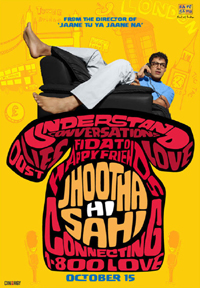
India’s so big on Krishna sensibilities. He’s everywhere. Still there are some things I thought he could never fit with. If someone gave me the words of this song on paper and told me they were gonna give some solid techno treatment to it, I would have called the person a fool to their face. I thought all previous pieces of music which attempted to digitalise Krishna sounds, miserably failed. After hearing this I changed my stance; I lacked imagination.
A. R. Rahman comes out with another masterpiece. I would have bet this is bhajan or thumri material but he makes an immensely successful dance floor number out of it. Nowhere does it feel contrived or forced. It’s a pretty complex and imaginative tune and yet it sounds so simple. Rahman loves doing that.
To be fair, the song’s not over the top techno but an Indian sort of techno. It mixes the dandia and digital dance floor flavours in such an immensely beautiful manner that one’s left awestruck and wondering whether he/she should swing to the melody or groove to the beats. I even think there’s a folk tinge to the song.
The amazing, laughing and equally complex vocals are by Javed Ali and Chinmayi. The sitar (Asad Khan) and flute (Naveen Kumar and Navin Iyer) portions are also lovely. The deep, layered lyrics by Abbas Tyrewala, the director of the movie that this song comes from, say a lot more than what they actually say.
The gal says:
“Maiyya Yashoda mori gagri se Jamuna ke pul par maakhan, haan koi, re maakhan chura le gaya
ho maiyya yashoda kaise jaaun ghar Jamuna ke pul par maakhan haan koi, re maakhan chura le gaya
mori baanh modi, natkhat re,
kare dil ko jodi, natkhat re,
mori gagri phooti, natkhat re,
main bojh se chhooti, natkhat re,
mori thaame kalai us kinare le gaya.”
(Mother Yashoda, out of my earthen pot, on the bridge across [the River] Yamuna’s, the butter, yes, someone stole the butter/Mother Yashoda, how do I go home?/On the bridge across the Yamuna, the butter, yes. someone stole the butter/Twisted my arm, mischievous him/Bound heart with me, mischievous him/My earthen pot broke, mischievous him/I was relieved of the burden, mischievous him/Grabbed my wrist and took me to that shore.)
The guy replies:
“Maiya Yashoda sach kehta hoon, main Jamuna ke pul par maakhan ki gagri se maakhan bachane gaya.”
(Mother Yashoda, I talk truth, I went to the bridge across the Yamuna to save the butter from the earthen pot that held the butter.) From Jhootha Hi Sahi (Saregama India Ltd. CDF 112325, 2010)
Sapnay – Silk Route
This is one band that I have ‘always’ liked for its rich music and visuals (videos). Their work has always been path-breaking. Their music smells of hills and mists. It says simple things, simply but the mood they create always spills on to you. Leaves me mellow for hours, even after I have switched the music off.
This one, from their second album Pehchaan (2000), especially, gives me goose bumps. Mohit Chauhan does the vocals, guitar and haunting harmonica. Kem Trivedi’s on keyboard. Kenny Puri’s on percussion and drums.
It says:
“Sapnay hain sooni ankhen
jaane kyon kho gaye
socha tha sahil pe milega
thehra sa ek pal.”
(Dreams in empty eyes/Don’t know why they got lost/Had thought on the shore we’d meet/A moment that stands still.) From Boyz to Men (BMG Crescendo (India) Ltd. 51250, 2001)
Kuch Kuch Hota Hai – Udit Narayan and Alka Yagnik
The ultimate happy-go-lucky Bollywood fare. Reminds me of Archie comics and the time I used to hang movie posters in my room.
Love the ghada (earthen pot) percussion in this eternal love song which says:
“Kya karun haaye
kuch kuch hota hai.”
(Oh what do I do/Something something happens [literally: “that’s how it sounds”].)
Udit Narayan and Alka Yagnik in their sweet Bollywood voices sing Jatin Lalit’s composition and Sameer’s lyrics. From Kuch Kuch Hota Hai (Sony Music 491740 4, 1998)
 Paani Panjan Daryawan Wala – Satinder Sartaaj
This is from the guy who brought hope back to the Punjabi music industry. He stepped in at a time when the ‘thinkers’ were growing exceedingly sick of the multitude of cheesy duets and other tired fare that had dwarfed the soul sounds which Punjab has always been so proud of.
Sartaaj walked in, dressed in salwar kurta and a turban tied over open hair like the Sufis. He usually performed seated on the floor and usually to hushed concerts (a rarity in Punjab). His songs talk about Punjab, Love and God. They respect life and urge others to do so. They are soft and soulful. This one’s no exception. It worries about Punjab and its youth, about artificiality and feuds.
It says:
“Pani panjan daryawan wala nehri ho gaya
munda pind da si shehar aa ke shehari ho gaya
O yaad rakhda vaisakhi ohne vekheya hunda je
rang kankan da hare ton sunehri ho gaya.”
(The water of the five rivers now flows in canals/The guy from the village went to the city and turned urban/He would have remembered Baisakhi [Punjab’s harvest festival] if he’d seen/The colour of the wheat crop turn from green to golden.)
“Tera khoon thanda ho gaya ai khaulda nahi e
ji eho virse da masla makhaul da nahi e
tennu aje nai khayal pata odon hi lagguga
jadon aap hatthi choya shehad zehri ho gaya.”
(Your blood has grown cold, it doesn’t heat up anymore/This matter about heritage isn’t something to be laughed at/You don’t give it a thought now but you will realise things/When honey that your own hands drew turns to poison.)
The lyrics are by Sartaaj and the music’s by Jatinder Shah. From Sartaaj (Moviebox Records Pvt. Ltd. Sr No. 1162, 2010)
Rāg Jait (Vibhas Ang) – Hariprasad Chaurasia
As a kid, when some koel used to call out sitting on some tree near my home, I used to call out after it, aping it. If the koel responded, I used to be very happy. I used to keep calling out to it until it got bored of me. It mostly did before I did. There was something beckoning, pleading, conversational about the way it called out. As if it said, “yes”, “what?”, “I’m here”.
Hariprasad Chaurasia’s flute reminds me of that koel. His flute talks, beckons, asks me to listen, tells me tales and does it all so sweetly. He does it in Rāg Jait (Vibhas Ang) using the pa, ga, re, sa combination, which is common to the Purvaangs (first halves) of both the Jait and Vibhas ragas, with just a tanpura for accompaniment. (The only difference between Jait and Vibhas is that Jait uses dha shudh and Vibhas uses dha komal. But Panditji uses dha shudh so he sticks to the basic Jait combination. From Hariprasad Chaurasia (HMV STCS 850135, 1982)
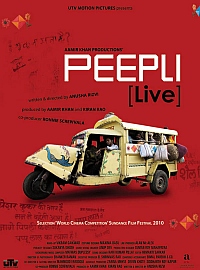 Mehngai Dayain – Raghubir Yadav and Bhadwai Village Mandali
Everything, every single thing about the movie that this track comes from – and its soundtrack – is awesome. It’s one of the most unlaboured (seemingly) and yet chilling ways in which Bollywood has ever dealt with big issues and the irony hanging over them. I would love to, but can’t talk about it all, so, for the moment, I choose Mehngai Dayain.
The track is a folksy take on inflation and the most effective that I’ve ever come across. When it came to folk, Raghubir Yadav had always been one of my personal favourites. I had heard him hum little somethings as an actor in the film Rudali (as Sanichari’s elusive son Budhwa) and in Maya Memsaab (as the crazed street-beggar). He kept making appearances as a vocalist in large and small chunks on some sound tracks too. On every occasion he loaded the track or moment with the village wisdom in his voice.
But somehow it felt he was never taken as seriously as a vocalist, as he should have been. This, however, is different. He makes himself heard (thanks to the film crew for that too) and his rendering is immensely satisfying. This song is a proof of his musical wit. The village guys that he collaborates with – The Bhadwai Village Mandali – are, like him, masters in their art. The song has been written and composed by them. They are a group of part-timers who do music on festive occasions in the village, using traditional instruments, as the CD notes tell me. The song’s devoid of pretence and gets us nostalgic in the delightful way it gets village sounds and words flooding in. Like the old days. Raghubir Yadav and the Bhadwai Village Mandali sit in the shade of a tree in the village square (the recording was done on sync sound as the film crew shot) and sing:
“Sakhi saiyan to khoob hi kamaat hain
mehangayee dayain khaaye jaat hai.”
(Lady friend, my husband earns a lot but the inflation witch eats it all up.)
“Soyabeen ka kabe haal
garmi se pichke hain gaal
gir gaye patte, pak gaye baal
aur makka – ji-ji-ji-bhi kha gayee maat hai
mehngai dayain khaye jaat hai.”
(What does one say of soya beans?/The cheeks have sunk with the heat/The leaves have fallen, the hairs have ripened/And corn, yes, corn has lost the battle too/The inflation witch eats it all up.) From Peepli Live (Super Cassettes Industries Ltd. SFCD 1-1600, 2010)
Kahe Ched Mohe – Birju Maharaj, Kavita Subramaniam and Madhuri Dixit
All things classical are writ large over this song. It starts with aroused sarangi and forceful tabla bols (mouth percussion based on the matras – beats – of the tabla), followed by the soul stirring voice of Pandit Birju Maharaj adulating a woman’s beauty. The song is in Rāg Puriya Dhanashree and brims over with the rhythmic genius that is largely responsible for the drama and aggression that marks Indian classical dance. And since it is served on the Bollywood platter, the drama gets to a whole new level.
Krishna’s an integral element in this one too (told you). Kavita Subramaniam (Krishnamurthy) soon arrives on the scene asking him why he teases her. In the interplay between percussion and Subramaniam’s melodious vocals, Madhuri Dixit renders her conversational, lyrical interludes from time to time.
The song’s composition and lyrics are by Pandit Birju Maharaj. He is also the choreographer for the video version of the song where Chandramukhi, the courtesan, dances to a melancholy Devdas. I love it most for Pandit Birju Maharaj’s voice in the beginning. I wish there was more of him in it.
It says:
“Kahe ched mohe garwa lagaye
Nand ko lal aiso dheeth
barbas mori laaj leenhi
binda Shaam manat naahi
kaase kahun main apne jiya ki, sunat nahi, maayi.”
(Why does he tease me? He embraces me/Nand’s son is such a rogue/He robs me of my honour/Wicked Shaam doen’t pay heed/How do I say what’s in my heart? he doesn’t listen, mother.) From Devdas (Universal Music 6337 333, 2002)
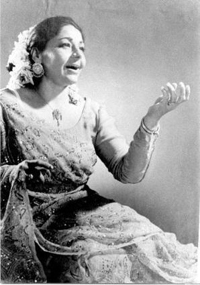 Gulon ki baat karo – Farida Khanum
Ghazals are one of the reasons I wonder if I had a past life. The atmosphere they create does something intense to me. An I-was-there feeling. I have been listening to this one since I was a kid. My mother played it on tape along with many other of Farida’s precious songs. I love its composition. It’s about nostalgia and class.
It says:
“Gulon ki baat karo
gul rukhon ki baat karo
bahaar aayi hai
guncha labon ki baat karo.”
(Talk about flowers/Talk about flowering trees/Spring has come/Talk about blossoming lips.)
The music’s by Farida and Akhtar Hussain. Faiz Ahmed Faiz gives us the words. From The Best of Farida Khanum (HMV HTCS 04B 4480, 1992)
The copyright of the images lies with the respective photographers, companies and image-makers. The copyright of the lyrics lies with the associated copyright holders.
3. 1. 2011 |
read more...
[by Ken Hunt, London] Winter draws on in London but on the fictitious tropical island the sun is shining. Helping to banish gloom this month is a rather fine selection of music. Ladies and gentlemen, boys and girls, this month’s haul of traveller’s tales embraces Methera, Amy Rigby, Ida Kelarova, the Hallé Orchestra under Mark Elder, Dave Bartholomew, Bonnie Raitt & Was (Not Was), the Oysterband, Alim and Fargana Qasimov, The Byrds and Czech Philharmonic Orchestra under Rafael Kubelík.
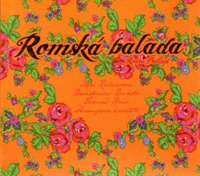 Bijav – Ida Kelarova
Romská balada (‘Roma Ballad’) is a collaboration between vocalists Ida Kelarova and Desiderius Dužda and the pianist Tomáš Kačo with the new line-up of the Škampa Quartet – Helena Jiříkovská and Daniela Součková on violins, Radim Sedmidubský on viola and Lukáš Polák on cello. One of the great joys of the work is its programming and overlapping tracks. The performances flow into one another, mood building on mood, song after song developing a narrative, a narrative that turns into a Czech Roma cycle. Kelarova, one of the great champions of Roma song and culture, is on top form. She turns Dužda’s song Bijav (‘Wedding’) into something utterly plaintive.
The CD comes with two booklets. One in Czech and English provides the context for Romská balada – “the ballad of sorrow, grief, pain and dark earth” – while the other provides the lyrics in Roma with Czech and English translations. Bijav begins, “I came home/Nobody was there”; as that opening might suggest, it is more elegiac than celebratory. It dodges cliché. It goes straight to the heart, even without knowing Roma. It is one of the finest pieces of this Roma jigsaw, predicated on the Roma proverb, “Don’t look at the man’s skin colour, look at the man’s heart.” The work in its entirety is nothing short of a landmark in contemporary Roma expression, artistry and creativity. From Romská balada (Indies Scope MAM474-2, 2010)
The Banks of Green Willow – Hallé Orchestra under Mark Elder (conductor)
In her talk, A Most Sunshiny Day at Cecil Sharp House in late October 2010, Shirley Collins played part of George Butterworth’s The Banks of Green Willow and it sparked a series of memories and meditations. It is another of his English Idylls (in all but name) and this version under Mark Elder hits all the right places. Apparently it was the last piece of his own music that Butterworth heard performed before he fell in the Great War. That adds a monstrous poignancy to the piece. It is a piece from a pre-gramophone age, a pre-instant retrieval era, generous to its source’s inspiration: England’s folk tradition. The Hallé do the piece proud.
Elsewhere English Rhapsody takes us into the realms of Frederick Delius and Percy Grainger, especially their takes on Brigg Fair before concluding with 39-second snatch of Joseph Taylor’s Brigg Fair, from a cylinder recording made in 1908. Like Butterworth’s Banks of Green Willow, a covenant with the past. From English Rhapsody (Hallé CD HLL 7503, 2008)
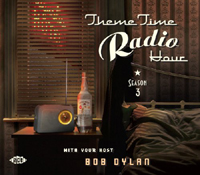 The Monkey (Speaks His Mind) – Dave Bartholomew
To declare an interest straightaway, I wrote one of the pocket essays that accompanies each track on this double-CD (in my case Elizabeth Cotten and Brenda Evans’ Shake Sugaree). But that was the extent of my involvement in this third anthology inspired by the Theme Time Radio Hour (with your host Bob Dylan). When the finished artefact arrived, on it went. This particular track from Show 97 Noah’s Ark is multi-valenced. It wittily upends Darwinian evolutionary orthodoxy. The tale is told from the viewpoint of three monkeys “sat in a coconut tree”. The monkey narrator tut-tuts his way through a shopping list of miscreant human behaviour. He ends, “Yes! man descended, the ornery cuss/But brother he didn’t descend from us.” A parable from the top of the coconut tree. From the various artists’ Theme Time Radio Hour – Season 3 (Ace Records CDCH2 1270, 2010)
Gower Wassail – Methera
Methera is the string quartet of Lucy Deakin (cello), John Dipper and Emma Reid (fiddles) and Miranda Rutter (viola). Their repertoire is a mixture of material from the certain European folk traditions – but specific, not scattergun – and original or borrowed compositions. An instrumental setting of the Gower Peninsula traditional folksinger Phil Tanner’s singing. Methera are really so very good. From Methera In Concert (Methera TAN002, 2010)
Baby Mine – Bonnie Raitt & Was (Not Was)
When Stay Awake, the album of Disney interpretations from which this track originally came, first appeared in 1988, one of its most haloed interpretations was this song. Any parent with a smattering of English worth their salt will connect with its sentiments. Back in the days, I put it on car tape and would regale the safety-belt trapped nippers in the back of the car with the track’s missing harmony vocal as we drove.
And now a word from Stay Awake‘s sponsor, Hal Willner: “The track is one of the highlights of the Disney record.” At one point certain people were playing silly buggers about granting permission for this track to be included. Thank heavens that it worked out well. This is such a choice piece. No apologies for two tracks from the same album. From the various artists’ Theme Time Radio Hour – Season 3 (Ace Records CDCH2 1270, 2010)
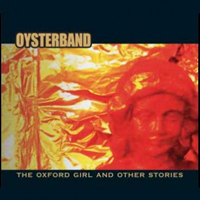 The Early Days Of A Better Nation – Oysterband
I have no quarrel with an act re-visiting its earlier repertoire on commercially released disc. How frequently does compartmentalising stuff work? This song by Ian Telfer and John Jones has an anthemic quality. “Work as if you were living in the early days of a better nation” is a line they thought they were half-inching from the Scots artist-writer Alasdair Gray, but they were eventually disabused. More within the CD booklet notes. From The Oxford Girl And Other Stories (Running Man Records RMCD6, 2008)
Mugham Bayati Shiraz – Alim and Fargana Qasimov
This track was recorded in August 2009 at the Morgenland Festival in Osnabrück in Germany. It is stupendous. No need for supporting testimony. Trust. From Intimate Dialogue (Dreyer Gaido CD 21060, 2010)
Goin’ Back – The Byrds
In Mole In A Hole (covered by Richard and Linda Thompson), its author Mike Waterson laid out his cards in the opening verse: “Like the flowers, like the bees/Like the woodlands and the trees/I like the Byrds on their LPs/And I’m a refugee.” It never felt like he was slave to end rhyme when he declared his interests. The Byrds’ cover of this Goffin-King song is the second track on what feels more like a song cycle than a mere LP. In 1968 it was head-spinning and time has only enhanced its majesty.
The preceding track, Artificial Energy, ends with them singing that they’re coming down off amphetamine. Goin’ Back was a song closely associated with Dusty Springfield and an unlikely inclusion, not so much because it was a cover. It was more the nature and associations of the song. Goin’ Back was followed by Natural Harmony and a remarkable sequence of songs.
Later, they clarified that its inclusion had a great deal to do with Springfield’s outspoken condemnation of apartheid. The Byrds turn it into a political song by dint of association. Those that saw beyond the camouflage understood. Those that hadn’t yet been alerted to the possibility of subterfuge afoot could just enjoy a piece of sublime Byrdish harmony vocals and instrumentation. From Notorious Byrd Brothers (Columbia/Legacy 486751-2, 1997)
Vltava – Czech Philharmonic Orchestra under Rafael Kubelík (conductor)
This CD reissue of a Supraphon album first released in 1990 is a live recording. The Czech Philharmonic Orchestra under Rafael Kubelík recorded it as the opening concert of the Prague Spring Festival on 12 May 1990. If any member of the audience didn’t tear over at some point in the CPO’s performance, I would be very surprised. After all, it was being performed a few hundred metres from the river of the title (also known as the Moldau amongst the more Germanically inclined) that this particular movement is named after, in the concert hall named after its composer – Bedřich Smetana (1824-1884) – in the art deco architectural masterpiece that is the Prague’s Obecní dům (‘Municipal House’). (Long sentence I know, but it works if you mark up the breaths.)
Most important of all, there was a spirit of freedom abroad, granting Má Vlast (‘My Country’) a still more heightened poignancy. There are several recordings to choose from. This is the one I plumped for. Artistically speaking, Má Vlast is a definition of Czech-ness to compare with painter Alfons Mucha’s Slovanská epopej (‘Slav Epic’). This piece of water music puts a lump in my throat – and, unlike the Mucha ‘canvas cycle’, I get no images of warfare or major trial and tribulation from it. From Má Vlast (Supraphon 11 1208-2 031, 2002)
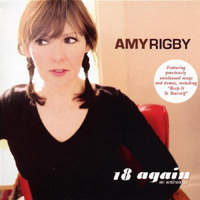 Keep It To Yourself – Amy Rigby
Deadpan witty, with a semblance of the almost dignified, and yet so very reasonable with it, this song of Amy Rigby came with a recommendation from a pal, Gavin Martin, the music critic of the Daily Mirror during a discussion. I can only thank him profusely. I checked it out and was captivated by the eloquence of her songwriting. She takes serious themes (as opposed to subject matter) and cloaks them in silliness. And vice versa. This album from which Keep It To Yourself comes groans with exemplary song matter. The concluding demo version of Magicians is yet another arresting end-of-the-relationship song. Thank you Mr Martin. From 18 Again – an anthology (Koch KOC-CD-8384, 2002)
The copyright of all other images lies with the respective photographers, companies and image-makers.
5. 12. 2010 |
read more...
 [by Aparna Banerji, Jalandhar City] For this month’s super ten I start with Shubha Mudgal followed by Gayatri Iyer, Sahaj Ma, Jagjit Singh and Lata Mangeshkar, Surinder Kaur, Kailash Kher, Richa Sharma and Sukhwinder, Bhupinder and Chitra, the Wadali Brothers and Suraiya and Shyam.
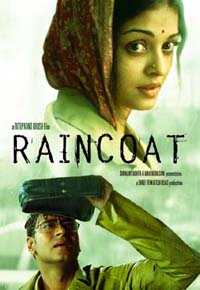 Mathura Nagarpati – Shubha Mudgal
I first listened to this song during one of those rare train journeys which I made with my grandmother. This is also the only song that she ever bore listening to on my earphones (which she usually hated) without complaining once. The allusion to her revered Lord Krishna might be part of the reason. I hadn’t understood much of the song then, but she liked it and explained it to me during the course of the journey.
In the movie that Mathura Nagarpati comes from, a village guy begins a journey to the city where his beloved (separated from him by marriage to Mr. City Guy) lives. The song features a train moving out of lush green villages towards the dry, crowded city.
Talking about Hindu mythology, Krishna was born in Mathura, spent his childhood in Gokul and Vrindavan, where he fell in love with Radha. But the two never shared matrimonial bliss. As a young man, Krishna went to Mathura and became a leading prince there, later getting married to Rukmani. Krishna never went back but this song imagines him making a trip back to Gokul.
It says:
“Subah subah kaa khyal aaj
Waapas Gokul chale Mathura raaj.”
(What thought possessed your mind so early in the morning today/That you go back to Gokul, king of Mathura?)
“Mathura nagarpati kahe tum Gokul jao?
Manohar besh chor Nandraj
Sar se utar ke sundar taaj
Raajdand chor bhoomi parvaj
Phir kahe bansuri bajao?”
(King of Mathura, why do you go back to Gokul?/You give up your pleasant visage/Take off your beautiful crown/Leave your royal sceptre/And take to the streets/Why do you play the flute again?)
The Braj-tinged, rustic lyrics by Rituparno Ghosh (also the director of the movie) are the heart of the song. The music director might have been tempted to go over-the-top classical, since the lyrics would have easily supported it. But Debojyoti Mishra knew better. The lingering, aching, somehow subdued composition accentuates the pain and irony that the lyrics want to convey. Shubha Mudgal’s subtle-bold voice renders a soul to the song which no other vocalist would have been able to provide it with. A song for the sweet and sad times. From Raincoat (Times Music TCIFI 025C, 2004)
Haan Maine Chukar Dekha Hai – Gayatri Iyer
Getting this song home was sort of an accident. I loved the film Black (which has no song, at least in the video version) so much that I bought the audio album just for the heck of it. Discovering this song in the very second track was a shock. It surprised me, made me cry and then made me dance. It’s about what a girl, who cannot see, sees. And after listening to this song I realised that she sees much more than we, who can see, do. I think of it as a happy song because she isn’t sad about what she can’t see but is happy about what she can.
It says:
“Garam gunguni dhoop se baatein ki hain maine
Pani ke behne mein hansi suni hai mine
Sab kehte hain deep bujha hai
Lekin baati so jati hai
Haan maine chukar dekha hai.”
(I have talked to the warm and cosy sunshine/Have heard laughter in flowing water/Everyone says the light of the lamp has died down/But it’s just the wick that sleeps/Yes, I have touched and seen.)
“Thanda thanda rang boondon ka
Mulayam rang hai phoolon ka
Chubhne vale rang pehenkar
Dulhan saj dhaj ke jaati hai
Haan maine chukar dekha hai.”
(Cold is the colour of water/Soft is the colour of flowers/It’s prickly colours that she dresses up in/When the decorated bride goes to wed/Yes, I have touched and seen.)
The vocals by Gayatri Iyer are rebellious. They don’t adhere to the regular Bollywood playback singing rules. She sounds like the girl she sings for. Composer Monty is, of course, the talented guy who made her do it. Lyricist Prasoon Joshi gives us those precious words. From Black (Yash Raj Films Pvt. Ltd. YRM – MC 10005, 2005)
Chand Er Gaye Chand Legeche – Sahaj Ma
A traditional Bengali Baul song. This is about the meeting of souls. Lalon Fakir gifted us the words and the melody way back. Bickram Ghosh does little things to it, here and there – his style. The entire album is beautiful. In this track, at places it feels you could have done without the piano and keyboard rhythms. Contemporary and folk instruments play peekaboo as Sahaj Ma’s earthy voice sings the rustic melody. The riddles that it puts forward are sweet:
“Chander gaye chand legeche
Amra bhebe korbo ki
Jhee er pete mayer jonmo
Take tomra bolbe ki.”
(Moon touches moon/But why should we think about it?/A daughter gives birth to a mother/What would you say about it?)
‘Jhee’ means a servant girl or a slave girl in sophisticated Bengali, but, in this context, Lalon Fakir uses village slang. So ‘jhee’ here would translate as ‘daughter’.
From Folktail (Saregama CDNF 197221, 2005)
Mili Hawaon Mein – Jagjit Singh and Lata Mangeshkar
One of my favourite ghazals. From one of the rare albums which saw Jagjit and Lata collaborating. Reminds me of the times when we used to get our daily dose of music through poetic, Urdu-mouthing vocalists on Doordarshan, who sung to enamoured studio mehfils [cushion concerts]. The big-time obsession with slang hadn’t yet happened and kurta-clad, Ghalib-doting poets were still earning their bread and butter with a lot of ease.
The ghazal talks about a person who’s lost touch with his roots and the poor guy realises it. At least I see it that way. Intense Jagjit and honeyed Lata turn you into a philosopher. The music’s by Jagjit Singh and Wasim Barelvi is the lyricist.
It says:
“Mili hawaon mein udne ki vo saza yaaron
Ke main zameen ke rishton se kat gaya yaaron.”
(Such was I punished to fly with the winds, friends/that I was cut off from the ties of the earth, friends.)
From Sajda (HMV STHVS 852109, 1991)
Jutti Kasoori Pairi Na Poori – Surinder Kaur
The sweet folk of Punjab. Surinder Kaur’s songs always have a matter-of-fact tone. Her voice, despite its intricacies, murkis and meandering specialties, has a conversational feel about it, which is so integral to folk music and which has made her such a hit with the masses of Punjab. The words are by Gian Chand. The music’s traditional.
On the surface, this song talks of a young bride whose shoe just won’t fit. Beneath it, it talks about the trials of a newly wed Punjabi bride at her new home.
It says:
“Jutti Kasuri pairi na poori
Haye rabba ve sannu turna peya
Jinna rahan di main saar na janan
Ohni raahi ve mennu murna peya.”
(The shoe from Kasur didn’t fit my feet/Oh God, I still had to walk/I had to turn through roads that I knew nothing of.)
“Sauhre pind diyan lammiyan vatan
Bara pavada pai gaya
Yakka te bhare koi na kita
Mahiya paidal lai gaya.”
(The long paths of my in-laws’ village/What a mess I got into/Even a carriage wasn’t hired/My husband made me travel on foot.)
From Parkash Kaur and Surinder Kaur’s Bemisaal (HMV MM 840494, 1999)
Na Batati Tu – Kailash Kher
This is a fun song. It teases and is loaded with musical wit, both in lyrics and execution. Sufi, soulful Kailash Kher, along with his band Kailasa, tells you if they can do soul, they can do humour too. Starts with lots of mouth percussion and sitar. Then the guitars and drums step in with Mr. Kher and make you jump and move. The song was released in Kailasa’s album Chandan Mein in 2009. It also went on to be one of the bonus tracks for Dibakar Banerjee’s film Love Sex Aur Dhokha (2010).
The song’s basic thought lies in its opening line: “Na batati tu pichan” (Won’t say it, you gauge it). From Chandan Mein (Sony Music 88697 55560 2, 2009)
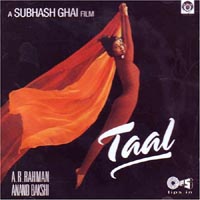 Ni Main Samajh Gayee – Richa Sharma and Sukhwinder
One of the lesser known tracks from Taal. But I like it the most. It comes straight from the saints and dervishes. Gives you a typical Sufi dargah feel, where those filled-with-ecstasy devotees dance and shake their heads all night long. It makes me feel drugged and dizzy.
Both of them, Richa and Sukhwinder, are from Punjab. They scream out the message, which they sing with as much ecstasy as the saints which they make us think of. AR Rahman’s music transports us to a brand new world yet again. Anand Bakshi gives us the words.
“Rang itna chadha ki tapak gaya
Hontho se aankh mein thahar gaya
Ban ke phir vo ghanghor ghata
Zulfon mein vo phir ulajh gaya.”
(The colour got so deep that it dripped/From the lips it got to the eyes/Then it became a dense cloud/And settled in the tresses.)
From Taal (Tips TC – 4167, 1999)
Aasmani Rang – Bhupinder and Chitra
Vishal Bhardwaj and Gulzar are a lethal team. This song, belonging to an album conceived, written and narrated by Gulzar gets its music from the former. The album’s not just a soundtrack, it’s an audio film. A love story much more effective than some of the fine fare I have seen on video. The duo uses a lot of their favourite hill sounds.
This song is a flashback. With the sound of a waterfall in the background, Gulzar tells us how she stands (more details about ‘her’ in the album) on one end of a bridge and remembers what happened on the 21st floor of the revolving restaurant in Toronto that night. How big his hand was and how his aasmani (blue) eyes looked like the sky. The song that follows is their oh-so-poetic conversation at the restaurant. Chitra and Bhupinder talk. Their song flows with soft, sweet guitar and sounds like two exceptionally in-tune people sharing a conversation in sing-song. Gifted Bhardwaj’s delicate composition and Gulzarsahib‘s free-versed poetry creates the mood for us. There’s a pinch of melancholy too. The duo is so fond of it.
Sample:
“Kalaiyon se khol do ye nabz ki tarah dhaakta waqt
Tang karta hai
Kalaiyon pe jab se maine tere haath pehne hai
Ruk gayi hai nabz aur waqt urta rehta hai.”
(Free your wrists of this time that beats like pulse/It disrupts/Since the time I wore your hands on my wrists/The pulse has stopped and time flies.)
From Sunset Point (Sony Music 498400 4, 2000)
Ghoonghat Chak Ve Sajna – Wadali Brothers
Look inside, says this musical sermon that the Wadali Brothers deliver. Dynamic qawwali unfolding secrets of the soil and spirit in Bulleh Shah’s down-to-earth poetry.
It says: “Ghunghat chak ve sajna hun sharman kahnu rakhiyan ve.”
(Take off that veil, dear, what do you shy away from?)
“Bulleh Shah asmani uddiyan pharda ain
Oh jerha ghar baitha ohnun phareya ee nai
Bulleya raati jagen dine peer sidhaven
Ate raat nu jagan kutte tain theen utte.”
(Bulleh Shah you try to catch what flies in the sky and pay no heed to what sits at home/You stay awake all night and play saint in the day/The dogs are much more wary than you are on those nights.)
From Ishq Musafir (Music Today B 02026, 2002)
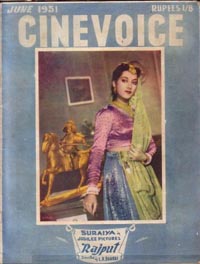 Tu Mera Chand Mai Teri Chandni – Suraiya and Shyam
This comes from the sweet, innocent world of Hindi cinema’s B&W days when heroines were coy and knew how to blush. This song’s as innocent as those days and if songs could blush, you’d say it does (and swoons too).
Actress Suraiya sings it for herself while Shyam does the male playback. It’s from the movie Dillagi (1949). The music is from Naushad, the man who initiated Suraiya’s singing career and stayed her mentor all through. Lyrics are by Shakeel Badayuni. From the Golden Collection – Suraiya (Saregama STHV 836039, 2003)
Aparna Banerji is a Bengali, Punjab-based journalist. She and I met at the Harballabh Sangeet Sammelan in Jalandhar in December 2008. We first talked at the festival and have never stopped talking since. She is a family friend. On this occasion her focus is on filmi sangeet, folk and qawwali. There is no telling what her focus might be next time. This, though, is passionate writing. I am more than tickled lobster pink that Aparna is the first guest donut atoll castaway and that she is heating fevered brows with her insights here. She has the gift. She gets impassioned about music. I like that. – Ken Hunt
The copyright of the images lies with the respective photographers, companies and image-makers. The copyright of the lyrics lies with the associated copyright holders.
15. 11. 2010 |
read more...
 [by Ken Hunt, London] Winter draws on in London but on the island the sun is shining. Helping to banish gloom is a rather fine selection of music this month. Ladies and gentlemen, boys and girls, this month we have Norma Waterson, Mohammad Reza Lotfi, Tükrös Zenekar, O’Hooley & Tidow, Ronu Majumdar and Kishan Maharaj, the Butterfield Blues Band, Santana, Wizz Jones, Bukka White and Melissa Etheridge. It begins with a song of mortality and the acceptance of mortality and ends with one bitter and not accepting. In between all human life is there.
 Black Muddy River – Norma Waterson
Norma Waterson tackles this song with great dignity and flair. The accompanists include Richard Thompson on electric guitar, Danny Thompson on string bass and Roger Swallow on drums. There’s also something magical about her voice and the way her voice and that of her daughter Eliza Carthy entwine and slow-dance together. The song’s opening lyrical gambit gets me every time: “When the last rose of summer pricks my finger/And the hot sun chills me to the bone.” It’s a song of such strength and poignancy. It’s a late period Garcia/Hunter Grateful Dead song but Norma Waterson wasn’t aware of its provenance at all when she short-listed it from an unknown recording found on an unmarked cassette. She just fell for the song. From Norma Waterson (Hannibal HNCD 1393, 1996)
Magyarpalatkai Menyasszonykísérő/Csárdás És Sűrű Csárdás – Tükrös Zenekar
Tükrös Zenekar is a Hungarian ensemble – the zenekar of their name – that has Old Hungary’s village folk music as its focus. But Old Hungary, not in any nonsensical way like yearning for ceded territory or suchlike. Or like a rummage through artefacts from a bygone Hungary in a figurative Budapest flea market. Their name works best as a pun. Tükrös is the sort of container that might hold washing paraphernalia like a razor, a mirror and shaving brush. Tükör means ‘mirror’. Put them together and you have an ensemble holding a mirror up to the past, mirroring back the old sounds, the sound of Old Hungary.
A Mi Mezőségünk (‘Our Transylvanian Heath’), Tükrös Zenekar’s third CD, begins with the sound of tolling church bells (maybe calling the faithful in) before going into this opening suite, which is as fine a recreation of Hungarian village music as I have ever heard. There is a sublime tension to the way they play. It might sound stiff at first to the newcomer’s ears but it is as taut as a bowstring and when they let loose the arrow it really hits the bull’s eye. Gergely Koncz and Attila Halmos play violin; Péter Árendás and Endre Liber, viola; and András Lelkes, string bass. This Hungarian ensemble (remember, zenekar) has village music as its ace up the sleeve. By the time their vocalist Éva Korpás enters into the music, you will be dancing in your head on the Transylvanian Heath. From A Mi Mezőségünk (FolkEurópa Kiadó FECD 040, 2008)
 Farāz – Mohammad Reza Lotfi
My introduction to the Iranian ostads (‘masters’) Mohammad Reza Shajarian and Mohammad Reza Lotfi was arranged by Kavi Alexander of Water Lily Acoustics. One day I found myself opening a package of Iranian classical recordings on the Los Angeles-based Kereshmeh label. It would be impossible to express what a box of enduring delights it proved to be. Ten or so years later I discovered a whole collection of Iranian classical recordings that somebody had donated to the Oxfam charity shop in Richmond upon Thames. Over two months or so I bought up a fair few albums, as funds permitted, through the simple ruse of first prioritising the greats, like the vocalist Mohammad Reza Shajarian, and leaving the ones with the most Farsi text on the packaging till last.
This October I got a commission to write a piece about Iranian music. At the end of the assignment I needed to charge my ears with a different sort of Iranian music and the recording that screamed out to be played was The Abu-Ata Concert, one of the greatest recordings in the classical canon. It was recorded in the German Cultural Centre in Tehran – I assume its Goethe-Institut – on 4 March 1981. On the evening of the performance there was a demonstration on the university campus. Mohammad Reza Lotfi, the tar (long-necked lute) virtuoso was part of the faculty as Head of its School of Music at Tehran University and he was detained too. He arrived late for the recital and it began ninety minutes late. Farāz is an extraordinary Lotfi solo. Maybe there’s a touch of channelled rage to the performance. More likely it is passion. From Mohammad Reza Shajarian and Mohammad Reza Lotfi’s The Abu-Ata Concert (Kereshmeh Records KCD-107, 1997)
 Flight of the Petrel – O’Hooley & Tidow
The title of this composition by Belinda O’Hooley and Heidi Tidow might waft memories of Lal Waterson’s Flight of the Pelican. It is a very different kind of avian lament. It deals with society’s progress as imperceptible and grinding as glacial flow. In its world “bees drop like coins”, motorways are backed up and communities are like the aftermath of a road traffic accident and we take what it takes to get us through. From its arrangement with piano and string quartet to O’Hooley & Tidow’s vocals, Flight of the Petrel is sheer class. And it’s only the opener. Note the burning piano behind them. Oh, the symbolism. From Silent June (No Master’s Voice NMCD32, 2010)
Raga Ahir Bhairav (Alap, Jod, Jhala) – Ronu Majumdar and Kishan Maharaj
Recorded live at the Mahashivratri Festival in Benaras, it says on the cover. That is all the information you get in typical – sorry to stereotype – Indian fashion where CD product gets knocked out with little or no useful, contextual information (beyond recycled, copy-and-pasted biography). The Mahashivratri Festival itself celebrates Lord Shiva and Benaras or Varanasi is popularly known as the ‘City of Lord Shiva’. As to which year it was recorded, well, that must have been considered insignificant by Times Music. That is regrettable because Ronu Majumdar is playing superlative bansuri (bamboo flute) and Kishan Maharaj reinforces why he was such a presence in contemporary tabla music. From Generations (Times Music TDICL 079C, 2002)
My obituary of Kishan Maharaj is at www.independent.co.uk/news/obituaries/kishan-maharaj-fearsomely-talented-tabla-player-834614.html
East-West, Live Version #3 – The Butterfield Blues Band
East-West was the title song and defining composition on the Butterfield Blues Band’s second LP in 1966. (For some reason, they weren’t credited as the Paul Butterfield Blues Band this time around.) At this point they comprised Paul Butterfield on harmonica, Michael Bloomfield and Elvin Bishop on electric guitar, Mark Naftalin on keyboards and the rhythm section of Jerome Arnold on electric bass and Billy Davenport on drums
East-West blended blues and modal improvisation in a way that seemed really fresh. East-West Live contains three versions captured in grainy sound between the winter of 1966 and the winter of 1967. East-West, Live Version #3 is from the Golden Bear, Huntington Beach, California and the winter of 1967. It lasts just under half an hour. Of the three live recordings, it is one that shows off this other, modally inflected blues the finest. Arnold and Davenport are especially tight and inventive.
Parenthetically, Fairport Convention listened to the Paul Butterfield Blues Band. In late 1966 Fairport’s electric guitar maestro Richard Thompson saw them on tour. The band played at London’s Marquee Club but I have a dim memory of Thompson telling me something about seeing them in Cricklewood. The Chicago band’s arrival was well anticipated and material from East-West was in the set. East-West may well have sowed seeds for Fairport’s own voyage into modal waters, with A Sailor’s Life on Unhalfbricking (1969). On the sessions of which Dave Swarbrick guested on fiddle, directly setting in train events which led to him joining the band. From East-West Live (Winner 447, 1996)
Black Magic Woman/Gypsy Queen – Santana
In 1971 the Santana that had made Abraxas, the previous year’s album, landed in Hamburg to promote it. A small troupe of us went to see them play in a massive concrete box that passed as a concert venue. Such were the vagaries of German public transport that we could travel by train to Hamburg but the only way back after the concert finished, lay not through Altona railway station, but hitching northwards via Pinneberg. The night was clear and starry and the concert kept playing in my head. Literally. We had a souvenir open-reel concert recording of the night’s concert. In my mind’s ear, this bonus track on the Abraxas reissue has a similar vibe to that Santana concert in Hamburg.
Years later, talking to the banjoist Bill Keith, I had the concert ticket stub as a bookmark in something pertinent to the interview. It turned out that his band had played as the opening act at the Santana gig. Still more years later, I discovered the Bombay music director R.D. Burman had also got fired up about Santana. Small worlds of coincidence. Assuming you believe in coincidence. From Abraxas (Columbia/Legacy CK 65490, 1998)
When I Leave Berlin – Wizz Jones
This track was recorded in October 1973 for Wizz Jones’ When I Leave Berlin album for Village Thing and, though I may have heard it then, I first remember being aware of the song in 1991. Wizz Jones and many other folkies had earned a good income from touring in West Berlin, long before David Bowie ever rented a two-room flat in the West Berlin district of Schöneberg. I have no idea whether Jones or Bowie ever crossed across to East Berlin in the 1970s. My one traipse across to the East in the summer of 1970 was an important step, personally and professionally, although it took two decades to realise that. “The gates are open/Mothers are weeping with their sons,” wrote Wizz Jones. It is a Cold War hymn and more. The accompaniments are from Lazy Farmer – Joan Bidwell on flute, Sandy Jones on banjo, Jake Walton on dulcimer and Don Coging on banjo. From the various artists’ compilation Ghosts From The Basement (The Weekend Beatnik WEBE 9046, 2010)
Fixin’ To Die – Bukka White
Like many people of my generation found it, back-sourcing where a piece of music had come from was no easy task. In the case of the blues singer Bukka White, tracking down this song that had flitted into my consciousness on Bob Dylan’s first LP involved one of most bizarrely inappropriate record covers it was ever my misfortune to clock. It involved a container of water, some false gnashers and a goldfish. (Or were there two goldfish?) If it ever had any meaning it sailed over my head and fortunately that image has gone muzzy in the meanwhile and doesn’t stalk my dreams.
The song went other places, for example, lodging in Buffy Sainte-Marie’s early repertoire as well. Bukka White’s version has played in my head for years and its appearance on the cover-mounted CD with Mojo‘s December 2010 issue wafted in many good memories of an epoch in which curiosity and private passions involved hoovering up music. Thankfully, that epoch also planted seeds of curiosity that never stopped germinating. From Mojo Presents Dylan’Scene (Mojo, December 2010 issue)
 Similar Features – Melissa Etheridge
This song appeared on Melissa Etheridge’s 1988 debut. Back then she was a hot new singer-songwriter but stood out from the torrents of new singer-songwriter recordings that arrived weekly in the post. I interviewed her on 28 June 1988 at the office of Island Records in London for a magazine that folded before I had had time to even start transcribing the interview. She was a superb interview, by turn frank and gracious, candid and discrete. In the interview she sowed new levels of understanding about the songs on her eponymous debut album.
She opens and closes with the lines: “Go on and close your eyes, go on imagine me there/She’s got similar features with longer hair/And if that’s what it takes to get you through/Go on and close your eyes, it shouldn’t bother you.” (© Rondor Music) It’s a barbed hook of an idea holding the song together. Even without knowing what happened next in Etheridge’s life, Similar Features works on several levels. If that’s the way your pleasure tends, it is a novella. Is this a case of serial mistakes being unfolded? A junk-and-upgrade scenario? A tale of old fashioned rejection and grievance? That’s the power of a truly great song.
Island also put Similar Features out on her five-track promotional EP Live (PR 2555-2, 1988) and comparing it and the Melissa Etheridge version I realised I preferred the way she moved the air in the studio. I certainly enjoyed the ride, revisiting Bring Me Some Water, Like The Way I Do and their kind, whilst weighing up versions and deciding that it was the debut album version to plump for. From Melissa Etheridge (Island CID 9879, 1988)
The copyright of all other images lies with the respective photographers, companies and image-makers.
10. 11. 2010 |
read more...
 [by Ken Hunt, London] As summer slides into mellow fruitfulness, what better batch of lifesavers on a desert island could one wish for than these? Let’s start with Dusty Springfield and her wicked way with telling a delicious tale about forbidden love. You’ll have to look for taboo subjects amongst the choices by Ahmad Sham Sufi Qawwali Group, Little Feat, Martin Carthy & Dave Swarbrick, Ralph McTell, Los Lobos, Joe Ely, Jerry Garcia, Bonnie Dobson and Dave Swarbrick. You might well find one or two sins hidden here.
 Son of a Preacher Man – Dusty Springfield
Dusty Springfield (1939-1999) had established herself as one of the quintessential voices of British popular music by the time her Dusty In Memphis (1969), on which this track appeared, came out. After the break-up of the Springfields, she put out I Only Want To Be With You (1963), an immediate hit, Her hit-making continued with stuff like You Don’t Have to Say You Love Me (1966). This song, written by John Hurley and Ronnie Wilkins, was in another league. Son of a Preacher Man first appeared as a single in November 1968. There was something about its groove and her delivery that catapulted it into the popular imagination. Let’s face it, it’s a great story.
Underpinning this tale of breaking society’s rules is the headiness of its Jerry Wexler, Tom Dowd and Arif Mardin production. It hooks you from the first musical phrase, even before she opens her mouth. Centre stage, of course, is that voice. Oh, the soul of that voice! Yet one of the minor miracles of the song is the melodic development of the bassline. The bassist, incidentally, is Tommy Cogbill. In the United States it appeared on Atlantic. Elsewhere it appeared on Philips. A song to crow about. Her voice and that pulse of Memphis funk is recommended to blow away mental cobwebs. From Dusty In Memphis (Mercury 063 297-2, 2002)
Sovay – Martin Carthy & Dave Swarbrick
This Sovay is the result of yet another periodic revisiting of the work of guitarist Martin Carthy and fiddler Dave Swarbrick and seeing them at Kings Place in London in September 2010. At the time of this live recording’s release in 1990 Carthy observed that Sovay had been a part of their core repertoire during their first term together between 1966 and 1969. It was with 1969’s Prince Heathen that everything clicked into place. It is still a peak in Britain’s folk revival’s mountain chain. Sovay, though, was where it all began for M&S. Despite knowing this song so well, it still catches me off-guard every so often. This was one of those occasions. From Life and Limb (Special Delivery SPDCD 1030, 1990)
A Kiss In The Rain – Ralph McTell
Ralph McTell’s take on the relationship between Anne Briggs and Bert Jansch begins with the line, “In my mind l see Annie and Bert wandering free.” This song takes them and Blackwaterside as its inspiration. It is true to its inspiration, if shaky on historical fact in places. That matters not one jot. This is a song, not biography. From Somewhere Down The Road (Leola Music TPGCD31, 2010)
Jupiter Or The Moon – Los Lobos
Sometimes with Los Lobos it is the vibe of the recording that gets and ensnares you even before you have engaged with what they are talking to you about. This is one of those songs of theirs. Big drum sounds as opposed to big drums. “If I could/make stone into gold/You know I would,” may sound pretty humdrum but the band turns David Hidalgo and Louie Pérez’s song into something exquisite. Plus it has a great in-house production from the band. (Like they need incomers.) And the way the guitar creates a pianistic quality is very, very beguiling. Likewise the song’s allusions and nods. From Tin Can Trust (Proper PRPCD0065, 2010)
 Rae Maykhana O Masjid – Ahmad Sham Sufi Qawwali Group
Rather like being in a place you know fairly well and just trusting to the deities of discovery and taking the path untrod, surely one of the finest things about music is the chance encounters and new delights discovered on the journey. The Rough Guide to the Music of Afghanistan is one of those journeys and is full of wayside attractions and diversions. Simon Broughton of Songlines put the anthology together and, as is World Music Network’s wont, the first pressing has a bonus disc. This track opens that disc.
The Ahmad Sham Sufi Qawwali Group is based in Kabul. Long established, they have toured abroad, performing in India, Russia, Tajikistan and even Scotland. Rae Maykhana O Masjid is translated in the notes as ‘The Way To The Mosque And The Wine-house’. (Quite why tavern and mosque are inverted, I don’t know.) Mir Ahmad Sham and second vocalist Zia Mohammad deliver a Sufi meditation. It pivots on a semantic conundrum about where the wine (that is, ‘knowledge’) of love is served. That wine leads to spiritual intoxication. The twist is that the singer is on the outside, too lowly to enter either wine-house or mosque. The flute – possibly an uncredited Zalai Paktia – is a choice addition to the ‘standard’ qawwali party instrumentation of percussion, hand percussion and harmonium. Flute conjures images of Rumi’s Song of the Reed. From The Rough Guide to the Music of Afghanistan (World Music Network RGNET1237CD, 2010)
Me And Billy The Kid – Joe Ely
This is one of the finest songs that Joe Ely ever spat into the face of an audience. Once heard, never forgotten. Not having one of those iPod thingees, it is a song that went on mental music shuffle. The key to understanding it lies in its opening line: “Me and Billy The Kid, we never got along.” Well, and then the second line might indicate a grudge coming down the track. “I didn’t like the way he cocked his hat and he wore his gun all wrong.” Their relationship goes downhill right away.
Without giving away the story, tips to note in the narrative might include “we had the same girlfriend”, “she had a cute little Chihuahua” (italics mine) and “But it was me she loved”. A tale about getting even. The understated steel guitar from Lloyd Maines works really well. From Live @ Antone’s (Rounder 3171, 2000)
Banjo run – Jerry Garcia
The death of the Seattle-born actor Kevin McCarthy on 11 September 2010 triggered a sequence of memories that led to this piece of blink-and-you’ll-miss-it music. McCarthy played the male lead, Dr. Miles J. Bennell in Don Siegel’s original Invasion of the Body-Snatchers. Released in 1956, it is a science-fiction story set in small-town America. The town is being taken over, its citizens duplicated by an extra-terrestrial beings. These human replicas are emotionless but have a nice line in herd instinct. Twenty-some years on Philip Kaufman re-made the film and set it in San Francisco. The film might be said to have shifted from feeling like the product of Sen. Joseph McCarthy’s era – yes, apparently Joseph and Kevin were related – to opening up to interpretations of conformity. Either way, the plot hinges on the dramatic device of sleep and staying awake. You snooze, you lose.
Garcia, the banjoist with Old And In The Way (and Grateful Dead stalwart), plays the banjo run at one point as Harry the homeless person’s dog scampers by with his master’s face adorning its head. It is a nicely menacing touch, the sort of shock-horror trick that American pulp comix specialised in during the 1950s and 1960s. It must have tickled Garcia’s childhood ghoul sense of humour. As I read Kevin McCarthy’s obituary, this burst of banjo ran through my head. It’s not even a track. Or like Garcia’s tail-end banjoistic device that the Grateful Dead employed at the end of the Dark Star single. From Philip Kaufman’s Invasion of the Body-Snatchers (1978)
Un Canadien Errant – Bonnie Dobson
This song has grown into a Canadian classic and a wellspring of Canadian-ness. The title translates as ‘A Wandering Canadian’. That is exactly what Bonnie Dobson became, though she put down roots in England. Her delivery of this song, accompanied by her own guitar, is memorable. She was the first Canadian to go south of the border and make a mark in the States. Out in California she penned a song of no little familiarity, triggered by the film adaptation of Nevil Shute’s apocalyptic novel On The Beach. That Cold War anthem was Morning Dew. Un Canadien Errant was first released on her Mercury album, For The Love of Him (1964). For me, it is as emblematic of Bonnie Dobson as Morning Dew. Do not translate the title as ‘A Mistaken Canadian’. She is bang on the money here. From Viva La Canadienne (Bear Family Records BCD 16720 AH, 2010)
Sweet Alban – Dave Swarbrick
This is one of the pivotal compositions on Dave Swarbrick’s raison d’être. That album was eight years in the making. A bit of life and death intervened in the making of what I fervently believe to be his finest ‘solo’ album. On 20 April 1999 he came round to be acquainted with the fact that he was in that day’s Daily Telegraph obituary column. (There’s more about this unwished-for recruitment into the ranks of those who have got to read their own obituary in the November/December 2010 issue of R2.)
The bearer of these ‘glad tidings’ was the woman to whom this marvellous composition is dedicated. It’s for Jill Swarbrick, whose middle name is Alban. When you listen to Dave Swarbrick’s contemplative bow strokes and swoops and Kevin Dempsey’s rich chords on guitar, bear that inspiration in mind. From raison d’être (Shirty no number, 2010)
 The Fan – Little Feat
Little Feat’s performance at Fairport Convention’s Cropredy on 13 August 2010 followed the death of the band’s first drummer – Richie Haywood – the previous day in Canada. On the way to the festival, Feats Don’t Fail Me Now was playing. It is still one of the most genuinely exciting rock albums ever to emerge from California in the 1970s. Haywood’s taut drumming had a great deal to do with the band’s magic and generating the excitement that was Little Feat. But he was one component. Little Feat had a lyrical signature that set them aside, that was central to the band being so different.
The Fan has an arrestingly unsavoury opening gambit. In Britain there was no lyric sheet with the LP, so, back in the day, the words had to be teased out of the mix. The more painstaking disciples of such weaknesses had a fuller picture of sleaze revealed. Verse 1 sets the scene and grabs the attention with, “Heard you got an infection/Just before your lewd rejection/Wait’ll the shit hits the fan/You couldn’t turn him down.”
This particular Lowell George/Bill Payne song led a whole series of lives. The Hotcakes & Outtakes (2000) version, originally on the 1981 Hoy-Hoy! compilation, is pretty good. But the Feats Don’t Fail Me Now version is still it by a long chalk. And Little Feat did their fallen comrade proud at Cropredy. From Feats Don’t Fail Me Now (Warner Brothers BS-2784, 1974)
The image of Little Feat from Croppers is © Santosh Sidhu/Swing 51 Archives. The copyright of all other images and lyrics lies with the respective photographers, companies and image-makers.
7. 10. 2010 |
read more...
 [by Ken Hunt, London] This month a raft laden with new provisions landed. It would have been rude not to, as they say, that is, not to have included some. In no particular order, ladies and gentlemen, here’s the Peter Rowan Bluegrass Band, Flora Purim, Jody Stecher and Kate Brislin, Laurie Anderson, Alastair Hulett and Dave Swarbrick, Jenna and Bethany Reid, Bill Kirchen, Wargaren, Annette Pinto and Diva Reka. It’s not entirely new stuff because, as ever, it reflects other work going on during the month.
Jailer Jailer – Peter Rowan Bluegrass Band
Peter Rowan has a body of great songs behind him and a cadre of collaborators that really takes some beating. Bands of the calibre of Earth Opera, Seatrain, Muleskinner and Old And In The Way provide a pretty fine array of calling-cards to come wooing with. And that’s before factoring in his apprenticeship of bluegrass fire playing with Bill Monroe.
So what sets this new outfit apart and amongst the finest he has ever performed and recorded with? The musicianship is a given. After all, he has Paul Knight on bass and vocals, Keith Little on banjo and vocals and, especially, Jody Stecher on mandolin and vocals. But Legacy – the album this comes from – is a parcel of astonishing new Rowan compositions. Jailer Jailer may not be everybody’s favourite but it touches the hem of the Sufi garment like in the way it dishes up its paradoxes. “My cage is better than your cage” is followed by “You know my god is better than your god” and “My truck is better than your truck”. But to get a completer inkling about the jailer’s role in this tale you will have to listen to the song yourself. This song is like lowering clouds on the horizon drawing ever closer. From Legacy (Compass Records 7 45432, 2010)
Stories To Tell – Flora Purim
 This is the title track from Flora Purim’s album Stories To Tell, originally released in 1974 on Milestone Records M-9058. The instrumentation is as richly hued as her voice. The core band on the album is George Duke on keyboards and synthesisers, Earl Klugh on guitar, Airto Moreira on percussion and King Errisson on congas with the song’s co-composer (with Purim and Mario Capolla), Miroslav Vitous on electric bass. It’s very much of its time when jazz and jazz-funk was reaching out into new weird territory. Listen to the electric guitar to hear a foretaste of the licks and effects that Jerry Garcia would employ on the Grateful Dead’s studio album Shakedown Street released in November 1978. From Stories To Tell (BGP CDBGPM 218, 2010)
Fine Horseman – Jody Stecher and Kate Brislin
I was a long way from home and got to reminiscing about Lal Waterson – whose song this is – and when I arrived back home Jody Stecher and Kate Brislin’s new album was waiting for me like a perfect homecoming present. Lal’s line about strange dreams running through her head is about as typical a Lal line as one could imagine. She juxtaposes that thought with the everyday sensuousness of somebody toying with her hair. I’ve written it before of Lal’s songs but you just learn to sing them in the hope that the meaning will come. Mostly, the meaning will never work if you stick a pin through it, as if it were some sort of specimen moth. Remarkable song. Remarkable rendition. I love the final harmony that Kate adds at the end of the song. From Return (no name, no number, 2010)
Only An Expert – Laurie Anderson
Laurie Anderson’s Homeland is a fragmentary work that figured in my mind since seeing her perform it at TFF Rudolstadt in 2007. I should hasten to add that ‘fragmentary’ refers to the suite’s development. Only An Expert (Can Deal With The Problem) as presented here is a much transformed piece of work since the last two occasions I saw her perform it. It has metamorphosed into a different beast.
And, quite frankly, this is one of those shape-shifting compositions that can support changes in tempi, lyrics, grooves and instrumentation. Lyrically speaking, it is timeless. There will always be somewhere or someone needing to justify something and who better to call on than experts and consultants? They understand. And they have ‘solutions’ crawling like aces up and down their sleeves. It’s a humorous song with a serious heart. It fits Homeland perfectly. From Homeland (Nonesuch 524055-2, 2010)
Don’t Sign Up For War – Alastair Hulett and Dave Swarbrick
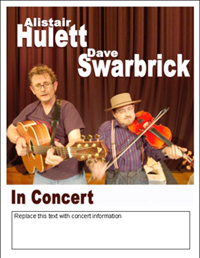 You get what it says in the title. Yet the song tells a story about the repercussions of putting rhetoric into practice. As experienced by John Maclean who got to know the rough end of the Defence of the Realm Act five times between 1915 and 1920. This album by Alastair Hulett (15 October 1951-28 January 2010) and Dave Swarbrick passed me by on its release. It really is a marvellous piece of music and historical document. Hulett’s detailed booklet notes are erudite yet impassioned. From Red Clydeside (Red Rattler RATCD005, 2002)
Jan’s March – Jenna and Bethany Reid
This is the opening track of a suite of tradition-based compositions celebrating the Shetland Bus, a clandestine operation during the Second World War connecting the Shetlands and fascist-occupied Norway. Its hero is a member of the Norwegian resistance called Jan Siguard Baalsud (1917-1988). The musicians named above play fiddle and in Bethany Reid’s case piano on the album. James Thomson plays flute and pipes, Iain Sandilands percussion and James Lindsay double-bass on the album. This is a composition by Jenna Reid. It’s a lilting overture of a piece played by the ensemble. It’s one of those melodies that you can’t quite place but feel as if you’ve known it forever. From Escape (Lofoten Records LOFCD001, 2010)
More information at www.jennanandbethanyreid.co.uk
I Don’t Work That Cheap – Bill Kirchen
Yes, yes, yes, it’s a shameless blag from Dylan but it has plenty of allusions to Blighty. Plus it has George Frayne, the ol’ Commander, pounding the ivories. From Word To The Wise (Proper PRPCD053, 2010)
Er Zou Er Een Meisje Gaan Halen Wijn – Wargaren
 Wargaren was a relatively short-lived Dutch folk band. Its predecessor Pitchwheel finagled a couple of tracks onto the Folk Centre Utrecht’s scene sampler FCU (1969). In 1976 Met Stille Trom (Universe hot103) appeared, from which this performance derives. It was Wargaren’s solitary LP and by the time it appeared they had broken up. The most signal aspect of Er Zou Er Een Meisje Gaan Halen Wijn is the voice of Rina de Heus. She sings here over a bed of gentle acoustic instrumentation.
Her understated voice gets me every time I listen to this piece of music. It never gets in the way of the story. The band’s Kees van der Poel went on to form Wolverlei. Its Rob Smaling went on to be active in many Dutch musical endeavours. Jurek Willig also joined Wolverlei and later worked as a sound engineer, for example, on a 2009 release of Ernst Krenek’s Lamentatio Jeremiae Propheta. And Rina de Heus supposedly gave up singing – a tragedy for the Dutch folk scene – and emerged as an actress in the early 1980s. From the Matthija Linnemann-compiled Dutch Rare Folk: 43 Lost Classics From The Golden Age Of Nederfolk 1967-1987 (Food For Thought FFT7060157, 2007)
Sobit Rupnem – Annette Pinto
It should be rammed down people’s throats over and over again that, when it came to world music, the Indian subcontinent’s film industry knew a great deal about head starts. The album that Sobit Rupnem comes from homes in on ‘Music From Goa/Made in Bombay’. Much of it could be called an amalgam of anywhere-Indian filmi sangeet (film song) elements spiced with Latino elements in a transplanted Iberian peninsula kind of way. Not derivative, more like true colours. It was with enormous regret that the album that this track comes from, arrived after the closing date for updates to my ‘East-West Fusions’ chapter of the Rough Guide to World Music (2009). From Konkani Songs (Trikont 0395, 2009)
www.trikont.de
Prochu se Nayden – Diva Reka
 Diva Reka proper is Kostadin Genchev on kaval (an end-blown wooden flute), Dimitar Hristov on tambura (a long-necked lute), Stela Petrova on string bass and Petar Mitov on percussion. But after seeing them perform at TFF Rudolstadt in July 2010 and listening to their eponymous debut, it is the interplay of the quartet and its guests that puts the stamp on their achievement. Prochu se Nayden is Bulgarian folk-jazz. It opens with guest Valentin Vassev setting the mood on piano. Then Evelina Hristova, the lead vocalist on this track, another guest, joins in. The band folds around them. A slow into medium-tempo, slow-build air, it encapsulates the joy and majesty of Diva Reka, the finest new Bulgarian band to come my way in a long time. From Diva Reka (Gega New GD 353, 2010)
Diva Reka at TFF Rudolstadt 2010, photograph (c) Ken Hunt
More information at the Sofia-based label’s website: www.geganew.com
31. 8. 2010 |
read more...
« Later articles
Older articles »