Giant Donut Discs
[by Ken Hunt, London] More boffo music from the rain-soaked rock, as ever reflecting work streams and passions. Lisa Knapp, John B. Spencer, Béla Fleck, Zakir Hussain and Edgar Meyer, Ökrös with Ági Szalóki, Element of Crime, Toots and the Maytals, Miles Davis, Pentangle, Asha Bhosle and R.D. Burman, and the Kronos Quartet with Alim & Fargana Qasimov are the month’s turn-ons.
 Blacksmith – Lisa Knapp
Lisa Knapp is a singer whose passion and gift are astonishing. The Blacksmith is a traditional song that seems to have been with me my entire journey into traditional English music. It has a wondrous melody and it tells a story to wonder at and weep over. Its lyrics capture the bewilderment of love found and love lost better than nearly any other song in the folk or popular canon.
Knapp first heard The Blacksmith as sung by Shirley Collins. In an unpublished part of an interview that she did with me for R2‘s article to celebrate Shirley Collins’ 75th birthday in August 2010, Knapp said, “When I first heard her – The Sweet Primeroses was probably the first one I heard – I’d never heard anything like it. Her voice was so unique. For me, it was like fresh air, so sparklingly unique and really inspiring. She made me want to sing folk music. There’s no mistaking her. You know it’s her. I liked that. I like that in people. She really did just sing the song. She never over-exercises in her singing style. It’s so clearly her.”
The version on this album is remixed by Youth. The mix is remarkable. (But how I would love to listen to how it sounded before!) Yet it is Knapp’s voice that hooks and reels the listener in. From Wild And Undaunted (Ear To The Ground Records ETTGCD001, 2006)
Alone Together – John B. Spencer
This is one of John Spencer’s more acerbic songs but he delivers his barbs in such a low-key way. “When the smile on your face don’t touch your eyes”, “When we make love to be polite” and “All our friends sit on the fence/While we crack jokes at each other’s expense” are examples of Alone Together’s wit and observational powers from. “It’s my version of Breaking Up Is Hard To Do,” is how John describes it on this album.
A lover of words, John had a droll and deadpan sense of humour. Mordant to the end, when John’s coffin was carried in for his final send-off, he had the fruits of the allotment on top rather than the usual scentless roses and bland chrysanths. Goonishly, amongst the veg were sticks of rhubarb. John had had time to consider his final send-off and that visual gag made me laugh out loud as he waltzed in. We were there to remember, not to forget.
I’ve probably got Alone Together somewhere on a demo cassette with him playing his Telecaster and singing with bloody budgie twittering as his chick chorus. (Honest!) As we say in London, loverly man, loverly song. From Left Hand of Love (Round Tower Music RTM CD 82, 1996) (Keeping it in the family, there’s also his sons’ up-tempo version on Fast Lane Roogalator (Irregular Records IRR056, 2004).)
More memories of John B. Spencer at http://kenhunt.doruzka.com/index.php/john-b-spencer-1944-2002/
 Bahar – Béla Fleck, Zakir Hussain and Edgar Meyer
Over the course of July 2010, for me three bands raised the spectre of Shakti – the benchmark of excellence in matters Indo-jazz.
The first was The Shin’s live Black Sea Fire musical extravaganza at Tanz&FolkFest Rudolstadt because of its adoring embrace of the compositions of John McLaughlin (even though they were more Inner Mounting Flame than Shakti).
Next, there was an Indo-jazz masterpiece called Raga Bop Trio from Steve Smith, George Brooks and Prasanna.
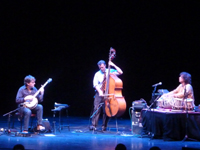
The third was the wondrous Béla Fleck, Zakir Hussain and Edgar Meyer concert at the Barbican. This composition unveils a whole new world in which banjo (Fleck), double-bass (Mayer) and tabla (Hussain) do things together that have never been done before, creating worlds of melody that mesmerise. The picture is from the trio’s London concert (c) Swing 51 Archives. From The Melody of Rhythm (E1 Entertainment KOC-CD-2024, 2010)
Cigánykesemes: Si e dracu suparatu, Az ördög megsértödött, Ungureste rar; Cigánycsárdás; Csingerálás – Gypsy tunes: Lament, Slow Hungarian, Gypsy csardas, Fast csardas – Ökrös
Presciently, the Hungarian traditional powerhouse Ökrös calls on the powerful and plangent voice of Ágnes Szalóki here. She sings the heart out of the opening part of this medley, sings it unaccompanied, before the band joins in. Later you hear some of her other voices.
If you only listen to ten albums of Hungarian folk music your whole life, try and find this revelation. The melodic, rhythmic and time changes on this track alone are an instant conduit to Hungarian music. You probably won’t find it in any shop. ABT produced albums so exquisite in so many ways – artwork, calligraphy and, of course, music – that most are out-of-print. Mind you, if you go truffling in Budapest, you might find the odd ABT CD in some small record shop.
Much of music is theatre. The painter Maggi Hambling distilled a great truth in a couple of sentences in 2009 (in the London edition of Time Out). “You only need to see a shark in a tank once, whereas you can go back and look at a Rembrandt self-portrait thousands of times.” Like art of the greatest kind, this is something Rembrandt-like, worthy of revisiting again and again. From Bonchida, Háromszor – Bonchida, Times Three (ABT005, 1998)
Kaffee und Karin – Element of Crime
It’s hard to explain the literary uplift that Element of Crime delivers to anyone that can’t understand German. They are German chanson personified. Just like people who don’t understand French listen to the chansons of Brel, Brassens and Gainsbourg and melt, maybe one day soon people will listen to Element of Crime and melt to Sven Regener’s voice and lyrics.
The title translates as ‘Coffee and Karin’. Its backdrop is a bistro or café scene. After coffee and beer comes talk, “Deinen Namen hab ich vergessen/Deine Nummer fällt mir nicht ein/Einen Ring hab ich niemals besessen/Und einsam will ich nicht sein” – “I’ve forgotten your name/Your name doesn’t occur to me/I’ve never owned a ring/And I don’t want to be alone.” Sheer Brel. A tip-off from Pankow’s Jürgen Ehle. From Immer Da Wo Du Bist Bin Ich Nie (Universal 2713646, 2009)
Pressure Drop – Toots and the Maytals
Toots Hibbert sings the heart out of the song. The Maytals play it unrelentingly as if it were a looped track done in real time. This version is just the blueprint of other things that came. A reggae song for all time. Did I ever tell you about the time I interviewed Toots? From Funky Kingston Island CCD 9330, undated)
It’s About That Time/Sanctuary – Miles Davis
I only ever saw Miles Davis once and it was at the Isle of Wight Festival on 29 August 1970. The line-up was Davis on trumpet, Gary Bartz on saxes, Chick Corea on electric piano, Keith Jarrett on organ, Dave Holland on basses, John DeJohnette on drums and Airto Moreira on percussion. (Making it the first time I ever saw Airto live.) What a phenomenal line-up.
Listening to It’s About That Time forty years on, I marvel at my receptiveness to what was very strange and angular then. It launched my interest in Miles Davis’ music. Oh, and the drugs did work. From Isle of Wight, part of Miles Davis: The Complete Columbia Album Collection (Columbia Legacy 88697524922, 2009)
 Light Flight – Pentangle
Lavinia Blackwall of Trembling Bells prompted the inclusion of this track. Her merely mentioning it opened a sluice gate of memories. High amongst them were memories of the BBC television series Take Three Girls in the original series of which the actresses Liza Goddard, Susan Jameson and Angela Down played the three girls. Pentangle (only Americans ever called them ‘The Pentangle’) supplied this opening credit music (and sundry incidental music). In his big, two-issue Rolling Stone interview in 1972, the Grateful Dead’s Jerry Garcia name-checked Pentangle and that felt good in a moderately patriotic, steady-on-Carruthers way.
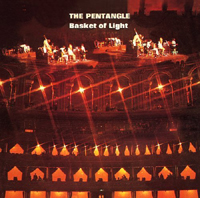
Terry Cox plays trap drums, Bert Jansch and John Renbourn guitars and Danny Thompson double-bass. Jacqui McShee soars (and multi-tracks vocals) over Light Flight’s driving instrumental track. If you want to listen to what went before what is now called ‘acid folk’, ‘psych-folk’, ‘wyrd folk’ or, heavens open and wash the folk infidels away, ‘folktronica’, this consummate piece of folk-jazz or jazz-folk musicianship will really, really help. Such a groove! Ah, strange folk-jazz pleasures. From Basket of Light (Transatlantic TRA 205, 1969 and Sanctuary CMRCD207, 2001)
Qashlarin Kamandir – Kronos Quartet with Alim & Fargana Qasimov
“Your eyebrows are bow-like/Your eyebrows are bow-like and your gaze is stunning/Your words are sweeter than honey and sugar/Please, come to me, sweetheart, you are my flirtatious beauty.” People pay me to listen to such musical sorcery! From Music of Central Asia Vol. 8 – Rainbow (Smithsonian Folkways SFW CD 40527, 2010)
 Piya Tu Ab Aaja – Asha Bhosle and Rahul Dev Burman
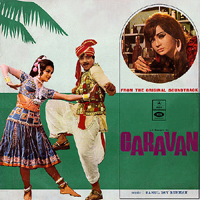
R.D. Burman had a stack of compositional tricks. It is a sad truth that Mother Nature isn’t always up to the job and Mother Nature’s son has to help out. In film Foley artists are the people that craft the sound effects from sticks of celery and buckets of stones and water. R.D. Burman did his own sound effects (that ol’ Listerine bottle is a classic) but frequently when he was putting together tracks in the studio he relied on the talents of his right-hand man, the multi-instrumentalist Manohari Singh. Born in Calcutta on 8 March 1931, Singh died in Mumbai on 13 July 2010. I cannot remember an LP sleeve (certainly not this one) that ever credited the session or side musicians. Pretty hard and fast as rules go, the credits give the playback singers and the music director/lyricist. Singh was a major asset on the R.D. Burman team. The saxophone interjections on this track are marvellous, if brief. That was one of Burman’s tricks. Leave them expecting more. From Teesri Manzil and Caravan (Saregama CDF 120017, undated)
16. 8. 2010 |
read more...
[by Ken Hunt, London]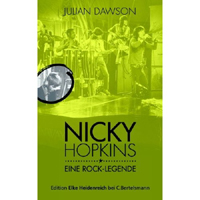 Swing 51‘s Giant Donut Discs® column gathered musical snapshots from all manner of people. These were Julian Dawson’s GDDs as published in Swing 51 issue 13/14 with annotations and updates. This is one in our series of Donuts from the vaults. For information about Julian’s musical activities, visit his official website at the bottom of his Donuts. (And how frequently does a writer get to write that?) In April 2010 the German-language edition of his biography of the pianist Nicky Hopkins appeared. Its title is Nicky Hopkins – Eine Rock-Legende (Elke Heidenreich) – a justifiable title for a studio musician for The Beatles, The Rolling Stones, The Who and The Kinks (whose 1966 album Face to Face included Session Man about him) and, transplanted to American soil, player with Quicksilver Messenger Service, the Steve Miller Band, Harry Nilsson, Jerry Garcia and Jefferson Airplane.
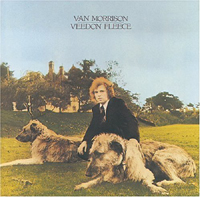 Streets of Arklow – Van Morrison
From Veedon Fleece.
Ken Hunt: This one needs little amplification. Track 4 of Van Morrison’s 1974 album for Warner Brothers.
Cash On The Barrelhead – The Louvin Brothers
Ken Hunt: In Britain it was getting easier to track down the Louvin Brothers’ recordings by the end of the 1980s. The US musician Gram Parsons’ influence was a big impetus in this respect.
End Of The Rainbow – Richard & Linda Thompson
Ken Hunt: The lyrics went, you may remember: “Life seems so rosy in the cradle/But I’ll be a friend I’ll tell you what’s in store/There’s nothing at the end of the rainbow/
There’s nothing to grow up for anymore.” Good bracing stuff.
Sources at www.richardthompson-music.com/song_o_matic.asp?id=52
Let’s Burn Down The Cornfield – Randy Newman
From 12 Songs.
Ken Hunt: Another of those pesky songs where the lyrics say it all.
I Found Out – John Lennon & The Plastic Ono Band
Ken Hunt: It wasn’t the obvious track from Lennon’s first solo album – Mother and Working Class Hero copped the plaudits but choosing the obvious was never on the cards or in the game plan when inviting people to pick their Giant Donut Discs.
So What – Miles Davis
From Kinda Blue.
Ken Hunt: Jazz marbled people’s Donut choices from the off and that was fine and to be expected and encouraged. The general coverage of the magazine did not condition in any way what people picked.
Ain’t That Good News – Sam Cooke
Ken Hunt: The song originally appeared on Ain’t That Good News, the last album to be appear before Cooke’s death in December 1964. The album would subsequently be overshadowed by another song on it called A Change Is Gonna Come.
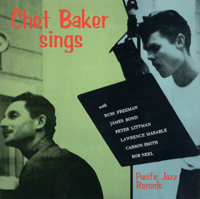 But Not For Me – Chet Baker
From the 1954 album, Chet Baker Sings.
Ken Hunt: More jazz. Chesney Henry ‘Chet’ Baker Jr. had died in Amsterdam in the Netherlands in May 1988 after falling from a hotel window. There is a plaque in his memory outside the Prins Hendrik hotel at Prins Hendrikkade 55 in Amsterdam. Corregium: the album was actually released in 1953.
All The King’s Horses – Aretha Franklin
Ken Hunt: A song combining nursery rhyme and fairy tale.
Tenor Madness – Toots Thielemans
From Toots Live.
Ken Hunt: Julian Dawson always had a thing about harmonica.
Julian is now resident at www.juliandawson.com
(c) 1989, rejuvenated 2010 Swing 51
17. 7. 2010 |
read more...
 [by Ken Hunt, London] This time around on the desert island’s solar powered phonogram we have Trembling Bells, Buddhadev Das Gupta, Andy Cutting, Maggie Holland, Polkaholix, Jackson Browne, Shirley & Dolly Collins, Eliza Carthy and Norma Waterson and The Bells of St. Margaret’s, Westminster (under Tower Captain George Doughty). Plus for a limited period on the internet, July 2010’s special offer, a bonus donut from David Lindley and Wally Ingram.
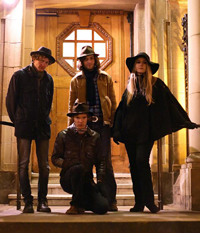 I Listed All Your Velvet Lessons – Trembling Bells
Trembling Bells are the most refreshing and impactful band of a folk hue that I can recall since Last Forever and Bellowhead. Listening to them can be like having a flicker book of boldly worn musical influences and resonances riffling in front of your ears. The Glasgow-based quartet uses the studio and the mixing desk really well. And the mixes and Alex Neilson’s songs give up their secrets reluctantly.
That might entail fresh discoveries nearly every pass. It helps to concentrate on one ‘voice’. Maybe Lavinia Blackwell’s keyboard lines running through When I Was Young or I Listed All Of The Velvet Lessons on their debut album Carbeth. Or on this particular track, I Listed All Of The Velvet Lessons, the use of brass. The song has a touch of the Blakes and Dolly Collinses about it. OK, I’m exaggerating there. But it really is memorable. From Carbeth (Honest Jon’s HJRCD43, 2009)
Chhaya – Buddhadev Das Gupta
There is no point in trying to choose any sliver or stage of this notable 77-minute performance over another. This is not the interpretation to single out some aria-like passage or the big finale from. This Donut is the entire performance of this seldom heard raga. One of the reasons it’s rare is because it is devilishly difficult to establish its clear identity from ‘neighbouring’ ragas. Like pesky neighbours, they can be intrusive.
Buddhadev Das Gupta is not a member of any hereditary musician family (although his brother, Dilshad Khan, also became a professional classical musician). His livelihood was in engineering for much of his life. But while working as an engineer, he was studying music with Radhika Mohan Maitra and developing a phenomenally empathetic style as a sarod player. He calls himself an “old style” sarod player and there is everything to embrace in that description.
Chhaya is proof aplenty of that attitude of his and his application of mind. And, if Radhika Mohan Maitra schooled him so ably, so beauteously, it is a tragedy that few will have heard his guru play. Lyle Wachovsky’s India Archive Music recorded this mighty performance in November 1994. Everything about this CD from the quality of the recording to the quality of the booklet notes sings the India Archive Music approach with its lavish attention applied to this release. Samir Chatterjee accompanies on tabla. From Sarod (India Archive Music IAM CD 1038, 1999)
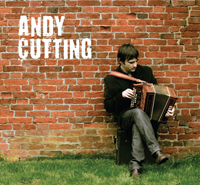 Uphill Way – Andy Cutting
The squeezebox maestro Andy Cutting’s talent first blossomed in these ears in the late 1980s during his time with Blowzabella (a dance band that helped shape many talents). He later spent time with Chris Wood, Nigel Eaton and as a mainspring with the bands of June Tabor and Martin Simpson, with Fernhill, Kate Rusby, John McCusker, Chumbawamba and Pete Morton. If judging someone by the company they keep counts, Andy Cutting moves in exalted English folk circles.
Andy Cutting’s first solo album, from which this track comes, took from 2001 to 2008 to make and that seems about right. You can knock out cheap and cheerful wine but the more rounded ones, maybe even the ones that might turn out to be vintage, take time and time to get to know them.
Uphill Way is from the opening sessions, captured by Oliver Knight in May 2001.It gets its name from Cutting looking out of the car on London’s A406 or North Circular Road whilst stuck in traffic on a crammed driving course. Looking out, he clocked a street by the same name. The tune is a wonderful piece of Englishness. Those with time on their hands can test their googling skills to guess exactly where inspiration struck. From Andy Cutting (Lane Records LANECD01, 2010)
More information at www.andy-cutting.co.uk
S.C.H.E.I.D.U.N.G. – Polkaholix
Polkaholix spell out Scheidung (‘divorce’) in a sort of warped take on the Bobby Braddock and Curly Putman song D-I-V-O-R-C-E, made gold by Tammy Wynette. They do it in much the same fond manner as Andrew Lloyd Webber and lyrics by Richard Stilgoe’s U.N.C.O.U.P.L.E.D. in Starlight Express. It’s about the division of property and chattels and the fall-out after the end of a marriage. Dance to a the pain of d.i.v.o.r.c.e. Auf deutsch that’s S.C.H.E.I.D.U.N.G. From Polkaface (Monopol Records 940833, 2010)
www.polkaholix.de/phx
Take it Easy/Our Lady of the Well – Jackson Browne
The last few years Jackson Browne has introduced a twitchy cuteness before playing Take It Easy on stage. It was one of the early hits that propelled The Eagles into whatever tier of freezing hell they propelled themselves into. Browne’s version of the song that he co-wrote with The Eagles’ Glenn Frey has the added bonus of segueing into one of his ‘lost’ songs, Our Lady of the Well.
Its artistic unity is made all the more manifest by Sneaky Pete’s trippy pedal steel. Micky McGee’s drum part on Take It Easy is slinky while Jim Keltner’s drums are something to dream about. David Lindley is all over both tracks, as is Doug Heywood on electric bass.
Basically though, this is a plea for and to Our Lady of the Well. In the last verse he sings,
“If you look for me, Maria
You will find me in the shade
Wide awake or in a dream
It’s hard to tell –
If you come to me, Maria
I will show you what I’ve made
It’s a picture for our Lady of the Well.”
(c) Jackson Browne, Swallow Turn Music
Our Lady of the Well adds the cool and shade of an enclosed courtyard with a well in its middle, probably set somewhere in colonial California. Or the setting could just as well be a well in Jaipur or Jalandhar. If you think that sounds fanciful, listen to the lyrics. Find and replace Maria with Durga Ma or Devi Talaab to get a measure of the song’s transferability. From For Everyman (Asylum 243 003, 1973) And yes, For Everyman, as of 2010, is overdue a proper re-mastered edition.
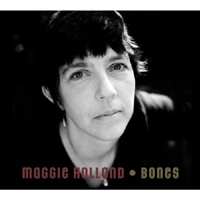 A Place Called England – Maggie Holland
Maggie Holland distils so much about England in this song. She isn’t a hugely productive songwriter but since she wrote A Place Called England, Perfumes of Arabia and Change In The Air plus A Proper Sort of Gardener and Living A Lie with Jon Moore that does not matter one iota.
This version of A Place Called England is a re-recording and an album bonus track. In the notes she writes how it was first recorded on Irregular’s Getting There in 1999. “It had taken 5 years worth of journeys up and down between Scotland and England staring out of train windows to write.” It is such an outstanding piece of Englishness out to remind what a mongrel race the British are. That was probably part of its appeal when it came to June Tabor covering it. From Bones (The Weekend Beatnik WEBE 9044, 2007)
www.weekendbeatnik.com and www.maggieholland.co.uk
Death and the Lady – Shirley & Dolly Collins
You just do not get the quality of songs at funerals nowadays. All that “Wish me luck as you wave me goodbye” jolliness and “Always look on the bright side of life” irony. Shirley and Dolly Collins originally nailed down the coffin lid with this one in 1970. Try to bribe Death in order to get an extension on the blessed mortal coil. It’s that same deal going down the tube that Oh Death conjures when Ralph Stanley sang it. Only his take manages a jauntiness absent in the Collins Sisters’ bone-cold song.
Shirley Collins’ delivery is perfect. Dolly Collins’ arrangement is bare bones. This is a Seventh Seal beach party song. As Shirley Collins told me in a recent interview: “It’s so fascinating when people think they can challenge Death.” From Love, Death & the Lady Fledg’ling Records FLED 3039, 2003)
May Morning Dew/The Snows They Melt The Soonest – Garcia
Notions of purist authenticity have blighted many a chap’s appreciation of folk music. Certainly that applies, mea culpa, to periods of my time in folk music. Garcia, the Hispanic resonances of their name notwithstanding, is a Czech band and Katerina Garcia is their lead vocalist on this recording.
To go Czech, the band’s core line-up is Kateřina Garcia on vocals, whistle and acoustic guitar, Luboš Malina on banjos, whistle, tárogató and kaval, Petr Košumberský on acoustic guitar and Adam Stivín on bass. If this fine performance is typical of the calibre of their music-making, batten down the hatches because they serve up lashings of the Irish tradition superbly. And more delicately than more acts than I dare think of. A real poke in the eye for purists. But better still, a real treat for anyone enamoured of Irish music. PS The performance is followed by a cover of Donal Lunny’s Tribute To Peadar O’Donnell. From Woven Ways (Supraphon SU 5827-2, 2007)
www.myspace.com/katerinagarcia and www.facebook.com/pages/Garcia-cz/103944399638948?filter=1
Ukulele Lady/(If Paradise Is) Half As Nice – Eliza Carthy and Norma Waterson
I have no problems with silliness, especially if it’s dressed up in a hula gal grass frock like Ukulele Lady. What’s more, marvels like this Hawaiian-paradisiacal pairing come along all too rarely. Eliza Carthy and her mother Norma Waterson sing, Martin Carthy (respectively father and husband to the aforementioned) and Aidan Curran play guitars, Danny Thompson throbs along on double-bass and Roger Williams pulls out something special around 3:10 from his magic sack of trombone mutes. From Gift (Topic TSCD579, 2010)
Stedman Caters – The Bells of St. Margaret’s, Westminster under Tower Captain George Doughty
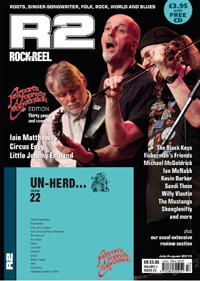
For the July/August issue of R2 (issue 22) Fairport’s Simon Nicol and I talked about church bells. In 2007 the parish church near to the Fairport Cropredy Convention festival in Cropredy, Oxfordshire – Saint Mary’s – gained two new bells bringing the tower’s total to eight. Hitherto, its tower had never been fully equipped, because bells cost a lot and, at the risk of stating the obvious, the village was and is small.
“Because the village has gained from the association with the festival over the previous thirty years,” Simon told me, “the two bells were made and they were named for two separate dedications. We were chosen as one of the recipients of this honour. There is a ‘Fairport Festival Bell’ – that’s what it has got written on it – hanging in the church tower now alongside its 400-year-old predecessors/brothers. It’s an amazing thought that that bell will be there, whether the festival survives or not. It will certainly be there as long as the building stands.”
As I was writing about the bells of Saint Mary’s, bellish associations and memories kept pouring in unbidden. Like the Sunday sounds of church bells from childhood and church bells from communities in India. And then, with thoughts of the blessed Saint Vivian (Stanshall) and bellish thoughts in mind, well, tie me to a tree and call me Brenda, Ring Forth! Westminster arrived. The narration of the stage, television and film actor Nicholas Smith (Royal Shakespeare Company, The Avengers, Dr Who, Are You Being Served?, Wallace & Gromit: The Curse of the Were-Rabbit amongst others) binds the story of the Bells of the Abbey and Palace of Westminster together. (For details of order, hundredweights and quarters for the bells, the booklet notes are to be recommended.)
Track 11 here gives Smith’s redolently voiced history of the Bells of St. Margaret’s, Westminster – sometimes known as the parish church of the House of Commons – before it leads into the ten bells being rung out. For me, the complexity of the way they interlock melodically and rhythmically over nine minutes is as eye-opening as when I first listened to Ravi Shankar and Alla Rakha. With thanks to Stephen Mitchell, bell-ringer of that parish. From Ring Forth! Westminster (Cantate Music CBC032, 2005)
www.cantatemusic.co.uk
For more about Simon Nicol and bells, go to: www.fairportconvention.com and/or www.rock-n-reel.co.uk
July 2010’s Special Bonus Donut
Bonus Track – David Lindley Y Wally Ingram
The cover proclaims “Studio Album! Overdubs! Special Guests!” Were a listener so disposed, well, Bonus Track, an alternative taksim-opening Turkish take on National Holiday (the album’s fourth track) might be supposed to have Jimmy Stewart on lead vocals. It is, however, but one of Lindley’s many voices. And, yes, Lindley did meet the Hero of Harvey. Would that nice Jimmy Stewart really have turned “aftershave” (National Holiday version) into “leather slave” (Bonus Track version)? Thrice nay! From David Lindley Y Wally Ingram’s Twango Bango II (no label, no number, no date)
www.davidlindley.com
17. 7. 2010 |
read more...
[by Ken Hunt, London] This time around on the desert island phonogram we have Amira Medunjanin and Merima Ključo, Dave Swarbrick, Bea Palya, Elizabeth Cotten, Leonard Cohen, Marlene Dietrich, Vishwa Mohan Bhatt & Matt Malley, Kraftwerk, Jerry Garcia, Leonard Cohen, and Illa Arun, Sapna Awasthi & Kunal Ganjawalla.

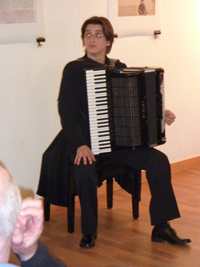 Kradem Ti Se – Amira Medunjanin and Merima Ključo
On 27 May 2010 Amira Medunjanin and Merima Ključo – respectively voice and piano accordion – played St. Etherburga’s Centre for Reconciliation & Peace on Bishopsgate in London. The night’s repertoire consisted of the 14 tracks that make up their album and after playing the album they had to revisit one for their encore. The duo represents something special in contemporary Bosnian music – a merging of the traditional, the contemporary and the future. This is the opening track of the duo’s inspirational debut album. It throbs with tension and the yearning of sevdah. From Zumra (Gramofon GCD1017, 2008 and World Village 450012, 2010)
For more information visit www.amira.com.ba and www.merimakljuco.com
The Fair Haired Child – Swarbrick
Dave Swarbrick has made some corking solo albums down the decades. The one from which this piece of music comes is amongst his very finest. Time may well show it to be his finest. It will take time to digest and savour it fully. Because if something like a film that is fixed and immutable – let’s ignore directors’ cuts and all that old malarkey – can reveal new things with repeated viewings, then how much more open to changing responses and insights is recorded music where imagination forces to run movies and patterns in our heads?
The Fair Haired Child, he credits it to Edward Bunting’s first, 1796 edition of The Ancient Music of Ireland, finds Dave Swarbrick as a member of a four-piece. On it he plays fiddle in the company of Beryl Marriott (piano), Kevin Dempsey (guitar) and Maartin Allcock (bass guitar). There is such great joy in the ensemble playing this Irish harp tune, a joie de vivre no less. One might speculate why. Probably it boils down to Dave’s appreciation of the gift of life, given his scrapes with near-death. Britain’s National Health Service – it has its faults but speak to anybody who survived the nation’s previous, private medicine regime for inklings of how it was before – and the transplant team at the Queen Elizabeth Hospital in Birmingham get thanked. Raison d’etre, ‘reason for being’ indeed. Rarely has a title worked so well. One of the albums of 2010 by anyone’s definition of British folk. From raison d’etre (SHIRTY 1, 2010)
Part-time Lover – Bea Palya
You never quite know with some book reviews, do you? You don’t know whether the reviewer has homed in on the salacious details to keep the casual reader titillated or the customer satisfied. From Robert Sandall’s review in Sunday Times‘ Culture section of Mark Ribowsky’s biography Signed, Sealed, and Delivered: The Soulful Journey of Stevie Wonder, it sounded as if a lot had gone down, supplying grounds for reappraising this song of Stevie Wonder’s.
Hitherto, Wonder’s song Part-time Lover sounded like an overlap with songwriters Dan Penn and Chips Moman’s Dark End of the Street. Palya’s version takes Wonder to uncharted Hungarian territory. From Én leszek a játékszered – I’ll be your plaything (Sony Music Entertainment 88697642232, 2010)
www.palyabea.hu/en/
Freight Train – Elizabeth Cotten
Long before the world knew about Elizabeth Cotten, thousands upon thousands of people knew Freight Train. The song is like one of those pebbles on the beach that are rounded with the rough edges smoothed away, much like traditional songs that have been sung and handed on. Only Libba Cotten had composed it. The first version of this song most people will have heard was probably one of the cover versions. For example, the Chas McDevitt Skiffle Group, featuring Nancy Whiskey, took it into the UK singles chart in 1957. Ramblin’ Jack Elliott, Peggy Seeger, Jerry Garcia & David Grisman are among the acts that covered Libba Cotten’s song.
Libba Cotten’s version, recorded by Mike Seeger is the one which I treat as the benchmark. Listening to her work again came about because of a commission to write about her Shake, Sugaree. Sometimes all it takes is a little gentle reminder. Freight Train was already a Donut before Chas McDevitt sang it during the Diz Disley Memorial Concert at the Half Moon in Putney in South London on 26 May 2010. From Freight Train and Other North Carolina Folk Songs and Tunes (Smithsonian Folkways SF CD 400009, 1989)
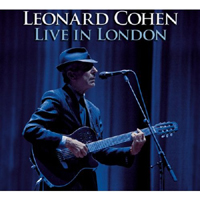 Ain’t No Cure For Love – Leonard Cohen
Great song. Great arrangement. Excellent introduction, too. There is something about this song’s world-weary love of life. It’s a song to remind you of all the best people that set you on the path. Like Leonard Cohen says to Sharon Robinson, Charley Webb and Hattie Webb, Tell it, angels. From Live In London (Sony Music 88697405022, 2009)
Ich bin von Kopf bis Fuss auf Liebe eingestellt – Marlene Dietrich
Friedrich Hollaender’s song began life and notoriety in the 1930 film Der blaue Engel (‘The blue angel’ or ‘The drunken angel’ for lovers of wordplay) and it spawned many parodies. In English it became Falling In Love Again. Marlene Dietrich’s German-language interpretations (there were many) are the interpretation to which I boomerang. There is something about Dietrich’s sultry delivery that is sensuous rather than sexy. She really was the skeleton key to this song. There are several versions on many anthologies. From The Essential Marlene Dietrich (EMI CDP 7 96450 2, 1991)
Sleepless Nights – Vishwa Mohan Bhatt & Matt Malley
The title track of their album. Arguably its highlight. The combination of Matt Malley’s growling electric bass and the upper sonorities of Vishwa Mohan Bhatt’s Mohan vina – a modified, Indianised guitar – combine beautifully. And strangely the bass and keyboard sonorities arc over into Kraftwerk if you squidge your eyes really tight until you see shapes and colours. From V.M. Bhatt & Matt Malley’s Sleepless Nights (World Village 468097, 2009)
Autobahn – Kraftwerk
In 1974 Autobahn was a piece of music that distilled and defined something, as if for the first time. Autobahn captures the mood of travelling long-distance on West German motorways. The German-language lyrics are intentionally prosaic. There are lines about the grey of the road, white lines and green edges, switching on the radio and the loudspeakers intoning “We’re driving on the autobahn” like a loop. It captures the boredom of the motorway as kilometres pass beneath the tyres. It is the miscreant Teutonic equivalent of Jackson Browne’s Running On Empty without that song’s romance and the road lore of US highways.
Autobahn is one of the great transcontinental travelling songs. Even if you don’t speak German, you can just pick up on its “Wir fahr’n auf der Autobahn” (‘We’re driving on the motorway’). It lasts over 20 minutes in its ‘LP version’ while the keyboard melody line about 15 minutes in is the musical equivalent of spying something different in the topography on a boring motorway journey. Best experienced on a German Autobahn. From Autobahn (CDSTUMM 303, 2009)
www.kraftwerk.com
The Wheel – Jerry Garcia
The Wheel was one of the highlights of Jerry Garcia’s debut solo album in 1972 and its closing track. Garcia actually played all the instruments on the album, bar drums, for which he brought in the Grateful Dead’s drummer Bill Kreutzmann to do the honours. It starts itchy and jittery, like a continuation of Eep Hour, earlier in the running order. Then in comes Garcia’s pedal steel to calm things down.
How you interpret Robert Hunter’s lyrics is down to you. The possibility of karmic inevitability is one that has stood the test of time well. As the song progresses and moves forward, that pedal steel soothes. Its sing-song quality puts you, lulls you, the listener, into a place of security, no doubt just before the rug gets pulled out from under your feet and you get your karmic comeuppance. From Garcia (Rhino R2 78063-A, 2004)
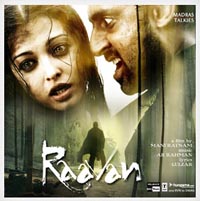
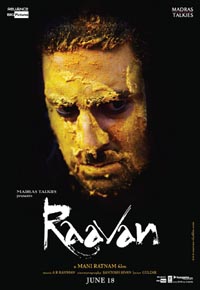 Kata Kata – Illa Arun, Sapna Awasthi and Kunal Ganjawalla
Like in the old days when the box-office success of a Hindi commercial film could be given an extra boost by the early release of its soundtrack LP, the A.R. Rahman-Gulzar score for Raavan was released in May 2010, a month ahead of the film’s official release date. The music sounds big with lashings of Rahman’s trademark melodic and rhythmic touches. It also reunites him with director Mani Ratnam, the man who launched his career with the 1992 Tamil film Roja.
Kata Kata opens with a nagaswaram fanfare and uses the South Indian shawm as a recurring effect. What sets Kata Kata apart is the way it plays with preconceptions of what lead vocalists ‘should’ sound like in blockbuster films. Not to be confused with the Tamil-language version of the film – Raavanan – with its score by Rahman-Vairamuthu. From Raavan (T-Series SFCD 1-1575, 2010)
Small print: Amira Medunjanin and Merima Ključo photographs are (c) Ken Hunt 2010
21. 6. 2010 |
read more...
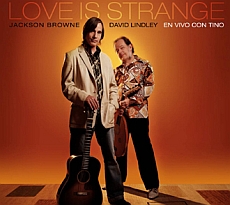 [by Ken Hunt, London] Even though this month’s choices are skewed and heavily informed by volumes 7-9 in Smithsonian Folkways’ Music of Central Asia series, in terms of preference, as usual, there is no order implied and no order to be inferred. As ever, the common link to May 2010’s GDDs is that this is music that stuck around. This month we meet, greet and embrace Jackson Browne David Lindley, Barb Jungr, the Kronos Quartet with Alim & Fargana Qasimov, Asha Bhosle, Les Byrds, Sirojiddin Juraev, Homayun Sakhi and Rahul Sharma, Jiři Kleňha and Neneh Cherry and Youssou N’Dour.
 The Crow On The Cradle – Jackson Browne David Lindley
This is the sort of musical tastiness that prompts the unwary to say that if there is a tastier track released in [gentle reader, add the year you’re reading this], they will eat polyester garments, assisted only by their hot sauce or condiment of choice and a couple of lubricating Pacificos to fend off the odd rictus. Personally, not being of a polyester-chomping bent, I would not enjoy the experience, even though wise men have said one can cram several portions of the aforementioned stuff into one’s mouth in one go. So, it is with deep regret that I inform you that Browne y Lindley deliver a lorryload of taunting temptations on their superlative 2010 offering, recorded on their Spanish tour in March 2006.
By London, with each gig impromptu and rehearsals deliberately avoided, their performances were full of spontaneous touches and ripples. The Crow On The Cradle is one of Sydney Carter’s finest songs. This version is prime quality stuff. The performance has an immediacy that is startling while its lyrical content is the stuff of timelessness. Sydney Carter must have known that when he wrote the song. Unhappily he had not foreseen what would happen when Browne and Graham Nash (con Lindley) covered it at a 1979 MUSE concert and it appeared on the set, No Nukes – sales of which were assisted by contributions from James Taylor, Tom Petty and the Heartbreakers, Bruce Springsteen & The E Street Band, Crosby, Stills & Nash. (The presence of Sweet Honey In The Rock and Gill Scott-Heron cannot be gainsaid either.) Carter told me that the unexpected influx of royalty money caused him all manner of grief. For years he had to explain to the tax people that it was an aberration. He wasn’t complaining too loudly. Last, there is the no ampersand or ‘and’ between their names. This is music made on an equal footing. As Sydney Carter’s song so eloquently demonstrates. From Love Is Strange (Inside Recordings INR5111-0, 2010)
www.jacksonbrowne.com
www.davidlindley.com
www.insiderecordings.com
Once In A Lifetime – Barb Jungr
This is the opening track of an outstanding collection that Barb Jungr calls ‘The New American Songbook’. While other interpreters add retreads to the old American Songbook – or in the case of Tony Bennett continues to do it his way, in his own signature style – she demonstrates that the Songbook is expanding rather than its girth is expanding. On Once In A Lifetime she is not fumbling for life-signs from stricken old songs: she is fingering the pulse on a new intake of songs. Apologies if the metaphor doesn’t do it for you. Why? Because Barb Jungr knows how to quicken a pulse and how to breathe new breath into a song.
Her decision to cover this David Byrne and Brian Eno song is a bold one. The first time I heard Barb Jungr sing this song was on the BBC Radio 4 programme Woman’s Hour with accompaniment stripped back to piano. It seemed that she had hit upon a different way to do justice to this Talking Heads mainstay. The album version, produced by Barb Jungr & Simon Wallace, has the touch of a jeweller or watchmaker. She cuts and turns the facets in the song in ways that cast, reflect and refract new light. The inclusion of Clive Bell’s shakuhachi and flute is inspired and Simon Wallace’s piano watery and flowing. An interpretion to linger in the memory. From The Men I Love (Naim Label naimcd 144, 2009)
www.barbjungr.co.uk
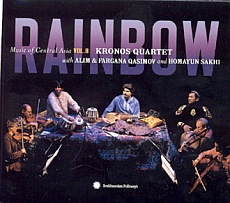 Köhlen Atim – Kronos Quartet with Alim & Fargana Qasimov
When they debuted this composition at the Barbican’s Ramadan Nights festival celebrating Ramadan and the start of Eid ul-Fitr on 26 September 2008, nobody needed, cue Sting, to be an illegal or legal Azeri-speaking alien in London to get what Köhlen Atim (‘My Spirited Horse’) was all about. It is a horsey song that goes from a trot to a canter to a gallop. All bets are off when it comes to this performance. It is a clear winner. From Music of Central Asia Vol. 8 – Rainbow (Smithsonian Folkways SFW CD 40527, 2010)
Log Cabin Home In The Sky – The Incredible String Band
Log Cabin Home In The Sky is one of those songs that enlivened 1968, the stuff to sing after last orders on the way home from the pub. Mike Heron’s lyrics are amusing. Robin Williamson’s sawing fiddle is a beautifully vague stylistically speaking (which was the point) but atmospheric as if straight out of Old Nick’s Fiddle Triangle – Cape Breton, Berkeley Old Time Fiddler’s Convention (immortalised on the Folkways’ album Berkeley Farms) and the Fake-Appalachians. Cultural thievery from two of the best. Chutzpah and a hoot to boot. “Now is the time to slip away from the California sun/To a place where a man can be as free as the wind” etc. From Wee Tam & The Big Huge (Fledg’ling FLED 3079, 2010)
Fledg’ling is at www.thebeesknees.com
Rishte Bante Hain – Asha Bhosle
Rahul Dev Burman composed the music: Gulzar wrote the lyrics: Asha Bhosle sang. Rishte Bante Hain means ‘Relationships Grow Slowly’. It is one of R.D. Burman’s most lilting melodies that he ever magicked out of his imagination. Even before factoring in its lyrical content, the magic is clear in the detail of the arrangement and is filigree touches. Finger-pop percussion, sarod and Ashaji‘s voice of sailing over everything, with only of a spot of multi-tracking as assistance. Eloquence on so many levels.
A song to go to the grave with. From Dil Padosi Hai (1987) available on The Rough Guide to Bollywood Legends: Asha Bhosle (RGNET 1131 CD, 2003)
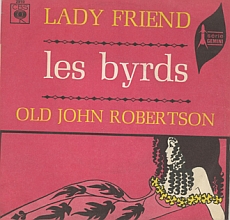 Lady Friend – Les Byrds
Mike Ledgerwood’s review on page 15 of the Disc and Music Echo of 2 September 1967 enthused, “The Byrds are back! With that crashing, full-blooded guitar sound and haunting voice harmony built around David Crosby’s ‘Lady Friend’ (CBS). A vast improvement on their recent offerings. Deserves to be a hit.” But who could afford Disc and Music Echo?
One baking hot summer’s afternoon in 1968 in a small town somewhere on the Cherbourg peninsula, the light was so bright it was dazzling. The French town was undergoing a collective siesta. All the cafés and bistros were as shut as an early-closing Sunday in Britain. In that small town whose name nobody will ever recall, a Francoise Hardy-inspired, aching-loined adolescent ducked into a little record shop that, in denial about sunshine and siesta, was stoically open and trading. It was like an oasis of life in a mirage of inertia without a diablo de menthe in sight. Adjusting his fetchingly blue eyes to the darkness whilst flicking through the picture-sleeved 45s, one caught his attention. It was Les Byrds.
Maybe it was the confidence of callow youth or just not knowing he was a junior polyglot in the making, but reading Les Byrds did not throw him. As somebody sang, life was much simpler then. One went into a record booth in some foreign country clutching a record and, 2:30 minutes later, maybe one emerged happier and francs and centimes lighter.
Lady Friend, with its welling harmonies, pounding drums, stabbing brass and chiming guitars, is one of those David Crosby songs that allegedly helped split the band. Supposedly, Triad, Crosby’s hymn to troilism – not a word heard much back in England – had proved too rich, too rum for Les Byrds (so Crosby got Jefferson Airplane to cover his beastliness) and Lady Friend probably sounded like a loose cannon going off. It never made an album but in that small corner of Cherbourg that lad located a treasure.
Three decades later he spoke to Crosby about that encounter. Crosby had no notion that the Lady Friend had ever be released in France – with or without a picture sleeve. “Man, that’s a collector’s item!” he laughed. From Les Byrds – Lady Friend b/w Old John Robertson (7-inch single, France, CBS Série Gemini 2910, undated and/or The Byrds (Columbia/Legacy C4K 46773, 1990)
Qushtar – Sirojiddin Juraev
A piece comparable to Davey Graham’s Anji for acoustic guitarists. Qushtar apparently means ‘double strings’. Juraev’s technique involves tuning strings in unison and fretting and plucking the dutar – the Uzbeki long-necked, fretted lute – at the same time. This is also combined with a tapping effect reminiscent of flamenco guitar. A tour-de-force. From Music of Central Asia Vol. 7 – In The Shrine of the Heart – Popular Classics from Bukhara and Beyond (Smithsonian Folkways SFW CD 40526, 2010)
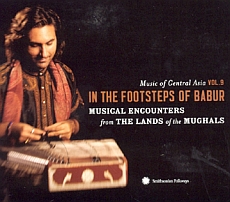 Dhun in Misra Kirwani – Homayun Sakhi and Rahul Sharma
In Hindustani music a dhun is a folk air or sometimes a piece played in a folk idiom. ‘Misra’ or ‘Mishra’ signifies ‘mixed’ and indicates that the composition does not follow strict râg rules. Kirwani is a South Indian râg that has gained great popularity in Northern Indian musical circles. However, Misra Kirwani is hardly a commonplace morsel. (Ali Akbar Khan released a 1985 recording of it on his In Concert at St. John’s, on which Zakir Hussain accompanied on tabla.) This rendition is an Afghani-Jammu-Kashmiri one. Sakhi plays the rubab – a kindred instrument to sarod – while Sharma plays the santoor, the instrument that his father, Shivkumar Sharma turned new worlds of music-lovers on to.
Sharma came up with the opening composition in Misra Kirwani, Sakhi followed suit and then they flew. This spontaneous composition’s variations are a one-off and the next time who knows where the next logical conclusion might lead them? This rendition is better than good enough for the present. From Music of Central Asia Vol. 9 – In The Footsteps of Babur – Musical Encounters from The Lands of the Mughals (Smithsonian Folkways SFW CD 40528, 2010)
Poslechněte, lidé – Jiři Kleňha
It is peculiar how people forget to stop assuming that things won’t change. Me included. We riff on life and forget to remember. Jiři Kleňha is somebody I associate with Prague. He was another of the street musicians that played on Charles Bridge but unlike the guitar-playing buskers and the jazz band he did something only found in Prague. Jiři’s pitch was at the Karlova, Old Town end of the bridge and he played a hammer chord zither called the Fischer’s Mandolinette. Apparently the instrument had been part of a family of chord zithers whose stronghold in the first decades of the twentieth century had been on the Saxony side of the German border and the Sudeten in Czechoslovakia. In German the instrument was also known delightfully as Fischer’s Lieblings-Klänge, meaning ‘Fischer’s Favourite Sounds’, though it has also been translated more freely as ‘Fischer’s Lovely Sounds’.
Over many’s the year, I stood and watched Jiři Kleňha play. He rarely played for more than a few minutes – two or three – at a time before invariably somebody would approach him and ask him about the unfamiliar instrument that he was playing. Down the years, admirers of his artistry had translated his giveaway sheet in Czech into various languages. He would courteously enquire where somebody came from before fishing out the appropriate variant of his leaflet from his bag. One early evening a few years back, I waltzed David Harrington of the Kronos Quartet across the bridge from the hilly castle side, hopeful that Kleňha would still be there. Getting closer, the bright ringing tones of the Fischer’s Mandolinette confirmed he was. Entranced, we stood and listened.
The longest piece of the 37 tracks on this Yuletide CD is under three minutes in length. Each is a miniature, an exquisite Czech miniature, a distillation of melody. The last time I was in Prague in September 2009, Kleňha wasn’t there the whole week. I do hope he was somewhere nice on holiday. The title track from Poslechněte, lidé (no number, 1995)
More information in Czech, Russian and English at www.aa.cz/citera
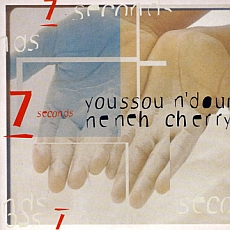 7 Seconds – Neneh Cherry and Youssou N’Dour
The weekend of 17-18 April 2010, as Werner Richard Heymann (1896-1961) wrote all those years ago, had to be a piece of heaven. In Whitton, Middlesex in any case. The skies were clear and blue. More betterer, thanks to the Icelandic volcanic eruptions at (the eminently copy-and-pastable and equally unpronounceable) Eyjafjallajökull, the skies were clear of planes over London until 21 April. Bliss. Sitting in the Admiral Nelson on a writing jag/break, Neneh Cherry’s 1994 record came on. As she and Youssou N’Dour sang, Whitton and the world became a still more harmonious, an even still more betterer place.
Co-credited to Cherry, N’Dour, Cameron McVey and Jonathan Sharp, 7 Seconds (though in my head until checking it was always 7 Seconds Away) appeared on N’Dour’s album The Guide (Wommat) and became the performance that didn’t really fit or sit comfortably on her solo album, Man. The spring sunshine, the drone of bees, the silence of hoverflies, a couple of days of listening to songbirds in the garden adjusting their volume controls not having to compete with the growl and revving back of incoming, Heathrow-bound planes, led to an epiphany or three. And 7 Seconds with its lyrics in Wolof, French and English became the theme song for a new springtime of peace and communication, however hippy that sounds.
7. 5. 2010 |
read more...
[by Ken Hunt, London] April and another month in music rolls around and brings ten snapshots of what got played oodles. This divine bumper pack of GDDs comes courtesy of Broadlahn, David Lindley & Wally Ingram, Fred Astaire, Reem Kelani, Rajan Spolia, the Grateful Dead, Bonnie Dobson, Peerie Willie Johnson, Abida Parveen and Mac Rebennack.
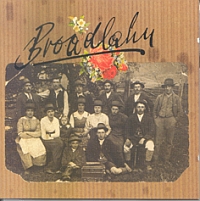 Bua von Muata Natur – Broadlahn
The Graz-based Austrian folk fusion group Broadlahn was founded in 1982 and took their name from the dialect word Broadlahn which means a wide avalanche as well as being the name of an area of alpine pasture in Austria’s Upper Styria region. Bua von Muata Natur is a setting of the Beatles’ song Mother Nature’s Son from Broadlahn’s first album. (Bua is a southern idiom for son or boy.)
It opens with the sound of metal being whetted as a rhythm track. Scythe rhythm is a trick worthy of Tom Waits – and nifty trick enough for that wonderful Bavarian folk-punk band Hundsbuam (meaning the mildly pejorative ‘Dog Boys’ or ‘Sons of Curs’) to have employed it too. Broadlahn’s setting of the lyrics works really well and the performance really brings out the melody’s charms. I happened to be planting raspberry canes and Broadlahn’s version of the Lennon/McCartney song from The White Album sprang into my mind and kept popping up the whole month like a rabbit after my tasties. From Broadlahn (The Fab Records 1990 (GDCD 4009, 1993)
More information about Broadlahn at www.broadlahn.at
When A Guy Gets Boobs – David Lindley y Wally Ingram
In simple statements are great truths revealed. This paean to male sagginess begins with a mellow, flowing introduction that could go in any number of directions. The direction it goes in is John Lee Hooker-wards, though that vibe only really kicks in once Lindley finishes his taxim-like overture and starts singing about Mr Puffy’s expanding set of new glories.
The song even has a Homer Simpson-esque ‘renunciation’ of fattening foodstuffs that in the spirit of Homer you just know will never happen. Maybe it was the product of Stilton, water biscuits and port before climbing the wooden hill to Bedfordshire. Maybe it was brought on by thinking about Bollywood playback, Lisbeth Scott and Avatar, followed by the UK film critic Mark Kermode’s rebranding Avatar as Dances With Smurfs. But in a hypnagogic state I dreamed a dream of David Lindley singing When A Guy Gets Boobs in Springfield and the world was a happier place.
A plea to Mr Groening. If there were any justice in the world a canary-coloured Lindley will guest in The Simpsons singing When A Guy Gets Boobs. From Live In Europe! (No label name, no number, 2004) available from www.davidlindley.com
Let’s Face The Music And Dance – Fred Astaire
Fred Astaire (1899-1987) is a much underestimated singer. His top hat, tails and cane unfairly overshadowed his vocal prowess in his lifetime. He delivers Let’s Face The Music And Dance from the 1936 RKO picture Follow the Fleet with great nuance, style and glamour. It’s one of those songs, the lyrics of which define a time and are also timeless. Came the war, those lyrics came freighted with additional meaning. That is the timelessness of Irving Berlin’s song. I heard the song on the BBC. It lodged and stayed and as it wasn’t on the Fred Astaire anthology that I have you get no discographical recommendation.
Yafa! – Reem Kelani
Before The Last Chance, an anthology of eight songs about Israel and Palestine” on themes of Shoah and Nakbah – the ‘Holocaust’ and ‘Catastrophe’ of Jew and Palestinian – I regret to say that the Palestinian singer, musician and broadcaster, Reem Kelani’s music had passed me by. As had her name. It also appears in some places as Riim Yusuf Kilani.
Yafa! (‘Jaffa!’ as in the ancient port) is her setting of words by the poet Mahmoud Salim al-Hout (1917-1998). It is a threnody for a bygone time in the city of the title, in a place that seems as if it was a paradise in comparison with the Hell it is now.
Zoe Rahman’s piano accompaniment is languid and brooding. The pairing of voice and piano is powerful stuff. The track originally appeared on Reem Kelani’s Sprinting Gazelle – Palestinian Songs from the Motherland and the Diaspora. From The Last Chance (Fuse Records CFCD 008, 2010)
For more information, see www.reemkelani.com
It’s Still Raining – Rajan Spolia
This is the Punjab-born, British-based guitarist Rajan Spolia at his inspiring best. He lists it as a Nash/Goffin/King composition. However, it is more in the spirit of a ragamala – a ‘garland of ragas’ – than a medley. Spolia conjures ‘I Can See Clearly Now’ out of some Beatle-esque phrasing. But that is just part of this marvellous piece of music. The man is long overdue wider recognition. The sheer invention and fluidity of his playing is remarkable. From More Than Words: Snake Music (Chapter IV) (Hard World HWCD008, 2010)
Go to www.rajanspolia.co.uk for more information
Dark Star/El Paso/Dark Star – Grateful Dead
In November 1971 the Grateful Dead arrived at the Municipal Auditorium and Convention Center in Austin, Texas. The band was in a process of regeneration, thanks to the recruitment of their new keyboardist Keith Godchaux. The other players were Jerry Garcia on lead electric guitar and vocals, Bill Kreutzman on kit drums, Phil Lesh on electric bass guitar and vocals and Bob Weir on rhythm guitar and vocals. (Ron ‘Pigpen’ McKernan was increasingly out of action and recruiting another keyboardist was a far-sighted move.) Godchaux had learned the core repertoire from the vantage point of an admirer of the band’s music. This recording of the band’s signature space anthem, recorded by Rex Jackson, finds Godchaux straining at the leash, egging the band on with piano filigrees and fills.
Ten minutes or so into the performance, Weir suggests, feints or cues them into a segue and a couple of minutes later they slide into Marty Robbins’ cowboy-film-in-song El Paso. A masterful transition. Weir sings his cowboy song, visits the cantina, does his business, doffs his Stetson, gets shot (“dreadfully wrong”) and within five minutes, Garcia and Lesh remind the band that they are back in modern-day Texas. They return to Dark Star space via a worm hole through atonalism and jor-like, unmetered rhythmicality before breaking out of the ‘darkness’ into the full glare of what they call Dark Star here but which is more like uncharted space. From Road Trips – Austin 11.15.71 (Grateful Dead Productions GRA2-6014, 2010)
Stay With Me Tonight – Bonnie Dobson
Bonnie Dobson recorded this female take on the Stones’ Let’s Spend The Night Together in 1983. Annie Graham, Gerry Hale and Richard Lee of Telephone Bill and The Smooth Operators accompany her on this archival recording that had vanished until now. She is sassy and inviting and a great little character actress on this one. From Looking Back (Biber 76831, 2010)
Margaret’s Waltz – Aly Bain and Peerie Willie Johnson
 ‘Peerie’ Willie Johnson (1927-2007) was a Shetland-based guitarist who thanks to the curvature of the globe – and the absence of land masses – was able to enjoy faraway radio stations on the other side of the Atlantic. How strange is geography! Certainly, far stranger than geography teachers ever taught me. Still stranger, Johnson was posted to the main Royal Air Force base on the Shetland Islands soon into the Second World War. That was where my bandsman father was posted as the full-time (as in, excused any form of military activity whatsoever) clarinettist, saxophonist and arranger for the base’s dance band. Apparently Johnson used to sit in with the band. If he did he must have sat in with my father.
I wrote Peerie Willie Johnson’s obituary in The Guardian and I am writing his entry for a Supplement for the Oxford Dictionary of National Biography. That is why I have been cramming his music again. This sweet fiddle and guitar waltz, originally on Aly Bain’s The First Album, does not capture the fire of Peerie Willie Johnson. It captures the smoulder. It reminds me of the tale told about Jean Ritchie and Doc Watson. Doc Watson, one of the all-time greats of guitar, hadn’t cut loose when accompanying her. She was puzzled. He told her that he had played what was necessary. That is what happens here. By the way, since you have been so patient and haven’t asked, ‘peerie’ is a Scots idiom for ‘small’, ‘little’. Like ‘wee’. His tradition lives on. From Willie’s World (Greentrax CDTRX309, 2007)
Isho Jannat Zameen Te Le Aaya Ae – Abida Parveen
A good friend turned me on to this album by the Sindhi Pakistani Sufi singer Abida Parveen, presented by the poet-lyricist Gulzar. Based on Punjabi folklore, the star-crossed tale of Heer and Ranjha attributed to Waris Shah unfolds. The meeting is a fortuitous one.
“Kohl [a darkening cosmetic] lines the top of her eyelids
Like Punjab sits atop Hind [India]
Those eyebrows arch arrow-straight
Like words line the sheaf of books.”
The accompaniments blend ancient and modern. The sound palette for Isho Jannat Zameen Te Le Aaya Ae includes bansuri (bamboo flute), rebab (short-necked fretless lute), dholak (double-headed barrel drum) and tabla, electric bass guitar and keyboards. What really, truly sings out is Abida Parveen’s voice. From Heer By Abida (Times Music TDIGH 016C, 2004)
I Walk On Guilded Splinters – Dr. John
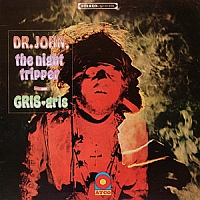 The Last Song you hear tonight should be this one. I Walk On Guilded Splinters – that is the way they spell ‘gilded’ on this anthology, topping ambiguity with ambiguity – originally appeared on Dr. John’s album Gris-gris in 1968. The vibe, the winds, the beats and the backing voices cook up something very deep and slightly disturbing. You do not have to know what Mac Rebennack is singing about or the ingredients he is throwing into the cauldron to intuit that he has been places you never will see or possibly never will want to see. From The Dr. John Anthology – Mos’ Scocious (Rhino 8122-71450-2, 1993)
2. 4. 2010 |
read more...
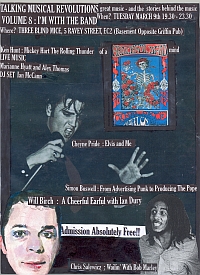 [by Ken Hunt, London] March’s stuff and nonsense comes from Mickey Hart and chums, Joni Mitchell, The Carolina Chocolate Drops, Bob Bralove and Henry Kaiser, Wajahat Khan and the Medici String Quartet, The Six and Seven-Eights String Band, Jo Ann Kelly, Dillard & Clark, Farida Khanum and Sohan Nath ‘Sapera’.
Rolling Thunder/Shoshone Invocation into The Main Ten (Playing In The Band) – Mickey Hart
In 1972 I clapped eyes on Kelley/Mouse’s Rolling Thunder cover artwork in a record rack in the tiny Virgin record store at Notting Hill Gate. It shone out that in some way it was Grateful Dead-related. It turned out that it was the Dead’s absentee drummer Mickey Hart’s solo debut. The opening track sequence draws on and draws in so many threads. Shoshone shaman Rolling Thunder, marimbas from Mike and Nancy Hinton, tabla from Alla Rakha and Zakir Hussain, the whole Calif rock caboodle participating on The Main Ten – John Cipollina and Bob Weir on electric guitars, Stephen Stills on electric bass guitar, Hart on drums, Carmelo Garcia on timbales and the Tower Of Power Horns. That’s why I opted to talk on the subject of Mickey Hart when my fellow writer friend Gavin Martin invited me to talk about anything I wanted at Talking Musical Revolutions 8. From Rolling Thunder (GDCD 4009, 1972)
Help Me – Joni Mitchell
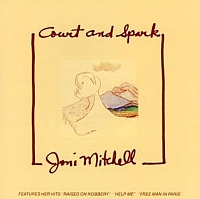 A long-running email dialogue with a rather special vocalist planted Help Me in my head and then the song kept rattling around. Potentially, Help Me is ghazal-like in its layered ambiguity. On hearing Help Me at the time of its release, it had seemed very much a woman’s song. Then under the influence of Iqbal Bano and Farida Khanum and a nazm here and a ghazal there, I got to thinking about how gloriously open to re-interpretation Help Me could be, once going beyond the tale of one of Joni Mitchell’s romances that failed to work out. And more importantly, how it might be twisted to reveal new facets and ambiguities with a further turn or two.
The arrangement begins with trademark Mitchell guitar chords (those tunings that always caused a double-take or two) before the band storms in. Her voice on this recording is as smooth as a silken scarf being run through a gold ring. As songs go, it is both as sheer as silk and barbed. As Help Me exits in one channel, in comes Free Man In Paris (another fine song) in the other. One day Joni Mitchell’s Asylum-era is going to get the treatment and sound it deserves. (What is it with the CD’s flat, gated (?) drum sound?) From one of her greatest works Court & Spark (Asylum 7559-60593-2, 1974)
Snowden’s Jig (Genuine Negro Jig) – Carolina Chocolate Drops
It’s always gratifying for the year to start with a humdinger of a concert that really sets the bar high. The Carolina Chocolate Drops did that with their Bush Hall, Shepherds Bush, London at the beginning of February 2010. I was born with two-left feet but when I hear something like Snowden’s Jig I really do wish for some sort of painless transplant that would enable me to do the soft-shoe shuffle. From Genuine Negro Jig (Nonesuch 7559-79839-8, 2010)
Red Queen – Bob Bralove and Henry Kaiser
During his tenure with the Grateful Dead until they folded their hand following Jerry Garcia’s death in 1995, keyboardist-composer Bob Bralove’s role gradually evolved. He and guitarist Henry Kaiser have taken as their starting points on this album an assortment of improvisations that Bralove fashioned in Grateful Dead concerts.
Explaining the project for this here website, Bralove lifts the latch to say, “Ultraviolet Licorice was a recording that was inspired by the back-up material I did for the drums and space parts of GD shows. By the end of the GD I was playing tracks and playing live as segues between drums and space. I recorded all of those performances isolated from the band. I could record just what I was playing to inspire the band to improvise. Henry and I looked at that material which was recorded during the last six years of GD shows and said, ‘Why don’t we use this to inspire us?’ So we went into Fantasy Studios in Berkeley, CA in July of 2008, dropped all of those recordings onto the multi-track and recorded live to them. On that session I played acoustic piano (Steinway Concert Grand) and Henry played electric and acoustic guitars. It was a one day session and a wonderful time.”
Red Queen differs from much of the material on Ultraviolet Licorice. It could almost be a throw-back to Paul Kantner’s Blows Against The Empire. At 2:28, it is the shortest piece on the album and therefore closer in length to Bralove’s Quicksilver Rain, Wind Before The Storm, Urban Twilight and the Bralove/Tom Constanten composition Cowboy Sunset on Bralove’s solo piano album, the delightful Stories in Black and White (BLove 1001, 2007).
Today, the Red Queen conjured in my mind is the Red Queen of Through The Looking-Glass. Tomorrow, she may be a character in a card game. The day after that, who knows? From Ultraviolet Licorice (BLove no number, 2009)
For more information about its participants go to http://bobbralove.com/music.html and http://www.henrykaiser.net/
Raag Desh – Quintet for Sarod and String Quartet – Wajahat Khan and the Medici String Quartet
Desh, also known as Des, is a late evening raga. It is very popular, it is much performed and, personally speaking, it is one of my favourites for the vistas it opens up. The sarodist Wajahat Khan, one of maestro Imrat Khan’s sons, places Desh (it means ‘country’ twinned with ‘homeland’) in a very different landscape to the ones that most interpreters have placed it in. The reason for that is simple: Paul Robertson (violin), Stephen Morris (violin), Ivo-Jan van der Werff (viola) and Anthony Lewis (cello). Collectively, the Medici Quartet. There is such sensitivity apparent here. Khan breaks the performance into four movements: Prayers of Love, Monsoon Memories, Romantic Journey and Celebration. The effect is pastoral and elevates the suite to amongst the highest achievements in East-West classical collaboration. From Wajahat Khan and the Medici String Quartet (Koch 3-6996-2, 2000)
Clarinet Marmalade – The Six and Seven-Eights String Band
The Carolina Chocolate Drops’s gig jolted me into revisiting my past. I thank them for that. The Six and Seven-Eights String Band of New Orleans, though from a parallel tradition to the one the Drops are exploring so ably, could be their godfathers. They are probably more or less forgotten now. More’s the pity. Apparently string band jazz was popular around 1910-1925 in New Orleans but little of it was ever recorded. The Six and Seven-Eights date from that era. They were long gone when that marvellous mandolin maestro David Grisman alerted me to the existence of their solitary Folkways album. Like Dave Apollon, they became part of my back-education.
There is a total joie de vivre – surely the right expression for a New Orleans-based band of such character – to their music. Credits: William Kleppinger (mandolin), Frank ‘Red’ Mackie (string bass), Bernie Shields (steel guitar), Dr. Edmond Souchon (guitar); produced by Frederic Ramsey Jnr and Samuel Barclay Charters. Smithsonian Folkways will do you a copy as part of the archival service. From The Six and Seven-Eights String Band of New Orleans (Smithsonian Folkways Recordings FA 2671, 1956)
The downloadable liner notes are at: http://media.smithsonianfolkways.org/liner_notes/folkways/FW02671.pdf
Black Rat Swing – Jo Ann Kelly
 It is strange how things can happen. Jo Ann Kelly (1944-1990) was, to my mind, the finest and most natural female blues artist that England ever produced. Her self-titled Epic album was reviewed in one of the first issues of Rolling Stone that I ever saw. She was somebody I would have loved to have interviewed and learned from. We never talked to each other. The irony was that we were frequently tens of yards apart during our lives.
After she died in October 1990 there was a bash to commemorate her in a pub – the Royal Oak maybe – close to Clapham North tube station in London. The following Sunday I visited my parents in Mitcham on the north Surrey-south London border. As usual, I relayed what I had been up to and mentioned reviewing a musical wake for Folk Roots for a blues singer who had died way too early called Jo Ann Kelly. My mother commented that one of her neighbours five or so doors down had also been called Jo Ann, had been a musician and that she too had died recently. My mother continued that Jo Ann’s partner was called Pete Emery and talked about Jo Ann cycling off with her daughter on the ‘dickey seat’ – a Hunt family joke from my mother’s family’s Singer car’s pannier seat days (sorry about the Saxon genitive mouthful) – of her bicycle, taking her to school. At that point we realised that we were talking about the same person, doors down on the street that I had left two decades before. Never managed to find Pete Emery in afterwards when I knocked. Then when my mother’s illness caused me to move back in, events overtook. It never happened then either.
One of the people I met at Jo Ann’s farewell bash was John Pilgrim, master of the Viper-ish washboard, whip-speed anecdote and quip alike. If I could bottle Pilgro’s recollections and finagle a monopoly on incontinence pads, I would be a very rich man. John plays washboard on Black Rat Swing, a Soho pick-up (honest, it’s a great story) and pre-Pentangle Mike Piggot plays fiddle, the lass sings and Pete bubbles away on electric guitar. It is an epitome of groove. From Do It & more (Hatman 2023, 2008)
www.manhatonrecords.com
The Radio Song – Dillard & Clark
Dillard & Clark – Doug Dillard and Gene Clark – were an act that never achieved their full potential yet what they delivered on their two albums – The Fantastic Expedition of Dillard & Clark (1968) and Through The Morning, Through The Night (1969) – was truly spectacular. The warmth of the harmonies and the strength of the musical support conjure glowing memories. The Radio Song is a performance that I associate with a visit to Collett’s in New Oxford Street at the time of the album’s UK release. Hans Fried – who, with Gill Cook, was one of the lurking presences in that record shop – and I got stuck into good-natured banter about Dillard & Clark and the Flying Burrito Brothers.
The interwoven strands of Dillard & Clark’s voices, the chop-chord and burbling mandolin, steady rhythm guitar and the sly introduction of bowed string bass create the sort of combination you can spend hours – and years – unpicking. From The Fantastic Expedition of Dillard & Clark/Through The Morning, Through The Night (Mobility Fidelity Sound Lab MFCD 791, undated)
Read more about Dillard & Clark at Crawdaddy!‘s online presence:
http://www.crawdaddy.com/index.php/2010/02/02/the-fantastic-expedition-of-dillard-and-clark/?utm_source=NL&utm_medium=email&utm_ca mpaign=100209
Bale Bale – Farida Khanum
Farida Khanum is a Punjabi treasure. That assessment should apply to both sides of the Wagah Border. Regrettably, there is a really unfortunate snootiness on the border’s Indian side towards Pakistan-based artists. This is a piece of Punjabi tradition, praising the gait of Punjabi womankind. Talking the walk, if you prefer. “Bale Bale” – maybe “bole bole” comes closer for Anglophone ears – means, “Say, say”, “Tell, tell”, that sort of thing in the scheme of Punjabi-ness. No doubt there are better recordings of her doing this staple in her repertoire but I really do not care one iota. Don’t be put off by the la-la-la introduction.
There is an ambience and presence to this recording (and her other seven performances on it) that distils so much. This version, the (untranslated) French notes state, comes from the film Pardesi (‘Stranger’ or ‘Foreigner’) after an idea by Martina Catella. It’s a simple song with harmonium, hand-drum and handclap accompaniment. In its simplicity it says so much about the Punjabi character and the perils of division. It’s a very optimistic song. From Pakistan – Musiques du Pendjab, Vol. 2 – “Le Ghazal” (Arion ARN 64301, 1995)
Phagan Ka Lehra – Sohan Nath ‘Sapera’
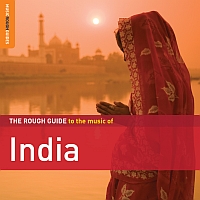 I should apologise for this choice but I’m jolly well not going to. Advance copies of my Rough Guide to India arrived and, like one does, I played it. This piece of Punjabi folk music taps into Ludhiana’s Rajasthani migrant worker influx – think Mexican bracero field workers at whatever picking time in California in particular to get a US parallel – and consequential cultural cross-fertilisation.
Shefali Bhushan’s Beat of India from which this snake-charmer music derives is one of the truly great labels promoting India’s folk arts. If there is one more active when it comes to promoting India’s folk music, pray tell. This is music with dirt under its nails, not folkloristic park entertainment or ‘gentrified’ folklore. From The Rough Guide to the music of India (World Music Network RGNET1231CD, 2010)
Context from Aparna Banerji at http://www.tribuneindia.com/2010/20100117/spectrum/book6.htm
11. 3. 2010 |
read more...
[by Ken Hunt, London] This month’s prime quality stuff offers up some seriously magnificent music. This time round on the Banquet Isle with the hole in the middle, Joseph Spence and the Pinder Family, Steeleye Span, Emily Portman, Chumbawamba, Jenny Crook and Henry Sears, Eddi Reader, Lennie Tristano, Kate & Anna McGarrigle, Incredible String Band and KK are serving up the goodies.
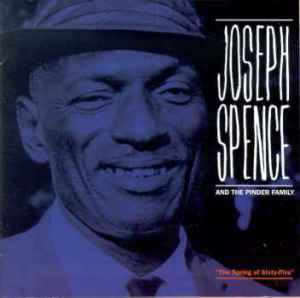 I Bid You Goodnight – Joseph Spence and the Pinder Family
Manumission is a ‘big’ word in several senses. It means a release from slavery. (The Shorter Oxford Dictionary finesses its meaning better if more wordily.) The day I first heard I Bid You Goodnight, a piece of musical magnificence if ever, upstairs in Collet’s folk department in New Oxford Street in London was a day my life changed forever. It was nothing less than a musical manumission. That Nonesuch album, The Real Bahamas, was mind-blowing.
I Bid You Goodnight was more blues, more gospel than I had ever heard from anyone in my life. The weaving voices were revelatory, a similar sort of impossibility to The Watersons. It was the stuff of dreams that necessitates re-calibrating and re-tuning your ears. (All the while delighting in so doing.) I Bid You Goodnight is a performance that needs repeated doses – not to get the gist of, but to imbibe over and over the better to appreciate it.
Later, I met Jody Stecher and Peter Siegel who had recorded Joseph Spence and the Pinder Family in the Bahamas in 1965 for that Nonesuch LP. (The credits were misspelled ‘Pindar’ on the original vinyl Polydor Special edition of the LP that I tracked down in Woolworth’s at Tooting Broadway for twenty-five pence, as they had been on the US Nonesuch edition.) Still later, Peter took me and my daughter to the exact spot near the Brooklyn Bridge where he had taken Joseph Spence. A hallowed place, one might say.
When I interviewed Jody Stecher, he told me about a second take of I Bid You Goodnight that had never been issued because of a glitch because of people pressing in too close to the microphone. That second version, the one here, now cleaned up, eventually appeared in 1992. It differs from the Nonesuch ‘original’ the way folk music should differ. (If you want something pretty much replicated exactly from performance to performance, opt for the Eagles.) For Giant Donut Discs I am taking the Rounder version.
For reasons of the heart, mind and body, the Nonesuch version, however, would be one of my all-time Desert Island Discs. From The Spring of Sixty-Five (Rounder CD 2114, 1992)
Who’s The Fool Now? – Steeleye Span
Around 1968-69 I seem to remember hearing this song sung by The Home Brew (Michael Clifton, John Fordham and Ray Worman) on the wireless. Maybe I’m conflating events but in my memory the session also had Shirley Collins singing. I placed plastic against Bakelite and recorded the broadcast on a Phillips open-reel. I have no idea what happened to that tape but Steeleye Span’s rendition brought memories flooding back.
The song is a lustrous commentary on the state of inebriation – or altered states. Or maybe merely an observation on absurdity and a world in which a hare chases a hound, a mouse chases a cat, cheese eats a rat and so on. It opens disc one of the CD and DVD. From Live at a distance (Park Records PRKCD104, 2009)
More information at: www.parkrecords.com
Fine Silica – Emily Portman
Emily Portman’s reaching for notes on Fine Silica evokes in me memories of Annie Briggs and Lal Waterson. Exquisite. From The Glamoury (Furrow Records FUR002, 2010)
More information at: www.emilyportman.co.uk
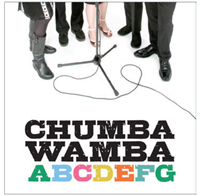 Pickle – Chumbawamba
I was writing some lines about the first time I heard Anne Briggs’ Hazards of Love in a record shop and the way the information on the back of an LP or an EP was a whole world of information to be lapped up in those pre-internet days. The following day Chumbawamba’s newie landed on the doorstep and rather than plopping ABCDEFG on the digital Dansette and listening to it, I deliberately took the package down the Nelson to read the notes before playing the CD. Much as I had done with Hazards of Love back when.
Loads of the stories in the notes were ones I knew but I’d never seen them assembled in such wantonly redolent order. Reading them felt like it used to do when one was spinning the dial on the radio and slipping and sliding between domestic radio stations, static and faraway signals. The tales embrace Brecht, Metallica, the Devil’s Interval and Shostakovich. Good company, eh?
Pickle is inspired by a retort of Martin Simpson’s about “people who want to keep music faithfully traditional, want to preserve it and not alter it.” Martin’s reply: “That’s not music” – pause – “that’s a pickle.”
Coda. Since these are my donuts, the Chumbas’ Hammer, Stirrup & Anvil about Shostakovich’s ear and what we get to hear gets shoehorned in here as a Bonus Donut. From ABCDEFG (No Masters NMCD33 and Westpark WP87186, 2010)
More information at: www.chumba.com
Kwela Ceilidh – Jenny Crook and Henry Sears
Certain things do not transplant well. The new soil they attempt to grow in changes them. British folk clubs, Irish pub sessions and Hungarian táncház usually become different elsewhere once uprooted from their native habitat. The Herschell Arms is a freehouse in Park Street, Slough (as in the sly Robb Johnson song, She Lives In Slough, concerning a certain Slough-based royal). Let me contradict myself. The Herschell Arms was an Irish pub on in British soil that bust clichés, at least at the time that The Herschel Sessions was cut.
It includes live session recordings by Broderick (Luke Daniels, Clare Garrard, Colm Murphy and Don Oeters), Jenny Crook and Henry Sears, Cunásc (Paul Curran, Eric Faithful, Brian Hurst and Roger Philby), Herschel Street (Alan Burton, James Fagan, Steve Hunt and Nancy Kerr) and Don Mescall.
Kwela Ceilidh is a string duet for harp and mandolin by Jenny Crook and Henry Sears. Crook was apparently a finalist for the BBC’s Young Tradition Award in 1992 and contributed music to David Attenborough’s The Private Life of Plants while Sears has done sessions for Alison Moyet and the BBC. The tune just jumps out at the listener. I cannot comment on the continued availability of The Herschel Sessions CD but I found a reference to a version of the same tune (that I haven’t heard) as being on their Chasing the Dawn. This, however, would appear to have the tune’s first recorded excursion – happy to be contradicted – and highly effective it is too. From The Herschel Sessions (OSCD003, 2000)
More information at: www.jennifercrook.com
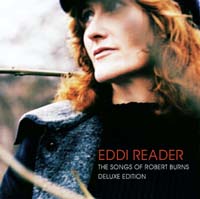 Ae Fond Kiss – Eddi Reader
Adding to a month’s listening on Burns Night in January 2010 without adding something from the Scots Bard would be remiss. Eddi Reader’s rendition of Ae Fond Kiss (‘One Fond Kiss’ in Scots) is sublime, the way pain can be. But especially the pain of parting.
“Ae fond kiss, and then we sever/Ae fareweel [farewell], alas, for ever” – Burns’ opening lines are so simple and yet so telling. As songs of separation go, it knows few rivals in any language to my ken. Ae Fond Kiss, take it to your bosom and it will mean different things at different times in your life. Ae Fond Kiss is a love song of the profoundest ilk. Its line “For to see her was to love her” communicates a sense of loss and unconditional love and exerts a pull as few songs or pieces of poetry ever achieve. A song of love and parting for all seasons. From The Songs of Robert Burns (Rough Trade RTRADCDX097, 2008)
C Minor Complex – Lennie Tristano
Lennie Tristano (1919-1978) made piano solos maybe the like of which nobody had ever heard before. Here he is flying and delivering new lessons not only in how to play but in how to listen to jazz in 1962. I would imagine The New Tristano has lost not one jot of immediacy and impact down the years. Listening to what each hand is doing is a lesson in itself. This is the sort of music that parallels what was happening with the marvellous Jacques Loussier and his explorations of jazz from an alternative perspective on his trio’s Play Bach albums. (Remember how Play Bach No. 3 (Decca SSL 40 507, 1959) and Play Bach No. 5 (Decca SSL 40.205 S, 1964) felt?) From The New Tristano (Atlantic Masters 8122-77676-2 – the CD edition gives 1962 again)
Matapedia – Kate & Anna McGarrigle
Kate McGarrigle wrote songs. Anna McGarrigle wrote songs. Matapedia’s wonderful lyrics leave you guessing which sister wrote which bit of the song. Matapedia, the album, is one of their masterpieces. Whether individually or collectively Kate & Anna McGarrigle wrote some of the finest songs in the English and French languages and bequeathed them to posterity. Too close to Kate McGarrigle’s death to write anything more analytical. From Matapedia (Hannibal HNCD 1394, 1996)
Ken Hunt’s obituary of Kate McGarrigle in The Scotsman of 23 January 2010 is at http://news.scotsman.com/obituaries/Kate-McGarrigle.6007824.jp
The First Girl I Loved – The Incredible String Band
January 2010 saw me delivering an article about the Incredible String Band’s first five LPs. None of the re-mastered albums were available as I wrote that piece for R2. The day I was due to ping the article off, The Incredible String Band and 5000 Spirits landed on the doormat. 5000 Spirits played while doing the last-minute tweaks. Joe Boyd and John Wood – respectively, the producer and sound engineer on the original Elektra sessions – have done wonders with its master. First Girl I Loved, the last track on the album, left its mark yet again.
The remastered Robin Williamson was singing very clearly, “Well, I never slept with you/Though we must have made love a thousand times” a few days later when my daughter rang, prompting a startled “What are you listening to?” Strange the power of words and song. The song is eely and ends as an epistle. Robin was 23, coming on 24, when the album on which this appeared came out.
He took the song to new places subsequently, expanding it into an astonishing performance piece. Him doing the song with its spoken word section at Stagfolk, the folk club in Shackleford, off the Hog’s Back in Surrey, around 1980 still lingers as a memory. Annoyingly Southern Rag commissioned me but never ran the review. From The 5000 Spirits or The Layers of The Onion, Fledg’ling FLED 3077, 2010)
Look out for more information about the Incredible String Band reissue programme at The Bees Knees, “a music information archive and the home of Fledg’ling records”: www.thebeesknees.com
Ajab Si – KK
 As a film Om Shanti Om is an exceptional mishmash/mash-up on a Bollywood pile-up scale, both cinematically and musically. It flips between past and present lives, past and present movies with lashings of the supernatural and rebirth, revenge and disco beats. The music is from Vishal & Shekhar and the lyrics are from Javed Akhtar.
The film itself is tongue-in-cheek referential with allusions to Karz and a red carpet of Bollywood cameos, including the bow-down-and-be-so-very-humble-in-her-presence Rekha (Bhanurekha Ganesan) and that what’s-his-name? fellow from Sholay. This is maybe the least obvious track to pick from the soundtrack, much of which is decidedly upbeat and comes ringing with kitsch lines like “My heart is filled with the pain of disco”. That said, who gives a flying flip? Because it’s Bollywood, innit? From Om Shanti Om (T-Series/Super Cassettes Industries Limited SFCD 1-1261, 2007)
11. 2. 2010 |
read more...
[by Ken Hunt, London] Who said most months’ Giant Donut Discs reflect deadlines and commissions with a pinch of music for pleasure? This month’s reflects twinges of pain as well. A little pain goes a long way. This time around, we feast on Davy Graham, Wenzel, Llio Rhydderch and (Fernhill’s) Tomas Williams, Achim Reichel, Sonu Nigham & Madhushree, Billie Holiday, The Fisher Family, Los Lobos, Shirley Collins and Big Brother & The Holding Company.
She Moved Thru’ The Bizarre/Blue Raga – Davy Graham
 Davey Graham died on 15 December 2008, days before I was due to journey to India. That was why I missed his funeral. He would have approved of that – an excursion trip to India trumping a funeral trip. In the days before travelling I wrote his obituary for The Scotsman. Then whilst travelling in India I wrote his German-language obituary for Folker! (since then the magazine has dropped the exclamation mark) between Agra, Jaipur and Jalandhar. This is the way I wish to remember him: as a friend and a musician who at his best and at his various peaks made the rafters ring. He could be infuriating and could be infuriatingly good too. As here. When he recorded this he was Davy, by the way. From the Dave Suff-compiled anthology A Scholar and a Gentleman (Decca 532 263-1, 2009)
Ken Hunt’s obituary in The Scotsman dated 18 December 2008: http://news.scotsman.com/obituaries/Davey-Graham-Guitarist-composer-multiinstrumentalist.4803436.jp
Arschgeweih – Wenzel
It’s saucy. He’s naughty. And Wenzel is a Liedermacher‘s Liedermacher, a songwriter’s songwriter. He twists like an eel. He writes eely songs that sit around like time-bombs a-ticking away which you can never guess when they might ‘fully’ make sense. They come drenched in allusion and allegory. Arschgeweih! As a title, in the English ‘Arse Antlers’ works even better. There are no subtitles but, admit it, it is a hoot of a title to hook the unwary.
It opens with the potty mouth/barber’s invitation “Das Schamhaar kurz rasiert.” or “Public hair shorn short.” and from that opening gambit it just gets better and better because he’s not bothered. Plus who could resist offerings from a record company whose name translates both as “Sailor blue” or “Drunk as a sailor? If this is what a boy from the German interior can do, imagine what he could have done if he had grown up on Hamburg’s Reeperbahn or in Rostock! From König von Honolulu (Matrosenblau //08, 2009)
Bedd f’ anwylyd (My Lover’s Gone) – Llio Rhydderch and Tomas Williams
It’s not a perfect take but the combination of Rhydderch’s triple-strung harp and Williams’ trumpet captures another dimension of Welsh vernacular music. It’s an apple with blemishes but, that said, many of the tastiest apples will never get on a supermarket shelf. It also says oodles about what’s happening in Welsh arts nowadays. From the Various artists’ Blodeugerdd – Songs of the Flowers (Smithsonian Folkways SFW CD 40552, 2009)
Die Gedanken sind frei – Achim Reichel
Achim Reichel is one of the defining musicians of Hamburg’s music scene. A contemporary of whatever the Beatles were called in their Reeperbahn days, he survived Hamburg’s little-white-pills-and-Pils beat scene era and went on to create a body of work that bottled Hamburg’s very essence with shanties and folksongs (Volxlieder is a corruption of Volkslieder or folksongs).
One of the most enjoyable conversations – as opposed to interview – I ever had with a musician during the Noughties was with Achim Reichel. It lapsed into Hamburg dialect and Platt. This old song about thoughts being free, as in cannot be controlled, is one of most haunting songs of the German condition. Ougenweide’s Frank Wulff lays his mojo hand on this studio recording like a Hamburg whore to healing superb effect. From Volxlieder (Tangram 69532, 2006)
Inn lamhon ke damaan mein – Sonu Nigham & Madhushree
 Watching Jodhaa Akbar in a freezing apartment in Jalandhar in the depths of winter in January 2009 summoned unbidden the opening words of T.S. Eliot’s poem The Journey of the Magi: “A cold coming we had of it/Just the worst time of the year.” Elliot’s lines carry echoes of an Anglican sermon preached on Christmas Day 1622 and unless you have experienced a Punjabi winter they may sound out-of-place. The snakes and the frogs are tucked away hibernating even though, no doubt, the daytime winter temperatures were far milder than England in the early 1600s. But winter in Punjab is a different sort of cold to the ones westerners are used to.
Even before the heating finally kicked in and before the film’s images took hold or Hrithik Roshan (Akbar) and Aishwarya Rai (Jodha) wove their cinematic magic, A.R. Rahman’s OST was already on the way to dispelling the cold. It’s difficult to call an A.R. Rahman soundtrack underrated nowadays. Jodhaa Akbar deserves to be better known, not least of all – mirroring Rahman’s life – it blends Muslim and Hindu elements so cleverly and with such integrity. The soundtrack from which this song comes is masterly, a major piece of quality work. Javed Akhtar is the lyricist. The song itself is a typical Rahman composition in the sense that it could only come from him or one of his copyists – copycats if you wish. If anyone wants to hear what Bollywood was like in the second half of the first decade of the Twenty-first Century C.E., listen to Sonu Nigham & Madhushree. And be prepared for mood, tempo and rhythmic shifts, anchored in a marvellous melody.
Furthermore, the CD itself is a superlative piece of packaging, of the sort explains why the artefact can add value to the ‘product’. (Like that of Rab ne bana di jodi (YRM-CD 90050, 2008) since you ask.) From the soundtrack to Jodhaa Akbar (UTV 88697 23373 2, 2007)
Gloomy Sunday – Billie Holiday
It’s not the best version of the Hungarian suicide song but it was the one that introduced me to the masterpiece. Teddy Wilson & His Orchestra accompany. It was recorded in 1941 and finds its new lend-lease life here as part of Bob Dylan’s radio show entitled President’s Day (no. 68). From Theme Time Radio Hour – Season 2 (Ace CDCH2 1225, 2009)
Joy of my Heart – The Fisher Family
 This track was recorded by Bill Leader in 1965. There was no room in the house so Joe Boyd slept in the car. It’s a wonderful affirmation of life. Norman Buchan’s notes said, “This Gaelic song is full of praise for the beauty of the Western Isles, and many have been translated into English – not always successfully – by Marjorie Kennedy-Fraser and others. This one reverses the process. It was written in English by Hugh S. Roberton to the Gaelic tune Leannon Mo Ghaoil. It has been translated into Gaelic by John Bannerman.”
The Fisher Family on this recording are Archie, Cindy, Joyce, Priscilla (later Cilla) and Ray. For its joy of life. From The Fisher Family (Topic 12T137, 1966, reissued in Japan on the British Folk Paper Sleeve Collection VSCD-834, 2002)
Kiko And The Lavender Moon – Los Lobos
 The performance is here because it’s magical and moreishly sinister.
“He plays and plays/Still playing till he/Goes off to sleep.”
The source’s artwork is so bland and puny that it’s going to be shamed but mercifully not named here. So there!
A Denying: The Blacksmith – Shirley Collins
Folk poetry is a rare thing and this is rare by any standard. A version appeared on Shirley Collins’ EP Heroes In Love. That was how I first heard it. Having heard it, I went ferreting out England’s folk heritage that no manner of Cecil Sharp-inspired singalongs or country dancing in school had ever prepared me for. Hearing that EP helped make it make sense. Hearing Anne Briggs’ The Hazards of Love reinforced the wonder of a tradition I had never suspected existed or indeed had ever existed. Those two EPs were the first two folk record purchases I ever purchased. That is about as high as it gets in my opinion. I got more than lucky with those two sweet little mysteries of life.
This version is the second variant Shirley Collins recorded, though. It is the one from her Anthems in Eden song cycle that begins:
“Oh, a blacksmith courted me, I loved him dearly.
He played upon his pipes both neat and trimly,
With his hammer in his hand he strikes so steady
He makes the sparks to fly all round the smithy.”
A Blacksmith Courted Me is a sublime tale of love and desertion – the way pain can be sublime. And Shirley Collins’ performance on her and her sister Dolly’s version on their magnum opus captured an additional facet of this superlative piece of folk poetry. Shirley’s voice doesn’t rant or rail: it captures the bewilderment of abandonment. Folk poetry in its highest state. From Anthems in Eden (EMI Harvest SHVL 754, 1969)
I Need A Man To Love – Big Brother & The Holding Company
 A choice brought on by guitarist James Gurley’s death at the age of 69, a couple of days before his seventieth birthday. It brought back memories of Big Brother & The Holding Company and the birthing pangs of their Cheap Thrills album, on which this song was originally released.
Agreed, the smart money would be on the Cheap Thrills version. This one’s slightly shorter in length yet still not what you’d call succinct. The song is a new introduction to their repertoire in April 1968 and is still being played in.
The group shot in the cover artwork is by Baron Wolman and was taken at the Palace of Fine Arts in San Francisco in 1969. Left to right: up front, Janis Joplin, Dave Getz, James Gurley, Peter Albin and Sam Andrew. From Live At Winterland ’68 (Columbia Legacy CK 64869, 1998)
Valerie J. Nelson’s obituary of James Gurley from the Los Angeles Times of 24 December 2009 is at http://www.latimes.com/news/obituaries/la-me-james-gurley24-2009dec24,0,1577562.story
Baron Wolman’s website http://www.fotobaron.com/
Big Brother & The Holding Company’s website: http://www.bbhc.com/
2. 1. 2010 |
read more...
 [by Ken Hunt, London] Most months’ choices reflect work. This is no exception. As ever, there is no particular order. These selections lodged in the cranium for various reasons. In the main, they reflect events and associations. Inara George came from nowhere. Matt Turner, Peg Carrothers & Bill Carrothers came from reviewing and talking to Patrick Humphries about a BBC radio programme. Mhuri yekwa Muchena and Louis Killen came from continually looking to where we come from as opposed to not looking back – and Griselda Sanderson from cross-connecting. Tom Constanten and Vishwa Mohan Bhatt came from concerts. Robb Johnson came from winter tales of the Hounslow expatriate kind. But they all join together here.
Thorneymoor Woods – Louis Killen
 Louis Killen recorded this poaching song with a twist during his sessions with the premier recordist of Britain’s Folk Revival, Bill Leader from 1964 into 1965. The song Thorneymoor Woods was one of the nine tracks that appeared on Ballads and Broadsides (Topic 12T126, 1965), one of the era’s most important examinations of English or Anglo-Scottish folksong. The song was, to some extent, overshadowed by Killen’s ‘big song’ of the period, The Flying Cloud. Mind you, most of his repertoire was overshadowed by that tale of buccaneering and slaving and final come-uppance.
Thorneymoor Woods is lighter. Frankly, beside The Flying Cloud nearly anything short of an incest ballad or a bit of infanticide would have qualified as light. Consequently, it played an important role in Killen’s live repertoire. It provided balance and light and shade, a chance for the audience to recover from being racked and ruined.
 Thorneymoor Woods is a variant of The Nottinghamshire Poacher. It takes place far from where Louis Killen grew up – Tyneside – but in the same county in which Anne Briggs was raised. She sang in some ways the better-known version of the song on her LP Anne Briggs Topic (Topic 12T207, 1971). (That, incidentally was the album on which her Blackwater Side appears – the yarn out of the Minotaur’s den that leads to Led Zeppelin song of a similar name.)
Better-known version? Well, Killen’s Ballads and Broadsides went out of print and for decades was unavailable with copies changing hands for goodly sums on the second-hand market. The album’s reissue in 2009 reinforced how powerful an interpreter of traditional song he was. This song and his performance indicate why. From Ballads and Broadsides (Topic Records TSCD 126, 1965/2009)
Basant – Gangubai Hangal
“Men will be ustads and pandits. Bais will be bais.” – Gangubai Hangal, on ustads being Muslim masters/teachers, pandits Hindu masters/teachers and bais always just females until attitudes change.
Gottfried Düren made this recording in May 1991 at the Sangeet Natak Akademi in New Delhi. It may seem impertinent to say this but I shall anyway. Any singer or admirer of Hindustani classical song could do far, far worse than listen to this album of hers every so often in order to recalibrate the senses and sensitivities. She was one of a kind and her treatment of Basant, the seasonal raga that translates as ‘Spring’, is gorgeous. Top up your reality levels, springtime or otherwise.
The loss of Gangubai Hangal in July 2009 was a major blow. She was an old-school singer for whom superlatives and descriptions frequently failed and will always fail. (‘Always’ is a big word but justified in her case.) She represented a generational handing-over of one specific vocal tradition amid many Hindustani vocal traditions to another generation. Her interpretations took a simpler path, not that her interpretations were simple. She told her stories without prettifying them yet added ornamentations exquisite enough to curl the toes.
Down to earth, she asks in the booklet notes to this recording that insightful question: “Where is the need for new ragas when we can’t master even half the number of our old ragas?” From The Voice of Tradition – Vocal Music from North India (Haus der Kulturen der Welt/Wergo SM 1501-2, 1991)
Reginald Massey’s obituary ‘Gangubai Hangal – Acclaimed Hindustani classical vocalist beset by caste prejudice’ from the Guardian posted on Sunday 23 August 2009 is at
http://www.guardian.co.uk/music/2009/aug/23/gangubai-hangal-obituary
Ken Hunt’s obituary ‘Gangubai Hangal: Singer who rose above her low caste status to become a grand dame of the Kirana school’ in the Independent of 15 October 2009 is at:
http://www.independent.co.uk/news/obituaries/gangubai-hangal-singer-who-rose-above-her-low-caste-status-to-become-a-grand-dame-of-the-kirana-school-1802616.html
Oh! Susanna – Matt Turner
Matt Turner (cello), Peg Carrothers (voice) and Bill Carrothers (piano, voice) have approached the songs of Stephen Foster (1826-1861) in a wholly unusual fashion. Or in a series of wholly unusual fashions, to be more accurate, because the trio’s treatments – various and several – are so different.
It’s hard to impossible to choose one track from this work but Oh! Susanna brings much of what they do into sharp focus. The project is a limited-edition (2000-copy) release. Get it while you can from: Illusions, 4 Passage d’Enfer, 75014 Paris, France. From Matt Turner’s The Voices That Are Gone (Illusions, ILL 313003, 2008)
www.illusionsmusic.fr
The Recruited Collier – Anne Briggs
Because Anne Briggs continues to inspire year in, year out after her supposed ‘vanishing’. From Anne Briggs – A Collection (Topic TSCD 504, 1999)
Fairytales In Feltham – Robb Johnson & The Irregulars
Years down the line, years after coupling a bunch of songs together and adding new ones, Robb Johnson has knitted together a winter suite of songs with Christmas as the denouement. This opens the debacle. It is a soap opera/social commentary set in the hallowed London Borough of Hounslow. Hard to choose one from the suite, so here’s Johnson’s opening gambit. From The Ghost of Love – A Christmas Song Cycle (Irregular Records IRR076, 2009)
http://www.irregularrecords.co.uk
Marenje – Mhuri yekwa Muchena
Raindrops from Heaven delivered by two mbiras. The album is credited to Traditional Mbira Musicians and the Kevin Volans Ensemble. This music was in my mind when I was writing the notes to the Kronos Quartet’s Pieces of Africa album, released in 1992. And this month – for reasons unknown – the overwhelming urge came to listen to World Network’s Zimbabwe – Mbira volume and the Mhuri yekwa Muchena (Muchena Family) recordings. And this track got stuck on repeat. It is very good. From Zimbabwe – Mbira (World Network 52.990, 1991)
The Magpies And The Wolf – Griselda Sanderson
This track is a mood piece for nyckelharpa, Hammond organ and percussion that reminds me of Pieces of Africa. A wonderful introduction from John Crosby. From Harpaphonics (Waulk WAULK3. 2008)
www.grissanderson.com
http://twitter.com/johncrosby1950
‘Hichki’ – Vishwa Mohan Bhatt and Musicians of Rajasthan
At Vishwa Mohan Bhatt’s concert with his son Salil and Sanju Sahai on tabla on Sunday 29 November 2009 at Kensington Town Hall – Note Asia’s inaugural concert – he played this Rajasthani folksong about hiccoughs (‘hichki’) that summons images of similar folk superstitions about, say, sneezing, as an instrumental.
Desert Slide was one of the finest albums I have ever been party to. Hichki hinges on a Rajasthani folk belief or superstition. When a person thinks of somebody from whom they are separated – the one he or she is missing – they are said to get the hiccups. My grandmother spoke of sneezes and surprises. The narrator here has got the hiccups. In Rajasthan the song is set in what is commonly called Bhairavi but it is truer to Kirvani from the South Indian Hindu heartland.
It’s about sadness or melancholy, pain and pangs of separation. An emotional cocktail. From Desert Slide (Sense World Music 085, 2006)
http://www.noteasia.org/
http://www.senseworldmusic.com
Mountains of the Moon/Dark Star – Tom Constanten
 Likely as not, Tom Constanten’s name produces a kneejerk reaction through his connection with the Grateful Dead. Paradoxically, he has played more gigs with Jefferson Starship’s various packages than his gig count with the Dead. This recording from Karlsruhe in Baden-Württemberg in southwest Germany reinforces how exceptional he is at tickling the ivories.
Their late 2009 European tour brought Tom Constanten, Gary Duncan (formerly Quicksilver Messenger Service), Dave Freiberg (Quicksilver Messenger Service and Jefferson Starship) and Paul Kantner (Jefferson Airplane and Jefferson Starship) to Britain. Whilst in London, Constanten suggested a preference for the Hamburg concert’s performances from the 2005 tour over the Karlsruhe concert. No matter, Karlsruhe or Hamburg this time as opposed to Hamburg over Karlsruhe every other time.
Mountains of the Moon/Dark Star segues into People Are Strange – that old-time toe-tapper from the Doors. Importantly, as this recording shows, he’s still improvising, still keeping himself and his audiences on their toes. From Mick’s Picks Volume Three – Substage, Karlsruhe 06/16/05 Bear Records bearvp103CD, 2008)
Photo: Gary Duncan and Tom Constanten, fresh graffiti at the 100 Club, London, November 2009 (c) 2009 Ken Hunt/Swing 51 Archives
http://www.tomconstanten.com/
Trouble – Inara George
 “Well, I’ll write a letter and I’ll send it away/And put all the trouble in it you had today.” Lowell George’s daughter, Inara George interprets this Little Feat jewel here. It’s heartfelt; it’s got Van Dyke Parks producing; and it summons the stunned memory of how I felt when I learned about her father’s death from the cover of Melody Maker outside Sutton station in July 1979. Broke, I sloped off nevertheless to the Robin Hood to mull over Lowell George’s life and music, to mourn and nurse a solitary pint of Young’s Special. His death became a short-lived model for small celebrations of people’s lives. Later, I went to the Bishop Out Of Residence in Kingston to reflect on the lives of Jerry Garcia and Peter Cook. Still later, I mourned the demise of Young’s elsewhere in a Fuller’s pub.
Decades of work as an obituarist have largely robbed me of that immediate time for grieving. Inara George’s recording of Trouble connects me and wafts me back. “Well I’ll write a letter and I’ll send it away/And put all the trouble in it you had today.” Sometimes I can’t help but change the pronouns in my head. From Rock And Roll Doctor – A Tribute to Lowell George (CMC International 06076 86242-2, 1997)
5. 12. 2009 |
read more...
« Later articles
Older articles »