Interviews
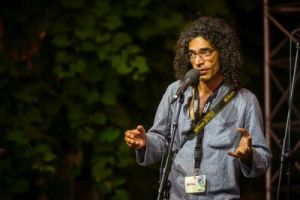
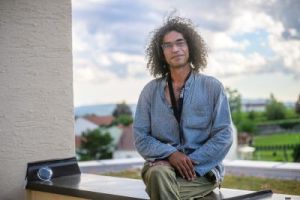 [Petr Dorùžka, Krems, Austria] Music enterpreneur Ankur Malhotra explains: The reason is favoritism and classism. There are millions spent by billionaires on weddings rather than be used to support the musicians via grant systems.
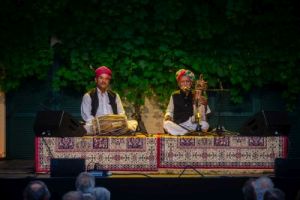
Malhotra represents some of the best Indian folk and roots musicians who perform on major festivals worldwide. Barmer Boys play spiritual Hindi and Muslim songs from the Rajasthani desert. 77-year-old Lakha Khan is the last living sarangi violin master. His music ranges from ragas to Sufi chants and epic chants. Decades ago, the virtuoso violinist Yehudi Menuhin was one of the first Western supporters of Indian music. He declared that the dark and hypnotic tone of the sarangi is “the very soul of Indian feeling and thought”.
Indian music has been explored step by step by the West during the past 70 years. On his travels, Menuhin discovered two greats of classical music, Ali Akbar Khan and Ravi Shankar. He presented Khan in 1955 at the New York Museum of Modern Art. Shankar was touring in the West since 1956, in 1960 he gave a concert at the Prague Spring festival, and four years later at the Woodstock festival. Nusrat Fateh Ali Khan from Pakistan took qawwali sufi chants to Womad festival in 1985, thanks to Peter Gabriel.
 However, music from the Indian subcontinent is still unknown in its full range. Yet, there are many cases when it flows to the West under favorable conditions. But when a Western listener travels to India as a cultural tourist, leftovers of colonial mentality reappear. Malhotra also explains this contradiction. The interview took place during the Glatt und Verkehrt festival in Krems on the Danube in Austria.
How many professions do you have?
It depends on the time of day and what needs to be done. I am a mechanical engineer, I have an MBA degree, I have also worked in robotics, with aircraft engines, and children with dyslexia. But music has been more than a hobby for me since childhood. As a student, I made mixtapes for friends, later I became a radio host and DJ on American radio (WORT 89.9FM). I have worked in various capacities for my artists as producer, video director, sound engineer, photographer, mastering, cutting dub plates, websites, tour management, PR and marketing. Yes, I do have many professions.
So you started your career as an engineer?
I graduated from R.V. College of Engineering in Bangalore in South India, majoring in Mechanical Engineering. Then two years of software programming. And at the same time, I was making my way towards the music. I lived half in India, half in the US for the past two decades.
What kind of music did you prefere?
I was interested in blues, psychedelia. And Indian classical music too. When I was studying business in the US, I saw Bob Dylan and Neil Young for the first time. I started volunteered for a festival in Madison, Wisconsin. It was then that I noticed how many places in the world music comes from, but India was missing. That has no logic, because today it is the most populous country in the world. Our culture has a centuries-long history of music. I asked: can I do anything about it?
But Ravi Shankar played at Woodstock. George Harrison introduced Indian music to rock audiences. And then there was Shakti and other fusion bands.
That’s a tiny fraction. What about Indian folk music? Master players from the countryside also have a lot to offer. I was figuring out how to start, how to shape the identity of an artist. But first you need to record the music.
So you made field recordings? In Rajasthan, the birthplace of the European Roma?
Yes, that’s how I started working with some of the legendary folk masters from Rajasthan, also recorded their biographies, presented them at concerts. Musicians from all across Western Rajasthan and Kutch in Gujarat. By the way, Indian music is unimaginably diverse, and just in this relatively small zone of India (still larger than many Western European countries combined!) there was so much musical diversity to be found. Then we also have black communities, originally from East Africa, the Sidis based in Kutch.
Were their ancestors brought there as slaves?
 Some were slaves, some came as traders, others as sailors, and as travelers. Exchange between India and East Africa has been going on for centuries.
For field recordings you need financial support. Could you apply for any government funding?
I took it as a labor of love. I was motivated by my love for music. There were some mentors who donated funds and some used equipment (Sony cassette recorder).
Have you been investing your savings?
I had minimal savings from my start up world and those all went into the business I co-founded (Amarrass Records). We struggled on extremely low budgets for a few years, but eventually I had to come up with some kind of sustainability plan.
How did you plan the next step? Licence field recordings to record labels, radio stations, academic archives?
Private stations in India are interested in commercial stuff, Bollywood. And as far as archives are concerned, my work was not meant to be an academic exercise. I wanted the music to bring joy to audiences. I wanted the music to create a lasting impression. I wanted the audiences to know the musicians name, know their music and their art. Those musicians knew nothing about distribution and show business, but they needed someone to get them out into the world. In Madison, Wisconsin, I was connected with one of the oldest community stations, WORT 89.9 FM, and in 2013, on my first US tour, we recorded in the studio with musicians. Later we got airplay and support from European stations like Funkhaus Europa, BBC, and more.
The 20th century had several milestones when Indian music came entered the Western world. Yehudi Menuhin introduced two giants of Indian classical music, Ravi Shankar and Ali Akbar Khan, to international audiences. George Harrison popularized the sitar. And in Britain, a modern version of the traditional bhangra music emerged, originally played in Punjab to celebrate the successfully harvested crops.
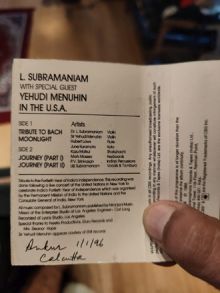
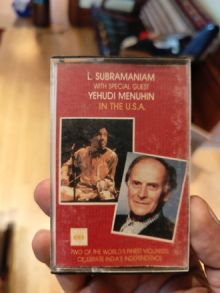
I would elaborate further. Menuhin, for example, played with the South Indian classical violinist L. Subramanian in the USSR in the early 1980s. When I was growing up in Delhi, I used to listen to an L. Subramanian cassette recording with the jazz violinist Stéphane Grappelli (Conversations). All these were key artists and opened the world’s ears to Indian music. Then, when modern bhangra emerged in the Indian diaspora in the 1980s, Indian music merged with hip hop.
How do Punjabi Indians really feel about British bhangra?
For example, Apache Indian, a British artist with Indian roots, had a big hit in India in the 1980s, which was made possible the multinational music television company MTV. But there are other connections. The Indian market was also penetrated by the Algerian rai singer Khaled. We played with Barmer Boys in Berlin (Wassermusik 2017) when Khaled was performing there. They performed their version of Khaled’s big hit Diddi, and he invited the Barmer Boys on stage. When Vieux Farka Touré (guitarist from Mali and son of the late Ali Farka Touré) came to India, he jammed with musicians from Rajasthan. Malian kora virtuoso, Madou Sidiki Diabaté, has performed with Lakha Khan. They could not talk to each other, but wonderful sound colors flowed from their instruments. Together they played 48 strings, 21 on kora, 27 on sarangi.
The kora, sounding like a European harp, is relatively familiar in the West, unlike the sarangi.
The sarangi, like the sitar and other Indian instruments, has three sets of strings: melodic, sympathetic, which provide additional color, and drone. The melodic ones are made of goat’s intestine, and the others are made of steel and bronze. It’s a notoriously difficult instrument to master and while the sound of the sarangi is omnipresent in a lot of classic Bollywood, the master musicians and luthiers who make this folk instruments are disappearing.
And that’s why the instrument is so hard to tune. When the temperature changes, does each of those strings go out of tune differently?
 Yes, but at the same time, that is the beauty of the instrument. It’s sound has such a wide range of overtones. One single instrument creates amazing layers of sound.
But, because of that complicated tuning, the sarangi as an accompanying instrument is gradually being displaced by Indian harmonium, and becoming the most endangered species in the world of Indian instruments?
Lahka Khan is the seventh generation of master players in his family, a recipient of the India’s highest honor, the Padma Shri Award. No wonder he looks down on the harmonium. You can play any note on the sarangi. It has no frets, whereas on the harmonium only notes corresponding to the keys can played. According to Lakha Khan, “you don’t even need any master skills to play the harmonium”. When I first met Lakha, he told me a story. His father told him before he died that if the sarangi continues to be played in the family, his name would be preserved in the memory of India. Each player is expanding his skills through his whole life and sacrifices everything for the instrument.
How do India-Pakistan relations work in culture?
There is no cross-border exchange, a completely absurd situation. The two countries are united by the same culture, but the governments do not allow the union, and music to be practiced. Meetings take place in third countries. Two years ago, we performed at the Aga Khan Museum in Toronto, and there were some beautiful moments. A master player from India and a qawwali singer from Pakistan were next to each other on the big stage.
Here in Austria, Lakha Khan performed this morning at an early concert as part of the festival. How did it go?
At 7 o’clock, he played morning ragas in the garden of the monastery. We named that concert the Awakening of the Gods, because unlike humans, they are not lazy and get up at sunrise. Specifically, we evoked the gods Rama, Krishna and Shiva. The second morning was a Sufi affair invoking the majesty of Allah’s creations. It was sold out. We did a similar concert at the Roskilde festival in Denmark.
If you are presenting Indian music to the world audiences, is there any chance for financial support?
In theory, this can work on two levels in India. In the philanthropic, private sector where you have patrons, and also on the state level. But neither works in music of my artists. For example, the Indian government offers programs where an artist gets a grant to perform in a concert to celebrate the Independence Day. So, the whole event is based on a routine, while the artist himself, the musical content, the creative part, are neglected by the officials. All that remains is to look for support through private initiatives.
On the other side, South Korea has a well-thought-out grant system which is more functional than in some European countries. The music of a country whose population is 30 times smaller than India’s is heard far more often at world festivals. Isn’t that an example Indian institutions should follow?
 Korea is an exceptional example. It works similarly in Canada and in Scandinavia. There you can get a grant of 10,000 Euros. You will record an album with that money. Indians have a lot to learn, especially if they can spend hundreds of millions on a wedding. At the same time, such money could dramatically change the image of Indian music in the world.
Hundreds of millions of rupees?
No, dollars. This is only possible because in India the dividing line between the government and corporate structures is somewhat blurred.
Thanks to corruption?
This is the first cause, the second is nepotism.
Nepotism, can you explain that?
That is the hidden structure. Who do you know, how well you get along with them, what contacts do you have. This determines your market value. And according to the list of acquaintances, your further destiny.
Which is strongly reminiscent of the unfortunate Indian caste system.
Exactly. A number of caste prejudices are so deeply rooted in society that they penetrate into the economic sphere as well. So, your place on the social ladder is all ruled by caste. And that also determines if you get invited to the party.
Have you had the opportunity to play at someone’s wedding with a band?
Yes, a couple of times in India. It happened in the diaspora, but also with the Barmer Boys in Denmark.
But a proper Indian wedding takes more than one day.
It depends on the region, sometimes even a week. They often invite more bands.
Can you put this to European perspective? In my country, it happens that a band from the Balkans cancels a concert at a festival when they receive a more lucrative wedding offer. Does that mean, that one wedding is equal to, say, five times a fee from a big festival like Roskilde?
Yes, depending on how wealthy the wedding party’s families are, the fees can be enormous sums.
Any example?
In July 2024, the son of multi-billionaire Ambani got married. The cost was 200 million dollars. Imagine someone like Rihanna among the guests. Her fee is 5 million. Mark Zuckerberg gave the newlyweds a private jet as a wedding present. Mukesh Ambani is the richest man in Asia. The status of the local airport was shifted to international. Just temporarily because of the wedding. That is the definition of nepotism. When you are a wealthy business executive in India, you can change the rules whenever it suits you.
When you play a wedding as a musician, you receive a fee according to the contract. The other part is the bills that the guests stick on the foreheads of musicians to play their favorite songs. How much does this make?
Sometimes more than the contract itself. They also attach banknotes to the musicians’ clothes, and make sure that everyone else sees it.
In India, you also have festivals whose program curators are experts from Europe. For foreigners who come to the festivals as cultural tourists, their names may be a guarantee of quality, but if you look at it from the point of view of an Indian, aren’t they missing something?
These festivals take place in historical forts, palaces, i.e. places that are not easily accessible to the ordinary Indian. A certain exclusivity is created, the event is expensive for the local listener. Besides tourists, these festivals are aimed at the local elite. I see it as segregation. Behind the scenes there are separate spaces for players of different importance. Organizers insist on their own prices, fees are often at the level of a pittance.
So, while the colonial mentality has died out in Europe, it does persist in the business European are doing in India?
Organizers circumvent the rules, considered as good manners in the industry. The musician’s manager also functions as a protection for the artist from unfair practices, but some of these presenters go directly to the artist and reduce the fee to minimum. The artist does not have the training to defend his interests. It’s a completely different approach than the festivals we play at here in Europe, which are aimed at the widest audience. Which is much more in line with my priorities. In this way, more permanent ties are created, important for the music community.
There is a large Indian diaspora in Britain and elsewhere. To what extent are those immigrants part of your audience?
It may sound surprising, but it is not. For example, in New York or Toronto, where the diaspora is very strong, we did not see many Indians in the audience.
In India, you have classical music, ghazal love songs considered as “semiclassical”, Bollywood music, spiritual chants. In Europe the line between classical and popular music is still rigid. How does it work in India?
Classical players look down on folk musicians. Lakha Khan, who comes from a folk music background, sees it this way: Yes, the classical players have to follow all these rules, but we have freedom. We can move across genres, we can play what a classic player is not allowed.
Would they invite him to a classical music festival in India?
Rather not. The Government of India has formalized this concept and made rules. There is an Indian Council for Cultural Relations and classical players get paid four times as much as folk musicians. The system is hierarchical, so even an inferior classical player is better off than a master folk musician.
A unique opportunity for artists to break out to international festivals is the annual Womex conference and showcase festival. You and the Barmer Boys were lucky to be selected but then cancelled. Why?
The reason was health problems. Lead singer Manga needed major heart surgery. He was only 49, like me. But when you work in India with rural artists, access to medical care and how to pay for it are highly complicated issues. And besides, these artists have no education. Manga is illiterate, his passport has a fingerprint instead of a signature. Science, medicine, that is a distant world for him. He escaped from that hospital and sought refuge in a Sufi shrine. There he recited prayers in the hope that he would be healed before the doctors.
(Unfortunately, Manga died in September 2024, 5 weeks after this interview).
In the case of Lakha Khan, does the term “last living master” have a different meaning in India than, ?say, among American bluesmen?
For one thing, yes. In India, so much work is still needed, so that the awareness of that music, its meaning, penetrates into public opinion, and into the institutions that can support it. For example, few people in India know who Lakha Khan is. But there are more people in the world today who have an idea about his talent.
28. 9. 2024 |
read more...
 Denis Péan is the guiding spirit of the French group Lo’Jo. In October, the band presents their new album Feuilles Fauves on tour, including a Prague concert.
[Petr Dorůžka, Praha] After 42 years and 14 albums, Lo’Jo still sound like a group of visionaries from another world. Their roots go back to the punk rock era, but you can’t hear it in their music. Also, Lo’Jo is untouched by French musical stereotypes. If you hear a chanson track, it’s shifted into a distorted Tom Waits perspective. Musically, Lo’Jo was inspired by trumpeter Don Cherry, psychedelia, experimental music by groups like Magma, African genres, but these influences are more ideological than stylistic. The group’s sound cannot be described using routine clichés, everything here works differently. But one thing grabs you right away: the voices of two North African singers, the El Mourid sisters. They are playful, affectionate, sensual and yet laconic. They create the perfect counterweight to the narrative vocals of Denis Péan. The female voices frame the band’s sound perfectly, but unfortunately to the listener, they often quickly disappear, leading the Guardian critic Robin Denselow to note: “The only disappointment is that the sisters aren’t given a larger role. They provide some gloriously edgy backing.” However, it is up to the painter to use the chosen color only sparingly and thereby add meaning to it.
Denis Péan accompanies himself on the Indian harmonium, an instrument that deserves separate study. Nico, the female singer on the Velvet Underground’s first album, was responsible for the parallel life of the Indian harmonium in the West.
“History is a book made of porcelain,” sings Péan on the Transe de Papier album. His texts are unique metaphors based on the art of abbreviation. His language was inspired by Apollinaire, Baudelaire and Nietzsche, as well as books from the local radical bookstore La T©te en Bas, which later became the target of extremist violence. The band’s instrumental pillar is the strained melodic strokes of violinist Richard Bourreau. He met Péan at the conservatory in Angers, a city of 150,000, halfway between Paris and Brittany, where they both studied Baroque music. In addition, musicians were attracted by styles from all distant and mysterious corners of the world. From Bourreau’s violin we hear tango and Irish music as well as folk styles from Eastern Europe.
Denis and I have been preparing for the following interview since spring 2024. When I identified his face in the audience at the Babel Music festival in Marseille at the end of March, he confirmed that the interview would take place, but by email. I agreed, knowing that email conversations lacked interaction, which this time was balanced by the content. Péan answered laconically, but the group’s history offers stories that, like the “butterfly effect”, had a deep impact on later musical development. The crucial link was the connection between Lo’Jo and the then-unknown Justin Adams. He became their producer 5 years before he became famous as Robert Plant’s guitarist. Adams clarified this little-known story when he performed at the Respect festival in Prague in June 2024. Late 1990’s, Lo’Jo were invited to a concert in Bamako, the capital of Mali, and logically took Adams, their producer, with them. In Bamako, they were contacted by a person who introduced them to the Tinariwen, a group of desert nomads playing electric guitars. Both Lo’Jo and Adams were fascinated by their music. The resulting event was the first edition of the Festival au Désert near the border with Algeria, which took place in January 2001. The Prime Minister of Mali, four ambassadors, and representatives of the UN visited. Government Toyotas welcomed the nomadic Touaregs on camels. Later in summer, the first album by Tinariwen was released, with Lo’Jo and Adams participating. Not many people remember now, that the phenomenon of “desert blues” was partly invented by a French band who refuse to be fashionable.
 What kind of music did you grow up with?
My parents weren’t interested in the arts. We didn’t have music in the family’s house.
Also, there was no traditional music in my native area. My education was silence. When I became a teenager, an older guy in my village gave me my first musical initiation with seventies Anglophone psychedelic music.
You played a bassoon in the old days – what made you choose such an unusual instrument?
Because of the introduction of Le Sacre du Printemps by Stravinsky and the Vivaldi Concerto for bassoon.
And when did you pick up an Indian harmonium? The best known artist who used that instrument was Nico. Is any influence from her?
I saw Nico solo in concert with Indian harmonium at the end of the seventies, but I began to play this instrument when I met Indian musicians from Rajasthan.
How did Don Cherry influence you? What did you ask him after his concert in Théatre d’Angers in 1978 ?
In my native town Angers, we had a cultural centre where jazz musicians performed. I had a chance to listen to Carla Bley, Miles Davis, Art Ensemble of Chicago, Lounge Lizards, etc. I became addicted to Afro-American culture, not only to music to but also to thoughts about politics, slave history and civic rights. When I met Don Cherry, I was so shy, but I felt we shared the same soul and I think he was a visionary and that he felt this too. Don was a pioneer in the way he mixed jazz with traditional Indian, African and European sounds.
How many languages do you speak?
I’m specifically very interested in French literature and poetry, but I compose some songs in Spanish, English or Creole.
And how many languages can you understand at a limited level?
I feel close too to the Creole language of the Réunion Island. It sounds very rhythmical and musical, it’s a very creative form of a new language of survival for the slaves.
I used to write songs (especially girls’ chorus) with an imaginary “Lo’jo” language made of sounds more than meaning.
If I remember well, in the past you made a song in Wolof. Was it more an adventure or a project based on linguistic research?
Yes, and pther songs in the Dogon language or Lingala. That adventure in Africa gave us something very precious about music, humanity and philosophy.
We’ve met at Babel Music. Did any of the bands impress you? My favourites were: Belugueta (Occitania) and Sanam (Lebanon).
I liked the very emotional Palestinian singer Christine Zayed, also Belugueta. And Alostmen were so powerful.
Do the Lo’Jo members still live in a common house outside Angers, in the French countryside? How many people with family members in total?
We were around fifteen people living in the Lo’jo house where we received many musicians coming from all around the world, especially from West Africa and the Indian Ocean.
Claire_Huteau.jpg "(c)Claire_Huteau") Once you said: I go to prisons, psychiatric hospitals, to the schools where I play. So Lo’Jo did a concert in French prison, like Johnny Cash in Folsom Prison?
Once you said: I go to prisons, psychiatric hospitals, to the schools where I play. So Lo’Jo did a concert in French prison, like Johnny Cash in Folsom Prison?
Yes, we play in prisons, but my most emotional musical experience was playing for babies in a centre for orphaned children. Unusual places to play in are a challenge for creativity.
The style of your music is not exactly French chanson, yet there are some common links: focus on the lyrics, deep yet hidden emotionality, and a high level of sophistication. Were you influenced by any chanson singers?
Not really, I have respect for different artists, but I follow my own way and experiment my own form of language and singing.
Often Tom Waits is mentioned as a related artist. Can you comment on this?
People have their own references, it’s possible that a Russian guy will compare me to Vladimir Vysotsky or an African guy to Boubacar Traoré.
Tell me about the books you write. Was any of them translated?
It’s poetry, my experience of life, games with language, the esoteric perspective, musical flow. There’s no translation, except for some songs. It’s perhaps very difficult to translate.
Justin Adams produced some of your albums, years before he became famous as Robert Plant’s guitarist. How did you find him? Or was it the other way?
In the early nineties, when our album Fils de Zamal came out, the artistic director of the label was Andy Morgan, a friend of Justin – they played together in their first punk group when they were teenagers. Andy wanted us to meet Justin, who was just out of a painful break-up with the musician Jah Wobble and wanted to bounce back from it by producing albums. Years later, Andy became the first English manager of Tinariwen.
Actually, one of the major points in Lo’Jo’s biography was the meeting with Tinariwen. Do you remember how it happened?
Lo’jo organized the Festival au Désert at the beginning of the century, in the little town called Kidal. We’ve met the musicians of the legendary band Tinariwen, and we recorded their first album Radio Tisdas Sessions in a dusty radio station. We introduced the band in Europe and the United States. We became great friends and still are now.
What was the main quality of the band you liked?
The lyrics, I took part of a translation team for the album Aman Iman. The hypnotic power of rhythm, the sensual atmosphere of sound.
Justin Adams was also involved. Did you introduce the band to him, or was it the other way?
Before this festival, Justin was the artistic producer for 2 albums of Lo’jo and we even brought him with us to Mali. We met Tinariwen together in the Adrar of Ifoghas, near to Kidal in north Mali at the end of 2000.
You toured France with them in 1998, and 3 years later you helped them to create the Festival au Désert. How did you find the funding? And did you invest your own money, or just your time and energy?
Lo’jo produced the festival. We carried sound and light equipment from France.
We had some financial help coming from the famous French street theatre festival “Châlon dans la rue”. It was a crazy improvisation.
The name Lo’Jo sounds great in English and in French too. Maybe that is the definition of what these 2 languages have in common. Or maybe you have another explanation?
If I spoke Arabic or Czech, I would write songs in Arabic or Czech.
Your new album is called Feuilles Fauves. Can you explain the name for non-French speakers? I tried and got this: Leaves gone wild. Is this close to what you mean?
“Feuilles” is the vegetal part: leaves, also for humans, the piece of paper to write on. “Fauves” is the animal part, also the wild part of human.
The singers Yamina and Nadia Nid El Mourid are rather Berber, or Kabyle, than Arab? Are they from the Algerian Sahara or Atlas mountains?
Their parents came from the Atlas mountains, the Algerian side from the mother and the Moroccan part from the father. They are Kabyle/Berber, not Arab.
Robin Denselow in The Guardian calls for more space for Yamina and Nadia. Can you imagine them as solo singers with Denis Péan providing background harmonies?
That’s exactly the case on this new album.
For The Quietus you said: “I was obsessed with not trying to be fashionable, I didn’t want to do what other people were doing.” 15 years before that, Magma took a similar path, in ideas, yet in a very different style. Did you listen to Magma before starting Lo’Jo?
When I was a teenager, I saw Magma in concert. It was a very deep experience for me. There’s nothing similar to Magma.
1. 9. 2024 |
read more...
A long talk with Phillip Page, who took Värttinä, JPP and Kimmo Pohjonen around the globe.
 [Petr Dorůžka, Praha] Finland is musically one of the most diverse regions of Europe. The country of five and a half million offers tricky rhythms from Karelia, Sami joik, high energy dance tunes of pelimanni fiddlers, Finnish tango, runo songs from the Kalevala epic and of course music of Finland’s two national instruments, accordion and kantele. In Finland, tradition is practiced as a living process and not as a museum exhibit, due to many dozens of creative musicians and educators. The crucial move in updating Finnish folk music to modern times was made in 1983, when Heikki Laitinen (* 1943) started the Folk Music Department at the Sibelius Academy in Helsinki. One of the first entrepreneurs to bring Finnish music to the world stage was Phillip Page. Already charmed by Finnish LPs as a DJ and record shop manager in the US, he moved from Texas to Helsinki in 1987. Since that time, he worked with artists such as JPP, Maria Kalaniemi, Värttinä, Kimmo Pohjonen and others, introducing them to audiences around the world.
What kind of music were you growing up with? And did you get any kind of musical education?
I was not a musician although I studied music in school for about ten years, sang in choirs, dabbled at piano and was in two bands. Beatles and Beach Boys were the first bands that changed / shaped my life. The adventure, the songwriting/compositions, vocals, harmonies, arrangements, the innovation. My favorites in my formative years late 60s – early 70s: George Harrison – Wonderwall (1968: dreamy trippy soundtrack featuring Shivkumar Sharma and numerous Indian musicians plus Eric Clapton, probably the most brain expanding influential album of my life), Spirit’s groundbreaking first album (1968), Van Dyke Parks – Song Cycle, Beach Boys – Smiley Smile, Györgi Ligeti, Apple Records, Freddie Hubbard / İlhan Mimaroğlu – Song of Songmy LP, Bee Gees, Stones – Satanic Majesties, Bowie, Genesis, Van der Graaf Generator, Egg, Gentle Giant, K Crimson, Amon Düül II, Gong, Strawbs, Shirley & Dolly Collins, Wigwam, Pekka Pohjola, Jukka Tolonen, Zamla/Lars Hollmer, Supersister. Anything from anywhere that was different and adventurous, composition based. I was seeking and buying records full time. The local record shop called me Captain Record.
How did you start your professional career?
September 1, 1971 at a regional record distributor and managing the number one alternative record shop in Houston TX. Soon I was an FM radio DJ doing weekly six-hour shows playing all the best underground European and American records. I wrote LP reviews for local music magazine The Lamb. I was import buyer/manager and starting team member at Cactus Records, Houston, the first giant record mega-store in Texas and ran a distributor of UK and European import LPs
In Texas. One major event was in 1975, meeting David Crosby and Graham Nash who turned me onto the 1966 Nonesuch Records album Music of Bulgaria by Phillipe Koutev. That amazing album opened up a whole new world.
The Nonesuch album was one of the most overlooked records in history, released twenty years before the British label 4AD sold 100 000 copies of Le Mystere des Voix Bulgares album that made Bulgarian choirs popular worldwide.
That is correct. After the Indian music of George Harrison – Wonderwall, the Bulgarian LP was my second introduction and ear-opening exciting path of exploration into non-western classical and folk musics. “Theodora Is Dozing” was / is an incredible introduction to the genius of Philippe Koutev. Of course, on my first trip to Bulgaria in 1985 I bought a pile of Balkanton LPs.
From Cactus in Texas I went to JEM Records, New Jersey in 1977, managing the Visa Records label, releasing albums by and doing national FM radio promotion for National Health, Peter Hammill, Patrick Moraz, Shirley Collins and others. Then to Virgin Records America in NYC 1980-82 doing national FM radio promotion, mainly for XTC plus Motors, Fingerprintz, The Ruts etc.In 1982, my good friend Louis Karp and I conceived, created and opened Waterloo Records in Austin, TX. I simultaneously did regional US sales for Important Records distributor, including Texas promotion/tour press for Metallica – Kill ‘Em All LP.
What was the most impressive concert of that era you remember?
Genesis – The Lamb, Houston Texas, 1975 and The Shirts at the Bottom Line, NYC, 1978
And, how did you discover music of Finland?
In 1971 in a Houston record shop, my music seeking antenna found the album: Wigwam – Tombstone Valentine, double LP on Verve Forecast label. That was a life changing event.
It was produced by Los Angeles musician, producer Kim Fowley, who also worked with many L. A. artists including Frank Zappa and produced Feelin’ Reelin’ Squeelin’, the B-side of the first Soft Machine single.
Yes, Fowley produced the Wigwam album and apparently he organized the Verve deal. I am not sure who decided to make it a double LP in USA (with non-Wigwam tracks) but it was a brilliant move. The cover, band name, album title, were like nothing I had ever seen and the album instantly “spoke” to me, like a zap from another dimension: “Enter this new world. Buy Me Now”. Of course I obeyed and playing the album at home, the first song was beyond anything I had ever heard or experienced, as was the entire album.
 Inside the music business, I dived deeper into Finnish music, and went to Finland in 1983, ’84, ’85 see and hear for myself and when back in Austin Texas began importing Finnish LPs into USA via my company Suomi Sounds selling by mail order and at Waterloo Records.
At which point did you decide to settle down in Helsinki?
In 1987 I went to Kaustinen Festival, Finland and instantly was blown away by the band JPP and the festival. Another life changer and I instantly knew I had to stay. Helsinki became my base and I spent all my time in Digelius Music shop and mail order company, my main Finnish connection since 1974. I was an employee and in fact co-conceptualist with owner, Ilkka “Emu” Lehtinen.
The name of the band that changed your life, JPP, is short for Järvelän Pikkupelimannit, “Little Fiddlers of Järvelä”. At that time they were, and still are, a family band of relatives featuring master fiddlers, playing high energy dance music typical for their home region.
I had been importing their first two LPs into USA via my company Suomi Sounds 1985-87. Four fiddlers (three were of the Järvelä clan) plus Timo Alakotila on harmonium plus double bass. They were amazingly innovative, mixing trad folk tunes plus original compositions and arrangements with distinctive melodic and harmonic twists that I had never heard. Way beyond folk music, they were a miniature orchestra playing, composing and arranging in a totally new and distinctive way. Timo Alakotila was for me a genius composer up there with Brian Wilson, Sibelius and Benny Andersson.
After moving to Helsinki, what were the next bands that caught your attention?
 Seeing Maria Kalaniemi’s first solo show in Helsinki was magical. As an accordion player and composer, she was so special, different, original. A serious player / composer opening ears and hearts of all who heard her. Immediately I knew I wanted to work with her. I also started working with Värttinä in 1993 organizing press, radio and extra gigs around their SXSW Austin showcase, then licensed the Seleniko CD to USA and made several US tours plus international tours and licensing.
Värttinä’s Seleniko album (1992), produced by Womex co-founder Ben Mandelson, reached the top of the European World Music radio charts, and remained there for 3 months. Wasn’t that the crucial era for both you and Finnish bands?
Indeed it was an important time for all Finnish music folk music and contemporary folk music artists. In 1993, I brought all three: Maria, JPP and Värttinä, to Rudolstadt Festival in Germany, followed by more gigs and tours and licensing in Europe, USA and later Japan.
Rudolstadt at that time had budget similar to Womad in the UK and was very influential. Finnish music was breaking through but from the mainstream view, it was so far away from the music that makes money. Did you have a vision that working in this area would help to pay your bills?
Well, my expenses were low: cheap rent and sharing flats with friends, my office was inside Digelius. My main vision was that these artists were truly brilliant and had great chance for international attention, work and success. My goal was to help make that happen.
How did the business plan of Digelius music start? In a garage, like Google decades later?
Digelius started in Helsinki in 1971, same year that I began in the music business in Texas. Digelius began as a tiny electronics shop and quickly became a jazz shop, importing jazz and all kinds of LPs from USA, UK, Europe etc. “Emu” Lehtinen was the expert who turned Helsinki onto exceptional music of all kinds. When I joined, jazz was the biggest genre for Digelius and we promptly decided to expand into worldly musics, avant garde/experimental, etc. Not much later we moved from the tiny shop to the much larger, highly visible corner space at Viiskulma (Five Corners).
You could find similar cases in other places at that time. Sterns in London, later one of the most important labels focused on African music, started as radio shop. Was there any exchange between these emerging independent labels/distributors?
I am not sure if Emu had been buying from Sterns before I arrived or if I initiated that. We had steady business with Sterns importing and exporting for many years. We were importing LPs and CDs from around the world including large and small companies and distributors. We also bought direct from artists. We imported LPs / CDs from Japan plus LPs from EMI Pakistan and EMI India. Exports of Finnish music were to international partners in many countries: UK, Europe, Japan, USA. I also ran the Digelius international mail order business, selling folky ethnical worldly and other musics to individual buyers worldwide. As regards other players: Tapio Korjus was established for many years with his successful Rockadillo Records and Agency. Martti Heikkinen was importing from Rounder Records and others.
Years later, in 2019, it was Tapio who co-organized the first Finnish Womex in Tampere. In the Digelius era, people were still buying CDs, and producers could invest money into projects like Buena Vista. How profitable was your work at Digelius?
Profitable? Well we stayed afloat but there were periods when Emu and I both did not take salary. We kept it going somehow.
So in these periods you just lived off your savings?
I had commissions from gigs and CD license deals from my Hoedown Arts management company plus I was DJ
on Finnish national radio YLE doing weekly two-hour shifts for four years (which fortunately paid very well!). My program Worlds Away was very eclectic
Was it in English? Was it the only English music show on YLE?
John Peel and I had the only two English language programs on YLE.
How did promotion work, how did airplay help to sell your CDs? There were some important like-minded partners around the globe. World Music Charts across the whole Europe, Cliff Furnald with his RootsWorld magazine and radio in USA, fRoots magazine in London.
As regards my management work, all these and many others were in my regular contact list. Sending CDs, press releases etc. Radio airplay definitely helped draw attention and of course World Music Charts was vital, especially as so many Finnish albums entered the Top Ten. fRoots and Songlines gave us positive reviews on a regular basis. Those things plus touring generated significant interest, fanbase, CD sales.
While attracting new audiences, was there any turning point?
 Kimmo Pohjonen at Womex Berlin 1999. A life changing event for him and me. His career took off from that one amazing gig.
Any travel stories?
One of the main reasons I wanted to represent artists was so I could see them on stage as often as possible. There are so many great stories. The best was seeing audiences go apeshit at the concerts. Värttinä at Club Quattro, Tokyo. Phenomenal. Kimmo at Womex. Wow. One big challenge was with JPP: getting Timo Alakotila’s 100 year old / 88kg harmonium on the plane as checked baggage with no costs. We succeeded every time except one!
The two decades, between 1990 and 2010, that was the most important time of discovering unknown musical territories. The French producer and festival director Christian Mousset was exploring music of Mali, Madagascar, La Reunion. Francis Falceto started the Éthiopiques CD series mapping music of Ethiopia. Both of them received Womex awards for lifetime achievement in years 2009 and 2011. Did you get any recognition from the Finnish authorities for your work?
Yes I think I received three awards: one from Kaustinen Festival and two from Music & Media convention.
How is your life now? How did your work with JPP, Maria, Värttinä, Kimmo evolve during the past decades? Don’t you miss seeing audiences go apeshit?
Management work evolved into exciting projects such as director of Värttinä’s – Ilmatar album which led to the Lord of the Rings musical with Värttinä as co-composers and then the Miero album with Real World. With Maria the highlight was Accordion Tribe with ten years of touring and three albums (including working with Lars Hollmer, now sadly passed on). For Kimmo: Uniko with Kronos Quartet was a high point plus mainly KTU with Pat Mastelotto and Trey Gunn. With JPP, co-ordinating the String Tease album was a rewarding project,
bringing in Väsen as special guests. Hoedown Arts evolved until 2016 when I moved to countryside where peace and nature quickly became priority. Of course, I still seek, explore, buy and listen to music daily with the same ravenous appetite. The hectic work schedule is now greatly reduced to minimal but yes I do miss the gigs with the wild audiences.
Is there still new music to be discovered? Can you relate to what the young generation is listening now?
There is an incredibly vast amount of new and old music of all kinds to be discovered, going back one hundred years to the present, from all around the world. Every day is a new opportunity to find something exciting. As regards the “younger generation”, the current mainstream music is not to my taste but fortunately many thousands of people, from teens to eighties are still making music outside the mainstream and much if it very adventurous and thrilling. One must dig deep to find it but thankfully we have internet. I still buy many albums per week and my daily joy is discovering something old or new, not previously known or heard and listening at home or out and about on one of my ten iPods.
What kind of work do you do now? Maybe you should teach management at Sibelius Academy?
I do very little work from past projects but there is the new project with Timo Alakotila and Japanese accordionist Yuka Fujino. I introduced them to each other in Tokyo in 2022 during Timo’s Nordic Women tour. They recorded their piano / accordion album Seiras in Helsinki in summer 2023. A gorgeous, exquisite dreamwork from two like-minded composers / players.
On the subject of Timo Alakotila: harmonium is an instrument almost forgotten elsewhere, but maybe Finland is country with most harmoniums per 100 bands, is there a reason?
Timo can answer that. Somehow the harmonium became an important part of Finnish folk music tradition. Which is good, that being my second favourite instrument.
Besides Finnish music, did you develop also affection for Finnish countryside, language?
Finnish nature is beautiful, peaceful, re-energizing and spiritually very important for Finnish people and it is an importantpart of their character. I am fortunate to be able to experience this in balance with the world of music.
The Uniko project was originally commissioned by the Kronos Quartet in 2003. In 2011 you were in Prague at Strings of Autumn festival where Uniko was performed by Kimmo Pohjonen, Samuli Kosminen and the Proton String Quartet. Would you like to share memories of the concert?
 Yes, that was a big and memorable event. The Uniko music is so powerful, the audience felt the full force of the work and responded with incredible gusto. It was one of those experiences that made my work so fulfilling, not to mention the artists feeling the same way. Yes, a magnificent occasion. Uniko in fact continues to the new decade, as performed with Tallinn Chamber Orchestra in 2022.
Your latest project is the album Seiras, recorded by pianist Timo Alakotila and accordionist Yuka Fujino. In the press release you wrote: “Timo and Yuka met in Tokyo in 2022 and began discussions about collaboration based on mutually aligned attitudes towards the art of composition”. Can you specify these “mutually aligned attitudes”?
Melody is the main focus in the musics of both artists. They hold that to be the highest form of communication and expression. They are true “melodists”. Harmonies and arrangements and performance are vital as well but melody is the basis for their work. Their styles are quite similar. For example, Yuka’s piece “Nanohana” sounds and feels like it could have been composed by Timo.
The project also can be seen as a creative musical puzzle. While accordion is considered a Finnish national instrument, here it is played by Japanese lady. You plan a Japanese tour, will the Japanese react in a different way than you expect Finnish audiences to react?
There are actually quite a few female accordionists in Japan, as well, there are very many in Finland. Female Japanese
accordionists are performing, recording and releasing CDs. Japanese audiences are well aware of the prominent female accordionists. Yuka is very busy and Maria Kalaniemi has performed there several times. Japanese audiences feel the emotion of the instrument and have great respect for it, same as in Finland. I think female accordionists have a special understanding and deep relationship with their instrument. Certainly that is the case with Maria Kalaniemi and Yuka Fujino. The April 2024 Japanese tour with Timo and Yuka is organized by Yuka and we are hoping they will perform in Finland in summer 2025.
Further information on artists mentioned in the interview
Kimmo Pohjonen
Timo Alakotila
Yuka Fujino
Sizzling Finnish Folk Fiddling
Maria Kalaniemi
Finnish Folk Band Keeping The Karelian Vocal Music Traditions Alive!
�
26. 6. 2024 |
read more...
For fifteen years she studied rural songs south of Naples. Her album Bucolica is one of the best roots recordings of 2023.
 [Petr Dorůžka, Praha] How would collectors like Béla Bartók or Leoš Janáček work if they lived today? Endangered traditions they managed to capture have definitely disappeared in some regions, but they still live elsewhere. Hiram Salsano was born in Agropoli, a seaside resort 120 km south of Naples. Since 2005, she has been visiting rural farms in the interior and recording the songs of the oldest living witnesses.
It is easy to find parallels of her work in a wider context. The American folklorist Alan Lomax is known primarily for the recordings of black bluesmen from the south of the United States, but his later collecting work in Europe, including Italy, was no less important. On his Italian expedition he worked with Diego Carpitella, a professor of ethnomusicology who was nine years his junior. Lomax discovered that Italian regional music was at least as varied as American music due to its geographical distribution. “Strange as it is,” he wrote, “true Italian folk music is unknown even to the Italian population, not to mention the rest of the world.” When he and Carpitella toured the countryside, they were often greeted by the local mayor, unaware that the collectors would try to escape the authorities as quickly as possible to contact the local janitor or cleaner, who would more likely lead them to the real source. In his diary, Lomax writes: “Day after day I encountered ancient and completely unknown styles. I began to understand how the enlightened people of the Renaissance felt when they discovered these buried and hidden treasures of Greek and Roman antiquity.” This is just to explain that the Italian musical heritage has a centuries-tested endurance, and it is therefore not surprising that Hiram Salsano, 60 years after Lomax, still had something to discover. She transformed the results of her research into her album Bucolica, which attracted the attention of specialized world critics in 2023. You can see the whole survey on her own website https://www.hiramsalsano.com/home-page/press,
read the detailed Andrew Cronshaw’s review here https://www.rootsworld.com/reviews/salsano-23.shtml and
Ciro De Rosa’s interview here https://www.blogfoolk.com/2023/06/hiram-salsano-bucolica-autoprodotto-2023.html.
In October 2023, the singer won the International Jury Prize at the Premio Andrea Parodi competition in Sardinia.
In recent years, Italian music has become better known thanks to pizzica, the tambourine driven rhythm from Salento. What kind of secrets do we find in music from Campania?
Traditional music from Campania retains several peculiarities. One is a rather personal use of the voice. Voices in Campania are articulate, rich in melismas, and do not refer to the tonal system but to the modal system. Melodies are enriched with microtones that would not be possible to reproduce even with western notation methods. Among the instruments, the most common is the chitarra battente, that is, the guitar used as percussion, the shawm, tambourines, accordion and bagpipes.
If we go back in history, did polyphony exist in Campania? How is the local tarantella similar to or different from the Salento pizzica?
There was and is polyphony in Campania, which is still alive today. We find devotional songs, work songs, songs of departure, songs of distance, and love songs in various areas of Campania where they are still sung in several voices. For example, one type of our traditional songs is called “alla longa”, with two voices that go into polyphony and meet in unison in the final note. Local tarantellas are certainly related to the pizzica and other forms of tarantella found throughout southern Italy.The tarantellas present in the various regions are all different. There are cases in which several ways of playing the tarantella have developed in the same region. For example, in Campania, the tarantellas of Avellino (Montemarano) are different from those of Cilento.
 An important part of the story is when Alan Lomax explored Italian music with Diego Carpitella. Did they make recordings in Campania?
In 1954, Lomax’s expedition investigated all the regions of Italy. In his passage through Campania he collected interesting testimonies. Some tracks recorded in Campania were used as the soundtrack for the film Il Decamerone by Pier Paolo Pasolini. The track ‘Cicci’ on my album is based, among other things, on a recording by Lomax, a drum track collected in Pagani (Salerno), where the rhythmic session is performed by voices instead of the drum.
Campania is probably the only Italian region whose name is not taken from a specific place but has a more general meaning: campo is a field, campagna is countryside. Is there a real story behind this? And is Campania more ‘rural’ than neighbour regions like Basilicata or Calabria?
Surely a historian or scholar could tell us more. In general, the word Campania indicates a flat and fertile area, Campania felix, the ancient territory of Capua in Roman times. Today, Campania is a very urbanized region, even though it retains large green and rural areas, Cilento being one of them. We find a ‘Lucanian’ culture linked to the ancient borders, and we still find a lot in common with Basilicata and northern Calabria.
You have called your CD Bucolica. Would the translation be very close to the word ‘rural’?
The name Bucolica derives from the adjective bucolic, i.e., pastoral, which I then transformed into feminine. I chose this name because it anticipated the concept of music from southern Italy that I wanted to express.
You studied at the Goetheanum, was that in Switzerland?
Yes, I studied at the Euritmeum Zuccoli of the Goetheanum in Dornach, Switzerland. I took a course in eurythmy, an art of movement devised by Rudolf Steiner at the beginning of the 20th century.
 Is it a university focused on anthropology? What did you learn there?
Actually, it is a university focused on anthroposophy, a different discipline from anthropology. In short, you could say that the former studies everything about man not only in the visible aspect (physical) but also in the invisible aspect ;(spirit, soul) the latter, on the other hand, studies everything about man in terms of visible traces, morphology, psychology, etc.
I learned a lot especially in relation to the movement of the body related to the rhythm and harmony of the human being connected to the natural and cosmic elements.
Did you study singing? Or did you simply learn from folk singers?
For several years I studied singing and the ways of musical expression just by listening to various traditional singers. Then I decided to study some basic singing practices such as breathing, emission, intonation, and so on, applying this knowledge to what I was listening to and trying to reproduce.
What is the most important local instrument in Campania?
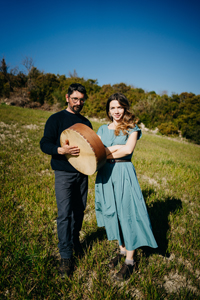
In the Neapolitan area, the main instrument is the ‘o Tammurre, a frame drum with a diameter of 35 to 45 cm. It is a wooden hoop with a goat skin and tin rattles. It has a different shape from the current tambourines used for the pizzica in Salento. Each player chooses the diameter that is most comfortable for him.
How did you carry out your research? Did you travel with a tape recorder and visit families?
We went to look for elders who possessed knowledge not only in music but also in agriculture and, above all, in humans. They passed on values and songs that we tried to learn. Our research was related to practice and not to the acquisition of material to fill an archive. We wanted to learn from them. We recorded on a Panasonic minidisk.
The Cilento region is known for its beaches and tourist crowds. It is surprising that unknown musical tradition still survives in the area. Where exactly did you find your sources?
My research was based on two areas of personal experience: the Lattari Mountains, an area on the border between the Gulf of Naples and the Gulf of Salerno, and the Alburni Mountains, which lie at the gateway to the current Cilento Park. For the Monti Lattari, I investigated the municipalities of Agerola, Pimonte, Castellammare di Stabia, Gragnano, and Sant’Antonio Abate, listening to work songs, devotional songs, and dance songs, i.e., those sung to the rhythm of the drum.
In the Alburni area, in the province of Salerno, in the municipalities of Postiglione, Sicignano, Castelcivita, Corleto Monforte, and so on, I listened to tarantellas, serenades, devotional songs, extended songs, and lullabies.
In each area, I attended festivals and tried to get to know and get in touch with individual performers who were still tied to their native musical repertoires.
How old were the singers you worked with?
The research and learning phase for me started in 2005. I met singers and performers of various ages, born between 1930 and 1960, and each of them left a great testimony to the passage of these musical elements. The older the singers were, the more songs related to the agricultural and pastoral world they knew and remembered.
Were they above all ‘grandmothers’, the last living masters of popular song?
Women knew and handed down their songs, often different from those ;of men. The context changed women often sang in private, for their families, for their children, for their grandchildren, or they accompanied themselves at work. In public, they sang mostly devotional songs. Men, on the other hand, sang not only at work but also at times of public celebration. The women knew a rich repertoire of lullabies, songs dedicated to the various tasks they performed in the countryside, prayers, fairy tales, etc. For example, I also learned a lot from my grandmother, who used to entertain us with her songs and stories during childhood.
Who was the oldest?
As I said before, the oldest was probably born in 1930. In some cases, they only knew how to write ;their first and last name in other cases, they had gone to school up to the third or fifth grade and applied themselves to writing and reading small things.
Did you have to use any ‘tricks’ to get them to sing for you?
Absolutely not, just ask if they knew any songs from the past and they would start singing and remembering. Except on one occasion when the singer could not remember a work song and so had to perform the task to sing and remember, showing that the gesture was related to the melody of the song. Otherwise, they had a great desire to be heard.
Do you remember any funny stories?
Actually, fun was always guaranteed. Along with songs, these farmers and workers had a great sense of humor, and every opportunity was good for joking and playing. Moreover, their stories were really adventurous.
Let us now talk about Naples. The city’s best-known style is the Neapolitan song. Enrico Caruso is known as one of the masters of the genre. But probably this tradition evolved from peasant roots?
Of course the world of cultured city music has always had exchanges and encounters with the music of the countryside. The great performers and writers have always drawn on the indigenous ;musical repertoires for their compositions the song ‘Fenesta ca lucive’, also sung by Caruso, is an example of how a text originally a funeral lamentation then becomes a classical opera.
During your research, did you find anything that could be recognized as the ‘roots’ of opera music or of Neapolitan song?
Certainly there is a type of cultured popular theater, often performed by folk artists, that has evolved over time.
 The Neapolitan singer, director and ethnomusicologist Roberto De Simone, now almost 90, is a specialist in this field.
Since the folk revival in 1960’s, Maestro De Simone’s compositions have brought stories, music, and images belonging to the popular world onto the stage.
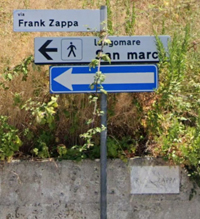
One of the streets in Agropoli, where you were born, was in 2008 named after Frank Zappa. Have you, or your musicians, ever listened to Zappa?
I had a very broad musical education Frank Zappa was listened to by my parents and remains in my memories.
At your competition concert of the Premio Andrea Parodi, I’ve heard a little twist in your voice, that sounded like throat singing from Mongolia. Did you study this technique?
You’ve heard right. I was enchanted by Asian throat singing, I started studying it with a colleague, he is a student of the world-famous, originally ??Vietnameseof master Trn Quang Hi. I’m just at the beginning so far, in this truly fascinating technique.
The competition, in which you won the international jury prize, is dedicated to the legacy of the late singer Andrea Parodi. According to the rules, each of the finalists does a coverversion of one of his songs. Which is not just a tribute to his legacy, but a test of creativity to add something extra to a well known song. You accompanied yourself on a rattle, a child’s toy. This was not meant as a joke or provocation, the result was a truly spiritual experience. What was the song about?
I chose Stabat Mater by Parodi, it is a religious song from the Holy Week that precedes Easter. In my home territory there is a strong tradition of Easter songs. I love laments and dirges, it is a genre close to my sensibility. So I have tried to make the piece in the spirit of my nature, adding elements from the Cilento and Sardinia, Andrea’s home region. The wooden thing that I used as a percussion instrument is called ‘zerra’ in our country, it was played at Easter processions. The reason? The church bells are tied at that time, so they don’t ring to commemorate Christ’s death. On the streets you only hear ‘zerre’ [plural of ‘zerra’] and singing liturgical hymns.
15. 2. 2024 |
read more...
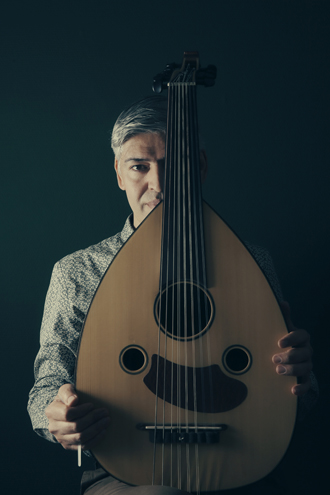
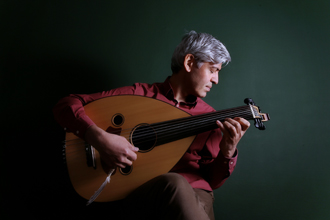
Amsterdam-based ud player Mehmet Polat studied Indian and Turkish music. He makes music with both Turkish and Western players
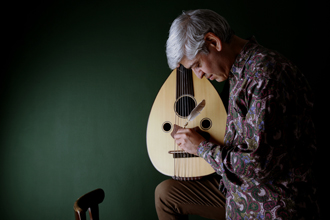 [Petr Dorůžka, Praha] The ud, one of the most common instruments in the Middle East, is considered to be the forerunner of a whole host of stringed instruments, including the European guitar. Unlike the guitar, it does not have frets and therefore is not limited by European scales. Besides Arab countries, a number of excellent players live in Turkey, Israel or Armenia and, thanks to the migration in recent decades, also in Europe. The instrument has gained respect in jazz thanks to musicians as Anouar Brahem from Tunisia, who records for ECM, or Rabih Abou-Khalil from Lebanon.
In addition to its musical role, the instrument also functions as a cultural symbol, linking the Middle Eastern traditions with Western genres like jazz, flamenco or acoustic music. Mehmet Polat’s music draws inspiration from this ever-changing area. His concerts are an exceptional experience. Polat and his bandmates lead their audience to the open musical landscape, where the art of listening to others is the rule, rather than promoting one’s ego.
Polat recorded his latest album, Embodied Poetry, with Bulgarian drummer Martin Hafizi, Dutch pianist Mike Roelofs, bassist Daniel van Huffelen, and guest players on trumpet [Gijs Levelt], duduk [Vardan Hovanissian] and ney [Şükrü Kirtiş].
https://mehmetpolat.bandcamp.com/album/embodied-poetry
What music did you grow up with?
Mostly with Turkish Alevi music and folk music at home and in my village. My father had a beautiful voice, a great musical memory, all my siblings and cousins were highly musical. I started playing Turkish baglama when I was around 5 years old. I continued till my age of 18, and then switching to ud.
What kind of Western pop music influenced you?
I was listening to Turkish pop music on TV and radio, and I have never been an active listener of Western pop music. Inactively I was hearing it everywhere.
Was there any formative moment in your youth that changed your view on art and music?
When I was 18, I saw a 12-year-old boy playing Paganini caprices. This gave me an amazing motivation to work harder.
Do you come from a musical family?
My brothers play Turkish baglama, my mother and father sing. I was the first one from my family who chose music as a profession, studied in the conservatories and performed internationally. My niece Fazilet Polat has followed my path. She plays Western classical music on flute, she plays in the Istanbul Opera Orchestra.
Were you born in the Netherlands or in Turkey? How and for what reason did your family moved to Europe?
I was born and raised in a village in suburbs of Urfa, Turkey in 1980’s. In 1998 I moved to Istanbul for my studies, in 2007 I have moved to the Netherlands. I came to the Netherlands for studying master degree at Rotterdam Conservatory’s Indian Music department. Since then I have been living here in Amsterdam.
At Rotterdam Conservatory, what made you choose Indian music?
Initially recordings of Ravi Shankar, Hariprasad Chaurasia, Zakir Hussein, Shakti. This music was the first reason why I wanted to learn Indian Music, it was so familiar but also different.
During your studies at the Rotterdam Conservatory, were you playing Indian music on the ud, or some Indian instrument?
Yes I was learning it on the ud. There were more students who were learning on sax or even darbuka.
Your latest album is called Embodied Poetry. Interpretations of the title can be diverse. I read it as “stories stored in our physical bodies”. Maybe you have a more personal explanation?
I see this album as an outcome of lots of stories about life experiences that came to my life as birth, death, survival, love, struggle, balance, perseverance and motivation for going on, diverse emotions and lessons (both life and for artistic development: I have followed jazz lessons by guitarist Mark Tuinstra, I have learned jazz standards, jazz timing, improvising on chords etc.).
You explain that 2 pieces are directly based on Indian ragas, Yaman and Charukeshi. Can you explain why did you choose these two? Just because of the musical content, or also because the emotional level, time-of-day they are related to?
I love those ragas, both because or their musical content and also they are part of my emotional world. I can relate them, they can speak out my inner world through my melodies and ud.
Do you consider Turkey as your second home? Do you travel there often to explore your roots?
Initially yes, Turkey could be my second home, but social, cultural and economic obstacles withhold me somehow. Anyhow approximately once in a year I go visit my family. I’d love to perform there as well. About my roots, I think I have brought them with me to Amsterdam. Every phrase I play sounds a bit Turkish to me. Even I find it good to get disconnected from my roots, for opening up for new cultures. I am not afraid of that.
How did you study music, at school? Or did you also have a private teacher?
I have started with Turkish baglama at the age of 5, I have learnt it from my brothers and other players in my village. After that till my conservatory years I had various private teachers and courses.
 The Netherlands is known for it’s advanced educational system in non-Western musics, was this helpful?
I have studied at CODARTS, it was super helpful for me. Next to my studies in Indian music, I could also interact with musicians from Latin, flamenco and even tango departments.
Do you remember your first public performance?
I was 7 years old, playing Turkish baglama and singing at a national day (23 April) celebration at my school.
Once you told me you are Alevi. What does this mean to you, in a practical way, and in a spiritual way?
Coming from an Alevi village and family has helped me to get a humanistic perspective, respecting others, gender equality, secularism, being open minded in life and opening ourselves up for art forms as music, poetry and dance. I am grateful for this. But further now I live just a secular life without any spiritual feeling or belonging any group of beliefs.
Is Polat common name between Alevis? I am asking this, because the previous interview in the magazine was with Meral Polat, so some readers will be curious if there is any relation.
Polat means ‘steel’ in Turkish, Persian and Arabic. It’s originally a Persian word. So written Polat is one of the most common surnames or names in Turkey. Meral is a friend of mine but we are not related. Just a beautiful coincidence.
I suppose there is a large Turkish Gastarbeiter diaspora in Netherlands and even bigger in Germany. But do these people come to see Mehmet Polat concert? If not, what do they listen to?
A small percentage of gastarbeider diaspora come to my concerts here. Those are usually from Kurdish, Alevi or other minority groups, or their grandchildren. A small group of the diaspora has become world citizens, left thinking, open minded and don’t belong to any ethnic of religious group. They also come to my concerts.
But unfortunately more than 60% of the diaspora here watches only Turkish TV and get their cultural and political inputs from there.
Your label is Aftab – does it have a meaning? Is it a common name in Muslim world, any relation to the Pakistani singer Arooj Aftab?
Aftab means ‘sun’ in Persian. I love it. By living in Netherlands I am missing the presence of the sun sometimes for weeks.
How difficult it is to survive with music that is NOT mainstream, and is also NOT part of any widely accepted genre like jazz?
It’s true that it’s not an easy task, it requires some extra work to help the audience listen and feel & understand it. And at the end it’s my responsibility to get my music heard, by audience. In bigger cities we usually have audience for my ‘multicultural jazz’ music. Recently, on June 22 2023, we have played in Bimhuis. Although it was a Thursday evening on summer, the hall was full.
But also you do other things, a programme called Heimwee naar verte with Joke Hermsen and Maryana Golovchenko.
This show is about homesickness. Amazing philosopher Joke Hermsen has initiated this project. The project has started with Joke’s new book ‘Onder een andere hemel’ (under a different sky). Myself and the great Ukrainian singer Maryana Golovchenko will make music about the subjects, Joke will combine her lecture with our music.
Do you have any concerts in the Middle East, Turkey, Morocco, Israel?
I have been in Morocco, Egypt, Jordan and Turkey for concerts. And I would love to go there again and discover other countries from the region.
Have you ever worked with a singer? Any recordings?
Yes I did. Aynur, Mikail Aslan, Cemil Qocgiri, Mircan Kaya, Flip Noorman, Naomi Inez, Karima el Fillali. I am also teaching a Classical Turkish Music Choir in Amsterdam. Check these links
– https://open.spotify.com/album/7dcbHt09RUCOZuozJFwxmF
– https://open.spotify.com/album/3KAu4OtRzdAn62lw4vJnnl?si=QAmhDEHMSp2SZ5t6ARzD-A
Turkish court music
Can we talk now about Ottoman classical music?
Ottoman Music was well developed in the court. Next to its artistic aesthetic it was also used for healing people.
 How much it was improvised?
Ottoman Music was based mainly on makams (a concept of melodicity which is based on tonality and certain route/rules the melodies must follow). Most known makam improvisations are called ‘taksim’ and ‘meyan’. Taksim is a free improvisation with or without any accompaniment. Meyan is a melodic or rhythmical improvisation on an ongoing groove during the pieces.
There was just 1 melodic voice and no harmony, like in Indian music?
Exactly.
Did the genre evolve continually until present time, or was there some turning point when the Ottoman rule ended, that is seen like the end of the “classical” period?
Song forms and instrumental forms are still being composed, performed and listened. But classical forms (for example beste, yuruk semai, agir semai etc) are not being so much composed. Especially after television was invented, the classical forms have started to vanish.
Did notation at some point enter the music system? And was improvisation of the greatest masters written down on paper, a process that can be seen as a parallel to works of European composers? Cemil Bey could be an example?
I am sure Turkish music historians can tell a lot more about it. But yes, notation came later. Afterwards the greatest masters have written their compositions on notation. Today we are using Western notation in French system (do-re-mi..) with extra accidentals for microtones. Also for each specific pitch we have older names as well, like rast, zirgule, dugah, kurdi, segah etc.
Is there any direct relation between Turkish makam and Indian raga system?
Yes, especially when we play certain scales and follow certain rules, makam and raga systems are similar.
The ud
What it takes to bring new ideas on instrument like ud? Is it just technique, or also incorporating ideas from non-Eastern cultures?
It is a combination of having a good technique, being open to different cultures, having a broadened vision and a good taste. Ud was mostly seen as a traditional instrument which must accompany vocals. But I use it as a solo instrument, for that I have developed an advance technique based on spreading my fingers wide, transposing all the makams in every half tone. For doing that I have practised average 10 hours during my first years of learning, 25 years ago.
Why transposing is so important?
Since Turkish Music is mostly vocal music, every vocalist may want to sing the songs in the range of their voice. In this case the instrumentalists must to adapt to singers’ voice’s range, and that means we must transpose instantly. But transposing makam scales – especially to the half tones – could be ultra challenging. Because you have to keep the intervals correct, accommodate the embellishments, make your instruments sound good. Mostly the instrumentalists avoid that and play just on the keys which works on mainly open strings. But I embraced this challenge and learned from it.
How did ud playing evolve in 20 century?
Serif Muhittin Targan (1892-1967) had a big influence on developing ud in Turkey and in the Arabic world. He was also a good cellist, he could apply all his technical capabilities on the ud. Had a wide perspective and brought ud to an advance level. Targan had a lot of Western influences.
In what sense was Munir Bashir so influential? Did his studies in Hungary bring any Western ideas?
Munir Bashir was a student of Serif Muhittin Targan. Of course his studies in Hungary brought Western Ideas.
Rabih Abou-Khalil studied in Beirut, besides ud also a flute, with the Czech professor Josef Severa, did this also bring some Western influences?
Yes it did.
And Anouar Brahem made many albums for ECM, for Western ears his music still sounds Eastern, but I am sure listener from the Middle East hears many Western elements, can you name some?
Anouar Brahem has a good taste, subtle playing, broadened vision and interesting ideas which I like. I like his albums with unusual bands with for example bass clarinet, accordion, sax and more.
Are there several parallel “schools” how to play ud, like Syrian, Egyptian, Iraqi, Israeli, Turkish, or is it now just a huge melting pot?
Yes, characteristic differences of the local cultures are definitely affecting the style of the ud. I want to add also Iran, Azerbaijan, Armenia, Greece and North African countries on this list. All play the ud in their styles and even with different tuning systems. I believe that the instrument is just a tool, music is in your brains and heart. You externalise what you know and feel at the end, no matter what instrument you play. If a Japanese folk musician plays ud, I am sure the ud will sound more Japanese.
You also designed an ud with two extra bass strings to broaden the range and function of his instrument. Do you use it on regular basis?
Yes I do, especially in projects without bass player and bass needed, I play the bass lines with my ud. Also during my solo shows I loop bass lines to improvise on top of it.
East and West
For Europeans Eastern music seems a mystery, most of the intervals sound “wrong”, with no links to human emotions in a way major or minor scales work in Europe. Maybe listeners from the East have same feeling from Western music?
Actually not. In Eastern music we have substitute makams/scales for Western major and minor. For major we have mahur and cargah in Turkish music. In Arabic Music that’s called ajam, Persian Music mahoor etc. And for minor we have nihavend, buselik and its variants.
Or maybe, the feeling is not “wrong”, but for Eastern ears the Western melodies are trivial, simplistic, lacking ornaments and the mystery of microtonal intervals?
Actually in Western modern music there are examples with microtones and larger irregular rhythms. Also in Baroque and Renascence times there were ornaments. I am sure musicologists can say way more about that. Also it is more more than just East and West. We have many cultures and traditions in the world like North & South America, Asia, Afrika etc. I would consider them also as good sources to get influenced with.
Once I asked the Israeli ud player Yair Dalal about the differences between Eastern and Wester scales, and he explained that the most important thing is the “neutral third”, which is exactly between the major and minor third. I had to agree that “neutral third” is for Europeans a factor that immediately sounds Eastern, but is it really that simple?
I would say, that depends on makam. In some makams third note is important or with microtone. In others that could be fourth (f.e. neva), or fifth (f.e. huseyni) or sixth (f.e. Turkish acem) and so on.
1. 2. 2024 |
read more...
 [by Ken Hunt, London, Burns Night 2018] David Crosby is a musician whose influence is paramount to the way my musical tastes developed. Directly or indirectly. This interview snippet is drawn from a far longer one conducted in September 2012 for an article in R2 that appeared at the time of the release of the 2012 DVD set.
Here we discuss, among other subjects, a range of possibilities to do with writing songs and the influence of the Nubian oud player Hamza El Din. Hamza, it turned out serendipitously, had also been an influence on Crosby. And mirroring my own experience in a similar way to Ravi Shankar he opened my head to another set of possibilities with his Nonesuch Explorer LP Escalay. I would later interview him for the Kronos Quartet project Pieces of Africa and in his own right. He became a friend.
 So, we’re here to talk about you and the chaps…
[Laughter] Yes. Ask anything.
Just arising out of the DVD [2012] there is this lovely transferrable maxim from a rather good songwriter whose name was Robbie Burns. He talked about talking about a problem rather than “nursing your wrath to keep it warm”. He talked about instead of bottling it up, getting it out. I thought that was a useful transferrable maxim for some of the stuff that CS&N had done.
I think that part of our job is talking about stuff that disturbs us or that we see. I think that goes right back to the troubadour days in Middle Ages Europe. Part of our job admittedly is just to make you boogie. Part of our job is to take you on more emotional voyages. But part of our job is to carry the news. So, we do talk about things that are going on. In America there’s some really awful stuff that’s happening. We’ve lost our Constitution. Our votes no longer count. It’s a corporatocracy and they run the country. And that’s a very disturbing thing.
So, yes, we do get stuff off our chests pretty often. Sometimes it is political. I think mostly we write about, you know, love: love lost, love found, love celebrated, love remembered. But, yeah, we do talk about the real world some of the time.
You can’t go on stage and just preach. That really doesn’t work. And it’s not our place to do it, but we can look at something and say, ‘That isn’t right.’ Or, ‘We believe that it is not right.’ I think the best we ever did was probably Neil’s song Ohio, but we’ve done it a lot of times. And I think it is part of what we’re supposed to do.
How did you as a band respond to Almost Gone being put into your lap?
We all jumped on it. Because we don’t think the man was treated fairly or is being treated fairly. We thought that he did a very brave thing and gave the American people a glimpse into the inner workings of our political, diplomatic and military machinations. We thought that Nash had done his job and we tried to support him.
 How did he bring the song to the table?
[Laughter] He sat down and sang it.
But it wasn’t, as you describe in the DVD, with you handing Neil Young a magazine and him firing off Ohio. He brought the song to you?
Well, it’s a very organic thing. We just sit down with each other and sing the song. We used to call it the ‘reality rule’. If you couldn’t sit down and sing the song to somebody and make them feel something, then it wasn’t really done yet or it wasn’t the one. But if you can sit down and sing a song to the other guys and they say, ‘Oh yeah, I get that,’ then it’s real and we do it.
In that book that Graham Nash oversaw – I’ll use that expression – Off The Record, you talk about the difference between competition and cooperation and you come up with an aurochs line, hunting the wild beast, so to speak. Do songs tend to be brought in a fairly finished state to you as a band?
They grow as they are put into the chemistry. One of us may think up a counter-line, the way we did in Teach Your Children. Or one of us may say, ‘I don’t think that’s the best way to say that. What if you said, ‘Ta-da-da-da-de-da‘?’ We improve each other’s work, we always have.
How has that gone with writing credits therefore? Are you fairly lax about those matters?
Yeah. We’re not doing it to try to get a piece of the pie. We’re doing it to make the song better. Sometimes it’s so absolutely obvious that we’re writing a song together that we give credit to each other. But very often we don’t even bother because we’ve all done it for each other so many times that it’s all balanced out.
What might be an example of credit where credit’s due?
I have a song called Camera [on After The Storm, 1994] that I wrote largely about my father [Floyd Crosby] who was a cinematographer and photographer. I just didn’t have the chorus. Stephen said, ‘It needs a chorus.’ So I said, ‘Well, freakin’ write one!’ And he did – and so it became a Crosby/Stills song. When the guy gives you the whole chorus you really can’t ignore that.
But there have been some pieces where they were just contributions and we don’t beat each other up about that. We didn’t do this to make money. [Guffaws]
You lying toad!
Ahh, we did it with the intention to meet girls… [Still laughing] After we’d gotten the attention of girls we did it because we thought it was the most fun thing we could do. So, we don’t really worry too much about that. We’re not desperate for credit or money – either one. All of us have written well. Anybody who doesn’t know that we can write, sing and play isn’t listening.
So we don’t really agonise over, [mock-indignant tone] ‘Well, I thought those three words up!’ No, we don’t do that.
With the new material on the DVD, had you – for instance, with your Radio – road-tested those songs before the filming?
Yeah. We’ve been doing that one since the beginning of the tour because the guys liked it. It’s part of a record that James and I are making. My son James is the keyboard player. He is a brilliant writer and a much better musician than I am. I’m inordinately proud of him. He and I brought that one to the other guys. We said, ‘We’d like to try this one,’ and they said, ‘Oh, goody.’ They jumped on it. It seems to go down well.
A friend of mine, now dead, came up with a great line. His name was Hamza El Din and…
You know Hamza El Din?
Yeah. Knew him.
You’re talking about the oud player?
The oud and tar player.
I know the instrument you’re talking about and I know the man. Hamza El Din is amazing. Friends with him?
Anyway, Hamza had this wonderful piece called Escalay which means ‘water wheel’. He told me this story that when he was a feisty youngster he played this composition quite fast, you know, as if the water wheel was going round fast. Then when he got older it got slower. And when he got to his mature years it was even slower still. And I wondered – and there are two parts to this [question] – how, first, the physicality of playing the music affects you now compared with earlier…
Pretty much the same way. The excitement of playing music has not dimmed. But we do some tricks to try to sustain it. We change the arrangements of things pretty much all the time. We change things night by night. You’ll hear Nash and I take chances with the harmony off the record. We’ll sing something completely different. We do that in order to keep the stuff fresh and to keep ourselves from becoming like a wind-up toy. We constantly try to find new things in the songs to excite us, to get that little thrill out of the song. I think that’s a really healthy thing. I hope that it continues. So far it’s still working really well for us.
One of the things I found interesting is how little you’ve changed the tempos. The arrangements may change but the tempos are fairly fixed.
A tempo is a large part of how the emotional content of the song works. We rarely slow something down or speed it up. We do change the arrangement a lot, but not very much with tempos. You’re very observant there.
I don’t know about observant. I just pay attention.
That’s what I meant.
Since we are of advancing years, you and I both, do you believe in Dr. Stage?
What’s that mean?
If you’re feeling poorly or under the weather or out of salts, when you get on stage you suddenly feel better.
Yes.
Dr. Stage is an actorly term in England.
You know, I’ve been through a lot. I’ve got a number of things completely bonkered in my health and in my body. But the minute that I start singing I feel wonderful and I don’t notice any of that stuff.
Are you still a record collector?
Yes. In a very specific sense. I do look for two kinds of things.
I look for great singer-songwriters. And sometimes I find them! Somebody like Shawn Colvin or Marc Cohn. Or this young man that I’ve just recently met: Marcus Eaton. You can find them. They’re rare but they do exist.
The other thing I look for is world music, music from other countries and cultures that affects me very strongly. Hamza El Din stunned me as a player, almost as much as Ravi who was the first other-music-stream person to penetrate my consciousness. I thought Ravi Shankar could move a melody around as skilfully as John Coltrane. I was very affected by it and one of the first things that I did when I met the Beatles was to tell George about Ravi. He says, he said, and I don’t know if it’s absolutely true because I wasn’t there, that I was the one to turn him on to Indian music, which obviously affected the hell out of him once he heard it. I don’t know if that’s true but that’s what he said, so I’m goin’ to go with that.
I do really like other kinds of music because it affects me. It widens my palette of colours. It stretches the envelope.
© 2018, Ken Hunt/Swing 51
�
25. 1. 2018 |
read more...
 [by Ken Hunt, London] This interview with David Harrington of the Kronos Quartet took place on 11 July 2014 – long before Folk Songs (released by Nonesuch Records in June 2017) was even conceived. It is published for the historian-minded. This sliver ends with talking about Ukrainian composer-musician Mariana Sadovska.
So, 40th Anniversary. There’s a venerable history of string quartets lasting a long time whether in Moravia or Budapest or wherever. What do you think worked for Kronos to last these decades?
You know, I think it’s probably the energy that the members of Kronos have received from the music that we play and from the relationships that we have composers and other performers. And the fact that the music that has come our way has been so interesting, exciting, and fun and challenging. For me, that’s what’s kept me going for sure.
Do you look at all to some of the old string quartets that survived the buffets of time and history, for instance, surviving communism in the case of Eastern European ones?
You mean, look at them for like inspiration?
Yeah.
I’m sure every quartet has its own dynamic and internal energy.
I would look at somebody like Pete Seeger for inspiration probably more than I would a lot of other people. I heard he was out chopping wood ten days before he died. And I’m sure he was singing, too. For me, I feel like the string quartet is my instrument, more than the violin is my instrument. I’m sure I play the violin and deal with all the things you have to deal with to play the violin in order to have the quartet as my instrument.
Part of the programme you’ve got scheduled for London [note: it took place on 18 May 2014 as Explorations: The Sound of Nonesuch Records – Session Four at Milton Court, Guildhall School of Music & Drama] has a folk music connection. Is it a one-off or is that programme going to appear elsewhere?
Well, I think elements of our programmes end up appearing all over in many of our concerts. For example, the other night [15 February 2014] in Burlington, Vermont we played a [Mary Kouyoumdjian] piece called Bombs in Beirut that was just written for us. It deals with the Civil War in Lebanon. Later on the programme we played Steve Reich’s WTC 9/11. After intermission we played Black Angels by George Crumb. Now, we’d never done anything quite like that but all of those pieces have figured, and will figure into the future. Once you find something that is gripping and exciting to play and has many angles to it that can be appreciated in various settings, when you find that kind of material then it will end up in other settings definitely.
I was just wondering whether you have future plans already pencilled in, for instance, to work with Natalie Merchant or Rhiannon Giddens.
Not right at the moment. I’ve got an idea for Rhiannon Giddens that I can’t wait to talk to her about.
I had an email from Peggy Seeger this morning. She was talking about how Rhiannon is so phenomenal. I’ve seen [Giddens] live a few times and I’m just spellbound by her.
Yeah. She’s great.
I can imagine how she might fit in with the Kronos. I’ll come back to the folk stuff. There is a long history of folksong being slipped into classical composition.
I was interested that you singled out Pete Seeger. What sort of material do you have planned – if you have it planned yet – for the London concert?
We’re exploring that right now. That’s why it’s a little too early to talk about that right now specifically.
I don’t know if you’ve heard yet but we have an album coming out as part of the 40th Anniversary celebration. Nonesuch is re-releasing five of our albums: Pieces of Africa, Nuevo, Floodplain, Caravan and Night Prayers. [Note: Ken Hunt wrote the CD booklet notes for Pieces of Africa and Caravan.]
Also we’ll be playing with [Ukrainian composer-musician] Mariana Sadovska in London.
When’s that? Is it part of the same programme?
We have two different visits to London.
There’s the Nonesuch visit and then there’s the other one. During that time is when we’ll also be doing [Sadovska’s] Chernobyl. The Harvest.
That’ll be interesting. I saw her last year [2013] at Rudolstadt. She did a really powerful piece about the Ukraine and basically people’s perceptions of the country – it just being a huge brothel and stuff like that. A really powerful piece.
Well, the songs that make up Chernobyl. The Harvest are absolutely amazing and really, really beautiful. She’s really done a great work for us. It’s one of our favourite collaborations.
It’ll be the first time in England.
I’ve never seen her perform in England. That’s going to be interesting. I’ve only ever seen her perform in Germany. I’ve seen her perform a couple of times in Germany.
http://www.kronosquartet.org/
19. 6. 2017 |
read more...
Part 1: Some Influences and Inspiration
 [by Ken Hunt, London] 2010 marks the 50th anniversary of the publication of Alan Garner’s novel, The Weirdstone of Brisingamen and HarperCollins has duly published a 50th anniversary edition. Hence the excuse to re-publish part of the first part of this interview. Any changes are so that the text conforms to our style guide and to contextualise and clarify matters. There has been no attempt to impose updates on this interview.
Finding an article on the English author Alan Garner in a magazine like this, the contents of which revolve around music, may appear a little unusual at first sight but Garner’s is a talent which fully justifies the inclusion of an article on him in any magazine with an interest in folk music and folklore. Alan Garner is commonly regarded as a writer of children’s books – a description which undervalues his talents by a long chalk (without denigrating that profession) and which fails to take account of the main corpus of his work. His books, when viewed chronologically, show a steady progression. The early fiction – The Weirdstone of Brisingamen (1960), The Moon of Gomrath (1963) and Elidor (1965) – with hindsight seems shaky in parts, yet reading them at the time, as they appeared, each book seemed far more forceful to a boy entering his teens. Nevertheless those books laid down the rudiments of Garner’s writing style; formative prose it may be but enjoyable for all that. At the time of their appearance they were lumped with much of the fantasy writing so prized by admirers of C. S. Lewis and Tolkien, yet apart from superficial resemblances in form those books are poles apart. One of Alan Garner’s quotes summing up his whole attitude to what might be described as the fantasy folly of the Sixties was used as an introduction to the review of Neil Philip’s A Fine Anger, (which appeared in the fifth issue of this magazine). That examination of Garner’s work cogently argues the case that its subject is an original talent. The Owl Service (1967) and Red Shift (1973) were clear evidence of this, and they mark a turning point In Garner’s literary style. Prior to The Owl Service his prose lacked the tautness that was to exemplify his subsequent work but the clincher was Red Shift whose bare prose was a revelation. By the time of that book certain elements in his work were clearly discernible. His use of dialect, particularly the dialect of his home county – Cheshire – was increasingly more accomplished (even if his later works like The Stone Book Quartet were to eclipse the earlier experiments). His innovative handling of time as an essential dramatic device, whether in the split time frame of Red Shift or in the interconnectedness of the past with the present in The Owl Service. A story, Feel Free, in several senses bridges the divide between those two novels in that it has elements found in both of the longer works. It has a paranormal element (which was used so successfully in The Owl Service and the television adaptation of that work) and makes use of slipped time (which also formed a part of Red Shift). It was published as one of the stories in an anthology under the title of The Restless Ghost (1970) edited by one S. Dickinson and in the earlier Miscellany (1967) edited by E. Blishen. Another characteristic feature of his work is his drawing upon locally based historical incidents or myths and in this he has become extremely accomplished. For example, there is the strand in Red Shift depicting the events leading up to and following, the English Civil War massacre at Barthomley Church which is situated not far from Garner’s Cheshire home. This was further reinforced by The Stone Book (1976), Tom Fobble’s Day (1977), Granny Reardun (1977) and The Aimer Gate (1978), which make up the so-called Stone Book Quartet; these four volumes plot four generations of Garner’s family during the course of a particular event in the life of a particular person in each generation and a local flavour abounds. As Alan Garner relates in the following interview not just the locality but also the specific dwelling in which he and his family live affect him and his writings. In his sleeve notes for the Argo recordings of the Quartet, Ray Horricks gives a picture of the Garner residence: “The house is remarkably close to the main Manchester/Crewe railway line, but by car can only be approached by driving up to, opening and then closing behind one, a series of farmer’s gates. It’s a fascinating place. The oldest part dates from about 1380; the later medicine-house and wing from 1500 and 1550 respectively. Apart from which these later parts were transported to the site from Newcastle (Staffs) and joined to the older part by a modern corridor incorporating a bathroom…” The structure itself is impressive and occasional visits from architectural students attest to its significance. The interior is replete with the trophies of the author’s magpie habits: eye-catching stones or archaeological finds, a library of impressive dimensions, an odd spear or two (props left over from the television adaptation of Red Shift), odd objects in general… ” It is no wonder that Garner finds his Cheshire life and background such a rewarding source of inspiration and that it has played such an important role in his work since its onset, since that first novel.
An equally fascinating aspect of Alan Garner’s work is the part that folk tale has played in the creation of his books. Even that debut novel (subtitled A Tale of Alderley) had links with a traditional story about a king under the hill at Alderley Edge. As early as 1969 he was adapting and retelling material of a traditional or folk origin in The Hamish Hamilton Book of Goblins (which became A Book of Goblins in paperback and A Cavalcade of Goblins for its American edition). The impressive The Guizer: A Book of Fools (1975) followed in a similar vein and, as the title may suggest (for the word is not one in common parlance), it hinges upon the role of the Fool in various societies, though not necessarily in any sense of idiocy; a guizer is an actor in a mumming play. An epigrammatic comment encountered early in The Guizer may serve to illustrate the author’s intentions: apparently (according to The World of Primitive Man), an Eskimo uttered the following on gazing at the panorama that greeted him from the top of a New York skyscraper: “I can see things more than my mind can grasp; and the only way to save oneself from madness is to suppose that we have all died suddenly before we knew, and that this is part of another life”, a quote with a distinct Borges flavour to it. The next book in the vein of folk tale was to be published in two forms: the earlier being as individually published paperbacks (in 1979) followed by all four in one volume called Alan Garner’s Fairytales of Gold (in 1980); these stories (The Girl of the Golden Gate, The Golden Brother, The Princess and the Golden Mane and The Three Golden Heads of the Well) with their brightly coloured pictures are more obviously geared to an audience of children. The book published in 1981, The Lad of the Gad, again made use of folklore. It contained five tales (Upright John, Rascally Tag – which appeared in an earlier variant as one of the stories in Jubilee Jackanory (1977) – Olioll Olom, The Lad of the Gad and Lurga Lom) and the collection is in a very real sense a summation of this branch of Alan Garner’s work for it combines many of the threads into a powerful tapestry. As the author remarks in the interview he does not revise his work to any great degree, but this is only partially true in that his earlier books have undergone a measure of revision at stages in the past, resulting in a tightening of the prose. This gradual winnowing of the prose has led to a removal of many superfluous or inessential segments and in Red Shift, for example, all prolixity has been removed: passages of speech are bare the way speech often is. The Lad of the Gad has that selfsame ‘bare’ quality and it makes for powerful effect.
At this juncture it may be as well to quote from Garner’s introduction to Lad of the Gad on the subject of folk tale and its place today:
“The oral tradition of folktale no longer exists in the English language. Now, rather than human recollection shared through community of audience and the storyteller’s own belief, the source of every folktale is another hook. Made written, folktale is treated as a juvenile branch of literature; but the two are different, and we should mark the differences. The word in the air is not the same word on the page.
“The folktale, when written, should still continue to be worked as it was when it was a spoken form, so that it stays relevant and vital; yet the body of British folktale is obsolete, a reductive continuity of Nineteenth Century texts, which reflect the attitudes of the period when the bulk of our traditional remains were set in print. Since that time, the British folktale has become, properly, a subject for scholarship, and, less properly, a vehicle for the moral instruction of the young. Shorn of its inherent music, mistakenly pursued for rational meaning, folktale has lost its force within the general culture.”
This seems to strike at the heart of the matter. The art of story-telling is a dying art as far as the oral tradition in the British Isles goes. There may be the odd pocket which has nurtured the art but the erosion of the old changing way by mass technology and the media has left its mark. Hearing somebody like Seamus Ennis breathing life into a tale is sufficient proof that the loss of that sort of skill is a very sad one indeed. He could demonstrate the story-teller’s art like few others and in each variation, in each subtle development in the story line, he revealed an age old craft. Alan Garner, as he points out above, believes that the art of tale spinning should not grow stale and musty. The Lad of the Gad shows that belief in operation and vindicates that belief fully.
Alan Garner is also an accomplished playwright and his books make potentially good television or film. There is a cinematic quality to much of the writing. That The Owl Service and Red Shift found their way onto the TV screen was important for the development of Garner’s writings; not only did it enlarge his readership in the way that television spin-offs so frequently do but by appearing on the TV screen it must have opened up new ideas for presentation. More television work followed in due course, although strangely a nativity play (which made use of traditional song in its action) entitled Holly from the Bongs (1966) has to date eluded any adaptation for the small screen. To Kill A King (1980) and The Keeper (1982), both mentioned in the interview, are clearly later works in the corpus. Amongst future commissions is the adaptation of The Stone Book Quartet for television in the form of “four fifty-minute plays, to be shown in 1984”. A pilot for this project was worked on in 1981.
Alan Garner’s influence is probably hard to assess. He is a writer who repays attention and scrutiny. Robin Williamson, another keen user of traditional and folk elements in his work and his Gruagach stories and Tree of Leaf and Flame have links with similar territory as some of Alan Garner’s work; Williamson expanded upon this when speaking of Alan Garner: “I admire his writing a lot. He seems to have been reaching for Celtic matters which have a very present relevance; you know, the way a myth can reach out and touch someone in the present moment. That’s what The Owl Service, for instance, is about. I think he’s a fantastic writer. I was wondering when someone was going to notice the similarities, because I think there’s a lot of comparison between what he’s been doing and what I’m doing, although, whereas I have a lyrical, a more of a poet’s approach, I think he has a novelist’s approach to the same material and he must be aware of some of the things that I’m aware of, perhaps more than I am in some ways.”
Two further publications deserve mention in this introduction. Neil Philip’s A Fine Anger is a book which is highly recommended to anyone who wishes to understand Garner’s works. Likewise Labrys 7. They are reviewed in issues 5 and 6 of this magazine respectively. Labrys 7 also contains an almost complete screenplay for To Kill A King (amongst other works by Alan Garner).
The interview that follows was recorded on 4th September 1982 at Alan’s Cheshire home. Like Ray Horricks said in his sleeve notes to Granny Reardun [the Argo recording], the home is close to the railway line, although its apparent atmosphere of remoteness is accentuated by the track which leads up to the property, seeing as it is unmade and somewhat bumpy. Only the trains disturb the sensation as they rumble by behind the house. A number of people assisted in this interview. Neil Philip and John Matthews were enormous helps. Sonia Birch and Nicky Henderson at Collins helped at various stages, as did BBC Publications. Most of all thanks are extended to the Garners.
I wondered how much folk song has influenced you.
Folk song has influenced me a very great deal as source material. I’m not able to talk much about the music because I have no musical education so I can’t work with music technically; I find that this isn’t altogether a bad thing because I’ve got a very happy relationship with Gordon Crosse, the composer, who finds that what he calls ‘my natural musicianship’ is enough for him. In other words I turn him out a libretto which is workable and then I’m, very fortunately for him, unable to do anything more about it; I can’t get in the way of his composition; I can’t suggest things. But yes, I’m very concerned for the music, for folk song and like it and I need it, which isn’t quite the same thing. Especially Scots, the Lowland Scots folk songs I’ve found very rewarding sources. My own area of Cheshire is very poorly represented in folk song; there’s hardly any which could be tied down to the area at all. I’ve collected, I think, four pieces which were a local variant but that’s all that can be said of them.
Did you do much in the way of collecting or were they the only examples that you could locate?
They were the only examples I could locate and that was largely brought about by being provided almost unexpectedly from the men I was talking to anyway. They were old men I was talking to for their own historical memories and they would sometimes come out with bits of song that they knew. There’s an interesting one which came from Alderley which was sung to me as an example of gibberish and I recognised it. It’s a Gaelic folk song and the man was singing with a Cheshire accent words which were recognisably Gaelic in origin. And how that came to his family, and he said it was only sung in his family, it’s not possible to infer with any accuracy but I think I’ve got it because in 1745 when Charles Edward was marching South for the Battle of Derby he passed through Alderley Edge and bivouacked for the night and I think it’s just possible that within that family memory there’s carried some record of a song that was being sung. Otherwise I can think of no other reason for a Gaelic fragment being retained in a Cheshire dialect voice.
There was no Scots blood in the family?
No, no. It was a remarkable family in that it was one of the few families which can be traced on the land and on the same piece of land for 300 years as yeoman farmers.
I use music myself but not directly. Some of the words of the folk songs are directly helpful. Mainly my use of music is as a catalyst. I find that I unconsciously – I don’t plan it – I’m playing certain types of music to myself when I’m in certain types of difficulty with writing and there is a pattern which doesn’t actually relate to folk song but it may relate to something else. When I’m really faced with the problem that there’s something there to write- but I don’t know what it is, it’s just an enormous pressure, I find that I’m playing Jimi Hendrix very loudly for very long periods of time and I almost anaesthetize myself with it because I play it so very loudly. I get complaints from the neighbours a quarter of a mile away! I like the kind of music that he plays but not enough to collect it but I do find that I lay my hands on anything I can get of Jimi Hendrix. I think he was a rare genius and what he communicates is almost impossible to put into words. It exists at the area where language doesn’t reach. So, I use him to get through some kind of barrier in the work and then, at a much later stage, when I’ve overcome the main problems and it’s largely the physical slog of getting through the writing, I find that I go towards the formalised stuff, like Faure’s Requiem or typical Nineteenth Century vegetative music, very succulent music, and I think that’s because some order is coming into the work that I’m doing and I like to see the order in the music. Then right at the end, which is the worst part of writing – I think it’s possibly even worse than the Jimi Hendrix phase – is when the book is almost finished. By ‘almost’ I mean within a couple of days and for a period afterwards, after the actual finishing of the manuscript, I go into an enormous depressive cycle, because it’s rather like giving birth. I’m redundant now. There’s nothing else I can do. I made a mess of what I have done. I can’t alter it. It’s out, it’s there, it exists. And then I really do need to have the reassurance that there is perfection in the world, so I go for the mathematical beauties of Bach and his religious music, in particular in his masses, and that sees me through the really dangerous part of having finished something. That is when all judgement goes, because when writing I suspend judgement. Judgement comes back again at a later stage of revision. But I’m an intuitive writer; I never plan what I’m going to write. This is what Gordon Crosse says is typically musical. I just follow it organically, as it comes. I hardly ever revise anyway but I’m prepared to revise. But I don’t control it as it’s coming out.
Don’t you find yourself sweating over phrases or words?
I used to do. Over the years, and I have been doing it for 26 years today as a matter of fact…26 years today I started The Weirdstone Of Brisingamen, at three minutes past four on a Tuesday afternoon – I have a memory for irrelevancies. The fourth of September 1956. The first two books were written very labouredly. It was rather like carving hieroglyphics. It felt strenuous and it shows in the books. The words are wordy. It’s an overblown book, which, I think, is almost impossible to avoid when you first start. As time’s gone by there is a shift which isn’t planned. Again, it’s automatic; it’s within me. And that is the period between the conceptual moments when the ideas arrive spontaneously from some stimulus or other, aren’t sought, and I just know I’m pregnant. There then follows a period of assessing what this implies in the way of research and then there’s the research which has two functions. One is that it satisfies the academically trained mind in me. In other words I go through the motions of working. It feels like work and it looks like work. And then after that’s over, when all the research sources are cross-referring to each other, I know there’s no more to do. I’ve read it all and there’s still no story. That’s the sensation that I had maybe two years earlier that I was pregnant. And that goes into a really grim phase which I have to come to terms with, which I call the “Oh, my God!” bit, because I’ve done the research; I’ve gone through the hoop of working at it, at the background; and there’s still no story. I just have to let it ride. I can’t do anything else and, again, I play a lot of folk music then. This period is never less than a year and with the current one – I’m in an “Oh, my God!” at the moment – that’s four years. What happens at the end of that is I experience something which is recognisable the instant that it happens. It’s very like the sensation that I think most people have of being half asleep and their foot slipping off the kerb, the jolt of coming awake. Well, I feel a jolt within me and I hear quite without any understanding, I hear words, which I put down. I just write them down and that’s always the last sentence of the book.
Is that what is being described in To Kill A King?
Yes, yes. [Laughter] Well, not exactly. I’m using it. It’s not an exact reduplication. And I get that down quickly and I feel very relieved. It’s a totally emotional sensation; it’s not rational. I just feel very relieved and I know that’s the end of the book and then quite soon afterwards, a few weeks or months, I have a slightly less violent jolt. I start to see and hear in my head people talking and moving and I find I can spool back on that and play it again. It’s rather like editing. I have to get the lip-synch. I have to get that. And when lip-synch occurs the focus on the visuals gets crisp and also on the sound. I can actually hear clearly what’s being said. From then on it’s very much like automatic writing. I just listen to it and I take it down and I do not question it. To begin with, it only comes in spurts. By ‘comes’ I mean I can only concentrate on it in spurts, then I get very tired. The clearest example so far is the Red Shift where after nearly five years, which is the “Oh, my God!” plus the research, I heard somebody say, “Shall I tell you?” which is the opening line of the book and the whole of that dialogue was obtained by putting it all into focus and into synch. And so I wrote it all out. The first third of the book cane in about nine months and that was slow for this stage of the writing. Then the second third following straight on took three months and the third third took about three weeks, so in the end I was writing very fast. Towards the end comes the other moment of horror which I can never rationalise away and that is to see the end of the book coming; there is that fixed, last sentence or paragraph that was there at the beginning. It’s almost like a docking manoeuvre and I feel, “Oh, my God!” If I miss this, I shall go into outer space and never be able to stop writing this book!” But of course, it always goes click. Now, I’ve described there the subjective experience. What I know now from observing it often enough “is that period of research has an importance in that it’s rather like putting down a concrete platform on which to build. It never shows but when decisions have to be made about the way things are developing if there’s a choice between A and B, if B makes sense in the context of all that research B would seem the better idea. And so the research is very useful but it never afflicts me consciously and the “Oh, my God!” is really at the time when the book’s being written. I now know that, for me, the process is very like a computer, that the “Oh, my God!” is the switching off of my conscious, analytical self to enable my subconscious to analyse all that work, all that research and to select that which is relevant only, and having done that I get the print-out. It’s almost like a computer signalling that it’s ready to go: I get the end of the book, which means that it’s there, somewhere, and has to be given shape. And then it starts. The more I write the longer the “Oh, my God!” bit is and the shorter the writing, until by the time of The Stone Book Quartet this was written in a single sitting. I know they’re short, but still 7,000 words for me is a long piece of writing. I’m not prolific. But the manuscript at the end of the Quartet, the last one The Aimer Gate…the speed of writing was so great that the fibres in the paper had broken down under the pressure of the ball-point pen; it’s an exercise book and instead of being stiff paper it goes like rice paper. It’s limp. And that’s just with the actual intensity of the pressure. I don’t remember writing it, well, I can remember writing it but I wasn’t aware of time passing. My wife says she fed me occasionally. But I don’t want to give any impression that it is a mediumistic or in any way an esoteric function. I think it can be explained away in straightforward terms of the way the brain works. Nonetheless interesting for all that! [Laughter] Which is answering your question about folk song. [Exploding with laughter]
You were talking earlier about collecting some songs. This Joshua Birtles was one of the people whom you collected from. “I’ll dye, I’ll dye my petticoat red…”
That’s it. That’s the chorus. “Siubhail, siubhail, siubhail a ruin, siubhail go socair agus siubhail go cuin” – “Sweet Willy in the morning all among the rush”. And on the tape that I did of him, I’ve got him saying, laughing at the end of that, “What that means I’ve no idea.” But I have on a Topic record, one of those classic albums, an old Hebridian lady, very old lady, singing it as a spinning song. In English it would be held as “Shooly, shooly, shoo-gang-rowl, shoo-gang-lollymog shoog-a-gang-a-lo”, but not “Sweet Willy in the morning among the rush”. Even her version was a bit bilingual because she had the line, “I’ll dye, I’ll dye my petticoat red”, but the chorus that she sings was in Irish. Those Topic records have stood me in very good stead, because one of the stereotypes that exists in the Russian mind is that all Englishmen are bursting with English folk song and the first time I went it hit me. I was almost dragged off the ‘plane and told to sing and for two consecutive nights in a railway train I didn’t get any sleep; I just had to sing all through the night…
[Note: The particular volume being referred to here is part of Topic’s Folk Songs of Britain series (originally issued on Caedmon in the United States). Elizabeth Cronin sings “Shule Aroon” on Volume 1 Songs of Courtship (Topic 12T157). As Alan Garner commented after the interview, “Siubhail a ruin” is pronounced, approximately, ‘shule aroon’.”]
…reinforcing the stereotype!
Yes! [Laughter] It was amazing when I was scraping the barrel what was accepted as folk song. Bobby Shaftoe. Oh, I was drawing heavily on the school phase! I should imagine that the whole of school singing is very much influenced by Sharp and his collections, his bowdlerized collections. I have no reputation here for having the slightest interest in folk song. Yet every time I appear in the Soviet Union it gets quite wearing. They cry over “Black is the colour of my true love’s hair”. It makes them weep. A bit of a weepie. They respond to it. Waltzing Matilda was also considered to be an English folk song.
One thing that puzzled me, and I think it puzzled Neil Philip too, was the connection between Tam Lin and Red Shift. I for one never fathomed that out.
Yes, it is a difficulty. Because I do so much work simply to find something that interests me, and I think there are puritanical reasons as well, I do reward anybody who cares to dig but it’s as easy to make the mistake that I’m a tight, academic scholar in my work; I’m not. I’m really being a magpie, as you noticed earlier. I grab what is relevant and, for me, what was relevant in Tam Lin, what seized my mind, was only one aspect of it which was Tam Lin telling Janet that he was going to do everything he can to destroy himself and her at the end. He’s going to change and be slippery. He’ll be very unpleasant. I thought, “Yes, I recognise that.” And from that I got the names of the characters, but to worry too much about tying in with the whole piece is really to get yourself bogged down in a great deal of difficulty, because there’s no need to follow it so far as to say at the end of the Red Shift Janet is pregnant at the end. I mean, she could be, I suppose! [Laughter] I don’t build with meticulous following of the source. I don’t know if I should. I just don’t know. It is a magpie attitude. I just take what’s there but there again because I’ve done it for so long I can see recurrent patterns. Each writing is a fresh experience but there are recurrent patterns, generalisations which can be made. One is that I feel that the piece, in this case “Tam Lin”, would not have sprung at me if it hadn’t been relevant. Why did I choose that? Why did that come out and hit me? Why did seeing a particular plate with an abstract pattern on it bring out of my mind instantly The Mabinogion? It was Griselda who said, “Here is the pattern and I’ll make it into a paper owl,” and I said, “Have you read The Mabinogion?” Which is a great conversation stopper! The owl/flower idea came out. Things like that I observe quite frequently. Serendipity is something I enjoy very much. Finding and seeing connections. Only a very rare few stick, like the owl service did in bringing The Mabinogion out of my data banks and causing me to become obsessed with it for several years…as the result of seeing the plate. I don’t like rationalising too much because I think I tend to believe it and could become a victim of it in the end. At the time it’s all instinctive. I save the cleverness for the research. I never plot. And I know that the piece that results is far better than I could’ve written. If I consciously sat down, as I did at the beginning of The Weirdstone of Brisingamen and The Moon of Gomrath, if I sat down and plotted something on paper, it would not be as good as the thing I entrusted to my sub-conscious mind. I’m not good enough to make Red Shift as tightly constructed as it is. I couldn’t have held all that consciously in my mind or on paper; that came from the sub-conscious. And I hope the next one will.
Have you got a theme that you’re working towards?
I’m not being precious now; I just can’t talk about it. It panics me to think about it. If I started to talk about it, two things would happen: one is that I would confuse and annoy myself and I would lose confidence in it, and worse I would release the pressure. For me talking is so much easier than doing and if I were to talk about something that hadn’t been done yet I don’t know if I’d have the interest or the energies to go much further with it. It’s one of the many reasons why I avoid London society. I don’t enjoy the company of other writers very much but I certainly would avoid any literary social life where people talk about it. No, I have no time for it; I’d much rather talk about archaeology. [Laughter]
On the way here I was thinking about To Kill A King in which there is a stage direction ‘Harry is pent up’; at that stage the whole house is pent up, is tensed and it struck me that Pent Up House would make a good soundtrack for it…
The whole of this site and house I use emotionally very much. The brief for To Kill A King involved a certain amount of autobiography. That was what was wanted by the BBC: a personal experience. Now, although I never experienced what happened in To Kill A King, I used it to exemplify more clearly what I had experienced which is what I feel to be a symbiotic relationship between this house and its site and me, in that I feel this house will absorb any amount of tension and pain. It will just absorb it and eventually everything will settle down and in To Kill A King the numinous woman who appeared is, for me, the personalization of the site that I live on. This is based on emotion and also on practical observation. I’ve been living here for over twenty-five years and I was an archaeologist and the site has revealed itself to be very remarkable. Not only are the buildings remarkable but the site has been occupied, can be observed and can be proven to be, for 15,000 years. Recently I’ve done the work which seems to show that the observations of Professor Thom and his megalithic observatories are true which is the ability of neolithic man to construct basically the circles on the ground, of which Avebury and Stonehenge are examples. He was able to measure very accurately the movements of the sun and the moon and predict eclipses by using aspects of the site – stones or wooden posts -and distant features of the landscape, which were not man-made; so you had to find a place where this occurred, rather than settling down and saying, “I’m going to live here. I’m going to build my observatory here. Now, what fits?” And this appears to be one of them. The chances of it being chance are almost nil. So, yes, it is an important place, in that it has energies which anybody can register. The room we’re in now is the only place where I can write or have ever written. Where I am sitting is the place where I would sit to write. It’s also the place where, for the first thirty or forty years of the century, because of the size of the local midwife, all the children in the house were born. The midwife couldn’t get up the stairs, so before I came to live here children were born in this corner of the room. I have written everything in this corner of the room and in the Nineteenth and early Twentieth Century there was a long history of poltergeist activity in this building and it turns out to have been in this room. From aerial photography and from some archaeological work that was done here the main tumulus of the many that are on this site has its centre in this corner of the room. Very sophisticated metal detectors go berserk in this room, so it’s a scientific observation which can be repeated. There is an American one which is so sensitive that it doesn’t register metal, it registers disturbance in the magnetic field of the soil. In other words, if anyone’s dug a hole, that registers. That described very accurately that there was something, a cubic shape, about five feet down, which suggests to me, the archaeologist, what is known as a cyst, that is, a stone chamber. It’s a cube of about three feet. I’m not going to dig it up because I’ve seen 2001 about eleven times and not going to dig up my black slab! Also anybody can dowse in this room. I was highly sceptical about dowsing until it was explained to me carefully and I then went out to prove that, if it existed, anybody could do it and found that I could do it. Anybody who comes here and tries dowsing can dowse in this room because the responses are so strong, so much so that if anybody wanted to do it, I don’t tell them anything about it. I just say, “Try in here.” I draw a sketch plan unbeknown to the person who’s going to do it and I mark the places where they’re going to get reactions. It’s not water that’s being picked up; I don’t know what it is. But there’s a 100 per cent reaction from this, from everybody who has ever tried it. They all quickly isolate, first of all, the main source and once they’ve had the experience of something reacting in their hands, two things happen. One is that they have no sense of doubt anymore whatsoever. They know. Once it’s happened to you, you know you’re not doing it. Soon after they become more sensitive and they can find the other two sources. Now those three sources: one corresponds to the same signal that the mine detectors get and the other two appear to be random until they’re plotted, on the archaeological map of the site and they are the post holes of large wooden posts which form part of the henge system here. So, that is an example of both the complexity and the strength of the place. It works on an entirely emotional level and it also works scientifically; in other words, in this room you can find things by repeating the experiment.
[Note: These observations are the basis for Alexander Thorn’s Megalithic Sites in Britain (Clarendon Press, 1967), Megalithic Lunar Observatories (Clarendon Press, 1971) and, with A S Thom, Megalithic Remains in Britain and Brittany (Clarendon Press, 1978), all three of which expound on the theories in great detail.]
There was something that you touched upon a little earlier before we started the interview and in Neil Philip’s A Fine Anger about film. You described a sequence in terms of angles, from a lens’ point of view and you’ve also mentioned at one stage being influenced by Seven Samurai. Were you ever a fan of Resnais’ L’Année derničre ę Marienbad and that sort of film? [To interpolate for Czechs, Mariánské Lázně]
Not a fan, no.
It’s just that in that film, L’Année derničre ę Marienbad, you’ve got the ‘memories’ of other times, which finds echoes in some of your works. I wondered whether that had affected you.
It may well have gone in subliminally, but not consciously. It’s the most obvious things that I recognise. I’m sure that nearly everything that I do has got some source somewhere else. Seven Samurai was particularly apt, because it came at a time when I was becoming aware of film, 1954, and I was living in London. That sounds pretentious. I was in the army and I was so inefficient that I had to be posted to London where I could not do anything dangerous and that’s where I saw Seven Samurai first. I tend not to like French film very much. I’ve always had an antipathy for the French language, which is totally subjective. It’s not based on anything except prejudice. I just don’t like the sound of it. Yet Japanese, which I don’t understand a word of, I like listening to. It’s a very musical sound, a rather harsh sound. I suppose that Marienbad had an influence, must have done, because I saw that twice. I was vaguely impressed by it. Didn’t like it but was moved by it. I think that most of the film influence I have is again childhood, because in the Forties I used to go to the local cinema, so I became something of an expert on Hollywood B-movies. One thing I didn’t remember until long after I’d done it was…I can’t remember the name of the film but I think it registers as the worst film I ever saw in my childhood. It seemed to consist entirely of three men going in and out of a New York skyscraper flat shouting at a woman. It was supposed to be a comedy but I couldn’t get a hold of it except I remember one incident from it where the woman said she didn’t like saying ‘goodbye’ so she always said ‘hallo’ when she said ‘goodbye’. I used that in the Red Shift very prominently and it was only after we’d made the television film of Red Shift in which that doesn’t appear – the use of ‘hallo’ does not appear in the film of Red Shift – that it suddenly floated back into my mind when we were working on the film. So, that’s how things happen. It’s usually years and years ago. I don’t think I’d ever deliberately go and poach stuff.
Our second instalment contains more on the use of language, especially dialect, his background and meeting readers.
18. 10. 2010 |
read more...
 [by Ken Hunt, London] Ralph McTell is one of Britain’s foremost commentators on the national condition using demotic idioms – folk, blues, ragtime. Rather like Wolf Biermann, Franz-Josef Degenhardt and Christof Stählin in Germany (and then add your own regional or national candidates), he has depicted his homeland through music, through songs, that meanings of which seem immediately apparent but which may well prove to be more eely or oblique.
This snippet is drawn from a long interview conducted in September 2006 for an article that appeared at the time of the release of the self-effacing man’s 4-CD boxed set, The Journey – Recordings 1965-2006 (Leola OLABOX60) that David Suff put together for the label.
True to his roots, McTell booked a folk club gig at Twickfolk @ the Cabbage Patch Pub in Twickenham, Middlesex in March 2010, prompting this morsel.
What did you learn about your own creative process from The Journey?
Very good question. I think we have to go back to my perceived role for myself. I think that it is not a keeper of the scrolls or the tradition, or a protector of the tradition; it is the belief that there is a basic honesty in one man and a guitar if the subject matter is right. My stimulus is drawn from men and women who appeared to do that for me. All, I think, I sought to do while I was doing that, was to get better at what I was doing. Which is partly to enjoy and to discover the music myself and to exploit what little I have or what my offering could be and to try to improve. But not to lose sight entirely of what first motivated me. The odd excursion I have made into a broader folk-rock field or whatever was all done with the same intent. The idea of doing songs in the main still had to fit those criteria.
Listening back [to The Journey], it’s not as good as what I hoped at the time. Considering I’m a very bad recording artist. I’ve had a 40-year career, sometimes I say in spite of my recordings! I’m not at ease in the studio. I don’t like recording studios. I don’t enjoy recording and I don’t particularly enjoy listening to my own records. But I enjoy the process of creating. I leave the ‘studio bits’ to other people. I have managed to develop the rather useless talent of hearing what I want to hear when I’m listening to playback. I’m not as hard enough on myself, on mixes and on performances as I should be.
When I was working with a producer like Gus Dudgeon who sought perfection at every level, he must have despaired of me. We parted company on the basis that I couldn’t keep repeating performances. Since I have liberated myself from that by doing only live vocals and only one or two takes I’m much happier with those recordings that have gone back to the basic honesty of those first recordings by other people that I love.
So, that’s what I’ve learnt. I’ve learnt, one, that there’s nothing wrong with the odd foible, dodgy note, slightly sharp, breathless, more moved than moving – as my manager once said to me – and gone for the way Bob [Dylan] does it. I’m not blessed with a voice that can soar and rise and do the things that Bob can do in his individual performances, but my voice has grown, has got broader, wider, deeper, whatever. I’m as sincere as I ever was. I trust my 40 years of guitar playing and singing to get a reasonable performance down in the studio.
But to say I’m a fan of my own records is not true. I can be delighted with other people’s performances but they’re very wordy songs, so I don’t often give a lot of room for other people to blow or to play over. They’re there to enhance the song and to fill out what I hear in my head within the chord structure that I’ve created.
How do you feel about your personal progress? For instance, you have a song on the boxed set to do with your wife, Nanna. You have a very early recording of Nanna’s Song [from Eight Frames A Second, 1968] and you have a much later one [from Travelling Man, 1999] which is a much simpler version of Nanna’s Song. Is that going back to what you’ve just said about the basic honesty of a man and guitar and a voice?
Yes, I think it is. When I wrote that song I wrote it how you hear it the second time. When I took it to the studio, they went, ‘Oh God, it’s French! We’ve got to put some accordion on it.’ It was all a kind of musical cliché. Actually that song on that first album probably sold the album. Because I think it was an honest intent. If someone were to study that song I hope they would see it’s not just a song of being in love in Paris. It’s a song of regret that things are coming to a close – though they never did. But that’s the perception of the song at the time. It’s a wistful song that deals with meeting and parting somehow. Are they still together? Do you know what happened?
I’ve got this thing about songs. If you get it straightaway, it’s one kind of song; if it creeps into you, it’s another song; if you return to a song, it’s another. I picked a quote up the other day from Samuel Taylor Coleridge: it’s the poems we go back to, to read again that are the special ones. I would like my songs to be thought of like that. I would like it would be possible to go back to them and find something that you didn’t get the first time.
The exception to that is the ‘big song’ – The Streets of London. It is what it is: it does what it says on the tin: there’s no need to go back to it. And ironically it’s the one that everybody goes back to and keeps talking about. That’s the way it is. Most of my songs aren’t as direct or as straight ahead as that. I like to think there’s nearly always a built-in ‘something else’.
Small print
Unless otherwise stated, all interview material is original and copyright Ken Hunt. If you wish to quote, seek permission. It’s the writer’s way.
For more information and updates about Ralph McTell, go to www.ralphmctell.co.uk
2. 4. 2010 |
read more...
 [by Ken Hunt, London] Peggy Seeger was one of people like Ramblin’ Jack Elliott and Big Bill Broonzy and Cisco Houston whose records introduced Britain to an authentic lexicon of Americana. That word didn’t exist in the 1950s but if it had those musicians would have pretty much defined it. In that period, as far as Cold War Britain of the 1950s was concerned, American music was a unholy trinity of the crypto, wannabe and cod. Skiffle, Britain’s first youth movement, was a hugest craze but, as an American, Peggy Seeger had a head start.
By the time Peggy officially relocated to England in 1959, the folk scene was largely a young person’s scene. A decade on, when I saw her with Ewan MacColl (1915-1989), every time I saw them he whiplashed me back to my schoolboy days and sitting on a form in school assembly. He had a headmasterly hauteur towards folk club audiences. That British folk scene regularly felt like two diary-keepers from opposing sides documenting a battle. One faction I understood: and the MacColl-Seeger one had nothing in common with what I was experiencing, with my life, with my music.
When she emerged after MacColl’s death in October 1989, my ears felt less biased. It began with reviewing her 1992 Smithsonian Folkways anthology Songs of Love and Politics – a great record – for Q magazine and being charmed and captivated by her takes on traditional and non-traditional songs. The quality of her voice and what she was communicating lifted the latch. There were some traditional songs like Pretty Saro and Broomfield Hill. Yet it was the discovery of her own feminist observations on male conditioning such as Lady, What Do You Do All Day? and, especially, Gonna Be An Engineer that caused me to ditch my Seegerish blinkers.
 The sheer quality of what she has brought to the folk scene is incalculable. Enough of ruminating: time to let her to talk.
To kick off, I wondered how you felt the creative process has changed for you over the course of your musicianly life?
Thank God for a new question! Well, I didn’t make up a song, I didn’t create a song until I was about 22. That was when I was in China. [Song of the Forts] was a song that hopefully nobody is ever going to hear. It was a hopeless song. It was based on trying to express a feeling about militarism in a way that was like a political speech to music. I met Ewan when I was nearly 21 and I got very enthused with the idea of political song. His early songs were extremely direct and I think not nearly as well crafted as his later ones. I wasn’t very proud of the song but I just felt it was good to have written it. Then I wrote a couple of songs that were like his song the Trafford Road Ballad and something that was like one of his marching songs for Aldermaston [the Campaign for Nuclear Disarmament march destination]. I was kinda copying other people, which I think sometimes is a necessary thing to do. I think it’s a necessary thing to do in singing ballads and singing folksongs that you learn to sing as close to the people that sing with the intentions of the creators of the songs – of course if that’s possible – and then you go your own way. Copying things, I think, was very important. I learned to put new content into an old form.
In early days I put an awful lot of words into the songs, especially the feminist songs. I think the development of the creative process, for me, has been influenced by Ewan MacColl, by the traditional songs, by my knowledge of classical or formal music. The last has been really useful for me in the offbeat pieces that I’ve done, as on my songs for the 2004 one [Peaceful Woman, Fighting Hard]. The accompaniment for the Bush song was great such fun. I have a wonderful time performing that because I can hit any note on the piano, so long as I can resolve it in a way that my voice can come back up to. It’s a kind of plagiarism of a traditional song.
Then I had my partner Irene who said, ‘Be more human in what you do.’ Ewan had ‘more human’ in his songs probably than I did. I just hadn’t worked it out. Some of the humour that I used was borrowed directly from cartoons, from jokes, from other people’s words. I ‘plagiarised’ terribly.
Who doesn’t?
I try to acknowledge it when I do it. All these things have fed into what is essentially a media-trained person. It’s been an absolutely wonderful journey. I’m beginning to plot my next move. What I’d like to do is create songs that I can sing on political platforms. My voice is not strong and many of the songs I’ve made have been too complicated.
What do you mean by that exactly?
I’ve never been good at actually performing on political platforms. I don’t sing well actually standing up for a start. My voice is not strong. And many of the songs that I’ve made are too complicated to sing like that. I will probably remake my song, No More, No More, No More about Nelson Mandela. It needs words that people can use and remember. That’s what I want to do.
This creative process that you’re going through right now, when it comes to the delivering of songs, is that to do – though I’m loath actually to use the analogy – with the smoothing away that occurs with years?
A tone of voice adds an awful lot, an added dimension to the meaning of words. I write songs for singing, not the singer. You can write a song on paper but unless you sing it, you won’t realise it. Writing in short sentences if you’re going to read it out over the radio where people don’t have the benefit of lip-reading is important. So it’s important in something that is spoken to not be too complicated unless you’re going to speak very slowly. In a short sentence you can use a long word.
The creative process, as far as I’m concerned is one of adding one creative thing on top of another. And also going back to original inspirations. One of the songs I’ve been performing is The Judge’s Chair about abortion. I created that literally like a traditional ballad. Literally. I used all the ways of a traditional ballad. It’s made of their strength.
 How do you mean that?
There’s a whole stack of things that happen to ballads that don’t happen in other types of songs. Things like: they jump into the middle of the action; scene changes are no heralded by any logic; you get incremental repetition, repetition of a motif, of an idea, each time with slightly different circumstances; non-judgemental attitudes. There is a whole stack of things that people recognise in a traditional ballad. These are things that people somehow recognise in the cultural genes that are handed down to them. Maybe it’s inherent in the language, I don’t know. Ewan used that in The Ballad of the Carpenter [the alternative name for The Ballad of Jesus Christ in the 1957 BBC radio broadcast, released as Sing Christmas and the Turn of the Year (Rounder, 2000)]. I consciously use that.
In Song of Myself you lay down your history and you talk about journalists asking you the same questions over and over again.
I get sick of it. God, you get sick of it! It’s like they have to hear you say what they have read already. You hear it on the radio in interviews. The interviewer asks a question and then you ‘so and so and so’. The person says, ‘Oh yes, I did that.’ There’s got to be a better way of interviewing people against past events. Why not just give a capsule? Born so-and-so. Parents so-and-so. Took up the banjo. Now tell us about who you really are. And get deeper in, quicker.
There’s so much small talk with interviews. Often now I will say I don’t want to spend more than five minutes on family, Pete Seeger and Ewan MacColl. Let’s talk about who I am now! They can read about that anywhere. Send them to the website if they’re really interested. But do we really have to give everybody encapsulated information? When what we really need to share is feelings, responses, attitudes, quirky things.
Maybe things that are not quite as favourable to you as a person but which take you off the pedestal. You can say, OK, this person may be special here with what we’re talking about, but. Sure, I shit, I fart, I pick my nose, I do this, this, this. Other people can feel, ‘Gosh, we’re all in this together.’
The website to be sent to: www.pegseeger.com
Not to be confused with that of Irene Young whose 2004 portrait of Peggy Seeger from Peggy’s website appears above: www.ireneyoungfoto.com
Small print
Unless otherwise stated, all interview material is original and copyright Ken Hunt.
1. 2. 2010 |
read more...
Older articles »