Interviews
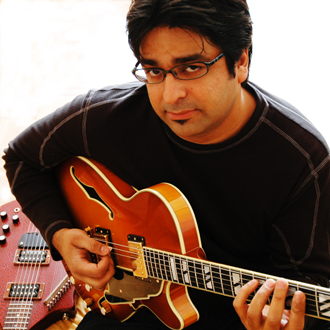 [by Petr Dorůžka, Prague] The Karachi born, New York City based jazz guitarist Rez Abbasi comes to Europe for a ten day tour which includes two gigs in Czech Republic – 23 April he plays in the Prague Reduta club, and on 27 April at Jazzfest in Brno. He is joined by his Indian wife Kiran Ahluwalia, who is a well known singer on her own right.
Rez, you left Pakistan when you were 4 years old. Did you come back to rediscover your roots?
Rez: Yes, I of kind took a backwards approach. But I am fortunate in that I’ve been able to perform a lot with Indian musicians of various styles. That’s the best way to learn in the long run. So the music I compose and conceive is very much coming out of the spirit of sharing ideas with jazz musicians and Indian musicians.
You also studied tabla with Alla Rakha. For how long?
Rez: I didn’t physically study with the great master but attended many group classes of his for a month and continued to study tabla with one of his best students for a year.
Alla Rakha was a lifelong partner of Ravi Shankar. Did you have a chance to meet him also or take a lesson from him?
Rez: No, however I did attend a master class given by another sitar maestro, Ustad Shahid Parvez. Honestly, the desire to try and play the guitar like a sitar didn’t last with me. It doesn’t appeal to me when I hear people doing this sort of thing because it just sounds like imitation. That being said, however, I do strive to be influenced by all music on a much subtler level. It becomes more of a jazz approach from the streets rather than an academic thing. So if there is a flavour of Indian music in my playing, it comes from my intuition rather than picking up a sitar.
How much have you been influenced by the people you’ve worked with?
Rez: I’ve learned most of that through my relationship with Kiran and her music and through the other Indian players I’ve worked with. Masters like Kadri Gopalnath, A. Kanyakumari, Gaurav Mozumder and a host of jazz players that strive to incorporate Indian music into jazz, Rudresh Mahanthappa, Vijay Iyer and George Brooks.
In the Czech magazine Muzikus I’ve read comments about Kiran singing in unison with Rez’s guitar. Who takes the lead? And, can you somehow predict where the other will move? Or you just relay on a set of prepared memorized tunes?
Kiran: When Rez has composed a specific melody for me to sing then I sing it but with Indian ornamentation. Since we come from two different musical backgrounds, the first step for us is to sit down and decipher everything – he tells me the melody step by step and I write it in a way that I can understand. The final result is us doing the melody together. In terms of improvisation – we figure out which scale would work the best. When I am improvising then of course he is listening and playing things that relate to him on the spot.
Rez: Sometimes we play the melodies in unison and that is written out. When Kiran improvises, I often play some chords or melodic ideas around her as an accompaniment. She is another improviser in the group and the musicians treat her as such.
What the Western media now describe as world music in my opinion was already started some decades ago by the Bollywood composers. By default they have to know both Eastern and Western musical idioms and are finding effective ways to fuse them together. Would you name any Bollywood (or even Indian composer in general) who should get more recognition from the western audiences?
Kiran: Yes world music is a term used primarily by English speakers to describe music that comes mostly from ‘far off’, non-English speaking places. In that sense ‘world music’ is centuries old. And yes, Bollywood music has long been open to influences from other non-Indian musical cultures although in India the influences that Bollywood music takes in are never presented as collaboration. I like a lot of Bollywood composers. A R Rahman is totally deserving of his recent recognition at the Oscars. Some other Bollywood composers I like are go by names “Salim-Suleman” and “Shankar Ehsaan Loy”.
Rez: The Western media has not done a good job in describing forms of music in general. The term world music is much too broad and just like the term “fusion” cannot give justice to the multitude of sounds we hear today. The original Bollywood composers did incorporate some great ideas but modern Bollywood is more concerned with making Pop hits. It’s rare but there is some good stuff coming out today. A R Rahman and Sanjay Divecha are some that have done a great job melting the borders of music.
 Fusing jazz and Indian music has a long history, with Mahavishnu Orchestra, Shakti, modal jazz playing. Was that any inspiration for you?
Rez: Not really. I do like that sound but only later in life was I introduced to artists like McLaughlin. I wasn’t a big listener of the fusion from the 70s. I do like Coltrane’s incorporation for sure and think it was absolutely sincere but it only scratches the service of the possibilities. In terms of what some other musicians did with Indian music, I personally find the outcome contrived. Musicians too often put groups together based on the prospect of fusion. To create music that has its roots in various forms, takes composers that are also rooted in those forms. My music is solidly grounded in jazz and becomes modernized through incorporating music from India as well as 20th century Western classical music, all music that I firmly am rooted in. The syntheses of sounds are just that, a synthesis. A listener should hear it all as one sound, no separation.
A colleague of mine who stages concerts in Greece says that he prefers to hire Indian musicians instead of the local ones, because Indians have much better memory of tunes and learn the new pieces quicker. Do the Indians really have some special musical genes, or is it just a myth?
Rez: I think it has to do with the way they train as students. I was brought up in America, but the Indian musicians I’ve worked with usually don’t read western music and therefore use their ears more which ultimately strengthens memory. But it can also become limiting if indeed they are learning complex music from a western composer. Initially it takes longer for the music to be learned so I think it balances out in the end. And they do have their own way of writing things out.
Kiran, you are coming to Prague and Brno with Rez’s jazz group. So, it will be Kiran joining only in the jazz tunes, or is there also space for ghazals from your solo albums?
Kiran: These concerts will be Rez’s compositions and artistic vision. I will be adding my Indian vocalization (if that’s a word) and improvisation to Rez’s jazz tunes.
More:
http://www.reztone.com/tour.html
http://www.kiranmusic.com
21. 4. 2009 |
read more...
How New York City was seized by the East European invasion
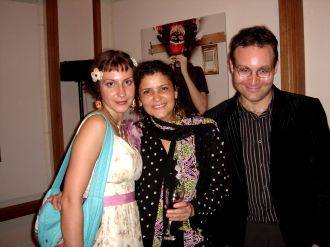 [by Petr Dorůžka, Prague] New York is a cosmopolitan city with very rich musical landscape. Do you think there is something special the Russian, East European, or Slavic musicians living in New York can offer that musicians from elsewhere lack?
Absolutely. In the folk scene, New York arguably has amongst its citizens the best Slavic/Balkan/Russian musicians that I’ve ever met. Not only are they strong as performers, they are incredibly open as musicians, adapting the Western musical styles in much more genuine and honest ways than happens in the East. There’s a great symbiotic relationship that happens all the time – the American players learn from the Eastern, and vice versa. We all go to each other’s performances, learn the tunes, and sometimes play in each other’s bands, feeding off each other like vampires. It’s a small world.
In larger context, the most spiritual contemporary music comes from the former Soviet territory, like Arvo Pärt, Giya Kancheli, Sofia Gubaidulina, do you feel related to these artists?
There’s a hushed silence in Pärt and Kancheli’s works, which I greatly appreciate and relate to. (I haven’t listened to enough of Gubaidulina’s works to comment, alas!) Silence is harder to come by in American works, perhaps. Aside from silence, I’d say that our language and background is quite different – Pärt and Kancheli’s being more inspired by religious and classical music, mine being more inspired by jazz + folk. For me, even the slow, nostalgic moments are always in a dance.
You also worked with Petr Kotik, how was it playing together?
I have been performing as violist with Petr Kotik’s “Orchestra of the S.E.M. Ensemble” for approximately 12 years, from my first years as a student at Juilliard. Some of this work has also lead to touring with the baritone Thomas Buckner.
It is always a thrill to work with Petr Kotik. Despite the cold, barren feel his music may emanate on first listen, his in-person energy is truly whacky and childlike, his music always spiritual and unpredictable.
You’ve also worked with another Czech born musician living in New York City, the singer Marta Töpferová, how did that happen?
It was meant to be. I met Marta the same evening I met Lucia Pulido, approximately 8 years ago. While on my way home from a John Zorn improv jam at Tonic, I looked into the Living Room Café, to see who was playing that night. On stage were Lucia Pulido, Marta, and Satoshi Takeishi, performing incredibly complex music from Colombia. I was instantly in love with the whole group, and kept in touch. Over the next few years, I occasionally sat in with Marta’s (now-defunct) group, the Acustilocos, and recorded tracks for an album with her band mate, Angus Martin. When Marta asked me to record on her album, I was excited to my ears. I’m thrilled with the way the track turned out.
Yet there is another side to the NYC East European heritage, the gypsy-punk of Eugene Hütz, does this kind of music have any value for you?
I love Eugene, his depth and energy, and have played many gigs with Sergey [Ryabtsev, their violinist] and Yura [Lemeshev, the accordionist] over the years. I love their Gypsy quality, but am not a big fan of Punk – my childhood was an overwhelmingly happy one, and I rebelled through free improvisation. As such, I admire their great success from the side, and hope that one day my music will also reach this kind of frenetic boiling point – but on its own terms.
You are a classically trained musician who spent his formative years playing 20th century music. How easy or difficult is it to switch to the warm spectrum of roots styles as you do on the album Mnemosyne you recorded with Kontraband?
Actually, I don’t really consider it to be a switch at all, and I have little to no consciousness whatsoever of changing styles, roots or otherwise. When we play with the Kontraband, we reflect on our experiences of playing in more “rootsy” ensembles over the years, but we do not aim to intimate (or imitate) any particular style except our own. Maybe after the recording is complete, I can recognize in hindsight that this or that solo is more reflective of this or that style, but during the moment of performance, there is no such thought.
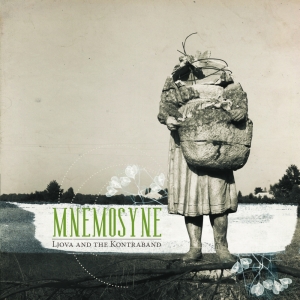 The album’s cover features a photo of a headless concrete statue, probably built during the Stalin era and partly destroyed later. While the man built monuments decay, the trees in the skyline flourish. But, what is the real story behind the picture?
As you know from the press release and elsewhere, the title of the album is Mnemosyne, which is the title of Stickney’s poem, and in Greek is the name for the Goddess of memory. For the CD cover, I spent some time looking at paintings and photographs of women, and other things which could conjure up an image of Mnemosyne. Memory is often unjustly wicked, and sometimes wrong. When, at long last, I found Rena’s photograph, I was struck by the beauty and the serenity of the scene, as well as by how and where the statue was broken. It looked like Mnemosyne was shot in the face, but still standing proudly…
As a parallel to this, I included another possible portrait of Mnemosyne, also by Rena, looking at herself ghost in the mirror, inside the CD booklet.
Koyl, one of the songs from the album, comes originally from the collection of Moshe Beregovski, an Ukraininan-Jewish ethnomusicologist, who spent part of his life in Gulag. How did his collection survive the Stalin era?
Unfortunately, I do not know off hand… but according to a YIVO institute newsletter from 2002: “Beregovski [1892-1961] served as head of the Department of Musical Folklore of the Institute for Jewish Culture at Kiev where he amassed a vast archive of recorded folk, instrumental and Hasidic music. Under the then-Soviet policy of anti-Semitism and eradication of Jewish culture, Beregovski was arrested in 1950 and deported to a labor camp in Siberia, where he was confined for seven years. Upon his release, he prepared a volume featuring parts of his collections, which appeared posthumously in 1962.” It is a wonderful collection, my wife and I often get inspired by reading and singing its many magical tunes.
What is your personal story?
I was born in Moscow in 1978, and moved to New York with my parents when I was 11. My father, Alexander Zhurbin, is Russia’s foremost composer of works for musical theatre, though he has also written several operas, symphonies, concerti, as well as over 60 film scores and hundreds of songs across many genres. He studied with Shostakovich and Khachaturian at the St. Petersburg Conservatory. In 1975, he wrote the first Russian rock-opera, Orpheus & Eurydice, which sold millions of records and continues to play in the same theatre in St. Petersburg to this day. Presently, most of my father’s musicals are in the repertoire of theatres across the country. Amongst his latest works is an opera based on Shakespeare’s King Lear (called Liromania).
My mother, Irena Ginzburg, is a poet, writer, and translator. Her father (my grandfather), Lev Ginzburg, translated many centuries of German poetry into Russian, and wrote books on contemporary German history. My mother continued his mission by introducing many Germany Women Poets to Russian readers, poets such as Annette von Droste-Hülshoff and Ingeborg Bachmann.
When we moved to New York, my father became the Composer-in-Residence at the 92nd Street Y [ed: 92nd Street Young Men’s and Young Women’s Hebrew Association]. Soon after, he founded the Russian-American Musical Theatre, and later, the New York Festival of Russian Films.
After 11 years in New York, my parents returned to Moscow, and live most of the year there. In addition to endless stream of commissions to write music for all mediums, my father is now the host of two TV programs and a radio show. He’s also published three books of articles, thoughts, and recollections. My mother has recently published an acclaimed book of memoirs about growing up in Moscow, and is working on her second.
My parents have always been their best and worst collaborators, writing and performing songs together. At last, they are finally recording an album.
How did the family influence you?
Growing up in a household where both parents are highly intellectual and artistic, we’ve always had plenty of music, words, and important people floating in and out of the house. I didn’t meet many doctors or lawyers when I was growing up, so that was never on my mind as a profession (until it was too late, that is). I had access to an endless wall of books, closets full of hard-to-get recordings. When we moved to New York, I “lived” part-time at the Library of the Performing Arts in Lincoln Center, digging up modern curiosities.
I grew up with an interesting contrast: whereas my father is completely open in terms of genre and style, my mother always keeps to a highly personal range of material, about which she’s very passionate. In my own work, I try to be both – open to outside ideas, but mostly using them to reflect my own light.
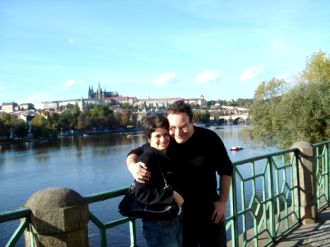 My wife, Inna Barmash, is another contrast – she is an incredible folk singer, born into a family of engineers. As enigmatic as she is pragmatic, she will begin working as an attorney at a big corporate law firm this October. Like my parents before us, we are also writing songs together, and will record them with my ensemble, Ljova and the Vjola Contraband, later this year [2008].
How are you involved with Yo-Yo Ma and the Silk Road project?
I began arranging for Yo-Yo Ma and the Silk Road Ensemble several years ago, at the recommendation of my cousin, Jonathan Gandelsman (a violinist with the ensemble), and the composer Osvaldo Golijov. I have also performed with the ensemble at Carnegie Hall, and recorded on their Silk Road Journeys: Beyond the Horizon CD for Sony Classical. At first, they had asked me to arrange a set of Roma pieces from the repertoires of Taraf de Haiidouks, and also from the soundtrack to Tony Gatlif’s film Latcho Drom. Several months later, I was asked to arrange Azeri, Chinese, Indian, Iranian and Moldavian music for the ensemble’s performances, as well as for the soundtrack to the Japanese NHK-TV network’s documentary series, The Silk Road. Most recently, I have collaborated with the great Iranian kemanche master, Kayhan Kalhor, on his composition The Silent City, and with the brilliant Chinese pipa performer Wu Man, on her Red, Blue and Green suite. Working with the Ensemble is a lot like flying – I have my complete discretion as to the artistic direction of the arrangements, and they generally love whatever I do. Yo-Yo Ma is without a doubt one the most open-minded and nurturing musicians in the world. I hope they will come to play in Prague soon.
Did you work on arrangements for Kronos, and which?
My relationship with Kronos is a bit different, in that their preference now is to have exact transcriptions of the source material, and then to arrange it themselves. As part of this, I’ve transcribed quite a list of music from different countries, including Iraq, Iran, Sweden, as well as several tracks for their release with Asha Bhosle, You’ve Stolen My Heart: Songs from R.D. Burman’s Bollywood, collaborations with Matmos, and Clint Mansell’s score to Darren Aronofsky’s “The Fountain”, featuring Kronos and Mogwai. On commission from the Los Angeles Philharmonic, I also worked with Kronos on a concert with the Moroccan Cantor Emil Zrihan, fleshing out arrangements for Kronos and Emil’s ensemble.
Also you thank indirectly Lucia Pulido, and Asha Bhosle, could you please explain why?
Both of these voices have been incredibly inspiring in developing my tone, my music, and my personality. I’m hopeful you can hear this on the album’s performances (Lucia’s influence on Middle Village, and Asha’s on Crosstown).
Several years ago, while working on the Kronos & Asha Bhosle album, I had a chance to speak with Asha & David Harrington (Kronos’s first violinist and founder) on the phone. I was sitting in a Bangladeshi café in Tribeca, in between watching films at the Tribeca Film Festival. Asha’s voice was being heard in the café’s CD player, and also in my phone. Short of my mother’s, it was arguably the sweetest voice I’ve ever heard.
You mention collaboration with the Iranian master musician and composer Kayhan Kalhor. As his instrument is kemenche, was the notation somehow respecting its wider timbre range, compared to Western violin?
Over the past few years, most of my arranging work has revolved around composers from different cultures and traditions than my own. I’ve arranged music from China, India, Iran, Iraq, Sweden, Tanzania… But my approach to these arrangements is essentially similar — first and foremost, I take stock of any technical considerations/limitations, and then think of the best way to express myself in the work. I try to re-interpret the original work as much as possible, and make something of my own. If I steer to close to the original, I feel that I’m cheating the listener from having a fresh, personal perspective.
In The Silent City specifically, I arranged only the latter half of the composition, from a single-line sketch by Kayhan Kalhor. Kayhan guided me simply by allowing the greatest freedom, and requesting that I be as dissonant as I wanted to. I went with my instincts, much like the composition itself, never looked back.
http://www.ljova.com/
31. 12. 2008 |
read more...
[by Ken Hunt, London] At the time of doing this interview – 13 August 1979 – the Scots musician Robin Williamson was based in California and working with the Merry Band. Their latest album at that point was A Glint At The Kindling (1979). This interview is an excerpt of a far longer interview. It concentrates on Williamson’s time with the Incredible String Band and before the band’s formation. The Incredible String Band had overturned people’s appreciation of what contemporary folk bands could do. No lesser mortal than Dylan had name-checked the Incredibles’ October Song in his interview with John Cohen and Happy Traum in the October/November 1968 issue of Sing Out! and that was big medicine.
12. 11. 2007 |
read more...

Transparente uses a richer accompaniment then the traditional fado setup. Which musicians will you bring on tour?
Transparente is closer to what I’ve been looking for as my sound, my Fado.
My main goal is to pass to the live performances the general sonority of this record so I’ll be adding to the traditional Fado combo (Portuguese guitar, classic guitar and acoustic bass), cello and percussion.
Luis Guerreiro on Portuguese Guitar, Antonio Neto on classical guitar, Vasco Sousa on acoustic bass, Paulo Moreira on Cello and Joao Pedro Ruela on percussion.
Where Fado was born? Only in Lisboa or are there Brasilian influences?
Fado’s history is kind of mysterious. Some theories says that the Portuguese sailors and the African slaves are in its base; According to some musicologists, Fado’s roots are also in the Lundum and Modinha; two kind of music styles coming from Brazil.
Fado started to appear in Lisbon in the beginning of the 19th century as an urban music and it was sung. Fado appears in a different form among the underprivileged and due to that it’s regarded as popular music. Fado was the people’s “newspaper”, it was through this song form that some news where known.
Was fado prohibited at any point? Was there a fado dance?
Portugal lived for 40 years under a dictatorial regime and Fado was a little the regime’s music. On February 25 1974, this regime had finally come to an end and Fado was put aside, it was somehow “locked up”. The only possible ways to listen to Fado was in the most traditional neighbourhoods of Lisbon, so, not prohibited, but out of “fashion” for some time, let’s say.
As I said before, some musicologists say Fado roots are Lundun and Modinha, which are known as a sensual music style that used to be danced in Brazil, it looks like that this was the way it arrived in Portugal, but the dance was so sensual that became a forbidden dance.
Originally, was it a street music? And when did fado happen to reach the
rich educated people?
Fado is very much a street music, which is learned from the elderly. It’s a tradition passed down orally and not through books or schools. It’s a music style where people express their deepest feelings and emotions. It was in Lisbon’s most typical neighbourhoods where the simple people lived, that it was possible to have contact with Fado. There was a point in history where the royalty started having Fado, but played with the piano. Some decades ago, Portuguese people started looking at Fado as the music that best represents Portugal; nowadays it is like this that people look at Fado, no matter age, class, etc.
What is important for a fado singer? Did you take any lessons? Do you
have a voice teacher?
I assume you mean important regarding the voice. Well, I like tea, and drink a lot of water!
I don’t really have singing lessons. I have, however, a teacher who looks after my voice as well as a doctor who’s always there for me.
Africans have a great talent for music. Do you feel the art of making
music is easier for you when your mother is an African?
It’s possible that the warm and melodically African rhythms may have influenced me, even if I don’t notice that. I’m very sure that these influences come from my mother. I was in Africa for a small period of time, but I grew up listening to music from Senegal, Antilles, Cape Verde and voices like Miram Makeba or Cesaria Evora.
Do you have any memories of childhood in Mozambique? Do you miss Africa?
I was 3 years old when I left Mozambique and most of my memories are from my grandfather (my mother’s father). I was very spoilt by him, as I was his first granddaughter. This is very typical in Africa, as the first-born is treated in a very special way.
My grand parents had a big farm where we used to spend our weekends. They had horses and lots of pigeons. My grandfather used to take me for long horse rides. In the morning we used to sit on the porch and he gave me fruits to eat.
As soon as my life allows me to, I’d love to travel to Mozambique and visit my family, also to remember everything I lived there when I was a child.
What exactly does mean the word Transparente, and how does it relate to
the theme of the album?
Transparente means crystal, clean. It reflects my maturity as a performer and my unstoppable search for my sonority. For my Fado.
Transparente is completely “naked” in poetry and way of singing. That’s me. That’s my music, my declaration of love to Fado.
Tell me about your African grandmother. Did she sing?
It was my grandfather who use to sing in family parties, but I can’t say that I have anyone in my family connected to music. My African grandmother didn’t know how to sing, she talked about one’s fate.
How did you collect material for the CD? Are there any cover versions?
I started by researching through the greatest Portuguese poets.
I could count on the help of three of the most important Portuguese songwriters. They wrote and composed songs, especially for me, like “Meu Fado Meu” [Paulo de Carvalho], or “Transparente” [Paulo Abreu Lima/Rui Veloso]. I also wanted to work with a younger composer from the new order, able to write and compose about the new Lisbon, so I found Pedro Campos, who wrote “Montras”.
I don’t think that there are cover versions in this album, but instead a tribute to the three most important people in the history of Fado, which I consider my teachers and my gurus: Amália Rodrigues, Fernando Mauricio and Carlos do Carmo.
Are there any links between fado and literature?
Fado, as well as poetry, expresses all kind of feelings. Without those feelings it would be impossible to talk about poetry or Fado.
Poetry is the highest level of literature. Through it, thoughts, emotions and feelings are expressed. Fado is a gathering of all of these.
Could you please introduce some of the authors?
Fernando Tordo is one of the best Portuguese songwriters who worked with me in this album by writing “Fado Tordo”.
Mario Pacheco, one of the best Portuguese guitar players, wrote and performed with Amália Rodrigues. He composed two songs for Transparente: ” Há uma música do Povo”, a poem by Fernando Pessoa, and “Há palavras que nos beijam” by Alexandre O’Neill. He had already worked with me in “Fado Curvo” with another poem by Fernando Pessoa: “Cavaleiro Monge”.
Paulo Abreu Lima is the author of “Transparente”, composed by Rui Veloso, another big Portuguese songwriter. Both of them had written and composed for me in “Fado Curvo” : “Feira de Castro”.
The “Recusa” is a very mysterious song. It indicates you are not just a
fado singer, but fado itself. But that sounds quite complicated. Can you explain?
“Recusa” was written by one of the most traditional poets, Mário Rainho. The poem says: “(.) if to be a singer of Fado is to lose sight of the sun (.) to be sad (.) to be on the edge of tears (.).”. This is exactly what I am not! Fado is not crying all the time. I don’t dress up all in black. I dance; I move and express my own personality. That’s why I feel different. This is my Fado. And, if being a Fado singer is to be all what I’m not, then I’m not Fado, I’m Fado when I do it my way, respecting all its codes, but always my way. This is my music. It is where I find myself and where I recognize myself. Fado has space enough for everything, for joy, for feeling melancholic, to celebrate and to be happy.
In the past, did you sing in the fado houses? Can you describe the
atmosphere?
You live an intimae atmosphere in Fado houses. People are happy to be there. There’s a positive energy in the air, it’s a fantastic environment!
People meet there to get together, to relax, have a drink and at the same time to join in the emotion that Fado is. I go a lot to Fado houses, even if I don’t sing, I like to breed it!
Is there one fado house called Senhor Vino? And do you also have a song of that name? What was first?
“Ouça lá ó Senhor Vinho.” was written and composed by Alberto Janes. It was created for Amália Rodrigues and was recorded and released by herself in 1976. The album was named “After this Song”.
There is, in fact, a Fado House called Senhor Vinho. It’s located in one of Lisbon’s most traditional neighbourhoods: Madragoa.
Your performances are well known for the intense atmosphere. What are
your feelings after the concert, are you tired? Do you need a BIG rest?
I do give away all I can to my audience, and of course that brings some tiredness, but I love it, so, as long as I can do it, I’ll keep on doing it!
Did Jaques Morelenbaum work with a fado singer before?
As far as I know Transparente is the only Fado album produced by Jaques.
Why did you select him? What is your attitude to Brazilian music?
I’m very fond of Brazilian rhytms, such as Bossa Nova, Vinicius de Moraes, Tom Jobim, Elis Regina or Caetano Veloso, for who Jaques Morelenbaum is currently the musical producer. I already knew that Jaques had worked with Caetano Veloso and Ryuchi Sakamoto. We met in music festivals in Portugal and abroad. I’ve always loved his work. I’ve always wanted to work with him. I spoke with my record company and they liked the idea. I suggested it to Mr. Morelenbaum and he returned to my suggestion with all possible dates to start working. I’ve always thought that doing it would help me to reach the sonority I was looking for. When I listen to this album I feel my Fado, my sound. Jaques Morelenbaum uses all musical instruments in a magical way, with lots of care. He was the producer for this record; he understood me.
When did you discover him for the first time? What kind of music were you
listening before?
As I said before, I already knew Jaques work with Tom Jobim, Caetano Veloso or Sakamoto. I met him in Lisbon some years ago. I listen to all kind of music, as long as it’s good. But I have to confess, I have my preferences: Maria Callas, Tony Bennett, Nina Simone, Sting.
Now your album is on the top of the charts. What is the chart music any time Mariza doesn’t have a new album? Is it this anonymous international pop? Do you have any favourite singers in Portugal?
Like everywhere we do have international pop artists in the charts, but there’s good music being done in Portugal, like Rui Veloso, Carlos do Carmo, Jorge Palma. To name a few.
What kind of book would you take with you to a desert island? And any musical instrument, or a CD?
I would certainly take various Portuguese and international poetry, which I would read listening to classical music.
Is it different when you sing for non-Portugese audiences? Do you have
to translate the lyrics?
I think that everybody has a little bit of Fado inside themselves. Because it is a music that have in the base feelings, emotions, etc. People all around the world are able to understand it, even if they speak a different language. Nevertheless, I carefully explain what I am going to sing, but the rest of it is emotion. It’s a kind of give and take.
How many languages do you speak?
I speak a little of English, Spanish, some French, and Portuguese, of course .
Do you have any personal dreams?
To be happy
�
9. 7. 2007 |
read more...
 [by Kate Hickson, UK] Joe Boyd, the author of White Bicycles (subtitled “Making music in the 1960s”) did a great deal when it came to acting a midwife to the soundtrack to many people’s lives during the 1960s. He produced era-defining music by the likes of Eric Clapton & The Powerhouse, Pink Floyd, Soft Machine, The Purple Gang, Fairport Convention, the Incredible String Band, Nick Drake and Brotherhood of Breath. Then he went on to do it again, overseeing recordings by the likes of Richard & Linda Thompson, Kate & Anna McGarrigle, Maria Muldaur, Dagmar Krause and 10,000 Maniacs. With his Hannibal hat on, he brought Hungary’s Márta Sebestyén and Muzsikás and Bulgaria’s Bulgarka Vocal Trio to our attention.
He has shaped our musical perceptions, maybe third-hand as when Kate Bush turned on to Bulgaria’s best-known musical export, as he wrote about in Rhythms of the World (1989), but also in ways deserving of attention way beyond dimly remembered tales of bygone jolly goods.
Factor in Boyd’s time on the hamster wheel of the London club scene, artist management with Witchseason, his film activities, notably Scandal and Jimi Hendrix (since released in an updated two-disc edition by Warner Home Video), and as all-round scenester and White Bicycles has material enough to whet the appetite of any devotee of that era’s music.
The scene: North London. The date: March 2006.
Let’s try to avoid paraphrasing White Bicycles tales.
All for it.
Did you go about White Bicycles with a mental shopping list or did you do a mind map of the subjects you had to cover?
The first idea was, I’m going to write a book and two friends gave me one-sentence pieces of advice – which I immediately recognised to be true. One was, ‘Don’t do the whole thing, just do the Sixties.’ The other one was, ‘Separate chapters by subject rather than period.’ So I wrote a chapter about the Incredible String Band. That helped in a way to push me out of the picture when I was writing about Nick [Drake] or Muddy Waters. Once I had that I found the structure came to me pretty easily. In the course of numerous drafts, my prose was cleaned up, honed and streamlined and became less cluttered.
Did you have a free hand with what you could record for Elektra over here [the UK]?
Not at all. Fundamentally, my job with Elektra was slightly fudged in the sense that I really wanted to be a producer. I like to think what I have is a connoisseur’s eye for the business end of things. In my visits to England in ’64 and the spring of ’65 I went to Collet’s [Record Shop in New Oxford Street, the most important folk and jazz record store in London] and I talked to Hans [Fried] and Gill [Cook, the store manager], checked the bins to see what was what. I was interested in the record business as a business. And in things like distribution and promotion.
In the first half of ’65 a number of things happened. The first one was I helped Paul Rothchild find Butterfield and add Mike Bloomfield to the band. Rothchild was already a friend, but he now had a concrete reason to try and get me into the door at Elektra in some fashion as a kind of payback for helping him sign Butterfield. And also because having done that I’d showed that I was an asset. Potentially.
What he and I were always talking about was A&R. Like who’s good and who should be signed. I guess I’d met Jac Holzman but I ran into him at some little festival at some weird ski resort in Connecticut in August of ’65. After Newport. For some reason, George Wein had been involved a concert on Friday and Saturday nights and because I was working for George I went up there and acted as production manager, got the sound check done, set up the stage.
Because Judy Collins and Tom Rush, Phil Ochs maybe, were Elektra artists, Holzman came to the festival. There was a reception backstage after the first concert. I’d had a hard day, swallowed a glass of cheap red wine quickly and found myself in conversation with Holzman. He said, ‘So tell me, you’re been to England a few times, what’s Elektra’s presence over there?’ I answered, ‘Oh, it’s crap.’
Is this in the Bounty [Elektra’s UK budget outlet label] days?
No, Bounty didn’t exist then.
They were being imported by a company called Record Imports Ltd who were focussing mainly on Nonesuch. They had a big classical catalogue and also handled Blue Note. They had an office in a basement in Poland Street.
I said, ‘Well, first of all the records cost too much. There’s no good promotion. You’re not a serious presence.’ I said it all in rather blunt and rather undiplomatically because I’d had a few drinks. Afterwards I said to myself, ‘What am I doing? I’ve insulted Jac Holzman!!!’ To the contrary, I think. I think that Rothchild had been pushing him to see if there might be a job of some kind at Elektra. I think that rather than insulting him, Holzman quite liked my attitude and my aggression about what ought to be done about Elektra in England. So these two strands came together. At the end of September I was invited to come up to a meeting at Elektra. Rothchild and Holzman were there and they asked if I wanted to go to London and open an Elektra office. It was actually set up as a joint venture with Record Imports.
I was always struggling to get to be allowed to do anything as a producer. If you think about Holzman turning down Eric Clapton, Pink Floyd and The Move during that period, it was a shame. Although I don’t know if we as an organisation would have really been up to the task of marketing all those artists at the time. It was a pretty low-level, folkie, amateurish operation. The Love and then the Tim Buckley advance copies arrived probably a month or two before I left.
Still on the other hand you did get Sydney Carter, Alasdair Clayre and Cyril Tawney.
Yeah. Looking back on it, they had very good justification in being wary of what Boyd would be up to! Obviously from a commercial point of view in terms of whether I was the person who should have been given more of a free hand, it’s a lot ‘nicer’ to point to Eric Clapton & The Powerhouse and the Incredible String Band and the possibilities of Clapton and the Pink Floyd than it is to Sydney Carter and Alasdair Clayre.
I had a good time making that record Alasdair Clayre. Alasdair was a poet and wrote some good songs, taught English, was a Fellow of All Souls. Peggy Seeger played on the record. But I think I got into the idea of recording that record largely because he was my way of staying in contact with Vashti Bunyan. I felt that she was the star.
How were they connected then?
He knew her and he took me to see her. He played and she played at an ICA event, the old ICA before it moved to the Mall. He took me backstage afterwards. She’d gone so I kept sending messages to her through him. He saw her occasionally and I admit I was obsessed that I had to sign Vashti Bunyan. If I had to make an Alasdair Clayre record to prove what a good job we could do. Or if I told Alasdair to fuck off, I’d never find Vashti again. It sounds ridiculous from this distance, but at the time it had a logic.
What was the charm of her music for you?
Again, it’s like those memories we were talking about, the record that I eventually did with her, Diamond Day, stands in a way between me and what she sounded like three or four years earlier. I remember thinking that she was gorgeous, she had this gorgeous voice, she had these lovely songs. In a way my take on her was not much different than Andrew Oldham’s who signed her at the time. She was like Marianne Faithfull, only better. I haven’t heard the single that she did with him or any of the demos of the songs that she might have performed at the ICA ever. I just remember having this feeling that this was special and could be successful. She had a star quality in an anti-star sense, in a diffident, shy, hair falling in front of her face kind of way.
I think that what’s happening now with Vashti is fascinating. It sort of justifies my feelings. She performed with her hair falling in front of her face, very shyly at the Barbican in front of 2000 people and absolutely justified top billing. She’s getting offers from all over the world now to go tour, the record’s selling and selling and selling. I feel, I saw that, I saw all that in 1965 at the ICA!
Validation.
Yeah!
You touched on the Incredibles. I can remember going to Collet’s in New Oxford Street round about the time that Changing Horses came out. Hans Fried sagely told me they were under the sway of Scientology at that point and that one could detect that in the lyrics. I was never able to. Can you give me a hint of how they were coloured creatively?
I never really discussed these things with them. Their joining Scientology worried me because, to me, it seemed like a self-important, obscured cult. There were a lot of things that seemed at first to benefit them. It’s very hard to analyse a writer’s motive, why they write something. Certainly Scientology is full of stuff about past lives and has a strange take on the world and the spirit-mind-body relationship. You can parse some of those later lyrics, particularly I think in U, and come up with analyses in terms of the writings of L. Ron Hubbard and maybe come up with something. For me, what was noticeable most of all was [them] kinda going off the boil. One song in I Looked Up, for example, which I thought was actually one of their better later songs and I enjoyed recording it, was “This Moment”. That is very core to Scientology.
The theory of Scientology seems, on paper, to be very sound. If you somehow clear away the ‘engrams’ as they call them, the links that are built into your cellular system between painful memories and the details of what’s around you at this very moment, if you can sever the connection between the fact that you may have been in a school room with the colour of these walls and a teacher rapped you on your knuckles and humiliated you in front of the class, you will be freer in this moment to live, to be yourself, to respond to things that are happening now rather than things that happened long ago when you were smelling that smell, seeing that sight or hearing that sound. “This Moment” is one of their best Scientology-related songs because it’s a perfectly reasonable and universal sentiment. It just happens to come with a particular Scientology edge to it. I even like Licorice’s little verse.
My concern was about the decline in the quality of their songs. It was never clear to me whether Scientology had anything to do with that, because there were a lot of other things going on. It’s very hard really to find original artists who maintain a level of originality, freshness and spark six albums in.
One of the things I found interesting – and I don’t if this had any bearing on your role – was the way they would perform material before putting it out on record. That kept an edge and avoided comparisons. Often they would tour and not play or promote the new album’s material.
A lot of musicians were like that in the Sixties. I risk sounding like Old Fart about the modern day and young people these days, but I do find it depressing going to a concert and seeing a lot of artists playing their album. They play all the songs they’ve recorded and know what you want to hear. They know what they’re promoting and that the record company’s paying tour support. In the mid Sixties people played what they wanted to play. That was one of the things you did. You played songs you hadn’t recorded yet to try them out, to test them, to hone them, to get them ready to be recorded. That made the whole [recording] process of a different nature. And possibly higher quality.
They never did jam with Chick Corea though!
You alluded earlier to Nick Drake’s college friends peopling the songs; did you have many acts that you would talk to about the content of the songs? Was that a tendency of yours?
No. And I never really talked to Nick either about his songs. I tended to take them pretty much at musical face value. I didn’t really get into what they were about.
Were you in any way prepared for the impact for the effect of psychedelia on this country when it hit this country? A spirit was afoot.
For me, during the whole year of 1966 you could sense all these things building up. When Elektra and I parted company, which was September of ’66, I was faced with a choice. I had to decide whether I was going to stay in Britain or go back to America. I had no job.
My father came to England in October or November ’66 but he remembers getting on the bus to go to Heathrow [London Airport] to go back to America. He gave me a hundred dollars or something as a present. I was standing at the door of my bed and breakfast hotel and I was wearing my raincoat and it was torn. That’s the image he still has. I was in a precarious economic position. Fortunately, John Hopkins – Hoppy – had much more momentum, having been a very successful photographer, but he, combined with my friendship with him, kept me in touch with what was going on in the so-called ‘underground’ and how it was getting bigger and bigger and bigger. It was Hoppy that invited me to go the Roundhouse to the International Times launch party. That was really the template for UFO. Hoppy had reached the point where his activities with the Notting Hill Free School, International Times and all that meant he would have had to say to all his regular customers for his photographs, ‘I’m not available, I don’t have time.’ He pretty much had lost his main source of income, as had I. The Incredible String Band wanted me to manage them; I’d suggested it and they’d agreed that I should manage them. I had that but they weren’t making any money and I wouldn’t make any money managing them for quite some time. Hoppy had no money from International Times. We were both in this position that we really wanted to be doing what we were doing, but we needed cash flow to pay the rent. So UFO was that. So, that’s the long answer to your short question. Yes, I did see psychedelia as something that was going to be much, much popular. That’s why Hoppy and I started the UFO. We saw it as something that had potential to get a lot of people through the door and for us to pay our rent thereby. We did it definitely as a means of capitalising on what was going on.
Did you keep a collection of the posters from the UFO club?
In those days I didn’t keep things. When I think of some of the records that I had! The poster company crashed and burned at a certain point. The creditors got all the stock. I was running around frantically and never at that time, knowing that this was going to happen, did I go over and carefully rolled p two copies of each poster and put them in my attic. Very soon I was very depressed that I hadn’t. I got together with Felix Dennis and he suggested we had lunch. We went to a little workers’ caff. I’d never really known Felix. The International Times crowd was rather snooty towards the Oz crowd – they were Johnny-come-latelies and we couldn’t read their magazine, they were never part of the UFO world. Their real momentum came after UFO closed.
Suddenly in 1975 or 1976, I’m having lunch with Felix. He said he lived nearby, said he’d show me his pad. His study had all these beautiful framed UFO silkscreen posters. I said, ‘Oh Felix, oh Jesus, God, it’s breaking my heart. You were together enough to collect these.’ By the time Osiris went under, it would have been easy for him to take a few posters. And he had. That was the difference between Felix Dennis and me! He said, ‘You mean you don’t have a set of the posters? Oh well, I have an extra set.’ He pulled out a big tube that was not complete but had almost all of the UFO posters and gave them to me.
One of the things I particularly enjoyed about the book was the sound of bubbles of mythology being burst. That was to do with the whole business about the use of axes at Dylan’s performance at Newport. That’s a story that’s gathered so much moss as it’s rolled down the decades.
Paul Rothchild is the likely source for this. There is a story in some Dylan documentary where he talks about Pete Seeger talking about, ‘Cut the thing.’
This was a power line. Is anybody going to cut through that?
Exactly! I know Paul and Paul liked a good, embellished story. He’d heard me talk about the prisoners and the axes and certainly he was aware how violently the Old Guard responded to the sound. I’m also certain the source of this is Paul Rothchild. I know where Rothchild was during that whole thing. He wasn’t behind the mixing desk. He wasn’t backstage. He couldn’t have seen. He wouldn’t have seen and he could only have gotten it by hearsay. I was bragging about snatching the wires away from the axes with the Texas prisoners and Pete Seeger seeing me doing it. I certainly told Rothchild as well, how violently appalled they were by the level of the sound. The fact that I was reporting to Paul the violence of Seeger’s response to the sound and an incident with axes and wires and Seeger is my guess how that happened. If I didn’t see it, that doesn’t prove it didn’t happen. But Seeger knew enough about the way sound controls worked! You don’t power the speakers. The power would have been way back with the generator or a line to a utility pole or way off somewhere in the bowels of the production area, nowhere near the backstage. And a sound cable to a speaker? Well, they’re stacks of speakers and you’d go round cutting one after the other. Seeger knows enough about the way things work. It’s a mix-up. It makes a good soundbite though.
Afterword:
Fledg’ling Records released a similarly titled White Bicycles CD to coincide with the book’s publication. It includes Boyd-produced tracks by Pink Floyd, Purple Gang, Fairport, Geoff & Maria Muldaur, Johnny Handle, Dudu Pukwana & The Spears and Soft Machine. Boyd contributes written notes about each selection. More information at www.thebeesknees.com.
Read the review of White Bicycles in Czech
The White Bicycles CD won Mojo magazine‘s Compilation of the Year Award for 2007.
More information at http://promo.emapnetwork.com/mojo/honours2007/
9. 6. 2007 |
read more...
July 2006
How was the Ostrava concert, compared to the other gigs you did with Värttinä?
 Ostrava concert was great. Audience knew the band and they were ready from the first minute. People were singing and dancing whit us, so whatelse can you ask.
I never heard your recordings, but I suspect they are very different from Värttinä’s: blues, soul, English? So, what are the things you have in common, which led to your production job?
Common thing is music, singing. I’m specialised in different kind of vocal sounds and techniques and that is the reason Värttinä asked me to produce the Miero album. And after that they thought that i might be good choice to take Mari’s place for awhile. If music is the thing and not one musicstyle, if you are openminded then you can join any production and still have your own artistical style..
I liked your pictue sitting on a piano in a Finnish interview . The picture has almost punk attitude. What is your musical background, were you originally a punk grrrrl?
I’ve never been punk girl. I have classical background. I have gratuated from Sibelius Academy. I compose litlle classical music and rock/oio music with ethnic flavor.
“My Finnish translation of Peter Guralnick’s great book Sweet Soul Music is scheduled to be released in July by Johnny Kniga Publishing,” That says a lot.. What are you other favourite books, both music and general?
I didnďt translate that book in finnish, Honey B.&T-bones guitarplayer did. And actually it was released last weekend in Pori Jazz festival. But I do like books that tells about music.
Scandinavia seems to be blues oasis, maybe because blues is about suffering and keeping your strenght?
Scandinavia is also rock and especially heavyrock oasis. Bluesbased music is alternative music. Not very big thing. But bands can do pretty much gigs if they want. Nowdays I do only festival and concerts, not that much small clubs.
Honey B. & T-Bones is your only project?
As I told earlier I compose and visit other bands occationally. I start to work wit one finnish world music band called Outo Voima. They used to be insrumental band, but they asked me to join as a vocalist. Sometimes I work with Symphony orchestras, free jazz bands and modern rock grupes. I also teach pop/hazz singing in Sibelius Academy. (Johanna from Värttinä is my student)
After 23 years on the road, how do you avoid doing the same thing again?
Of cource every artist do some same thing all the time. Audience would be dissapointed if they donďt hear some older hits with old licks. But my philosofy is to create something new all the time. As much it is possible. Maybe thatďs the reason I have survived in this heavy business. At that moment on stage or at studio or when you are composing you have to have a feeling that “this thing” is the only thing you want to do. Live just that moment. Give what you have. Show and express feelings.
22. 7. 2006 |
read more...
His playing is everchanging and full twists like an imaginary landscape. No wonder, the chamamé accordion style is a “mestizo music”, rooted both in European polkas and Guaraní Indians culture. When Spasiuk played at Womex in 2001, many people wondered: “This music makes me dance, but also opens the gates of imagination. I never thought you can do this with an accordion!” This hard to define spirit is fully captured on Spasiuk’s last CD, Tarefero de mis pagos, produced by Ben Mandelson. I talked to Chango at the BBC World Music Awards Ceremony in Gateshead in January 2005, where he performed as a winner in the Newcomers category.

Chamamé is often explained as meeting of two cultures: Indian and European. Is it really as simple as that?
First I have to say that Guaraní have their own music, different from chamamé. The chamamé development took several centuries. First the Spanish Jesuit monks came to the area now called Misiones in the North East of Argentina. During the 1600’s, they were teaching European music and religion to Guaraní. And the final step was taken by the immigrants from Europe who took their accordions with them.
When the Jesuit monks imposed Catholic religion on the Guaraní Indians, did some conglomerate faith like Candomblé in Brazil developed in Argentina?
They tried to impose, but with no success. The Jesuits were surprised to find people of that advanced and sophisticated spiritual world in the jungle. The only people who took up Catholic religion were the Creoles of partly European descent. The Jesuits taught Indians to build violins and other instruments. They became musically highly accomplished, but when the Jesuits left, some of them went back to the jungle. And some became music teachers.
Contrary to Brasilian forro or the Celtic reels and jigs, chamamé is not just a dance music?
Even if chamamé was music for dance at the village square, there is also another level. In chamamé you find mystery, higher power, things from the other side. That goes along with the Jesuit music, who played baroque composers for the Indians.
Books by Julio Cortázar, Gabriel García Márquez and other South American writers are often referred to as Magic Realism. When I’ve heard Chango Spasiuk for the first time, my impression was: This music is transcending the traditional musical cliches in the same way, as Cortázar transcends the stereotypes in literature.
That’s a nice thing to hear – thank you. There are several levels in what I do: I try to make chamamé, as well as the daily life of people living there better known, but I do also express my own feelings, my inner world. I’m not trying to do any fabrication, and if someone finds truth in my music, I appreciate that. And I don’t think I’m something important in the history of chamamé. That’s the way it is: Chamamé is using me, and I’m using chamamé…
Was there a Robert Johnson or Muddy Waters of chamamé?
Of course. 5 people helped to develop the music, living between 1930’s and 1980’s. All of them were playing button accordions and/or bandoneon: Transito Cocomarola, Isaco Abitbol bandoneon, Tarragó Ros, Ernesto Montiel, Blas Martinez Riera. Their work was recorded, not written down. This is very different from tango, when compositions are written in notation. As a result of this, there is not any strict definition of chamamé.
When talking about chamamé, most Europeans would think of Raúl Barboza. How would you classify him?
Barboza is my friend. But these 5 people mentioned were the classics, Barboza was born later. He left Argentina and transmitted chamamé in Europe.
Where did you ancestors come to Argentina from?
My grandparents were from Ukraine, I still know a few words in that language. The biggest migration wave started in 1897 from the Ukraine region close to the Polish border. In early 20th century Russians, Basks, Volga Germans, and other immigrants came to Argentina and all of them brought their music with them.
On your last album, there’s one special song, Starosta, very Slavic, related to polkas, but with some changes in the rhythm. How did that develop?
My father was a carpenter, but he was playing violin. People were playing these polkas inaccurately, they were changing the structure on the run. Imagine somebody who walks on foot to a neighbor village in the time of a wedding. When he gets close, he hides behind a tree so nobody bothers him, and stays there listening. All night, and then he hears a song he really likes, he learns it by heart, goes back home, grabs his instrument, and plays what he remembers. The song goes through transformation.
25. 1. 2005 |
read more...
Your “Secrets of the Rocks ” booklet is really very secretive. You mention places like R…, G.., and E., For the foreign travellers to Greece, could you explain what these places mean to you? And are there still some deserted islands in Aegean or Ionian seas?

Kristi– In my first album, back in 1986, there was a song that was speaking about one secret beach near Athens, where no cars could arrive. People had to climb for one hour inside a rocky pine forest in order to reach this natural sea paradise, where there were no umbrellas, no bars and lights and of course no… bathing suits. Few people knew Ramnunda then. But that song of mine became a radio hit. And next summer, the beach was filled with people. Unfortunately some of them would leave their garbage there. Others were bringing their loud cassette recorders. Others were wearing bathing suits and maybe looking at the nude naturalists with a bad glance. I didn’t feel good with what had happened to that secret beach due to my song. I felt responsible. This is the reason why both Stathis and I didn’t want to put on the cover of our album the whole names of those few secret, remote beaches of those faraway, not yet exploited by tourism islands, where we often like to live for some days with our tend or even without a tend, just with our sleeping bags and where The Secrets of The Rocks were written.
Yes, one can still find some such places on some small, remote Greek islands. I suggest to those who may be interested, to travel south and search for them. It’s much nicer when you discover a beautiful, hidden place by your self, than when you are told by someone else or have read about it.
Stathis-I’m sure there must be in the Czech Republic too some similar “secret” places near rivers or lakes or whatever , where people can go and enjoy nature.
In your concerts, you explained baglamas was prohibited in the 20’s. Could you tell more? Were musicians put into prison? Did the prohibition also included other instruments, like saz or bouzouki? 
Kristi– It was in the mid 30’s when the string instrument bouzouki and the vocal improvisations on eastern scales, called amanes, were prohibited by a new law of the dictator of the times called Metaxas (nothing to do with the famous Greek Metaxa drink!). In 1922 many Greek refuges from Minor Asia had come to Greece in terrible condition. They would gather in those small private places, backyards or taverns, that were called tekes and smoke hush and play their rembetika songs of sorrow and pain with their bouzouki. But at that time the dictator Metaxas didn’t like this eastern atmosphere and mentality. He kept saying and he was also trying to impose this to the rest of the people, that Greece belonged to the west and not to the east. So he made this law and the rembetes were often captured and put in jail. It was then that they started to use baglamas, which is like a bouzouki, but much smaller. Because of it’s small size they could keep this instrument hidden inside the jail and under their coat when on the road. I really cannot tell how they were able to “hide” it’s ear piercing, crying sound when they were “secretly” playing it.
And by the way, hash smoking was also important part of the rembetika tradition. You mentioned this habit during your Prague concert, in a different context. Does the connection between herbs and music have different level/meaning in Greece, than in the hippies and rasta culture?
Kristi– It has exactly the same meaning in certain kinds of Greek music, like in rembetika, and in some of the laika songs, which is a continuity of rembetika. I wouldn’t say hash smoking has much to do with other kinds of Greek music, like with dimotika, which means the traditional songs of the rural areas of Greece. Remember that rembetika were songs of the city.
Stathis– Rembetika has to do more with the Blues culture.
Ross Daly once told me about a lira player who catches bees, puts them into plastic bag and then plays their “music” on his instrument. On you Prague concert, you mentioned a bouzouki player who learns music from imitating nature. Could you explain more about this method?
Kristi -It’s funny because in our previous album Echotropia, we have a song called Beehives, in which Stathis has recorded bees in a field and then turned their recorded buzz into a rhythm loop.
In the show I was talking about Giorgos Zambetas, a very famous songwriter of laika songs who has passed away.
He was a very interesting figure and some of his sayings and lots of stories about him are often mentioned. One of these, was that when once he was asked in an interview, how he had learned to play his bouzouki, he had answered, “by listening to the frogs”. It’s not a method of learning. It’s just to have open ears and listen to the environment around you. There is music everywhere. And as Aristotle had said, art is an imitation of nature. If you listen to the sounds of a jungle, all those birds bubbling rhythmically, you can tell why music from Africa and from South America is so rhythmical. Listen to the wind which never stops for days on some Greek islands and you will feel why in traditional Greek and in Byzantine music there is always one monotone sound backing up the main melody, giving that psychedelic feeling of dizziness. Rock music is also the music of the environment of it’s era of cars and loud machines. And nowadays, isn’t it electronica, what we are listening to all day? Mobiles ringing everywhere and little computer sounds all around us?
A sailor’s question: When you told the story behind Calima, you talked about all this humidity and headache coming from this southern wind. The same situation is explained in the Visconti’s film Death in Venice, when scirocco comes and makes the main hero suffers even more than you suffered at Canaries. So, is Calima more like scirocco or like Livas?
Kristi- I love this talk about the winds and their names! So in Venice it is the scirocco wind that bothers them. I didn’t remember this interesting detail from that beautiful film. Scirocco in Greece we call specifically the wind that comes from south east. They say that it can sometimes become dangerous for boats because when the night falls it becomes very strong. Livas is a very hot, burning wind that comes from the south and brings to the Greek peninsula the sand of the Sahara desert. This creates headaches to people. You wake up some mornings and there may be sand on your car, your balcony, the streets. In the Canary island the wind which is creating similar effects comes from the east, because these islands are on the Atlantic ocean opposite the west coast of Africa, so the wind of the Sahara is travelling from the east to the west to arrive on top of them and blur the atmosphere of Santa Cruz de Tenerife, where I learned about all these.
Czech people are not familiar of Greek music. What you would recommend from past? Do you have any personal heroes on the Greek scene?
Kristi– I would recommend albums of rembetes Vassilis Tsitsanis and Marcos Vamvakaris, to mention 2 of the most wellknown and goodquality, authentic rembetes, and of the songwriter Manolis Chiotis, who innovated the style of bouzouki playing and somehow started the scene of laika songs. I would also recommend albums of authentic, traditional, rural Greek music. All the albums of Mrs. Domna Samiou, the lady of Greek traditional music, a very impressive singer herself. Travelling around Greece for years, she has gathered and put in albums some of the nicest songs of various areas of Greece, performed mostly by herself and by some of the best traditional musicians of Greece. I would also recommend the songwriter, lyra player from the island of Crete, Psarantonis. In his own magical way, he is the living tradition of Cretan music. I would also recommend the 2 famous Greek composers that have become classic, Manos Chadzidakis and Mikis Theodorakis. Their songs and music is a somehow more sophisticated approach to the tradition of rembetika and laika songs.
Stathis– Other personal heroes are Anestis Delias from the rembetika era.He was Keith Richards of the rembetes but he was not that lucky and died young.

Dionysis Savopoulos also is a figure that especially between 1970 to 1980 was my hero. He was the first Greek songwriter who combined rock music with Greek and Balkan traditional music and created a new sound.
What kind of “formal” musical education did you get? Conservatory, Byzantine music school?
Kristi– I went to both and learned a little of both kinds of music. But I am not a very much formally educated musician, mainly because I am lazy. As Stathis is often telling me, I became lazy, just because I am able to any time open my mouth and sing, which needs less practise than to learn an instrument and anyway you can make music just with this.
Stathis– I ‘m learning music mostly by myself. Listening to music, playing with others, imitating my hero musicians! I also studied in a Conservatory at the 90’s.
And how did you develop your art of writing lyrics? Do you have any favourite poets, drama writers, novelists?
Kristi- Writing comes out of me very naturally since I was a child. I never say to myself you have to sit down and write a lyric, it’s the lyric itself which is violently waking me up and makes me get out of bed, go find a pencil and put it down, so as to get rid of it and relax and be able to sleep again. By the way, the same thing is happening to Stathis with most of the melodies he has written. As for readings, I very much like one Greek contemporary poet by the name Iannis Ifantis. I love and I would recommend to a foreigner the classical novels of Alexandros Papadiamantis, the “Greek Dostoyefski”, who lived in the beginning of the 20th century. I know some of them have been translated at least in German. In German there is also a translation of a long novel of Zirana Zateli, a very magical, contemporary Greek woman writer.
From abroad I love Tom Robins! I also enjoy Clive Barker’s fantasy fiction. But I don’t read much fiction anymore. I mostly like to read theoretical books about various subjects that interest me, like Yoga, Nature, Eastern and ancient Religions and rituals, mysticism, history, travelling.
There seem to be a newly found understanding between Turkish and Greek musicians and audiences. How the Greeks see Turks now? And how do they enjoy Turkish music?
Kristi– Greek and Turkish music have always been interacting with each other. Greeks and Turks are neighbours, so of coarse they get influenced by each other and nowadays they often play music together. You often find Turkish songs with Greek lyrics in the Greek music market and Greek songs with Turkish lyrics in the Turkish market. I think Turks and Greeks have become friends finally. We have so many things in common and in some cases, our music resembles very much.
Stathis– Turkish and Greek musicians where always cooperating. We are lucky that politicians and generals from both sides, have finally decided to keep on a peace process , so the audiences are positive now . There are no frontiers between musicians . And between all artists I presume.
Do you have any projects besides your band?
Kristi- I must admit that I don’t feel the need to mix with any other musical project, at least not now. I enjoy very much what we are doing together with Stathis: Writing songs in various places and then recording them in our home studio. Bringing our band to play on top and then edit and change things and try this and try that and argue and then come up with an album and then with rehearsals with the band and live concerts and more new songs etc etc. This whole thing is very fulfilling for me, because through our own songs and our own productions we are able to express our own truths, our own secrets, ideas feelings, in our own, personal way.
Stathis– I agree
The setup of your band changed since Echotropia times. What did make you to switch the setup?
Stathis– We have switched the set-up a lot of times. We don’t want to be a replica of ourselves.
Kristi- We got tired of our previous folk-rock sound of our live shows and wanted to experiment more with live made loops and percussions instead of drums. We like the way Stathis’s traditional string instrument and the electric guitar are mixed with these loops and with the bagpipes. This is how this “folktronic” sound came out. We often also use a lyra player together with the bagpipe, the string instruments, the percussions and the electronics. This last year, whenever we had the chance, Stathis and I also experimented on performances with just the two of us on stage, emphasizing mostly on the electronic part, with a lot of improvisation, live sampling etc.
And why you choose the Indian harmonium?
Kristi- Because from the first moment that I had seen and heard this instrument, played live by my “hero” Nico, I mean the singer of the Velvet Underground, who had come to Athens for a concert back in the mid 80ies, I fell in love with it and wanted to find one and buy it. Then of coarse years later Indian harmonium became more common as an Indian instrument, due to the rise of World Music. I bought this one in India this year and it makes me crazy how it breaths like a real person when you play it. Being a lazy musician, as I already admitted, I don’t play any complicated things on it, but I love to make it breath, coordinating it with my own breath when I sing and I feel like as if this is giving me a kind of a strange, double power when singing. My small, portable Indian harmonium has become a good friend of mine and I have named it Sitaram.
Stathis– In our live performances we need a “warm” sound, “pads” as they call them in music terms. But we really hate those huge sounds created by most of the synthesizers. So the Indian harmonium and the use of my set of filters and samples create the sound we want.
Did you have chance to perform in Turkey, Middle East, India? Could the Eastern audiences understand more deeply songs like Majoun than Europeans?
Kristi- We have only played in Tel Aviv in two festivals in 1998, when the political situation was different there. People were enthusiastic.
In Prague, the Saal Schick Brass band played the same festival as you, but one day earlier. Do you still have any common projects?
Kristi- Probably you didn’t hear that their concert was cancelled. They didn’t to come to Prague (there were no tickets I think) and didn’t play. But anyway I answer the question. From time to time the SSBB invite me and Stathis and we play with them in concerts. We enjoy very much doing this. When I sing with them, I love to hear their huge brass band’s sound in my ears. They are very good musicians and performers and they are very good friends!
Kristi and Stathis’ home page
9. 5. 2004 |
read more...
The real “problem” is that for the last 50 years bands have been getting smaller and smaller in size till now you have 1 DJ spinning records through very loud PAs. This is all very modern but it means that it is harder for live musicians to “learn” an audience, and vice-versa. Also, as radio & TV has got worse or at least more limited over the last few years (with a few notable exceptions), this does not help… So people have to keep playing, and doing interesting things.
9. 11. 2001 |
read more...
« Later articles