Live reviews
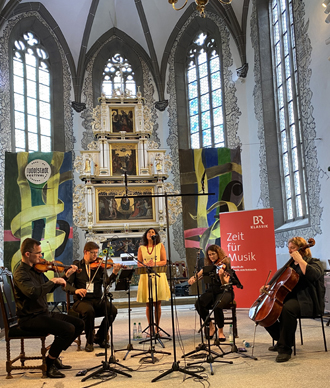 [by Ken Hunt, London] Traditional folk tunes have long leached into classical composition. In Central Europe in the times before many nations gained independence, music stoked senses of cultural identity and aspirations of nationhood. The polyvalent artist Iva Bittová came out of the Communist-era, Czechoslovak alternative theatre scene. She is a violin-vocal virtuosa, a Bachelor of Music, and an acclaimed film actor. She is of mixed Moravian, Slovak, Hungarian and Roma stock. The Mucha Quartet came together at the Conservatory in Bratislava, the capital of the Slovak Republic, in 2003.
This bespoke Rudolstadt Festival performance took place in the Stadtkirche, the town’s baroque church and the programme of mixed Moravian and Slovak folksongs for voice and string quartet. It transported. At its heart were works by the Moravian composer-collector, Leoš Janáček (1854-1928) and his benchmark folksong collection Moravská lidová poezie v písních (Moravian Folk Poetry in Songs), and the Hungarian composer-collector, Béla Bartók (1881-1945) and his Slovenské spevy (Slovak Songs).
One of our age’s most versatile and incomparable voices, fittingly Bittová went vocally from bird cheeps to her operatic, rafter-raising mezzo range. In this recital she never touched the violin.) The surprise sprung, for me, were the Mucha Quartet’s ‘solo’ interludes. They were the Slovak composers Eugen Suchon (1908-1993) and Alexander Moyzes (1906-1984). Personal highlights were the Suchon folksong settings for quartet, especially the joyous ‘Pod Anicka, podze za mna’ (‘Be my bride, Annie’) and ‘Husicky popolavé’ (‘Little Grey Geese’).
It was a concert which seared itself into the imagination. It met with a rapturous reception. It was recorded for the European Broadcasting Union.
L-R Juraj Tomka (first violin), Jozef Ostrolucký (second violin), Iva Bittová (vocals), Veronika Kubešová (viola) and Pavol Mucha (cello). Image © Ken Hunt/Swing 51 Archives
23. 11. 2024 |
read more...
[by Martha Hawley, Haarlem] The Fira Mediterrània was held in October 2023 for the 26th time, in celebration of Catalan traditional and popular culture, accompanied by performance and artistic contributions from around and across the Mediterranean. The pace of the festival is determined by the topography of its base in the hills north of Barcelona, in Manresa, all on an incline, very appealing to this visitor from the Lowlands. Performance venues are spread out all over town, in and around commercial and residential zones, in small theatres, even smaller cafés, and in large tents wherever an empty square allows.
There are many performing dancers on stages, but the music inspires visitors to just spontaneously break into action on the street.

Manresa’s main theatre is the Kursaal, where the opening night spectacle was held, featuring Italian singer Maria Mazzotta, music and production by Catalonia’s well-known musician and producer Raúl Refree, and the female Plèiade Choir. Mazzotta’s voice was a dynamic, penetrating pan-Mediterranean timbre for opening the festival, and Plèiade impressed with their sound.
Catalan music itself is one of the oldest unbroken musical traditions in Europe; musicians and artesans furthering the old arts are present on the stretches of outdoor festival grounds in the center of town.
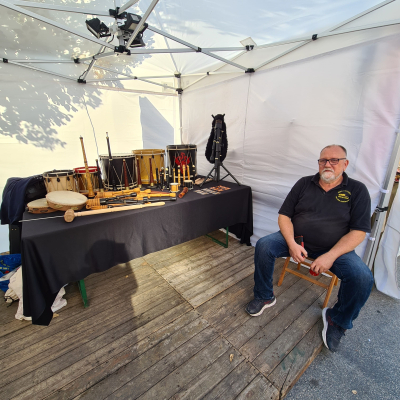
Among the traditional instruments undergoing revival are the bagpipes, banned, as were all popular sounds, languages and compositions, under the Franco dictatorship. Recovery of local culture began 40 years ago, but the Catalan, Italian and Turkish pipers in the “Mediterranean Bagpipes Company” met just a few months ago. This was clearly a fortuitous meeting, as their exuberant sound drew joyous listeners and dancers out onto the public square.

Fusion from around the Mediterranean is a familiar sound at the Fira, but Catalan sounds hold their own throughout the programming. Vocalists, solo musicians and theatre companies abound, not to mention the Cobla, often played as dance music for the beloved Sardana. This year, the “Cobla Lluisos de Taradell” brought a female teller of legends, backed by traditional Cobla musicians, to enthrall the young crowds, and it seemed a very celebratory way of sharing the old culture with the new generation.

As affirmed by the Fira’s Artistic Director Jordi Fosas, it is one of the festival’s challenges to pass on traditional culture to the youngest listeners, while taking into account the changing demographics in Catalonia. New residents come from all over Spain, Latin America and North Africa, and the concept of “popular culture” must change and expand with the local population.
Mediterranean-rim countries are already there, with, as mentioned above, Italy’s Puglia leading the opening night. France’s “Les Mécanos” explored French and Occitanian traditional song in glorious a capella formation. Turkey was also represented, with the exquisite sounds of the “Ali Dogan Gonultas Trio”. The melodic and emotional delivery left a deep impression on the audience.
Old-style arts get reworked at the Fira. The “Compañia Carmen Muñoz”, uniting Andalucia with Catalonia, gave us modern jazz dance with flamenco postures and more that picked up speed as the electronic accompaniment increased its volume. The dancer narrated as she whirled forcefully, recalling John Cage and philosophies of space, movement and time. This at times overwhelming performance was given in an empty brick factory, up a hill and down a few back alleys, which the city of Manresa makes available on occasions like this. As challenging as it was to listen, this seemed an apt metaphor for certain aspects of cultural change nowadays in Catalonia – the old structure housing the new. I will look forward to what’s there next.
all photos (c) Martha Hawley
17. 10. 2023 |
read more...
[by Ken Hunt, London]  Even as she juggles an extensive repertoire and audience expectations, Eddi Reader is the sort of performer who gives one-off performances. The concert tour celebrated four decades as a professional musician. Reeling back the years the concert focused on her time as solo headliner and years as the lead vocalist in the successful Scottish group Fairground Attraction. (Even further back she sang for her supper singing with the Eurythmics (check out the YouTube footage singing ‘Sweet Dreams (Are Made of This)’ on Top of the Pops) with fellow Scot Annie Lennox) and as a session singers in the London studios. What she delivered at Kings Place was bespoke for the occasion and drew on an astoundingly diverse and impressive trove of material, traditional, original and covers.
She hit the London concert on her 40 Years Live tour wearing a silver-glitter Covid mask creation that would set any Frozen fan’s heart aflutter. And then removed it, da-da-dah-dah-ing David Rose’s ‘The Stripper’. A fair proportion of the audience stayed masked. Her set had allusions harkening back to her London days. As she frequently does, she adjusted lyrics from the opening ‘The Right Place’ changed to the predictable improvisation “I’m in the Kings Place now.” Throughout Reader sprinkled anecdotes and banter in her introductions and sometimes partway through the songs. She had not lost the knack. A notable stream of consciousness intro for, it turned out, ‘Baby’s Boat’, began in her busking days in France with Mark Wright. She leapt forward to visiting him at Winchelsea on the East Sussex coast. A boatload of refugees landed on the beach and the authorities were there to ‘receive’ them. Families with small children and cuddly toys stepped onto dry land. The people in the shoreline pub they were in had an impromptu whip-round of twenty pound notes to buy them hot food – chips (pommes frites) and the like – and blankets.
That is my homeland, not the septic isle Britain’s Home Secretary, the diehard Eurosceptic Priti Patel has championed – while conveniently ignoring how her expelled Ugandan-Gujarati family benefited from another kind of British attitude to refugees before she was born. Eddie Reader’s preamble gave no clues that ‘Baby’s Boat’ from her 2013 Vagabond album was coming. Even though, the connection with its introduction was tenuous, it didn’t matter a jot.
Accentuating the one-off-ness of the concert, good-naturedly she poked fun the southern English accents on the ‘Charlie Is My Dahling‘ chorusing. Totting the Fairground Attraction quota up afterwards – remember, Burns’ ‘Ae Fond Kiss’ was anthologised in their bits and bobs collection of the same name before her 2013 career milestone Sings the Songs of Robert Burns – was a surprise. Her dad, a devotee of “St. Elvis of Presley” she quipped, had even done a mass when ‘Perfect’ reached the top of the charts. The concluding Maryhill tenement party routine of the evening – already there before lockdown – came with added zip because her sister Jean the younger was in the audience. Quite the little actress, Reader flicked imaginary Embassy Regal cigarette ash at a Maryhill tenement party, play-acting Jean the senior being coaxed to sing. Father Ted‘s Mrs Doyle’s “Go on, go on, go on.” left my lips. She ended perfectly with a make-believe party flow during which she sang ‘Second-Hand Rose’ and ‘Moon River’. Reader’s mezzo soprano range matched only, in my experience, that of the Czech singer Iva Bittová and Germany’s Scarlett ‘O (Seeboldt). She and her band flew.
Eddi Reader sang and delivered as if her entire life and art belonged on that Kings Place stage, not that she was back in it for the money. Seeing that joy from such an remarkable artist exceeded the inspirational. Seeing her pour her heart out on stage brought tears of happiness.
All photos © Santosh Dass/Swing 51 Archives
Further information: http://eddireader.co.uk/


18. 11. 2021 |
read more...
[by Ken Hunt, London] What was the last live gig you saw before Covid-19 brought live music in front of audiences juddering to a standstill?
Mine was Yorkston Thorne Khan’s London concert on 11 March 2020. It was the start of their tour promoting their third album, Navarasa: Nine Emotions. YTK are James Yorkston on nyckelharpa (Swedish keyed fiddle), 6-string guitar and vocals, Jon Thorne on double-bass, 6-string guitar and vocals, and Suhail Yusuf Khan on sarangi and vocals.
Watching how they have developed their unique blend of north-western Indian and Anglo-Scottish literary and musical traditions, with a strong jazz bass underpinning, has proved delightful. They appeared on the bill on the Rudolstadt Festival in 2017 confirmed how promising they were. Seeing the stream of new, original material develop since then has been revelatory. Here the Scots traditional ballad ‘Twa (‘two’) Brothers’ and Robert Burns’ ‘Westlin Winds’ were exceptional examples of how to blend, respectively, the Anglo-Scottish ballad tradition and bols (Hindustani rhythm syllables), and Sufi poetry and Burns.
One of the great things about YTK has been seeing repertoire items sown, grown, blossoming and coming to fruition live – and how the concert versions of what they play eclipse studio versions. Their London concert reinforced that many times over. Plus there were the spoken drolleries (Yorkston: “Most people think of me as only a clothes horse” and the like). And the profundities, typified by their 2015 collaborative debut Everything Sacred‘s ‘Broken Wave (A Blues For Doogie)’ and its ‘And I am sleepless/And terrified.‘ which has swelled in resonance and stature.
Post-Covid hindsight screams about the injustice of YTK not really having the chance to have gone out and properly promoted Navarasa: Nine Emotions. Kings Place proved to one of the few and last concerts on their truncated tour. Afterwards, we spoke to them and I talked about having returned from Zürich days before and having read with growing alarm about how day to day the Swiss-German broadsheets had been plotting the spread of Covid from canton to canton. It now feels like an interlude of lightheartedness before something terrible like a war descends.
Postscript
Afterwards Suhail Yusuf Khan spent time in Britain. He interviewed me about Hindustani music. That was an unusual inversion.
All images © Ken Hunt/Swing 51 Archives
Further information: https://www.yorkstonthornekhan.com/


24. 10. 2021 |
read more...
 [by Ken Hunt, London] Regardless which of the nine Mousai (Greek mythology’s Muses of the arts), their descendants or their modern-day mutant offspring anyone evokes, the ways of presenting Art remain ever-changing and ever-evolving. That’s the nerve the German Jewish philosopher and cultural critic Walter Benjamin exposed. It is in live performance and especially ones with extemporisation that a special kind of magic can occur. A cultural and multi-media extravaganza, „I Exist“ – nach Rajasthan (‘to(wards) Rajasthan’), as the cliché goes, it ticks many boxes.
Two days before Berlin, „I Exist“ had premiered at Dresden’s Festspielhaus Hellerau. Like any good touring production, straightaway a process of assessment and fine-tuning started. Dresden was different to Berlin, as Berlin would be to Munich. In Berlin – in the Ostbahnhof district – the first element of the production each audience saw was the UK-based Delaine & Damian Le Bas’s set design. It had static central and side panel art. Of British-based Traveller and Gypsy stock, the husband-wife team’s visuals were outsider art in orientation. In part it was heavily calligraphic, yet, most critically, it drew on Rajasthani folk and religious art motifs. Curtain up, the overhead video installation started ‘rolling’. With gong chimes from the production’s red-clad percussionist Maria Schneider, the music began.
The northern Indian state of Rajasthan flanks Pakistan’s Sind province and conceptually „I Exist“ is the product of the principals visiting the fabled ancestral home of the Gypsies in 2016, and their responses to the region’s history, culture and colours. Their experiences shape and form the work’s focus. Musically speaking, „I Exist“ blends contemporary and traditional music elements, whether fixed compositions or improvised sections. Complementing the music, the dual-screen video installation above the musicians captured elements of Rajasthan’s distinctive folkways, its pre-eminent hereditary musician clans – the Langas and Manganiars (or Manganihars) – and tribal peoples, and the foreign participants’ reactions to Rajasthan’s eye-opening cultural otherness. Anyone who has spent time there, even on a casual level, will attest to the sheer vibrancy of its lambent light and shimmering colours.
Above all, „I Exist“ is the product of teamwork. Marc Sinan is its artistic director, composer and electric guitarist-conductor. The western musical element is provided by the Marc Sinan Company in co-operation with the Dresden Symphony Orchestra and the No Borders Orchestra (an assembly of percussion, violin, viola, cello, double-bass, western flutes, trumpet, accordion). Musically, the all-important otherness came from the scene-stealingly good violin-vocal virtuosa Iva Bittová, a Czech musician of part-Roma bloodlines. In the video, as she referenced, without naming, the Roma survivor of Auschwitz-Birkenau, Růžena Danielová, the hairs on the back of my neck rose. She had movingly performed Danielová’s concentration camp composition in James Kent’s Holocaust: A Music Memorial Film from Auschwitz, televised by BBC2 in early 2005. The utterly, truly desi or down-home Rajasthani element was provided by three musicians. Under the musical direction of Vinod Joshi, „I Exist“ also had the brilliancy of female vocalist Raju Bhopa and male vocalist and harmonium player Dayam Khan and the dholak drummer Papamir. These three Rajasthani musicians’ contributions grounded the whole production in a Rajasthani sensibility and earthiness while their colourful traditional costumes – and Bittová’s complementing scarlet stage outfit – gave off something of the saturated-colour vibrancy of the place.
 In one section of one song the Rajasthani musicians evoked the memory of a figurative bridge builder of a most singular kind. Namely Baba Ramdev. He could stand as emblematic for the entire project. (And the purpose of music.) Raju Bhopa sang about the legendary, medieval Hindu sant and Islamic pir who shared multi-religious sainthood, so to speak, much like the later mystic poet and sant (saint) Kabir. To this day, worshipping Baba Ramdev crosses the Hindu-Muslim divide and bridges caste divisions. His followers can be caste Hindus, tribal people or the casteless. In the last case that applies to Dalits and the supposedly castefree Muslims alike. Baba Ramdev could be the project’s patron saint. Well, that’s one interpretation.
At times it was nigh-impossible in a very good way to decide what to concentrate on. (This image captures that with its combination of overhead video and live music.) At times the video footage was irresistible. For example, one segment had Kathodi scheduled tribal people playing a folk instrument like nothing on the planet. The thalisar is an upright rod with a base plate which the musician stroked in a milking motion with both hands. Otherworldliness. I like that.
All images © Ken Hunt/Swing 51 Archives.
Top Iva Bittová in Berlin-Kreuzberg before the concert.
Below: A composite shot to give a feel of Delaine & Damian Le Bas’s visual presentation. Top left is Delaine Le Bas; top right Damian and Delaine & Le Bas. The live concert ‘part’ is left to right: Iva Bittová, Raju Bhopa, Dayam Khan and Papamir (plus unknown other).
http://www.bittova.com/
http://www.artexchange.org.uk/exhibition/safe-european-home-damian-and-delaine-le-bas
Update December 2017. Damian Le Bas died on 9 December 2017, aged 54.
25. 8. 2017 |
read more...
 [by Ken Hunt, London] The Sage is the hub of so much arts-related activity on Tyneside and the wider north-east England region. It was meet and right for the venue to host this much anticipated project. Its promotional literature described Eliza Carthy bringing together second-generation folk artists, like herself, from across Europe. Her accomplices were the genre-stretching Czech vocalist-violinist Iva Bittová, the Greek singer and lute player Martha Mavroidi, the frame drum player and violinist Mauro Durante from Italy’s Canzoniere Grecanico Salentino, and the Finnish group Värttinä’s core vocal trio of Susan Aho, Mari Kaasinen and Karoliina Kantelinen. A scaled-back Wayward Band acted as house musicians. Keeping the second-generation premise further alive, its Barn Stradling is the son of the folk musicians Rod and Danny Stradling.
Expanding on the basic premise, the advance information said, “The unique idea behind this project is to discover what makes these family musicians tick, whether as musicians they have continued pursuing traditional music or whether than have ‘branched out’ into other genres, whether their musical communities in their own countries are pre-existing or self-made, how those countries view what they do.”
 Commitments prevented me attending the pre-concert talk. For anyone who hadn’t attended, the first half might have appeared diffuse. It acted as an introduction to the collaborators. With material in a state of flux into the afternoon rehearsals, it would have been impossible to produce a set list in advance for the public. Nevertheless, a sheet with biographical portraits could have helped the members of the audience to get their heads around what the general generational and cultural contexts were. This was a unique concert but it was also a stage on the project’s journey as there are plans to expand and consolidate it, including recording it in 2017.
 It fell to Iva Bittová to open. Her solo slot started with an audience walkabout, a sung poem in English and climaxed with an exhilarating full-tilt rendition of a signature song of hers, Strange Young Lady – or Divná Slečinka for the Czech-enabled. Martha Mavroidi performed alone, with a second song blighted by technical gremlins. Her triumph over adversity clearly won her a place in the audience’s heart. She followed with a duo performance of Aremu (Who knows.) with Mauro Durante. It made manifest a Greek and Griko connection. (Griko is an Italiot Greek dialect and minority culture, recognised by Italian law, from Italy’s ‘boot heel’ region of Salento.) Last, Värttinä swept in, completing their set with an exuberant joik.
What brought so much together so well was the Fife-based sound engineer Ben Seal’s ‘stage domain’. Its especially clear sound meant the audience could concentrate on, or home in on individual voices, even during, for example, the Remarkable Finale (as I shall dub it). The second half provided both the meat of the programme and portents aplenty of what might materialise at some point in the future.
 The second set opened with a Bittová/Carthy violin and vocal duet. Given the geographical location on Tyneside, it was fittingly adapted from the Northumbrian Minstrelsy. O I Hae Seen The Roses Blaw became O I Have Seen The Roses Blow that afternoon. A violin exchange began it and Carthy carried it forward. On the last verse Bittová sang a game-raising, complementary vocal part. Next came a partnership brought together by Ian Anderson for the Queen Elizabeth Hall’s Bridges – Celebrating 35 Years Of fRoots Magazine celebration in March 2014. Carthy and Mavroidi performed Thalassaki and Bushes And Briars together, both bringing umpteen latent possibilities to life. A roll of the dice added an untoward factor as the concert progressed. Carthy’s voice was a stopgap Vocalzone pastille and blackcurrant lozenge realm. After performing the project’s absentee Orcadian sojourner Kris Drever’s The Light of Other Days with the stripped-back ‘Wayward Quintet’, they switched to vocal recovery territory with some instrumental wizardry. Mauro Durante augmented the Wayward Band for Pizzica Indiavolata. It proved a rhapsodic pointer to a bright future (and one shorn of the word indiavolata‘s diabolic or devilish underlying meanings). The penultimate barnstormer with the Wayward Band and Värttinä brought together Three Drunken Maidens and Kanaset (Chicks, as in little Finnish chickens). The Remarkable Finale took them through Roma, Finnish and English trad. arr. territory – with Fe labu mange, Oi da and The Sportsman’s Hornpipe. Worked up over the afternoon’s rehearsals, like much of Generations, it was seat-of-the-pants, extemporised stuff drawing on ideas laced together over the previous 48 hours.
 Generations is a mouth-watering work in progress. They came prospecting for gold and found nuggets. Its potential as “an album at some point next year” (as Carthy put it) shone. With Bittová, Durante and Mavroidi on board, the assembly probably won’t need the full Wayward Band. With this concert’s core house band – guitarist Dave Delarre, drummer Laurence Hunt, melodeon player Saul Rose, bassist Barn Stradling and fiddle player Sam Sweeney – it would be foolish not to counsel a less-is-more approach.
All images © Ken Hunt/Swing 51 Archives.
From top to bottom (and, so to speak, left to right) the images capture the rehearsals. The first is Värttinä, Mauro Durante, Eliza Carthy and Iva Bittová. The second is unidentified crew member, Värttinä, Martha Mavroidi, Mauro Durante, Eliza Carthy, Iva Bittová and the back of Saul Rose. The Sage stage rehearsal shot is of members of the Wayward Band and Värttinä. The concert images are of Martha Mavroidi and Värttinä.
9. 11. 2016 |
read more...
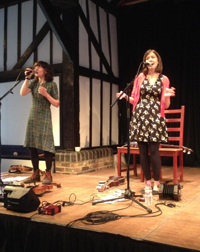
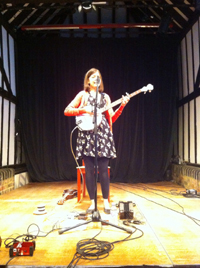 [by Ken Hunt, London] One day before her third album Coracle‘s official release the Emily Portman Trio performed much of it a good number of songs at a Sunday lunchtime concert at the Riverhouse Arts Centre in Walton-on-Thames. A splendid, characterful venue yards away from the Thames, its barn-like interior is all wooden beams and half-timbered decorations.
It made for a stark backdrop for the Trio. Even with the sun shining outside, it suited Portman’s songs from the womb to the tomb and their proclivity for seeking out dark spaces. In a real sense rather than touring the new album they were touring a triptych of The Glamoury (2010), Hatchling (2012) and Coracle.
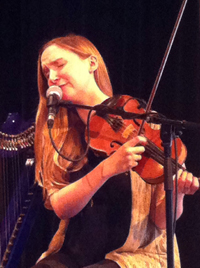
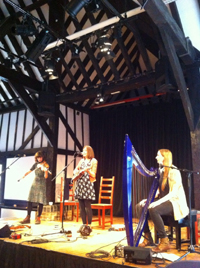 The Summer 2015 touring trio comprised Emily Portman on vocals, concertina, banjo and ukulele, Rachel Newton on vocals, harp (a Camac electric with, amongst other tricks, guitar effects which had replaced the acoustic harp two days before) and viola, and Lucy Farrell on vocals, viola, violin and on High Tide (a setting of an Eleanor Rees poem) musical saw. The sound palette was considerably scaled back from the arrangements on Coracle and consequently gained a distinctive tautness.
In fact, the opener turned out to be Hollin (a dialect name for the holly tree) from Hatchling and for a good way into the first set the repertoire stuck close to the first two albums. Portman has a skill at reimagining the signs and wonders of traditional folk tales. Introducing Tongue-Tied she admitted her debt to Angela Carter (and Carter’s adaptation of The Twelve Wild Ducks, a folk tale from Norway). Stick Stock, another example, draws on the German folk tale The Juniper Tree. (One anthology edition drawing on the tale, The Juniper Tree And Other Tales from Grimm benefited from Maurice Sendak’s illustrations.)
Part-way through the concert the thought struck that the cultural wherewithal in Angela Carter’s Book of Fairy Tales (2005) or its Virago predecessors from the early 1990s might be postulated as 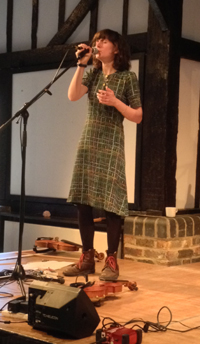 Portman’s handbook. It could have been that it cracked open a vein of tradition-based imagination and creativity. Carter had an appreciation of folksong, for example, taking part in the Centre 42 project. Furthermore, her then-husband Paul Carter figured in several important recordings’ credits. To name but one – however invidious one may sound – he is credited as recording supervisor on Anne Briggs’ The Hazards of Love EP. More than read and appreciated, Angela Carter may well have helped to provision Portman’s fantastical expeditions with a blueprint for reworking traditional folk tales into quasi-folksong settings. In the case of Bones And Feathers she told how a she-wolf tale got relocated to Fenham, a district in Newcastle upon Tyne – the city in which she studied.
 The second set opened with Nightjar (the word refers to a bird, Caprimulgus europaeus, more heard than seen). They concluded with When You’re Weary which ends Hatchling. Their unaccompanied encore of this part-song lullaby sent the sensible not off up the wooden hill to Bedfordshire but more like round the corner to The Swan on the banks of the Thames for Sunday lunch. Over the course of their set, Emily Portman touched on truths and myths, verities and lies. When Lucy Farrell played musical saw it set off a train of thoughts that led to to playing again Tine Kindermann’s 2008 Oriente album Schamlos schön. For which I thank the Emily Portman Trio.
 I don’t want to even to begin trying to imagine the British folk scene without Emily Portman. She has made a place for herself there. She is brainfood and the Riverhouse Barn’s brooding backdrop was made for the black and white of Portman’s morality tales and the dark spaces that oral folk literature can lurk in and occupy. A Sunday lunchtime concert on the longest day of the year. What could go amiss? One of the concerts of the year.
riverhousebarn.co.uk/
www.emilyportman.co.uk
19. 8. 2015 |
read more...
 [by Martha Hawley, Amsterdam] Roberto Fonseca and Fatoumata Diawara passed through the Netherlands in May 2015, in the company of musicians from Mali and Cuba, stopping at the Music Meeting in Nijmegen, and in Amsterdam’s North Sea Jazz Club, where I heard them. The North Sea Jazz Club is licensed to use the name of the sprawling North Sea Jazz Festival – both maintain a programming policy of jazz with a broad range, including Latin, African, funk, soul and more. The Club prides itself on giving big names the opportunity to perform in a small venue.
Roberto Fonseca and Fatoumata Diawara are well-matched to carry their musical roots forward, both having played with hometown greats. After doing some acting and performing in musicals, Diawara first toured the world as a back-up singer for Oumou Sangare. Fonseca has been
on stage for longer, and earned a name for himself as back-up pianist for Ruben Gonzalez in the Buena Vista Social Club. This is not their first encounter – Diawara was one of 15 guest artists on Fonseca’s album YO in 2010 – but in this project they share the lead.
At the North Sea Jazz Club in Amsterdam, the crowd is enthralled when Fonseca, the band and Diawara appear. She is a striking figure, smiling and colorful from head to toe, wielding an acoustic guitar. To give as many people as possible the chance to share this intimate setting, tables and chairs have been removed. For me, the 450 people in the room somewhat diminish the feeling of intimacy, but I go with the flow and station myself on the front lines. Necks are craned – including those of many tall Dutch people – as the buzz carries the observation that the evening’s star vocalist is pregnant. The mother-to-be certainly seems to have enough energy for at least two.
The melodies and rhythms of Mali and Cuba sustain their seduction throughout the evening, but it is Diawara on stage who offers us the best moments, the moments crowds long to experience, when she looks out at us and holds her arms up high, exhorting all women to fly away and be free, to fly wherever they want to go. She describes running, running, and looking back to see if her parents are coming after her, on her trail to force her to marry her cousin. Women must keep running towards the destinations of their dreams, she tells us.
Diawara has had to cover some distance to be where she is now; her parents were not in favour of the artist’s life for their daughter. At work as a back-up singer, she started playing guitar and then released an album: Fatou. She never looked back. The project with Fonseca is not her first collaboration with jazz musicians. One such gig involved working with Herbie Hancock on The Imagine Project in 2010. More recently she wrote (and co-composed with Amine Bouhafa) the ode to Timbuktu for the film by Abderrahmane Sissako.
Fonseca, on the other hand, grew up in a musical family. At some point, a jazz cassette of Keith Jarrett and Bill Evans came into his life and got him started as a jazz musician. After Rubén González died, Fonseca became the accompanist for Ibrahim Ferrer, who told him: jazz is beautiful, but you must never forget your roots. At school he was told: urban music is terrific, but never forget your classical Cuban background.
There’s little chance of that happening: Bolero had always been a familiar sound to him, thanks to his mother, a classical singer. Before he sat down at the piano he had performed as a drummer – his father was a drummer in the Afro-Cuban tradition – and Fonseca’s first professional gig apparently featured him as Ringo Starr in a Beatles cover band. I’m sorry I missed that phase in his career – there was a time when listening to the Beatles in Cuba was not done.
In Amsterdam, Fonseca is pleased and proud to introduce and reintroduce Diawara, and his piano stayed dynamic, but he seemed to be very tired that evening and for much of the set his focus seems to be away from the crowd. The piano rings true and clear, but it is Diawara’s presence that creates the connection and makes the concert a success. People are already on their feet in this standing room only event, and there is no let up in their enthusiasm. The crowd claps and responds to Diawara’s call for vocal participation. She is hard to refuse, but at times the audience appreciation seemed more a form of encouragement and a call for more, as if waiting for the fireworks to really begin.
Meanwhile, the musicians are grooving: Yandy Martínez, Bah Sekou, Sidibé Drissa and Ramsés Rodríguez, introduced by Fonseca as the band’s ‘pretty boy’. They are not featured, however, in the number with the most intensity: with Fonseca and Diawara alone on stage. No clapping or dancing, just voice and piano. All 450 listeners in the room are drawn in; the performers embrace at the end of the number.
It’s hard to tell how much further this combination could go, but for the time being, it’s an intriguing combination of traditions, old and new. The tones of Fonseca wafted into our lives via his work with Ferrer and the Bolero. It could be argued that staggering numbers of Latin Americans alive today are ‘bolero babies’, the fruit of romantic unions brought about by the poetry of classical ballads introduced to a younger generation by Ibrahim Ferrer and Omara Portuondo. Fonseca learned that well and it carries into his affinity with contemporary sounds: jazz, funk, soul.
Diawara builds on the Wassoulou tradition brought to us by powerful female griots including Kandia Kouyate and Oumou Sangare. Diawara sings about the most pressing themes in the society where she was raised: women’s independence, and children who are not raised by their parents, as in her own case. She sings speaks out against arranged marriage, against female genital mutilation. Not the romantic appeal of the bolero, just very real. She also sings to those on the move, the younger generation of Africans, male and female, who are not able to travel freely and gain a global perspective. Girls come to her in Bamako and tell her how happy they are with what she is doing. The audience in Amsterdam is clearly comprised of music-loving girl-supporting globe-trotters on the Diawara band-wagon. When the concert is truly over, a young African man elbows me to display his very own selfie with Fatoumata Diawara. He is thrilled, and the phone is flashed for all passersby to see.
I was close to the stage at the start, but the exuberant opening blasts sent me seeking better sound towards the back, where I could stand at the bar, taking notes by candlelight. As I edged towards the back, I passed several African women edging their way towards the front. I’m sure they made it within the radiant reach of Diawara’s smile.
Photo courtesy of Kartel Music Group
8. 6. 2015 |
read more...
 [by Ken Hunt, London] John Mayer’s impact on hyphenated fusion exceeds calculability. Though the Jazz Café’s ‘Events Brochure’ rebirthed him as Bombayite, Mayer is Calcutta-born. In the 1960s when he and the Jamaican-born saxophonist Joe Harriott combi-doubled their quintets, even more than Don Ellis, they were the defining ensemble shaking (up) the raag and jazz cocktail. Frankly, today’s Indo-Jazz Fusions excels its Sixties namesake – undoubtably helped by today’s availability of information but also because Harriott’s ensemble probably never got raag. Chez Jazz Café, IJF numbered nine with Simon Colam (piano), Mayer (violin/tanpura), Dave Foster (basses), Andy Bratt (kit drums), James McDowall (flute), David Smith (trumpet/flugelhorn), Carlos Lopez-Real (saxes), Sandip Chakravarty (tabla) and Jonathan Mayer (sitar).
Then as now, most fusion forms in jazz or ‘world music’ were simply musicians having a blow and someone thinking up a spiritual-sounding or mellifluous-unpronounceable title. Indo-Jazz Fusions’ approach, as now, was to launch from compositions. Mayer, a classically trained musician, slipped between the interstices of the Hindustani and western classical imaginations and their irreconcilable music business ‘realities’. From the 1950s onwards, he meticulously logged his compositions, East-West or otherwise, through the medium of music publishing. Which is
why he can prove that so often he anticipated movements. This IJF incarnation likewise uses a sliding scale of Injun to jazz, as Khamaj, Mela, Jyoti and Indigo illustrated, and anyone could have found a place to board somewhere on its musical graph.
In four decades of journalism ‘adorable’ is a word I have never used. Why use it now? Mayer nurtures new talent in a way that is remarkable for someone of his seniority. As this gig showed, he is so encouraging and ego-free as to be adorable. At one point he halted a piece not because there was some chatter in the audience but, he announced, because they were chattering over one of Lopez-Real’s compositions. At 71 Mayer is remarkable, relevant and rejuvenating. Qualify each with ‘musically’ and ‘adorably’.
Note: John Mayer (1929/30-2004) died at the North Middlesex Hospital, Edmonton, London, on 10 March 2004. He died of injuries sustained in a road traffic accident crossing the main road near his home two days earlier. We were good friends.
14. 3. 2015 |
read more...
 [by Ken Hunt, London] Noëmi Waysfeld & Blik’s Kalyma is an anthology of songs driven by enforced exile. Kalyma‘s springboard was a vinyl LP of songs derived from prisoners in the Siberian gulags in her parents’ record collection. Dina Vierny, the muse and model of the sculptor Aristide Maillol (1861-1944), whom he appointed executor of his estate, became a wealthy art dealer and patron of the arts. Those latter roles granted her access to the Soviet Union.
Ergo the album Chants des prisonniers sibériens d’aujourd’hui (‘Songs of Siberian Prisoners of Today’) eventually released in 1975 on Pathé Marconi in France.
 Noëmi Waysfeld & Blik’s interpretations of those Yiddish- and Russian-language songs formed the core of her performances in the festival’s church venue – and, the next day, in the open air on the castle terrace. As in mainly the case with Kalyma, she sang to accompaniments by Thierry Bretonnet on piano-accordion, Florent Labodiniére on acoustic guitar and oud and Antoine Rozenbaum on double-bass. Kalyma‘s key songs came out. These included the up-tempo title track, ‘And You, You Laugh’ – a prisoner’s imagining of their other half’s faithlessness beyond the barbed wire – and ‘Shnirele perele’ (‘String of Pearls’), for which she blanked the Messianic Yiddish lyrics and extemporised in German with her accompanists winging it behind the changed line lengths and stresses.
A fairy-dusting of coming projects slid in. She sang three self-composed, Yiddish-language re-poetisations of Portuguese fado songs from Amália Rodrigues’ repertoire. A signpost to what is coming. Noëmi Waysfeld & Blik proved themselves beyond superb.
All photographs © Santosh Sidhu/Swing 51 Archives.
21. 10. 2013 |
read more...
Older articles »