Live reviews

 [by Ken Hunt, London] Imagine an ideal world in which no two concerts by a principal song-delivering vocalist were ever the same. That would mean repertoire, in fact an extraordinary breadth of song repertoire and, naturally, the interaction between composed and spontaneous composition – not just jamming or busking it.
And all that within a series of strictly demarcated rules of engagement. Delivering that would mean shooting the grammatical rapids of melody, rhythmicality and linguistics, too. (Grammatical in a music sense.) In essence, that was what Aruna Sairam did in Paris – a city she first appeared in, she advised, before an audience of something like 20 or so people in 1988, as she explained in a ‘Meet the Artist’ discussion organised by Les Ateliers du Monde the previous day.
Over three decades of reviewing Aruna Sairam’s music initially on CD or later in concert, I have never encountered any vocalist to compare with her. For me, she reveals in extraordinary ways. Concert to concert, she negotiates the impossible, springing surprises. At the Théâtre de la Ville, approaching her 60th birthday, this most physical of singers did not so much sing as fly vocally with a repertoire that enabled her, albeit sitting cross-legged, to dance. To see is to believe.
In Paris she flitted between tradition and modernity, as, in my experience, like no other South Indian classical vocalist. She worked her way through a repertoire of Tamil, Sanskrit and Marathi songsmithery. Her closing tillana Kalinga Nartana by the 18th Century composer Ootukkadu Venkatasubba Iyer was as good as it gets in terms of melodicism twinned with rhythmicality. She sang of the Boy Krishna dancing the serpent-demon Kalinga – in this context an alternative to the more usual name, Kaliya – into submission.
 There have been three truly great deliverers of devotional song which I have had first-hand knowledge of. They were, in order of experience, Nusrat Fateh Ali Khan, Alim Qasimov and Aruna Sairam. Despite her appearance as the first entirely Carnatic billing in the BBC Proms’ 116-year history in 2011, she remains the great unknown.
Still, if there is any justice, that won’t be for long.
All photographs © Ken Hunt and Santosh Sidhu/Swing 51 Archives.
Note: the ‘Sayeeram’ on the poster is the French-language rendering of her family name.
19. 11. 2012 |
read more...
 [by Ken Hunt, Prague] Rabindranath Tagore (1861-1941, Rabindranath Thákur for my Czech readers) was the all-original singer-songwriter – before the term existed – with the folk poetry touch, a poet-bard who in Scots would be called a makar. He had melody purloining skills to make Woody Guthrie blush. In an era of luxury liners and Pullman trains, he travelled probably about as widely as was possible in that pre-David Attenborough era. He set lyrics to ragas, traditional airs, Baul songs, Ganges boatmen’s work songs and melodies, like Auld Lang Syne (!), heard on his travels. Where he differs from most song-makers is the enduring popularity, relevance and cultural penetration of his work. An unlettered field worker in Bangladesh and a Kolkata university professor are equally likely to have memorised his words.
Idris Rahman led the participants into the room with a slow processional version of Alo, amar alo, ogo/alo bhuban-bhara (‘Light, light, light, oh light/That fills the world’ in William Radice’s translation) on, to go Indian, clarionet. Radice, a translator-poet who is to Tagore what Coleman Barks is to Rumi, recited from memory or read in English and Bengali while Mukal Ahmed and Munira Parvin concentrated on Tagore’s Bengali originals. Clarinettist Idris and his sister, the pianist Zoe Rahman contributed both sparse accompaniments and extended musical interludes.
When Zoe Rahman took off after Radice and Parvin’s conversational Mayurer Drishti (‘In the Eyes of a Peacock’), it was clear that something other than pianistic improvising was going on. Without fanfare or announcement, they were sneaking in material from her almost completed Kindred Spirits album. It turned out to be the new composition Hridoy Amar Nache Re (‘My heart dances, like a peacock, it dances’). You could read into the music what you liked, maybe coloured by the afterimages of the words you had just heard. The Betjeman-like train rhythms of Ishtesan (‘Railway station’) and technology versus natural world imagery of Pakshi-manab (‘Flying man’) were developed with, respectively, locomotive and station motifs and bird flight and song. Tagore’s response to the Italian invasion of Abyssinia, manacles and slavers and the horrors of colonialism were sharp-focussed in Tagore’s Africa piece. For it, the Rahmans chose Abdullah Ibrahim’s Ishmael as their opening text before going into Tagore’s Hridoy Amar Prokash Molo (‘My heart…’) with glancing allusions to one of his greatest hits, Akash Bhora Surjo Tara (‘The sky is full of the sun and stars’). 150 years on from his birth, this evening magically confirmed and celebrated Tagore’s continued relevance.
William Radice’s and Ken Hunt’s articles about Tagore appear in Pulse‘s Spring 2011 issue celebrating Tagore. More information at http://www.pulseconnects.com/
For more information about Zoe Rahman go to http://www.zoerahman.com/
For more about Tagore’s Czech connections, I recommend time spent reading David Vaughan’s piece here in print and/or listening to its audio file: http://www.radio.cz/en/section/books/rabindranath-tagore-an-indian-poet-who-inspired-a-czech-generation
14. 11. 2011 |
read more...
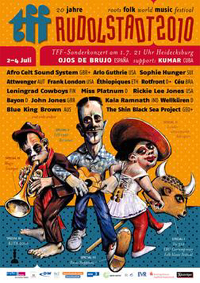 [by Ken Hunt, London] In July 1991, the first year that Tanz&FolkFest Rudolstadt was staged, just like the 2010 ‘edition’, it took place under blue skies in baking temperatures. The 1991 bill served up plenty of scope for serendipitous discoveries of the new kind and reacquainting oneself with familiar acts. Bernhard Hanneken’s festival programming for the 2010 festival did something similar in spades – only to surfeit degrees (let’s not talk of lampreys) – with 27 stages scattered over the town. Then add a pedestrian street dedicated to street music. The highlight of that section of the festival’s programming was 70-year-old Klaus der Geiger (‘Klaus the Fiddler’), a Cologne-based street musician and busking institution, a man who studied with the composer-musician Pauline Oliveros, turned his back on mainstream classical music, turned to street music and has stayed radical.
One of the lessons attending a fair few Tanz&FolkFest Rudolstadts has taught me is to welcome and embrace the unexpected. Even handling the English-language content for the festival programme cannot always be a preparation. One perfect illustration of embracing the unexpected happened the night before the festival. In Prague. On 1 July 2010.
Baráčnicka rychta is a restaurant that is modern-day Prague on a platter with a serving of bygone Prague added to the dish. (This is not a restaurant review but the tavern serves an exquisite Czech repertoire of dishes. In addition in 2010 it was a rare Prague outlet for the Svijany brewery’s beers.) Even with a street map it is hard to find. (And harder to leave.) One level down, overlooked by the dining area, it has a dance hall. Suddenly, mid meal, there was an eruption of electricity downstairs and the Czech rock band Natural kicked off its set. (Imagine being a once-Czechoslovakian and being wafted back to pre-disuniflication, imagine coming from Tottenham and listening to the Dave Clark Five rather than the sound of riots and buildings burning). For Czechs of a certain generation Natural meant something. They were opening for the Bulgarian rock group D2. Instead of being the ruination of the evening, it was a flash of serendipity to be warmly embraced and enjoyed. The following Saturday D2 would come back to haunt me in Rudolstadt…
Enough of the Czech Republic: let’s return to Germany. Notably, 2010 brought back three of the highlights of the 1991 festival with the Sardinian vocal temptress Elena Ledda, the Czech iconoclasts Jablkoň and Bavaria’s Wellküren. (Jablkoň in the Stadttheater (‘town theatre’) sounded ‘proper all grown-up’ compared to the exhilarating, caterwauling punk-folk scruffiness of their set beside the ramshackle, run-down Boulevard in July 1991.) As to the delights of the familiar, Arlo Guthrie on the Heidecksburg’s main castle stage was remarkable. He had the whole Thüringer Symphoniker Saalfeld-Rudolstadt visibly tensing and waiting for the conductor’s wand as Guthrie, in trademark fashion, prolonged his introductions. His internationalist introduction to his father, Woody Guthrie’s This Land Is Your Land was truly special. He explained how other nationalities have done find-and-replace-style searches with its geographical references. That’s about a fine a testimony to folksong’s internationalism as I know.
The Hindustani violinist Kala Ramnath, with Abhijit Banerjee on tabla, gave one of ten finest Hindustani recitals in the Stadttheater (town theatre’) it has ever been my privilege and pleasure to witness in three or so decades. (My detailed review appeared in the Autumn 2010 issue of the UK-based Indian arts magazine Pulse.) By comparison, her concert in the Stadtkirche (‘town church’) was excellent though marred by off-stage distractions. There were too many aural and visual distractions from creaking pews to a couple canoodling right at the front (bringing to mind past injunctions and laments fro Ravi Shankar). Thankfully, Kala Ramnath deep into her spontaneous composition missed the canoodling. Alas I didn’t.
The discoveries were many but three in particular stand out. One chance discovery was the jam-band E.G.s. With temperatures in the 30s, they played their delightful German-language rock and occasional reggae repertoire on the Theaterplatz stage to an audience largely sheltering from the sun under the proverbial linden trees. They were arresting. Their music throbbed with life. It was perfect festival music. The main three discoveries, however, began with the German songstress Tine Kindermann. She reconstructed her glorious 2008 schamlos schön (‘Shamelessly beautiful’) on the main stage in the marketplace (Am Markt). Her theremin-like musical saw playing was centre stage and it proved perfect for adding enough eeriness to counterbalance the sunshiny day. She puts the Grimm back into macabre. Ever pondered how sanitised bedtime Märchen (‘fairy stories’) are now? Two further discoveries completed Hunt’s prial of festival discoveries. Namely, the frankly astounding Bulgarian band Diva Reka (meaning ‘Wild River’) and Cedric Watson & Bijoux Creole, who closed the finale concert. Both appeared on the marketplace stage.
During a discussion entitled ‘Wine in New Wineskins?’ I mentioned Diva Reka. They were a recent project exploring possibilities for acoustic-ethno music while staying grounded in Bulgarian folk traditions. Apparently, usually they performed as an instrumental quartet. At the festival they had drafted in two members of Bulgaria’s Eva Quartet (who had been at the festival in 2000). They melded a variety of musical styles including some classical music, some rock but especially jazz. It was far removed from the Bisserov Sisters back in 1991. Who were, are and ever shall remain dear to my heart. (On the planet only Mitra Bisserova has ever persuaded me, a non-dancer with a bad knee (or two) and heart whispers, to dance to Bulgaria’s nasty knee-knottingest rhythms.) At the end of the talk – remember the beginning of the paragraph? – a Bulgarian National Radio journalist approached to garner some quotes about Diva Reka. We chatted about Diva Reka, the Bisserov Sisters back in July 1991 and then with a barely concealed smile I dropped in having seen D2 the other night in Prague. You could not make it up…
As always, sitting in England and reading the book-size festival programme, it’s astonishing how much I missed but also how much I saw. Quite frankly, there is no festival quite like Rudolstadt. Partisan hand on unpartisan heart.
More information at http://tff-rudolstadt.de/
The festival programme’s image above is by Jürgen B. Wolff and nobody is trying to steal his copyright from him because he is a very good egg.
22. 8. 2011 |
read more...
 [by Ken Hunt, London] By any standard, she is one of the greats of popular music. He is, in my opinion and that of many others’, the finest sitarist of his generation, with a work ethic and melodicism drilled into him through studying sitar with his father, the legendary – for once the word is deserved – Vilayat Khan and working as a Bollywood session musician. This world premiere looked to their recently released collection of sitarist-singer Shujaat Khan’s settings to traditional melodic or lyrical themes, Naina Lagaike – to stick to the CD artwork’s spelling – though the concert programme carried the more accurate “Naina lagai ke”, meaning ‘I rue having locked eyes with you’ was an unmissable event. It was also the programme’s baptism of fire before a paying public.
Concerts that wrong-foot and thwart expectations are amongst the best. This one did so to no little degree. That said, there were elements in the auditorium who for some benighted reason or the other thought it should be, or wanted to turn it into an Asha Bhosle Bollywood bash. They wanted Bollywood now and called out greatest hit titles. To state the flaming obvious, what should have been the giveaway clue was the dual billing on the tickets and concert programme.
Shujaat Khan clarified upfront that they were “doing something very different” before the instrumental sextet of sitar, flutes, guitar, keyboards/synthesiser and two percussionist attuned the audience’s ears to the evening’s sound, with a piece attributed to the semi-mythical Amir Khusro. Though the audience in due course got a taste of Bollywoodisms with, say, Mera Kuchh Saamaan (‘Some of my belongings’) and even one of her father, Dinanath Mangeshkar’s Marathi-language martyr songs, it was the album’s Aaja Re Piya Mora (‘Come back my love’) and their kind that elevated this concert.
Spontaneous creativity should come with blemishes. “Give me spots on my apples/But leave me the birds and the bees,” is, of course, part of a verse generally attributed to Amir Khusro. In it he distils how each act of musical creation should be different and individual, just as it is the apple’s flavour and content that is the gardener’s goal, not an fruit sized and shaped by the conformities of the marketplace. That is, naturally, merely one interpretation. Amir Khusro’s left many puzzles. The main puzzle of this particular night was the absence of a Shujaat Khan sitar solo.
With Saregama having recorded the run of UK concerts, the Royal Festival Hall concert may well have captured a piece of history being made. Let’s hope.
CD image courtesy of Saregama, © Saregama 2011
15. 8. 2011 |
read more...
 [by Ken Hunt, London] The Great Folk Jukebox was billed as “A Tribute to Singing Englishmen with Marc Almond, Bishi, Green Gartside, Bella Hardy, Robyn Hitchcock, Lisa Knapp, Oysterband & June Tabor” (with, as the Oysters’ John Jones quipped, “the beast that is Bellowhead” – nine thereof – as house band). The ‘Singing Englishmen’ part was a doffing of the cap to a Festival of Britain concert held on 1 June 1951. Although there were allusions to Bert Lloyd’s The Singing Englishmen – a slim songbook published to coincide with the St. Pancras Town Hall concert and its six themes of freedom; courting; “On the job”; seas, ships and sailormen; “Johnny has gone for a soldier”; and “Life, Liberty and the pursuit of happiness” – in truth, this was more like a gathering of the tribes.
The link to the 1951 songbook was tenuous and stylistically a few miles short of a million from the Workers’ Music Association’s original event. Crediting Pete Bellamy (Gartside), Martin Carthy (Hitchcock), Shirley Collins (Bishi) and Anne Briggs (Hardy) as influences pointed to the place of folk revival singers in today’s appreciation of folksong. Almond prowled and commanded the stage with Reynardine – all florid gestures and torch song mannerisms – to fashion a bravura performance. Bishi’s Flash Company for “all the pretty flash girls” with mandolin (played by Bellowhead’s Benji Kirkpatrick) and cello (Bellowhead’s Rachael McShane) supporting her minimalist sitar felt more lived-in and flowed more freely than her Salisbury Plain. Hitchcock ‘in’ matching shirt and guitar ripped the guts out of Sam’s Gone Away. In those three cases, it became the singer not the song – and far from that implying in a bad way.
Divers And Lazarus – it had actually figured in the 1951 choral performance – from the Oysterband and Tabor put the song first. Talking in the intermission to a Marc Almond devotee, the performance that had touched him the most was June Tabor’s unaccompanied delivery of The Blacksmith. That made two of us.
Small print
With thanks to Dave Arthur
8. 8. 2011 |
read more...
 [by Ken Hunt, London] Nigel Kennedy’s late May 2010 flourish, his Polish Weekend at the Southbank Centre, brought together an array of Polish jazz and musical talent that included Kennedy’s Orchestra of Life (playing Bach and Ellington), Robert Majewski, Anna Maria Jopek and Jarek Śmietana. Tucked away in the early Sunday afternoon slot was the Piotr Wyleżoł Quintet. A relatively recent development, aside from the band’s pianist-leader, it comprised Krzysztof Dziedzic on kit drums and Adam Kowalewski on double-bass, their fellow countryman Adam Pieroeńczyk on soprano and tenor saxes and the Czech Republic’s David Dorůžka on electric guitar.
The concert began over half-an-hour late because Kennedy, who wanted to emcee their appearance, arrived late. His brief, laddish introduction managed to shoehorn in two lessons in bad manners. His affable excuses in Polish and English sounded more ‘adorable me’ than apologetic. Next, he failed to mention Dorůžka and Pierończyk while individually introducing his Nigel Kennedy Quintet band-mates.
 The Piotr Wyleżoł Quintet already had a CD release, Quintet Live – a concert affair recorded at Polish Public Radio’s Katowice studio – under its belt. Yet at times elements within the band seemed under-prepared or as if their minds were elsewhere or wandering. During Dorůžka’s opening composition Was This The Last Time?, Pieronczyk finished adjusting his soprano’s mouthpiece nano-seconds before his break; when Dorůžka tapped him on the shoulder, it hadn’t looked like cliff-edge timing, more like away with the fairies. Over Nicholas Patou, Dr. Holmes, Snake and Els Gats, the quintet’s strengths and weaknesses emerged.
In the Purcell Room, Dziedzic’s kit cried out for another cymbal so he could quietly ride the rhythm. And while democratic divvying-up of solos is laudatory, few added much to the journey, to the narrative’s unfolding. Wyleżoł and Dorůžka’s were the prime exceptions. Next time, more eye contract, greater interplay, more preparation and closer ensemble playing.
Small print
The images of Piotr Wyleżoł and David Dorůžka are © Santosh Sidhu/Swing 51 Archives.
David Dorůžka’s website is at: http://www.daviddoruzka.com/ Piotr Wyleżoł’s appears to be under construction at http://www.piotrwylezol.com/
Note
This review was originally commissioned for Jazzwise but fell victim to the magazine’s austerity measures. Dorůžka is the grandson of the eminent jazz critic Lubo Dorůžka and favourite son of Petr Dorůžka of this parish.
25. 7. 2011 |
read more...
 [by Ken Hunt, London] The Royal Oak is home to one of the finest folk clubs in the south of England. It epitomises so much about the English folk club set-up. It takes place on Thursdays while not far away the Elephant & Castle at White Hill in Lewes hosts the weekend Lewes Saturday Folk Club. The Royal Oak’s guests regularly include the cream of established of artists. Between March and May 2011 bills featured Tom Paley, Martin Carthy & Chris Parkinson, Jez Lowe and Tim Laycock as the main guests. Yet it is one of those clubs, like Sheila Miller’s Cellar Upstairs folk club in Camden in north London, that balances established and new acts so well. This night the honours fell to Marry Waterson and Oliver Knight.
 Interestingly, this sister and brother duo’s newly released debut The Days That Shaped Me formed only part of their live repertoire, though its songs were like the string running through a necklace. Their opening gambit had Marry Waterson – “one of the unbeatable Waterson Family voices,” announced Vic Smith, the club’s master of ceremonies – sing their mother, Lal Waterson’s Fine Horseman from Lal and Mike Waterson’s Bright Phoebus (1972). It is a cryptic song etched into many people’s memories, maybe from Anne Briggs’ early purloining of the unfinished song for her The Time Has Come (1971) or interpretations by the Silly Sisters and Dick Gaughan through to King Creosote and The Owl Service. Tellingly, Marry’s languid rendition just told a story written in her mother’s hand the way her mother would have told it. She did the same with Flight of the Pelican from Once In A Blue Moon (1996) – Lal and Oliver Knight’s first joint venture on disc. It was once an anti-Thatcher song with heraldic imagery implicit. In 2011 its relevance is less Thatcher’s regime than its gnawing aftermath, summed up in the closing lines, “We who dreamed young and were silent this autumn/Your children’s children’s rights have gone.” If you vote silence in, you bequeath blame.
The second song of the first set, and the first from The Days That Shaped Me, is a hymn to female hormonal fluctuations, Curse The Day. It was followed by a run on that album’s bank with Windy Day, The Gap (always good to have a Doris Day name-check), Another Time (“an early one”) and Revoiced. Revoiced came across as the most Lal-like of the batch. Unlike the album (and later engagements on the tour), its arrangement was a stripped bare approach. No Kathryn Williams harmonies, just the basic unit of Marry’s vocal and Oliver’s guitar. It felt like it might have if they’d been singing in a car or rehearsing round the kitchen table. Marry’s unaccompanied Welcome Sailor from the Watersons’ For Pence and Spicy Ale (1975) was actually introduced as “a song learnt around the kitchen table”. The first set concluded with Memories, the song that gave title to Lal Waterson & Oliver Knight’s Bed of Roses, released the year after Lal’s death in September 1998.
 The second set took other routes. Two in, Oliver did solo guitar piece combining a little brick from the Pink Floyd’s The Wall and his own Train To Bay – the title clips the definite article Yorkshire-fashion – again from Bed of Roses. The last London-bound train curtailed the experience but the inclusion of three new songs was highly promising. The first, the opener is summed up in the title. Love Song To A Lyric is Marry’s declaration of the besotting strength of writing. I Won’t Hear proved more oblique on first hearing but seemed to be about shutting out and shutting in voices figuratively or literally. (Of course, I have been wrong many times before.) Rosie, one of the ones that melds lyrics from Marry and Lal, had one of those trademark family lines – “Rosie had a tea cosy” – running into crochet. Ah, their mother’s spirit lives on…
Further listening
The Days That Shaped Me (One Little Indian Records TPLP1087CD, 2011)
Small print
The images, apart from the artwork for The Days That Shaped Me, are © Ken Hunt/Swing 51 Archives.
Marry Waterson and Oliver Knight’s website is at http://watersonknight.com/
For more about Folk at the Royal Oak, go to http://www.users.globalnet.co.uk/~tinvic/ and http://www.myspace.com/royaloakfolklewes
16. 5. 2011 |
read more...
 [by Ken Hunt, London] An Evening of Political Song, explained the Southbank literature, “drew upon a rich history of political song” before, sigh, spoiling things slightly by lamely billing this night in Richard Thompson’s Meltdown as “a night of songs in the key of revolution and protest”. Still, mustn’t grumble, ‘political song’, as dictionary definitions go, is about as precise as ‘folk song’ in its handy one-size-fits-all solution to issues that just won’t go away.
The night provided a blast of political song designed to engage and stimulate – or even to provoke to the point of offending – while avoiding any why-oh-why? breast-beating material. This though isn’t a concert review. It focuses on three songs as snapshots of what political song today can embrace
Tom Robinson’s take on Steve Earle’s John Walker’s Blues threw the fat into the fire. It focuses on John Walker Lindh, a US national who joined the Taliban and had the shit-luck to get captured. A paradigm political song, it has attracted outright censure and considered debate. Here Earle is no talking newspaper and, beyond the Talibanery, he gets down to motivation for such a heinous act of betrayal of the American Dream. As Robinson sang the exit lines – “But Allah had some other plan, some secret not revealed/Now they’re draggin’ me back with my head in a sack/To the land of the infidel” – he left the audience with much food for thought.
Shock tactics can also work, so long as they are detonated sparingly. Take stand-up comic Denis Leary’s jolly sing-along recording I’m An Asshole with its first-person bead-roll of me-me-me-not-you-me selfishness, like parking in “handicapped spaces”. Nuanced humour is not Leary’s forte, so using ‘handicapped’ was probably accidental irony, but he knows how to play the cringeworthy card. Harry Shearer – the voice of Mr. Burns, Smithers and Ned Flanders in the English-language version of The Simpsons and the, ahem, well-toned body of Derek Smalls in Spinal Tap – delivered confrontation of another kind. Deaf Boys, on which Thompson and Judith Owen did back-up vocals and finger-clicks, lambasts paedophiliac Catholic priests abusing deaf boys entrusted to them. Lines like “Deaf boys can’t hear me coming.” were genuinely shocking. It really hit a raw nerve in me.
The grand finale hit raw nerves of a different kidney. Ewan MacColl’s Moving On Song is a telling plea for equality of treatment. It’s originally from the 1964 Radio Ballad, The Travelling People. A full complement took the stage but my eyes and ears stayed fixed on Norma Waterson as she lived out the song. At the time of the concert I was researching and writing an essay for the Oxford Dictionary of National Biography about the Scots Traveller story-teller and sangster Duncan Williamson making the song with its “Go! Move! Shift!” chorus sound all too horribly pertinent.
To see clips of what was going on, visit http://meltdown.southbankcentre.co.uk/2010/events/an-evening-of-political-song/
Photograph of Harry Shearer, © and courtesy of the Southbank press office.
Ken Hunt’s column RPM about political and socially engaged song appears issue to issue in R2.
http://www.rock-n-reel.co.uk/ and http://www.facebook.com/R2magazine
20. 12. 2010 |
read more...
[by Ken Hunt, London]  Ali Akbar Khan shuffled on stage with a walking stick, reasonable given he was one week away from 81. By night’s end, all memories of the frail character that had mounted the dais at the concert’s beginning had vanished. Swapan Chaudhuri, one of the most exceptional tabla players alive, provided the percussive accompaniment – a job a bit like catching eels with bare hands. He has an uncanny knack of being able to match and bat back this sarodist’s glorious spontaneity. Alam Khan was the second, junior sarodist but he coped brilliantly with his father’s senior waywardness. Ken Zuckerman, one of Khan’s senior disciples and head of his Basel college, and Malik Khan, Khan’s next son down after Alam, provided the drone accompaniments.
The section before the intermission (half had no place here) was an interpretation of ‘Hindol-Hem’ shaped with all the depth, authority and daring of a senior maestro. It coiled like a krait drawing life and energy from the spring sunshine. It was one of those performances during which Time becomes an observer. Typically, Khan himself lost himself, hence the remark about half. Announcing only that he would know what he was playing when he was playing it, he concluded with a ‘Piloo’- or ‘Mishra Piloo’-based piece with a dash of ‘Zila Kafi’ in the less demanding ragamala (garland of ragas) performance style. Before long, the music took over and began playing him. It produced a performance of unbelievable intensity, imagination and stamina. Its outrageousness had me laughing out loud at the sheer outrageousness of his playing and phrasing. A night imprinted in the grey cells.
This commissioned review, written directly after the concert, never ran owing to space restrictions. Ustad Ali Akbar Khan died in San Anselmo, California on 18 June 2009. Shortly before going on stage he learnt that he was unlikely to receive his fee in full and he channelled that discovery into one of the most intense performances I have ever seen from any musician. After the concert there literally was blood on his sarod’s strings.
21. 6. 2010 |
read more...
The golden-throated bird on the Hogarthian wire
 [by Ken Hunt, London] Say you woke up one morning and the smell wasn’t coffee but the stench of something having gone off. What would you do? It happened to Leonard Cohen while he was on retreat at the Mount Baldy Zen Center in southern California’s San Gabriel Mountains. With a sheaf of law suits behind him, Cohen’s remedy was to hit the road, drumming up new interest by touring and giving audiences what they wanted. He picked himself up, brushed himself down and started all over again – sensibly chronicling the process with the revenue-injecting CD and DVD Live in London from the O2 venue in London in July 2008.
In July 2009 the nearest he got to London was Brooklands, near Weybridge – an outdoor venue on the site of the world’s first purpose-built motor racing circuit. (And being Surrey naturally the overcast skies turned drizzle into rain and, forewarned, forearmed, Neil Larsen’s keyboards were draped by waterproofing throughout – though his Hammond B3 sang out of a security about as pretty, the big screens could not lie, as a reused condom.) At Weybridge, no doubt ‘immortalised’ on mobile phone cameras, during Hallelujah Cohen interjected, “I didn’t come all this way to Weybridge/To fool yer” – though please do re-run the moment on YouTube in case I misheard and he sang ‘weighbridge’. Ad-libbing stage remarks is not his forte yet, however. He delivers the mulled-over, so to speak.
That same month saw him scheduled to give concerts in Cologne, Berlin, Antwerp, Nantes, Paris, Toulouse, Weybridge, Liverpool, Langesund, Molde, Dublin, Belfast, Lisbon and Leon. That is eight countries, not counting that return to the United Kingdom for the Belfast concert. Not bad for a chap born in September 1934.
 Throughout the concert two cameras stationed in front of the stage provided the pixels for the big screen on each side of the stage. But a sneaky third did emerge. It was probably most tellingly deployed during the opening song of the second half – Tower of Song – because the camera was in on the joke with its close-ups of Cohen’s right hand tinkling the ivories in unapologetically pedestrian fashion – to great applause. Camera and audience were complicit in the joke. After his ‘spotlit moment’ he gleefully announced, “Thank you music lovers.” To renewed applause. Clearly the band’s keyboardist could have run rings around him but that would have defeated the point of Cohen’s little planned coup de théâtre.
Cohen really was the good humour man. His wry lyrical proclivities long ago trounced the slit-your-wrists clichés because so many songs have their drolleries – even Dress Rehearsal Rag (not performed) is a song not without its odd humorous lapse. Too many people buy into the received opinion and ignore the light and shade to concentrate on the darkness. Take that Nirvana In Utero moment and the way Kurt Cobain bought into the cliché with “Give me a Leonard Cohen afterworld/So I can sigh eternally” in Penny Royal Tea. To digress slightly in order to introduce a folkloristic twist to In Utero, in European herblore preparations of polajka – in Czech – or pennyroyal were used to promote menstrual flow or induce abortion. Whereas probably it’s just accident that Cobain inadvertently added an abortifacient twist to in utero, Cohen’s writings work effortlessly on multiple levels. A number of his songs allow and usher in Zen-strength possibilities.
 Whether noirist or boulevardier, the lover reflecting on his past adventures or present aches, Cohen proved to be the perfect Hogarthian. Plus he delivered sung poetry with a stand-up comedian’s timing. In his and Sharon Robinson’s In My Secret Life he sang, for instance, “I bite my lip/I buy what I’m told/From the latest hit/To the wisdom of old” and held and elongated old in a way that added wit to word. (Not having heard Live in London beforehand, it was still fresh for me.) During I’m Your Man, the lines “And if you want a doctor/I’ll examine every inch of you” were delivered to arch effect, pure roué theatre, cueing female screams.
His songs were littered with self-deprecating observations and wall-eyed philosophical insights. Everybody Knows in the first set with its “Everybody knows that you’ve been faithful/Give or take a night or two” and suchlike was full of barbs and though the songs may be as familiar as hell, seeing him deliver them and raise his hat to the audience afterwards added poignancy. That is what the live moment demands and delivers way beyond the DVD souvenir. Cohen used every ounce of his limitations to deliver a truly superlative performance, praising his accompanists with remarks such as “So very beautiful” after Tower of Song, endearing himself still more for his rapt audience.
Now to get to the heart of the matter, here was a 74 3/4-year-old man who achieved what he did not merely because of the strength of his catalogue but, importantly, because of the power and suppleness of his ensemble under m.d. Roscoe Beck. During The Future – as on Live in London, the second song in the first set (the first seven songs were performed in the same order as that double-CD and DVD) – the voices of Sharon Robinson and The Webb Sisters – and their silky melt of different vocal colours and timbres – lifted the song each time they warbled “Repent” while on Dance Me To The End of Time Javier Mas cleverly conjured a Greek feeling with Spanish instrumentation, summoning a wind from Hydra, Cohen’s Aegean island past out of which so many important early songs took on shape and substance.
 The crux of the matter is, the band gives him the freedom to fly and cover his deficiencies brilliantly. For example, during Suzanne the three female singers sang the phrase “with your mind” as a rising harmony that allowed him to trail off and cleverly bury his final note. The arrangements and instrumentation weren’t about recapturing past vinyl glories, they were about getting under the skin of the songs and pouring old wine into crystal decanters – as opposed too many acts’ plastic carry-out or wine box – for today’s delectation.
Two songs in, my friend’s sister sitting next to me whispered the wish to adopt Leonard Cohen as her grandfather. I wrote the remark down in my notes, followed by, lapsing into German, “an open invitation to Unzucht.” Unzucht means ‘sexual offence’ in German jurisprudence. Leonard Cohen was that good. He really was. And he definitely still has powers to charm sweet songbirds down from the trees.
Ensemble
Leonard Cohen: vocals, guitar, keyboards
Roscoe Beck: musical director, 5-string electric bass, double-bass, backing vocals
Rafael Gayol: drums, percussion
Neil Larsen: keyboards, accordion
Javier Mas: bandurria, laud, archilaud and 12-string guitar
Bob Metzger: electric and acoustic guitars, pedal steel, vocals
Sharon Robinson: vocals
Dino Soldo: tenor and soprano saxophone, winds, vocals
Charley and Hattie Webb (The Webb Sisters): vocals
Hattie Webb: harp
Set list
First Set* Dance Me To The End Of Love* The Future* Ain’t No Cure For Love* Bird On The Wire* Everybody Knows* In My Secret Life* Who By Fire* Heart With No Companion* Democracy* Anthem
Intermission
Second Set* Tower Of Song* Suzanne* Sisters Of Mercy* The Partisan* Boogie Street* Hallelujah* I’m Your Man* Take This Waltz
Encores
* So Long, Marianne* First We Take Manhattan* Famous Blue Raincoat* If It Be Your Will* Closing Time* I Tried To Leave You* Whither Thou Goest
Apart from the Live in London image, photos (c) Santosh Sidhu/Swing 51 Archives and Ken Hunt/Swing 51 Archives (the Corvus splendens Crow On the Wire image)
More information, videos and sundry guff
http://www.leonardcohen.com/
19. 7. 2009 |
read more...
« Later articles
Older articles »