Live reviews
[by Ken Hunt, London] The literature in the Barbican’s foyer called it “An evening of Ragas with legendary sitar player Ravi Shankar and his daughter Anoushka.” But it was far more than that. It also said, “Ravi Shankar – Farewell to Europe tour.” The sadness lay in the leave-taking. It meant that a good number of people attending in the audience were there to be able to say – at some stage later – that they had seen him in concert. It happens. It happened with Frank Sinatra and it happens with Bob Dylan and the Rolling Stones.
16. 6. 2008 |
read more...
 [by Ken Hunt, London] Well before the first of Jazzwise‘s sequence of Indo-Jazz-related pieces began running, before the first interview was done, the idea of delivering more than column inches formed part of the discussions. And it happened, thanks also to the concert promoters, Serious. “Dedicated to the new directions in Indo-jazz ,” as Jazzwise‘s editor Jon Newey put it from the stage, it happened over two house-full nights, on 29 and 30 May 2008 in the cavern-like rather than cavernous basement of a pizza chain’s Soho jazz den. Each of the four acts, namely the Stephano D’Silva Band and Andy Sheppard and Kuljit Bhamra – both appeared on the Friday – and The Teak Project and the Arun Ghosh Sextet – who appeared the next night – represented and revealed the vitality of difference within today’s Indo-jazz genre in its British manifestation. We witnessed different approaches, styles, phrase books, instrumentation and dynamics.
Indo-Jazzwise’s opening act was in many ways a tribute to the Goan guitarist Amancio D’Silva (1936-1996). His son, Stephano D’Silva opted in the main to reprise his father’s repertoire with material including Goa, Ganges, What Maria Sees and Jaipur. The quartet comprised Stephano D’Silvia on electric guitar and vocals, Achilleas A. on trumpet, John Edwards on double-bass and Thomas White on kit drums. D’Silvia’s guitar style has an edge and sonorities that are slightly out of fashion; you just don’t hear that old San Francisco sound much nowadays. It was laid-back but also edgy. And if you had to pick one composition from the set to illustrate that, it would have to be his father’s Stephano’s Dance – named after Amancio D’Silva’s middle child. Since brothers, unlike fathers, don’t have to be even-handed, the tribute to his younger daughter Song for Francesca failed to get into the set, while What Maria Sees – the Maria in question being Stephano D’Silva’s older sister whose voice piped up “I’m here” on cue – did get a look-in. Ganges was gorgeous evoking on Indian brass band music at times. It even went into a drum solo. And Jaipur (“It’s a rocker”) sounded fresh and green-grass new. Hiram (“Hiram was an old friend of my dad’s – played mean guitar too”) started with a glitch when D’Silva couldn’t locate the poem My Father’s Home, which he had intended to preface the performance with, but they recovered. A Street In Bombay and Your House rounded off an excellent set. A band waiting to be recorded.
 The saxophone-tabla duo Andy Sheppard and Kuljit Bhamra produced a different sort of Indo-jazz altogether and something on its margins. In a more world music vein, Sheppard has collaborated with the sitarist Baluji Shrivastav with Re-Orient while Bhamra has collaborated with Alwynne Pritchard on their jointly credited Subterfuge/Invitro. Sheppard and Bhamra have also collaborated in a bigger ensemble – whose work I don’t know. This duo was, however, a totally unknown quantity and they lived up to expectations of the unknown. From the opening Bye Bye, Sheppard introduced electronics – replaying and looping phrases, feeding off his own soprano saxophone lines and ‘accompanying himself’. Similarly Dancing Man And Woman showed they were in very different Indo-jazz territory with tabla and percussion. One of the evening’s highlights was Dear Prudence. The melody snaked out of the grass. With its historical links with the Beatles, the Maharishi Mahesh Yogi and Mia Farrow and her sister Prudence, it made, so to speak, any number of Indo-connections. Radio Play, the next piece, involved trapping a radio broadcast, tapping into it, swirling it round the mouth and through the embouchure. This particular night the loop was voices; as Sheppard announced, “There’s no music on the radio.” The improvisations went into birdcall later in the performance. The first of two encores – “a drop of the Irish” – featured soprano sax masquerading as Uillean pipes on Kiss The Bride and they concluded with a Jim Pepper tune, Malynia, with Sheppard on tenor sax. What shone out was that there was nothing pre-conceived or pre-packaged about the duo’s music. As Sheppard remarked at one point, “That was pretty cosmic – was for me anyway.” Live, they spontaneously blurred traditional elements of jazz and northern Indian music with chance elements and electronics without it becoming a mishmash.
 The Teak Project was the first of the mini-festival’s four acts with an album to their name – their The Teak Project (First Hand FHR02, 2008). Their set might be said to have been the one closest to ‘traditional’ Indo-jazz. It had sitar and tabla, courtesy of Jonathan Mayer and Neil Craig respectively, as part of its instrumentation, for example. The trio’s sound tends towards the chamber end of Indo-jazz with, for example on Without A Doubt, thanks to Justin Quinn’s guitar, a touch of My Goal’s Beyond-era John McLaughlin. (His mother was McLaughlin’s first wife but that is incidental and pre-prehistory as far as Quinn’s or The Teak Project’s music is concerned.) They opened with Deliver Me off the album, a melodic statement that teased imminent tabla pyrotechnics in its build-up but cleverly kept the audience waiting and wanting more. Emily, named after Mayer’s daughter born just after his father, the composer and violinist John Mayer, was killed in a road traffic accident in March 2004, is one of Jonathan Mayer’s compositions. Live and as never before, it struck me as a portrait of a very serious little girl, so much so that afterwards I put that take on interpreting it to its composer. He admitted Emily is suffused with thoughts about his father – incidentally a talker whose amphetamine mouth’s off-button was broken at birth. On a note of new arrivals, Craig’s new composition Due added to the post-The Teak Project repertoire. The title’s spelling came from its composition whilst awaiting the birth of his first child – his daughter Lace – on 11 May 2008. The Teak Project has a rosy glow about them and to discover that they are road-testing the first of their new compositions was wonderful news. The only downside to the performance was that tables and sightlines made it hard to see them on stage from many angles because Mayer and Craig played cross-legged and Quinn sat on a chair.
Like Northern Namaste (Camoci Records CAMOC1001, 2008), Ghosh’s debut album, the Arun Ghosh Sextet opened with Aurora. Unlike the recording, the piece did not fade out. Over the course of this wondrous calling card, Aurora included clarinet solos and melodic consolidations from Ghosh himself, a tenor sax break from Idris Rahman (no slipping from soprano to tenor for him) and a piano solo from Kishon Khan. The second piece, Longsight Lagoon – Longsight being a district in Manchester – came across as a fun piece to play, replete with possibilities. On it, in modal terms and inflections Khan’s piano was definitely more Aziza Mustafa Zadeh than V. Balsara or Jnan Prakash Ghosh. To translate more Azerbaijani modal than Indian. Deshkar (‘helpfully’ illuminated by Ghosh’s “an Indian scale from India”) and Bondhu (derived from Bengali boatmen’s folksong) preceded the blast-away Uterine – another birth reference – one of the top-notch compositions in his portfolio. The Sextet’s other musicians were Liran Donin on double-bass, the standing Nilesh Gulhane on tabla and fellow Mancunian Dave Walsh on kit drums and percussion, especially on Deshkar (Love In The Morning). Over 45 minutes or whatever it was, Ghosh displayed extraordinary charisma and musicianship and a consistently riveting compositional skill, born out of composing for theatre. The sextet proved its worth over and over again. When there was a sound glitch with Donin’s amp at the beginning of Uterine (one to hear before you die), piano, tenor and drums covered in such a way that if you had had your eyes closed it would have sounded as if was just Indo-jazz vamping into an introduction.
Ken Hunt is the author of John Mayer’s entry in the Oxford Dictionary of National Biography and the extensive article on the history of Indo-jazz “Indo-Jazzwise – Meeting of the Spirits” in the June 2008 issue of Jazzwise.
For more information about Jazzwise visit www.jazzwise.com; for The Teak Project visit www.firsthandrecords.com; and for Arun Ghosh www.arunghosh.com and www.camoci.co.uk.
From top to bottom, the photographs are Andy Sheppard and Kuljit Bhamra (Ken Hunt), Arun Ghosh (Santosh Sidhu) and The Teak Project (Santosh Sidhu).
�
14. 6. 2008 |
read more...
 [by Ken Hunt, London] Goldfrapp’s fourth album Seventh Tree (2008) was reviewed in several places in the British press along the lines of it being “psychedelic folk”. Reviews came with a sprinkling of words such as “pastoral approach” and, oh the joys of semi-accurate quotations, “middle of the public bridleway”. It was the dangled carrot of talk about psychedelic folk that attracted me. Sort of. Not because I am an acolyte of psychedelia’s darker folk arts. I had a decade when editors told me how important every twee and fey, post-Wicker Man manifestation of “psychedelic folk” was. It drove me up the wall and “psychedelic folk” still turns me itchy-twitchy. Goldfrapp was another gig visited not out of revenge for others’ past sins. But again in the spirit of non-preparation, blank-canvas concert attendance.
Alison Goldfrapp is the once Orbital and Tricky singer, the once-disco dolly in retro hot pants, formerly bathed in the light of glitterballs. She mixed freely with dancers wearing get-ups like horses or equestrian statues in a kind of post-glam, kitsch disco rock way. Or so I believe. That much at least had stuck. Goldfrapp, by the way, is also Will Gregory, the former Tear For Fears. When they kicked off, it was clear that they meant business. This was no duo presentation. The stage was abuzz with musicians – and there was a string section sizeable enough for me to give up trying to work out how many they were.
As Alison Goldfrapp sang, I felt an intense solidarity with The Guardian‘s Alexis Petridis who got taken to task in the letters column the following week for giving Seventh Tree a four-star (out of five) review while confessing to one vocal sounding like “Only clowns apley wurgh doh bollergh”. He, at least, had the advantage of having a copy of Seventh Tree. My Goldfrapp baptism was rawer still, since Goldfrapp’s press officer failed to respond. My notes read that way too, mere jumbled phonemes dancing on the notebook path to incomprehension. Fact is Petridis’ approximation made more sense than most of what she sang for the entire first half and 90 percent of the second. In fact I dug his review out of the recycling in order to build a small papier mâché shrine to him to celebrate his acuity. Lyrically Goldfrapp conjured a literary image. In Aldous Huxley’s Ape And Essence – and its BBC television play of yore – the religiously inclined raise nonsense to scripture, with people treating shopping lists like ‘gospel plow’.
What soon became apparent was that this “psychedelic folk” tag had even less pertinence than the usual use of “folk” in the British mainstream press. “Folk”, whether prefaced by “psychedelic” or not, tends to say more about the commentator than the genre. If there was an ounce of folk in the entire evening it sailed over my head. Likewise, any bucolic or rustic content. The good thing was that it removed the need to strain for post-Vaughan Williams or post-Shirley Collins folk morsels amid the sumptuousness of the sound – big string section, six-piece female choir, harp and sundry other instruments. Handily everyone dressed in white/whiteish apart from Alison Goldfrapp, who was dressed in a baby-doll nightie, somewhere around orange on the Chivers jelly-Pantone colour scale, once the lighting had done its business over her.
However, in the second half more words emerged from the blancmange of sound. Consequently making out three words in thirty was no problem for a world music pioneer who has listened to Hungarian and Thai music. The golden rule is to entrain to the rhythm, pick up on the mood, and Bob’s your uncle. By the end Goldfrapp made sense, though little literal meaning. They rounded off the night with the highlight, Happiness – the capping encore – for and before which they dished out plastic kazoos. “If you haven’t got a kazoo, sing along,” she said. (Quirkily the jazzer, raconteur and calligrapher Humphrey Lyttelton had just used this wheeze too, one obituary reminded after his death a week later on 25 April, to set what sounded like the new kazoo orchestra record.) The audience kazoo’d along with gusto at all the right moments though not necessarily with all the right notes.
Maybe that was what “psychedelic folk” thing meant, that “Ain’t got no home in this world anymore.” thing that the Incredible String Band had kazoo’d back in the 1960s when people made their own amusement. Actually no. Take a tight trip on reality, “psychedelic folk” is a still a complete misnomer, even if the multi-screen backdrop with its woodland blurs and treescapes (my new word) did have its wicker moments. That said, in Alexis Petridis’ Guardian review the words “psychedelic folk” did come in double quote marks, so read that as “”psychedelic folk””. Pay heed to punctuation. Despite having no notion of what she sang beyond the odd “You’re my Saturday” and “How do you find happiness?” it was nevertheless an enjoyable gig cum experience. The utterly and truly happy crowd was still blowing happy Happiness kazoo raspberries all over the Waterloo concourse while heading for their trains. Sing after Alexis, “Only clowns apley wurgh doh bollergh.”
4. 5. 2008 |
read more...
Folk Roots New Routes
Queen Elizabeth House, Southbank Centre, London 25 March 2008
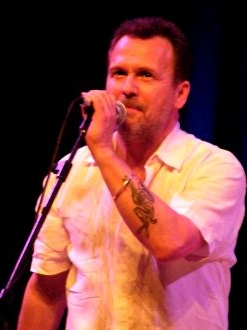 [by Ken Hunt, London] You’d be hard-pressed to find a finer and more authoritative curator for a programme of folk music than Shirley Collins. After all, she is one of the singers who poured ideas into Britain’s second Folk Revival. Under the banner Folk Roots New Routes (a title lifted from her and Davy Graham’s 1964 duo album), she curated the five-day season of folk-themed concerts at London’s Southbank. And, if she is no longer singing in public and on stages, quite frankly that is an irrelevance because she needs to prove nothing, having created so much of such outstanding worth already. (In any case she gave three talks on the Saturday – Romany Rai (about Gypsy singers and songs from Southern England), A Most Sunshiny Day (about England’s traditional music) and America Over The Water (about her time with the Texan musicologist Alan Lomax on their music-collecting sweep through the Southern States of the USA in 1959).) Whether ticketed concerts by Alasdair Roberts and Catherine Bott or free events (examples being Friday’s excellent one with Lauren McCormick and Emily Portman – two thirds of the Devil’s Interval – followed by Lisa Knapp or Saturday’s Brighton Morris Men), Shirley Collins’ Folk Roots New Routes crammed in plenty. It all began with this Martin Simpson and Chris Wood concert.
The honour of opening this Folk Meltdown fell to the violinist, guitarist, singer and songwriter Chris Wood. He did an exemplary set, much informed by his Trespasser (2007) album. Collins announced him as “a true English eccentric” (amongst other things). Without stooping to cliché about the reported English penchant for eccentricity, bear in mind that eccentricity is no bad thing. Wood took the stage with his accompanists Rob Jarvis on trombone and Barney Morse Brown on cello. Gently setting aside issues or charges of eccentricity, part of Wood’s take on that currently much discussed word, Englishness might be explained by one of his song introductions. In his preamble to his third song, he cautioned, “Just because it’s English, you don’t have to understand it.” Aspects of Wood’s English worldview were revealed bit by bit. We got tales of the Lollard proselytiser John Ball – courtesy of Sydney Carter’s song of the same name – and England’s so-called ‘peasant poet’ John Clare. We got tales of Wood’s daughter not so much nutting a-going as nutter (in Hard from his The Lark Descending), the second home syndrome, Agincourt and Peterloo, the impact of enclosures, “the old trap-door of English law” (love that line in Wood’s Mad John) and Mummers’ plays yanked kicking and screaming into the present (in his and Hugh Lupton’s tour-de-force England In Ribbons buoyed along by Woods’ distinctly Carthy-style Morris guitaristics). Rob Jarvis and Barney Morse Brown returned for the set’s conclusion, a neat musical bookend. A couple of observations to close. Maybe it was QEH nerves but Wood’s natural speaking voice seemed to diverge further from his singing voice than usual. Last, his treatment of social issues through songs set in the past and the present, notably Mad John, reveals him to be a worthy carrier of Sydney Carter’s baton.
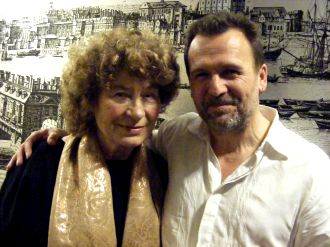 Martin Simpson’s solo set concentrated on his most recent repertoire – notably from his Prodigal Son (2007). Predictably the set included his newly anointed BBC Radio 2 Folk Awards ‘Best Original Song’ – Never Any Good (With Money) – a flick through the family photograph album and a fine tale of fatherly foibles. (Prodigal Son won the BBC Radio 2 Folk Awards’ ‘Best Album of the Year’ in February 2008 too.) Martin Simpson is an instrumentalist of consummate power. Somewhere down the line he found his singing voices a few years back, found in the sense when singing goes from just singing to another level. Voices because he has two singing voices. Having lived in the USA, maybe he has a semi-excuse. You could hear one voice on Little Musgrave and Never Any Good – the English one – and the American one on Duncan & Brady and Randy Newman’s Louisiana 1927. Duncan & Brady came with a good anecdote about playing it super-fast on the Later television show and being hugged afterwards by Ronnie Wood. (In order not to spoil its telling in case it is part of the current introduction to the song, the anecdote is herewith truncated.) Louisiana 1927 is a song that, given Louisiana’s hopeless history of natural disasters compounded by political apathy, continues to gather added meaning and relevance as it rolls along.
At the concert’s end, a small sadness was planted. Sooner or later this particular repertoire of Martin Simpson’s will be history as a performance repertoire. It was a wonderfully rounded repertoire but repertoires, by necessity, must move on or atrophy – even though individual pieces move on to the next concert repertoire. Others, slivers of them at least, have begun new or parallel lives as incidental music on radio and television. As ‘this’ night’s Batchelors Hall and Duncan & Brady already have in a sequence on smallholding on BBC television’s magazine programme Countryfile attest. The concert was a reminder of why we must grab opportunities to experience the magic of live performance when we can. Concerts like this evening of adrenalin and light-hearted bonhomie.
6. 4. 2008 |
read more...
[by Ken Hunt, London] In 1969 the Toronto-born Canadian folksinger and guitarist Bonnie Dobson arrived in England and never really left. She settled in London, raised a family and eventually largely dropped out of making music. Part of the first wave of Canadian folksingers that made their names down south, she had established her name in the United States and once in England chose to disappear off the radar after 1989. More or less. Because every so often – well once in 2007 and 2008 – she has put her head above the parapet. When she sings you go, even if it is a dimly lit, out of the way place above a pub in Chalk Farm.
Time and geography have draped a veil over much of what she did in the early 1960s. It was extremely hard to track down her early recordings outside in Europe in those heady Cold War days of the early to mid 1960s. Her Prestige-era albums largely remained a secret outside North America. Meaning, as a generalisation, only people of a certain generation or disposable income got to hear them in Europe. Though she slipped deliberately into a form of anonymity, her songs did not, most notably in the case of her 1962 song Take Me For A Walk, better known as Morning Dew. As Take Me For A Walk it appeared on The Best of Broadside 1962-1988 (Smithsonian Folkways, 2000). As Morning Dew it was much covered. And contested, since Tim Rose took advantage of her financial innocence by claim-jumping part of her royalties. She lived to rue Mr Rose.
Bonnie Dobson established herself in Britain, recording a new phase of her life in song. She got a steady stream of radio work, singing folksongs in English and French, putting her own stamp on Ian Tyson and Gordon Lightfoot material. And she kept writing songs, ones that reflected her newfound land and identity. Frequently sassy, regularly overt panegyrics to gender equality and affirmations of life, the best of Dobson’s songs have stood up extremely well. Gradually she slipped out of the limelight, though she never quite disappeared, even if after 1989 that near as damn it applied.
Bonnie Dobson re-emerged in June 2007 as one of the Lost Ladies of Folk at London’s Queen Elizabeth Hall. The concert presented her as the last of six acts, the de facto headliner. Her voice had deepened, was less agile than on the old albums but that voice, her presence and her sheer professionalism stole the show. But a return to the fray was not on the cards. Which was why it was surprising to learn that she was going to dust down the Martin and sing in public at an acoustic music club off Haverstock Hill in north London. At the other end of Haverstock Hill, trivia hounds, to where in the dreadful winter of 1962 Dylan asked nicely if he could have a go with Martin Carthy’s samurai sword to chop up a dead piano for firewood.
The impetus for Bonnie Dobson’s public appearance was to raise funds for a humanitarian organisation founded in 1999 called Hope and Aid Direct. (It provides aid for poor and displaced people in the Balkans.) She played to a packed house in the upstairs room at Monkey Chews. The sightlines were not good but from where I stood it felt as if it would have been hard to shoehorn many more people into the room. Not bad for an unadvertised gig that wasn’t mentioned anywhere in print or internet to my knowledge. It was the low-key gig she wanted.
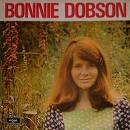
She opened with wonderful authority with one of her calling-cards of old. Many will be more familiar with Someday Soon from Judy Collins’ version than Bonnie Dobson’s but Ian Tyson’s song is something that both can equally claim as theirs. (Dobson’s version is available on Bonnie Dobson, originally released in 1972 and reissued on CD in 2006.) She proceeded to run through a set that embraced French-Canadian terroir in folksong, local geography (her squadron leader song referred to waving the Union Jack on nearby Primrose Hill, nowadays a sleb-haven but long up-market), the embitterment of love gone bad and, naturally, her personal account of the Apocalypse called Morning Dew.
In the club atmosphere she could talk more easily than at the Queen Elizabeth Hall. She led into one song saying “I was raised by Pete Seeger, I can’t help this.”, raised the spectre of bygone comparison with Joan Baez but of the “tits and arse” variety (“You never wanted me.” she started singing) and evoked how a song haunted by nuclear apocalypse can adapt to transferable meaning and pertinence, thanks to climate change and other manmade visions of the Apocalypse. As Ratdog’s Bob Weir (once of the Grateful Dead) told me in 2007, “It was another of those tunes where you could almost make your meaning or just sit there and dream while you were listening to it.” That was certainly the case at Monkey Chews. She projected wonderfully well for somebody no longer used to singing in any place other than her home.
It is impossible to predict what may come next. Bonnie Dobson always had a splendid ear for a superior song. She took to Ewan MacColl’s First Time Ever I Saw Your Face early, becoming the first person to interpret it on record, unless I am much mistaken, in North America. It was, she told me in 2007, “a very explicit song for its time” and even if time has chipped away at its explicitness, its poeticism remains intact. Dobson’s treatment of the song Peter Amberley furnished the Haverstock Hill Samurai Warrior with the melody for I Pity The Poor Immigrant on John Wesley Hardin. (Listen to her 1962 Philadelphia Folk Festival performance on The Prestige/Folklore Years, Volume Four (1995) for proof positive, though Dylan apparently coughed to it at some point.) Why this history and mention of songs not sung? Well, Bonnie Dobson has a superb track record and can still sing the heart out of a song. Cross your fingers and click your little heels and hope that, to misquote Ian Tyson, someday when she sings in public again.
14. 3. 2008 |
read more...
 [by Ken Hunt, London] Hungary is one of Europe’s most productive hothouses for truly revelatory female singers. Once upon a time in Western Europe Márta Sebestyén was all we knew of Hungarian singers. She was our Hungarian sun and moon, earth and horizon. Mind you, starting at the top was not necessarily a bad thing. But it was only getting the chance to see her fly vocally in concert that it truly hit home how world-class a singer she was. In my experience, it is in the live situation that Hungarian music truly reveals its depth and its heights. That applies to most music with a living, beating heart. Despite the generational gap and the apparent differences in their music and approaches, Sebestyén Márta and Szalóki Ági are names fit to speak in the same breath.
With the political changes of the late 1980s and early 1990s, it became possible to appraise the Hungarian music scene more accurately, more objectively. Hearing a woman with such a distinctive voice as Irén Lovász led to seeking out Szilvia Bognár, Bea Palya and Ági Szalóki. And later Nóri Kovács. Their music opened up new vistas of song. In early 2006 while working on assignments in Hungary’s capital, Budapest, whilst engrossed in research and drowning in dictionaries and booklore, my host slid a striking new voice under my guard. Losing a battle against the angels of the devilish Magyar language was compensated for. The Hungarian folk-jazz of Ági Szalóki’s second solo album Hallgató / Lament (2005) utterly derailed my concentration. That is why two years on, I find myself seeing her in London, not singing with Besh o droM, Makám or Ökrös but fronting her own band. To find myself seeing her, not on some massive stage or singing at London’s Pulse Festival with Besh o droM, but in the genteel setting of the Hungarian Cultural Centre (HCC) in London’s Covent Garden district is a dream. What a difference two years make!
 More salon than venue, the HCC is intimate. Skilled Hungarians can probably sardine, sorry, sit 50 or 60 people and a side-plate of neck-craning snappers into the room. It is therefore also intimate in the sense of small. So, to finally see Ági Szalóki sing in such surroundings had to be a rare privilege. It was different, not like her albums. She came with a stripped-down, three-piece version of her band – József Barcza Horváth on double-bass and two electric guitarists, Gábor Juhász on Fender Stratocaster and Dávid Lamm on a Heritage model. (The Heritage is a Gibson splinter firm out of Kalamazoo, Michigan, I googled later.) This salon soirée line-up heightened the intimacy inordinately. The room also suited her petite, waif-like physicality and her voice admirably. Hearing her sing without a microphone is a priority on my Hungarian wish list.
Despite having gigged as featured or guest vocalist with Besh o droM, Makám and Ökrös or having played on stages like those of Budapest’s Szigetfesztivál, the Théâtre de la Ville in Paris, the Montreal and Ottawa Jazz Festivals and Glasto (that’s the Glastonbury Festival for any reader who isn’t a music journalist) and London’s Barbican Centre, she considers herself a népdalénekes – ‘folk singer’ – and is proud to label herself that way on her business card. That she chooses népdalénekes as her job description speaks volumes. In that respect she is like Szilvia Bognár – one of the three singers along with Ágnes Herczku on Szájról szájra (‘From Mouth To Mouth’). Like Szilvia Bognár, her business card also says népdalénekes. Folk does not have to be a dirty word and népdalénekes testifies to the power and cachet of folk music in the Hungarian belief system – something I wholeheartedly approve of myself.
In the HCC programme booklet the evening was billed lumpenly as “Ethno Jazz”. Partway through, she offered the better title of “My Favourite Songs” as an alternative before launching into a fiery Jewish Bulgarian song in Ladino. The Hungarian-ness of her repertoire though was a constant. Whatever the idiom or musical inflection, the result was Hungarian and an exceeding of expectations. Sprinkled throughout the set were announcements – in English, sometimes with a Hungarian coda – of this or that being, say, a Hungarian folksong from Transylvania. Or translations of an opening verse into English from her or Lamm to her left. She sang torch songs associated with Katalin Karády (1910-1990) – Hungary’s diva supreme, a cultural icon to rival, in national cultural terms only a few. Edith Piaf in France or Marlene Dietrich in Germany being examples. (To point fingers, not Celine Dion.) She touched on Hungarian literature with a setting of poet, author and literary translator Sándor Kányádi’s Napszállatja, napnyugta. She sang Gypsy material. And tapping into a strange place in the Hungarian psyche, she even sang a fado – a borrowing with a history that includes Misia and a little YouTube. It prompted the realisation that, over a couple of slugs of pálinka (plum brandy), the Portuguese and Hungarian temperaments could fold into one. And extrapolating from that line of thought, furthermore Ági Szalóki’s next step could be singing fado in Hungarian translation or singing Szomorú Vasárnap (Gloomy Sunday) in Portuguese as a fado. Think Hungarian twist on the Czech singer Iva Bittová singing Szomorú Vasárnap in an English translation in the film The Man Who Cried. As a reviewing coda, she also got audience participation of a kind familiar to anyone who has ever attended a British folk club but the audience singing the chorus was an ’embassy first’ for me.
 Instrumentally, the musicians stuck close to the sung word. On Holnap (Tomorrow) she sang an unaccompanied medium tempo overture – with lines in Hungarian like “Who knows if you’ll see me tomorrow” – before the band, cued in, boosted the tempo. A highlight was the evening’s parting glass. She sang Napszállatja, napnyugta with just double-bass accompaniment. The title’s literal meaning, in the Hungarian language’s standard agglutinative (non-philologically speaking, “arse about face”) manner, is “Sun flies down, sun goes down”. “But,” the HCC’s Zsuzsa Kalmár explained to me afterwards, “it sounds better in Hungarian” – and she was spot on. Its revelations worked both as sound-poetry and emotionally for Hungarian illiterates (like me) in the audience. Ági Szalóki’s way of singing and the way the band accented metrical beat, syllable and linguistic stress guaranteed that a sense of poetry-in-song shone through. This concert was a dream ticket to the magic theatre. And that was why seeing Ágnes Szalóki finally singing live in a ‘solo setting’ was such a musical treat. I cannot imagine the blast Hungarian speakers must have got.
For permission to use photos, we thank the Hungarian Culture Centre for the posed group shot taken after the concert (left to right: Gábor Juhász, Ági Szalóki, Dávid Lamm and József Barcza Horváth) © 2008 Hungarian Cultural Centre; FolkEurópa for the use of the portrait from the © 2005 Hallgató / Lament photoshoot; and © 2008 Ági Szalóki and www.szalokiagi.hu for the use of the live shot from her Christmas 2007 show.
27. 1. 2008 |
read more...
 [by Ken Hunt, London] London’s embassies regularly host exhibitions, talks, artist showcases and recitals. Generally speaking, these events are free. The Czech Embassy situated on the leafier fringe of London’s Notting Hill district is no exception. Its showcase featuring the classical violin maestro Pavel Šporcl stands out in my memory. But British Sea Power launching their new album Do You Like Rock Music? on embassy grounds? It neither conformed to embassies promoting their own nation’s artists, nor, on the face of it, did it seem the likeliest venue.
I approached reviewing British Sea Power’s album launch gig in a way seldom possible for a full-time freelance journalist. I treated it and them as a blank canvas and deliberately went with, as near as possible, no preconceptions of any kind. Aside from a vague memory of one British Sea Power track on a freebie giveaway CD once, I had never consciously heard them. I did my ‘non-homework’. In the spirit of non-preparation all background listening or reading research was banned. I went with several blank sheets of paper for notes and that was that.
 What had filtered through was that British Sea Power were East Sussex-based, around Brighton, down the coast from Rottingdean and that consequently there had been a Copper Family connection at some point in their past. And, lastly that they were an indie rock band. Here I must confess to not quite knowing what ‘indie rock’ really means. But, by way of perspective, nothing like the confusion and bewilderment that my music journalist mate Joel McIver generates when he talks metal and reels off brain-numbing metal subgenres and names like Killswitch Engage, Avenged Sevenfold and Audioslave. The one useful contamination of my innocence came from the Embassy itself telling me that Do You Like Rock Music? had been partly recorded in the Czech Republic.
If ever there was a European nation capable of laughing off Britain’s much-vaunted historical sea power, surely the landlocked Czech lands must be way up the list. But Czechs today know a good deal about tabloid xenophobia, job losses and economic protectionalism. And how that applies at home and abroad. An Evening Standard abandoned on the homeward train after the gig listed British Sea Power at the Czech Embassy as its ‘Don’t Miss’ gig of the day. Its preview began, “Alarmed by the News of the World‘s anti-Eastern European immigrants rhetoric, young indie-rockers British Sea Power decided to make a stand. Having ‘always liked that part of the world’, they recorded an ode to European expansion, Waving Flags, as their latest single.” The Evening Standard may well have got it right when hailing it London’s ‘Don’t Miss’ gig of the night. (Comparison is, of course, impossible.) It was a truly great night. For me, Waving Flags stood head and shoulders above most of the evening’s songs – all unknown to me, remember. Only No Lucifer, probably because of its chanted chorus of ‘Easy!’ (repeated over and over again) lodged more forcibly in the cranium.
I went a British Sea Power virgin and came out a convert, certainly a convert to their energy. But most importantly curious about what the albums sounded like. To be honest, Do You Like Rock Music? afterwards turned my head far more than the gig itself. The gig has been raw, directed energy, a silhouette of body with a guitar bodysurfing, lyrics mostly AWOL in the overall sound, images of Abi Fry’s bow moving on some songs but her viola’s voice indiscernible in the mix. Do You Like Rock Music? reveals them playing outside the rock cliché field, certainly lyrically speaking. And their Open Season (2005) carries the dedication, “For Robert Copper of Rottingdean”. (And there is the good possibility that there will be a further Copper overlap in 2008). Next time I see British Sea Power play I will be better equipped to appreciate what the band does. But how often do you get to go in cold to a baptism of fire?
Photographs: (c) 2008 Santosh Sidhu, Swing 51 Archives
27. 1. 2008 |
read more...
[by Ken Hunt, London] Founded in 1968 in Czechoslovakia, the Plastic People of the Universe finally made their UK début in January 2007. No founding members played but the spirit of the band that commandeered its name from a Mothers of Invention track remained intact and strong. The Communist regime vilified the “psychedelic band of Prague” nicely captured in…
27. 12. 2007 |
read more...
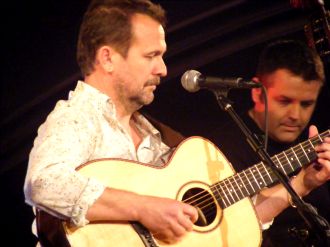 [by Ken Hunt, London] To my mind, Martin Simpson’s Prodigal Son was more than one of the finest releases of 2007 – it was the finest album of his recording career, trumping even The Bramble Briar (2001), also made for Topic. And he made his first album, Golden Vanity for Trailer back in 1976, so the lad’s been around for some while. Explaining why Simpson has remained such a signal feature in my soundscape would degenerate into a wallow of words. Suffice it to say that his instrumental playing is impeccable, much like his taste in instruments. Over the last decade he has developed exponentially into one of England’s finest interpreters of British and American song material in a folk idiom, whether traditional folk, blues or, in the stamp of that maestro of mystery, Hank Bradley, bogus-folk from the US group Last Forever. Increasingly, as the Union Chapel concert hammered home with Love Never Dies (from 2003’s Righteousness & Humidity) and Never Any Good (from Prodigal Son), he continues to evolve as a songwriter.
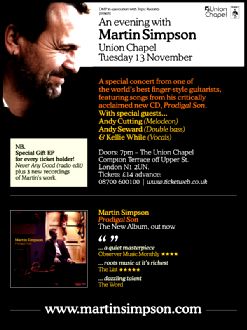 He opened with a mind-focussing instrumental overture. Mind-focussing for him more than anyone else. Eyes shut tight, he segued from She Slips Away (about his mother’s death) and Mother Love (about his wife and daughter) into Little Musgrave. Little Musgrave – alias Matty Groves – is one of those Anglo-Scottish ballads of betrayal, retribution and restoration of the social order that our forebears apparently delighted in. Little Musgrave is multi-levelled. It drums home what a contravention of the upstairs/downstairs hierarchy can call down. The price of a midnight shag comes costly for one-off or trice-off Toyboy Musgrave. As the concert unfolded, Simpson played compositions by Cyril Tawney, Bob Dylan, Blind Willie Johnson, Randy Newman and himself. Tawney’s Sammy’s Bar he said he saw as being “about the relationship between Britain and the USA”. Nowadays what I see as being at the song’s broken heart has shifted. The poodle relationship remains. But I see it mostly in terms of exploitation. Surely, if anything, Cyril’s narrative addresses the relationship between money and sexual exploitation. It’s why great songwriting such as Sammy’s Bar permits new interpretations to seed and grow. One highlight was that song of Blind Willie Johnson’s about not being able to keep from crying sometimes. Simpson’s effects on the instrumental introduction – I’m not going to bluff the technology – reminded me of koto and shakuhachi territory. It contrasted well with the next number – Newman’s Louisiana 1927 – with its crisp snaps and flourishes and, another indication of great songwriting and song selection, its pre- and post-Katrina stings and relevances. Simpson’s own Love Never Dies is two playlets in song as opposed to a three-act play. The way he tells it, the song draws on a couple of visits to the same truck stop between Memphis and Arkansas during Simpson’s domicile in the USA. It telescopes observations and incidents. Apart from the 2003 version, it also appears on Simpson’s catch-it-while-you-can-at-gigs limited edition Never Any Good. Also part-Prodigal Son promo and part-trailer for the shape of things to come.
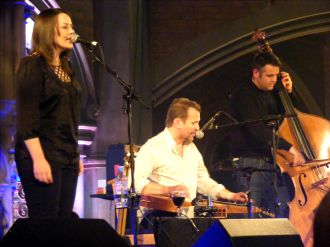 The second set brought on the band. Andy Seward, the co-producer of the three new tracks on Never Any Good (2007), played double-bass, Andy Cutting played one of those three-row squeezy things and Kellie While sang. The set opened with Lakes of Champlain. Simpson and Cutting opened before Seward joined in and then While started singing the lines beginning with “Mother, oh mother.” Until this point, I have held back that the show was being filmed by a team led by Robin Bextor for a DVD release. (Don’t you love the evasiveness of the passive voice?) Lakes of Champlain was the only performance of the evening that I felt could have done with a re-take. The energies didn’t work for me, were too hesitant in parts. The second song, Dick Connette’s Last Forever outgrowth from Pretty Saro, Batchelors Hall (pity the poor Saxon genitive, and maybe bachelors, come to that), turned things around. Thereafter the quartet never looked back, so to speak. Meaning that the whole band was not necessarily on stage the whole time. The set was another travelogue, with interposed observations on the human condition. The “bent copper” tale, Duncan And Brady summoned a memory of New Orleans from Simpson and an encounter with a citizen of that fine city who trilled “Louisiana’s got the best politicians money can buy!” Pretty Crowing Chicken into the fiddle tune Hiram’s Tune – or so it sounded – was announced as being “against the Geneva Convention” on the basis of being a three-row and banjo duet. (Pre-emptive banjo joke strike etc.) Leastways, that was how it started out before Seward joined in on plucked, later bowed string bass. The highlights continued with Richard Thompson’s Strange Affair, one of his more multi-levelled songs, and Simpson’s own Never Any Good – the omission from the title being (With Money) – about his father and his parents’ relationship. The home stretch was a slide take on The Lakes of Pontchartrain to what I would like to call an all-purpose, cut-and-paste rock’n’roll tune, similar to the vibe I get when Achim Reichel goes into post-Reeperbahn, Hamburg shanty territory. You get elegance with dirt under the figurative nails. The encore was Waitin’ For A Train in a rather un-Boz Scaggs-, un-Singing Brakeman- version, with lashings of banjo.
To conclude, I guess if there is anything puts people off about Martin Simpson – and causes grumbles about dark alleys and breaking his fingers – it is the very thing that elevates him to the highest highs in the pantheon of acoustic guitarists. He has an instrumental prowess on the guitar in particular that that can be deemed to be over-consummate. Like Adrian Legg and David Lindley, his playing goes to places most guitarists never go. Generally, Simpson’s balance of simplicity and flash stays on the right side. Occasionally I wish he’d play fewer notes and go for the song’s picked clean bones. But most of all, I wish time allowed me to see more of his performances. Mostly because of the ways I’ve seen I Can’t Keep From Crying Sometimes, Dylan’s Buckets of Rain and, most especially his own Never Any Good and Love Never Dies keep evolving. That intrigues me enormously.
There is a rather good biography of Martin Simpson at http://www.martinsimpson.com/biography/?PHPSESSID=97f349f32089f93 19563efc729b966ac
14. 11. 2007 |
read more...
 Queen Elizabeth Hall, London 22 July 2007
[by Ken Hunt, London] Transformative is probably the most appropriate word to describe the influential Northern Indian rhythmist, composer and teacher, Alla Rakha Qureshi, and how his music affected people. Ustad in the concert’s title is the Muslim counterpart of Hinduism´s more familiar words pandit and guru. Certainly, Alla Rakha educated many, many people. The default-standard tale is that the West turned on to Indian music through the sitar. There is no denying the inherent truth, if hackneyed, of that proposition. But it was never the whole story, never the truth, the whole truth. For many people, the neon, flashing sign over the entrance to appreciating Hindustani music didn’t come with Ravi Shankar or Ali Akbar Khan, the Beatles, the Byrds and their kind. It came, heresy of Hindustani heresies, through clicking with taal (rhythm cycle). In other words, for many people, rhythm came before raga.
The musician responsible for handing out the skeleton keys to Hindustani rhythmicality was the once A R Qureshi of the Bombay film industry reborn as the Alla Rakha of Hindustani art music. Assuming you had any musical wit, once you heard him, rhythm took on new, multiple levels of meaning. You would be changed forever after. Seeing him play was an experience you could liken to what Burns conjures in his poem Ae Fond Kiss (One Fond Kiss): for to see him was to love him. Seeing him perform live you couldn’t but be seduced by the power and depth of his art and artistry. The facial grimaces and body levitations were pretty special too.
Since his death in February 2000, the Allarakha Foundation, run by his daughter Khurshid and her husband Ayub Aulia, has kept the flame burning. Over the years the tribute concerts’ mood has changed, going, as is proper, from the emotional to the celebratory. In 2001 Sultan Khan singing his friend to sleep with a Rajasthani sarangi and vocal lullaby was a dam burst of emotion. It is no exaggeration to say that most of the London audience was openly tearful, unashamedly declaring in public what Alla Rakha’s loss represented and meant to them. This 2007 concert hit a more celebratory note than that first death anniversary tribute but it was just as memorable. Alla Rakha’s oldest son Zakir Hussain Qureshi – let’s include the Qureshi for once – provided the link to family, pedigree and gharana – a school or style of performance. The illustrious Hindustani flautist Hariprasad Chaurasia headlined.
The honour of opening the concert fell to a trio, as yet without a name. They consisted of Kishon Khan on piano, the Swiss bassist Patrick Zambonin on six-string electric bass and the Cuban percussionist Oreste Noda on congas and percussion. The first piece, unnamed as they played it, named For Zakir by the intermission – thanks to the mind-focussing prospect of PRS income – opened alap-like with Khan’s piano. For Zakir flitted in and out of modality. It never went where, say, Adnan Sami went with Hussain on his now barely remembered, enfant terrible-period calling card, The One And Only from 1990. (Whilst London correspondent for the El Cupertino-based Keyboard I was, having caught him on British television, the first correspondent to champion Sami as something special in the United States – years before his reinvention as a Bollywood music director or composer.) Or the historic raga-to-keyboard work of Jnan Prakash Ghosh and V. Balsara. The trio’s worldview is different. The Bangladeshi-Cuban connection was best revealed on the second of their two numbers. Called Manush Guru, it was based on a piece by Lalan Shah, also known as Lalan Fakir, whose Sufi poetry suffuses the subcontinent’s mystical philosophies. Lalan Shah touched on Bhakti Hinduism (Reformation devotional) and Sufism (mystic Islam). Most especially, his work was revealed in that to-be-marvelled-at, syncretic philosophy practised by the Bauls in which godhead is reduced to the Man of the Heart or that which lies within each of us, a philosophy that superannuates the sky pilots’ favourite chum. After a skip-beat pause, the trio spun into Sapasa (named after its opening notes sa and pa in Indian sol-fa) with Noda’s congas playing pseudo-tabla. Why devote so much space to an opening act that played two pieces? Because they were worth it.
Zakir Hussain appeared next with harmonium accompaniment from Fida Hussain and Surjeet Singh playing lehara patterns on sarangi – melody supporting rhythm in other words. Hussain announced it as a peshkar, as a homage to the ones that have gone before, and a way of announcing pedigree and guru. His spoken interjections provided context. Sometimes the context was biographical as he talked about his father or his father’s Punjabi tabla style. Sometimes he told tales in rhythm, with typical Hussain verbal quirkiness (“life is good, TV’s on – plasma”), as when he announced two tabla notes as characters in a story. Minimalism personified, imagine Prokofiev’s Peter And The Wolf characters reduced to a note rather than an instrument. He interposed spoken insights that illuminated the Punjabi style of tabla playing and percussion composition. Like the one about an age when a percussion composition might be handed on as a dowry item. A consummate performance and display of virtuosic musicianship.
The honour of concluding the concert fell to the bansuri (bamboo flute) maestro Hariprasad Chaurasia with Sunil Avachat playing second bansuri, Hussain on tabla and the concert promoter Gilda Sebastian on tanpura, the stringed drone instrument. Chaurasia played a new composition of his own devising with a light dhun or folk air touch to it. Called Brindavni Malhar, it evoked both geography in Brindava – a place associated with the flute-playing Lord Krishna – and weather since Malhar is a rainy season raga. Passages evoked the pitter-patter of rain and, it seemed, the repetitive simplicity and carrying power of woodland birdcall. Unbeknownst to Chaurasia, Britain was suffering extensive flooding. At times Hussain played with a lightness of touch and deft understatement I can only compare in my experience to his restrained accompaniment while accompanying the bansuri virtuoso G S Sachdev at Ali Akbar Khan’s eightieth birthday bash in Marin County, California in 2002. That time, he was on his mettle, a perfect accompanist and beyond exceptional in his invisibility. But his accompanying Hariprasad Chaurasia’s three raga performances warranted high praise indeed. Every so often you go to a concert and it is so extraordinary you scarcely dare to believe your senses. A Tribute to Ustad Alla Rakha fell into that rare category.
�
13. 8. 2007 |
read more...
« Later articles
Older articles »