Live reviews
 15-29 July 2007, Krems, Austria
Krems is a beautiful and peaceful town on the river Danube in Austria, known for its Riesling wines and – in past years – also for the Glatt und Verkehrt festival. The name literally means a knitting style that changes between two types of stitches, the “smooth” and “inverted”. This is actually a good definition of the programming, which includes some well known local traditions in an unusual setting, like the Indian guitarist extraordinaire Amit Chatterjee performing with the Austrian yodelers Broadlahn, an idea which dates back to times when Amit was a regular member of Joe Zawinul’s syndicate.
 Or imagine a “voices triangle” from three very different corners of world. The Norwegian yoiker Inga Juuso stands on the left, an Alpine trio with Gretl Steiner, looking like a good-hearted Granny who just escaped from a fairytale, in the center. The right side of the stage is occupied by Ayarkhan, consisting of three astonishing ladies in Yakutian fur costumes with shining metal bonnets, doing their Horse Spirit songs and a striking voice-through-jew’s-harps performance. While staging a mega jam session would the obvious idea, the programme director Jo Aichinger took a more sensitive approach, and for most of the set focused on the visual and sonic contrast of separate performances.
But also you can create a momentum by mixing contrasting ingredients of the same culture. The Antchis Chati Choir from Georgia revived the “krimanchuli” polyphonic style, more rhythmical and raw than the polished recordings of better known choirs like Rustavi. After their drinking songs of innocence followed the turbo-performance of The Shin, “pan-Georgian” ensemble which includes duduk, bagpipe, dancer, and almost flamenco-sounding guitar.
On the other hand, the performance of the Kurdish singer Aynur stood like a monolith on its own, not related to any other pieces of the programme. I was stunned by the power of Aynur’s voice and percussive intensity (most of her band members switch between percussion and melodic instruments) on her breathtaking showcase at Womex in 2006, so this was time to explore the subtle details, like the classical Ottoman style of the violin lady Neriman Günes Akalin, who is also a long time member of the Turkish multicultural band Kardeş Türküler.
 For many, the programme climax came with a project labeled Colombian-Austrian Encounter, led by Lucía Pulido, who is not exactly a household name, but thanks to her sensitivity, taste and vocal capacities, has developed almost a cult position in the New York Latino scene, adding a spiritual level to Colombian rural songs. Since this spring, as an artist-in-residence she rehearsed with the principal Austrian electronic wizard Patrick Pulsinger, trumpet player Franz Hautzinger and others. Despite the result seemed to be more like a work in progress than a finished opus (the musicians plan to meet again in Colombia), following it was highly rewarding and enjoyable, like climbing a risky road that leads to a panoramic summit. If you plan to go to Mercat de Música Viva de Vic in Spain this September, be sure not to miss Lucía Pulido with another mixed project, Benjamim Taubkin’s América Contemporânea.
12. 8. 2007 |
read more...
Rudolstadt, Germany, 6-8 July 2007
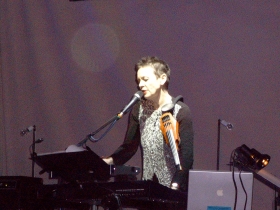
[by Ken Hunt, London] As far as Germany is concerned, the sovereignty of TFF Rudolstadt must now be taken more or less as a given. It is a model of how to revitalise a local economy too. The 2007 festival reasserted such contentions many times over. Like nearly every festival I’ve ever attended, the knack lay in out-balancing longueurs with high points. That said, this year TFF RU unwound a new strand of adventurousness with part of its US-themed programming. Philip Glass’ setting of Allen Ginsberg’s poetry, Hydrogen Jukebox (in a performance from Ensemble Creativ), the Degenerate Art Ensemble and, most notably, Laurie Anderson raised the bar in that respect.
 Over its life the festival has gone from the socialist showcase and display of left-leaning solidarity of its beginnings in 1955 to a festival that has grown and grown since going ‘free-world’ (reader, add emoticon of choice) in 1991. It has grown into something that would have overwhelmed the minds of the town’s population in its pioneering GDR socialist days. The mind-boggling array on offer was more than enough to do any full-time professional music journalist’s head in, let alone a local burgher with a resident’s discount ticket.
One long-established feature of the festival, organisationally speaking, is its series of Schwerpünkte or major themes. Over the years, three have survived – a nation, an instrument and a dance. This year had the United States as the country; keyboards the so-called ‘Magic Instrument’; and polonaise the dance. There was also a sidelong dive into the world of Sufism on the 400th anniversary of the birth of the poet-philosopher known variously as Jelaluddin Balkhi or Rumi (1207-1273). Those names variously reveal his birthplace in Balkh in modern-day Afghanistan and his family finding sanctuary and resettling in Konya in modern-day Turkey. Parenthetically, Rumi translates as ‘from Roman Anatolia’ according to Coleman Barks and John Moyne’s The Essential Rumi (1997). And then, of course, there was the music and dance that had nothing to do with any of those river-like themes. There is still a massive dance contingency for whom the non-dance acts count as secondary. And vice versa.
Before going any further, these reflections are necessarily subjective. The sheer scale and geography of the festival mean any one festival-goer can only skim the surface of what was on offer on the 24 outdoor and indoor venues. Next, I have to declare an interest, as they say (cynics say theoretically) in UK parliamentary terminology. I act as editor of the English content in the hefty programme. Furthermore, a chunk of my time and energy this year was taken up with a talk with Laurie Anderson. The rather unfolky and somewhat clunkily titled talk Laurie Anderson. Allen Ginsberg. Philip Glass. Sketches of American Counterculture was turned from ‘talk’ into a natter in minutes with tales of sex and drugs and William Burroughs, exchanged memories of Allen Ginsberg and artistic derring-do about her work in all its multimedia variety.
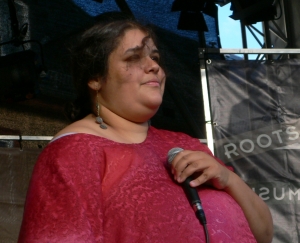 Given this website’s Czech roots, it was fitting that Ridina Ahmedová was the first music that I experienced at the festival. She was the opening act on the Konzertzelt (concert tent) stage in the Heinepark. One of three venues in Heine’s pet park, now you ask. Jo Meyer was acting as the stage’s Moderator (master of ceremonies; compere would be so vulgarly televisual). Finding the original live wire of German dance bands from JAMS to Polkaholix acting as the stage’s master of ceremonies occasioned a double take. Imagine seeing Britain’s Jo Freya or Belgium’s Wim Claeys doing that job instead of playing or calling the dance.
As Ridina Ahmedová’s name indicates, her cultural bloodlines and lineage are mixed, with a Sudanese father and a Czech mother (with a Russian and Jewish gene pool). Nothing, certainly nothing on her solo album hlasem (by voice), quite prepares you for witnessing her singing first-hand even if it slots all the components into place. The reality, however, trounced all expectations. Guaranteed. And here’s why. First you see her recording a melodic fragment or a cadence-in-melody live. Played back through some electronic gubbins, it becomes a looped phrase against which she sings live. Before your eyes, so to speak. If that sounds complex, the reality isn’t. The art lies in turning theory into practice. Second takes clearly weren’t part of her act, but there again neither was the 20.47 train going by or sound leaking from the nearby dance stage. As the full measure of what she was doing became clear, it was like peeling away layers of incredulity. Her take on Mongo Santamaria’s Afro-Blue may have been familiar melodically via John Coltrane (or even the Albion Band circa 1978 and Rise Up Like The Sun) but sung countermelody live it took on a different dimension. Her voice is strong and flexible, in Czech terms like a youthful Ida Kelarová because of her power and expressiveness, though quite different stylistically. The comparison is high praise. Leading me to say unequivocally: Ridina Ahmedová is in a league of her own.
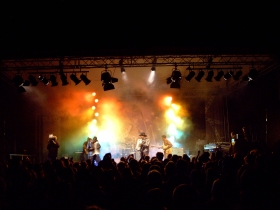
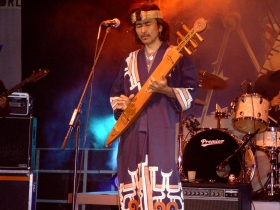
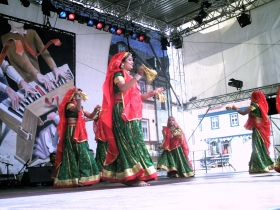 Music and dance are bound to waylay you at this festival. You sit unwinding or waiting for friends to turn up and before you know it a catch of melody from a nearby stage will turn your head. Like the Polish band Que Pasa pumping out good old-fashioned dance tunes on the Theaterplatz stage after the Laurie Anderson talk. Everything is hustle and bustle. Someone you expect to see again or run into, you never meet or see for the entire festival. Musical revelations come casually. Like, say, with the Oki Dub Ainu Band on the Burgterrasse (castle terrace) on Friday evening. Less so with the Gujarati dance ensemble Shilpagya and their Bollywood-into-folk or mock-folk themes on the main Markt (marketplace) stage, however. Or not quite as planned in the case of Charlie Mariano. Or Ali Reza Ghorbani. The Boston, Massachusetts-born saxophonist and one of the most important East-West crossover musicians of our era, that would be that Mariano fellow, was in such demand that the church doors were shut. Scores of people sat listening to his South Indian set with vocalist R.A. Ramamani, mridangam (barrel-drum) player T.A.S. Mani and multi-percussionist Ramesh Shotham on the grass outside – we English know the true meaning of lawn (Rasen) – basking in the Saturday afternoon sunshine. Twice over, an outside broadcast – thanks to a German radio broadcast. Ali Reza Ghorbani on the other hand started late and, adopting a Peter Cook whiny voice, the clock is a harsh mistress. When it came to the Seattle-based Degenerate Art Ensemble in the castle courtyard of the Heidecksburg on Friday night, having got waylaid meant missing the bulk of their only show. With lead singer Haruko Nishimura looking like a Björk understudy in a hoop dress (speaks a truant from sartorial elegance and know-how), DAE sounded like a cross between the Art Bears and fun. If you get my drift.
 Saturday night was RUTH night for me. RUTH is pronounced like ‘Root’ and the annual RUTH awards are a deliberate pun on ‘roots’ and all that. Awards went to Charlie Mariano, the non-singing, non-dancing Mike Kamp (from Folker! magazine), Achim Reichel and the remarkable Sicilian singer Etta Scollo. Let’s home in on just one act.
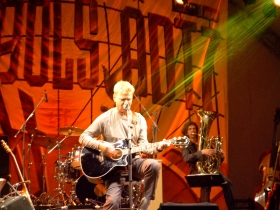 Setting aside Reichel and his band’s exemplary musicianship, he proved himself a masterful bandleader. (The last musician I saw to compare was Bob Weir fronting RatDog.) Reichel is a veteran. He started out playing in the band he founded – The Rattles – during the explosive Reeperbahn beat group era that began in 1960 – the era that began with The Jets and The Beatles, groups perceived in many ways to have overshadowed The Rattles on the Hamburg scene. He went through psychedelia, German-language poeticism, Low German sea shanty and dialect and High German folk song. He also acted as midwife to Ougenweide’s extraordinary take on lyric-based folk song and Brian Eno’s Another Green Land. (Fittingly, Ougenweide’s Frank Wulff was in the Reichel and Etta Scollo bands.) He has seen and played a lot, in other words. Watching him at close quarters, from a secret on-stage location, was like being promoted to privileged fly on the wall. Reichel was a grab bag of split-second eye and physical cues and clues, surprised looks and private smiles of encouragement for band and sound crew. “Rocking the Morris” was a once-upon-a-time expression in English Folk Dance and Song Society circles. Hear the sneer? The way Reichel & Co. [GmunbH] rocked and locked into Heidenröslein (Little Heath Rose) would have had that Johann Wolfgang von Goethe and Johann Gottfried Herder revolving in their merry graves. Heidenröslein is of immeasurable significance to the German and European folk song movement. It is central to the interconnected history of Goethe and Herder, to Herder’s coining of the word Volkslied, the conceptual ancestor and forerunner of the word ‘folk song’ in English. (And you know where that led.) Reichel reminded that the time is long gone when people spoke about sacrilege and affronts to cultural purity. His shanty arrangements, sometimes dipping into the international seafarers’ melodic lexicon, reinforced his Hamburg roots. Mine too. A great Heimweh (home-sickery [sic, sic]) for Hamburg descended, an expression of how powerfully Reichel had moved me. And I probably will never get the opportunity to talk of homesickness for Hamburg again.
Such is the festival’s geographical spread that it is hard to get a measure of numbers. Word came that there had been 75,000 visitors to the festival. That only really seemed to make sense when the Sunday finale rolled around. For the first time after the Farewell Concert in the marketplace they staged a major event afterwards: Laurie Anderson in the Heidecksburg courtyard.
Logistically it was a blooming disaster, Mary Poppins. Too many people with too many mobile distraction devices – and their disruptive where-are-you? calls, prompting the properly English fuck-off-and-die grinding of teeth – were funnelled into an area too cramped for the throng. If anything like it is going to be repeated in future years, there needs to be another big concert in the Heinepark in order to split the maddening crowd. Something like the Italian singer Gianna Nannini’s Saturday gig, say. Not that she moved me but I knew she had a presence nonetheless.
Artistically, it worked beautifully. Anderson came bearing synchronised surtitles in German. Apparently. From my angle that part of the stage could have been on Mars. She made no real concession to commerciality – aka greatest hits – in the performance. Unless you count performing Let X=X from Big Science, then just reissued in remastered form. (Mind you, she didn’t do the partially German-language Example #22 – given the lack of proofreading/shoddy proofreading on the new edition of Big Science, maybe a good idea – much like, but to a lesser extent than, Marianne Faithfull who chickened out of doing even the merest token of her Weimar-era material when she had her chance at Rudolstadt too.) Several of the new repertoire items were exceptional. Homeland is down for 2008 release and, judging by the fourpiece’s performances, brimming over with potential. An as-yet-untitled song about whores (sample line: “Don’t you love the Beverly Hills Hotel?”) is heading for very interesting places. Most exceptional of all was Only An Expert Can Deal With A Problem. It is a series of apercus, epigrams and reflections on the American state. It steadily built on its vehement foundation. Experts get called in to ‘solve’ problems. People with problems appear on Oprah’s talk show. Experts really can identify what looks like an everyday object to the non-specialist as something pretty darn dangerous. Like maybe something in Iraq, for instance. As it develops, the piece twists and contorts into solutions turning into problems. Only An Expert Can Deal With A Problem is one of those songs with the potential to keep growing verses to reflect the present. Like Tom Robinson’s Glad To Be Gay has for decades. Homeland may have a talking newspaper waiting in the wings, waiting to comment on the formidable US of A. An amen to that.
Petr Dorůžka’s review from Rudolstadt 2007 in Czech
23. 7. 2007 |
read more...
 Music International Exposure,
March 2007
Tel Aviv, Jerusalem, Israel
In the world-music-jargon of melting-pots and cultural crossroads Israel holds a prominent place. This March, the Israeli ministery of culture invited several dozens of festival organisers and journalists for a marathon series of showcases in Tel Aviv and Jerusalem. Surprisingly, the opening night was focused on klezmer, a style considered by many Israelis to be a dying phenomenon of past – along with the yiddish language. Yet it was refreshing to hear this originally East European music being revived by local young players. Contrary to their western parallels, the opening band Oy Division replaced shyness and caution of ethno-researchers by raw confidence and feeling. “Sephardic-kabalistic” Ensemble Iona moved even closer to trance music, a genre usually not connected with Israel nor with klezmer. Compared to Maghrebi or Indian ritual music, Iona’s trance elements were speaking from within, not being carried by movement or visuals. The band’s key player Naor Carmi, ex-member of Israeli seminal band Bustan Abraham, switched between bass and “yaili tanbur”, an instrument resembling cumbus but being played with a bow.
A detailed who-is-who guide to Israeli music followed, with the Arabian oud maestro Sameer Makhoul, the highly original voice artist Victoria Hanna, Afro-funk band Kuluma featuring an Ethiopean singer. The female percussionist-singer Din Din Aviv was a classical example of what makes Israeli music so special: the richness of colours and expression, the natural body language, playfulness in contrast to the strict and focused attitude of European artists. Aren’t Israeli’s the Brazilians of Middle East?
To find how the West connects with Israeli music, you should listen to the veteran singer-songwriter Ehud Banai: Dylanesque stories with middle-eastern sonorities of tar, a common instrument in Banai’s fatherland in Iran. The percussion duo PercaDu sounded like a cross between Steve Reich’s pieces and the Taiko drummers: the way these players attacked their giant marimbas and other tools was spectacular and subtle at the same time.
One day was reserved for a trip to Jerusalem’s Yellow Submarine club. Coolooloosh‘s hip-hop was as inventive as it can get, with a continually surprising interplay of horns. The musical overkill included also the JazzFest in Tel Aviv’s Giva’tayim theatre, which not only proved Israel to be a jazz superpower, but also exposed not yet discovered link Israel-Balkan, presented here by the well known flutist Shem-Tov Levy of Bulgarian origin, or the very inspiring Tizmoret, combining trumpet, saz, baritone horn and – again, Naor Carmi‘s bowed tanbur. The brass and rhythms resembled Goran Bregovic – but while Bregovic is too obvious and crowd pleasing, Tizmoret explores the hidden paths, and you really have to dive in their music to hear how much humour and wit is under the surface.
9. 7. 2007 |
read more...
 Pulse Festival of Central and Eastern European Music/Coin Street Festival
South Bank, London 16 June 2007
[by Ken Hunt, London] Now in its third year, the Pulse Festival proved hitherto to be something of an expatriate affair. Its focus on acts from countries from the former Soviet bloc meant that audiences from the acts’ homelands filled the venues in droves. It felt like patriotic solidarity or whatever you want to call it sucked people in. Mind you, that could equally be said of, say, Iranian, Kurdish or German expat audiences in London. Holding a day of free concerts on and near the National Theatre’s riverside terrace was an inspired idea. As was combining it with the Coin Street Festival. The free concerts included the Czech-Roma hip-hop ensemble Gipsy.cz, the UK-based hip-hop artist Goldielocks, the Polish rock band Tyman Tymanski & Transistors and the Slovak folksinger and folk music collector Zuzana Homolová. The Saturday concerts pulled in any number of randoms – tourists, families out walking, people attracted to the sounds of live music.
This review though concerns one of the Czech Republic’s great future exports. Namely Dan Bárta & Illustratosphere. Currently they are little known outside their homeland. However, in the Czech Republic Bárta’s reputation as a major vocalist is a given. If talking to Czech friends and strangers in a biased audience counts as a straw poll, then everyone knew him. The rub was that every one of them had previously failed in their attempts to buy tickets for the band’s concerts in Prague – Bárta’s home and base. It meant most of the crowd braving the showers was Czech. Why the band is so successful at selling out venues like the Akropolis in Prague – where they recorded the 2005 Retropicture album – swiftly became plain. (Ironically, I had seen Bárta perform once before in Prague when he performed solo and unaccompanied making his way singing up the central isle of the Smetana Hall in that art nouveau palace called Prague’s Municipal Hall.)
 Before talking about music, let’s talk about mechanics and optics – if sight lines count. Illustratosphere including Bárta is a six-piece band. Stanislav Mácha (keyboards), Robert Balzar (double-bass and electric bass), Jiří Slavíček (kit drums), Jaroslav Friedl (guitars) and Filip Jelínek (keyboards and percussion) positioned themselves in a half-ring. (Bárta told me the following day this set-up was their standard set-up.) It means each musician can see every other musician, pick up on body language, watch for physical cues and maintain eye contact throughout. Within the performance half-ring Bárta holds court, mostly with eyes closed when singing in order to hold in he words. He moves to the front to sing and connect with the audience, pulling back to the middle space in order to respond physically to what is being played instrumentally. He has a post-Jamiroquai performance style, if I have got Jason Kay’s act down pat from the Vitual Insanity video. Or it may be a generational thing. Bárta and Kay were both born in 1969. Working in the Prague production of Jesus Christ Superstar from 1992 before hooking up with Illustratosphere definitely helped his stage presence, stage awareness and stagecraft.
 It was one of those gigs when the band has so much to prove that they pull out all the stops. The lyrical mixture was in a ratio of about 60:40 Czech- to English-language material, mostly from Retropicture like Moje Vina, Some People, their cover of the Police’s Spirits In The Material World, Introduction To Happiness and Městem. It was clear that we were witnessing a consummate vocalist whose ease of voice artistry was uncanny. The extent of how tight Illustratosphere is as a band was clear as they played Introduction To Happiness and Vlčák.
Czech jazz is better known for its Jan Hammers and Miroslav Vitouses than its George Mrazes and Jiří Stivíns (or in Patti Smith rock-poetry circles, circa Horses, its Ivan Krals). If there is any justice in music, before this decade is done Dan Bárta & Illustratosphere will be holding down a proper engagement at Ronnie Scott’s Jazz Club in Frith Street. They already have enough repertoire to hold down a week of improvised, one-off magic.
Pictures (c) 2007, Santosh Sidhu, Swing 51 Archives
25. 6. 2007 |
read more...
[by Ken Hunt, London] As much as the films, Disney songs are the stuff of English speakers’ dreams (and nightmares if Fantasia‘s demon king counts), the common ground, the warp and weft of Anglophone culture. Hal Willner’s 1988 Stay Awake project was a fresh, ripe look at the Disney Songbook. Its cast included Los Lobos, Ken Nordine, Sinead O’Connor, Sun Ra, Bonnie Raitt, Syd Straw and Suzanne Vega. But one Stay Awake interpretation re-set the bar height beyond Sinatra’s wildest imagination.
25. 6. 2007 |
read more...
Theatre Royal, Drury Lane, London
7 June 2007
 [by Ken Hunt, London] There’s a good chance that you’ve read or maybe attempted to read The Lord of the Rings either in Tolkien’s idiosyncratic and often highly time-warped English or in translation. It’s much translated. It’s gone into many other languages and Peter Jackson successfully translated it into visual language in his masterful film trilogy (2001-2003). Turning the trilogy into a vehicle for the London stage has produced a lavish affair of a very different kind. Reportedly pumped into the production – and here I confess to the sin of repetition and coming over all faint – is the astronomical figure of GBP 12.5 million. Still, costs tend to sky-rocket when the stakes and potential for profit are high.
The Lord of the Rings previewed at London’s Theatre Royal from May 2007 until its premiere proper on 19 June 2007. It transferred from Toronto where it ran between March and October 2006. The three-hour London production supposedly has 25 minutes trimmed from the Canadian production’s script and more music has been added. (My gut feeling is that Laura Michelle Kelly who plays Galadriel, the Lady of Lothlórien gets to sing more than the original Galadriel had.) The music, credited to the Tamil film and Bombay Dreams composer A.R. Rahman and Finland’s Värttinä with Christopher Nightingale doesn’t quite dovetail. Värttinä’s folk idioms, rendered nicely by the pit orchestra under Richard Brown (including, pop-pickers, Andy Findon, formerally of the Home Service), are prominent in, for example, the opening pre-Fellowship of the Ring hobbit rural idyll. Here however, Peter Darling’s choreography understudies Morris parody too assiduously with neckerchiefs waved aloft and all that stuff. Värttinä’s pan-European folk music works well even if it lurches into sub-Chieftains territory at times. For me, Act Three (Return of the King) is the musically questionable act in preview. It is too transparently the Act designed to deliver the musical’s big numbers that people leave the theatre humming and singing. Frodo Baggins and Sam Gamgee get a song number about “now and for always” that dogs Tolkien’s own songwriting (as realised on that Caedmon LP of Middle Earth songs) before they slip-slide away into Mordor. The characters of Galadriel and Aragorn (played on the preview night by Robbie Scotcher, depping for an indisposed Jérome Pradon) get to go for the Big One too. Mind you, if I hadn’t taken notes, I’d still be ransacking my head for any melodic or lyrical memory of what anyone sang. The melodies and lyrics just aren’t memorable enough.
 Still, bear in mind that the music is only a part of the theatrical experience that is The Lord of the Rings. And The Lord of the Rings is spectacular. Central to the spectacle is Robert Howell’s imaginative and pretty-penny set and Paul Pyant’s lighting. Circles and rings figure prominently in the staging, though not in any ham-fisted and hammy way. The set has weather-beaten wooden effects of interlaced branches and a multi-sectioned revolving stage that looks like a section through a tree ring. The set enables the actors to shine athletically – most especially Gollum and the choreographed Orcs who careen about in mondo bondo black leather wear in a crouched position like a Middle Earth evolutionary prequel to Return To Oz‘s nasties before their stick hands developed into wheels.
 The London production has ditched several narrative- or comprehension-impairing plotlines from its Toronto predecessor. Put it another way, the musical’s narrative is definitely not competing with Peter Jackson’s film trilogy in time or on any other terms. This is popular theatre, pure and simple, so if you think you’re going to get the full trilogy staged before your very eyes, disabuse yourself outside the Theatre Royal before going in. The production wins by planting ideas of imagination and by never forgetting that this Lord of the Rings is a theatrical experience. Thus, when theatregoers take their seats before the first act, they get a glimpse of the Shire with hobbits frisking about and netting fireflies on stage. Sort of promenade theatre-fashion, hobbits also scamper around the audience ‘environment’. Far better happens during the break between Act Two (The Two Towers) and Act Three. In it Orcs materialise out of the darkness to harry theatregoers in the safety of their own seats. To say that there are a few nasty tricks involved is forewarning enough. Be assured, The Lord of the Rings will deliver ample surprises.
15. 6. 2007 |
read more...
 BBC World Music Awards
The 1000 year Journey
Barbican
London, May-June 2007
The Barbican centre, well known for its flexible and multi genre programming, hosted this year’s BBC Radio 3 Awards for World Music ceremony. The nearly 5 hour long show with 2 intervals was opened by the winner in Asia Pacific category, the Indian classical musician Debashish Bhattacharya, switching between 3 different instruments, all based on the lap steel guitar.
Unfortunately, three of the total of 10 winners didn’t appear on the bill. Gogol Bordello (Americas category) rejected the invitation due to other commitments, the French singer Camille (Europe) and Somalian rapper K’Naan (Newcomer) sent a last-minute cancellation. Consequently, the Paris-Argentinian Gotan Project (Club Global) played a long set, the three core members being augmented by additional performers, including a female singer, and a string section, all dressed in white, which effectively contrasted with the dark and fatal machine-like electronango grooves. This year “shaker of the year” award was given to Yusuf Mahmoud, the artistic director of Sauti za Busara Festival in Zanzibar, and the Danish-born but Zanzibar-bred organizer and educator Hildegard Kiel, for their joint effort to revitalize the Swahili taarab orchestra tradition.
Middle East/North Africa category was won by Lebanese Ghada Shbeir. Coming from Christian Maronite background, she explores the thousand year old Arabo-Andalusian tradition as well as even older Byzantine and Syriac chants. She is a musicologist by her second profession, her repertoire is well researched and her band features the remarkable Charbel Rouhana, well known for his innovative oud playing.
 The climax of the show was provided by the two oldest award recipients, who despite their age were not short of vitality neither drive. The Algerian born pianist Maurice el Médioni performed a wide array of styles, from boogie woogie to rumba and flamenco, always with a piquant Maghrebi flavour, as documented on his Descarga Oriental CD, recorded with the Cuban percussionist Roberto Rodriguez. After his last number, surprise surprise, Robert Plant entered the stage, to present the last award of the evening to Mahmoud Ahmed, the veteran master of Ethiopean ballads. His soulful voice with a hard driving horn section reminded of Otis Redding, but the typically pentatonic Ethiopian melodies drew from completely different musical culture.
Two days later in the same venue, The 1000 year Journey opened. The 3 week Gypsy series of concerts and films was started by Kolpakov Trio, led by the former director of the Romen Gypsy Theater in Moscow, and featuring his long-time admirer, the punk-Ukraininan bad boy Eugene Hütz from New York’s Gogol Bordello. Fanfare Ciocarlia fused driving brass section with some well known guest artists, like singers Mitsou from Hungary and Esma Redjepova from Macedonia – and the revue-like concept successfully tested on their latest CD Kings and Queens worked as well on stage. Taraf de Haidouks introduced their new repertory from the Maskarada CD to be released in late June. The band’s Belgian producer Stéphane Karo took the folk-inspired pieces by Bartok, Khachaturian and others and re-gypsized them back into the village-band format. The Barbican programme introduced also some inspiring non-gypsy artists, as the Sarajevo singer Amira, with repertory of passionate sevdalinka ballads and surprisingly delicate Macedonian tunes. On her current tour, she is accompanied by the British piano and accordion player Kim Burton, well known from the seminal British world music band 3 Mustaphas 3.
9. 6. 2007 |
read more...
 Pizza On The Park, London 23 April 2007
“A cause for national rejoicing,” exclaims the Oysterband’s front man John Jones whilst setting the scene for a rare Oysterband acoustic event. It’s St. George’s Day. What could be more celebratory than an (a) to (d) where
(a) is toasting England’s patron saint;
(b) is England’s national bard, Wm. Shakespeare’s birthday;
(c) is Boris Yeltsin’s exit from the Russian stage; and
(d) is an Oysterband unplugged bash at an upmarket pizza parlour on the wrong side of a Royal Park?
Over the course of their set, the Oysters conjure a little token religion, some socialism, the spirit of New Jerusalem and a buzz-saw cross-cut of culture, ancient of modern. Over the course of the evening, they really hit the parts that needing hitting.
For me, over 25 years, several incarnations and in many lands, the Oysters have revealed themselves as capable and incapable of many things. As my silver-backed friend Mike Kamp of Germany’s guerrilla folk magazine Folker! has observed of things that will not happen, the Oysterband will never land a great big hit. Mind you, that is so far off their agenda to be risible. Kamp’s point hinges more on the psychology and motivation of their music-making. If this gig had been designed as a promotional device to sell their 2007 album, Meet You There, one must say that the Pizza On The Park would have been shite. (Pardon quaint English vulgarity.) What they did was promote Meet You There‘s songs. And there is a big difference.
 What this gig revealed was the Oysters’ horse in the locomotive. As ever, the Oysterband was John Jones (lead vocals, squeeze box), Chopper (cello, guitar, harmonica), Lee Partis (percussion box etc), Alan Prosser (guitar) and Ian Telfer (violin). Everyone sings. “Horse in the locomotive” is a piquant expression (here with added mollusc Dada), appropriated from a book by George Ryle. Mind you, Arthur Koestler appropriated Ryle’s “ghost in the machine” (though we never mentioned that shite Koestler’s name again in the house after that midwife toad business erupted). Here it refers to the Oysterband’s inherent power not being reliant on technology or amplification. That is, to this mind, the hard selling point of Meet You There. Here Comes The Flood, Bury Me Standing (an image of Roma persecution and burial derived from Isabel Fonseca and turned into song) and, most especially, Where The World Divides with its harmonies revealed the horse in particular.
Stripping away the crunch of full-tilt power can also reveal what is lacking. Chopper’s English Civil War drama, The Puritan – a song that didn’t make Meet You There – came across as a demo or a work-in-progress. The lyric is in search of a paring; its arrangement needs sharper focusing. Singling it out is no especial criticism. Songs need essaying and try-outs in public before shape and confidence synchronise. Most of the new songs emerged as really sturdy. The song that really flew for me was Bells of Rhymney. It figures, Jones confided, in an upcoming BBC Radio 4 documentary about that song [Note: Huw Williams’ The Sad Bells of Rhymney was first broadcast on Tuesday, 12 June 2007]. As they played the song made so familiar by, amongst others, Pete Seeger and the Byrds, a lateral thinking process kicked in. As they performed the song, as clear as anything, a three-movement Hindustani version ran in my head in teentāl (16-beat rhythm cycle) which moved through a sequence of tempi from vilambit (slow) to madhyalay (medium) to drut (fast). Just free-fall associating, but a sign that what the Oysters were doing was lubricating and stimulating the mental juices.
This next thing may sound like a backhanded compliment. It isn’t intended to be. For decades I have tried to crack the Oyster Band/Oysterband code, never quite completely succeeding, but staying intrigued enough to continually return to experience what is going on and to partake of the experience through drought and plenty. I don’t want the mysteries to dry up and with Meet You There they have entered a fresh green period. Check out Meet You There: it is the self-inflicted kick up the arse they were long capable and incapable of.
Ken Hunt
PS By the way, I lied about Nikolayevich Yeltsin (1931-2007). Nobody mentioned him all night.
For Oysterish updates go to http://www.oysterband.co.uk/
Pictures by Judith Burrows.
For more information about Judith Burrows visit www.flarefilms.co.uk
9. 6. 2007 |
read more...
 Bush Hall, Shepherd’s Bush, London 6 October 2006
[by Ken Hunt, London] Bush Hall’s entrance on the Uxbridge Road doesn’t prepare you for what you find inside. Rather like the Tardis in BBC television’s Dr. Who, the interior is so much bigger than you are prepared for. The album artwork for Burlesque, Bellowhead’s début long-player (as opposed to their recorded début, E.P.Onymous and you’ve guessed what size that was), shows the interior of a balconied hall. Bush Hall felt a little like a bleached out echo of the Burlesque photo shoot. Maybe it helped Bellowhead’s decision to launch Burlesque there. It worked in ways that, if such a thing exists, unfaithful replicas of the cover artwork seldom do.
The octet musters an impressive instrumentation. Over the course of the evening people turned their hands to fiddles, percussion of many sorts (kitchen and pantry utensils included), sousaphone, tuba, saxophones, bass clarinet, guitar, bouzouki, mandolin, banjo, bagpipes, cello, trumpet, flugelhorn, oboe, free-reed instruments and trombone. Their sound and presence was mighty with performances and arrangements sticking tightly to the material on Burlesque with a sprinkle from E.P.Onymous for good measure. One of the things that impresses me most about Bellowhead the quality of the music aside is that they take the music seriously without seeming to take themselves seriously. They played their big songs Rigs of the Time, Fire Marengo and Flash Company with admirable playfulness and, when necessary, circus wit, However, their souped-up, trad-style instrumentals, like the funk and soul horn interjections juxtaposed with the fiddlistics of Sloe Gin, similarly hit the bull’s-eye. It’s the balance that creates their dynamics.

What set the launch concert apart and made it an event was the ambiance created by the band’s coming in costume. The range of hats was impressive. From cloth cap to pith helmet, topper to one that looked as if it had been stolen from the set of Oliver, Bellowhead’s headwear and costumes enacted a small-scale class war on stage. Costumes were not restricted to those puffing, blowing, thrashing or wailing on stage. Tasmin, the cover pin-up, reprised her black-and-red corset costume and feathered mask for anyone into vaudevillian corsetry. (Alas, I must have averted my eyes and missed the cover’s stunt dove.) What’s more, a coterie of audience members who had been tipped off had dug into the fancy dress chest and pulled out family heirlooms or charity shop bargains. During the intermission Bellowhead came down to mingle with punters and their lowly kind. Funnily enough, Bush Hall’s rectangularity must make it ideal for revivalist meetings. Certainly, it was a very different sort of revivalist meeting that Bellowhead convened. Bellowhead successfully zigzagged their way through the minefield we laughingly call folk music in the twenty-first century. All in all it was a very special night.
30. 10. 2006 |
read more...
Rudolstadt, Germany, 7-9 July 2006
[by Ken Hunt, London] Much has changed. Much remains the same since 1991, the year of the Rudolstadt’s first capitalist-swine-era folk festival. Post-reunification investment, the festival’s monetary and publicity injections and the media coverage generated by the festival have contributed to the town’s tell-tale affluence, so evident when comparing photographs of then with now. What looked shabby, potholed or ramshackle in 1991 has largely vanished. Shops now merely nod to yesteryear with displays of the odd Ostalgie board game, GDR-era children’s storybook favourites or accounts of ‘wie wir waren’ (the way we were) as Barbra von Streisand sang in the old film hit.
The 2006 TFF RU had France as its country or national theme with the likes of Les Primatifs du Futur, Françoiz Breant and umpteen others flying the tricolour in the hours before Zidane’s petit contretemps in the world cup final. Festival art and graphics director Jürgen Wolff’s essay in the weighty festival paperback cum programme dealt with the nearby Battle of Saalefeld during the Napoleonic wars. Alas for Prinz Louis Ferdinand of Prussia, he got more than a head butt and no Blücher arrived to tip the balance and inspire a song of the toe-tapping quality of Abba’s “Waterloo”. Tango was the dance of choice for those who do more than tap their feet at the dance (Tanz) part of the festival and, I seriously hope, get to exert themselves in even more tangoistically contorted fashion afterwards. The instrument of 2006 for those who got past its caterwauling clichés was the bagpipes.

The film critic Duane Byrge once remarked along the lines of the only problem with film festivals was the films. TFF RU is enough to make the cynic-critic re-yoke that beastly remark with a new harness. With 16 stages listed in the 2006 programme, the problem with TFF RU is the sheer scale of what is on offer. Clashes were inevitable, as happened on the midnight shift on Saturday night with Suzanne Vega atop the Heidecksburg, Rudolstadt’s castle on the hill, and Jimmy Cliff in the park named after Heinrich Heine. (Both acts were both excellent and crowd-pleasing, but to see Cliff meant leaving Vega.) To wax impressionistic therefore, amid interviewing and being interviewed, hanging out and hanging clothes out to dry, and leaving out performances that triggered only mild applause in my mind or ones that were mere pauses whilst walking somewhere else, here are my personal highlights.
The special concert (charged on top of the festival proper tickets) on Thursday, 6 July, was an Italian spectacular, “La Notte della Taranta” fronted by Stewart Copeland. To give a flavour of the festival’s vibe, before the evening’s performance the former Police drummer and film composer sat alfresco (merited on this occasion, I feel), often animatedly, at a table on the market square, untroubled by the public. “La Notte della Taranta” lived up to its tag of spectacular on the big stage at the Heidecksburg. The blend of voices and stringed, wind, keyboard and percussion instruments transplanted well, if temporarily, on German soil and the overall performance, albeit slightly overlong or unfocussed to my mind at times, was seductive. Traditional and modernistic elements were woven together exceptionally well. One highlight was the call and response between frame-drum and kit drums. It was the voices that carried the day for me. Magic.
On the Friday afternoon the festival proper kicked off. The day’s highlight, without a shadow of jingoism creeping in, was Britain’s Bellowhead. Another big band, ten strong, though mini on the scale of the very big band that delivered “La Notte della Taranta”, they were raucous and refined, disciplined and loose. A band of their size mixing brass, woodwinds, bagpipes, strings, free-reed, percussion and vocals is primarily destined for festivals and million-rupee big bashes. Therefore the opportunity to see them live was not to be missed. Their “Rigs Of The Time”, a trad. arr. exposition of corruption and scam worthy of Gay and Brecht’s poison pens, bottled the genie beautifully. Their forceful set also managed to gobsmack the local branch of junior festival-goers who were transfixed by where what sound was coming from. Strange percussion gestures and rude noises coming from the brass section hath strange powers. (Any gratuitous Shakespeare quotation from The Tempest has been omitted because this is another age’s popular culture.) Afterwards, Jürgen Wolff, in music as satirical and trenchant as his festival-related artwork, applauded Bellowhead’s “folk comedy” in such material as “Flash Company”. He never said it but it is nothing less than some sort of Hogarthian “Rake’s Progress” illustration given a lyric and musical accompaniment from East Anglia, England’s sticky-out arse into the sea.
An event in Konstantin Wecker’s off-stage life overshadows his music in the popular imagination, leastways as far as the general public in Germany is concerned, it would appear. The Konstantin Wecker: Bagdad-Kabul-Projekt warrants the public revising their attitude because of the power of the project. It consisted of a band of brothers from Iraq, Afghanistan, Turkey and Germany and, on the strength of their Saturday evening performance at the castle, it ranks as the greatest East-West divan bands, to corrupt Goethe’s line for modern purposes, arguably to come out of Germany in 50 years and certainly this century.
The Mexican Indian (Mixtec)-American singer Lila Downs bestrode the Heidecksburg big stage in bright sunshine on the Sunday afternoon like a cougar. The temperatures were in the 30s and she and her band responded accordingly, putting on a truly eye- and ear-catching show that revealed many layers of her performance artistry denied the audio – and probably the DVD – medium. Not least of these were the sheer physicality of her performance and the degree of the eye contact between the musicians. She coiled and uncoiled on stage, responded wide-eyed to an unexpected flurry of bass notes or an impromptu variation on a harp run (I love Mexican harp but lack the vocabulary to discuss it with authority), albeit on a melodic theme that she knew inside-out (therein lies the real deal). She hugged and tugged at the microphone. Above all, she sang as if this could be the last performance of her life. And afterwards, drained yet high from her high-energy exertions she took time to sign posters and CDs, talk to and have photos taken with beaming members of her audience, in the full knowledge that she was going straight into a television interview backstage. A super-trouper of the highest order.
Coming down from Lila Downs’ concert, only Geneva’s deadpan best would do. And not simply because the terrace stage is a slacker’s short stagger across the cobbles from the Heidecksburg main stage. A downpour had prevented hearing the Dead Brothers on the Neumarkt stage on Saturday. (Rain stopped audience participation rather than play on this occasion, another tokenist sports reference.) The Dead Brothers’ droll songs sung in American English, with Swiss German intros and a bit of High German to placate the locals, with images of crows, folk and country were just the thing to follow up afterwards. Much like every festival should do. Festivals are what you take away.
8. 8. 2006 |
read more...
« Later articles