Articles
 [by Ken Hunt] Ahmet Ertegun will predictably be most remembered for the big acts and platinum hit-makers. He and Nesuhi Ertegun also pay-rolled a project of immense significance for the worlds of US vernacular music – folk, blues, gospel, work song and beyond. That project was Atlantic’s Southern Heritage Folk Series (1960), seven LPs, also released in Britain, culled from 80 hours of field recordings made sometimes under the most arduous, sometimes the most exhilarating of circumstances. It was the work of the white Texan folklorist, author and broadcaster Alan Lomax (1915-2002) and the Sussex-born folk singer Shirley Collins. Collins’ America Over The Water (2004) and her Arts Council-supported multi-media talk of the same name home in on that 1959 field trip.
In her book she recalls Lomax’s growing desperation of getting the project off the ground. Columbia Records wanted them to send a Union engineer along with them, quite contrary to Lomax’s style and flexible approach.
“Alan went to Neshui and Ahmet Ertegun. To our joy, those two heroes came up with an offer to back the entire trip.”
In 1993 Lomax discussed Collins’ role with me,
“She was, of course, the perfect person to take into the field because she absolutely loved every single minute of it. Took wonderful notes. And was a huge help, was great with all the people and a perfect, perfect field companion. She helped me in hundreds of ways I don’t even know being an unobservant, busy male.”
In Lomax’s introduction to Atlantic’s four-CD reinstatement of the 1960 albums, Sounds of the South (1993), he observed,
“The set reflects, to some extent, what the Erteguns felt might best reach their pop audience. Yet some of the songways date back to ancient European or African origins. Others were created in the pioneer period. The whole collection is a testament to the creativity of the South, where country folk – people of African and British descent – continue to shape the deep songs of this country.”
The music they captured from the mouths and hands of Estil C. Ball, Bessie Jones, Ed Lewis, the Mountain Ramblers, Alameda Riddle, Hobart Smith and Lonnie and Ed Young remains one of the greatest treasuries of America’s folkways ever heard. To hear Calvary and the full flood of the Alabama Sacred Harp Singers’ white gospel is as mighty a religious experience as Sid Hemphill and Lucius Smith panpipe-and-drum Come On, Boys, Let’s Go To The Ball is elemental. Recording Mississippi Fred McDowell doing Keep Your Lamps Trimmed And Burning and Been Drinkin’ Water Out Of A Hollow Log lifted him out of Cora, Mississippi and into a recording career and on to stages round the world. Material from Southern Heritage Folk Series artists entered the repertoires of many acts and actual performances grace the Coen Brothers’ acclaimed O Brother, Where Art Thou? And it was the Erteguns that made it happen. In so doing they transformed many, many people’s lives.
This is a piece written directly after Ahmet Ertegun’s death discovered in the archives that apparently never ran.
18. 6. 2012 |
read more...
[by Ken Hunt, London] No blurb, just straight into this month’s music. This month summons Mahsa & Marjan Vahdat, Al Andaluz Project, Hedy West, The Ex, Scissor Sisters, George Mraz and Iva Bittová, Fairport Convention, Big Mama Thornton, Bill Monroe with Pete Rowan and Little Feat. As usual, loads of work-related currents. There’s a greater element of noise than usual this month. That’s down to other currents flowing around the fictitious island.
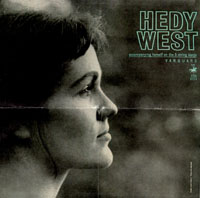 The Brown Girl – Hedy West
Hedy West was one of the most impressive musicians to emerge from the US folk scene in the early 1960s. For me, it is a marvel that so few people are aware of her massive contribution. The first album of her I heard was Ballads (Topic, 1967) and I bought a white-label test-pressing of the album at a folk record shop on New Oxford Street in London that I used to frequent.
It was the sort of place that a parade of folkies slouched towards as if it was Folk Bethlehem. The slouchers included Sydney Carter and the Young Tradition, Anne Briggs and Bert Jansch and later Jerry Garcia and Allen Ginsberg. I digress. Hans Fried who used to work at Collet’s – the afore-mentioned New Oxford Street record shop – joined us at Dave Arthur’s book launch do for his Bert – The Life and Times of A.L. Lloyd (Pluto Press, ISBN 978 0 7453 3252 9).
This particular song is from her pre-Topic days when she was recording for the New York-based Vanguard label. It is a supurb reading from her first full-length solo album for that label. Hans and I jawed about her Vanguard Years in the intermission. He is still a hero of mine. In the 1960s he helped me to focus my mind and put my feet on other paths – ones that perhaps determined where I am now. From Hedy West accompanying herself on the 5 string banjo (Vanguard VRS 9124, 1964)
Crane – Mahsa & Marjan Vahdat
Mahsa & Marjan Vahdat are sisters. The instrumentation is setar (the Persian long-necked lute many believe evolved into the sitar in the South Asian subcontinent), ney (end-blown flute) and daf (frame drum), supplied, respectively by Atabak Elyasi, Pasha Nanjani (whose overture to Crane is exquisite) and Ali Rahimi (also credited with the other percussion).
This track is a poem by the painter-poet Mohammad Ebrahim Jafari and it is set to a melody from Iran’s Khorasan Province. From Twinklings of Hope (Kirkelig Kulturverksted FXCD 376, 2012)
http://www.mahsavahdat.com/
 Sucked Out Chucked Out #3 – The Ex
“In 1960 the paper company Van Gelder decided to expand its product range with plastic. Van Gelder formed together with the US compagny [sic] Crown Zellerbach a joint venture Crown van Gelder PFI (Plastic Film Industry) for coating of paper with polyethylene and cast co-extrusion films. In 1980 the compagny [sic] became a 100% sister company of Van Gelder Papier and the name changed into Van Gelder PFI.
“In 1982 the American multinational Borden Inc. acquired the company and it continued under the name Borden PFI (Plastic Film Industry). During that period the product range and the capacity grew…” From www.afpholland.com/history-afp.html
There is something about the industrial nature – pun intended – of this particular Ex project “recorded at the Van Gelder ruins” that scratches the spot. It originally appeared as one of four 7-inch singles on VGZ Records in March 1983. Very agitprop. Magnificent noise as protest and socially engaged utterance. From Dignity of Labour (Sucked Out Chucked Out 1-8) (EX 010/013D, 1995)
Meet On The Ledge – Fairport Convention
“We used to say…,” wrote Richard Thompson in this magnificent vision of youthful writing, “That come the day/We’d all be making songs/Or finding better words…” before deflating optimism or pomposity with, “These ideas never lasted long…” Still haunting after all these years. From By Popular Request (Matty Grooves MGCD051, 2012)
Hijaz – Al Andaluz Project/Abuab Al Andalus
This track concludes the CD part of this CD/DVD release. The Andaluz Project/Abuab Al Andalus project is an examination of Moorish-era Iberian emancipation and tolerance. Three female vocalists front this band – namely, Morocco’s Iman al Kandoussi, Spain’s Mara Aranda and Germany’s Sigrid Hausen. The Project has at its core, those members of, respectively, Aman Aman, L’Ham de Foc and Estampie. I’m not sure where they are going but I am enjoying the ride and, no doubt, the ride will make more sense after seeing them live. From Live In München (Galileo GMC050, 2012)
http://www.galileo-mc.de
http://www.ojo-musica.com
Fire With Fire – Scissor Sisters
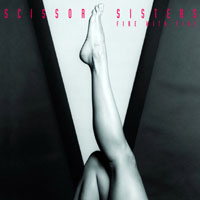 The death of Donna Summer caused me to think beyond the music she had made and beyond the music I generally listened to. Disco meant zilch to me musically but it was there. After her death, a number of commentators said that it had the important ability to unite people of different skin colours, sexualities and politics. I hadn’t done that before.
In September 2010, Scissor Sisters – an outfit that wears its disco colours on its sleeve – appeared on BBC’s Later with Jools Holland. My son hadn’t been able to get to any of concert venues. Thanks to a journo pal of mine – Ian Wade, credit where credit is due – who was doing press for Later, my son and I got to go to the filming. Scissor Sisters were toured out or hadn’t rested enough. Whatever it was, it was something that I recognised. The band or the director’s booth called for a re-take. Nearly everybody bar film crew left but we stayed to watch them do another take. Their lead vocalist Jake Shears’ professionalism was taxing to watch. It was another view from the other side of this life – to cue Fred Neil. A side of performing that few punters get to see or don’t get in the sense of realising what it takes to go out on stage and do it in public. From Night Work (2010)
Polajko – George Mraz and Iva Bittová
Polajko, the Czech name for the pennyroyal plant, popped into my head during a conversation with Sam Lee about folksong and herblore. He has an interest in both.
It is a Czech folksong that hinges on the unsaid, something that I like a great deal. No matter that it is a song-story of fine tunefulness, its better appreciation hinges on one element. Polajko is a plant, an infusion of which was used in traditional medicine to promote menstrual flow and therefore to induce a natural abortion.
This version has jazz lacings. Emil Viklicky (piano) and Laco Tropp (drums) shine. For me, Moravian Gems has a heightened poignancy, one that only five years on, I can express. At the time when Petr Dorůžka and I were working on the CD booklet notes, it was also a time when my mother was dying and I had moved back to become her carer. Moravian Gems was one of the albums I associate with that period. Only now can I listen to it again. And enjoy it in ways other than I did then. Only now it is stripped of pain. From Moravian Gems (Cube-Metier MJCD2736, 2007)
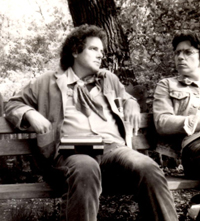 The Walls of Time – Bill Monroe with Pete Rowan
Before I met Hans Fried at the Bert – The Life and Times of A.L. Lloyd launch, I had wandered up the road to Cecil Sharp House with the writers Tony Russell and Phil Wilson. My hitherto unpublished photograph captures an unguarded moment between Pete Rowan and Tony Russell during the course of the first interview with Pete Rowan for Swing 51 that began in issue 4. Neither of them will have ever seen the shot before.
It reminds me not so much of a period of scratching together money in order to put out a small magazine – Tony was publishing Old Time Music and I was publishing Swing 51 – than the egoless desire to write for the ‘competition’. We were all part of the same cause.
Peter Rowan had a similar mindset. He knew Gill Cook who was working at Collet’s at that point and Tony had also done time behind the Collet’s counter… The Walls of Time reminds me of that period in an eidetic way. It represents something else starting to happen to bluegrass… In linear development terms, from this song you can arrive at Old And In The Way. From Make it your sound, make it your scene – Vanguard Records & the 1960s musical revolution (Vanguard VANBOX 14, 2012)
Ball And Chain – Big Mama Thornton
This track also comes from the John Crosby-compiled and -annotated 4-CD boxed set that Ace released in 2012. This is the song popularised by Janis Joplin, to whom Thornton pays tribute in her opening remarks. It first appeared on Willie Mae Thornton’s album Jail (1975). Tracks from this marvellous, five-outta-five-star compilation of Vanguard recordings compilation will figure for as Giant Donut Discs for a long time. Make it your sound, make it your scene was long, long in the making and will not be going away. This is the sort of project that Ace does so peerlessly. One of the anthologies of 2012. Ah! Big Mama Thornton. From Make it your sound, make it your scene – Vanguard Records & the 1960s musical revolution (Vanguard VANBOX 14, 2012)
www.acerecords.co.uk/
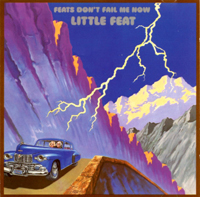 Spanish Moon – Little Feat
This woebegone tale of Lowell George’s is one of the bestest things that Little Feat ever committed to vinyl back in the day. It first emerged on their album Feats Don’t Fail Me Now (1974) where it appears almost like a wraith sketch at three minutes and one paltry second in length. It remains a song with hugest potential, both musically and lyrically. The lyrics place it in Brecht/Weill territory but for me the one element that holds it together is Kenny Gradney’s bass playing. It adds a storytelling dimension, the like of which few bassists will ever come close to delivering during their careers. The sinuous, sinewy elasticity of his bass line is a joy. Writing a piece about him for Bass Guitar Magazine gave me the financial incentive to distil many of my ideas about this song and, importantly, Kenny Gradney’s contribution to Little Feat into words. From Waiting For Columbus (Warner Brothers R2 78274, 1978)
http://www.littlefeat.net/
The copyright of all images lies with the respective photographers, companies and image-makers.
18. 6. 2012 |
read more...
 [by Ken Hunt, London] No blurb, just straight into this month’s music. This month summons the shades of The Band, Julie London, John B. Spencer, Andy Irvine & Dónal Lunny’s Mozaik, Khameesu Khan, Judy Collins, the Kronos Quartet, Emily Portman, Andy Irvine and the Bonzo Dog (Doo Dah) Band.
Tears of Rage – The Band
Dwelling on Levon Helm’s death on 19 April 2012 threw me into the kind of reflective mood that rarely occurs to me at least. The music that he played had been part of my growing. Like you do, I played a number of recordings that he appeared on while re-reading slabs of his autobiography, This Wheel’s on Fire: Levon Helm and the Story of the Band, co-written with the esteemed Stephen Davis. In it Helm fulminates about the divisions that occurred, prompted by the Band’s business affairs. He is also keen to credit the contributions of fellow band members Rick Danko, Garth Hudson and Richard Manuel – like himself overshadowed somewhat by Robbie Robertson.
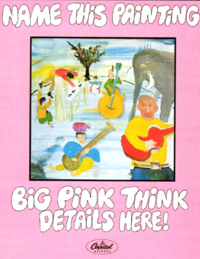
After a death it is frequently the right time to consider burying hatchets. This song sung by Richard Manuel and written by Manuel and Bob Dylan opened their debut LP in 1968. Dylan’s cover painting graced the front cover and on a European hitchhiking trip with stop-offs in Amsterdam I bought the US import version of album with the Klappcover – the double sleeve – which meant that Dylan’s painting had no text on it, though that wasn’t the point. (The figure in the foreground playing sitar with a red hot water bottle on his head did tickle my fancy.) Tears of Rage remains one of the finest opening tracks on any album ever made. From Music From Big Pink (Capitol 7243 5 25390 2 4, 2000)
Phil Shaw’s obituary in The Independent of 21 April 2012 is here: http://www.independent.co.uk/news/obituaries/levon-helm-drummer-and-soulful-singer-at-the-heart-of-the-band-7665825.html
Cry Me A River – Julie London
This track is the final track of the two dozen tracks on Trikont’s collection celebrating emancipated or less than emancipated women. It picks selected songs by Pearl Bailey (You Can Be Replaced), the Boswell Sisters (Everybody Loves My Baby), Mae West (A Guy What Takes His Time), Josephine Baker (C’est lui), Mitzi Gaynor (The Thrill Is Gone) and Marlene Dietrich (Hot Voodoo). The credit for this superlative anthology’s “compilation and concept” goes to Renate Heilmeier.
Renate Heilmeier writes of this track: “Not only the recording is legendary, but the scene in the movie The Girl Can’t Help It as well. Artistic agent Tom (Tom Evell) comes home drunk at night, puts on a record and opens a beer. Julie London appears to him as a singing version of the embodied sadness. The fifties cult movie by Frank Tashlin is set in the music scene of its day, and lots of guest stars show up: Little Richard, Fats Domino, Eddie Cochran, Gene Vincent and Julie London as herself. The leading female part is performed by Jayne Mansfield, one more strong woman.”
For me, this song is less about Jayne Mansfield and 1954 as something that wafts me back to Davey Graham and him playing it in Ken Russell’s 1959 documentary Hound Dogs and Bach Addicts: The Guitar Craze. From Head Over High Heels – Strong & Female 1927-1959 (Trikont US-0401, 2010)
www.heilmeier.de
 Forgotten The Blues – John B. Spencer
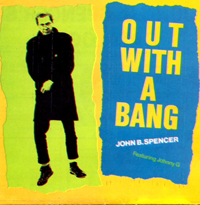
As part of my RPM column about political song/music in R2 I listened to this album by John Spencer and this track sang out. It had nothing to do with the task at hand. It’s just a superlative piece of writing. Forgotten The Blues was also taken up by Martin Simpson. From Out With A Bang (Round Tower Music RTMCD 36, 1993)
O’Donoghue’s – Andy Irvine & Dónal Lunny’s Mozaik
For me, writing any musician’s obituary involves periods of complete silence, apart from the sound of a keyboard or the sound of me reading aloud what I’ve written and blasts of music. While writing Barney McKenna’s obituary for Sing Out! and Penguin Eggs, this song of Andy Irvine blew through my mind, enhanced by recordings by the Dubliners and some Pogues. O’Donoghue’s is a song set in the bar of the same name in Dublin’s Merrion Row and involves a cast of characters associated with that pub between 1962 and 1968 (with a note of apology in the CD booklet to those who didn’t make it into the song). Most prominent among its cast of musicians is Barney McKenna.
When Andy Irvine played The Ram Club in Thames Ditton in Surrey on 4 May 2012, we chatted during the intermission and I mentioned including different references to O’Donoghue’s in the two obituaries I had written. He concurred that that was important. I corrected him that I meant his song – he had played it in the first half – and a surprised look crossed his eyes. It is a superb song from one of the finest musicians to have ever emerged from the Irish folk scene. One of those ‘we are custodians of what we love’ songs. From Changing Trains (Compass Records 7 4468 2, 2008)
 Pahari Dhun – Khameesu Khan
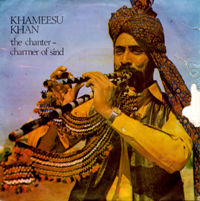
Occasionally it is necessary to remember the wonders of vinyl as in the case of this EMI (Pakistan) subsidiary label’s EP. Khameesu Khan played the alghoza – “a double-fluted blow instrument of the desert regions of Pakistan” as Ikram Azam’s notes described it. Alghoza is a double-ducted folk instrument with one pipe acting as melody pipe and the other as a drone. This recording came with the imprint of the NCA-FRC, the National Council of the Arts, Folklore Research Centre on it. This particular piece is delivered as a folk air.
Long out of print, like the hugest proportion of EMI (Pakistan)’s folk and light classical recordings, it might be as well to point out that, under the variant name Khamisu Khan, he also had a CD released on the French Arion label called L’Art de l’Alghoza du Sind (1999). Alghoza is one of those instruments worth listening to before you die. Any further information about this musician gratefully received. From Khameesu Khan – The Chanter – Charmer of Sind (Columbia EKCE 20024, 1973)
The Blizzard – Judy Collins
Perhaps not the most obvious recording of this song of hers. It is, however, closer to the way she is doing it in her live show of 2012, even if this particular variant first came out in 1995. It is a reflection on a breakdown of a relationship set in a snowy Colorado landscape. Stories need settings, well, usually if particularising an image is the intention. She comes off the road to stop for coffee as the weather deteriorates. Looks like there might be a blizzard tonight…” The song uses the theatrical device of talking to a stranger – somewhere between baring her soul and spilling the beans – about the relationship. It works brilliantly. She sang The Blizzard as part of a suite of songs for her solo piano at this From Voices (Delta Deluxe 4724041, 2003)
 Loving – Kronos Quartet
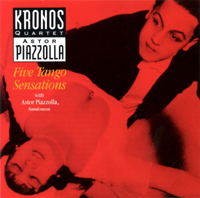
It really does not seem like this mini-album came out in 1991. The music on it still sounds timeless and yet taking tango somewhere else. The Kronos Quartet – back then David Harrington and John Sherba on violins, Hank Dutt on viola and Joan Jeanrenard on cello – was a different beast. It was no less a curious beast as it rootled out new music to tackle but its antennae were taking it in new flavoursome directions. One of those directions was world music.
One time in London David Harrington and I got into another of our serious discussions about what music was turning us on. In the grand manner of the forgetful, I slipped a date (November 1990) into my booklet notes to this five-movement suite composed by Astor Piazzolla (1921-1992). Piazzolla also plays bandoneon on this recording. It was the second piece that Piazzolla wrote for the Kronies (the first being Four, For Tango), but talking to him for the notes was never on the cards because his health was declining.
In order he titled the ‘Sensations’ Asleep, Loving, Anxiety, Despertar and Fear. He roils the waters with undercurrents of all sorts. It was a period of seeking in my life and Piazzolla’s suite connected so much and this became a soundtrack to my life. It still abides. From Five Tango Sensations (Elektra Nonesuch 7559-79254-2, 1991)
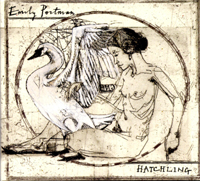 Hollin – Emily Portman
Hollin is the second track on Emily Portman’s Hatchling. She describes it as “An ode to the joys of wild living.” The wild living is more to do with “green leaves” before misjudgements set root. The arrangement makes excellent use of Lucy Farrell’s viola, Rachel Newton’s harp and Lucy Deakin’s cello.
Parenthetically, it is so refreshing to see Portman sparking off the likes of Angela Carter, Orlando Gibbons, sundry belief systems, Tim Van Eyken and Sandra Kerr on this album. The artwork on this album is by Olivia Lømenech Gill – the cover illustration is to do with the Leda legend, the subject matter of the album’s opening track Hatchlings. From Hatchling (Furrow Records FURR006, 2012)
More information at www.emilyportman.co.uk
The Close Shave/East At Glendart – Andy Irvine
This first of these two pieces is a song by Bob Bickerton with the clear and unambiguous intention to out-do the tradition. The beloved tradition has a legion of songs on the subject of the happy man on shore leave, furlough and so on who gets separated from his money. In them the tinker, tailor, sailor, soldier and maybe spy wakes to find himself – always a him – distanced from their purse. Vile trickery is involved of the Cherchez la femme type. We smile and/or yawn along at the gullible folk of olden days. No doubt though, somewhere over the internet rainbow, a tale is brewing about an internet scam along modernistic lines – that urgent bank transfer to get over some mishap abroad and so on.
Bob Bickerton’s song adds a twist to the tale and relocates the action to a New Zealand gold strike. One verse begins, “When I awoke next morning no trousers could I find…” and what was left behind was, the verse ends, “a woman’s dress, a yellow wig and a shaving kit not mine…” It’s a great example of storytelling in song. But that is what so much of Andy Irvine’s live repertoire is about. He engages you with his folk and worse tales.
This particular version with Irvine singing and on mandola and harmonica, Dónal Lunny on bouzouki and Máirtín O’Connor on accordion concludes with an instrumental outro. From Abocurragh (AK-3, 2010)
More information at www.andyirvine.com
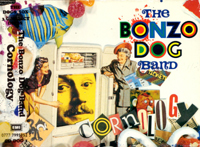 Mickey’s Son And Daughter – Bonzo Dog (Doo Dah) Band
A couple of years ago, Tom Constanten, a chap who once tinkled the ivories with the Grateful Dead, and I enjoyed a conversation over an extended and leisurely peregrination in the fair city of London. We caught up and chatted a day away on a day off in London whilst touring with Jefferson Starship. Our walk took in a variety of culturally intriguing landmarks, amongst them Ewan MacColl’s memorial tree in Russell Square, sundry blue plaques commemorating where people had once lived, and a pleasant selection of pubs with musical, literary, political, lexicographical and courtesan histories.
At one point I asked if there had been an act on a billing that had really caught his fancy and with the old time machine revved up which one would it be if he could go back and really concentrate on that act. Without hesitation he declared it to be the Bonzos who had opened for the Dead in San Francisco.
Jack-in-the-box thoughts sprung, an intense period of memories of the Bonzos and Viv Stanshall’s Rawlinson’s End scripts followed – the latter with its lovable cast of characters including Scrotum the Wrinkled Retainer. Mickey’s Son And Daughter is a different kind of Disneyfication. It first appeared on Gorilla in 1968 and this little piece of heaven’s nostalgia still makes me smile. From Cornology (EMI 0777 7995952 5/CD DOG 1, 1992)
The copyright of all images lies with the respective photographers, companies and image-makers.
18. 5. 2012 |
read more...
 [by Ken Hunt, London] Bass player Chris Ethridge (top right in photograph), who died on 23 April 2012 in his birth town of Meridian, Mississippi was one of the sidemen whose curriculum vitae was lit with musical magic and yet overshadowed in some way by one of his early excursions into working as a musician, even though he played bass with Willie Nelson during in the 1970s and 1980s.
Born John Christopher Ethridge II on 10 February 1947, he first made an impression with the Flying Burrito Brothers on their remarkable debut LP, The Gilded Palace of Sin (1969) with his bass playing and song credits. This group also included Gram Parsons on guitar (top left in photograph) and lead vocals, Chris Hillman, one of the founding members of the Byrds, playing stringed instruments. The pedal steel (bottom right) and guitarist Pete Kleinow (bottom left) completed the pre-drummer line-up.
Holed up in the chic as shit San Fernando Valley in the Los Angeles metroplitan conurbation, they had set about creating a Flying Burrito Brothers repertoire of original songs and a good few covers – notably Dan Penn and Chips Moman’s Dark End of Street and Do Right Woman – for that debut LP. In concert and radio broadcasts though, they augmented Gilded Palace repertoire with songs such as Dream Baby (How Long Must I Dream), Sing Me Back Home, Close Up The Honky Tonks and You Win Again.
Ethridge’s previous band had also featured Gram Parsons. That band, the International Submarine Band made one album Safe At Home which also featured Ethridge, unlike earlier singles. It was released after the band’s break-up in 1968. By that time its leading light, Gram Parsons was over the hills and far away – and indeed working with the Byrds of the Sweetheart of the Rodeo-era. Parsons chose not to stick with the Byrds. By 1968 he was gone and founded the Burritos, still without a permanent drummer when they cut that superlative debut of years. In A&M house photographer, Jim McCrary’s imagery, they were captured wearing Nudie suits. Ethridge’s had rose motifs
 Two of that album’s strongest songs – Hot Burrito #1 and Hot Burrito #2 – carried joint Ethridge/Parsons compositional credits. For them alone, Ethridge is worthy of being remembered. Hot Burrito #1 went on to grace Elvis Costello’s Nashville Bash Almost Blue (1981) under the title I’m Your Toy with John McFee adding pedal steel guitar to the track. Ethridge went on to co-pen She with Gram Parsons. One of Gram Parsons’ most memorable vehicles, arguably Hot Burrito #1, Hot Burrito #2 and She are Parsons’ three greatest originals. Etheridge did not play on Parsons’ solo debut GP (1973).
Ethridge had vamoosed by the time the Burritos made their second album, Burrito Deluxe (1970). He entered into the world of sessions where his bass playing worked well by melting away the stylistic walls between country, rock’n’roll and R&B. Amongst the most memorable of his sessions were Judy Collins’ Who Knows Where The Time Goes (1968), Phil Ochs’ Greatest Hits (1970), Arlo Guthrie’s Washington County (1970), Rita Coolidge’s eponymous album (1973) and three of Ry Cooder’s early must-hears – Ry Cooder (1970), Paradise and Lunch (1974) and, best of all, Chicken Skin Music (1976). With Joel Scott Hill and John Barbata, Ethridge also recorded the jointly credited, rather identity-less and lacklustre L.A. Getaway (1970)
 As a member of Willie Nelson’s touring band, he toured extensively as well as contributing to the Booker T. Jones-produced Stardust (1978). The album was a fine balancing act, for Nelson was not delivering what was necessarily expected of him with its covers of the Kurt Weill/Maxwell Anderson September Song, the Hoagy Carmichael/Stuart Gorrell Georgia On My Mind, the Jimmy McHugh/Dorothy Fields Sunny Side of the Street and the George Gershwin/Ira Gershwin Someone To Watch Over Me.
The copyright of all other images lies with the respective photographers, companies and image-makers. With particular thanks to Michael Moser.
Jim McCrary’s obituary by Valerie J. Nelson from the Los Angeles Times dated 6 May 2012 is at http://www.latimes.com/news/obituaries/la-me-jim-mccrary-20120506,0,1555697.story
18. 5. 2012 |
read more...
 [by Ken Hunt, London] More music for a balmy life on the fictional desert island. April’s selections come courtesy of Christy Moore with Declan Sinnott, Madeleine Peyroux, Gangubai Hangal, Janis Joplin, Santana, The Spook of the Thirteenth Lock, Chumbawamba, Sheila Smith, the Grateful Dead and The Animals. Lots of Irish thoughts and thoughts about Ireland ripple through this month’s selections.
Gortatagort – Christy Moore with Declan Sinnott
 John Spillane wrote Gortatagort (The Farm) about the place in Bantry, Co. Cork where his mother came from. Christy More imparts a real sense of presence to this song, though it took me seeing him perform it in concert for the song’s fuller magic to be uncorked.
The 6 April 2012 issue of The Irish Times carried Derek Scally’s article ‘Bucolic bliss drives Germany’s Heimat sensation’ and it prompted me to write a letter to the editor that I knew would never be run. Heimat is a concept that Irish people should understand better than many European peoples. It is not synonymous with Vaterland (Fatherland) or any of that trashy totalitarian stuff for a start. As Scally stated, it means ‘homeland’ and more. More particularly, it captures a sense of a place of belonging. When Christy Moore and Declan Sinnott performed Gortatagort at London’s Royal Festival Hall on 4 April 2012, what I also heard was an evocation of Heimat Irish-style.
Spillane recalls touchingly in his blog – at http://www.myspace.com/johnspillane/blog/431058506 – how Moore visited the site and soaked up its vibe.
From Listen (Columbia (Ireland) 88697 480002, 2009)
For more information about Christy Moore and John Spillane visit http://www.christymoore.com/ and http://www.johnspillane.com/ and http://www.johnspillane.com/gortatagort-the-farm
Wild Card In The Hole – Madeleine Peyroux
This is Madeleine Peyroux’ setting of a Woody Guthrie lyric dated to around 1949. It is an especial favourite among the album’s dozen tracks. Peyroux sings. Tony Scherr (guitar), Darren Beckett (drums) and Rob Wasserman (bass) provide the accompaniment. It is a tale about survival, most particularly what people do to survive in a world where it doesn’t matter one iota “who wins office/In that Big house on the hill.”
Talking to me in March 2012 in this outtake from an upcoming article in R2, Madeleine Peyroux said, “A lot of people have to really work hard to understand that something is a political message. I sing jazz songs, torch songs. You think it’s just a love song but it can also be a political statement ’cause anything you say about who you are is part of the community you live in. If you’re a woman saying you are in a relationship that is abusive and you sing about that in the blues, well, now people are aware that that’s a political issue. But back then ‘we’ didn’t think about it. Well, I think Woody and Pete Seeger knew probably more than anybody. Movements that have music and politics at the same time are when people get together.”
From the Woody Guthrie and Rob Wasserman ‘collaboration’ Note of Hope (429 Records FTN17844, 2011)
 Raga Adana – Gangubai Hangal
This rendition in the ‘Masterworks from the NCPA Archives’ series – India’s National Centre Performing Arts – from April 1974 illustrates over and over again what a consummate vocalist she was. Here she is accompanied by Sultan Khan on sarangi and Shesh Giri Hangal on tabla. Krishna Hangal adds the second vocal line. This performance gets off to a ropey start in audio terms but the performance far outweighs any initial hesitations about the recording.
You settle into, and luxuriate in sheer vocal distinctiveness. From Ragas Ahir Bhairav, Adana & Yaman (Sony Music 88697 95834-2, 2011)
Get It While You Can – Janis Joplin
The US soul singer and songwriter Howard Tate first recorded this Jerry Ragovoy song in 1966. His recording was picked up on by Janis Joplin (1943-1970) for Pearl, rush-released in its original 10-track form after her death. The song could be construed as an unveiled hymn to hedonism. In her hands – and it is one of the best performances on what turned out to be her finest and final album – she reveals the song’s inner heart as being far more fragile. Over the years, talking to people who knew her and the Full Tilt Boogie Band has prompted how much a tragedy her death was the band. I steer towards the more romantic fragility of her vulnerability of this interpretation. Whooping it up may have been her public face but whooping it up she isn’t here.
There is yet another edition of Pearl but I cannot be arsed to keep chasing the whims of the marketeers. From Pearl (Columbia Legacy COL 515134.2, 2005)
Waves Within – Santana
The album’s opening track Eternal Caravan of Reincarnation begins with cheeping crickets and saxophone musings and functions like a trek across the Thar Desert. Its drums fade and in comes Waves Within, one of the finest instrumental pieces in the early Santana canon. Caravanserai was a marked departure from the Santana of Oye Como Va and Black Magic Woman/Gypsy Queen and on its release it apparently caused some consternation. The group split after this album. One faction, represented by keyboardist Gregg Rolie (who co-composed Waves Within with guitarist Douglas Rauch) and guitarist Neal Schon, formed Journey. Lead guitarist Carlos Santana and drummer Michael Shrieve on the other hand took the music into jazzier realms.
The music on Caravanserai was quite unlike the Santana that I had listened to perform in an inhospitable concrete shell, sorry, concert hall in Hamburg in 1971. It had a depth of intensity that was heartening. From Caravanserai (Columbia Legacy 511128 2, 2003)
 The Brutal Here And Now (Part I) – The Spook of the Thirteenth Lock
Barney McKenna’s death on 5 April 2012 at the age 72 must have awakened many thoughts in many people’s minds. The last of the original Dubliners, his group ranks as an omnipresent force in Irish roots music and their influence ripples outwards through Planxty, the Pogues and Mozaic to The Spook of the Thirteenth Lock – and many points between – in the grand tradition of non-harmless noise.
The Spook of the Thirteenth Lock is a four-piece band. On The Brutal Here and Now, the album from which this track comes, Enda Bates plays bass, sings, adds electronics, acoustic and electric guitars, banjo and accordion. Allen Blighe, their lyricist, sings and plays banjo, electric guitar and esraj. Donnchadh Hoey plays guitars and piano, toots tin whistle and sings. Brian O’Higgins drums and plays percussion.
The Brutal Here And Now (Part I) captures the fieriness of the Dubliners and recontextualises that fieriness. Hear it if you get the chance. From The Brutal Here and Now (Transduction TDR012, 2012)
http://thirteenthlock.net/
Add Me – Chumbawamba
A tale about the sort of friend that you really don’t want on social media. “Would you like to add me as a friend? Add me. Add me.” The album that this cut comes from is one of their most thought-provoking works. Jo Freya makes a guest appearance on saxophone.
“I don’t like people but I think I could pretend…” Great warped line. From The Boy Bands Have Won (No Masters NMCD28, 2008)
 Dear Father, Pray Build Me A Boat – Sheila Smith
Sheila Smith was seven when Peter Kennedy recorded her in Laughton, not far from Lewes in the southern English county of Sussex in November 1952. Her singing is infused with Gypsy spirit and marvellously nuanced. She has a confidence and surefootedness to her delivery that is astounding in someone so young.
Shirley Collins, the compiler of this volume, observes, “This is a real gem, surely one of the most delightful field recordings of all time.” At her talk at the launch of the four new Voice of the People volumes at the EFDSS’s Cecil Sharp House on 15 March 2012, she played Sheila Smith’s Dear Father, Pray Build Me A Boat and it was as if there were ripples running through the room. From the various artists’ I’m A Romany Rai (Topic Records TSCD672D, 2012)
 Morning Dew – Grateful Dead
Bonnie Dobson’s song featured as a core repertoire item over the Dead’s lifetime (1965-1995). There are any number of interpretations that have emerged in the form of archival recordings over the years. This version appeals to me strongly. The band is bang on the money. It’s one of those recordings where you can pick an element to concentrate on.
Thinking about this song of dark times in another period of dark times, I sat in the Prince’s Head on Richmond Green in Surrey on St. Patrick’s Day – 17 March 2012 – and, writing, listened intently to Mickey Hart and Bill Kreutzmann drumming in the service of the song. My focus was occasionally marred by particularly choice passages of Phil Lesh’s electric bass. From Live At The Cow Palace – New Year’s Eve 1976 (Rhino R2 74816, 2007)
 We’ve Gotta Get Out Of This Place – The Animals
Disaffection, frustration and welling rage bottled into a far from ordinary pop song from the 1960s, but then the Animals were far from ordinary.
Listening again to this track was brought upon by hearing that there was a new edition – “Updated And Expanded” in banner headlines of the trade – of Sean Egan’s biography of the group Animal Tracks: The Story of The Animals, Newcastle’s Rising Sons.
A whole series of thoughts about the brooding atmosphere of this track – and It’s My Life in particular – flowed into my head. This is one of the finest working-class songs hymning migration. The leave-taking in this case tells a grittier story than most. From The Complete Animals (EMI CDS 79 46132, 1990)
The images of Christy Moore are © Santosh Sidhu/Swing 51 Archives. The copyright of all other images lies with the respective photographers, companies and image-makers.
23. 4. 2012 |
read more...
 [by Ken Hunt, London] Originally written on the eve of London’s post-Valentine Peace March on 15 February 2003, this with little taken out or added.
Ace’s catalogue is a growing and contracting – call it pulsating – reminder to reinforce why I decided to specialise and limit my listening and writing habits for sanity’s sake.
6 It Was Just A Dream – Big Bill Broonzy with Albert Ammons
on Spirituals To Swing (169/71-2)
I was raised on jazz, swing jazz in particular, by my saxophone-tooting/toting father. Semi-pro at 14, he actively fought the Musicians’ Union last-ditch fuckwit prohibition of semi-pro musicians. I get cross when music journalists pick big-box sets as their best-ofs – and I’ve done it – as if forgetting that most punters only get to put them on Christmas, Diwali or birthday lists. But this one transports me back to memories of my dad with its Benny Goodman, Golden Gate Quartet, Count Basie, Sonny Terry, Joe Turner and Big Bill Broonzy. I adore the way Broonzy turns adversity into humour in this 1938 tale. Wryness is such a powerful weapon.
7 She Used To Want A Ballerina into Helpless – Buffy Sainte-Marie
on She Used To Want A Ballerina (VMD 79311-2)
An imaginary segue. In the 1960s the inside front page of Melody Maker used to have a drop-column Fontana ‘advertorial’. One week it talked about Buffy Sainte-Marie. Within a fortnight I had heard her in a listening booth at HMV in Sutton. With this cred I was able to hold a sensible conversation in Wimbledon with two girls in the year above from the neighbouring grammar school in Mitcham to ours.
In a listening booth in the record shop at the foot of Wimbledon Hill, we listened to folk music. They, prettier than I, did what I would never have dared do, they went up to the counter and asked for a Johnny Cash LP to listen to… Thank you folk music.
Thank you Buffy Sainte-Marie.
8 Pack Up Your Sorrows – Mimi and Richard Fariña
on The Complete Vanguard Years (Vanguard 3VCD 200)
I first heard this song on Judy Collins’ Fifth Album (1965) and in the great tradition of record-buyers and folk-traditionalists I went in search of the original. It took some while back then in an age when tracking down a record often took years. Also because it reminds me of my old Kamerad Michael Kleff who now edits Folker.
9 Long Time Gone – Everly Brothers
on Songs Our Daddy Taught Us (CDCHM 75)
into Try A Little Tenderness – Otis Redding
on It’s Not Sentimental (CDSXE 041)
The numerate and argus-eyed will recognise this as beastly horridness. Two of the most influential acts in my musical development. Warner’s period Everly Brothers were the first pop act to mean anything to me. Harmony became my lodestar until modally based melody and rhythm cycles tore up the old rule book. Long Time Gone gets me every time. Otis Redding turned this old song into a musical necessity. Here’s a catch. Bing Crosby covered Tenderness in 1933 and an old anthology of his told a different tale of tenderness extended that frequently runs through my head when I listen to Otis Redding’s version. Harry Woods, its author, had a wooden leg. One time, tempers flared in a speakeasy and Woods used his leg to batter the opposition in the ensuing brawl. Isn’t it wonderful how a song can accommodate contradictory interpretations?
10 Howl (For Carl Solomon) – Alan Ginsberg
on Howl And Other Poems (FCD 7713)
Howl was like having your head ripped off, your cranium scooped out and everything put back the right way. It was the start of something so almighty it was revelatory. I met and interviewed Ginsy several times and he was delightful, sharp, waspish and, above all, interested.
Kronos’s David Harrington told me that just before they did Howl in New York, Ginsberg turned to him in the wings and radiating naughtiness chuckled how he couldn’t believe he was going to say “cocksucker” at Carnegie Hall.
I told the story to Phil Lesh, who himself toyed with setting Howl to music, and he pissed himself. Name-drop moi?
Actually, my source is the Ginsberg boxed set, Holy Soul Jelly Roll. But I do have the Ace signed vinyl.
http://www.acerecords.co.uk/
16. 4. 2012 |
read more...
[by Ken Hunt, London] Originally written on the eve of London’s post-Valentine Peace March on 15 February 2003 with little taken out or added.
Ace’s catalogue is a reminder why I decided to specialise and limit my listening but especially writing habits for sanity’s sake. Not all the people I wrote about in this piece are still alive, notably Ali Akbar Khan, one of my hugest musical influences.
 1 Bass Strings – Country Joe and the Fish
on Electric Music For The Mind And Body – VMD 79244-2
Bass Strings bottles the essence of psychedelic music, a microcosm beside the cosmos of the Dead’s Dark Star>St. Stephen>The Eleven. Compare the first version [on The Collected Country Joe & The Fish 1965-1970 – VCD 111] and this little beauty for insights galore into the creative process and why the righteously psychedelised mind passeth all understanding.
Joe McDonald is an excellent raconteur. Last time we met, gardeners both, we warmed up by exchanging recommendations about varieties of tomatoes, potatoes and basil, moved into environmental issues and launched a first-rate interview. Since his death, I usually think of the writer John Platt (1952-2001) when I listen to this masterpiece of an album.
2 Samson & Delilah (If I Had My Way) – Reverend Gary Davis
on Live At Newport – VCD 79588-2
A metaphor for life that has nothing to do with the biblical in my case.
3 Bilashkani Todi – Ravi Shankar and Ali Akbar Khan
on The Master Musicians Of India – PR20 1078-2
Chosen because I have known the work of these two musicians for longer than I haven’t, because I have known them as individuals for decades and because there was fire in their bellies when they used to play together, as here, before the shit hit the fan. (Do not cue Little Feat.)
[ADD JPEG KD_2000] 4 Om Shameo Shiva Shameo – Kadri Gopalnath
on Gem Tones – CDORBD 097
Kadri Golpanath is a saxophone colossus. What Ben Mandelson achieved with this album is nothing short of spectacular. When I compiled the second edition of The Rough Guide to India, this track was a first choice. But licensing – nothing to do with GlobeStyle – tripped me up.
5 Gonna Lay Down My Sword And Shield – Joseph Spence
on Gospel At Newport – 77014-2
Raptures of the deep from Joseph Spence, the musician whose singing with the Pinder Family introduced me to what they call World Music now. That first encounter with The Real Bahamas at Collet’s in London’s New Oxford Street, courtesy of Hans Fried, was the first stepping stone to me writing about it.
I never got to meet Spence but I got to know Jody Stecher and Peter Siegel who recorded that album. Peter took me and my daughter to the spot by the Brooklyn Bridge where Spence stood when he was over for Newport though.
Writing this on the eve of London’s post-Valentine Peace March on 15 February 2003, “Ain’t going to study war no more” rarely sounded sweeter or more needed.
http://www.acerecords.co.uk/
2. 4. 2012 |
read more...
 [by Ken Hunt, London] Sometimes life gets in the way of unpaid writing and technical (internetmabob) matters in the way of uploading. Hence skipping a month. Not that February 2012 was so bad a month. More like the hours got rationed and paying work intruded. This month’s selections are from the UK-based band Durga Rising, the Czech vocalist-violinist Iva Bittová and Wilmar de Visser (bassist with the Nederlands Blazers Ensemble), the Carolina Chocolate Drops’ Rhiannon Giddens, Wizz Jones, El Hachemi Guerouabi, Shamim Ahmed Khan, Judy Collins, Phoebe Smith, Celia Hughes, Belinda O’Hooley and Heidi Tidow. Slaap zacht.
Go Down Easy – Durga Rising
Kuljit Bhamra (percussion), Russell Churney (piano) and Barb Jungr (vocals, harmonium, mandolin) deliver this album. Smoochy, sultry, saucy and sexy – it’s the way Barb J. baits, tells and sells them. This is one of the tours-de-force from this now-reissued album. From Durga Rising (Keda KEDCD46, 2011)
Jabúčko – Iva Bittová and Wilmar de Visser
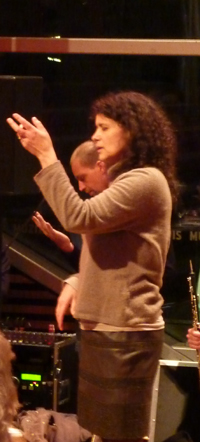 Wilmar de Visser and Iva Bittová played this at their joint concert at Amsterdam’s Muziekgebouw aan ‘t IJ – that steel, glass and wood structure on Piet Heinkade, one tram stop out from Centraal Station. The tram’s lady conductor and I bantered a bit on the way to the venue. I had never seen Iva and the Nederlands Blazers Ensemble (NBE) perform, though their Ples Upírů (‘Dance of the Vampires’, Indies Records MAM169-2, 2002), a live recording from Den Haag in April 2000, attests to a long-lived musical partnership. By the way, Ples Upírů is translated as ‘Dance of the Vampires’. Apparently, vampires are very popular nowadays, so mentioning vampires a few times may bring vampire-lovers to unexpected discoveries at non-vampiric websites. I digress.
The first word of proper Czech I ever consciously learned, thanks to my esteemed co-host of this site, was jablkoň (‘apple tree’) in 1991. There was nothing Biblical to my first lesson in Czech: it was the name of the Czechoslovakian acoustic music group, Jablkoň – formed in 1977 and still going strong. I watched in amazement – and amazement is apposite – on a little stage beside the main pedestrian street, today’s Boulevard, at TFF Rudolstadt in July 1991. Grasping the grammatical implications of the pip diminutive form jabúčko (‘little apple’) from jablkoň, the tree, would take many years and many lessons more.
This piece figured prominently in Iva Bittová and the NBE’s concert on 25 January 2012. I knew, if nothing else, that this concert marked a turning-point in my professional life. Iva was about to record one or two of our collaborative compositions in a week or so later in Switzerland. After that, for reasons of probity I would be withdrawing from writing about her work in the usual music critic sense. But I loved this performance because it reminded me of the concert.
This is from a DVD/CD rush-release from the NBE bash on 1 January 2012 at Amsterdam’s Concertgebouw at which Iva Bittová was one of the guests. The title Vreemde Vogels communicates the sense of ‘strange birds’ or ‘foreign birds’ in a rara avis sense. From Vreemde Vogels (NBE NBECDO30, 2012)
PS That same day, 25 January 2012, back in England my friend and work colleague Robert Maycock died in a car accident. Keith Potter’s obituary of Robert Maycock appeared in The Independent of 9 February 2012.
http://www.independent.co.uk/news/obituaries/robert-maycock-classical-music-critic-for-the-independent-6671390.html
Pretty Bird – Carolina Chocolate Drops
I count the Carolina Chocolate Drops as one of the great darling hopes of contemporary US roots music. This is a solo performance by their Rhiannon Giddens of a song by Hazel Dickens. No huge text or exegesis needed. Just love it. This track concludes their album. Hazel Dickens would be tickled, I suspect. From Leaving Eden (Nonesuch Records 7559-7967-1, 2012)
Ken Hunt’s obituary of Hazel Dickens from The Independent of 3 June 2010 is at
http://www.independent.co.uk/news/obituaries/hazel-dickens-pioneering-bluegrass-singer-whose-songs-championed-the-working-class-2292347.htmll
Massacre At Beziers – Wizz Jones
Wizz Jones remains one of the most insightful guitarists of our era. However, his prowess on the acoustic guitar has unfairly overshadowed his abilities as a song interpreter. Alan Tunbridge’s song about the Cathars, the eminently transferrable Albigensian Crusade and a Marvyn Gaye-like what’s going on? tale. This recording was made in Huldenberg, Brussels on 18 March 2006. From Huldenberg Blues (Sunbeam Records SBRC5085, 2011)
El Harraz – El Hachemi Guerouabi
The title’s English-language translation has it as ‘The Fierce Doorman’. Any song with that title must be smuggling something under the radar. This performance is in the chaabi style, meaning ‘of the people’. This particular double-CD set is a cornerstone of my non-rai Algerian music experience.
From Trésors de la musique algérienne (Institut du Monde Arabe 321.054.055, 2003)
If ever in Paris, do please visit Institut du Monde Arabe (Museum of the Arab World) at 1 Rue des Fosses St.-Bernard (5th arrondissement), 75236 Paris for further insights.
Janasanmodini – Shamim Ahmed Khan
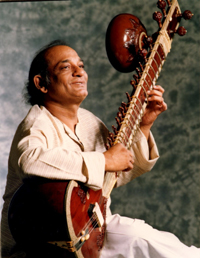 Shamim Ahmed (1938-2012) had such a mellifluous voice on the sitar, totally his but utterly bearing the stamp of his guru Ravi Shankar. This particular Hindustani-style raga composition of his guru’s came about in 1947 apparently (according to the notes). Shankar sounded out various people whether it already existed in the South Indian ragam firmament where mathematically speaking musically anything possible might be said to have been already catalogued or anticipated, so to speak. (I know: a nastily complex sentence.) This is a performance by a musician whose playing that has coloured my life. Shamim Ahmed’s interpretation has a joyful succulence to it. From ShankaRagamala – A Celebration of the Maestro’s Music by his Disciples (Music Today CD-A-04200B of CD-A-04200A-C, 2005)
Ken Hunt’s obituary of Shamim Ahmed Khan from The Independent of 7 March 2012 is at http://www.independent.co.uk/news/obituaries/shamim-ahmed-khan-sitar-player-taught-by-shankar-7542206.html
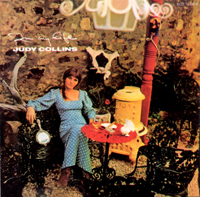
In My Life – Judy Collins
This Lennon/McCartney song had a fragrance to it when it emerged into the world back in the 1960s. Judy Collins’ In My Life interpretation had a willowy, plaintive quality that inspired me in 1967 and in its austerity it is still impressive. “But of all these friends and lovers, there is no-one compares with you…” is such a jejeune and inexperienced statement. It shouts inexperience. It has also become a song about aging. “Some are dead and some are living…” A magnificent song and a magnificent performance. My colleague Peter Doggett’s notes illuminate this reissue. Fifth Album & In My Life (Elektra/Rhino 8122 73392, 2006)
A Blacksmith Courted Me – Phoebe Smith
This is one of the most perfect songs in the English language. This is a recording made by Peter Kennedy in July 1956. Shirley Collins compiled and annotates this volume in Topic’s second (2012) tranche in its Voice of the People series. Quite properly, it concludes the first CD on this double set. Phoebe Smith’s is a performance that transports. She was one of the most mesmerising of the English Gypsy singers. From the various artists’ I’m A Romany Rai (Topic Records TSCD672D, 2012)
Jealousy Thoughts – Celia Hughes
This is a variant of Worcester City, with coughing, voices off and voices on. And it has a presence that is gooseflesh palpable.
“Too young to court, too young to marry,
Too young to court of a wedding day.
For when you are married, you’re bound for ever
And when you’re single, you’re sweet liberty.”
Celia Hughes’ voice has a clarity like few others. It is her only track on this second volume of Peter Kennedy’s recordings. From the various artists’ I’m A Romany Rai (Topic Records TSCD672D, 2012)
The Tallest Tree – O’Hooley & Tidow
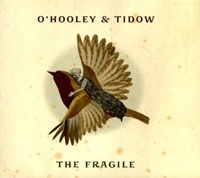 Belinda O’Hooley and Heidi Tidow are pretty self-contained as groups go but they are utterly in the spirit of the No Master’s Co-operative – the Northern England-based co-operative that now, amongst others, includes O’Hooley & Heidi Tidow, Coope Boyes & Simpson, Chumbawamba in that spirit of organise to survive. This is a track from their second album, recorded between September and October 2011.
It’s not big or clever to pick the opening track from an album. Sequencing albums is no little art in itself. This song has a few bird references – “The robin calls, the robin sees, the robin flies to the tallest tree” – with “crows in pinstriped uniform” as baddies bent on “the commoner’s nest egg…” Call me an old-fashioned naturalist but I connect those images with E.A. Armstrong’s 1958 The Folklore of Birds in Collins’ New Naturalist series and folklore wrenched into the present. Don’t be beguiled by the voices: heed the words. From The Fragile (No Master’s NMCCD39, 2012)
More information at http://www.nomasters.co.uk
The image of Iva Bittová at the after-concert at Muziekgebouw aan ‘t IJ is © Ken Hunt/Swing 51 Archives. The copyright of all other images lies with the respective photographers, companies and image-makers.
19. 3. 2012 |
read more...
 [by Ken Hunt, London] The mridangam virtuoso Palghat T.S. Mani Iyer, born 100 years ago in Palghat (the anglicised version of Palakkad) in Kerala, was one of the musical giants of the Twentieth Century. Prior to him, the mridangam had filled the subordinate time- and tempo-supporting role – the usual role of drums in both of the subcontinent’s art music systems and folk traditions. He was one of a generation of musicians that changed the complexion of South Indian music.
His vision and innovation was to shift the balance, so that, in his hands, the mridangam attained a greater melodic role with phrasing that reflected the words, whether sung or unsung. He redefined the artistry of the South’s principal barrel drum and rewrote the figurative book, inspiring such mridangists as Palghat R. Raghu (1928-2009) and Umayalpuram K. Sivaraman (b 1935) – and players he never met – to take his innovations and explore them further.
In 1940 Palghat R. Raghu’s family moved to Palghat, specifically so he could study drumming with Palghat Mani Iyer. Recalling this, he said, “Becoming his disciple was, for me, a dream come true,” In 1948 he wed Palghat T.S. Mani Iyer’s niece Swarnambal, further reinforcing the ties between guru and pupil. Mani Iyer guru had begun his career in music in 1924 at the age of twelve, accompanying the vocalist Chembai Vaidyanatha Bhagavatar (1896-1974) – Chembai being a village near Palghat – with whom he would work and grow over succeeding decades.
Mani Iyer was also part of the post-Second World War artistic explosion that brought South Asian classical music to Britain and elsewhere. He appeared at the pivotal 1965 Edinburgh Festival accompanying the Karnatic principal vocal soloist K.V. Narayanaswamy with his son Rajamani as second mridangist and the violinist Lalgudi G. Jayaraman.
Mani Iyer changed the face of mridangam playing. He reinforced the realisation that the rhythmist’s role could also be to colour and reflect the words as they unfolded.
Further reading
To learn more about Palghat Mani Iyer, the violinist daughter of Lalgudi G. Jayaraman, Lalgudi Vijayalakshmi’s article ‘A genius who redefined the art of mridangam playing’ from em>The Hindu of 28 December 2011 is recommended reading: http://www.thehindu.com/arts/music/article2755328.ece?homepage=true
Ken Hunt’s obituary of Palghat R. Raghu ‘Palghat R. Raghu: Master of Indian percussion who played with Ravi Shankar and Alla Rakha’ from The Independent of 30 June 2009 is at: http://www.independent.co.uk/news/obituaries/palghat-r-raghu-master-of-indian-percussion-who-played-with-ravi-shankar-and-alla-rakha-1724491.html
The artwork for South Indian Strings: Presenting The Art of Dr. L. Subramaniam with Palghat T.S. Mani Iyer (Lyrichord Records LLST 7350, 1981) finds him seated on the viewer’s far left – image © Lyrichord.
23. 1. 2012 |
read more...
 [by Ken Hunt, London] The batch of donuts has a great deal, on one hand, to do with current commissions; and on the other, choosing music that had nothing to do with work. The music is courtesy of Bessie Smith, The Kossoy Sisters with Erik Darling, Damien Barber & Mike Wilson, Rosa Imhof, Ida Schmidig-Imhof and Frieda Imhof-Betschart, Nusrat Fateh Ali Khan & Party, Martin Hrbáč, The Notting Hillbillies, Mobarak and Molabakhsh Nuri, Vishwa Mohan Bhatt & Musicians of Rajasthan and Peter Case.
Frosty Morning Blues – Bessie Smith
 This performance from January 1924 has a bare-bones accompaniment. Jimmy Jones (piano) and Harry Reser (guitar) do the honours. E. Brown’s slow blues starts out lyrically as a quite predictable tale, the sort of blues terrain where you can see the rhymes coming. It’s one of those songs where the man that she loves has vamoosed and left her alone. “Did you ever wake up on a frosty morning and discover your good man’s gone?” is the question she asks. Then she starts recalling how he wasn’t handsome and reminiscing. Her fire isn’t burning, for instance. She ends philosophically stating plainly that when you lose a man, he’s as good as dead. A perfect little vignette, packed with detail, with frost (rather than frostiness) as a metaphor. From The Complete Recordings Vol. 1 (Columbia Legacy C2K 47091, 1991)
I’ll Fly Away – The Kossoy Sisters with Erik Darling
This was recorded in August 1956 and released later that year. The New York-based twins Ellen and Irene Kossoy – Irene Saletan and Ellen Christenson, as they became – were three months past 17 years old when they made their debut album for Tradition of southern mountain material, singing close harmonies and accompanying themselves on banjo and guitar. On the album Erik Darling came in to beef up their sound. This most moreish track is a stand-out.
What sets them apart are their harmony vocals on this sacred song. The album notes say they had learned it from the singing of James and Martha Carlson. Listening to the album in 2002, their previous activities were blank pages. They turned out to be yet more of Pete Seeger’s children, having attended a summer camp at which he had, by all account, performed. After Bowling Green, they played the first Newport Folk Festival in 1959. There was further festival appearances, marriages, parenthood and minimal recording activity.
But something else did happen and that was it appearing in Joel and Ethan Coen’s O Brother, Where Art Thou? (2000), renewing interest in the sisters and I truly hope the arrival of new pension plan in the form of royalties from that film. From Bowling Green (Tradition TCD 3007/1, 2002)
More information is at http://www.kossoysisters.com/
 The Old Songs – Damien Barber & Mike Wilson
The title song of this duo’s album it may be, but it shoots me back to old friendships with its authors, Pete Bellamy and Bob Copper. Bob wrote the words and Pete the tune. According to the album notes, Pete sent it to the Wilson Family and few decades later it popped out in this form – “A twenty to thirty year gestation period for a Wilson Family song, is not unusual.”
It condenses many of Bob’s most heartfelt themes and takes in the longevity of the old songs (and gormlessness of modern ones), good ale and being glad to be alive. Yes, it gets cod in places but both Pete and Bob must have had twinkles in their eyes when they put the song together. Bob liked a spot of Sleepy John Estes and Pete had moments of rapture to the Rolling Stones.
Damien Barber and Mike Wilson net that quality of knowingness and even get a bit of post-Bellamy bleating in, too. From The Old Songs (DBS004, 2011)
Trois Jüüzli – Rosa Imhof, Ida Schmidig-Imhof and Frieda Imhof-Betschart
Rosa Imhof and Ida Schmidig-Imhof are sisters and Frieda Imhof-Betschart is their sister-in-law. This recording was made in Alois Imhof’s alpine pasture hut at Sali in the Muotatal district of the Swiss canton of Schwyz in June 1979. Muotatal historically was remote from mainstream Swiss society. In isolation a form of vocal music called Juuz evolved. Jüüzli is its diminutive form with vowel change and the Swiss-German -li diminutive suffix and refers to a kind of yodelling. It defies expectations of what yodelling sounds like.
The three women weave wordless vocal lines and harmonies in ways that, three decades on, still trounce expectations. The pieces last just over three minutes in total. The first, Dr Nägelibärgler, is named after the ;Nägelibärgler mountain the second, Höch Turä Jüüzli’, another mountain called Höch Turä and the last, Z’Butzener’s (At the Butzener’s), after a surname. Returning to this collection, first released in 1979, came about because of back-researching Switzerland’s roots-based music traditions for R2‘s article about Nørn that appeared in its November/December 2011 issue. From “Jüüzli” – Jodel du Muotatal (Le Chant du Monde LDX 274 716, 1990)
 Allah hoo, Allah hoo, Allah hoo – Nusrat Fateh Ali Khan & Party
The Party weaves lead and call-and-response vocal parts on this hamd – a qawwali praise song form directed at God/Allah – set in the light ‘mixed’ (mishra) raga ‘Mishra Khamaj’. Recorded at the Kufa Gallery on 14 December 1989, it is era-defining. It is Nusrat Fateh Ali Khan before all the bally-hoo. From Traditional Sufi Qawwalis – Live in London – Vol. I (Navras NRCD 0016, 1993)
Suchovské hudecké – Martin Hrbáč
The Moravian folk tradition of the Czech Republic is astonishingly vibrant and the notes to this particular track explain that Martin Hrbáč has been viewed as a successor to the Horňácko ([Moravian] Highlands) bandleader Jožka Kubik. A bandmaster himself, Hrbáč is a superb fiddle player of the ‘first violin chair’ kind, a bass player and vocalist. This instrumental performance is driving melodically with under-melodies glimpsed like petticoats to the dancing main melody. It captures the elemental force of Moravian village band music. The track originally appeared on his 1995 album, Horňácký hudec on the Gnosis label. From the various artists’ compilation Antologie moravské lidové hudby/Traditional Folk Music in Moravia – Horňácko (Indies MAM 486-2, 2011)
 Feel Like Going Home – The Notting Hillbillies
The Notting Hillbillies were Brendan Croker, Guy Fletcher, Mark Knopfler and Steve Phillips and they put on a very good show. No idea how much they worked together. My memory was that it was just their Missing … Presumed Having A Good Time album and its supporting tour. But I was wrong. Apparently they continued to do occasional gigs into the late 1990s.
They weren’t a spin-off of Dire Straits, as some suggested. They were, if memory serves me well, a gathering of three old friends – Brendan Croker, Mark Knopfler and Steve Phillips – augmented by Guy Fletcher on keyboards, who co-produced the album with Knopfler. They started out in Holbeck – an area of Leeds I got to know some later that decade when my son was living there. The street he lived on is now gone – well, Runswick Place is probably still there but his place certainly isn’t. It was bulldozed.
Clearly, as far as Knopfler was concerned, there was no financial imperative to play. He was sitting pretty. The story I recall hearing was that he had done it out of the kindness of his heart, friendship and the chance to play and record with some mates. The consequent trip had put Croker and Phillips on a secure footing financially. Anyway, that was the story I remember.
At one of their gigs supporting the album, they signed the CD artwork – hence the defaced cover. Before the gig I interviewed Guy Fletcher for an article in the El Cerrito-based Keyboard. The concert review – for another magazine – was grossly manhandled. One subbed change replaced ‘claque’ with ‘clique’ but worse was to occur. It was the infant days of computer spell-checking and jettisoning dictionaries.
Feel Like Going Home was a Charlie Rich credit and typical of the kind of repertoire that Brendan Croker was plying outside the Hillbillies with the 5 O’Clock Shadows – one of the most entertaining and illuminating rock bands on the pub-rock circuit during the 1980s. This song freeze-frames several periods in my life. What most affects me about this track is the tastefulness of the arrangement, the power of Brendan’s voice and the sentiments of the song. Feel Like Going Home was a parting glass on the album – and in concert. From Missing … Presumed Having A Good Time (Phonogram/Vertigo 842 671-2, 1990)
 Qalandari Tune – Mobarak and Molabakhsh Nuri
This untitled, rhythmically driving instrumental is from Baluchistan and the Sufi Qalandar tradition. Those of this tradition tread a profoundly Sufi path and pursue (if that’s quite the word) a way of life that often clashes with the orthodoxies of mainstream society. Mobarak plays the benju, a stringed instrument that cannibalises typewriter parts, though the times are a-changing and there is no knowing how the supply of manual typewriters will stand up. This tune sways rhythmically like shifting sands. The double-CD from which it comes is a complete joy and essential listening for anyone interested in the wider extent of Sufi music, beyond qawwali in other words, in South Asia. From the various artists’ anthology Troubadours of Allah – Sufi Music from the Indus Valley (Wergo SM 1617 2, 1999)
Helo mharo suno – Vishwa Mohan Bhatt & Musicians of Rajasthan
The Rajasthani “Helo mharo suno” translates as ‘Hear me calling you’ or ‘Hear my entreaty’. It is a praise song to the medieval holy man Baba Ramdev, one of the region’s most revered Hindu deities and Islamic pirs (saints). His modern-day is concentrated in today’s Rajasthan and Gujarat but stretches to Madhya Pradesh and Sind in Pakistan. He is a great unifying figure, famed for bringing together people of different religions, sects and castes.
The Rajasthani classical maestro, Vishwa Mohan Bhatt plays the classical guitar hybrid, Mohan vina on this album and his instrumental lines weave together marvellously well with the folksier regional instruments and vocals. I wrote the notes for Desert Slide and it remains one of my favourite recording projects of his. I have never stopped playing it. In fact it is the album of Vishwa Mohan Bhatt’s that I have played the most, even more than his and Ry Cooder’s Meeting By The River for which they earned a Grammy. It came back into steady rotation whilst working on an article about Sufi music. From Desert Slide (Sense World Music 085, 2006)
More Than Curious – Peter Case
Got to interview Peter Case a couple of times down the years. This particular track on his eponymous solo debut was one of the tracks produced by T-Bone Burnett and Mitchell Froom. The production has a real presence – notably the drum and the electric guitar sound. It stands out.
But it is the song itself that does it for me. “I’m the kind/That’s always takin’ things apart…” the song begins (and concludes). “If I could tonight/I’d take a look in your heart.” Ordinarily I couldn’t have afforded a Japanese import at the time of this album’s CD release but I was the London correspondent for Tower Records’ Pulse! magazine and got staff discount for this one. From Peter Case (Geffen (Japan) 32XD 812, 1986)
The copyright of all images lies with the respective photographers, companies and image-makers.
9. 1. 2012 |
read more...
« Later articles
Older articles »