Articles
 [by Ken Hunt, London] The year started brilliantly, thanks to the Carolina Chocolate Drops and Emily Portman. Then nothing much seemed to happen for the longest while – well, a month or so – and then the sluice gates opened and a wonderful year’s musical experiences began pouring out. It did, however, prove a disappointing year for quality new recordings of Indian music.
 New releases
Laurie Anderson / Homeland / Nonesuch
Jackson Browne David Lindley / Love Is Strange / Inside Recordings
Carolina Chocolate Drops / Genuine Negro Jig / Nonesuch
Hariprasad Chaurasia / Hariprasad Chaurasia and the Art of Improvisation /Accord Croisés
Andy Cutting / Andy Cutting / Lane Records
Diva Reka / Diva Reka / Giga New
Barb Jungr / The Men I Love / Naim Label
Ida Kelarova, Desiderius Dužda, Tomáš Kačo and the Škampa Quartet / Romská balada / Indies Scope
Kronos Quartet with Alim & Fargana Qasimov and Homayun Sakhi / Music of Central Asia Vol. 8 – Rainbow / Smithsonian Folkways
Emily Portman / The Glamoury / Furrow Records
Alim Qasimov and Fargana Qasimova / Intimate Dialogue / Drever Gaido
Leon Rosselson & Robb Johnson / The Liberty Tree / Trade Root Music
Peter Rowan Bluegrass Band / Legacy / Compass Records
Steve Smith, George Brooks, Prasanna / Raga Bop Trio / Abstract Logic
Rajan Spolia / More Than Words: Snake Music (Chapter IV)/ Hard World
Jody Stecher / Return / own label
Swarbrick / raison d’être / Shirty
Various Artists / Music of Central Asia Vol. 7 – In The Shrine of the Heart – Popular Classics from Bukhara and Beyond / Smithsonian Folkways
Various Artists / Music of Central Asia Vol. 9 – In The Footsteps of Babur – Musical Encounters from The Lands of the Mughals / Smithsonian Folkways
Wenzel / Kamille Und Mohn / Matrosenblau
 Historic releases, reissues and anthologies
Miles Davis / The Complete Columbia Album Collection / Columbia/Legacy
Miles Davis / Bitches Brew / Columbia/Legacy
Bonnie Dobson / Vive Le Canadienne / Bear Family
Swamy Haridhos & Party / Classical Bhajans / Country & Eastern
Incredible String Band / The Hangman’s Beautiful Daughter / Fledg’ling
Ravi Shankar / Nine Decades Vol 1 – 1967-1968 / East Meets West Music Inc
Ravi Shankar George Harrison / Collaborations / Dark Horse
Various Artists / Magic Clarinet / NoEthno
Various Artists / Rough Guide to Afghanistan / World Music Network
Various Artists / Theme Time Radio Hour – Season 3 / Ace Records
 Events of 2010
Carolina Chocolate Drops / Bush Hall, Shepherds Bush, London / 4 February 2010
Shraddhanjali – Zakir Hussain, Ranjit Barot and Sabir Khan / Queen Elizabeth Hall, London / 30 April 2010
Amira Medunjanin and Merima Ključo / St Ethelburga’s Centre for Reconciliation & Peace, Bishopsgate, London / 27 May 2010
Jackson Browne / Hampton Court Palace, Surrey / 8 June 2010
Tina Kindermann / Am Markt, Tanz&FolkFest Rudolstadt / 3 July 2010
Diva Reka / Am Markt, Tanz&FolkFest Rudolstadt / 3 July 2010
Kala Ramnath and Abhijit Banerjee / Stadttheater, Tanz&FolkFest Rudolstadt / 3 July 2010
Béla Fleck, Zakir Hussain and Edgar Meyer / Barbican, London / 9 July 2010
Little Feat / Cropredy Festival / 13 August 2010
Martin Carthy and Dave Swarbrick / King’s Place, London / 9 September 2010
The Alim Qasimov Ensemble / Barbican Centre, London / 19 September 2010
Christy Moore and Declan Sinnott / Royal Festival Hall, London / 6 November 2010
Iva Bittová and the Škampa Quartet / Howard Assembly Room, Opera North, Leeds, Yorkshire / 24 November 2010
Images: Smile, taken 20 July 2010 (still possibly a Banksy), and Tina Kindermann at TFF Rudolstadt © Ken Hunt/Swing 51 Archives
The copyright of the other images remains with the original copyright holders.
13. 12. 2010 |
read more...
[by Ken Hunt, London] Winter draws on in London but on the fictitious tropical island the sun is shining. Helping to banish gloom this month is a rather fine selection of music. Ladies and gentlemen, boys and girls, this month’s haul of traveller’s tales embraces Methera, Amy Rigby, Ida Kelarova, the Hallé Orchestra under Mark Elder, Dave Bartholomew, Bonnie Raitt & Was (Not Was), the Oysterband, Alim and Fargana Qasimov, The Byrds and Czech Philharmonic Orchestra under Rafael Kubelík.
 Bijav – Ida Kelarova
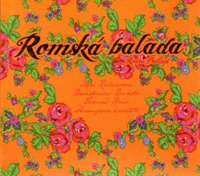
Romská balada (‘Roma Ballad’) is a collaboration between vocalists Ida Kelarova and Desiderius Dužda and the pianist Tomáš Kačo with the new line-up of the Škampa Quartet – Helena Jiříkovská and Daniela Součková on violins, Radim Sedmidubský on viola and Lukáš Polák on cello. One of the great joys of the work is its programming and overlapping tracks. The performances flow into one another, mood building on mood, song after song developing a narrative, a narrative that turns into a Czech Roma cycle. Kelarova, one of the great champions of Roma song and culture, is on top form. She turns Dužda’s song Bijav (‘Wedding’) into something utterly plaintive.
The CD comes with two booklets. One in Czech and English provides the context for Romská balada – “the ballad of sorrow, grief, pain and dark earth” – while the other provides the lyrics in Roma with Czech and English translations. Bijav begins, “I came home/Nobody was there”; as that opening might suggest, it is more elegiac than celebratory. It dodges cliché. It goes straight to the heart, even without knowing Roma. It is one of the finest pieces of this Roma jigsaw, predicated on the Roma proverb, “Don’t look at the man’s skin colour, look at the man’s heart.” The work in its entirety is nothing short of a landmark in contemporary Roma expression, artistry and creativity. From Romská balada (Indies Scope MAM474-2, 2010)
The Banks of Green Willow – Hallé Orchestra under Mark Elder (conductor)
In her talk, A Most Sunshiny Day at Cecil Sharp House in late October 2010, Shirley Collins played part of George Butterworth’s The Banks of Green Willow and it sparked a series of memories and meditations. It is another of his English Idylls (in all but name) and this version under Mark Elder hits all the right places. Apparently it was the last piece of his own music that Butterworth heard performed before he fell in the Great War. That adds a monstrous poignancy to the piece. It is a piece from a pre-gramophone age, a pre-instant retrieval era, generous to its source’s inspiration: England’s folk tradition. The Hallé do the piece proud.
Elsewhere English Rhapsody takes us into the realms of Frederick Delius and Percy Grainger, especially their takes on Brigg Fair before concluding with 39-second snatch of Joseph Taylor’s Brigg Fair, from a cylinder recording made in 1908. Like Butterworth’s Banks of Green Willow, a covenant with the past. From English Rhapsody (Hallé CD HLL 7503, 2008)
 The Monkey (Speaks His Mind) – Dave Bartholomew
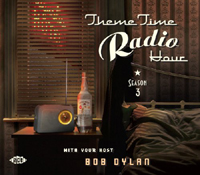
To declare an interest straightaway, I wrote one of the pocket essays that accompanies each track on this double-CD (in my case Elizabeth Cotten and Brenda Evans’ Shake Sugaree). But that was the extent of my involvement in this third anthology inspired by the Theme Time Radio Hour (with your host Bob Dylan). When the finished artefact arrived, on it went. This particular track from Show 97 Noah’s Ark is multi-valenced. It wittily upends Darwinian evolutionary orthodoxy. The tale is told from the viewpoint of three monkeys “sat in a coconut tree”. The monkey narrator tut-tuts his way through a shopping list of miscreant human behaviour. He ends, “Yes! man descended, the ornery cuss/But brother he didn’t descend from us.” A parable from the top of the coconut tree. From the various artists’ Theme Time Radio Hour – Season 3 (Ace Records CDCH2 1270, 2010)
Gower Wassail – Methera
Methera is the string quartet of Lucy Deakin (cello), John Dipper and Emma Reid (fiddles) and Miranda Rutter (viola). Their repertoire is a mixture of material from the certain European folk traditions – but specific, not scattergun – and original or borrowed compositions. An instrumental setting of the Gower Peninsula traditional folksinger Phil Tanner’s singing. Methera are really so very good. From Methera In Concert (Methera TAN002, 2010)
Baby Mine – Bonnie Raitt & Was (Not Was)
When Stay Awake, the album of Disney interpretations from which this track originally came, first appeared in 1988, one of its most haloed interpretations was this song. Any parent with a smattering of English worth their salt will connect with its sentiments. Back in the days, I put it on car tape and would regale the safety-belt trapped nippers in the back of the car with the track’s missing harmony vocal as we drove.
And now a word from Stay Awake‘s sponsor, Hal Willner: “The track is one of the highlights of the Disney record.” At one point certain people were playing silly buggers about granting permission for this track to be included. Thank heavens that it worked out well. This is such a choice piece. No apologies for two tracks from the same album. From the various artists’ Theme Time Radio Hour – Season 3 (Ace Records CDCH2 1270, 2010)
 The Early Days Of A Better Nation – Oysterband
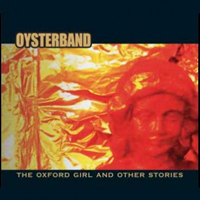
I have no quarrel with an act re-visiting its earlier repertoire on commercially released disc. How frequently does compartmentalising stuff work? This song by Ian Telfer and John Jones has an anthemic quality. “Work as if you were living in the early days of a better nation” is a line they thought they were half-inching from the Scots artist-writer Alasdair Gray, but they were eventually disabused. More within the CD booklet notes. From The Oxford Girl And Other Stories (Running Man Records RMCD6, 2008)
Mugham Bayati Shiraz – Alim and Fargana Qasimov
This track was recorded in August 2009 at the Morgenland Festival in Osnabrück in Germany. It is stupendous. No need for supporting testimony. Trust. From Intimate Dialogue (Dreyer Gaido CD 21060, 2010)
Goin’ Back – The Byrds
In Mole In A Hole (covered by Richard and Linda Thompson), its author Mike Waterson laid out his cards in the opening verse: “Like the flowers, like the bees/Like the woodlands and the trees/I like the Byrds on their LPs/And I’m a refugee.” It never felt like he was slave to end rhyme when he declared his interests. The Byrds’ cover of this Goffin-King song is the second track on what feels more like a song cycle than a mere LP. In 1968 it was head-spinning and time has only enhanced its majesty.
The preceding track, Artificial Energy, ends with them singing that they’re coming down off amphetamine. Goin’ Back was a song closely associated with Dusty Springfield and an unlikely inclusion, not so much because it was a cover. It was more the nature and associations of the song. Goin’ Back was followed by Natural Harmony and a remarkable sequence of songs.
Later, they clarified that its inclusion had a great deal to do with Springfield’s outspoken condemnation of apartheid. The Byrds turn it into a political song by dint of association. Those that saw beyond the camouflage understood. Those that hadn’t yet been alerted to the possibility of subterfuge afoot could just enjoy a piece of sublime Byrdish harmony vocals and instrumentation. From Notorious Byrd Brothers (Columbia/Legacy 486751-2, 1997)
Vltava – Czech Philharmonic Orchestra under Rafael Kubelík (conductor)
This CD reissue of a Supraphon album first released in 1990 is a live recording. The Czech Philharmonic Orchestra under Rafael Kubelík recorded it as the opening concert of the Prague Spring Festival on 12 May 1990. If any member of the audience didn’t tear over at some point in the CPO’s performance, I would be very surprised. After all, it was being performed a few hundred metres from the river of the title (also known as the Moldau amongst the more Germanically inclined) that this particular movement is named after, in the concert hall named after its composer – Bedřich Smetana (1824-1884) – in the art deco architectural masterpiece that is the Prague’s Obecní dům (‘Municipal House’). (Long sentence I know, but it works if you mark up the breaths.)
Most important of all, there was a spirit of freedom abroad, granting Má Vlast (‘My Country’) a still more heightened poignancy. There are several recordings to choose from. This is the one I plumped for. Artistically speaking, Má Vlast is a definition of Czech-ness to compare with painter Alfons Mucha’s Slovanská epopej (‘Slav Epic’). This piece of water music puts a lump in my throat – and, unlike the Mucha ‘canvas cycle’, I get no images of warfare or major trial and tribulation from it. From Má Vlast (Supraphon 11 1208-2 031, 2002)
 Keep It To Yourself – Amy Rigby
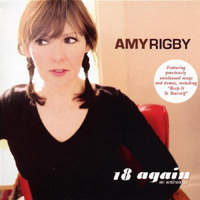
Deadpan witty, with a semblance of the almost dignified, and yet so very reasonable with it, this song of Amy Rigby came with a recommendation from a pal, Gavin Martin, the music critic of the Daily Mirror during a discussion. I can only thank him profusely. I checked it out and was captivated by the eloquence of her songwriting. She takes serious themes (as opposed to subject matter) and cloaks them in silliness. And vice versa. This album from which Keep It To Yourself comes groans with exemplary song matter. The concluding demo version of Magicians is yet another arresting end-of-the-relationship song. Thank you Mr Martin. From 18 Again – an anthology (Koch KOC-CD-8384, 2002)
The copyright of all other images lies with the respective photographers, companies and image-makers.
5. 12. 2010 |
read more...
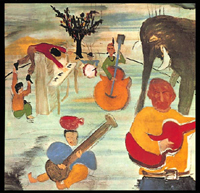 [by Ken Hunt, London] “Ten years ago on a cold dark night/Someone was killed ‘neath the town hall lights./There were few at the scene, but they all did agree/that the man who ran looked a lot like me.”
When those renegades from Canadian justice, The Band made their début album Music From Big Pink in 1968, they included a timeless-sounding song called Long Black Veil that they had learned from Leftie Frizzell, on whose 1959 version Marijohn Wilkin played piano. It had an eerie, old-time, murder ballad guilt to it and many people thought it was traditional. Marijohn Wilkin, the woman who set Danny Dill’s lyrics to music, to produce Long Black Veil died, aged 86, on 28 October 2006.
 Long Black Veil (1959) was supposedly nudged into existence by the story of a woman who haunted silent era heartthrob Rudolph Valentino’s graveside. Whether it was a ghostly or a figurative haunting remains the ectoplasm of story repetition, it touched is a sublime piece of haunting. After Leftie Frizzel, a litany of musicians covered including Burl Ives (too regularly marginalised but a major, major influence in folk circles), the Kingston Trio, Joan Baez, Johnny Cash, The Band, the New Riders of the Purple Sage and with The Chieftains with Mick Jagger.
She was born Marijohn Melson on 14 July 1920, the only child of Ernest and Karla, she was raised in Kemp, Texas. She relocated to Nashville around 1958 and had some minor chart success when Wanda Jackson covered her No Wedding Bells For Joe (1959), followed the same year by major chart action with Waterloo sang by Stonewall Jackson, co-written with John D. Loudermilk. Its chorus went, “Waterloo, Waterloo/Where will you meet your Waterloo?/Every puppy has its day/Everybody has to pay/Everybody has to meet his Waterloo.” (So no Long Black Veil.)
For a songwriter, their importance is, of course, measured by their songs and frequently by the stature of people who cover songs. Apart from the afore-mentioned, hers included Cut Across Shorty and One Day At A Time and Ann-Margret, The Beatles, Glen Campbell, Patsy Cline, Eddie Cochran and Rod Stewart. Not a bad little bead-roll.
Furthermore, she was also part of the process that brought Kris Kristofferson to people’s attention by signing the aspirant songwriter in 1965. She made records under her own name and wrote an autobiography called Lord Let Me Leave A Song (1978). As that title might suggest, she became a mite active in the Christian music industry.
22. 11. 2010 |
read more...
 [by Aparna Banerji, Jalandhar City] For this month’s super ten I start with Shubha Mudgal followed by Gayatri Iyer, Sahaj Ma, Jagjit Singh and Lata Mangeshkar, Surinder Kaur, Kailash Kher, Richa Sharma and Sukhwinder, Bhupinder and Chitra, the Wadali Brothers and Suraiya and Shyam.
 Mathura Nagarpati – Shubha Mudgal
I first listened to this song during one of those rare train journeys which I made with my grandmother. This is also the only song that she ever bore listening to on my earphones (which she usually hated) without complaining once. The allusion to her revered Lord Krishna might be part of the reason. I hadn’t understood much of the song then, but she liked it and explained it to me during the course of the journey.
In the movie that Mathura Nagarpati comes from, a village guy begins a journey to the city where his beloved (separated from him by marriage to Mr. City Guy) lives. The song features a train moving out of lush green villages towards the dry, crowded city.
Talking about Hindu mythology, Krishna was born in Mathura, spent his childhood in Gokul and Vrindavan, where he fell in love with Radha. But the two never shared matrimonial bliss. As a young man, Krishna went to Mathura and became a leading prince there, later getting married to Rukmani. Krishna never went back but this song imagines him making a trip back to Gokul.
It says:
“Subah subah kaa khyal aaj
Waapas Gokul chale Mathura raaj.”
(What thought possessed your mind so early in the morning today/That you go back to Gokul, king of Mathura?)
“Mathura nagarpati kahe tum Gokul jao?
Manohar besh chor Nandraj
Sar se utar ke sundar taaj
Raajdand chor bhoomi parvaj
Phir kahe bansuri bajao?”
(King of Mathura, why do you go back to Gokul?/You give up your pleasant visage/Take off your beautiful crown/Leave your royal sceptre/And take to the streets/Why do you play the flute again?)
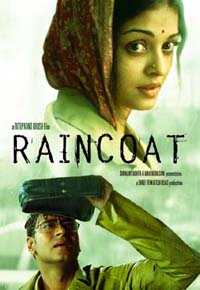
The Braj-tinged, rustic lyrics by Rituparno Ghosh (also the director of the movie) are the heart of the song. The music director might have been tempted to go over-the-top classical, since the lyrics would have easily supported it. But Debojyoti Mishra knew better. The lingering, aching, somehow subdued composition accentuates the pain and irony that the lyrics want to convey. Shubha Mudgal’s subtle-bold voice renders a soul to the song which no other vocalist would have been able to provide it with. A song for the sweet and sad times. From Raincoat (Times Music TCIFI 025C, 2004)
Haan Maine Chukar Dekha Hai – Gayatri Iyer
Getting this song home was sort of an accident. I loved the film Black (which has no song, at least in the video version) so much that I bought the audio album just for the heck of it. Discovering this song in the very second track was a shock. It surprised me, made me cry and then made me dance. It’s about what a girl, who cannot see, sees. And after listening to this song I realised that she sees much more than we, who can see, do. I think of it as a happy song because she isn’t sad about what she can’t see but is happy about what she can.
It says:
“Garam gunguni dhoop se baatein ki hain maine
Pani ke behne mein hansi suni hai mine
Sab kehte hain deep bujha hai
Lekin baati so jati hai
Haan maine chukar dekha hai.”
(I have talked to the warm and cosy sunshine/Have heard laughter in flowing water/Everyone says the light of the lamp has died down/But it’s just the wick that sleeps/Yes, I have touched and seen.)
“Thanda thanda rang boondon ka
Mulayam rang hai phoolon ka
Chubhne vale rang pehenkar
Dulhan saj dhaj ke jaati hai
Haan maine chukar dekha hai.”
(Cold is the colour of water/Soft is the colour of flowers/It’s prickly colours that she dresses up in/When the decorated bride goes to wed/Yes, I have touched and seen.)
The vocals by Gayatri Iyer are rebellious. They don’t adhere to the regular Bollywood playback singing rules. She sounds like the girl she sings for. Composer Monty is, of course, the talented guy who made her do it. Lyricist Prasoon Joshi gives us those precious words. From Black (Yash Raj Films Pvt. Ltd. YRM – MC 10005, 2005)
Chand Er Gaye Chand Legeche – Sahaj Ma
A traditional Bengali Baul song. This is about the meeting of souls. Lalon Fakir gifted us the words and the melody way back. Bickram Ghosh does little things to it, here and there – his style. The entire album is beautiful. In this track, at places it feels you could have done without the piano and keyboard rhythms. Contemporary and folk instruments play peekaboo as Sahaj Ma’s earthy voice sings the rustic melody. The riddles that it puts forward are sweet:
“Chander gaye chand legeche
Amra bhebe korbo ki
Jhee er pete mayer jonmo
Take tomra bolbe ki.”
(Moon touches moon/But why should we think about it?/A daughter gives birth to a mother/What would you say about it?)
‘Jhee’ means a servant girl or a slave girl in sophisticated Bengali, but, in this context, Lalon Fakir uses village slang. So ‘jhee’ here would translate as ‘daughter’.
From Folktail (Saregama CDNF 197221, 2005)
Mili Hawaon Mein – Jagjit Singh and Lata Mangeshkar
One of my favourite ghazals. From one of the rare albums which saw Jagjit and Lata collaborating. Reminds me of the times when we used to get our daily dose of music through poetic, Urdu-mouthing vocalists on Doordarshan, who sung to enamoured studio mehfils [cushion concerts]. The big-time obsession with slang hadn’t yet happened and kurta-clad, Ghalib-doting poets were still earning their bread and butter with a lot of ease.
The ghazal talks about a person who’s lost touch with his roots and the poor guy realises it. At least I see it that way. Intense Jagjit and honeyed Lata turn you into a philosopher. The music’s by Jagjit Singh and Wasim Barelvi is the lyricist.
It says:
“Mili hawaon mein udne ki vo saza yaaron
Ke main zameen ke rishton se kat gaya yaaron.”
(Such was I punished to fly with the winds, friends/that I was cut off from the ties of the earth, friends.)
From Sajda (HMV STHVS 852109, 1991)
Jutti Kasoori Pairi Na Poori – Surinder Kaur
The sweet folk of Punjab. Surinder Kaur’s songs always have a matter-of-fact tone. Her voice, despite its intricacies, murkis and meandering specialties, has a conversational feel about it, which is so integral to folk music and which has made her such a hit with the masses of Punjab. The words are by Gian Chand. The music’s traditional.
On the surface, this song talks of a young bride whose shoe just won’t fit. Beneath it, it talks about the trials of a newly wed Punjabi bride at her new home.
It says:
“Jutti Kasuri pairi na poori
Haye rabba ve sannu turna peya
Jinna rahan di main saar na janan
Ohni raahi ve mennu murna peya.”
(The shoe from Kasur didn’t fit my feet/Oh God, I still had to walk/I had to turn through roads that I knew nothing of.)
“Sauhre pind diyan lammiyan vatan
Bara pavada pai gaya
Yakka te bhare koi na kita
Mahiya paidal lai gaya.”
(The long paths of my in-laws’ village/What a mess I got into/Even a carriage wasn’t hired/My husband made me travel on foot.)
From Parkash Kaur and Surinder Kaur’s Bemisaal (HMV MM 840494, 1999)
Na Batati Tu – Kailash Kher
This is a fun song. It teases and is loaded with musical wit, both in lyrics and execution. Sufi, soulful Kailash Kher, along with his band Kailasa, tells you if they can do soul, they can do humour too. Starts with lots of mouth percussion and sitar. Then the guitars and drums step in with Mr. Kher and make you jump and move. The song was released in Kailasa’s album Chandan Mein in 2009. It also went on to be one of the bonus tracks for Dibakar Banerjee’s film Love Sex Aur Dhokha (2010).
The song’s basic thought lies in its opening line: “Na batati tu pichan” (Won’t say it, you gauge it). From Chandan Mein (Sony Music 88697 55560 2, 2009)
 Ni Main Samajh Gayee – Richa Sharma and Sukhwinder
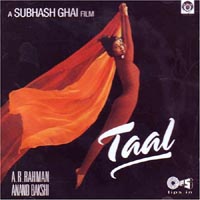
One of the lesser known tracks from Taal. But I like it the most. It comes straight from the saints and dervishes. Gives you a typical Sufi dargah feel, where those filled-with-ecstasy devotees dance and shake their heads all night long. It makes me feel drugged and dizzy.
Both of them, Richa and Sukhwinder, are from Punjab. They scream out the message, which they sing with as much ecstasy as the saints which they make us think of. AR Rahman’s music transports us to a brand new world yet again. Anand Bakshi gives us the words.
“Rang itna chadha ki tapak gaya
Hontho se aankh mein thahar gaya
Ban ke phir vo ghanghor ghata
Zulfon mein vo phir ulajh gaya.”
(The colour got so deep that it dripped/From the lips it got to the eyes/Then it became a dense cloud/And settled in the tresses.)
From Taal (Tips TC – 4167, 1999)
Aasmani Rang – Bhupinder and Chitra
Vishal Bhardwaj and Gulzar are a lethal team. This song, belonging to an album conceived, written and narrated by Gulzar gets its music from the former. The album’s not just a soundtrack, it’s an audio film. A love story much more effective than some of the fine fare I have seen on video. The duo uses a lot of their favourite hill sounds.
This song is a flashback. With the sound of a waterfall in the background, Gulzar tells us how she stands (more details about ‘her’ in the album) on one end of a bridge and remembers what happened on the 21st floor of the revolving restaurant in Toronto that night. How big his hand was and how his aasmani (blue) eyes looked like the sky. The song that follows is their oh-so-poetic conversation at the restaurant. Chitra and Bhupinder talk. Their song flows with soft, sweet guitar and sounds like two exceptionally in-tune people sharing a conversation in sing-song. Gifted Bhardwaj’s delicate composition and Gulzarsahib‘s free-versed poetry creates the mood for us. There’s a pinch of melancholy too. The duo is so fond of it.
Sample:
“Kalaiyon se khol do ye nabz ki tarah dhaakta waqt
Tang karta hai
Kalaiyon pe jab se maine tere haath pehne hai
Ruk gayi hai nabz aur waqt urta rehta hai.”
(Free your wrists of this time that beats like pulse/It disrupts/Since the time I wore your hands on my wrists/The pulse has stopped and time flies.)
From Sunset Point (Sony Music 498400 4, 2000)
Ghoonghat Chak Ve Sajna – Wadali Brothers
Look inside, says this musical sermon that the Wadali Brothers deliver. Dynamic qawwali unfolding secrets of the soil and spirit in Bulleh Shah’s down-to-earth poetry.
It says: “Ghunghat chak ve sajna hun sharman kahnu rakhiyan ve.”
(Take off that veil, dear, what do you shy away from?)
“Bulleh Shah asmani uddiyan pharda ain
Oh jerha ghar baitha ohnun phareya ee nai
Bulleya raati jagen dine peer sidhaven
Ate raat nu jagan kutte tain theen utte.”
(Bulleh Shah you try to catch what flies in the sky and pay no heed to what sits at home/You stay awake all night and play saint in the day/The dogs are much more wary than you are on those nights.)
From Ishq Musafir (Music Today B 02026, 2002)
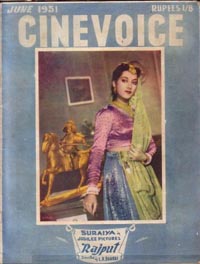 Tu Mera Chand Mai Teri Chandni – Suraiya and Shyam
This comes from the sweet, innocent world of Hindi cinema’s B&W days when heroines were coy and knew how to blush. This song’s as innocent as those days and if songs could blush, you’d say it does (and swoons too).
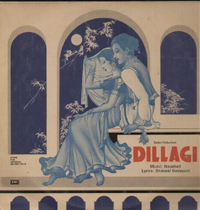
Actress Suraiya sings it for herself while Shyam does the male playback. It’s from the movie Dillagi (1949). The music is from Naushad, the man who initiated Suraiya’s singing career and stayed her mentor all through. Lyrics are by Shakeel Badayuni. From the Golden Collection – Suraiya (Saregama STHV 836039, 2003)
Aparna Banerji is a Bengali, Punjab-based journalist. She and I met at the Harballabh Sangeet Sammelan in Jalandhar in December 2008. We first talked at the festival and have never stopped talking since. She is a family friend. On this occasion her focus is on filmi sangeet, folk and qawwali. There is no telling what her focus might be next time. This, though, is passionate writing. I am more than tickled lobster pink that Aparna is the first guest donut atoll castaway and that she is heating fevered brows with her insights here. She has the gift. She gets impassioned about music. I like that. – Ken Hunt
The copyright of the images lies with the respective photographers, companies and image-makers. The copyright of the lyrics lies with the associated copyright holders.
15. 11. 2010 |
read more...
 [by Ken Hunt, London] Winter draws on in London but on the island the sun is shining. Helping to banish gloom is a rather fine selection of music this month. Ladies and gentlemen, boys and girls, this month we have Norma Waterson, Mohammad Reza Lotfi, Tükrös Zenekar, O’Hooley & Tidow, Ronu Majumdar and Kishan Maharaj, the Butterfield Blues Band, Santana, Wizz Jones, Bukka White and Melissa Etheridge. It begins with a song of mortality and the acceptance of mortality and ends with one bitter and not accepting. In between all human life is there.
 Black Muddy River – Norma Waterson
Norma Waterson tackles this song with great dignity and flair. The accompanists include Richard Thompson on electric guitar, Danny Thompson on string bass and Roger Swallow on drums. There’s also something magical about her voice and the way her voice and that of her daughter Eliza Carthy entwine and slow-dance together. The song’s opening lyrical gambit gets me every time: “When the last rose of summer pricks my finger/And the hot sun chills me to the bone.” It’s a song of such strength and poignancy. It’s a late period Garcia/Hunter Grateful Dead song but Norma Waterson wasn’t aware of its provenance at all when she short-listed it from an unknown recording found on an unmarked cassette. She just fell for the song. From Norma Waterson (Hannibal HNCD 1393, 1996)
Magyarpalatkai Menyasszonykísérő/Csárdás És Sűrű Csárdás – Tükrös Zenekar
Tükrös Zenekar is a Hungarian ensemble – the zenekar of their name – that has Old Hungary’s village folk music as its focus. But Old Hungary, not in any nonsensical way like yearning for ceded territory or suchlike. Or like a rummage through artefacts from a bygone Hungary in a figurative Budapest flea market. Their name works best as a pun. Tükrös is the sort of container that might hold washing paraphernalia like a razor, a mirror and shaving brush. Tükör means ‘mirror’. Put them together and you have an ensemble holding a mirror up to the past, mirroring back the old sounds, the sound of Old Hungary.
A Mi Mezőségünk (‘Our Transylvanian Heath’), Tükrös Zenekar’s third CD, begins with the sound of tolling church bells (maybe calling the faithful in) before going into this opening suite, which is as fine a recreation of Hungarian village music as I have ever heard. There is a sublime tension to the way they play. It might sound stiff at first to the newcomer’s ears but it is as taut as a bowstring and when they let loose the arrow it really hits the bull’s eye. Gergely Koncz and Attila Halmos play violin; Péter Árendás and Endre Liber, viola; and András Lelkes, string bass. This Hungarian ensemble (remember, zenekar) has village music as its ace up the sleeve. By the time their vocalist Éva Korpás enters into the music, you will be dancing in your head on the Transylvanian Heath. From A Mi Mezőségünk (FolkEurópa Kiadó FECD 040, 2008)
 Farāz – Mohammad Reza Lotfi
My introduction to the Iranian ostads (‘masters’) Mohammad Reza Shajarian and Mohammad Reza Lotfi was arranged by Kavi Alexander of Water Lily Acoustics. One day I found myself opening a package of Iranian classical recordings on the Los Angeles-based Kereshmeh label. It would be impossible to express what a box of enduring delights it proved to be. Ten or so years later I discovered a whole collection of Iranian classical recordings that somebody had donated to the Oxfam charity shop in Richmond upon Thames. Over two months or so I bought up a fair few albums, as funds permitted, through the simple ruse of first prioritising the greats, like the vocalist Mohammad Reza Shajarian, and leaving the ones with the most Farsi text on the packaging till last.
This October I got a commission to write a piece about Iranian music. At the end of the assignment I needed to charge my ears with a different sort of Iranian music and the recording that screamed out to be played was The Abu-Ata Concert, one of the greatest recordings in the classical canon. It was recorded in the German Cultural Centre in Tehran – I assume its Goethe-Institut – on 4 March 1981. On the evening of the performance there was a demonstration on the university campus. Mohammad Reza Lotfi, the tar (long-necked lute) virtuoso was part of the faculty as Head of its School of Music at Tehran University and he was detained too. He arrived late for the recital and it began ninety minutes late. Farāz is an extraordinary Lotfi solo. Maybe there’s a touch of channelled rage to the performance. More likely it is passion. From Mohammad Reza Shajarian and Mohammad Reza Lotfi’s The Abu-Ata Concert (Kereshmeh Records KCD-107, 1997)
 Flight of the Petrel – O’Hooley & Tidow
The title of this composition by Belinda O’Hooley and Heidi Tidow might waft memories of Lal Waterson’s Flight of the Pelican. It is a very different kind of avian lament. It deals with society’s progress as imperceptible and grinding as glacial flow. In its world “bees drop like coins”, motorways are backed up and communities are like the aftermath of a road traffic accident and we take what it takes to get us through. From its arrangement with piano and string quartet to O’Hooley & Tidow’s vocals, Flight of the Petrel is sheer class. And it’s only the opener. Note the burning piano behind them. Oh, the symbolism. From Silent June (No Master’s Voice NMCD32, 2010)
Raga Ahir Bhairav (Alap, Jod, Jhala) – Ronu Majumdar and Kishan Maharaj
Recorded live at the Mahashivratri Festival in Benaras, it says on the cover. That is all the information you get in typical – sorry to stereotype – Indian fashion where CD product gets knocked out with little or no useful, contextual information (beyond recycled, copy-and-pasted biography). The Mahashivratri Festival itself celebrates Lord Shiva and Benaras or Varanasi is popularly known as the ‘City of Lord Shiva’. As to which year it was recorded, well, that must have been considered insignificant by Times Music. That is regrettable because Ronu Majumdar is playing superlative bansuri (bamboo flute) and Kishan Maharaj reinforces why he was such a presence in contemporary tabla music. From Generations (Times Music TDICL 079C, 2002)
My obituary of Kishan Maharaj is at www.independent.co.uk/news/obituaries/kishan-maharaj-fearsomely-talented-tabla-player-834614.html
East-West, Live Version #3 – The Butterfield Blues Band
East-West was the title song and defining composition on the Butterfield Blues Band’s second LP in 1966. (For some reason, they weren’t credited as the Paul Butterfield Blues Band this time around.) At this point they comprised Paul Butterfield on harmonica, Michael Bloomfield and Elvin Bishop on electric guitar, Mark Naftalin on keyboards and the rhythm section of Jerome Arnold on electric bass and Billy Davenport on drums
East-West blended blues and modal improvisation in a way that seemed really fresh. East-West Live contains three versions captured in grainy sound between the winter of 1966 and the winter of 1967. East-West, Live Version #3 is from the Golden Bear, Huntington Beach, California and the winter of 1967. It lasts just under half an hour. Of the three live recordings, it is one that shows off this other, modally inflected blues the finest. Arnold and Davenport are especially tight and inventive.
Parenthetically, Fairport Convention listened to the Paul Butterfield Blues Band. In late 1966 Fairport’s electric guitar maestro Richard Thompson saw them on tour. The band played at London’s Marquee Club but I have a dim memory of Thompson telling me something about seeing them in Cricklewood. The Chicago band’s arrival was well anticipated and material from East-West was in the set. East-West may well have sowed seeds for Fairport’s own voyage into modal waters, with A Sailor’s Life on Unhalfbricking (1969). On the sessions of which Dave Swarbrick guested on fiddle, directly setting in train events which led to him joining the band. From East-West Live (Winner 447, 1996)
Black Magic Woman/Gypsy Queen – Santana
In 1971 the Santana that had made Abraxas, the previous year’s album, landed in Hamburg to promote it. A small troupe of us went to see them play in a massive concrete box that passed as a concert venue. Such were the vagaries of German public transport that we could travel by train to Hamburg but the only way back after the concert finished, lay not through Altona railway station, but hitching northwards via Pinneberg. The night was clear and starry and the concert kept playing in my head. Literally. We had a souvenir open-reel concert recording of the night’s concert. In my mind’s ear, this bonus track on the Abraxas reissue has a similar vibe to that Santana concert in Hamburg.
Years later, talking to the banjoist Bill Keith, I had the concert ticket stub as a bookmark in something pertinent to the interview. It turned out that his band had played as the opening act at the Santana gig. Still more years later, I discovered the Bombay music director R.D. Burman had also got fired up about Santana. Small worlds of coincidence. Assuming you believe in coincidence. From Abraxas (Columbia/Legacy CK 65490, 1998)
When I Leave Berlin – Wizz Jones
This track was recorded in October 1973 for Wizz Jones’ When I Leave Berlin album for Village Thing and, though I may have heard it then, I first remember being aware of the song in 1991. Wizz Jones and many other folkies had earned a good income from touring in West Berlin, long before David Bowie ever rented a two-room flat in the West Berlin district of Schöneberg. I have no idea whether Jones or Bowie ever crossed across to East Berlin in the 1970s. My one traipse across to the East in the summer of 1970 was an important step, personally and professionally, although it took two decades to realise that. “The gates are open/Mothers are weeping with their sons,” wrote Wizz Jones. It is a Cold War hymn and more. The accompaniments are from Lazy Farmer – Joan Bidwell on flute, Sandy Jones on banjo, Jake Walton on dulcimer and Don Coging on banjo. From the various artists’ compilation Ghosts From The Basement (The Weekend Beatnik WEBE 9046, 2010)
Fixin’ To Die – Bukka White
Like many people of my generation found it, back-sourcing where a piece of music had come from was no easy task. In the case of the blues singer Bukka White, tracking down this song that had flitted into my consciousness on Bob Dylan’s first LP involved one of most bizarrely inappropriate record covers it was ever my misfortune to clock. It involved a container of water, some false gnashers and a goldfish. (Or were there two goldfish?) If it ever had any meaning it sailed over my head and fortunately that image has gone muzzy in the meanwhile and doesn’t stalk my dreams.
The song went other places, for example, lodging in Buffy Sainte-Marie’s early repertoire as well. Bukka White’s version has played in my head for years and its appearance on the cover-mounted CD with Mojo‘s December 2010 issue wafted in many good memories of an epoch in which curiosity and private passions involved hoovering up music. Thankfully, that epoch also planted seeds of curiosity that never stopped germinating. From Mojo Presents Dylan’Scene (Mojo, December 2010 issue)
 Similar Features – Melissa Etheridge
This song appeared on Melissa Etheridge’s 1988 debut. Back then she was a hot new singer-songwriter but stood out from the torrents of new singer-songwriter recordings that arrived weekly in the post. I interviewed her on 28 June 1988 at the office of Island Records in London for a magazine that folded before I had had time to even start transcribing the interview. She was a superb interview, by turn frank and gracious, candid and discrete. In the interview she sowed new levels of understanding about the songs on her eponymous debut album.
She opens and closes with the lines: “Go on and close your eyes, go on imagine me there/She’s got similar features with longer hair/And if that’s what it takes to get you through/Go on and close your eyes, it shouldn’t bother you.” (© Rondor Music) It’s a barbed hook of an idea holding the song together. Even without knowing what happened next in Etheridge’s life, Similar Features works on several levels. If that’s the way your pleasure tends, it is a novella. Is this a case of serial mistakes being unfolded? A junk-and-upgrade scenario? A tale of old fashioned rejection and grievance? That’s the power of a truly great song.
Island also put Similar Features out on her five-track promotional EP Live (PR 2555-2, 1988) and comparing it and the Melissa Etheridge version I realised I preferred the way she moved the air in the studio. I certainly enjoyed the ride, revisiting Bring Me Some Water, Like The Way I Do and their kind, whilst weighing up versions and deciding that it was the debut album version to plump for. From Melissa Etheridge (Island CID 9879, 1988)
The copyright of all other images lies with the respective photographers, companies and image-makers.
10. 11. 2010 |
read more...
 [by Ken Hunt, London] The Sufi path is a path of mystic revelation within Islam that refracts its light through a prism of Islam, enabling it to be viewed, by those who are so-minded, as counter-Islamic or as casting a benign light into belief systems as varied as Hinduism, Sikhism, Christianity, Islam and the syncretic faith of the Bauls of Bengal. Capturing that diversity that that conjures in one film is impossible and, wisely, Sufi Soul – The Mystic Music of Islam goes for the heart rather than worrying (about) the extremities. I first saw this documentary at the MOFFOM film festival in Prague in 2005, which its director – and Songlines editor – Simon Broughton also attended for a post-screening director-audience discussion.
No doubt some will cavil and quibble about its content – in the foolish notion that it should replicate the musical scope of, say, Echos du Paradis – Sufi Soul (Network 26.982), the remarkable double-CD voyage into Sufi waters. The film’s success has to be measured in terms of its editorial balance – and what it includes and excludes. Now with half-an-hour-plus of DVD extras, such as unseen footage of Kudsi Erguner, Rahat Fateh Ali Khan, Sain Zahoor and others, the film presents a cornucopia of insights into Sufi music and its ability to survive and flourish. Furthermore, it includes commentary from, in my opinion, one of the most informed analysers and open-minded opinion-shapers of the East-West divide, William Dalrymple.
Sufi Soul – The Mystic Music of Islam Riverboat Records/World Music Network TUGDVD001
25. 10. 2010 |
read more...
Part 1: Some Influences and Inspiration
 [by Ken Hunt, London] 2010 marks the 50th anniversary of the publication of Alan Garner’s novel, The Weirdstone of Brisingamen and HarperCollins has duly published a 50th anniversary edition. Hence the excuse to re-publish part of the first part of this interview. Any changes are so that the text conforms to our style guide and to contextualise and clarify matters. There has been no attempt to impose updates on this interview.
Finding an article on the English author Alan Garner in a magazine like this, the contents of which revolve around music, may appear a little unusual at first sight but Garner’s is a talent which fully justifies the inclusion of an article on him in any magazine with an interest in folk music and folklore. Alan Garner is commonly regarded as a writer of children’s books – a description which undervalues his talents by a long chalk (without denigrating that profession) and which fails to take account of the main corpus of his work. His books, when viewed chronologically, show a steady progression. The early fiction – The Weirdstone of Brisingamen (1960), The Moon of Gomrath (1963) and Elidor (1965) – with hindsight seems shaky in parts, yet reading them at the time, as they appeared, each book seemed far more forceful to a boy entering his teens. Nevertheless those books laid down the rudiments of Garner’s writing style; formative prose it may be but enjoyable for all that. At the time of their appearance they were lumped with much of the fantasy writing so prized by admirers of C. S. Lewis and Tolkien, yet apart from superficial resemblances in form those books are poles apart. One of Alan Garner’s quotes summing up his whole attitude to what might be described as the fantasy folly of the Sixties was used as an introduction to the review of Neil Philip’s A Fine Anger, (which appeared in the fifth issue of this magazine). That examination of Garner’s work cogently argues the case that its subject is an original talent. The Owl Service (1967) and Red Shift (1973) were clear evidence of this, and they mark a turning point In Garner’s literary style. Prior to The Owl Service his prose lacked the tautness that was to exemplify his subsequent work but the clincher was Red Shift whose bare prose was a revelation. By the time of that book certain elements in his work were clearly discernible. His use of dialect, particularly the dialect of his home county – Cheshire – was increasingly more accomplished (even if his later works like The Stone Book Quartet were to eclipse the earlier experiments). His innovative handling of time as an essential dramatic device, whether in the split time frame of Red Shift or in the interconnectedness of the past with the present in The Owl Service. A story, Feel Free, in several senses bridges the divide between those two novels in that it has elements found in both of the longer works. It has a paranormal element (which was used so successfully in The Owl Service and the television adaptation of that work) and makes use of slipped time (which also formed a part of Red Shift). It was published as one of the stories in an anthology under the title of The Restless Ghost (1970) edited by one S. Dickinson and in the earlier Miscellany (1967) edited by E. Blishen. Another characteristic feature of his work is his drawing upon locally based historical incidents or myths and in this he has become extremely accomplished. For example, there is the strand in Red Shift depicting the events leading up to and following, the English Civil War massacre at Barthomley Church which is situated not far from Garner’s Cheshire home. This was further reinforced by The Stone Book (1976), Tom Fobble’s Day (1977), Granny Reardun (1977) and The Aimer Gate (1978), which make up the so-called Stone Book Quartet; these four volumes plot four generations of Garner’s family during the course of a particular event in the life of a particular person in each generation and a local flavour abounds. As Alan Garner relates in the following interview not just the locality but also the specific dwelling in which he and his family live affect him and his writings. In his sleeve notes for the Argo recordings of the Quartet, Ray Horricks gives a picture of the Garner residence: “The house is remarkably close to the main Manchester/Crewe railway line, but by car can only be approached by driving up to, opening and then closing behind one, a series of farmer’s gates. It’s a fascinating place. The oldest part dates from about 1380; the later medicine-house and wing from 1500 and 1550 respectively. Apart from which these later parts were transported to the site from Newcastle (Staffs) and joined to the older part by a modern corridor incorporating a bathroom…” The structure itself is impressive and occasional visits from architectural students attest to its significance. The interior is replete with the trophies of the author’s magpie habits: eye-catching stones or archaeological finds, a library of impressive dimensions, an odd spear or two (props left over from the television adaptation of Red Shift), odd objects in general… ” It is no wonder that Garner finds his Cheshire life and background such a rewarding source of inspiration and that it has played such an important role in his work since its onset, since that first novel.
An equally fascinating aspect of Alan Garner’s work is the part that folk tale has played in the creation of his books. Even that debut novel (subtitled A Tale of Alderley) had links with a traditional story about a king under the hill at Alderley Edge. As early as 1969 he was adapting and retelling material of a traditional or folk origin in The Hamish Hamilton Book of Goblins (which became A Book of Goblins in paperback and A Cavalcade of Goblins for its American edition). The impressive The Guizer: A Book of Fools (1975) followed in a similar vein and, as the title may suggest (for the word is not one in common parlance), it hinges upon the role of the Fool in various societies, though not necessarily in any sense of idiocy; a guizer is an actor in a mumming play. An epigrammatic comment encountered early in The Guizer may serve to illustrate the author’s intentions: apparently (according to The World of Primitive Man), an Eskimo uttered the following on gazing at the panorama that greeted him from the top of a New York skyscraper: “I can see things more than my mind can grasp; and the only way to save oneself from madness is to suppose that we have all died suddenly before we knew, and that this is part of another life”, a quote with a distinct Borges flavour to it. The next book in the vein of folk tale was to be published in two forms: the earlier being as individually published paperbacks (in 1979) followed by all four in one volume called Alan Garner’s Fairytales of Gold (in 1980); these stories (The Girl of the Golden Gate, The Golden Brother, The Princess and the Golden Mane and The Three Golden Heads of the Well) with their brightly coloured pictures are more obviously geared to an audience of children. The book published in 1981, The Lad of the Gad, again made use of folklore. It contained five tales (Upright John, Rascally Tag – which appeared in an earlier variant as one of the stories in Jubilee Jackanory (1977) – Olioll Olom, The Lad of the Gad and Lurga Lom) and the collection is in a very real sense a summation of this branch of Alan Garner’s work for it combines many of the threads into a powerful tapestry. As the author remarks in the interview he does not revise his work to any great degree, but this is only partially true in that his earlier books have undergone a measure of revision at stages in the past, resulting in a tightening of the prose. This gradual winnowing of the prose has led to a removal of many superfluous or inessential segments and in Red Shift, for example, all prolixity has been removed: passages of speech are bare the way speech often is. The Lad of the Gad has that selfsame ‘bare’ quality and it makes for powerful effect.
At this juncture it may be as well to quote from Garner’s introduction to Lad of the Gad on the subject of folk tale and its place today:
“The oral tradition of folktale no longer exists in the English language. Now, rather than human recollection shared through community of audience and the storyteller’s own belief, the source of every folktale is another hook. Made written, folktale is treated as a juvenile branch of literature; but the two are different, and we should mark the differences. The word in the air is not the same word on the page.
“The folktale, when written, should still continue to be worked as it was when it was a spoken form, so that it stays relevant and vital; yet the body of British folktale is obsolete, a reductive continuity of Nineteenth Century texts, which reflect the attitudes of the period when the bulk of our traditional remains were set in print. Since that time, the British folktale has become, properly, a subject for scholarship, and, less properly, a vehicle for the moral instruction of the young. Shorn of its inherent music, mistakenly pursued for rational meaning, folktale has lost its force within the general culture.”
This seems to strike at the heart of the matter. The art of story-telling is a dying art as far as the oral tradition in the British Isles goes. There may be the odd pocket which has nurtured the art but the erosion of the old changing way by mass technology and the media has left its mark. Hearing somebody like Seamus Ennis breathing life into a tale is sufficient proof that the loss of that sort of skill is a very sad one indeed. He could demonstrate the story-teller’s art like few others and in each variation, in each subtle development in the story line, he revealed an age old craft. Alan Garner, as he points out above, believes that the art of tale spinning should not grow stale and musty. The Lad of the Gad shows that belief in operation and vindicates that belief fully.
Alan Garner is also an accomplished playwright and his books make potentially good television or film. There is a cinematic quality to much of the writing. That The Owl Service and Red Shift found their way onto the TV screen was important for the development of Garner’s writings; not only did it enlarge his readership in the way that television spin-offs so frequently do but by appearing on the TV screen it must have opened up new ideas for presentation. More television work followed in due course, although strangely a nativity play (which made use of traditional song in its action) entitled Holly from the Bongs (1966) has to date eluded any adaptation for the small screen. To Kill A King (1980) and The Keeper (1982), both mentioned in the interview, are clearly later works in the corpus. Amongst future commissions is the adaptation of The Stone Book Quartet for television in the form of “four fifty-minute plays, to be shown in 1984”. A pilot for this project was worked on in 1981.
Alan Garner’s influence is probably hard to assess. He is a writer who repays attention and scrutiny. Robin Williamson, another keen user of traditional and folk elements in his work and his Gruagach stories and Tree of Leaf and Flame have links with similar territory as some of Alan Garner’s work; Williamson expanded upon this when speaking of Alan Garner: “I admire his writing a lot. He seems to have been reaching for Celtic matters which have a very present relevance; you know, the way a myth can reach out and touch someone in the present moment. That’s what The Owl Service, for instance, is about. I think he’s a fantastic writer. I was wondering when someone was going to notice the similarities, because I think there’s a lot of comparison between what he’s been doing and what I’m doing, although, whereas I have a lyrical, a more of a poet’s approach, I think he has a novelist’s approach to the same material and he must be aware of some of the things that I’m aware of, perhaps more than I am in some ways.”
Two further publications deserve mention in this introduction. Neil Philip’s A Fine Anger is a book which is highly recommended to anyone who wishes to understand Garner’s works. Likewise Labrys 7. They are reviewed in issues 5 and 6 of this magazine respectively. Labrys 7 also contains an almost complete screenplay for To Kill A King (amongst other works by Alan Garner).
The interview that follows was recorded on 4th September 1982 at Alan’s Cheshire home. Like Ray Horricks said in his sleeve notes to Granny Reardun [the Argo recording], the home is close to the railway line, although its apparent atmosphere of remoteness is accentuated by the track which leads up to the property, seeing as it is unmade and somewhat bumpy. Only the trains disturb the sensation as they rumble by behind the house. A number of people assisted in this interview. Neil Philip and John Matthews were enormous helps. Sonia Birch and Nicky Henderson at Collins helped at various stages, as did BBC Publications. Most of all thanks are extended to the Garners.
I wondered how much folk song has influenced you.
Folk song has influenced me a very great deal as source material. I’m not able to talk much about the music because I have no musical education so I can’t work with music technically; I find that this isn’t altogether a bad thing because I’ve got a very happy relationship with Gordon Crosse, the composer, who finds that what he calls ‘my natural musicianship’ is enough for him. In other words I turn him out a libretto which is workable and then I’m, very fortunately for him, unable to do anything more about it; I can’t get in the way of his composition; I can’t suggest things. But yes, I’m very concerned for the music, for folk song and like it and I need it, which isn’t quite the same thing. Especially Scots, the Lowland Scots folk songs I’ve found very rewarding sources. My own area of Cheshire is very poorly represented in folk song; there’s hardly any which could be tied down to the area at all. I’ve collected, I think, four pieces which were a local variant but that’s all that can be said of them.
Did you do much in the way of collecting or were they the only examples that you could locate?
They were the only examples I could locate and that was largely brought about by being provided almost unexpectedly from the men I was talking to anyway. They were old men I was talking to for their own historical memories and they would sometimes come out with bits of song that they knew. There’s an interesting one which came from Alderley which was sung to me as an example of gibberish and I recognised it. It’s a Gaelic folk song and the man was singing with a Cheshire accent words which were recognisably Gaelic in origin. And how that came to his family, and he said it was only sung in his family, it’s not possible to infer with any accuracy but I think I’ve got it because in 1745 when Charles Edward was marching South for the Battle of Derby he passed through Alderley Edge and bivouacked for the night and I think it’s just possible that within that family memory there’s carried some record of a song that was being sung. Otherwise I can think of no other reason for a Gaelic fragment being retained in a Cheshire dialect voice.
There was no Scots blood in the family?
No, no. It was a remarkable family in that it was one of the few families which can be traced on the land and on the same piece of land for 300 years as yeoman farmers.
I use music myself but not directly. Some of the words of the folk songs are directly helpful. Mainly my use of music is as a catalyst. I find that I unconsciously – I don’t plan it – I’m playing certain types of music to myself when I’m in certain types of difficulty with writing and there is a pattern which doesn’t actually relate to folk song but it may relate to something else. When I’m really faced with the problem that there’s something there to write- but I don’t know what it is, it’s just an enormous pressure, I find that I’m playing Jimi Hendrix very loudly for very long periods of time and I almost anaesthetize myself with it because I play it so very loudly. I get complaints from the neighbours a quarter of a mile away! I like the kind of music that he plays but not enough to collect it but I do find that I lay my hands on anything I can get of Jimi Hendrix. I think he was a rare genius and what he communicates is almost impossible to put into words. It exists at the area where language doesn’t reach. So, I use him to get through some kind of barrier in the work and then, at a much later stage, when I’ve overcome the main problems and it’s largely the physical slog of getting through the writing, I find that I go towards the formalised stuff, like Faure’s Requiem or typical Nineteenth Century vegetative music, very succulent music, and I think that’s because some order is coming into the work that I’m doing and I like to see the order in the music. Then right at the end, which is the worst part of writing – I think it’s possibly even worse than the Jimi Hendrix phase – is when the book is almost finished. By ‘almost’ I mean within a couple of days and for a period afterwards, after the actual finishing of the manuscript, I go into an enormous depressive cycle, because it’s rather like giving birth. I’m redundant now. There’s nothing else I can do. I made a mess of what I have done. I can’t alter it. It’s out, it’s there, it exists. And then I really do need to have the reassurance that there is perfection in the world, so I go for the mathematical beauties of Bach and his religious music, in particular in his masses, and that sees me through the really dangerous part of having finished something. That is when all judgement goes, because when writing I suspend judgement. Judgement comes back again at a later stage of revision. But I’m an intuitive writer; I never plan what I’m going to write. This is what Gordon Crosse says is typically musical. I just follow it organically, as it comes. I hardly ever revise anyway but I’m prepared to revise. But I don’t control it as it’s coming out.
Don’t you find yourself sweating over phrases or words?
I used to do. Over the years, and I have been doing it for 26 years today as a matter of fact…26 years today I started The Weirdstone Of Brisingamen, at three minutes past four on a Tuesday afternoon – I have a memory for irrelevancies. The fourth of September 1956. The first two books were written very labouredly. It was rather like carving hieroglyphics. It felt strenuous and it shows in the books. The words are wordy. It’s an overblown book, which, I think, is almost impossible to avoid when you first start. As time’s gone by there is a shift which isn’t planned. Again, it’s automatic; it’s within me. And that is the period between the conceptual moments when the ideas arrive spontaneously from some stimulus or other, aren’t sought, and I just know I’m pregnant. There then follows a period of assessing what this implies in the way of research and then there’s the research which has two functions. One is that it satisfies the academically trained mind in me. In other words I go through the motions of working. It feels like work and it looks like work. And then after that’s over, when all the research sources are cross-referring to each other, I know there’s no more to do. I’ve read it all and there’s still no story. That’s the sensation that I had maybe two years earlier that I was pregnant. And that goes into a really grim phase which I have to come to terms with, which I call the “Oh, my God!” bit, because I’ve done the research; I’ve gone through the hoop of working at it, at the background; and there’s still no story. I just have to let it ride. I can’t do anything else and, again, I play a lot of folk music then. This period is never less than a year and with the current one – I’m in an “Oh, my God!” at the moment – that’s four years. What happens at the end of that is I experience something which is recognisable the instant that it happens. It’s very like the sensation that I think most people have of being half asleep and their foot slipping off the kerb, the jolt of coming awake. Well, I feel a jolt within me and I hear quite without any understanding, I hear words, which I put down. I just write them down and that’s always the last sentence of the book.
Is that what is being described in To Kill A King?
Yes, yes. [Laughter] Well, not exactly. I’m using it. It’s not an exact reduplication. And I get that down quickly and I feel very relieved. It’s a totally emotional sensation; it’s not rational. I just feel very relieved and I know that’s the end of the book and then quite soon afterwards, a few weeks or months, I have a slightly less violent jolt. I start to see and hear in my head people talking and moving and I find I can spool back on that and play it again. It’s rather like editing. I have to get the lip-synch. I have to get that. And when lip-synch occurs the focus on the visuals gets crisp and also on the sound. I can actually hear clearly what’s being said. From then on it’s very much like automatic writing. I just listen to it and I take it down and I do not question it. To begin with, it only comes in spurts. By ‘comes’ I mean I can only concentrate on it in spurts, then I get very tired. The clearest example so far is the Red Shift where after nearly five years, which is the “Oh, my God!” plus the research, I heard somebody say, “Shall I tell you?” which is the opening line of the book and the whole of that dialogue was obtained by putting it all into focus and into synch. And so I wrote it all out. The first third of the book cane in about nine months and that was slow for this stage of the writing. Then the second third following straight on took three months and the third third took about three weeks, so in the end I was writing very fast. Towards the end comes the other moment of horror which I can never rationalise away and that is to see the end of the book coming; there is that fixed, last sentence or paragraph that was there at the beginning. It’s almost like a docking manoeuvre and I feel, “Oh, my God!” If I miss this, I shall go into outer space and never be able to stop writing this book!” But of course, it always goes click. Now, I’ve described there the subjective experience. What I know now from observing it often enough “is that period of research has an importance in that it’s rather like putting down a concrete platform on which to build. It never shows but when decisions have to be made about the way things are developing if there’s a choice between A and B, if B makes sense in the context of all that research B would seem the better idea. And so the research is very useful but it never afflicts me consciously and the “Oh, my God!” is really at the time when the book’s being written. I now know that, for me, the process is very like a computer, that the “Oh, my God!” is the switching off of my conscious, analytical self to enable my subconscious to analyse all that work, all that research and to select that which is relevant only, and having done that I get the print-out. It’s almost like a computer signalling that it’s ready to go: I get the end of the book, which means that it’s there, somewhere, and has to be given shape. And then it starts. The more I write the longer the “Oh, my God!” bit is and the shorter the writing, until by the time of The Stone Book Quartet this was written in a single sitting. I know they’re short, but still 7,000 words for me is a long piece of writing. I’m not prolific. But the manuscript at the end of the Quartet, the last one The Aimer Gate…the speed of writing was so great that the fibres in the paper had broken down under the pressure of the ball-point pen; it’s an exercise book and instead of being stiff paper it goes like rice paper. It’s limp. And that’s just with the actual intensity of the pressure. I don’t remember writing it, well, I can remember writing it but I wasn’t aware of time passing. My wife says she fed me occasionally. But I don’t want to give any impression that it is a mediumistic or in any way an esoteric function. I think it can be explained away in straightforward terms of the way the brain works. Nonetheless interesting for all that! [Laughter] Which is answering your question about folk song. [Exploding with laughter]
You were talking earlier about collecting some songs. This Joshua Birtles was one of the people whom you collected from. “I’ll dye, I’ll dye my petticoat red…”
That’s it. That’s the chorus. “Siubhail, siubhail, siubhail a ruin, siubhail go socair agus siubhail go cuin” – “Sweet Willy in the morning all among the rush”. And on the tape that I did of him, I’ve got him saying, laughing at the end of that, “What that means I’ve no idea.” But I have on a Topic record, one of those classic albums, an old Hebridian lady, very old lady, singing it as a spinning song. In English it would be held as “Shooly, shooly, shoo-gang-rowl, shoo-gang-lollymog shoog-a-gang-a-lo”, but not “Sweet Willy in the morning among the rush”. Even her version was a bit bilingual because she had the line, “I’ll dye, I’ll dye my petticoat red”, but the chorus that she sings was in Irish. Those Topic records have stood me in very good stead, because one of the stereotypes that exists in the Russian mind is that all Englishmen are bursting with English folk song and the first time I went it hit me. I was almost dragged off the ‘plane and told to sing and for two consecutive nights in a railway train I didn’t get any sleep; I just had to sing all through the night…
[Note: The particular volume being referred to here is part of Topic’s Folk Songs of Britain series (originally issued on Caedmon in the United States). Elizabeth Cronin sings “Shule Aroon” on Volume 1 Songs of Courtship (Topic 12T157). As Alan Garner commented after the interview, “Siubhail a ruin” is pronounced, approximately, ‘shule aroon’.”]
…reinforcing the stereotype!
Yes! [Laughter] It was amazing when I was scraping the barrel what was accepted as folk song. Bobby Shaftoe. Oh, I was drawing heavily on the school phase! I should imagine that the whole of school singing is very much influenced by Sharp and his collections, his bowdlerized collections. I have no reputation here for having the slightest interest in folk song. Yet every time I appear in the Soviet Union it gets quite wearing. They cry over “Black is the colour of my true love’s hair”. It makes them weep. A bit of a weepie. They respond to it. Waltzing Matilda was also considered to be an English folk song.
One thing that puzzled me, and I think it puzzled Neil Philip too, was the connection between Tam Lin and Red Shift. I for one never fathomed that out.
Yes, it is a difficulty. Because I do so much work simply to find something that interests me, and I think there are puritanical reasons as well, I do reward anybody who cares to dig but it’s as easy to make the mistake that I’m a tight, academic scholar in my work; I’m not. I’m really being a magpie, as you noticed earlier. I grab what is relevant and, for me, what was relevant in Tam Lin, what seized my mind, was only one aspect of it which was Tam Lin telling Janet that he was going to do everything he can to destroy himself and her at the end. He’s going to change and be slippery. He’ll be very unpleasant. I thought, “Yes, I recognise that.” And from that I got the names of the characters, but to worry too much about tying in with the whole piece is really to get yourself bogged down in a great deal of difficulty, because there’s no need to follow it so far as to say at the end of the Red Shift Janet is pregnant at the end. I mean, she could be, I suppose! [Laughter] I don’t build with meticulous following of the source. I don’t know if I should. I just don’t know. It is a magpie attitude. I just take what’s there but there again because I’ve done it for so long I can see recurrent patterns. Each writing is a fresh experience but there are recurrent patterns, generalisations which can be made. One is that I feel that the piece, in this case “Tam Lin”, would not have sprung at me if it hadn’t been relevant. Why did I choose that? Why did that come out and hit me? Why did seeing a particular plate with an abstract pattern on it bring out of my mind instantly The Mabinogion? It was Griselda who said, “Here is the pattern and I’ll make it into a paper owl,” and I said, “Have you read The Mabinogion?” Which is a great conversation stopper! The owl/flower idea came out. Things like that I observe quite frequently. Serendipity is something I enjoy very much. Finding and seeing connections. Only a very rare few stick, like the owl service did in bringing The Mabinogion out of my data banks and causing me to become obsessed with it for several years…as the result of seeing the plate. I don’t like rationalising too much because I think I tend to believe it and could become a victim of it in the end. At the time it’s all instinctive. I save the cleverness for the research. I never plot. And I know that the piece that results is far better than I could’ve written. If I consciously sat down, as I did at the beginning of The Weirdstone of Brisingamen and The Moon of Gomrath, if I sat down and plotted something on paper, it would not be as good as the thing I entrusted to my sub-conscious mind. I’m not good enough to make Red Shift as tightly constructed as it is. I couldn’t have held all that consciously in my mind or on paper; that came from the sub-conscious. And I hope the next one will.
Have you got a theme that you’re working towards?
I’m not being precious now; I just can’t talk about it. It panics me to think about it. If I started to talk about it, two things would happen: one is that I would confuse and annoy myself and I would lose confidence in it, and worse I would release the pressure. For me talking is so much easier than doing and if I were to talk about something that hadn’t been done yet I don’t know if I’d have the interest or the energies to go much further with it. It’s one of the many reasons why I avoid London society. I don’t enjoy the company of other writers very much but I certainly would avoid any literary social life where people talk about it. No, I have no time for it; I’d much rather talk about archaeology. [Laughter]
On the way here I was thinking about To Kill A King in which there is a stage direction ‘Harry is pent up’; at that stage the whole house is pent up, is tensed and it struck me that Pent Up House would make a good soundtrack for it…
The whole of this site and house I use emotionally very much. The brief for To Kill A King involved a certain amount of autobiography. That was what was wanted by the BBC: a personal experience. Now, although I never experienced what happened in To Kill A King, I used it to exemplify more clearly what I had experienced which is what I feel to be a symbiotic relationship between this house and its site and me, in that I feel this house will absorb any amount of tension and pain. It will just absorb it and eventually everything will settle down and in To Kill A King the numinous woman who appeared is, for me, the personalization of the site that I live on. This is based on emotion and also on practical observation. I’ve been living here for over twenty-five years and I was an archaeologist and the site has revealed itself to be very remarkable. Not only are the buildings remarkable but the site has been occupied, can be observed and can be proven to be, for 15,000 years. Recently I’ve done the work which seems to show that the observations of Professor Thom and his megalithic observatories are true which is the ability of neolithic man to construct basically the circles on the ground, of which Avebury and Stonehenge are examples. He was able to measure very accurately the movements of the sun and the moon and predict eclipses by using aspects of the site – stones or wooden posts -and distant features of the landscape, which were not man-made; so you had to find a place where this occurred, rather than settling down and saying, “I’m going to live here. I’m going to build my observatory here. Now, what fits?” And this appears to be one of them. The chances of it being chance are almost nil. So, yes, it is an important place, in that it has energies which anybody can register. The room we’re in now is the only place where I can write or have ever written. Where I am sitting is the place where I would sit to write. It’s also the place where, for the first thirty or forty years of the century, because of the size of the local midwife, all the children in the house were born. The midwife couldn’t get up the stairs, so before I came to live here children were born in this corner of the room. I have written everything in this corner of the room and in the Nineteenth and early Twentieth Century there was a long history of poltergeist activity in this building and it turns out to have been in this room. From aerial photography and from some archaeological work that was done here the main tumulus of the many that are on this site has its centre in this corner of the room. Very sophisticated metal detectors go berserk in this room, so it’s a scientific observation which can be repeated. There is an American one which is so sensitive that it doesn’t register metal, it registers disturbance in the magnetic field of the soil. In other words, if anyone’s dug a hole, that registers. That described very accurately that there was something, a cubic shape, about five feet down, which suggests to me, the archaeologist, what is known as a cyst, that is, a stone chamber. It’s a cube of about three feet. I’m not going to dig it up because I’ve seen 2001 about eleven times and not going to dig up my black slab! Also anybody can dowse in this room. I was highly sceptical about dowsing until it was explained to me carefully and I then went out to prove that, if it existed, anybody could do it and found that I could do it. Anybody who comes here and tries dowsing can dowse in this room because the responses are so strong, so much so that if anybody wanted to do it, I don’t tell them anything about it. I just say, “Try in here.” I draw a sketch plan unbeknown to the person who’s going to do it and I mark the places where they’re going to get reactions. It’s not water that’s being picked up; I don’t know what it is. But there’s a 100 per cent reaction from this, from everybody who has ever tried it. They all quickly isolate, first of all, the main source and once they’ve had the experience of something reacting in their hands, two things happen. One is that they have no sense of doubt anymore whatsoever. They know. Once it’s happened to you, you know you’re not doing it. Soon after they become more sensitive and they can find the other two sources. Now those three sources: one corresponds to the same signal that the mine detectors get and the other two appear to be random until they’re plotted, on the archaeological map of the site and they are the post holes of large wooden posts which form part of the henge system here. So, that is an example of both the complexity and the strength of the place. It works on an entirely emotional level and it also works scientifically; in other words, in this room you can find things by repeating the experiment.
[Note: These observations are the basis for Alexander Thorn’s Megalithic Sites in Britain (Clarendon Press, 1967), Megalithic Lunar Observatories (Clarendon Press, 1971) and, with A S Thom, Megalithic Remains in Britain and Brittany (Clarendon Press, 1978), all three of which expound on the theories in great detail.]
There was something that you touched upon a little earlier before we started the interview and in Neil Philip’s A Fine Anger about film. You described a sequence in terms of angles, from a lens’ point of view and you’ve also mentioned at one stage being influenced by Seven Samurai. Were you ever a fan of Resnais’ L’Année derničre ę Marienbad and that sort of film? [To interpolate for Czechs, Mariánské Lázně]
Not a fan, no.
It’s just that in that film, L’Année derničre ę Marienbad, you’ve got the ‘memories’ of other times, which finds echoes in some of your works. I wondered whether that had affected you.
It may well have gone in subliminally, but not consciously. It’s the most obvious things that I recognise. I’m sure that nearly everything that I do has got some source somewhere else. Seven Samurai was particularly apt, because it came at a time when I was becoming aware of film, 1954, and I was living in London. That sounds pretentious. I was in the army and I was so inefficient that I had to be posted to London where I could not do anything dangerous and that’s where I saw Seven Samurai first. I tend not to like French film very much. I’ve always had an antipathy for the French language, which is totally subjective. It’s not based on anything except prejudice. I just don’t like the sound of it. Yet Japanese, which I don’t understand a word of, I like listening to. It’s a very musical sound, a rather harsh sound. I suppose that Marienbad had an influence, must have done, because I saw that twice. I was vaguely impressed by it. Didn’t like it but was moved by it. I think that most of the film influence I have is again childhood, because in the Forties I used to go to the local cinema, so I became something of an expert on Hollywood B-movies. One thing I didn’t remember until long after I’d done it was…I can’t remember the name of the film but I think it registers as the worst film I ever saw in my childhood. It seemed to consist entirely of three men going in and out of a New York skyscraper flat shouting at a woman. It was supposed to be a comedy but I couldn’t get a hold of it except I remember one incident from it where the woman said she didn’t like saying ‘goodbye’ so she always said ‘hallo’ when she said ‘goodbye’. I used that in the Red Shift very prominently and it was only after we’d made the television film of Red Shift in which that doesn’t appear – the use of ‘hallo’ does not appear in the film of Red Shift – that it suddenly floated back into my mind when we were working on the film. So, that’s how things happen. It’s usually years and years ago. I don’t think I’d ever deliberately go and poach stuff.
Our second instalment contains more on the use of language, especially dialect, his background and meeting readers.
18. 10. 2010 |
read more...
 [by Ken Hunt, London] “The painting is from a 1984 album I did for Line Records in Germany called “Lose It Tonight”. A song I performed – the first and only time I ever lip-synched a TV show – on Germany’s #1 Pop music program of the 80’s called “MusicLaden”. It was great I met Pat Boone and showed him the way out.” – George Frayne’s lateral thoughts emanating from the Lose It Tonight cover.
Long before he grew pianistic wings with Commander Cody & His Lost Planet Airmen, George Frayne had what looked like a promising life ahead of him as a painter including, like Alton Kelley, a sideline in car art, sculptor and, heavens forbloodyfend (tmesis rears not only its ugly head but shows off its potty mouth), even a Teaching Fellow in Fine Art at the University of Michigan (1966-68). How he might have stuck and survived academe does not bear thinking about. Or, similarly, what he might have got stuck into, and welded onto academe. Musically speaking, things kicked off properly in the San Francisco Bay Area in 1969 but artistically for George Frayne it began in Michigan.
“I had never even seen a real mountain before my trip west, let alone a city built on one, San Francisco. The Berkeley Hills were larger than the biggest mound on Long Island.” – George Frayne.
The overwhelming majority of people would have first encountered George Frayne during his first flush of musical success during his time with his band, Commander Cody & His Lost Planet Airmen. Their debut album had cover artwork by his brother, Chris Frayne and the band’s newsletters and suchlike used his brother’s art as an extension, manifestation or representation of the band’s early image. Chris Frayne’s cover art of the geezer with the gnashers for the group’s debut album Lost In The Ozone (1971) now looks like a portent of the rabbit-botherin’ baddie in Wallace & Gromit’s The Curse of the Were-Rabbit (2005).
CC & His LPA played strange songs in standard country formats about life seen from the gutter angle of the great American country highway. They sang tales about getting wasted (Daddy’s Drinking Up Our Christmas and (Down To) Seeds And Stems Again), the repercussions and consequences of driving on the ‘wrong side’ of the road (Hot Rod Lincoln and Mama Hated Diesels), the unadorned pleasures of music and life (Beat Me Daddy Eight To The Bar) and little white pills and driving (Looking at the World Through a Windshield). Rippling through their repertoire was a lavish portion of deadpan humour.
 Though the text doesn’t really bring it out properly, this book contains a fair few of his brother’s images. It is an omission in the text that George Frayne doesn’t write more about his brother or illuminate the way they and their joint interests cross-fertilised each other’s imaginations. Examples from Art Music & Life make it plain that Chris Frayne’s Jet Truck (1972) – the cover for the Airmen’s second LP in 1973 Cold Steel, Hot Licks And Truckers’ Favorites (the one with It Should’ve Been Me, Kevin Lookin’ at the World Through a Windshield and ‘Blackie’ Farrell’s Mama Hated Diesels on it) – is not so stylistically distant from brother George’s T Bird (1973).
By the time the Good Commander and I first met – in November 1979 in London – he had revealed himself as a man well able to wield a paint brush. He had painted album covers and inevitably we talked about his painterly skills. I seem to remember him telling me about projecting images on canvasses or walls and reconfiguring them with paint, blocking colour and losing detail or tweaking the projected image. By the time of the second album (with Chris Frayne-painted rig straight out of Lowell George’s song Willin’), it was already manifest that there was a family thing about machinery going on. Cars, planes and mechanical gubbins were in the family psyche. George, it turns out, had a really big thing about Hollywood, machinery and cars. (Art Music & Life includes an appendix of his cars and their fates.)
The next time we met he talked about a film for a song, an animated film for the next band on, the Commander Cody Band’s song 2 Triple Cheese, Side Order of Fries. This was 1980, before MTV and promotional videos as standard. It sounded fascinating. George talked about an era of juke boxes in which the music had a musical short, too. Only in America could such foolish rumours circulate, comrade citizen. It turned out that he had not been speaking with a forked tongue or bullshittin’ me, merelt shootin’ the breeze. 2 Triple Cheese, Side Order of Fries wasa reality.
Yet, it’s really only with Art Music & Life that Frayne’s wide-eyed wonderment and grasp of visual Americana have properly come across. Images of Miss Reingold Beer 1951 – later the cover artwork of Drunks Dopers and Everyday Losers (2009) -, a Greyhound bus, Ming the Merciless, World War Two flying aces and aircrew, Jerry Garcia, Bill Graham, Louis Armstrong, Columbo (the TV detective series with Peter Falk in the starring role), Tony Bennett and Miles Davis bear witness to his artistic, graphic and musical fixations.
“The sculpture – Horsepower II – executed during the winter of 2007, is my most successful piece of art to date. It was painted on a white plastic life size male horse for the ‘Horses Saratoga Style’ event put on by the Saratoga Arts Council every five years.” – Frayne
Mostly his sculptures in this book don’t thrill me to the marrow. That’s my problem. First, I am not one bit mechanistic. (Chrome Totem #2 (1966) “was sold to a Pratt and Whitney exec”.) Second, sculpture is there to be touched or stroked and, if off-bounds, to be felt physically and walked around as much as security guards and electric fencing permit. There is one major exception to the sculpture business, not to the rules of vigilance. His witty painted sculptures Horsepower I (2002), with its bones, cogs and flywheels, and still more outré Horsepower II (2007) are straight out of the Cowparade ve zlaté praze/Cowparade in Golden Prague. Those painted cattle adorned Prague in 2004 and some are still there. (One is still on a spit if you look down from the right place from Prague Castle.) These painted beasts have become a separate artistic tradition in Europe raising funds for good causes. In a similar vein there have been painted bears in Berlin and decorated elephants in Antwerp and London.
This book is the other side of George Frayne’s life and art, though. What should pique your interest here are the tales, many tall, that accompany the images. Plenty of the anecdotes are is music-related. But don’t let that stop you. And, if this review is rather discursive, well, it’s in the spirit of the Great Man and this book.
All quotes are courtesy of George Frayne and Q Book Press.
George Frayne AKA Commander Cody – Art Music & Life Q Book Press, ISBN 978-0-9842650-0-8 (2010)
www.qualibreinc.com
Further reading to look out for: Geoffrey Stokes – Starmaking Machinery – Inside The Business of Rock and Roll First Vintage, ISBN 0-394-72432-1 (1977, out of print)
14. 10. 2010 |
read more...
 [by Ken Hunt, London] As summer slides into mellow fruitfulness, what better batch of lifesavers on a desert island could one wish for than these? Let’s start with Dusty Springfield and her wicked way with telling a delicious tale about forbidden love. You’ll have to look for taboo subjects amongst the choices by Ahmad Sham Sufi Qawwali Group, Little Feat, Martin Carthy & Dave Swarbrick, Ralph McTell, Los Lobos, Joe Ely, Jerry Garcia, Bonnie Dobson and Dave Swarbrick. You might well find one or two sins hidden here.
 Son of a Preacher Man – Dusty Springfield
Dusty Springfield (1939-1999) had established herself as one of the quintessential voices of British popular music by the time her Dusty In Memphis (1969), on which this track appeared, came out. After the break-up of the Springfields, she put out I Only Want To Be With You (1963), an immediate hit, Her hit-making continued with stuff like You Don’t Have to Say You Love Me (1966). This song, written by John Hurley and Ronnie Wilkins, was in another league. Son of a Preacher Man first appeared as a single in November 1968. There was something about its groove and her delivery that catapulted it into the popular imagination. Let’s face it, it’s a great story.
Underpinning this tale of breaking society’s rules is the headiness of its Jerry Wexler, Tom Dowd and Arif Mardin production. It hooks you from the first musical phrase, even before she opens her mouth. Centre stage, of course, is that voice. Oh, the soul of that voice! Yet one of the minor miracles of the song is the melodic development of the bassline. The bassist, incidentally, is Tommy Cogbill. In the United States it appeared on Atlantic. Elsewhere it appeared on Philips. A song to crow about. Her voice and that pulse of Memphis funk is recommended to blow away mental cobwebs. From Dusty In Memphis (Mercury 063 297-2, 2002)
Sovay – Martin Carthy & Dave Swarbrick
This Sovay is the result of yet another periodic revisiting of the work of guitarist Martin Carthy and fiddler Dave Swarbrick and seeing them at Kings Place in London in September 2010. At the time of this live recording’s release in 1990 Carthy observed that Sovay had been a part of their core repertoire during their first term together between 1966 and 1969. It was with 1969’s Prince Heathen that everything clicked into place. It is still a peak in Britain’s folk revival’s mountain chain. Sovay, though, was where it all began for M&S. Despite knowing this song so well, it still catches me off-guard every so often. This was one of those occasions. From Life and Limb (Special Delivery SPDCD 1030, 1990)
A Kiss In The Rain – Ralph McTell
Ralph McTell’s take on the relationship between Anne Briggs and Bert Jansch begins with the line, “In my mind l see Annie and Bert wandering free.” This song takes them and Blackwaterside as its inspiration. It is true to its inspiration, if shaky on historical fact in places. That matters not one jot. This is a song, not biography. From Somewhere Down The Road (Leola Music TPGCD31, 2010)
Jupiter Or The Moon – Los Lobos
Sometimes with Los Lobos it is the vibe of the recording that gets and ensnares you even before you have engaged with what they are talking to you about. This is one of those songs of theirs. Big drum sounds as opposed to big drums. “If I could/make stone into gold/You know I would,” may sound pretty humdrum but the band turns David Hidalgo and Louie Pérez’s song into something exquisite. Plus it has a great in-house production from the band. (Like they need incomers.) And the way the guitar creates a pianistic quality is very, very beguiling. Likewise the song’s allusions and nods. From Tin Can Trust (Proper PRPCD0065, 2010)
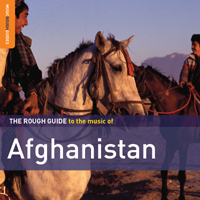 Rae Maykhana O Masjid – Ahmad Sham Sufi Qawwali Group
Rather like being in a place you know fairly well and just trusting to the deities of discovery and taking the path untrod, surely one of the finest things about music is the chance encounters and new delights discovered on the journey. The Rough Guide to the Music of Afghanistan is one of those journeys and is full of wayside attractions and diversions. Simon Broughton of Songlines put the anthology together and, as is World Music Network’s wont, the first pressing has a bonus disc. This track opens that disc.
The Ahmad Sham Sufi Qawwali Group is based in Kabul. Long established, they have toured abroad, performing in India, Russia, Tajikistan and even Scotland. Rae Maykhana O Masjid is translated in the notes as ‘The Way To The Mosque And The Wine-house’. (Quite why tavern and mosque are inverted, I don’t know.) Mir Ahmad Sham and second vocalist Zia Mohammad deliver a Sufi meditation. It pivots on a semantic conundrum about where the wine (that is, ‘knowledge’) of love is served. That wine leads to spiritual intoxication. The twist is that the singer is on the outside, too lowly to enter either wine-house or mosque. The flute – possibly an uncredited Zalai Paktia – is a choice addition to the ‘standard’ qawwali party instrumentation of percussion, hand percussion and harmonium. Flute conjures images of Rumi’s Song of the Reed. From The Rough Guide to the Music of Afghanistan (World Music Network RGNET1237CD, 2010)
Me And Billy The Kid – Joe Ely
This is one of the finest songs that Joe Ely ever spat into the face of an audience. Once heard, never forgotten. Not having one of those iPod thingees, it is a song that went on mental music shuffle. The key to understanding it lies in its opening line: “Me and Billy The Kid, we never got along.” Well, and then the second line might indicate a grudge coming down the track. “I didn’t like the way he cocked his hat and he wore his gun all wrong.” Their relationship goes downhill right away.
Without giving away the story, tips to note in the narrative might include “we had the same girlfriend”, “she had a cute little Chihuahua” (italics mine) and “But it was me she loved”. A tale about getting even. The understated steel guitar from Lloyd Maines works really well. From Live @ Antone’s (Rounder 3171, 2000)
Banjo run – Jerry Garcia
The death of the Seattle-born actor Kevin McCarthy on 11 September 2010 triggered a sequence of memories that led to this piece of blink-and-you’ll-miss-it music. McCarthy played the male lead, Dr. Miles J. Bennell in Don Siegel’s original Invasion of the Body-Snatchers. Released in 1956, it is a science-fiction story set in small-town America. The town is being taken over, its citizens duplicated by an extra-terrestrial beings. These human replicas are emotionless but have a nice line in herd instinct. Twenty-some years on Philip Kaufman re-made the film and set it in San Francisco. The film might be said to have shifted from feeling like the product of Sen. Joseph McCarthy’s era – yes, apparently Joseph and Kevin were related – to opening up to interpretations of conformity. Either way, the plot hinges on the dramatic device of sleep and staying awake. You snooze, you lose.
Garcia, the banjoist with Old And In The Way (and Grateful Dead stalwart), plays the banjo run at one point as Harry the homeless person’s dog scampers by with his master’s face adorning its head. It is a nicely menacing touch, the sort of shock-horror trick that American pulp comix specialised in during the 1950s and 1960s. It must have tickled Garcia’s childhood ghoul sense of humour. As I read Kevin McCarthy’s obituary, this burst of banjo ran through my head. It’s not even a track. Or like Garcia’s tail-end banjoistic device that the Grateful Dead employed at the end of the Dark Star single. From Philip Kaufman’s Invasion of the Body-Snatchers (1978)
Un Canadien Errant – Bonnie Dobson
This song has grown into a Canadian classic and a wellspring of Canadian-ness. The title translates as ‘A Wandering Canadian’. That is exactly what Bonnie Dobson became, though she put down roots in England. Her delivery of this song, accompanied by her own guitar, is memorable. She was the first Canadian to go south of the border and make a mark in the States. Out in California she penned a song of no little familiarity, triggered by the film adaptation of Nevil Shute’s apocalyptic novel On The Beach. That Cold War anthem was Morning Dew. Un Canadien Errant was first released on her Mercury album, For The Love of Him (1964). For me, it is as emblematic of Bonnie Dobson as Morning Dew. Do not translate the title as ‘A Mistaken Canadian’. She is bang on the money here. From Viva La Canadienne (Bear Family Records BCD 16720 AH, 2010)
Sweet Alban – Dave Swarbrick
This is one of the pivotal compositions on Dave Swarbrick’s raison d’être. That album was eight years in the making. A bit of life and death intervened in the making of what I fervently believe to be his finest ‘solo’ album. On 20 April 1999 he came round to be acquainted with the fact that he was in that day’s Daily Telegraph obituary column. (There’s more about this unwished-for recruitment into the ranks of those who have got to read their own obituary in the November/December 2010 issue of R2.)
The bearer of these ‘glad tidings’ was the woman to whom this marvellous composition is dedicated. It’s for Jill Swarbrick, whose middle name is Alban. When you listen to Dave Swarbrick’s contemplative bow strokes and swoops and Kevin Dempsey’s rich chords on guitar, bear that inspiration in mind. From raison d’être (Shirty no number, 2010)
 The Fan – Little Feat
Little Feat’s performance at Fairport Convention’s Cropredy on 13 August 2010 followed the death of the band’s first drummer – Richie Haywood – the previous day in Canada. On the way to the festival, Feats Don’t Fail Me Now was playing. It is still one of the most genuinely exciting rock albums ever to emerge from California in the 1970s. Haywood’s taut drumming had a great deal to do with the band’s magic and generating the excitement that was Little Feat. But he was one component. Little Feat had a lyrical signature that set them aside, that was central to the band being so different.
The Fan has an arrestingly unsavoury opening gambit. In Britain there was no lyric sheet with the LP, so, back in the day, the words had to be teased out of the mix. The more painstaking disciples of such weaknesses had a fuller picture of sleaze revealed. Verse 1 sets the scene and grabs the attention with, “Heard you got an infection/Just before your lewd rejection/Wait’ll the shit hits the fan/You couldn’t turn him down.”
This particular Lowell George/Bill Payne song led a whole series of lives. The Hotcakes & Outtakes (2000) version, originally on the 1981 Hoy-Hoy! compilation, is pretty good. But the Feats Don’t Fail Me Now version is still it by a long chalk. And Little Feat did their fallen comrade proud at Cropredy. From Feats Don’t Fail Me Now (Warner Brothers BS-2784, 1974)
The image of Little Feat from Croppers is © Santosh Sidhu/Swing 51 Archives. The copyright of all other images and lyrics lies with the respective photographers, companies and image-makers.
7. 10. 2010 |
read more...
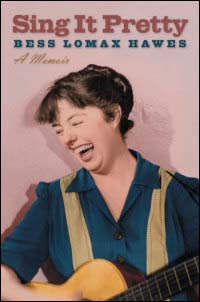 [by Ken Hunt, London] People’s appreciation of American folk music did not commence with the folk scare of the 1960s and the likes of the Kingston Trio, Peter, Paul and Mary, Joan Baez, Odetta, Buffy Sainte-Marie and Bob Dylan. A generation before them another folk revival, that similarly had no truck with segregation along racial lines, had been under way. Its crop of performers included progressives such as Josh White, Woody Guthrie, Huddie ‘Leadbelly’ Ledbetter and Pete Seeger. Like the next generation, the earlier one wrote new songs in various folk idioms, frequently darts with left-leaning barbs, dosed with class consciousness and social awareness.
The musician, songwriter and folklorist Bess Lomax Hawes, who died in Portland, Oregon on 28 November 2009, was one of those musicians and songwriters whose worldview coloured, most notably, the Almanac Singers – the template and forerunner for the United States’ first commercially successful and internationally influential folk supergroup, The Weavers. And she may have helped colour yours.
Bess Hawes, born in Austin, Texas on 21 January 1921 came from a Texican family that boasted two of the most important figureheads in the new folk movement. Only the Seegers, as it were, aced them. Her father was the folklorist and musicologist John A. Lomax (1867-1948) and her name derived from her mother, Lomax’s first wife, Bess Baumann, née Brown (1881-1931). Bess Hawes’ brother Alan (1915-2002), six years and some days her senior, became one of the foremost ethnomusicologists of the post-Second World War years in his own right. Her fate was sealed. “Folkloring,” she wrote, “in those days was a family affair.”
Her exclusive Hockaday School education, under financial pressure, made or gave way to a “slum school” with a high Mexican-American intake. Nolan Porterfield, her father’s biographer, quotes her saying, “I was well ahead of them in school terms, but they were ahead of me in life terms. It had a very profound affect [sic] on me – it developed my social attitudes for the rest of my life.” After finishing her education at Bryn Mawr College in 1941 – excessive absenteeism had placed her on probation – she cut out for the wilds of New York City.
There she found herself in the company of a bunch of like-minded people that coalesced as the Almanac Singers. Scratching for a living with odd gigs in small venues, before union congregations, some radio work and some recording, they were yet to become legendary. She was the only one with a regular income, a salary. Their living arrangements bore out their financial fragility. Renting a communal townhouse on Greenwich Village’s Sixth Avenue, Woody Guthrie lived there. Space was so cramped that she and Pete Seeger shared the same attic room. Decorously, in order to divide and maintain the platonic nature of their quarters, a curtain separated them.
She never let on, to use the vernacular, that she had the hots for Seeger. Yet their chaste relationship could never stand up to her father’s inspection. Getting wind of an impending ‘inspection’ she barely had time to move her belongings before he was fuming at the door and Seeger redirected him. In any case, soon afterwards – in 1942 – she married one of the musicians within the Almanacs’ circle, the photographer and musician Butch Hawes, with whom she had two daughters and one son.
Most of her songs served next to no time. Their time came and went in a trice in the manner of the times. Often she – and the Almanacs – simply took a familiar or public-domain melody and wrote new words to it for a strike, a demonstration or a session. One, however, definitely endured. She and Jacqueline Steiner wrote a campaign song for Walter A. O’Brian, Boston’s Progressive Party candidate for mayor in 1949 about a stranded commuter on the Massachusetts Transit Authority who can’t get off the train because he doesn’t have the excess fare. It became a transferrable commuter hymn that could equally apply to Boris Johnson and Transport For London’s price hikes.
“Well, let me tell you of the story of a man named Charlie.
On a tragic and fateful day,
He put ten cents in his pocket, kissed his wife and family
Went to ride on the M.T.A..
Well, did he ever return? – no, he never returned
And his fate is still unlearned.
He may ride forever ‘neath the streets of Boston.
He’s the man who never returned.
Charlie handed in his dime at the Kendall Square station
And he changed for Jamaica Plain.
When he got there, the conductor told him one more nickel.
Charlie couldn’t get off of that train.”
Titled M.T.A. or Charlie On The M.T.A., a decade later the Kingston Trio defanged it and turned it into a major hit. In recognition in 2004, the Massachusetts Bay Transportation Authority branded the CharlieCard, its equivalent of London’s Oyster Card, after the song’s hero. Call it simplistic thinking but the Oyster Card for its part was probably named for generating pearls for big business, as in rooking Charlies, rather than keeping prices down for commuters. If that’s the way your pleasure tends, M.T.A. and the CharlieCard constitute a small but telling win for the voice of the people and, perhaps, folk music.
Appropriately, it was the University of Illinois – the same company that had published the biography of her father, Nolan Porterfield’s Last Cavalier – The Life and Times of John A. Lomax (1996) – that published her autobiography, Sing It Pretty: A Memoir (2008). Especially in her later years she bore a hair-raising resemblance to her brother Alan. She was, so to speak, the distaff side of the coin. Doyen of the Smithsonian Institution’s Festival of American Folklife, she became a key figure in the US National Endowment for the Arts before retiring in 1992. In 1993 Bill Clinton felicitated her with the National Medal of the Arts.
Further reading: Sing It Pretty, University of Illinois Press, ISBN: 978-0-252-07509-4 (paperback)
13. 9. 2010 |
read more...
« Later articles
Older articles »