Articles
 “Nusrat Fateh Ali Khan’s music is not national at all. It’s become international. It’s become global. That’s what I would also like to reach.” – Alim Qasimov in conversation with Ken Hunt (1999)
[by Ken Hunt, London] In 1998 Alim Qasimov appeared at Tanz&FolkFest Rudolstadt. He was pretty much an unknown quantity. His recordings were little known outside the Azerbaijani domestic market or France and Switzerland. Qasimov truly was a Francophone find. Queuing outside the Landestheater the German Liederdichter – poet-songwriter – Christof Stählin and I got to talking and he recommended Alim Qasimov’s concert at the town church in a way that brooked no dissent. Once again, I must credit Christof with one of the musical discoveries of my life.
Jeff Buckley (1966-1997) fell for Alim Qasimov’s music too. Their one and only recorded collaboration titled What Will You Say appears on Buckley’s Live A L’Olympia (2001). (It is a tacked on, bonus DAT recording.) In September 2008 Alim Qasimov and his daughter Ferghana Qasimova appeared with the Kronos Quartet at the Barbican in London – and Getme, Getme from that concert graces the Kronos Quartet’s Floodplain (2009). The song had earlier appeared on the album The Legendary Art of Mugham (1997).
Alim Qasimov is one of the world’s most masterful singers. I say his name in the same breath as Nusrat Fateh Ali Khan (1948-1997). On Live at Sin-É (2003) Jeff Buckley says in a rap titled Monologue – Nusrat, He’s My Elvis what the qawwali maestro meant to him. (It is his introduction to Yeh Jo Halka Halka Saroor Hai, a phenomenal feat of memory and brilliantly enunciated delivery for anybody who doesn’t speak Urdu.) Having interviewed both Nusrat Fateh Ali Khan and Alim Qasimov and luxuriated in their music at close quarters, it would be churlish to hail one over the other. They rank as two of the finest vocalists of our age. Jeff Buckley wasn’t bad either.
If you want to start on the Alim Qasimov trail, try his Love’s Deep Ocean.
Note: The spelling of Ferghana Qasimova’s name was later standardized as Fargana Qasimova.
What follows is a revised essay, originally written for Alim Qasimov’s debut tour in 2000 that visited Cambridge, London, Coventry and Brighton – organised by Serious, as was the September 2008 engagement.
Alim Qasimov’s home is in Baku – the capital of Azerbaijan, or as many quip, the capital of the Caspian. Some say Baku’s name is a corruption of ‘Mountains of the Wind’ in Persian. Symbolically though this city on the Apsheron peninsula is built from the four elements of the ancients. Its earth is the yellow to beige sandstone out of which so many of its buildings are constructed. Its water is the Caspian Sea. During the winter the salty Hazri bears down cold and chiselling from the north. During springtime the Gilawar wafts in the promise of renewal from the south. But Baku’s fire is both literal and figurative. It is naphtha – the ‘Greek fire’ of the ancients – that lies close to the surface ready to combust and to unite with underground pockets of natural gas. And it is the fieriness of a culture that no number of invaders has ever dampened. Azerbaijan is translated as ‘Place of Fires’ although others say it derives from ‘Protected by Fire’. The philologically hampered can agree on one thing: there is fire in Azerbaijani culture.
 Baku has been an economically strategic centre for overland and seaborne trade for over a millennium. It is also one of Transcaucasia’s most important centres of the arts. Famed worldwide for its buildings, Baku’s architectural splendour is like nowhere else on Earth – yet like everywhere where East and West have ever met rolled into one. Only the warp and weft of Azerbaijan’s uttermost cultural and colonial catholicity, cosmopolitan chic, capitalism and Soviet stringency, and, so important, conspicuous oil wealth could have created such an elegant carpet of a culture. Invader, trader and missionary have defined and redefined Azerbaijan’s identity. Pre-Zoroastrian fire-worshippers from the Indian subcontinent, Shi’ite Safavidis, Sunni Ottomans, Hanseatic mariners, French culturalists and Soviet-era commissars of taste have left their masons’ marks all over Baku. Fantastical buildings abound. One building might combine gargoyle and minaret. Another ocean liner sleek and Soviet Constructivism. Another might shuffle Neo-classical, Gothic and French Islamic elements. Even the Electric Railway Station in the old Lenin Avenue – from where trains depart for Tbilisi (the old Tiflis) in Georgia, another major centre of cosmopolitanism – mixes and matches Persian, Egyptian and art nouveau styles, as if at the time of designing the building architect N.G. Bayey, to go mutated Yorkshire for a moment, had a head like an architectural sweet shop.
Azerbaijan’s musical heritage is truly the stuff of wonder. Culturally, Azerbaijan – or Azerbaidzhan, as it was sometimes transliterated during its time as a member state in the Soviet Union – is a crossroads culture. It has three enduring influences: pre-Islamic Turkish, Iranian and Islamic. Even though the region has been subjected to external influences for centuries and despite drives to graft Russian and European forms on the region’s Arabic-Persian musical rootstock during the Soviet era, somehow Azerbaijan’s musical traditions have survived with their character intact. In the years immediately after the disintegration of the USSR, as far as all but a very few Europeans were concerned, mugham – the region’s monodic, modal art music analogous to raga – and its ashiq – bardic – traditions were unfamiliar musical concepts. Indeed, it could be joked that for decades Azerbaijan’s musical heritage was virtually the exclusive preserve of French musicologists and it was mainly French labels such as Le Chant du Monde and Ocora that provided the wherewithal to learn about Azerbaijani music.
With them the domino effect began. The world‘s appreciation of Azerbaijan’s musical riches was poised to change. And that was due to Alim Qasimov.
A landmark in the appreciation of non-western classical music
Fittingly Alim Qasimov ranks not only as Azerbaijan’s greatest singer and mugham interpreter but also as one of the world’s greatest vocalists. Without watering down the music in any way, shape or form, however glib it may sound, he has turned the arcane into the accessible. His is a music that rolls in on waves of passion. As anyone who ever saw any of his recitals will attest, Alim’s concerts are nothing less than a before-and-after experience. They rival such decisive debuts in non-western classical music as the arrival of the sitarist Ravi Shankar when he took Hindustani (Northern Indian) raga out of its cultural enclave and introduced it like a software virus to upgrade the West’s cultural programming.
Mugham, like the great modal traditions of Persia and Hindustan, requires melodic and rhythmic dexterity while interpreting lyrics, often of great antiquity by named poets. Azerbaijan has no monopoly on mugham. It is also the art music of Armenia and Uzbekistan and historically the region’s musicians had theoretically only to switch language – Armenian, Azeri or whatever – and keep to the same melodic blueprint. A typical piece opens with a short, introductory mood-setting movement that can be likened to the opening alap movement in a Hindustani raga. The piece then develops a rhythmic pulse, provided by the vocalist’s daf or gaval, a frame drum inside which brass rings and tiny bells hang. Mugham’s foremost instruments for melodic accompaniment are the tar, a long-necked, fretted lute and kamancha or kemanche, a spike fiddle, meaning the instrument is pivoted on its spike, so its strings are turned towards the bow like a flower turns towards the light. Latterly, for studio and concert performances, Alim has augmented this traditional trio instrumentation with additional melody and percussion instruments.
 Love’s Deep Ocean (2000) represented a blossoming of Qasimov’s stylistic innovation and again paired him with his daughter Ferghana Qasimova for vocal duets. The measure of the soloist’s skill and art lies in how he – and traditionally it was a he – improvises on the melodic and poetic themes in order to deliver the composition’s emotional charge. The instrumentalists will echo phrases and support the piece’s development. Many lyrics dwell on love in its manifold manifestations, often presented in allegory just as Azerbaijani cuisine wraps ingredients in vine leaves.
Alim Qasimov: a pen-portrait
Alim Qasimov was born on 14 August 1957 in the village of Nabur about 100 km from Baku in the Shemakhi region – best known to his countrymen as a home of earthquakes. A mother tongue Azeri speaker – Azeri is a language in the mutually comprehensible Turkish family of languages – he describes his parents as “liberal”. The family took an interest in music. Despite his family’s lowly circumstances and with the blessings of only a basic education, his family encouraged him to pursue his budding interest in music. The proviso was, naturally, that he had to earn a living. Both parents were simple workers. They raised livestock, which their son helped tend, and generally earned money as best they could. Alim learned a great deal about singing and received a great deal of encouragement from his dad, who sang in an amateur way at weddings, parties and gatherings, while to his mother he attributes his sense of rhythm. Dreams of singing mugham do not support families, however.
In the meanwhile, he took a succession of jobs, working variously as a driver, in a laboratory and, almost inevitably, in a refinery. These were frustrating times for him. By 1977 he was married and he felt as if nothing he had turned his hand to had resulted in any sort of success. In 1978 he enrolled in the state music college but impatient with his rate of progress he began studying on his own, absorbing the performance styles of mugham masters on record, attending recitals as purse permitted. His concentrated effort produced success and recognition. Nevertheless, looking back, he admits that while he had the technique and, as he once described it to the German writer Jean Trouillet, the “façade”, to deliver consummate interpretations of mughamat – the proper plural of mugham – he still lacked the maturity to render the soul of the particular mugham. Achieving that required perseverance, patience and the passage of the years. There is no shortcut to maturity in mugham.
Of qawwali, mugham and maestros
Before Nusrat Fateh Ali Khan popularised qawwali with westerners and non-Muslims there had been others, such as the Sabri Brothers, who had alerted a post-war generation to the power of that primarily Pakistani, Sufi devotional form on record. Just as before Alim Qasimov there had been others. (In the case of qawwali and Persian-Tartar (Azeri) music, there had been commercial pressings as far back as the beginning of the twentieth century for local consumption.) The impact of Nusrat Fateh Ali Khan on the world of Islamic music as a whole cannot be underestimated and he had a rejuvenating effect on qawwali, as Alim Qasimov has had with mugham, as happened when a visionary introduces innovations grounded in a musical tradition.
 During the early 1990s Alim had the opportunity to see Nusrat perform in France. “His concert opened a lot of doors for me,” he told me, “answered a lot of questions. After watching him, I became a lot freer in my own interpretation of mugham music.” Qasimov would contribute to Hommage à Nusrat Fateh Ali Khan (1998), a tribute anthology that did much to spread the word about Qasimov’s greatness in the broader river of Islamic-derived musics. Alim admits that his music does not automatically tap into the Islamic or Koranic, although in a deeper spiritual way it does in its Sufi-like use of allegory, lyrical structure and its kinship with Persian mystical and poetic forms.
Of prizes and praise
It takes neither a cynic nor a sceptic to be chary about music industry awards and prizes and the way statuettes or gongs are given out. Too many are corporate or media circuses, occasions for little more than mutual backslapping, brown-nosing or a chance to get a marketing and monetary edge on the competition. How many awards really count?
On 19 November 1999 in the Krönungssaal – the crowning room of the Holy Roman Empire – in Aachen’s town hall Alim Qasimov was the joint winner of something sounding as if it was somewhere on a sliding scale between officiousness and officialdom called the International Music Council-UNESCO Music Prize. The difference with this one is it is nicknamed the ‘Nobel Prize for Music’. And it is given only to “musicians and musical institutions whose work or activities have contributed to the enrichment and development of music and have served peace, understanding between peoples, international co-operation and other purposes proclaimed by the United Nations Charter and the UNESCO Act.”
With the award of the IMC-UNESCO Music Prize, Alim Qasimov joined a select company of musical paladins. The first recipients of the prize in 1975 were Dmitri Shostakovich, Ravi Shankar and Yehudi Menuhin. In between its recipients had included Leonard Bernstein, Herbert von Karajan, Oliver Messiaen, György Ligeti, Krzysztof Penderecki, Iannis Xenakis, Benny Goodman, Daniel Barenboim, Mercedes Sosa, Cesaria Evora, Nusrat Fateh Ali Khan and, co-winner with Qasimov in 1999, Emmanuel Nunes. Qasimov’s accolade gave an international fillip to the ‘mugham cause’.
And with it a new age began.
Alim Qasimov Ensemble Azerbaijan: The Legendary Art of Mugham Network 28.296 (1997)
Alim Qasimov Love’s Deep Ocean Network 34.411 (2000)
Jeff Buckley Live A L’Olympia Columbia COL 503204-9 (2001)
Jeff Buckley Live at Sin-É Columbia COL 512257 3 (2003)
Kronos Quartet Floodplain Nonesuch 7559-79828-8 (2009)
Ken Hunt’s German-language article from the 6/99 issue of Folker! – Germany’s finest folk and world music magazine – is available online at http://www.folker.de/9906/quasimov.htm
15. 6. 2009 |
read more...
 [by Phil Wilson, London] Dr. Ralph Stanley – as he’s proud to be called these days – isn’t someone you’d necessarily describe as ’82 years young’, but he’s still in great form. There was a precautionary chair on stage at the Barbican, but he only draped his jacket over it, and even for the band members’ solo numbers and the instrumentals he remained standing and merely stepped back to allow them the spotlight.
Most of the musicians – Dewey Brown on fiddle, Steve Sparkman on banjo and James Shelton on guitar/vocals – have been with Stanley for at least 15 years, so there’s a camaraderie on stage that softens any well-oiled routines. Long-time bass-player Jack Cooke was absent with pneumonia but Audey Ratliff slotted in nicely although Ralph was also clearly missing the presence of his guitar-playing grandson Nathan Stanley on the trip.
The band came fresh from their annual Bluegrass festival at the old Stanley homeplace in Virginia, so Ralph apologised for the slight hoarseness of his own voice after three days’ constant singing but his choice of material more than compensated.
All of the musicians are useful singers and Stanley’s penchant for gospel (about one third of his recorded repertoire) is natural. They included old favourites like I’ll Fly Away, Angel Band and a wonderful version of Amazing Grace. The last was done as a vocal quartet in what he explained was “lining out” style – based on a preacher/congregation responsorial style – where the leader sings the line quickly and the singers repeat it in harmony at normal tempo.
Their set opened and closed with the classic instrumentals, Lee Highway Blues and an excellently fiddled Orange Blossom Special – but it was Ralph’s solo performance of the Dock Boggs classic O Death and the inclusion of many old time mountain songs and ballads that made this evening special. Not only Man Of Constant Sorrow, which he introduced as having been good to him over the years (and which he said he’d first heard his father sing at around 12 or 13), but also personal favourites like Little Maggie and Pretty Polly. Wonderful stuff.
5. 6. 2009 |
read more...
 [by Ken Hunt, London] Whilst writing the essay about the history of Call of the Valley back in those days when the internet was in its infancy and before mobile phones, it took months to obtain the right phone number for G.N. Joshi – or one that worked. The way things sometimes go, I finally made direct contact only to learn that he had died days before.
G.N. Joshi (6 April 1909-22 September 1994) wrote three books in total, beginning in the late 1970s with his Marathi-language account of his life Swar Gangechya Teeri – he translated it as ‘On The Banks of Swara-Ganga’ – and explained that in the title the Ganga (Ganges) stands as “the sacred River of Melody”.
He used the material contained in his Marathi autobiography to create a new work. Namely, his fascinating English-language autobiography Down Melody Lane. Read it if you have any interest in the Indian subcontinent’s music.
Down Melody Lane Orient Longman, Hyderabad, ISBN 0 86131 482 4 (1984)
See also http://downmelodylane.in from which the image of G.N. Joshi is taken.
5. 6. 2009 |
read more...
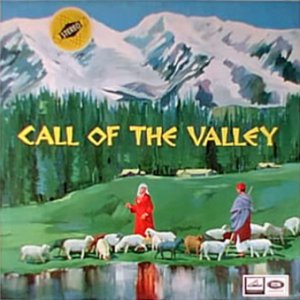 [by Ken Hunt, London] Key works that open doors to reveal unsuspected possibilities are fewer and farther between than press releases and other fictions would lead us to believe. On the basis that a little hyperbole goes a long way, glib judgements get bandied around with frightening frequency and lightning strike effect. For many people Call of the Valley opened up the skies, was a revelation. Its impact could be likened to revealing a new colour in the spectrum, for it was directly responsible for bringing Hindustani classical music – as Northern Indian classical music is known – to new audiences all around the globe. Its three soloists would go on to internationally acclaimed careers. But all that lay in the future. For countless listeners the first time they would hear the consummate musicianship of Shivkumar Sharma, Brijbushan Kabra and Hariprasad Chaurasia would be this record.
Shivkumar Sharma, Brijbushan Kabra and Hariprasad Chaurasia were all aged about 30 when they convened to make Call of the Valley. Shivkumar Sharma, who had made his first solo album in 1960, had worked to raise the status of the santoor to that of a respected classical concert instrument. A trapezoid-shaped member of the hammer dulcimer family, his santoor is modified to bear 87 strings arranged in 29 triplets of strings, each triplet tuned to the same note. The strings are struck with two mallets called qalam made of a hardwood such as walnut. In his native Jammu and Kashmir, where it is used to accompany a regional music called sufiana mausiqi or its poetic counterpart called sufiana kalaam, the santoor has 100 strings, albeit differently configured. Although its Persian relative, the santur, has long associations with Persian and Iranian classical music, Shivkumar Sharma’s decision to elevate such a lowly folk instrument to the concert platform was viewed as folly in conservative quarters.
Call of the Valley, in the opinion of Shivkumar Sharma and many other people, was responsible for establishing and popularising the instrument in Hindustani classical circles. It would decisively silence the critics. In 1967, however, it was an altogether different story. Brijbushan Kabra’s instrument was the guitar, another instrument that was having to prove itself because of its non-classical and western associations. Hariprasad Chaurasia was in the process of establishing himself as a flautist. His choice of the bansuri, a bamboo transverse flute, presented other problems. The flute is not just popular, it is of religious significance to the Hindu faith. In the 1960s memories of the flute virtuoso Pannalal Ghosh – he died in 1960 – were fresh. Hariprasad Chaurasia had to brave and convince the conservative wing of Hindustani music. The success of this album would place all three musicians on the musical map.
In 1967 the concept behind Call of the Valley broke new ground. While staying true to Hindustani tradition, it also captured a freshness and a timelessness. Conceived as a suite, Call of the Valley wove a story about a day in the life of two lovers in Kashmir. Santoor, guitar and flute were the voices that told the story. Underlying the tale was something that was as simple as it was radical. Shivkumar Sharma’s proposal was to make use of one of the basic organisational principles of the Indian raga – or rāg – system. The raga – “that which colours the mind” is a poetic description often applied – is the melodic heart of Indian music. For centuries music theoreticians have classified ragas in various ways, associating them with a particular season or time of the day according to their characteristics and mood. Talking to me in April 1987 Shivkumar Sharma sketched how this relationship works: “For early morning we have a raga that expresses a particular mood. In the daytime different ragas are played. They’re connected with Nature. How do you feel when the sun rises? You have a particular feeling when you see full moonlight. You react to Nature in different ways. Our ragas are connected with that and each raga expresses a different mood.”
“You know,” he reflected looking back on the project in June 1994, “when I was asked to do this recording and I thought about its theme, I wanted to have classically based ragas and convey them through a story. What I thought was we should weave a story around these rāgs as we had a time period that started with sunrise and afternoon through to evening and late evening and all that. I had one sketch in mind. I thought about a story and I discussed it with Mr. G.N. Joshi. I told him how I wanted to project the story.”
Classics are not magicked out of the ether and Shivkumar Sharma’s fantasia needed further definition and substance. But G.N. Joshi, the writer of the original sleeve notes, intuitively grasped the concept and gave the budding project the green light. “When I thought of this idea, when I thought of these two characters, one male and one female, and of Nature, I felt I should have a few more instruments. Naturally when I thought about it, I thought about my friends Hariprasad Chaurasia and Brijbushan Kabra, because if you want to create music together it is essential that you know the person, know the musician personally. We were friends. I naturally thought of them. I felt the guitar could express the mood of a male character, the santoor of a female character. The flute could express what Nature is and what a person feels about natural surroundings. When I talked to them they liked the idea very much. We knew we could work together very easily.
“We arrived at the whole synopsis of the story, so to speak, and how to proceed. We started with Rāg Ahir Bhairav and then Nat Bhairav and then there was a composition in Rāg Piloo. After Piloo we had Bhoop and then there was some composition based on Des. The last one was Pahadi, based on a folk song. After we were clear about all these ragas and compositions and how we would proceed and how each instrument would be involved in that, when the whole thing was ready, I again had discussions with Mr. G.N. Joshi and explained to him how I conceived this idea, how I felt about it. He explained the whole thing – which was the sleeve notes – the story about how a shepherd’s day goes and what each instrument was conveying.”
G.N. Joshi’s very presence at the sessions was a kind of validation. He would become the de facto producer of the album – albeit uncredited – as Shivkumar Sharma explains: “He was in charge of the recording section [at the Gramophone Company of India in Bombay]. I don’t know the terminology and what exactly his designation was but he was in charge. He used to be responsible for getting all these recordings done. He used to be responsible for engaging the musicians, getting the recordings done. He was the producer of that recording, a kind of producer.”
Because he was a key player in this Kashmiri drama, it is useful to capture a flavour of how respected G.N. Joshi was. Born in 1909, Govindrao Joshi was a singer. In 1930, as he wrote in Down Memory Lane, his account of a career in music, he received an invitation to broadcast from a Bombay radio station. The broadcast took place on New Year’s Day, 1931 and was well received. Which was how he came to record for HMV (His Master’s Voice), one of the names that the Gramophone Company of India traded under in those days. His setting of N.G. Deshpande’s Marathi poem Sheel (‘The Whistle’) – G.N. Joshi’ mother tongue was Marathi – proved particularly popular in Maharashtra. More recording sessions followed. By 1936 Joshi’s reputation could sustain a four-month tour of British East Africa, including Kenya, Uganda, Tanganyika and Zanzibar. Yet, like the dutiful son that he was, parallel with his singing career he had gone about getting himself pukka qualifications. In due course he was practising law. But music was his first love and he jumped at an offer to work full time as a recording executive for HMV in Bombay. He started on the first day of June 1938.
It was a post he would hold for 34 years. During that time G.N. Joshi would preside over many of the most historic sessions in Indian classical music. Call of the Valley was but one of the seminal sessions he helped to shape. At one extreme he would record a variety of important Marathi actor-singers whose work, he tells, was the living embodiment of literary high-browism. At another, more humdrum extreme, he was responsible for recording politicians’ speeches, singer-propagandists extolling the alcohol prohibition in force in the early 1950s, and government exhortations to open small savings accounts. Visionaries, and G.N. Joshi was one, also have to deal with the mundane. More relevantly, he was also personally responsible for a catalogue of magnificent artistry. Among the legendary vocalists he recorded were Ustad Bade Ghulam Ali Khan and his brother Ustad Barakat Ali Khan, Pandit Omkarnath Thakur, D.V. Paluskar, Ustad Amir Khan, Dr. Kumar Gandharva, Surashri Kesarbai Kerkar, Begum Akhtar and Pandit Bhimsen Joshi. He also preserved the work of masters such as Pannalal Ghosh, the multi-instrumentalist Ustad Allauddin Khan and his son, the sarod virtuoso Ustad Ali Akbar Khan, the tabla maestros Ustad Amir Hussain Khan, Ustad Ahmad Jan Tirakhwa and Ustad Alla Rakha, and the sitar virtuoso Ustad Vilayat Khan. By preserving many of Hindustani music’s most colourful vocalists and instrumentalists G.N. Joshi helped to shape and shade the future appreciation of Indian music. He was present at a pivotal time in Hindustani music. The old master-pupil tradition of handing on knowledge was under severe pressure and in decline. The World of Indian Arts will be forever in his debt.
Not for nothing then was Shivkumar Sharma delighted to have G.N. Joshi’s blessing. “This was a very novel idea at that time,” Shivkumar Sharma remarked. “Nobody had tried in Indian classical music a theme like that, trying to express a story-like theme. Mr. Joshi was himself a musician. It was very important that he could understand what we were doing.
“Normally what happens is that if a person is working with a record company he is not knowing music. It’s difficult to work or get things done together. If he happens to be a musician – like Mr. Joshi was – things can be very easy. We could understand each other and work things out together. He knew many great musicians like Ustad Bade Ghulam Ali Khansahib, Ustad Amir Khan and Pandit Omkarnath Thakur because he had been involved with all the recordings of HMV in those days.”
Their session with G.N. Joshi took place over the course of one night in HMV’s studio in Bombay. In addition to the three main voices of guitar, flute and santoor, Manikrao Popatkar played tabla. Typically for the period the original LP credits were incomplete. Shivkumar Sharma was able to clarify some things from memory. “Rijh Ram played pakhawaj [a two-headed barrel drum] as well as swarmandal. There were some other effects – bells and small effects – that were made by some musician from HMV.” (The latter’s name has gone unremembered.) “We did two or three days’ rehearsal together. Of course, everything was not fixed. We just fixed the compositions in the ragas and for the rest of it we just had tentative ideas of the timings. The recording was done in one day. We went in the studio in the evening and we worked till next morning. I don’t think we had to repeat many things or that there were cuts in the recording. We finished it in one session.”
Call of the Valley clearly found a commercial as well as an aesthetic niche because, unusually, the Gramophone Company of India never let it drop from the catalogue. A colleague at the company’s London office told me it even turned up in CD counterfeiting raids in Britain in 1994 – an accolade of the backhanded sort for a classical recording. Part of its appeal lay in the ease with which it engaged the listener, irrespective of their cultural background. “In India itself many people who were not interested in Indian classical music at all, they got interested in Indian classical music after listening to this record. Then they started listening to other things also. The same thing happened in America and in many of the European countries which I came to know later on when I used to go on tour. Many people even now meet me and tell me that they had not been exposed to Indian classical music, were never interested in it before but after listening to Call of the Valley they got interested and were attracted to these sounds.”
For time out of mind people have suspended critical judgement and emptied their minds to chant somebody else’s First Law of Self-promotion. Law or mantra, it goes, ‘The latest is the best.’ Consequently so much that is insubstantial gets hailed as an instant classic in the compulsion to laud the new to the skies. Call of the Valley was a historic landmark in the popularisation of Hindustani classical music. A benchmark of excellence, time has shown how important and how innovative its vision was. Call of the Valley has truly earned its status of classic. ‘Classic’ is a much abused word but it applies to Call of the Valley.
A version of this essay – and its first part – appeared in 1995 with the dedication: “For G.N. Joshi for Ustad Amir Khan’s Marwa, Call of the Valley and others yet to discover, my father Leslie Lloyd Hunt who put me on the path of music, for my uncle Alec Frederick Hunt who acquainted me with the correlation of culture, history and politics, and for Shivkumar Sharma for opening so many minds.”
1. 6. 2009 |
read more...
 [by Ken Hunt after G.N. Joshi] Picture a hamlet, as G.N. Joshi wrote in the original sleeve notes to Call of the Valley, nestling in the shelter of a Kashmiri valley. The story begins as sunrise approaches. Guitar signals dawn’s arrival. Santoor, the very epitome of the Kashmiri soundscape, joins in to play the early morning râg Ahir Bhairav, the first movement of the suite.
Swarmandal – a zither-like instrument – ripples usher in the second movement, Nat Bhairav. The day advances. The sun begins its climb with Joshi imagining Kashmir’s scenic splendour. Set to ektāl, tāl or taal meaning a rhythmic cycle, in this case one of 12 beats, the scene takes on colour and form. The sun’s rays dance off snowy peaks, their perpetual snow contrasting with the greenery of the wooded lower slopes. Birds sing and dart among the chinars, the Oriental plane closely associated with Kashmir. A mountain stream purls. Sheep and cattle graze. Bees make honey. It is a scene of bucolic bliss, of Mother Nature in all Her glory.
Rāg Piloo, the third movement, is set in teentâl, a 16-beat tāl. Freeze-framed like a sequence of ragamala images, the noted Northern Indian style of miniature painting, a girl is cautiously making her way to see her beloved, fearful of being spied. He feigns anger at her being late but melts, unable to sustain his teasing. Guitar takes his voice, santoor hers and the lovers lose themselves in talk. Like lovers do. Flute warns that something wrong – Joshi imagined that she detected prying eyes. She flees, promising a rendezvous that evening. Love’s labours thwarted, he remains to dwell on events and kismet.
With dusk sheep and cattle plod their way down from the alpine pastures. The faithful are gathering for prayer. Conch, mridang (a drum) and bells set the scene. The lover, hopeful that his prayers will be answered, is tense with anticipation. That devotional mood is reflected by the movement’s raga – Bhoop set in jhaptāl (a 10-beat tāl), performed dhrupad fashion, dhrupad being an austere, measured, devotional style of singing.
The couple make their way independently to the tryst outside the hamlet. Rāg Des in dadratāl (6 beats) plays. Des conjures images of the countryside. (Des or Desh means country.) They meet and walk towards the lake in the cool evening air talking now in their normal voices since there is little likelihood of eavesdroppers. It is a romantic atmosphere. The moon is mirrored in the lake’s placid waters and all is well with the world.
The moon is out. The final movement, rāg Pahadi in kaharwa (8 beats), becomes their moonlight sonata. It expresses that moment when time stands still. Joshi pictured it as them finding a dhony (or tony, a small sailing boat), gliding off and reaching celestial heights. Lost in the moment, lost in the stars, they hope that it never ends. The rest can be left to your imagination.
1. 6. 2009 |
read more...
“Folk returns to East Dulwich – but not as you knew it!”
 [by Ken Hunt, London] Brass Monkey was a band that unfurled before my eyes. Or so it seemed. From their varied beginnings consolidating in the trio of Martin Carthy, Howard Evans and John Kirkpatrick that performed from January to December 1980 to the establishment of the powerhouse acoustic quintet, Brass Monkey proper, in January 1981 of Carthy, Evans and Kirkpatrick with Martin Brinsford and Roger Williams, their impact was never less than revelatory.
For one thing the Metal Monkey’s instrumental alchemy was like no other band’s on the English folk scene. They summoned wood and wire (Martin Carthy), squeeze and button instruments (John Kirkpatrick), brass (Howard Evans and Roger Williams) and, thanks to Martin Brinsford, near-brass – saxophone and harmonica – and percussion elements. Above all, they created surprises, as if to the manor born.
There would be trombonist fluctuations but the core of the group remained intact. In March 2006, however, Howard Evans died and on 27 March 2006 Martin Brinsford, Martin Carthy, John Kirkpatrick and Roger Williams played their band mate home. It was a good send-off. At The Goose Is Out! folk club, off Dog Kennel Hill in East Dulwich (towards the back of Sainsbury’s car park, now you ask) Brass Monkey’s new line-up, circa 2009, opened with The Old Grenadier – a military march that Evans had brought to the band at its inception and they had sent him off with.
The new line-up comprises Paul Archibald (trumpets, cornets), Martin Brinsford (C-melody saxophone, mouth-organ, percussion), Martin Carthy (vocals, guitar, flatback mandolin), John Kirkpatrick (Anglo-concertina and button accordion) and Roger Williams (trombones and euphonium). If the very mention of those names and the combination of those instruments in one sentence sounds scary, imagine what they unleash. And they were touring a new album Head of Steam though their performance came with nods to their past. In remembrance of Howard, they kicked off with The Old Grenadier – one of the key early pieces he brought to the band.
 The main focus, however, remained fixedly on Head of Steam‘s repertoire, as it had to be. Paul Archibald may be playing Howard Evans lines on older material such as the final encore Waterman’s Hornpipe or Maid of Australia but he is definitely here to add a new chapter. For example, fluegelhorn didn’t figure in the set but he did add pointillist piccolo trumpet and, like Roger Williams and his trombone mutes, a greater variety of mutes than Howard Evans ever used. In other words, similar but different.
Given the nature of the music business, albums get recorded and then acts tour the album. Two months into touring this material and then recording it would have created, musically speaking, a far meatier beast. So it goes. The new material – the likes of The Moldavian Schottische/The Snowdrop Polka and Lichfield Tattoo/The Radstock Jig/The Quickstep From The Battle of Prague – actually worked better live than on the album.
This, however, isn’t a Head of Steam album review and one of the advantages of Brass Monkey’s unique creativity derives from them being an occasional assembly of talent – a sideshow, without being demeaning, beside their primary income streams. Brass Monkey is one vigorous offshoot.
There were several outstanding performances. One was the Martin Brinsford tour-de-force Happy Hours during which he blew double mouth-organ and Roger Williams puffed into one of largest trombone mutes – the so-called ‘bucket mute’ – known to organology and science. Lower-key was Maid of Australia from 2004’s Flame of Fire which Carthy delivered wholly without Peter Bellamy’s knowing wink or leer – Bellamy being a factor in Brass Monkey’s take-up of the song. On the basis of The Goose Is Out! performance there could be no disputing Brass Monkey’s prowess. When, as their first encore, they played the incest ballad Maid And The Palmer – one of the ten greatest English folk revivalist interpretations ever and a desert island disc choice – they reminded why life lived without Brass Monkey is no life at all.
Further information:
Head of Steam Topic TSCD575 (2009)
The Goose Is Out!
www.thegooseisout.com
Ken Hunt’s obituary of Howard Evans from The Independent is at http://www.independent.co.uk/news/obituaries/howard-evans-470889.html
All photos (c) Santosh Sidhu/Swing51 Archives
18. 5. 2009 |
read more...
 [by Ken Hunt, London] The Scots composer and musicologist David Johnson died on 30 March 2009 at the age of 66. Born David Charles Johnson in Edinburgh on 27 October 1942, his focus both as a composer and a musicologist was profoundly shaped by Scottishness.
Over the course of his life he composed over 50 works, amongst them five operas. Two of them were inspired by so-called Border ballads, namely his All There Was Between Them (1969) and Thomas the Rhymer (1976). Others drew on other Scottish elements including Music For Hallowe’en (1960) and Piobaireachd (1976) – piobaireachd is the traditional pipe music of the Highlands of Scotland also known as Ceňl Mňr -, both works for solo recorder. Literary influences also informed his composing. The Mortal Memory drew on Robert Burns while God, Man and the Animals (1983-88) for soprano, cello, harpsichord and recorder took Die Lebensdauer (Lifespan) from the fairytales of the Brothers Grimm as its text and starting point. This last work is one of the compositions on Animal Heaven (Metier MSV CD92036, 2001) alongside ones by, amongst others, Sally Beamish, Lyell Cresswell and Kenneth Leighton.
His musicological writings included Music and Society in Lowland Scotland in the Eighteenth Century (1972) and Scottish Fiddle Music in the Eighteenth Century (1984).
13. 5. 2009 |
read more...
 [by Ken Hunt, London] John Pearse died on 31 October 2008 in Besigheim in Germany aged 69. A wine lover – he wrote the book Cooking With Wine (1987) – it was wine that crooked its little finger at him and brought him to that Swabian wine region where he died. Born John Melville Pearse in Hook in the East Riding of Yorkshire on 12 September 1939, he grew up in the north Welsh seaside torn of Prestatyn in Denbighshire where the family ran a hotel.
Pearse supposedly took up the acoustic guitar in 1957, the clincher being getting fired up by Big Bill Broonzy – the US bluesman who toured the UK that year as part of a European tour and whose tour excited a whole generation of folk musicians including Pearse’s fellow Yorkshire musicians, The Watersons.
Pearse was a musician and inventor of any number of musical gizmos, accoutrements and basics – notably strings that were marketed under his name – and the people that used and endorsed his products over the years were a veritable Who’s Who of the music business. Amongst those who were proud to specify John Pearse strings as part of their kit were the Dobro player Cindy Cashdollar, King Crimson’s Robert Fripp, the folk-blues maestro Wizz Jones, Bill Kirchen formerly of Commander Cody & His Lost Planet Airmen, the violinist Tim Kliphuis, the Dixie Chicks’ Emily Robison and the guitar maestro Doc Watson. His business arrangements with his second wife, Mary Faith Rhoads survived their divorce. (Mary Faith Rhoads-Lewis’ obituary of her ex-husband appeared in the March/April/May 2009 edition of Sing Out!.)
Nevertheless, he will primarily be remembered by the public at large for his ‘how to’ guides to making music that were published in Britain, the United States and Germany. He championed acoustic stringed instruments in books and on television and not merely the ubiquitous guitar. His musical terrain also included ukulele, mandolin, dulcimer, balalaika and the Indian sarod.
Beginning in the 1960s, Pearse created a body of literature targeted at people of varying levels of instrumental expertise, but especially beginners and particular styles such as blues, ragtime and folk. Pearse’s Hold Down A Chord (1968) – the power of a good, direct title! – was an acoustic guitar folk standard and became to folk guitar what Bert Weedon had been to a generation of guitarists the previous decade. Pearse ranked alongside Pete Seeger and Bert Weedon when it came to instrument tuition books. But Hold Down A Chord also had the power of television behind it and was an early successful example of a television series and book tie-in. The enduring success of the series led to the original black-and-white series being remade in colour in Australia in 1982. Pearse also presented similar programmes on German and US television. And elsewhere.
He also worked for a time as a record producer for the Capitol, RCA and Warner Brothers labels though he recorded comparatively little over the years. Yet as early as 1966 he recorded with the duo of Colin Wilkie and Shirley Hart. Colin Wilkie’s recollections of their wild-eyed innocence abroad in Germany before either of them had settled there are at
Pearse himself blogged in later life, notably after suffering a dreadful accident in 1983 that left him paralysed from the neck down and wheelchair-bound. He blogged about disability issues, especially about disability access whether at trade fairs or in hotels, and making music. Against the odds, he came back to continue making music and recorded Live In Kutztown (2002).
He is survived by his second and third wives, Mary Faith Rhoads-Lewis and Linda Pearse, respectively, and his stepson Bill.
27. 4. 2009 |
read more...
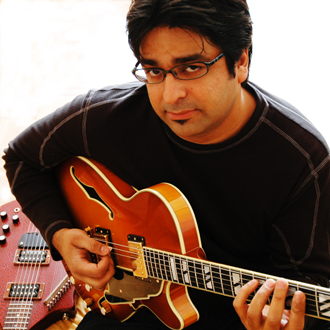 [by Petr Dorůžka, Prague] The Karachi born, New York City based jazz guitarist Rez Abbasi comes to Europe for a ten day tour which includes two gigs in Czech Republic – 23 April he plays in the Prague Reduta club, and on 27 April at Jazzfest in Brno. He is joined by his Indian wife Kiran Ahluwalia, who is a well known singer on her own right.
Rez, you left Pakistan when you were 4 years old. Did you come back to rediscover your roots?
Rez: Yes, I of kind took a backwards approach. But I am fortunate in that I’ve been able to perform a lot with Indian musicians of various styles. That’s the best way to learn in the long run. So the music I compose and conceive is very much coming out of the spirit of sharing ideas with jazz musicians and Indian musicians.
You also studied tabla with Alla Rakha. For how long?
Rez: I didn’t physically study with the great master but attended many group classes of his for a month and continued to study tabla with one of his best students for a year.
Alla Rakha was a lifelong partner of Ravi Shankar. Did you have a chance to meet him also or take a lesson from him?
Rez: No, however I did attend a master class given by another sitar maestro, Ustad Shahid Parvez. Honestly, the desire to try and play the guitar like a sitar didn’t last with me. It doesn’t appeal to me when I hear people doing this sort of thing because it just sounds like imitation. That being said, however, I do strive to be influenced by all music on a much subtler level. It becomes more of a jazz approach from the streets rather than an academic thing. So if there is a flavour of Indian music in my playing, it comes from my intuition rather than picking up a sitar.
How much have you been influenced by the people you’ve worked with?
Rez: I’ve learned most of that through my relationship with Kiran and her music and through the other Indian players I’ve worked with. Masters like Kadri Gopalnath, A. Kanyakumari, Gaurav Mozumder and a host of jazz players that strive to incorporate Indian music into jazz, Rudresh Mahanthappa, Vijay Iyer and George Brooks.
In the Czech magazine Muzikus I’ve read comments about Kiran singing in unison with Rez’s guitar. Who takes the lead? And, can you somehow predict where the other will move? Or you just relay on a set of prepared memorized tunes?
Kiran: When Rez has composed a specific melody for me to sing then I sing it but with Indian ornamentation. Since we come from two different musical backgrounds, the first step for us is to sit down and decipher everything – he tells me the melody step by step and I write it in a way that I can understand. The final result is us doing the melody together. In terms of improvisation – we figure out which scale would work the best. When I am improvising then of course he is listening and playing things that relate to him on the spot.
Rez: Sometimes we play the melodies in unison and that is written out. When Kiran improvises, I often play some chords or melodic ideas around her as an accompaniment. She is another improviser in the group and the musicians treat her as such.
What the Western media now describe as world music in my opinion was already started some decades ago by the Bollywood composers. By default they have to know both Eastern and Western musical idioms and are finding effective ways to fuse them together. Would you name any Bollywood (or even Indian composer in general) who should get more recognition from the western audiences?
Kiran: Yes world music is a term used primarily by English speakers to describe music that comes mostly from ‘far off’, non-English speaking places. In that sense ‘world music’ is centuries old. And yes, Bollywood music has long been open to influences from other non-Indian musical cultures although in India the influences that Bollywood music takes in are never presented as collaboration. I like a lot of Bollywood composers. A R Rahman is totally deserving of his recent recognition at the Oscars. Some other Bollywood composers I like are go by names “Salim-Suleman” and “Shankar Ehsaan Loy”.
Rez: The Western media has not done a good job in describing forms of music in general. The term world music is much too broad and just like the term “fusion” cannot give justice to the multitude of sounds we hear today. The original Bollywood composers did incorporate some great ideas but modern Bollywood is more concerned with making Pop hits. It’s rare but there is some good stuff coming out today. A R Rahman and Sanjay Divecha are some that have done a great job melting the borders of music.
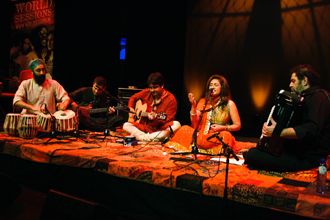 Fusing jazz and Indian music has a long history, with Mahavishnu Orchestra, Shakti, modal jazz playing. Was that any inspiration for you?
Rez: Not really. I do like that sound but only later in life was I introduced to artists like McLaughlin. I wasn’t a big listener of the fusion from the 70s. I do like Coltrane’s incorporation for sure and think it was absolutely sincere but it only scratches the service of the possibilities. In terms of what some other musicians did with Indian music, I personally find the outcome contrived. Musicians too often put groups together based on the prospect of fusion. To create music that has its roots in various forms, takes composers that are also rooted in those forms. My music is solidly grounded in jazz and becomes modernized through incorporating music from India as well as 20th century Western classical music, all music that I firmly am rooted in. The syntheses of sounds are just that, a synthesis. A listener should hear it all as one sound, no separation.
A colleague of mine who stages concerts in Greece says that he prefers to hire Indian musicians instead of the local ones, because Indians have much better memory of tunes and learn the new pieces quicker. Do the Indians really have some special musical genes, or is it just a myth?
Rez: I think it has to do with the way they train as students. I was brought up in America, but the Indian musicians I’ve worked with usually don’t read western music and therefore use their ears more which ultimately strengthens memory. But it can also become limiting if indeed they are learning complex music from a western composer. Initially it takes longer for the music to be learned so I think it balances out in the end. And they do have their own way of writing things out.
Kiran, you are coming to Prague and Brno with Rez’s jazz group. So, it will be Kiran joining only in the jazz tunes, or is there also space for ghazals from your solo albums?
Kiran: These concerts will be Rez’s compositions and artistic vision. I will be adding my Indian vocalization (if that’s a word) and improvisation to Rez’s jazz tunes.
More:
http://www.reztone.com/tour.html
http://www.kiranmusic.com
21. 4. 2009 |
read more...
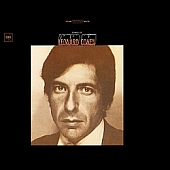 [by Ken Hunt, London] On its release Cohen’s Songs Of Leonard Cohen (1967) was more than a strained-voice recapitulation of what we already knew through Judy Collins, the song interpreter who had done so much to introduce the Canadian songwriter on her In My Life (1966) and Wildflowers (1967). Cohen’s delivery on his debut’s ten-song album was so much more world-weary, more experienced, more laconic, more droll. (Listen to Teachers and One Of Us Cannot be Wrong for serious drollery, the sort of humorous insight that bedded any number of muses). His voice would never match Collins’s dexterity, so he made a virtue of his limitations. On his Suzanne, So Long, Marianne and Sisters Of Mercy, Cohen seemed experienced in sensuous ways that would have made Judy Collins or Pete Seeger blush. Cohen seemed removed from Seeger’s world of impassioned politics, but that was a blinkered take on things (as his second album Songs From A Room revealed). Two hitherto unreleased bonus tracks – Store Room and Blessed Is The Memory – outtakes from the album’s John Hammond-produced sessions round off the original album. They add little great insight beyond the editorial process but they are welcome.
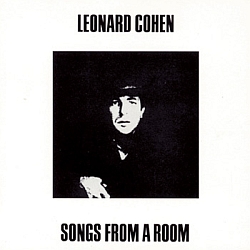 Though Anthony DeCurtis’s three accompanying essays don’t make the link, Leonard Norman Cohen, born in September 1934, was a child and graduate of the Canadian socialist and communist youth movement. Cohen’s dipping into The People’s Songbook (1948) with The Partisan on Songs From A Room (1969) made his politicised past explicit. Bird On The Wire, Story Of lsaac (introduced by Collins on her folk-rock masterpiece Who Knows Where The Time Goes?) and Seems So Long Ago, Nancy were and remain in an altogether different league. The album’s bonus tracks, Like A Bird – an earlier version of Bird On The Wire – and Nothing To One – ditto, You Know Who I Am – are both recordings produced by David Crosby in May 1968.
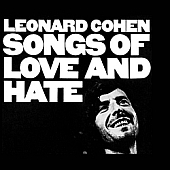 The cover artwork of Songs Of Love And Hate (1971) seemed stark and spare even by Cohen’s standards. White characters on a black background. At its black heart was Dress Rehearsal Rag – a different sort of Hesitation Blues and a jewel-like monstrosity of the story-teller’s art dealing with doing away with yourself. Or not. When Cohen released his own version of Dress Rehearsal Rag, the Velvet Underground had a head start when it came to morbidity – the whip-hand on bleak, so to speak – and Collins had premiered the song as long ago as In My Life, but Cohen’s take on suicide shone. Joan Of Arc and Famous Blue Overcoat also appear here. The bonus track is a 1968 try-out of Dress Rehearsal Rag in a band arrangement including drums (the instrument of choice for eschewal on Cohen albums) and a flowing mandolin.
The eye-popping chapter and verse of the story of Leonard Cohen getting rooked ran and ran in the press during 2005 and 2006 as the trial against his former business manager unfurled. Millions went walkies while he sat and contemplated on a Zen Buddhist retreat in sunny southern California. Cohen’s back-catalogue has long deserved a caring reissue of the Columbia Legacy kind. If Cohen’s financial misfortune played any part in prompting the reissue of these first three albums of his then that is, without a whiff of Schadenfreude, our good luck. Three lustrous albums.
Songs Of Leonard Cohen Columbia Legacy 88697 04742 2 (2007)
Songs From A Room Columbia Legacy 88697 04740 2 (2007)
Songs Of Love And Hate Columbia Legacy 88697 04741 2 (2007)
This review first appeared in fRoots issue 292 (October 2007).
16. 4. 2009 |
read more...
« Later articles
Older articles »