Articles
 [by Ken Hunt, London] Uriel Jones was one of the largely unsung heroes of popular music. His drumming added the muscle and sinew to many of the great hits that came out of his birthplace and hometown, Detroit, for he was a leading member of the Motown house-band, the Funk Brothers. He played on sessions that became international hits including Marvin Gaye’s I Heard It Through The Grapevine, Stevie Wonder’s For Once In My Life, the Temptations Ain’t To Proud To Beg, I Can’t Get Next To You and Cloud Nine, Marvyn Gaye & Tammy Terrell’s Ain’t No Mountain High Enough and Smokey Robinson & The Miracles’ I Second That Emotion during a period when Motown was an essential element in the soundtrack to people’s lives.
Born in Detroit, Michigan on 13 June 1934, it looked as if he would choose the trombone as his instrument. However, boxing and trombone embouchure did not mix and under the sway of the jazz drummer Art Blakey in particular he took up the drums seriously. In due course he fell into the orbit of Detroit’s rising pop label Motown.
Motown was a production-line hit factory and the house band backed whichever act was in the ‘snake pit’ (as the house studio was nicknamed) that day, up to six days a week. It was like a Bombay film studio with its succession of name playback singers following each other to lay down vocal tracks backed by the same session musicians. Yet while the likes of The Supremes, Marvyn Gaye & Tammy Terrell, the Four Tops and Smokey Robinson & The Miracles got the kudos and the glamour and became household names, the backing musicians were anonymous, uncredited on the singles or album jackets and on weekly salary. This was still seen as disposable music – ‘culture’ would not have had a look-in – and it was decades later that Uriel Jones and his fellow session musicians received overdue credit for their sterling work and contribution to popular culture.
Jones was not the only Motown drummer yet those song credits give a flavour of his achievement. The Funk Brothers, as they became anointed, had been part of Berry Gordy’s hit machine from the label’s inception in 1959. Benny Benjamin and Richard Allen preceded Jones but, with sales increasing and Benjamin’s efficiency diminishing, Jones joined the team in 1964. His entrance was timed to perfection for the great upswing in Motown’s fortunes. He was more a session musician though because he also went on the road with Motown acts on occasion.
Uriel Jones and the Funk Brothers got their belated recognition with director Paul Justman’s documentary film Standing In The Shadows of Motown (2002). Its tagline said, “The best kept secret in the history of pop music”. In 2004 the Funk Brothers received a Grammy Lifetime Achievement award with a citation acknowledging that they had had a hand in “more No. 1 hits than the Beatles, Elvis Presley, the Beach Boys and the Rolling Stones combined”. He died in Dearborn, a part of Detroit, on 24 March 2009.
1. 4. 2009 |
read more...
 [by Kate Hickson, Berriew, Wales] In the 1980s Swing 51 magazine would occasionally receive small packages from the United States containing cassette tapes merely identified as ‘Citizen Kafka’. It felt like the sort of deception the musical prankster Hank Bradley might perpetrate. However, Bradley’s looked and sounded different. Infuriatingly, the sender’s mailing address was missing and the US postal service was clearly in on the wheeze because every postmark came smudged to illegibility by bureaucracy. It felt a bit like a twofold conspiracy at the time. Prague folk might call it bonus Kafka-esque.
Citizen Kafka, it finally emerged, was an alias of one Richard Shulberg. He also rejoiced in the noms de télégraphie – wireless or radio aliases – Sid Kafka and The Citizen. As Johnny ‘Angry Red’ Weltz (the alias of fiddlin’ Kenny Kosek) wrote, The Citizen died – “(changed dimensions), (flipped incarnational polarity)” – on 14 March 2009 of a heart attack at his Brookyn home. He was aged 61. Richard Stephen Shulberg was born in the Bronx on 20 November 1947 and raised in Brooklyn.
He produced and presented broadcasts on the Pacifica Foundation’s WBAI-FM station for The Citizen Kafka Show, naturally under his main alias. Later he did The Secret Museum of the Air with Pat Conte for the same station and subsequently for WFMU. Secret Museum in turn produced spin-off anthologies for Yazoo (but they were too diffuse to hit the spot for me). In one 2000 article in The New York Times, Shulberg claimed to have done time as “an opal prospector, a film projectionist, a theremin player and an antiques vendor”. Not only did he collect records, evidently he collected jobs.
However, it was as a musician that he came into Swing 51‘s orbit. Richie Shulberg first entered the overseas consciousness as the central figure in one of New York’s finest musical collectives, the rather good Wretched Refuse String Band. Just as the Bonzo Dog Doo-dah Band were The Bonzos, they were The Wretcheds. WBAI’s Ed Haber was the Wretcheds’ champion. (Before each Citizen Kafka Show Haber would caution, “This show contains frank language.”) They played bluegrass and what was then being called newgrass. It was Ed Haber who sent a copy of the Wretched Refuse String Band’s Welcome To Wretched Refuse (Beet Records BLP-7003) to the magazine around ’80 or ’81. Their music had a manic vibe about it. In their playing was – and is – all the joy of life. It also had a cryptic reverence masquerading as irreverence that combined to create a true listening experience. And humour, lashings of humour.
And that woebegone name? It comes from the writer Emma Lazarus’s sonnet The New Colossus (1883) welcoming émigrés to the New World symbolised by the Statue of Liberty. She says,
“Give me your tired, your poor, Your huddled masses yearning to breathe free, The wretched refuse of your teeming shore. Send these, the homeless, tempest-tost to me. I lift my lamp beside the golden door!”
Fittingly in a very Wretched Refuse String Band way, the poem has been twisted into parody verse and worse.
The Wretcheds’ ‘only-child’ LP was reissued in 1994 in an expanded CD edition. (They also made appearances on a couple of albums on the Biograph label from the Fox Hollow Lodge String Band Festival but they don’t count.) Its track listing and composing credits makes for interesting reading. The CD includes material credited to the tradition, tunes by the father of bluegrass Bill Monroe and his electric guitar-wielding newgrass shadow Jon Sholle, a Thumbelina turned Hans Christian Andersen renegade, Andy Statman, Kenny Kosek, Roger Mason, Richard Shulberg’s party piece The Wheels of Karma and Statman’s Shulberg in Vilnus. Founding and/or/into later Wretcheds included banjoist Marty Cutler, drummer and percussionist Larry Eagle, guitarist Bob Jones, fiddler Alan Kaufman, bassist Roger Mason and mandolinist Barry Mitterhoff.
The Wretcheds polarised opinion. But listen to The Wretched Refuse Theme or The Wheels of Karma and you get a measure of their impact, why Richie Shulberg fit right in and why they made more people smile and groove than they ever hacked off. They remain one of a kind. Just like Citizen Kafka was one of a kind.
Wretched Refuse String Band Alcazar 117 (1994)
For services past, present and future thanks to Ed Haber and Ellen Jones.
Larry Eagle has posted videos of the Wretcheds in all their grainy glory from their 30 May 2008 gig at the Jalopy in Brooklyn. They give a flavour of the band and The Citizen. Watch, marvel and laugh along.
The Wretched Refuse Theme
http://www.youtube.com/watch?v=1l__lUsg1Fo
The Wheels of Karma
http://www.youtube.com/watch?v=c1_pYskx7Rg
Redwing
http://www.youtube.com/watch?v=SD9NIiQvaPM
22. 3. 2009 |
read more...
 [by Ken Hunt, London] Lest we forget, Hungary was directly responsible for the ultimate Fall of the Berlin Wall in 1989 and, likewise, lest we forget, Hungary’s strong and vibrant folk and roots music scenes have had a huge influence on Europe’s folk and world music scenes for longer still. My first brushes with Hungarian music came through having my ears turned and recalibrated by LPs on the Soviet-era state record company Hungaroton and UK releases on Joe Boyd’s Hannibal label. Things have got continually better. With musicians of the calibre of Szilvia Bognár in the vanguard of developments and consolidations, it is no wonder that Hungary’s roots music scene is in such fine fettle. Szilvia Bognár’s Semmicske énekek is what Hungary sounds like right now and it is spectacular.
Alas I am still biding my time until see Bognár perform as a headlining soloist. As a singer I have seen her perform live with the Budapest-based band Makám (and here on Semmicske énekek Hegyen s földön/Mountains and Valleys carries Makám-esque echoes) and as part of the miraculous trio with Ágnes Herczku and Ági Szalóki fronting the Szájról Szájra (‘From mouth to mouth’) project. Bognár belongs to that select pantheon of singers everyone should strive to listen to before the Grim Reaper scythes each and every one of us down. Or, put it this way, if I were in a lifeboat on an ocean or even Lake Balaton after a cultural shipwreck and got my pick of choice singers to be shipwrecked with, Szilvi would be singing her lungs out.
 Semmicske énekek/Ditties is her follow-up to her luminescent 2006 album Ének őrzi az időt/Songs preserve the heartbeat of time. They are works within an impressive continuity of creativity. Once again Zoltán Kovács is the composer-arranger for Semmicske énekek‘s music. The instrumental palette is little changed with a blend of contemporary and traditional instruments. Saxophone, shepherd’s flute (furulya), oud, guitars, gadulka (Bulgarian spike fiddle), kaval, violin and percussion of various kinds all feature. Her Szájról Szájra companions – the Agneses Herczku & Szalóki – join her on three tracks. The ones in question are Te kislány/Little Girl, De jó együtt/How Fine It Is Together and Szemünk-lelkünk/Our Eyes And Souls, while Szalóki adds vocals on Ádil hullám/The Waves of [the River] Volga.
Although born in 1977, Szilvia Bognár brings the wealth of generations of experience of her art, art beyond her years. Her voice, tone and timbre on Semmicske énekek brings new sense and meaning to the word ‘natural’. There are all manner of layered qualities to her voice as she sings of love, sings farewell to the figurative bride, sings for the jilted and lovelorn. For example, there is the lonesome plaintiveness to Este van/Evening Has Come that Péter Bede’s saxophone and István Pál’s violin subtly underpin. When you hear her sing Ága-boga/The Flowers of the Wreath you know you are as much in the world of sublime expressiveness as the world of folkloric symbol. Similarly, when she and János Gerzson’s oud raise Hungarian shades of the Ottoman Empire on the Bulgarian folk song, Zaljubih/Mother, I Fell In Love the wedding match is perfect, not forced. And when she sings the jilted woman’s song Kék szivárvány/Blue Rainbow she brings desolation and bewilderment to bear on a tale of betrayal. It is reminiscent of why Shirley Collins’ depiction of The Blacksmith likewise reveals the high art in folk poetry.
 Semmicske énekek – ‘Ditties’ just doesn’t work as a translation for high art in small or ‘low’ songs – is a masterpiece, not merely one of the year’s masterpieces. It is hard to communicate just how wondrous an instrument Bognár’s voice is. Her voice is totally under the skin of what we call folk music. When she first gave me her handmade business card, it stated her profession as ‘népdalénekes‘ or ‘folksinger’ and nothing I have ever heard from her lips has ever warranted revising that job description of hers. Hungarian folksong comes no better than this.
Semmicske énekek/Ditties Gryllus GCD 081, 2008 and Ének őrzi az időt/Songs preserve the heartbeat of time Gryllus GCD 057, 2006
Further information: www.kalaka.hu and www.bognarszilvia.hu
22. 3. 2009 |
read more...
 [by Ken Hunt, London] One of the great European jazz musicians of the Twentieth Century died at the age of 81 on 20 February 2009 in Hoei (Huy in French) in the western Belgian province of Luik (Liege). The Belgian multi-instrumentalist, arranger and composer Sadi, actually Sadi Lallemand (he took Sadi as his name because he didn’t like something about the sound of his surname), linked many post-war developments in jazz and popular music.
Born in Ardenne in the northwestern Belgian province of Namen on 23 October 1927, he was drawn to jazz through hearing Louis Armstrong on record as a boy circa 1938 and, his musicality stirred, he took up the vibraphone, the instrument with which he was particularly associated, in 1941. During the German Occupation he built up his playing and was good enough to get work on the lucrative US military base circuit after the end of hostilities. After the War he also played with various Belgian bop bands.
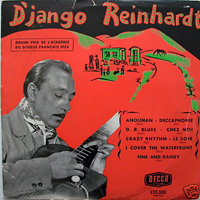
In due course he moved to Paris – one of the post-war magnets for jazzers and especially expatriate black US jazz musicians. From 1950 he found work there in the city’s thriving jazz clubs and played alongside top names such as Kenny Clarke, Sacha Distel, Stéphane Grappelli and Django Reinhardt. Sadi played on Reinhardt’s last Decca sessions on 8 April 1953. The session comprised, Charles Delaunay wrote in his early biography Django Reinhardt, Le Soir (‘The Evening’), Chez Moi (‘At [My] Home’), I Cover The Waterfront and Deccaphonie. Soon after Reinhardt was dead. The guitarist died at Samois-sur-Seine, near Fontainebleau in France on 16 May 1953.
Sadi, also nicknamed Fats (for example, on the Reinhardt session), was extraordinarily versatile and also played in orchestral settings, notably the orchestra of Michel Legrand and after his return to his Belgian homeland in 1961 with RTB (Belgium’s equivalent of BBC), Henri Segers Orchestra and the Kenny Clarke-Francy Boland Big Band. He recorded as a soloist and bandleader in his own right from 1953 for Vogue, Manhattan, Polydor and Palette.
12. 3. 2009 |
read more...
[by Ken Hunt, London] Oh, he was a one!
 “Jamie, come try me,
Jamie, come try me,
If thou would be my love
Jamie, if thou would kiss me love
Wha [who] could deny thee
If thou would be my love, Jamie?”
Wilily the writer is putting his words onto a woman’s tongue, the woman he wishes to get to know better. Or, in plainer talk, seduce. Thus when Eddi Reader flirts entreating the man – the very author of the words pulsating on her lips – to try her, there is a delicious, besotted undercurrent of contrary sensuality in flow. That is Eddie Reader and Robert Burns for you.
On Eddie Reader’s lips – even with the Royal Scottish National Orchestra, as on The Songs of Robert Burns blasting away in support – that song, Jamie, Come Try Me, is a song of sensuality, seduction and ambiguity. Ambiguity, because we can only imagine the inevitable ending of this piece of come-hither theatre. Mind you, the way Eddie Reader sings it, her performance makes destiny plain. And that inevitability is plainer still when she sings Jamie, Come Try Me without the orchestral flourishes on one of her live releases. Live: Newcastle, UK 24.05.03, for example.
England and the world have their William Shakespeare. Russia and the world have their Alexander Sergeyevich Pushkin. Elsewhere, when it comes to the international stage, few nations have produced a literary giant to compare with Scots poet-sangster Robert Burns (1759-1796). Likely as not, time will see Bob Dylan as similarly internationalist but that is a judgement for posterity not for here and now, for none of us will ever know that with the certainty that we can say that of Burns, Pushkin or Shakespeare in our lifetimes. That is not to say that Burns had an easy ride during his lifetime or his work has had an easy passage since his death. There is a lot of tartan and haggis out there to sidestep.
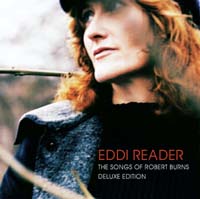
In August 2002 the Eddie Reader of Perfect and Patience of Angels returned to home to Glasgow and she threw herself into a Robert Burns project involving the likes of double-bassist Ewen Vernal and multi-instrumentalist Phil Cunningham for the January 2003 Celtic Connections festival. The Songs of Robert Burns was originally released in 2003. It re-appeared in an expanded edition in January 2009, timed to coincide with the 250th anniversary of Burns’ birth. In many ways though Eddie Reader’s roots lay in Irvine however, not Glasgow.
Eddie Reader and Ken Hunt talk about Burns
 Eddie Reader: In Burns’ day Irvine was a massive port and he met all these merchant sailors there. They taught him about drinking and women and song. When he was living in Irvine, he was trying to become a flax dresser. He ended up living in Irvine for a year and a bit. He wound up getting really ill. Eventually he had to come home because he only had a bag of oats left to last him six months. While he was in Irvine he’d write things like “Dainty Davie” and he met a wonderful sailor called [Captain] Richard Brown. The guy really influenced him. He wrote lots of poems about him.
You couldn’t help but be affected by the countryside, the sea and the harbour.
Ken Hunt: If I’m writing about something I love visiting the places where things happened. Do you do that at all? Talking about Burns specifically. To feel the vibrations. I know that sounds a bit hippy, but you know what I mean.
 I know exactly what you mean! Doesn’t everybody do that? I hope. I absolutely adore the history of something.
I was talking to Natalie MacMaster about this. She’s so sweet when she’s playing and I know when she’s playing it’s her genetics that are playing, not her. I look at her in her modern clothes and it’s like someone else’s fingers, her great-great-grandfather’s fingers, are moving. I said to her what it is to me is when you get a song and it’s almost like finding a bit of gold in a junkshop, the junkshop of human emotions. You find what someone has written 300 years ago is equally as relevant as something written today. When you find it in a book or you go and visit, say, Burns’ house and you know he actually stood on the step there, leant over that bed, poured over that sink or picked up a kid from that floor, it always makes something a little bit more real. Definitely. You can identify on a human level because you do these things now, so you know they must have done them all. It’s great for me the more involved I get in Burns. As I walk into a graveyard, there’s the grave of Jessy Lewars, who he wrote O, Wert Thou In The Cauld Blast for and who nursed him.
I go to Mauchline where Burns was brought up from the age of 16 through to when he left to become a star in Edinburgh at the age of 28. Those ten years in Mauchline he became a star in the town. The good thing about Burns is that most of his poetry is about people. It’s a description of somebody or a story about somebody. All of these people existed. They were real. They wouldn’t be mentioned hardly at all probably if it weren’t for this little guy wrote some poems about them. I get a great sense of affection for Burns and most of all when I’m in his environment. Definitely.
Do you get a sense of serenity from that…
Well, I’m quite a serene person anyway, I think.
…in a sense of heightened serenity?
 I’m very excited when I’m finding these things and I’m in that environment. I commune with… Actually, I think I probably feel more removed from the character of Burns when I’m visiting a house, much more than when I’m singing the songs. When I’m singing the songs I feel like he’s singing them with me. Or he’s watching me or dancing with me. Or whatever.
I’m much more connected to him and who he was when I’m singing the words.
Is there a sense of being energised?
Energised as well. Definitely energised. I’m never tired when I’m singing Burns’ songs. My voice never tires. There’s no hard work in it at all. Energised, yeah, more so than being in a house that’s been whitewashed three million times. And maybe the mattress isn’t the same! Visiting his old haunts definitely fills me with joy. When I see them for the first time it’s wonderful.
Photographs: Colin Dunsmuir, courtesy of Rough Trade. All rights reserved.
Eddi Reader The Songs of Robert Burns Rough Trade RTRADCDX097, 2009
To follow Eddie Reader’s activities http://www.eddireader.co.uk/ is the topmost of top tips.
12. 3. 2009 |
read more...
 [by Ken Hunt, London] Wherever there is a successful film industry, like the penumbra to the klieg lights, film magazines will mushroom in order to feed people’s apparently insatiable appetite for news – planted or otherwise – and tittle-tattle. In the Anglophone world, from Picture Show (when ‘picture’ was the British Empire equivalent of ‘movie’) to the “Hollywood girls and gags!” of Movie Humor, cinema was well served from the silent era onwards. But India’s was, is and shall ever remain a special case.
India has long been home to the world’s biggest film industry. Numerically and in terms of cultural penetration it outstrips Hollywood. Yet it is more than Bollywood. It includes the other major cine-woods – notably Kollywood (the Kolkata-based, Bengali equivalent), Mollywood (the cinema of Kerala in Malayalam), and Tollywood (the Chennai-based Tamil film industry).
Cinema spread like commercial wildfire in the Indian subcontinent from the 1890s, further to the brothers Auguste and Louis Lumiere showing their first reels in Bombay in July 1896. In a country in which illiteracy or near-illiteracy is still the norm in many states so many decades after Partition in 1947, silent film engaged and caught the public imagination with religious dramas, tales of the supernatural and slapstick, visual comedy. They transcended language and literacy skills. They glued the nation together and became a sort of neo-folklore. They re-defined and determined what popular culture meant. Film became the dominant cultural medium, displacing travelling companies and traditional theatre.
The arrival of film song
 In 1931 India launched its own talkies. Ardeshir M. Irani’s adaptation of a Parsee drama Alam Ara (‘Light of the world’) narrowly became India’s first talkie. Irani gave the subcontinent its first filmi sangeet (‘film song’) singer in W. M. Khan. Importantly, he used the same device – song and music – that the peripatetic theatre companies had used and were still using. Alam Ara became a hit that travelled too. A hit in India could be a hit too in, for example, Ceylon and Burma. Just as later Bombay film industry movies were hits in other continents in ways that Hollywood could not be. Hollywood came to epitomise Amerika, its values, its cultural myopia and especially its foreign policies. Bollywood films were and remain both neutral and, in the main, escapist. They carry none of the neo-imperialistic baggage of Hollywood.
Song – filmi sangeet – was the magic elixir that cinema-goers gulped down. The unlettered with ‘compensatory’ oral skills left having learnt the catchiest songs on first pass or a close enough take on the song to sing what passed as it to friends and family. Where once silent cinema had used mythic and religious stories to attract audiences, music now was the new universal element. That and spectacle. Increasingly song ‘choreographed’ to lavish dance scenes may have dislocated and suspended the narrative flow but they made borderline hits hanging on a whim and a prayer box-office magic. One great song could launch a film into the financial stratosphere.
 Cinema magazines
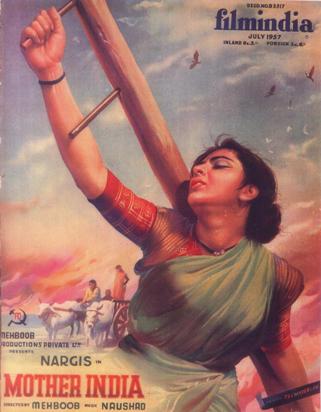
The film industry appreciated the power of words in print. People bought commemorative programmes for the film. These souvenirs had eye-grabbing cover graphics (often of the highest pictorial and printing standards), film credits and plot synopsis. They also had the printed lyrics to songs. These might be in Arabic or Shahmukti script and Devanagari for Urdu and Hindi readers respectively. The Mother India painting on the cover of Film India above is typical of the quality of these souvenir programmes’ artwork and shows why they were so prized.
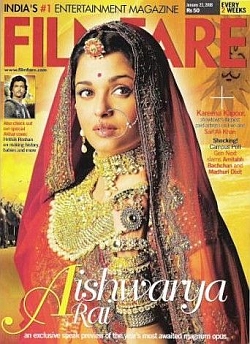
But from early on, the Indian film industry was also well served by film magazines. Bollywood may get the lion’s share of attention at home and abroad but cinema coverage has always extended (if an absolute like ‘always’ can ever be said or permitted) to regional cinema in regional languages. As a sociological phenomenon, India’s film magazines – and its letters pages – are the litmus test of the duality of conservatism and changing cultural and moral values. Yet whether discussing Dev Anand or Amitabh Bachchan, Helen or Aishwarya Rai, Guru Dutt or CyberIndian SFX, the coverage has stayed true to the lakh (100,000) and crore (100 lakh or 10,000,000) principles of success and failure.
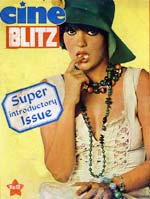
As happened in Hollywood and Britain, Indian film magazines swiftly tapped into allure and celebrity, the stock-in-trade of today’s English-language titles like Cine Blitz, Filmfare (or Film Fare), g magazine, Movie and Stardust. With the arrival of the talkies in India, the hunger for titillation through alleged liaisons and rumoured off-screen snogs steadily grew. During the 1930s, publications like The Cinema, Film India (or filmindia) and Filmland dominated the English-speaking readership. Film India, the brainchild of Baburao Patel, was especially influential and Patel’s eviscerating reviews were greeted with grimace and glee in varying measures.
 Between the 1950s and 1970s, a slew of new titles arrived. These included Film World, Filmfare, Madhuri, Screen, Stardust and Star and Style. Some survived. Most were gobbled up or went under. Following the Darwinian model though, when one went under other magazines appeared. Cinemaya (maya fittingly means ‘illusion’), launched in 1988, was but one that plugged a gap.
By the 1970s Stardust was arguably the market leader. Still, Filmfare had its prestigious awards that bolstered its reputation. The awards polarised and still polarise opinion – especially when a particular film, actor or song failed to scoop a particular award. Never underestimate controversy.
The Bombay-based Cine Blitz proved a particularly important title. Its launch issue in December 1974 rang bells like a sure-fire attention grabber. Prominent was a piece about flower-child Protima Bedi, later a gifted Orissi classical dancer. It came with photos of her streaking – a gesture of liberation and progressiveness unparalleled in denial-ridden, pseudo-moralistic India – on Bombay’s Juhu Beach. Of such circulation fillips are lakhs made.
 Regionally based bilingual titles such as the English-Gujarati Ranjit Bulletin also emerged. They were, to home in on Gujarati, today’s Abhiyaan (roughly something between ‘work’ and ‘mission’) and its forerunners like Cinema Sansar (sansar, as a word, summons a serried bank of meanings including ‘home’ and ‘humanity’) and Moj Majah (‘Enjoyment’). Elsewhere in the subcontinent, print and online publications devoted to cinema have flowered. Malayalam has its Villinakshatram and Chithram and Kannada its Viggy and Chitraloka. Many have bilingual presences. There are many more examples beyond the Bollywood blogster hordes.
The National Film Archive of India
First established in 1964, the National Film Archive of India (NFAI) is an organisation based in Pune with repositories in Bangalore, Kolkata and Thiruvananthapuram. Affiliated to the International Federation of Film Archives, the Pune site houses the ever-expanding national collection of film-related holdings with some 50,000 books and Central Board of Film Certification scripts, censorship records from the 1920s onwards and the main national archive of periodicals from the early 1930s onwards. Month in, month out, the NFAI acquires all the nation’s most important newspapers and periodicals on the subject – an indication of the commensal relationship between India’s press and the subcontinent’s film industry. Come the day its website expands, www.nfaipune.gov.in will become a useful tool internationally worthy of an international cultural phenomenon.
 The paradox
The major paradox is that, given the scale of music’s contribution to the industry, how little serious attention film music got historically and generally gets nowadays. Although, in the parlance of the time, “Miss Nurjehan” graced the cover of The Cinema as far back as 1931 – albeit, at the risk of blowing the relevance of the citation, as an actress rather than as a playback singer – the only publication that has consistently carried in-depth coverage of the Indian music scene is Screen, Mumbai’s weekly broadsheet-style paper. Through its succession of historian-minded journalists and name columnists such as Mohan Nadkarni reflecting on classical music from A. Narayana Iyer to Bhimsen Joshi and Rajiv Vijayakar doing detailed Q&A pieces about people like the Saawariya and Bhool Bhulaiyaa songstress Shreya Ghoshal, Screen has proved itself the magazine since the 1950s with, arguably, the keenest grasp of music in its Indian film context.
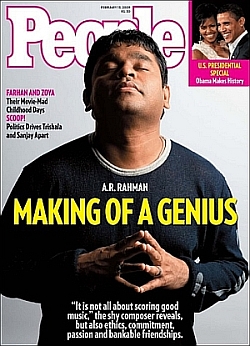
 Indian cinema is big business. Just as Filmfare covets an Aishwarya Rai or Kareena Kapoor front cover and interview, mainstream titles like Vogue India or India Today want the sales boost an Aishwarya Rai cover brings. It is interesting that titles like People and Rolling Stone are covering Bollywood’s musical side now. Nowadays a musical phenomenon such as A.R. Rahman merits the full front cover treatment. Of course, Rahman comes trailing clouds of glory such as Bombay Dreams, Lord of the Rings and Slumdog Millionaire. (Tellingly none of them is Bollywood.) It is a far cry from Mojo commissioning me to write an article about Rahman and then retracting the commission after the interview was in the can because he was deemed a month later to be far too obscure to merit a single column inch.
This leads us to that final question: that paradox. Given the importance of filmi sangeet in as the world’s most popular popular music form, where beyond the Lata Mangeshkar biographies are the magazines and books dedicated to India’s film song? Where is the detailed and in-depth coverage of this extraordinary popular music that out-performs rock, rap and reggae?
The good thing is that this feels curiously like being on the brink, like being witness to an exhilarating period. As happened, to give Western examples, when small magazines started running informative and informed, in-depth and passionate articles about rock or folk or punk as a reaction to the mainstream music press still treating those phenomena as mere youth crazes or passing fads. For, after all, when all is said, done and debated where would Indo-Pakistani film be today without filmi sangeet?
Ken Hunt is the author of the chapters on the Indian subcontinent’s music in the second and third editions of The Rough Guide to World Music. He compiled The Rough Guide to Asha Bhosle (World Music Network RGNET 1131 CD, 2003), The Rough Guide to Lata Mangeshkar (RGNET 1132 CD, 2004), The Rough Guide to Mohd. Rafi (RGNET 1133 CD, 2004) and The Rough Guide to Bollywood (RGNET1179CD, 2010).
3. 3. 2009 |
read more...
 [by Ken Hunt, London] One of high-flyingest jugalbandis (duets) in Indian music it has ever been my utter pleasure to witness took place on 25 December 2008. It occurred on the opening day of the 133rd Harballabh Sangeet Sammelan in Jalandhar City in the northwest Indian state of Punjab. It was a North-South jugalbandi. The North was represented by the transverse bamboo flute or bansuri maestro Ronu Majumdar and the tabla virtuoso Ram Das Palsule. The South was represented by the alto saxophonist Kadri Gopalnath and Hari Kumar on the South’s double-headed barrel drum, mridangam. The whole performance was a concatenation of revelations that told the rag‘s story marvellously. It also revealed the frankly heroic breath control techniques of the two wind players
The two principal musicians played Rag Hansadhwani, a rag (or more felicitously put a ragam) originally from the South Indian tradition. Like the better known Kirwani, Hansadhwani is a flagship Karnatic ragam that has found its niche – or nest – within the Hindustani repertoire. Its thematic content crosses the continents as well as the subcontinent, for it takes as its leitmotif the flight of the swan. The swan triggers art and symbol in every culture’s folklore and folkways wherever they live. Hansadhwani is but one Indian example. If this is a swan it is a whooping swan.
 Evocation, recorded at the Saptak Festival, Ahmedabad in the Indian state of Gujarat in 2007, predates the Harballabh Sangeet Sammelan by a year. Even though in the final analysis the Harballabh performance eclipsed it, the Saptak Hansadhwani is truly a magnificent flight of the imagination. Accompanying them on this recording are Abhijit Banerjee on tabla, Patri Satish Kumar on mridangam and Rajshekar on moorsing, an instrument elevated from plain old Jew’s harp to a solo percussionist’s lead instrument in South Indian culture. If calling Jew’s harp a percussion instrument sounds foolish, lend your ears to the moorsing tracks on Dr. L. Subramaniam’s never-beaten introduction to Karnatic music, the peerless An Anthology of South Indian Classical Music (Ocora C591001/2/3/4, originally 1990).
What really sets Evocation aside from the pack is the hyper-alertness of the two duettists to each other. The call and response playing during the second track (see track information below) is frankly electrifying and so far beyond the norm that even if you have never heard a single Indian classical record in your life you will instinctively know that you are in the presence of something extraordinary. Imagine what it sounded like to hear John Coltrane and Miles Davis together way back. However hard you may wish to deny it – and I tried to wean myself off such hyperbole, ultimately without success – Evolution will shake the ground on which you stand. I denied the evidence of my own ears for fear of hyping this album. If scales can also fall William Tyndale-style from the ears, Evolution is the best example I can recall of musical truths revealed in a decade. A masterpiece.
Photographs from Harballabh Sangeet Sammelan: (c) 2009 Santosh Sidhu and Ken Hunt, Swing 51 Archives
Kadri Gopalnath and Ronu Majumdar Evolution (Sense World Music 101, 2008)
Tracks: Rag Hamsadhwani alap (18:14); jor and jhalla (6:34); Hansadhwani/Pilu gat in addha taal (25;09); percussion solo 17:16.
www.senseworldmusic.com
24. 2. 2009 |
read more...
 [by Ken Hunt, London] Chancing upon the final-cut premiere of Alex Reuben’s film Routes was kismet. Alex Reuben is a DJ and filmmaker – British out of Ukrainian Jewish stock – with shorts like Big Hair (2001) and A Prayer From The Living (2002) to his credit. “I was a DJ so that’s how I started making films,” he tells me in Prague “Through the money I made DJing, that’s how I made films. All of the films are related to DJing in some way. More in the method I make them, though.”
Routes is the eye-catching offspring of Harry Smith and Les Blank. Picaresque, without spoken commentary, it is a fly-on-the-wall, fly-on-the-windscreen road movie about dance encountered on a journey through the Southern States of America. Reuben’s focus is dance, down-home and urban, dance steeped in tradition or dance stepped in emergent dance forms like clowning, krump and hiphop. It opens with a sequence of barefooting – a hybrid between clogging and a form of barefoot dancing associated with Negro slave ships – performed on a square of wood to fiddle, guitar, banjo and double-bass accompaniment. Only these are white feet dancing and white musicians pounding out dance rhythms at the Shindig on the Green in Ashville, NC. As he drives to New Orleans – the travel footage feeds the narrative, seldom seeming makeweight or ‘make-length’ – he encounters white, black and Native American dancers in settings that include solo dancers, family pair dancing and what looks like sprung ballroom, Cajun and zydeco, clowning, gang dance and, in New Orleans, second-lining and Mardi Gras Indian parading. “It was all pretty organic.,” he smiles.
In early August 2005 he arrived in Kentucky where he prepared and collated information and contacts. At the end of August he reached New Orleans, just after Hurricane Katrina struck on 29 August and just before the next strike. He had taken advice from, amongst others, Mike Seeger. Talking at the Q&A after the film’s premiere in October 2006, he recalls that Fats Waller’s was the first dance music that set his bones dancing and dry-mouths it was a piquant, bittersweet moment. His footage of streets devastated by Katrina’s stops at the ruined building that housed Fats Waller’s publishing company. It ends though as it began, enthused by dance music and dance.
A one-man film crew, Reuben began filming on the North Carolina leg with a HDV camera rigged to the side of the car so he could film road miles hands-free while driving. He also developed a two-handed filming technique with hand-held camera in one hand and microphone in the other. “I’m not always pointing the microphone the same place I’m pointing the camera,” he grins. “I tried to make the sound move, as if I’m drawing or painting in space. That’s why you get those variations in sound. Which I deliberately tried to do. I’m not interested in getting sound like you’d get from a mixing desk in a normal concert.”
Routes consciously builds on earlier work, whether David LaChappelle’s dance film Rize or Harry Smith’s Anthology of American Folk Music. He is aware of the baton thrust into his hand. Asked about the Harry Smith connection, he replies, “People think he was an anthropologist in that collection. When I looked into it and really listened to the reissue all the way through, I heard it completely differently. The Anthology is much more an artist’s project. For example, he was an expert on American Indian culture but there’s no American Indian music in the project, so it’s clear that he wasn’t out to make an anthropological study of all the music in the States.” A discussion ensues about Smith’s ethno-narcotic journeying.
“He was making a very personal connection between all those sounds. When I heard it, he programmed it like a DJ would select the set. It’s really like that. It really moves and builds to a climax. He’s categorised it. I wanted to collect dance and music in the same way that he wanted to collect songs. He thought it was going to be lost and die out. He used the term globalisation, which was interesting. Back then in the 1950s he used it. Which, of course, as we know, it hasn’t. I wanted to collect it in relation to dance.”
Routes contains the most eidetic dance sequence I’ve ever seen, courtesy of the Melrose Golden Girls. They are a bunch of split-second choreographed black cheerleaders performing krump moves like wide-eyed, psychedelised meerkats out of Mati Klarwein’s Annunciation, the painting that adorned the cover of Santana’s Abraxas album. Most people would have seen them as nothing more than a sideshow at a sports fixture. Reuben captures their perfection. The Melrose Golden Girls burn into the retina like nothing less than the hot sauce of community culture. From North Carolina to Louisiana, Routes captures a cosmopolitan, multi-racial, community-based America, the existence of which we forget at our peril. This is another sort of Americana. And one I can relate to.
A variant of this piece first appeared in fRoots issue 300. www.frootsmag.com
Photograph courtesy of Alex Reuben.
More at www.alexreuben.com
14. 2. 2009 |
read more...
[by Ken Hunt, London] It is October and the time of the season that has nothing of the Zombie or indeed Golem about it. Sitting in U Zavěšenýho, one of Prague’s minor miracles of a watering hole a stone’s throw from the castle, I am writing up notes about Prague’s MOFFOM (Music on Film Film on Music) festival. Loquacious as ever, I get into conversation with a French student from Grenoble. She is studying cinema in the city and studying film in this city makes total sense. Learning that I am working at the festival, we exchange viewing plans. Half an hour vanishes just talking about film and Prague’s cinemas. Her boyfriend has come from France to partake too. I leave them with a jaunty tourlou, a toodlepip, and carry off some wonderful insights into another cinéaste or cinephile nation’s appreciation of what we call in Czech pukka kino (‘true cinema’).
14. 2. 2009 |
read more...
[by Ken Hunt, London] Bang On A Can (BOAC) is an ensemble that blurs the boundaries between rock, the avant-garde and contemporary composition. Their concert in the Blauwe Zaal (‘Blue Room’) at DeSingel – a modernistic complex, founded, so to speak, on the deal that art is the basis and concrete of a culture – featured in its second half the headlining Czech vocalist-violinist Iva Bittová on her own or performing with BOAC. Note the hyphen because she does both at once and sometimes creates a third voice from the two elements in a manner that has to be seen in order to believe.
30. 1. 2009 |
read more...
« Later articles
Older articles »