Articles
 [by Ken Hunt, London] It’s one of those magnificently manipulative daughter-father lines. She is bending her father round her little finger. And both of them know it. Cyndi Lauper sings, “Oh daddy dear you know you’re still number one/But girls they want to have fun.” Girls Just Want To Have Fun became one of the most popular and most joyful English-language songs of 1983 and 1984. It appeared on Lauper’s She’s So Unusual (1983) and MTV picked up on its video to such an extent that it became their Video of the Year in 1984. The following year the song lent its title to a film staring Helen Hunt and Sarah Jessica Parker, though for some reason Girls Just Want To Have Fun the film didn’t use the Cyndi Lauper version of the song, plumping instead for a version sung by Deborah Galli with Tami Holbrook and Meredith Marshall. Nevertheless it still stuck close to the arrangement that Lauper had delivered. After all, Lauper put her stamp on the song in spectacular fashion.
The writer who handed her the raw materials to create such magic was Robert Hazard. Hazard was the stage name of the musician and singer-songwriter Robert Rimato. Born on 21 August 1948, his family was musically minded with his father Umberto Rimato singing in the Philadelphia Opera Company. Hazard was playing with the Philadelphia-based bar band Hazard and the Heroes with an EP to their name that was having some local success through the presence of two songs in particular Change Reaction and Escalator of Life when he had the inordinate good fortune to attract the attention of one of Rolling Stone’s roving reporters. Kurt Loder was sufficiently impressed to engage with Hazard and in November 1981 a very flattering article appeared in the magazine comparing him to Springsteen. It lifted him out of the position he had been in but ultimately it proved another regional signing that never matched the talk of national success.
Hazard’s own form of national success came from another direction. He had knocked off a song supposedly in 15 minutes whilst in a motel that, once turned into a calling-card by Cyndi Lauper, became an international success. Girls Just Want To Have Fun ensured that he was financially secure and while he kept making music and kept making albums – including The Seventh Lake (2004) and Troubadour (2007) – he also went into business selling antiques. Hazard died on 5 August 2008 in Boston, Massachusetts at the age of 59.
11. 10. 2008 |
read more...
[by Ken Hunt, London] You could hardly find a more thoroughly Swiss or Swiss-German gentleman than the folk musician Rudolf ‘Ruedi’ Rymann who died on 10 September at his home in Giswil in the Swiss Canton of Obwalden. In the public eye he was a musician and sportsman and by trade he was a farmer and cheese-maker. In retirement he was also a huntsman. He epitomised Swissness.
11. 10. 2008 |
read more...
[by Ken Hunt, London] The Guinean saxophonist and clarinettist, gravely voiced singer and songwriter, Momo ‘Wandel’ Soumah died in his homeland’s capital, Conakry on 16 June 2003. Of Baga tribal stock, he survived the, at times, perilous crossing from colonial times (exemplified by stints in dance bands with names redolent of the period such as La Joviale Symphonie and La Douce Parisette) to independence. During the socialist years of Sékou Touré’s presidency, an Afro-centric sound was de rigueur.
11. 10. 2008 |
read more...
 [by Ken Hunt, London] Peggy Seeger has sent a newsflash that she is happy for people to pass on. She and Jon Andrews have made a short video of her song Obama Is The One For Me. Grammy-winners Cathy Fink and Marcy Marxer have donated the instrumentation, backing vocals and recording expertise. And just to make things clear, she sent a caution:
Beware: this YOUTUBE video contains pro-Obama Material.
http://www.youtube.com/watch?v=j9wgVznm9OU
Please send the url on to whomever you want for whatever purpose.
For updates and information about Peggy Seeger, visit http://www.pegseeger.com/
Photo courtesy of Peggy Seeger
1. 10. 2008 |
read more...
 “Here’s to the Ronnie, the voice we adore
Like coals from a coal bucket scraping the floor
Sing out his praises in music and malt
And if you’re not Irish, that isn’t your fault” – The Ballad of Ronnie Drew
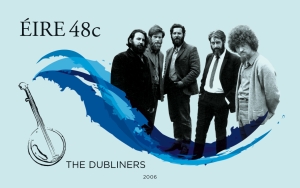
[by Ken Hunt, London] In November 2006 An Post – Eire’s Post Office – issued a set of four commemorative stamps with portraits of The Clancy Brothers with Tommy Makem, The Dubliners, The Chieftains and Altan on them. Each group added something special to Ireland’s appreciation of its own musical heritage and in turn to the wider world’s appreciation of Irish music. But there was never a folk band to compare to the Dubliners – the Chieftains were quite different – and in his prime Ronnie Drew’s voice was contender for the most distinctive in Irish music.
Born in Dún Laoghaire, Co. Dublin on 16 September 1934, the folk musician, singer and actor Ronnie Drew was a founding member of the Dubliners. Aged 27 he landed back in Dublin after having worked as an English-language teacher in Spain for some years. He fell in with a crowd that hung out at O’Donoghue’s pub in Merrion Row. (O’Donoghue’s features prominently in the annals of Irish folk music, but that is a tale for another time.) A band coalesced, initially under the name of the Ronnie Drew Group. With Joycian reinvention they jettisoned that name – much to Drew’s delight – and assumed a new name based on Luke Kelly’s current reading matter, James Joyce’s 1914 book of short stories, The Dubliners. As a name it sang a sense of regional identity and was both liberating and joyful.
What Ciaran Bourke, Ronnie Drew, Luke Kelly and Barney McKenna created together wasn’t so much a formula as a musical template. Over the next years there would be comings and goings but one of the most important characteristics of the early line-up was the contrasting vocals of Luke Kelly and Ronnie Drew. On their 1964 Transatlantic album (reissued by Wooded Hill Recordings, 1997), Drew’s voice on Love Is Pleasing is like a jackdaw creaking and chuckling across a clear blue morning sky. It was quite different to Kelly’s on Rocky Road To Dublin or Bourke’s on Jar of Porter.
Talking about the Dubliners after Drew’s death, Jenny Barton, who had run the Troubadour club in London’s Earl’s Court district during its 1960s heyday, laughed as she told me, “They weren’t always on time, they weren’t always sober.” But their music was powerful. And there was no band to match them on the British or Irish folk scene.
The Dubliners recorded extensively but one of their defining pieces was the folk novelty hit Seven Drunken Nights. It had once appeared in Francis James Child’s orderly tallying of Anglo-Scottish balladry as Our Goodman. By the time the Dubliners released it, it had been shorn of a couple of nights. It was the heyday of offshore pirate radio – before the Marine Broadcasting Offences Act of 1967 put paid to stations such as Radio Essex, Radio London and Radio Scotland. Radio Caroline just played the 45-rpm single over and over again. Indeed so repeatedly that it was plain that Major Minor – the record company – was ‘subsidising’ their playlist. The Dubliners had shifted to Major Minor after Dominic Behan had effected an introduction. We didn’t know the word payola back then in Europe.
 In Eire, RTÉ banned Seven Drunken Nights because of its bawdiness, though the ribaldry was more Carry On… film innuendo and hype than bawdiness per se. Still, as Jane Birkin and Serge Gainsbourg and the Sex Pistols would later learn and demonstrate, banning doesn’t necessarily kill sales. Seven Drunken Nights and Black Velvet Band were both hits in the UK. Drew’s time with the Dubliners was split between two periods: 1962 and 1974 and 1979 and 1995. Interestingly, the Dubliners and the Pogues went on to enjoy a minor hit with The Irish Rover – interesting because there was a sense of camaraderie across the generations with the two groups. Drew collaborated with many people but his collaborations with the ex-De Dannan singer Eleanor Shanley must be mentioned.
In addition to making music and mischief, Drew acted in theatre, film, television and revue. He came up with Ronnie I Hardly Knew You – a revue that toured internationally in the 1990s. The revue went to, amongst other places, Scotland, the USA, Hungary, the Czech Republic and Israel. It drew on folksong and the words of Brendan Behan (in whose Richard’s Cork Leg he had acted in the 1970s), Joyce (naturally), Patrick Kavanagh and Sean O’Casey.
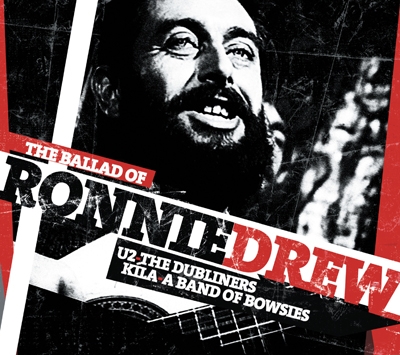
In January 2008 members of U2, Kila, the Dubliners and the Band of Bowsies went into Windmill Lane studios in Dublin to record a tribute song to Drew called The Ballad of Ronnie Drew. It was co-authored by the former Grateful Dead lyricist Robert Hunter, U2’s Bono and The Edge and Simon Carmody. ‘Bowsies’ is a Hiberno-English, that is, Irish-English, word connoting a disreputable drunkard or drunken good-for-nothing. Among the people who took on this affectionate moniker were Moya Brennan, Andrea Corr, Shane MacGowan, Christy Moore and Sinéad O’Connor. The song’s profits went to the Irish Cancer Society and it topped the Irish charts. In 2006 Drew had been diagnosed with cancer of the throat.
Ronnie Drew died on Saturday, 16 August 2008, in Dublin, at the age of 73. His obituary appeared the next Monday in The Daily Telegraph, The Guardian, The Independent and The Times in the UK – and that is no mean feat. At his funeral service in Greystones, Co. Wicklow, Phelim Drew came up with a telling anecdote about his father. According to Kathy Sheridan in The Irish Times of 20 August 2008, it concerned Michael Flatley allegedly making a million whatevers a week. “‘What would you do if you earned a million a week?’ Ronnie was asked. ‘I’d work for two. And then I’d stop’, he said.” Well, amen to that. “He was,” laughed Jenny Barton, “a hell of a character” – and on that score nobody could disagree.
Dedicated to Gill Cook (1937-2006)
For information of various sorts about The Ballad of Ronnie Drew, visit http://www.cancer.ie/news/ronnie_drew_song.php and watch the video at http://www.u2.com/highlights/?hid=437
2. 9. 2008 |
read more...
 [by Ken Hunt, London] At the beginning of the 1960s a new kind of folk scene started to develop in the USA. Overall, the scene consisted very much of localised affairs. In Colorado, Boulder was separate from Denver. The US East Coast scene, notably based around Boston and Cambridge in Massachusetts and New York operated independently of each other. Gradually they made contacts and connections. The dots joined up. Some New York musicians such as David Grisman and Jody Stecher relocated to California, for example. Artie Traum was part of the New York scene but by the late 1960s he was part of the bigger picture.
Guitarist, singer-songwriter and composer Arthur Roy Traum was born in New York City on 3 April 1943, younger brother to Happy Traum by five years. Early on, he accompanied the white blues singer Judy Roderick. He made his first recording with the True Endeavor Jug Band – The Art of the Jug Band (Prestige, 1963) – at the beginning of the 1960s. Nevertheless, he made much of his best-known and finest ensemble music with his brother, the Woodstock Mountains Revue (which also included his big brother) and the WMR’s pool of musicians such as Pat Alger (going on to form a partnership with him beginning with their From The Heart (Rounder, 1980). At one point he and his brother co-hosted the WAMC radio show Bring It On Home. The brothers’ names were very much entwined.
During the second half of the 1960s he also took up electric guitar and co-founded a very loud and quite floral rock group, variously, it would appear, known as Bear or the Children of Paradise (though both brothers referred to it only under the latter name in my presence). Co-founded with his brother, the band’s main claim to fame, once the ‘din’ had died down, was that the post-Happy Traum line-up delivered the soundtrack for Greetings. This 1968 film was directed by Brian De Palma – on his way to making Bruce Springsteens’s Dancing In The Dark video (1989) and such films as Bonfire of the Vanities (1990) and Mission: Impossible (1996). Historically speaking though, it was the first film to reach US cinemas in which Robert De Niro appeared in any role beyond that of an extra.
Coevally, a number of musicians coalesced around Woodstock, about 160 km north of New York, amongst them Happy and Artie Traum, Bob Dylan, The Band, Van Morrison and members of Janis Joplin’s Full Tilt Boogie Band (some of whom backed the Traums after her death). Happy moved to Woodstock – not to be confused with the festival of high renown – first in 1967 and Artie moved upstate soon afterwards. In Dick Weissman’s Which Side Are You On? – An Inside History of the Folk Music Revival in America (2005) the author recalls Artie house-sitting “one of the two houses that Bob Dylan owned in Woodstock” and his role as gatekeeper – meaning keeping people at bay so Dylan could maintain, as my father used to say, a modicum of privacy. The Band’s Rick Danko, Levon Helm and Garth Hudson would subsequently join a cadre of musicians that also included Bela Fleck and David Grisman when Artie made his Meetings With Remarkable Musicians (Narada, 1999). Its most poignant track in many ways was his duet Early Frost with his brother, though there is an added element there now since Artie’s death.
Albert Grossman took the two brothers as their manager and they signed with Capitol Records. They recorded two albums for the label – the first being Happy & Artie Traum in 1969 and the second Double-Back in 1971. With Grossman managing them they were positioned to open for a number of major headlining acts – coincidentally also Grossman acts – and appeared at the 1969 Newport Folk Festival. In 1970 Happy Traum who had been helming Sing Out! magazine through one of its finest periods had to relinquish the editorship with the pressure of work and outside commitments. The two brothers’ third album – this time for Rounder – called Hard Times In The Country (1975) was especially fine, with its exploration of Harry Smith’s Anthology of American Folk Music and the Pinder Family’s I Bid You Goodnight. It also included three Artie Traum compositions in No Depression Blues, Gambler’s Song and Gold Hill and came with liner notes written by the Beat poet Allen Ginsberg. Ginsberg’s ‘appearance’ was a returned favour of sorts. Like Dylan, Happy had done sessions for a Ginsberg album for the Beatles’ Apple label deemed too uncommercial (Subtitles: risqué) for public consumption – and scatological to boot – though it was eventually released on the Ginsberg collection Holy Soul Jelly Roll (Rhino Word Beat, 1994).
During the early 1970s, Jane Traum prompted her husband Happy one time during an interview with me, the brothers had put on a series of ‘& Friends’ concerts at the Woodstock Playhouse. This led to the formation of the Woodstock Mountains Revue, a loose collective including Pat Alger, Eric Andersen, Paul Butterfield, John Herald, Bill Keith, Maria Muldaur, John Sebastian and Paul Siebel. They made five albums but their finest hour came with the second, More Music From Mud Acres (Rounder, 1977). Artie Traum contributed two marvellous compositions Barbed Wire and Cold Front. (That same year his solo debut Life On Earth appeared on Rounder.) By the late 1970s, a touring band had coalesced. Two further WMR volumes were released in 1990 by the Japanese Village Green label entitled Live at the Bearsville Theater volumes one and two.
Artie had been moved by the music of John Coltrane, Miles Davis, Jim Hall and the Modern Jazz Quartet from early on. Jazz emerged as an important component in his music making. It led eventually to him recording a number of jazz-tinged albums. Letters From Joubee (Shanachie, 1994) contained ten compositions, all written or co-written by Traum, five of them co-credited to Scott Petito (also the album’s producer). Moroccan Wind was an outstanding example of his and Petito’s composing.
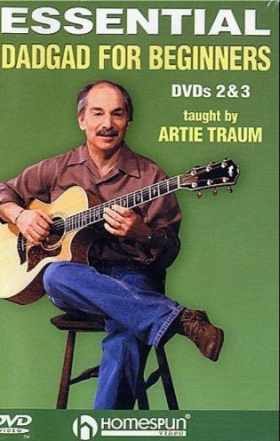
Later recordings include The Last Romantic (Narada, 2001), Acoustic Jazz Guitar (Roaring Stream Records, 2004) and Thief of Time (Roaring Stream, 2007). He also created a body of sterling audio/visual education materials, many for his brother’s company Homespun Tapes, amongst them, ones on DADGAD tuning and guitar accompaniment.
He died at his Bearsville, NY home on 20 July 2008.
15. 8. 2008 |
read more...
 [by Ken Hunt, London] The sixth London Mela returned to its spiritual homeland on the borders of Hounslow and Ealing to the west of London once again and once again it was a celebration cum fair, which is all mela means in several of the subcontinent’s languages. The blurb on the front of the programme proclaimed: “Eight zones with urban, classical and experimental music, DJs, circus, dance, visual arts, comedy, children’s area, food from around the world and a giant funfair.”
 The clarinettist Arun Ghosh closed proceedings on the Indo Electronica stage with a set drawing mainly on his Northern Namaste (Camoci Records, 2008) album. This time he fronted a quartet with Pat Illingsworth on kit drums, Liran Donin on string bass and Nilesh Gulhane on tabla. Ghosh, a highly physical player, shouldered all of the melodic parts and most of the solos. The weather immediately turned foully British with drizzle turning to rain (it being August). The quartet began with Aurora, a tune too good to leave the world without having heard. It got the dancers dancing in front of the stage despite the rain. The set stuck close to Northern Namaste‘s material but it was no replication of the performances on the CD. Variations aplenty occurred. At one point, Singing In The Rain emerged as a melodic figure. Early on, Ghosh and his black liquorice stick had jumped off the stage to freshen up in the rain.
 The performances expanded upon the recorded versions with, for example, an excellent percussion duet emerging during Come Closer. As the weather improved and the rain let up, the quartet pulled out a non-Northern Namaste plum or two. Ghosh’s lightly swung clarinet on Mongo Santamaria’s Afro Blue (popularised by John Coltrane), for example, mined rich new seams. Having run well over their allotted time and having been called back again and again for more, their visibly weary bandleader called their last number. He announced they were playing Aurora for those people who hadn’t been there at the beginning of their gig. The quartet actually eclipsed its opening version. It was a gig that confirmed Arun Ghosh as one of the most charismatic and imaginative performers on the British jazz scene. And he has the melodies to prove it. Aurora and Afro Blue are compositions to mention in the same breath and that is no journalistic hyperbole.
All photographs: Ken Hunt and Santosh Sidhu/Swing 51 Archives
15. 8. 2008 |
read more...
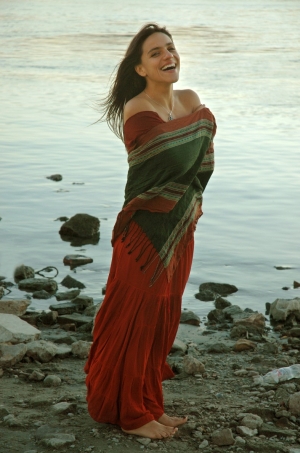 [by Ken Hunt, London] “There’s a lot of dancing in her music,” I say to the Hungarian dancer sitting next to me when the concert finishes. My observation about the performance has nothing to do with Beáta Palya as a dancer, little to do with her swaying or rockin’ in rhythm as she sings and everything to do with the way she sings. In a manner of speaking, Bea Palya sings from the haunches and the hips an awful lot. And what and how she sings is exceptional. The music she makes is Hungarian folk-crossed jazz or Hungarian jazz-crossed folk with other elements stirred in – chanson, for example, befitting her role in Tony Gatlif’s film Transylvania in which she plays the part of the cabaret chanteuse – that’s chantoozie in American-English.
The Palya Bea Quintet set at the Linbury Studio Theatre drew largely from her Adieu Les Complexes album. (Or inverted to English usage the Bea Palya Quintet.) Four of her seven accompanists on the album were on the stage with her at the Royal Opera House – they being András Dés (kit drums and percussion), Balázs Szokolay Dongó (soprano and sopranino sax, kavals and bagpipes), Miklós Lukács (cimbalom) and Csaba Novák (double-bass).
The concert itself was a blank canvas because Adieu Les Complexes was so new, even in Hungary, for the compositions to be unknown quantities. It was the first of two performances that members of the band did for the ‘Voices Across The World’ concert season. This one with its post-concert ‘Meet the Artist’ session – Palya and Peter Mills – was followed the next afternoon with a live soundtrack (“new music created and performed live”) session for writer-director Zoltán Fábri’s Körhinta (1956). The film’s title means ‘roundabout’ – as in magic (for those of a certain age) or A bűvös körhinta (for those who speak Hungarian) – or ‘merry-go-round’.
The Quintet opened with Adieu Les Complexes’ opening track – Hold (‘Moon’). In live performance its arrangement serves to introduce the instrumentalists sequentially. Hold is a wonderful vehicle for cimbalom in its combination role, much like piano, as melody and percussion instrument. At one stage Lukács took the ends of his two strikers and rubbed them on the strings to create some blink-and-you’ll-miss-it fleeting yet telling sonic variations. The magic is so often a combination of the visual and the musical in live performance. Clearly the night was unlikely to be a night of album replication. Hoppá became an audience participation song in ways that built on and outstripped the studio version with her cuing the audience to interject “Hoppá!”
Over the course of the set, she rarely left the new, non-Adieu Les Complexes repertoire. When she did it was spellbinding too. The Quintet delivered what might be called a mini-suite lifted from her Sándor Weöres-inspired album Psyché (2005). It consisted of Akrostichon, Minutes volantes III and Egy lovász fihoz. The last segment included a rip-roaring cimbalom solo. While the literary qualities of Weöres’ words about, she announced, the “life of a Hungarian woman”, were lost on me – his pieces appear in any number of Hungarian folk acts’ repertoire – the musicianship could not fail to deliver.
It was a case of trusting to feeling and instinct even though the literal truth soared and roared over one’s head. (As she announced in English, when introducing to Sometimes I’m Happy, “Emotion is international.”) Physically, she used her hands to chop and cut the air as she sang the Psyché song suite. And, after all, musical theatre at a venue such as the Royal Opera House is hardly going to go amiss. Like much of her performance the suite switched tempo and mood – soft and gentle to full-throated – with turn-on-a-forint timing and dexterity. The spaces in the suite’s arrangement with its telling ‘unsounded notes’ – rather like a khali or ’empty note’ in Hindustani tabla playing – and instrumental dropouts made for a remarkable ensemble performance. In a similar vein the bagpipe-driven Észoztó nagy szájhód (‘Big Mouth’) ended on an unplayed final note.
Her osmotic retelling of Lover Man started its journey as a Transylvanian folk melody before emerging as folk-jazz. She explained this in the Q&A talk and it was a light-bulb moment that good interviews achieve. It was one of those ‘Now I understand’ illuminations. Áll a kapun (‘My Prince Will Come?’) “about getting a husband – or not” began laconic and barely off lachrymose before hitting higher emotional registers. The Linbury Studio Theatre was one of those sorts of concert. Even the only piece that I had known beforehand, Pey-Dabadi – it’s only onomatopoeia but we like it – from her 2003 Ágról-ágra/Tradition in motion album was transformed. Its melding of Roma vocal rhythmicality in a ‘half-remembered’ Indian bols or rhythmic syllable sense was unerringly expressive and totally impressive. Put it this way: it was like a structure waiting to pounce. A remarkable concert and entrée into a remarkable album: Adieu Les Complexes. The Bea Palya Quintet delivered one of my concert highlights for 2008.
Further listening: Adieu Les Complexes Naive Sony/BMG (Hungary) 88697323112 (2008)
An interview (2007) in the Czech part of this website
Further information in Hungarian and English: www.palyabea.hu
27. 7. 2008 |
read more...
 [by Ken Hunt, London] Peter Kameron was a man who straddled many fields of the arts and entertainment. He was born in New York City on 18 March 1921 and went on to become the personal manager for a number of US music acts in the 1950s and the 1960s, signally amongst them, the Weavers and the Modern Jazz Quartet.
He broadened his approach and built on his expertise and experience to become part of the management team around The Who. They were a rather promising rock group whose Pete Townshend nevertheless made no bones about pitching songs to the folk scene to. (Something forgotten in the accounts.) Kameron was there when The Who set about establishing Track Records (1967-1978), headed by Kit Lambert, Chris Stamp and Pete Townshend. Kameron’s precise role in all this is ill-defined and unclear but he was there. Amongst the acts that recorded for the label were Crazy World of Arthur Brown, The Eire Apparent, Jimi Hendrix, John’s Children (with Marc Bolan) and Thunderclap Newman. It was a label with a vibe. In Polly Marshall’s The God of Hellfire – the Crazy Life and Times of Arthur Brown (2005), she quotes Arthur Brown saying, “We decided on Track, because they did The Who and because Pete was involved.” It was a label with cachet.
Kameron never stayed wholly within music, ducking and diving into independent film-making including You Better Watch Out, film score work and various publishing activities, most notably with the L.A. Weekly. Towards the end of his life, he channeled part of his money into endowing a chair at the UCLA Law School. He died at his home in Beverly Hills, California on 29 June 2008.
The illustration is the cover of Track Records 2406 002 (1970). Even then, the image was odd with its combination of Saskia de Boer’s dolls – the irrelevant presence of DJ John Peel, the Rolling Stone Brian Jones still confuse – and Graphreaks’ concept photographed by Peter Sanders.
19. 7. 2008 |
read more...
 [by Ken Hunt, London] Don’t you just love the thrill of unpublicised gigs? So long, that is, that the act delivers music worthy of the buzz and you attend. This nicely semi-secret Green Ray gig ticked all the boxes and more. The Dog House announcement just promised “psychedelic West Coast sounds” and an unnamed “special guest guitarist – all the way from San Francisco, the man who played Monterrey and Wood Stock Festivals”. Yup, two spelling mistakes in 18 printed words. The Green Ray are still improvising and pursuing that ol’ psychedelic Grail. Were they an American band they’d probably get saddled with the description ‘jam band’.
To say that the gig was unpublicised is bending the truth. A little. Its ‘publicity’ had a word-of-mouth or -email samizdat feel to it, worthy of the Plastic People of the Universe in their publicity-avoidance days. The A4-sized announcements downstairs in the Dog House were nicely grainy in a degraded photocopy way. Before the gig, scheduled for a civilised five in the afternoon, began and the upstairs room filled, the aforementioned “special guest guitarist” chortled in conversation how this one was “unannounced and unpaid”. And since this is the internet crawled over by search engines, let’s drop mystery and mystique into the compost bin of time. The guest was Barry Melton.
Thwarting expectations, two singer-songwriters opened with a calling-card set apiece. David Ferrard and his guitar opened the afternoon’s proceedings. Like Kim Beggs who followed, he was an unknown quantity for me. That unknown quantity quality extended to his speaking and singing voice, though his clarifications about his family background, life lived in Scotland and the USA and more explained his accent. Anyway, his accent is American and he took his set from his Broken Sky (2008) album. His opening song was Visions of Our Youth. It was – indeed is – an observational reflection on activism and, while one may smile and nod along in agreement, it is not a song to leave the venue singing. Sets such as this are snapshots. One Hell of a Ride, the concluder, felt little more than a rhyme scheme lassoing a melody, the stuff, without being too uncharitable, that fills out sets. Hills of Virginia may have an unmemorable title but the subject matter renders it second cousin to Utah Phillips’ Green Rolling Hills of West Virginia. In Utah’s song the miner looks back to what once was. In Ferrard’s song “the hills of Virginia” are a counterpoint to a tour of duty in Iraq. The tour gets extended – prompting the ironical money-line: “But then we were told/’Some of you here will be here for years/Better treat it like home.'” (A live version of the song is also on the Stop The War Coalition’s Not In Our Name in the good company of performances from Dick Gaughan, Robb Johnson, Amy Martin, Leon Rosselson and David Rovics and specially recorded, exclusive stuff from Roy Bailey & Martin Simpson and Jim Page.) The song that stuck the most was Dmitri’s Pocket Radio, a tale of an illegal immigrant to England turned asylum seeker. It even has a happy ending outro, the only part of the song that didn’t work for me.
Kim Beggs’ speaking and singing voice is decidedly Canadian. Stylistically speaking, her music falls between Canadian folk and country – a wide, vast territory that Ian & Sylvie first opened my ears to. Statistically speaking, most of her set came from Wanderer’s Paean (2006) though she also road-tested a song for her next album. She opened with Bucko – “C’mon Bucko/What I really want to do/Is two-step with you” being its limpet-on-your-brain refrain. Unlike her Wanderer’s Paean versions with their splashes of pedal steel, mandolin, basses, banjo and fiddle, here she was on her own and a long way from the Yukon. Walking Down To The Station, Lay It All Down and Ain’t Gonna Work from Wanderer’s Paean are all songs that would fit sweetly in the really early repertoire of k.d. lang. Maybe even Mama’s Dress too – which Beggs also did. The one that lodged was I Can’t Drive Slow Yodel about being stopped for speeding by “the handsome man with the golden shoulders” – that is, a speed cop, sheriff or whatever they’re called in Royal Canadian Mounted Police territory – and coughing to the offence (“I ain’t havin’ a baby” being one mea culpa). As she announced in the preamble to the song, she sweet-talked her way out of getting a ticket. It figured. Sort of, if only because there is a gift of the gab about her. She finished with a jaunty, upbeat trad. arr. song called Ain’t Gonna Work that Bambi-eyed charges of apparent work-shy tendencies with the disarming “I ain’t gonna work tomorrow/I ain’t gonna work today/I ain’t gonna work tomorrow/For that is my wedding day”. There may have been a ‘Lord’ before the last line, but I’m a humanist and we don’t hold with that stuff on Sundays or any other day. Two fine starts to a lazy Sunday afternoon with no time to worry. Or a “drift into a Sunday”, as Ken Whaley put it, perhaps summoning the same Small Faces song.
Quite what informed The Green Ray’s choice of name is a subject that invites speculation. The name is presumably an allusion to the rare optical phenomenon variously known as the green ray or green flash. It happens around sunrise and sunset when a green light burst becomes visible. Maybe it also evokes Jules Verne’s Le Rayon vert in an Alan Garner and Red Shift way or, riffing off that idea, even a comic book Green Lantern sort of way. Musically speaking, what is plain is that The Green Ray – the band – is a lineal descendant of Help Yourself and Man.
The Green Ray are Simon Haspeck on guitar and vocals, Ken Whaley on electric bass and vocals, Simon Whaley on drums and Richard Treece on guitar and vocals. Now, the only difficulty with that “vocals” inclusion was that there was still only one vocal microphone to go around, meaning no real chance for doo-wop harmonies, polyphony and all that folk jazz. This was rough and ready and in the spirit of improvised music and improvising equipment alike. Which made the presence of Barry Melton all the better. After all, he was once of Country Joe & The Fish (ergo the Monterey and Woodstock references). He is one of the San Francisco Bay Area greats and has been both the complicit and steadying hand on the shoulders of Mickey Hart’s waywardness. (He had played the previous weekend with Hart.) He once, take a deep breath, crawled on his back up an isle whilst playing an electric guitar solo (as the support act for Commander Cody & His Lost Planet Airmen) at the Hammersmith Odeon. He is a folkie turned rock guitarist turned public defender. And around the time he ‘did’ Hammersmith would have been around that time that Melton first worked with the Help Yourself-Man axis, come to think of it.
Ken Whaley got to ‘hog’ the microphone for the opening Before The Fall and it set the tone and pattern for the rest of The Green Ray’s performance. Babble On with Treece wailing on guitar from his seated position and Melton singing and hitting the slide was psychedelicised pub rock in the fine old tradition of entertainment. The Treece-Melton exchanges and passages were some of the best moments from the set as a whole. They followed Babble On with Running Down Deep, again with trademark fluid Meltonesque guitar. The rest of the set went to many different places with All My Tears, Swedish Detective Movie and a return to the stage for Kim Beggs in order to tell a story about – and I hope this is in the right order and no calumny – a low-down, beer-suckin’ cigarette smoker. (Melton sat out and smiled approvingly from rear of the stage.) The stage set-up and sound system were as basic as basic can be. The sound was raw, inflexible and unyielding. But between them these three acts painted a blank canvas with splashes of colour in so many unexpected ways. Don’t you just love the unexpected things that unpublicised gigs deliver?
Where next to go:
David Ferrard – Broken Sky (Flamingo West Records flam010), 2008 – www.davidferrad.com – and Not In Our Name (Songs For Change, no number) – www.songsforchange.com
Kim Beggs – Wanderer’s Paean (Out of a Paper Bag Productions CRCD024, 2006) – www.kimbeggs.com
The Green Ray and Barry Melton – www.senzatempo.co.uk
With thanks to two UK-based music writers that span the generations, span psychedelia and punk, and have probably never met: Nigel Cross and Alex Ogg.
�
26. 6. 2008 |
read more...
« Later articles
Older articles »