Articles
[by Ken Hunt, London] The literature in the Barbican’s foyer called it “An evening of Ragas with legendary sitar player Ravi Shankar and his daughter Anoushka.” But it was far more than that. It also said, “Ravi Shankar – Farewell to Europe tour.” The sadness lay in the leave-taking. It meant that a good number of people attending in the audience were there to be able to say – at some stage later – that they had seen him in concert. It happens. It happened with Frank Sinatra and it happens with Bob Dylan and the Rolling Stones.
16. 6. 2008 |
read more...
 [by Ken Hunt, London] Well before the first of Jazzwise‘s sequence of Indo-Jazz-related pieces began running, before the first interview was done, the idea of delivering more than column inches formed part of the discussions. And it happened, thanks also to the concert promoters, Serious. “Dedicated to the new directions in Indo-jazz ,” as Jazzwise‘s editor Jon Newey put it from the stage, it happened over two house-full nights, on 29 and 30 May 2008 in the cavern-like rather than cavernous basement of a pizza chain’s Soho jazz den. Each of the four acts, namely the Stephano D’Silva Band and Andy Sheppard and Kuljit Bhamra – both appeared on the Friday – and The Teak Project and the Arun Ghosh Sextet – who appeared the next night – represented and revealed the vitality of difference within today’s Indo-jazz genre in its British manifestation. We witnessed different approaches, styles, phrase books, instrumentation and dynamics.
Indo-Jazzwise’s opening act was in many ways a tribute to the Goan guitarist Amancio D’Silva (1936-1996). His son, Stephano D’Silva opted in the main to reprise his father’s repertoire with material including Goa, Ganges, What Maria Sees and Jaipur. The quartet comprised Stephano D’Silvia on electric guitar and vocals, Achilleas A. on trumpet, John Edwards on double-bass and Thomas White on kit drums. D’Silvia’s guitar style has an edge and sonorities that are slightly out of fashion; you just don’t hear that old San Francisco sound much nowadays. It was laid-back but also edgy. And if you had to pick one composition from the set to illustrate that, it would have to be his father’s Stephano’s Dance – named after Amancio D’Silva’s middle child. Since brothers, unlike fathers, don’t have to be even-handed, the tribute to his younger daughter Song for Francesca failed to get into the set, while What Maria Sees – the Maria in question being Stephano D’Silva’s older sister whose voice piped up “I’m here” on cue – did get a look-in. Ganges was gorgeous evoking on Indian brass band music at times. It even went into a drum solo. And Jaipur (“It’s a rocker”) sounded fresh and green-grass new. Hiram (“Hiram was an old friend of my dad’s – played mean guitar too”) started with a glitch when D’Silva couldn’t locate the poem My Father’s Home, which he had intended to preface the performance with, but they recovered. A Street In Bombay and Your House rounded off an excellent set. A band waiting to be recorded.
 The saxophone-tabla duo Andy Sheppard and Kuljit Bhamra produced a different sort of Indo-jazz altogether and something on its margins. In a more world music vein, Sheppard has collaborated with the sitarist Baluji Shrivastav with Re-Orient while Bhamra has collaborated with Alwynne Pritchard on their jointly credited Subterfuge/Invitro. Sheppard and Bhamra have also collaborated in a bigger ensemble – whose work I don’t know. This duo was, however, a totally unknown quantity and they lived up to expectations of the unknown. From the opening Bye Bye, Sheppard introduced electronics – replaying and looping phrases, feeding off his own soprano saxophone lines and ‘accompanying himself’. Similarly Dancing Man And Woman showed they were in very different Indo-jazz territory with tabla and percussion. One of the evening’s highlights was Dear Prudence. The melody snaked out of the grass. With its historical links with the Beatles, the Maharishi Mahesh Yogi and Mia Farrow and her sister Prudence, it made, so to speak, any number of Indo-connections. Radio Play, the next piece, involved trapping a radio broadcast, tapping into it, swirling it round the mouth and through the embouchure. This particular night the loop was voices; as Sheppard announced, “There’s no music on the radio.” The improvisations went into birdcall later in the performance. The first of two encores – “a drop of the Irish” – featured soprano sax masquerading as Uillean pipes on Kiss The Bride and they concluded with a Jim Pepper tune, Malynia, with Sheppard on tenor sax. What shone out was that there was nothing pre-conceived or pre-packaged about the duo’s music. As Sheppard remarked at one point, “That was pretty cosmic – was for me anyway.” Live, they spontaneously blurred traditional elements of jazz and northern Indian music with chance elements and electronics without it becoming a mishmash.
 The Teak Project was the first of the mini-festival’s four acts with an album to their name – their The Teak Project (First Hand FHR02, 2008). Their set might be said to have been the one closest to ‘traditional’ Indo-jazz. It had sitar and tabla, courtesy of Jonathan Mayer and Neil Craig respectively, as part of its instrumentation, for example. The trio’s sound tends towards the chamber end of Indo-jazz with, for example on Without A Doubt, thanks to Justin Quinn’s guitar, a touch of My Goal’s Beyond-era John McLaughlin. (His mother was McLaughlin’s first wife but that is incidental and pre-prehistory as far as Quinn’s or The Teak Project’s music is concerned.) They opened with Deliver Me off the album, a melodic statement that teased imminent tabla pyrotechnics in its build-up but cleverly kept the audience waiting and wanting more. Emily, named after Mayer’s daughter born just after his father, the composer and violinist John Mayer, was killed in a road traffic accident in March 2004, is one of Jonathan Mayer’s compositions. Live and as never before, it struck me as a portrait of a very serious little girl, so much so that afterwards I put that take on interpreting it to its composer. He admitted Emily is suffused with thoughts about his father – incidentally a talker whose amphetamine mouth’s off-button was broken at birth. On a note of new arrivals, Craig’s new composition Due added to the post-The Teak Project repertoire. The title’s spelling came from its composition whilst awaiting the birth of his first child – his daughter Lace – on 11 May 2008. The Teak Project has a rosy glow about them and to discover that they are road-testing the first of their new compositions was wonderful news. The only downside to the performance was that tables and sightlines made it hard to see them on stage from many angles because Mayer and Craig played cross-legged and Quinn sat on a chair.
Like Northern Namaste (Camoci Records CAMOC1001, 2008), Ghosh’s debut album, the Arun Ghosh Sextet opened with Aurora. Unlike the recording, the piece did not fade out. Over the course of this wondrous calling card, Aurora included clarinet solos and melodic consolidations from Ghosh himself, a tenor sax break from Idris Rahman (no slipping from soprano to tenor for him) and a piano solo from Kishon Khan. The second piece, Longsight Lagoon – Longsight being a district in Manchester – came across as a fun piece to play, replete with possibilities. On it, in modal terms and inflections Khan’s piano was definitely more Aziza Mustafa Zadeh than V. Balsara or Jnan Prakash Ghosh. To translate more Azerbaijani modal than Indian. Deshkar (‘helpfully’ illuminated by Ghosh’s “an Indian scale from India”) and Bondhu (derived from Bengali boatmen’s folksong) preceded the blast-away Uterine – another birth reference – one of the top-notch compositions in his portfolio. The Sextet’s other musicians were Liran Donin on double-bass, the standing Nilesh Gulhane on tabla and fellow Mancunian Dave Walsh on kit drums and percussion, especially on Deshkar (Love In The Morning). Over 45 minutes or whatever it was, Ghosh displayed extraordinary charisma and musicianship and a consistently riveting compositional skill, born out of composing for theatre. The sextet proved its worth over and over again. When there was a sound glitch with Donin’s amp at the beginning of Uterine (one to hear before you die), piano, tenor and drums covered in such a way that if you had had your eyes closed it would have sounded as if was just Indo-jazz vamping into an introduction.
Ken Hunt is the author of John Mayer’s entry in the Oxford Dictionary of National Biography and the extensive article on the history of Indo-jazz “Indo-Jazzwise – Meeting of the Spirits” in the June 2008 issue of Jazzwise.
For more information about Jazzwise visit www.jazzwise.com; for The Teak Project visit www.firsthandrecords.com; and for Arun Ghosh www.arunghosh.com and www.camoci.co.uk.
From top to bottom, the photographs are Andy Sheppard and Kuljit Bhamra (Ken Hunt), Arun Ghosh (Santosh Sidhu) and The Teak Project (Santosh Sidhu).
�
14. 6. 2008 |
read more...
 [by Ken Hunt, London] San Francisco’s graphic artist, painter and poster and collage artist, Alton Kelley died at his home in Petaluma, California on 1 June 2008 at the age of 67. It would be hard to over-estimate him as one of San Francisco’s foremost psychedelic artists and his impact on that scene’s rock music in visual and graphic terms. He was central to that blossoming of great handbill, poster and album art that people associate with San Francisco. Kelley blazed happy trails as part of the so-called Great Five – Rick Griffin, Victor Moscoso, Randy Tuten and Wes Wesley – with the signal difference that while the other four pursued their Muse largely through solitary activities, he shaped his unique vision usually in the glad company of Stanley ‘Mouse’ Miller – though Kelley and Griffin did collaborate on a poster advertising the triple bill of It’s A Beautiful Day, Deep Purple and Cold Blood at the Fillmore Auditorium in 1968.
Collectively Mouse-Kelley, theirs was a linchpin team that would create Zeitgeist-capturing or timeless images for the San Francisco Bay Area’s finest – the likes of Jefferson Airplane, the Grateful Dead, Quicksilver Messenger Service, Big Brother & The Holding Company and many of the rest. Their images shouted San Francisco to a wider world. The posters and/or album covers that Mouse-Kelley created for Foreigner, Mickey Hart, Robert Hunter, Journey, Led Zeppelin, New Riders of the Purple Sage, the Rolling Stones, Styx and Wings became part of rock iconography. However just as the posters of the Ivančice, Moravian-born artist Alphonse Mucha (1860-1939) are associated with one artist in particular, the ‘divine’ actress Sarah Bernhard (1844-1923), so Mouse-Kelley came to be associated in particular with the Grateful Dead (1965-1995).
 Kelley had headed west like so many others before him. The poetry talks of running out of road, braking before hitting the waters of the Pacific. But the reality had been crueller for generations. He settled in San Francisco in the mid 1960s. His actual birthplace was Houlton, Maine, where he was born on 17 June 1940. He did his proper growing up in Stratford and Bridgeport, Connecticut. Cars became a big deal and while still attending high school he fell under their automotive spell in the grand American way. As he would do till the end of his years, he would channel his obsession for cars into his artwork. He would do bespoke hot-rod-style paint jobs on them, he would showcase their images on posters and T-shirts, and he embraced the mythology of cars wholeheartedly, as much as his fellow Americans Hank Williams, Chuck Berry, Commander Cody & His Lost Planet Airmen and Bruce Springsteen did. It was the American car ‘n’ lost highway tradition in pictures. Plus and next, it was hardly coincidence that his longstanding collaborator, Mouse was similarly hooked on automotive excess, imagery and symbolism. That stuff calls and beckons down the tenses.
Kelley came out of an industrial design background. While he was never an academic, he knew his art and what moved him. He was a working-class pragmatist who had spent much of his life not in art adventures but in working as a mechanic and/or welder working on helicopters or road vehicles. He reached California in the 1960s, first settling in Los Angeles before relocating in San Francisco. His move coincided with San Francisco’s psychedelic explosion. Kelley was not especially precise about when he arrived in San Francisco, but his timing, whenever it was, was impeccable. The Vietnam War was in full spate and he needed something alternative in art terms. As he is quoted as saying in Mouse & Kelley (Paper Tiger, 1979), “Cars seemed as glamorous as washing machines.” He was being cute. He had bought into cars’ sleek-lined, finned and fendered iconography. He and Mouse would return to automotive imagery over and over again.
In 1965 he became a member of San Francisco’s hippie collective going under the name of the Family Dog. Amongst its number were Luria Castell, Chet Helms, Ellen Harmon and Jack Towle. And the collective had this bizarre notion to put on dance-concerts. Around 1965 the San Francisco Bay Area was becoming very different from elsewhere in the States. For one thing it was – and is – a walking city. Using public transport still carries no connotations of poverty, as elsewhere in citified USA. People walked or hopped on a trolley or a streetcar. And then continued walking. Haight’s telegraph poles were covered with theatre and concert posters. And, just like today, they had adverts of all sorts tacked to them. Only these posters and handbills tugged at the eyeballs in a new way. These were advertising the next Grateful Dead, Quicksilver Messenger Service, Big Brother or Jefferson Airplane gig. And if it was a Family Dog dance-concert poster, it was advertising the next the Avalon Ballroom show on Sutter.
 Kelley had the great, good fortune to bump into Mouse around this time. Mouse, born in Fresno, California on 10 October 1940, was likewise predisposed to the counterculture values of this new San Franciscan scene and the pictorial and graphic wonders of the past. They forged a new creative partnership. The partnership worked its influences relentlessly. Their posters were a hit-and-run artistic service. On their Howlin’ Wolf and Big Brother & The Holding Company poster at the Avalon in 1966 a slavering wolf roared. For the Dead and Sopwith Camel’s gig there that same year Frankenstein gazed out. The Mount Tamalpais Outdoor Theater gig with Joan Baez, Mimi Farina, the Grateful Dead and Quicksilver Messenger Service had Winnie The Pooh and his winsome little sidekick heading into the sunset, probably past the Sunset end of San Francisco, left of Golden Gate Park in other words, and onwards to the Pacific.
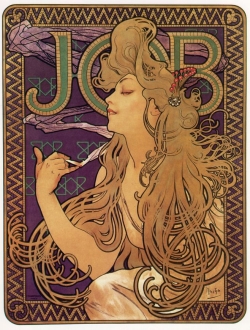
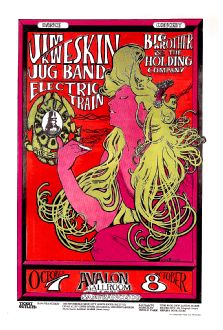
The Mouse-Kelley team proved as eclectic as the musicians themselves in their thieving. (The San Francisco Bay Area musicians stole beautifully.) What was grist to their mill? Well, old advertisements and mail order catalogues, images of Hollywood and Native Americans, science-fiction extraterrestrials and UFOs, sweet wrappers and robot visages, G-L-O-R-I-A Swanson and Mad magazine’s mascot-in-chief Alfred E. ‘What me worry?’ Neuman all figured. But from early on they snaffled the sensibilities of Belle Époque, Art Deco and Jugendstil materials. And since we are a Prague-based website, let’s be unambiguous: Alphonse Mucha must be mentioned. They gave Ol’ Mucha a new twist of psychedelicised life. ‘Girl with Green Hair’ advertised a 1966 Avalon Ballroom dance-concert by the Jim Kweskin Jug Band and Big Brother & The Holding Company. Out of the kindness of their hearts, an attractive woman whose original job in life was to sell Job cigarette papers was re-employed.
 Poster art has an illustrious history but it is predominantly a commercial art. Just as Mucha had his champagne and Job cigarette papers, Kelley-Mouse had their images of hot rods and, er, Zig-zag cigarette papers. Theirs was definitely commercial art. Their 1973 Monster T-Shirt Catalog peddled clothing with images of bygone babes, dragsters, a jester holding a skull mask or stroking his chin, cosmic goofs and even rolling papers.
By 1966 they were branching out into album cover art with the Grateful Dead’s eponymous debut. It is a period piece, a journeyman collage without any of the flair of their later work but this was an era of scalpel and cow gum. It is drab beside their later silkscreen poster work or their plunging into Pantone’s new fluorescent colours territory.
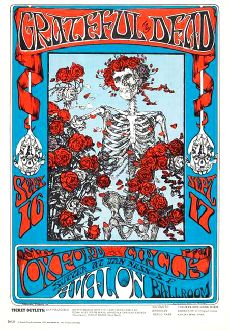
The Mouse-Kelley team came to work extensively with the Dead, indeed went on the payroll as part of the band’s extended family, it was said. They contributed massively to the Dead’s image. Kelley’s adaptation of an Edmund Sullivan illustration in the 1859 edition of Edward Fitzgerald’s The Rubáiyát of Omar Khayyám was perhaps their most iconic contribution. If it had been a film it would have blazed like the icons in Andrei Rublev, Andrei Tarkovsky’s 1966 film. It depicted a skeleton with a skull crowned or wreathed – choose your symbology – with roses. It started as a 1966 concert image, became an album cover in 1971 (for, confusingly, another Grateful Dead, this time a double live album) and afterwards entered the Dead’s core iconography.
They would work with other Dead images. The dusty brown cover photograph of Workingman’s Dead (1970) was Kelley wiping the lens on his Brownie camera. American Beauty (1970) employed rose symbolism – American Beauty is a variety of rose – and the ambiguity of lettering (‘American Reality’ could also be read). The triple-LP Europe ‘72 (1972) went cartoon on its cover. Terrapin Station (1975) included a sly reference to a Fillmore Auditorium poster for a Turtles (and Oxford Circle) gig that Heinrich Kley and Wes Wilson had done in 1966. That was the thing about Alton Kelley. If you knew your art and music history, there was so much in those images to nod sagely in agreement to. But there was a lot more in the way of allusions that you knew you would have to crack later. That is the history and magic of art, with or without the oomph of psychotropic substances.
We thank the copyright holders for permission to use:
Girl with Green Hair (c) Mouse/Kelley 1966 for FD, Rhino Entertainment
Skeleton and roses image (c) Mouse/Kelley 1966 for FD, Rhino Entertainment
Grateful Dead logo (c) Mouse/Kelley
14. 6. 2008 |
read more...
 [by Ken Hunt, London] The German protest movement, in which song was a mightily important element, first truly broached my consciousness in 1971. Formative experiences included attending anti-nuclear protests of the ring-around-the-plant kind and sitting at trestle tables with beer, bread and Bockwurst and with old (well, they looked old to me) comrades singing Kampflieder (‘songs of struggle’) and spouting Kampfsprüche (‘jingles’) at rallies that seemed to last for days. But all that was politics and protesting often in almost a carnival atmosphere, despite the constant presence of the camera-wallahs busily snapping away. Next steps, log car registration plates, match face to identity card and so on – quite enough to take you out of the paradoxical.
More important, if shallower (in a consumerist sense), was listening to Wolf Biermann’s messages from the East, like Chausseestrasse 131 and internalising writings such as his play Der Dra-Dra (only later did I discover Hedy West’s role in popularising his work in Sing Out!) and listening to the West German man-of-letters Franz-Josef Degenhardt laying out fresh tables. Still more important in their role of providing a balanced, daily musical diet was discussing and discussing those songs, winkling out their flesh from their shells and, sober or stoned, analysing what came out. Only Dylan came close. That was what whetted my appetite for German-language song with political messages. And to be honest that is what continues to feed my imagination with any song form. That weighing up of musical and linguistic grammars, lyrical twists and wordplays, open and concealed meaning, the past meeting the present, will remain at the heart of my musical experience until my dying day.
Things plodded along until the Wall fell in 1989. That was when I went on a crash course, albeit a privileged one, courtesy of my job, because my job granted me access to East German musicians in a way that hitherto only talking in Plattdütsch had. In English it is called ‘Low German’ and is generally downgraded to a dialect of Hochdeutsch or ‘High German’. No, it is a cognate language with many dialects of its own. It is also an intergrade language, linguistically speaking. Westwards it goes into Dutch. Head northwards, as in my case from Schleswig-Holstein, it goes into Danish. And in its very otherness, it was and is the unifying language of the two Germanys’ seacoasts. The first time I met Jo Meyer of JAMS and we slipped from High into Low German during a BBC radio recording we knew we had other ways to communicate.
Until recently, most commissioning editors considering an English-language account of German-language protest song would have winced, whinged and baulked at the very suggestion of a book by the name of Protest Song in East and West Germany since the 1960s stretching from 1848 revolutionary songs via punks and Liedermacher (‘song-makers’) to Berlin Love Parade. It is, however, long overdue. Robin Denselow’s When The Music’s Over – The Story of Political Pop (1989), a milestone contribution to the understanding of political or protest song within mainstream music, had its eye on other prizes. Denselow sidesteps Europe in the main. Yet German protest song is universality in a microcosm, as perhaps only Francophone or English-language song have ever been in the context of the wider European scheme of things. Reading this book at times becomes frustrating. The story cries out for parallels between Biermann’s Ausbürgerung – his stripping of citizenship -and de facto excommunication from East Germany and, say, the migration of the Czechoslovakian songwriter Karel Kryl (and not because of our website’s Czechness). Including Kryl would have set up a bigger screen on which to project the ‘transnationality’ of this book’s story.
The various essays in Protest Song in East and West Germany since the 1960s regale the reader with illuminating accounts. They include chapters about early revolutionary song (in David Robb’s ‘The Reception of Vormärz and 1848 Revolutionary Song in West Germany and the GDR’ and ‘Mühsam, Brecht, Eisler, and the Twentieth Century Revolutionary Heritage’), West Germany’s Folk and Liedermacher scene (in Eckard Holler’s ‘The Folk and Liedermacher Scene in the Federal Republic in the 1970s and 1980s’ and Robb’s ‘Political Song in the GDR: The Cat-and-Mouse Game with Censorship and Institutions’), performers such as Konstantin Wecker (in Annette Blühdorn’s chapter ‘Konstantin Wecker: Political Songs between Anarchy and Humanity’ – a performer I only ‘got’ many decades later) and Biermann (‘Wolf Biermann: Die Heimat ist weit’) and more recent drives (Robb’s concluding ‘The Demise of Political Song and a New Discourse of Techno in the Berlin Republic’).
Protest Song in East and West Germany since the 1960s is simply peerless. So, why do I have misgivings about it? Well, I want more people to know more about what came out of the two Germanys. At its most basic, it excludes. If you are unsure of your German or speak none, blocks of text are positioned like dragon’s teeth. At one point in Eckhard Holler’s Burg Waldeck festival chapter, it goes from “the artists were all asked to answer four questions about the politically engaged song and their own artistic commitment.” into repeating those questions in German without translation or footnote. So, sentences or phrases in English run into German and material that moves the narrative marvellously forwards (in German) become exclusion zones (in English). In the case of lyrics, a synopsis or a contextual commentary of, say, Wenzel’s faux-surreal masterpiece Das Berlin-Lied would have assisted immeasurably. Similarly, expressions such as Vormärz (something to do with an early or premature March?), Jugendbewegung (which youth movement?) and Liedertheater (song theatre?) are neither translated on their first occurrence, nor translated in the index, nor in the non-existent glossary.
The inclusion of a chapter laying out earlier, historical antecedents pre-Vormärz (roughly a period leading from 1815 up till 1848), and 1848 would have improved this excellent work enormously. Creativity in times of censorship – protest literature, if you will – is an ever-recurring and enormously fascinating area. Coded material, that is, material that allows the author or performer to speak or sing plainly without, as it were, moving their lips was not a new invention. The Hapsburg-era, Austrian playwright-actor and songwriter Johann Nestroy was a past master of saying one thing and delivering and detonating another. From personal discussions with Hans-Eckhardt Wenzel, the figure on the book’s cover, I know he was both aware of Nestroy and being part of a continuum. Robb clearly knows Wenzel’s work and is insightful about it, yet misses out on that little extra insight that might have explained so much.
Though Holler writes in his excellent chapter entitled ‘The Burg Waldeck Festivals, 1964-1969’ concerning one of West Germany’s most important song gatherings, there were moves “geared toward a critical re-evaluation of the recent German past” (in its simplicity as true as it is profound), peculiarly, overall, race relations get little coverage, get short shrift. This is not to typecast a people. The two Germanys engaged in decades of self-examination. (Famously, unlike Austria.) In the German Democratic Republic (GDR), as elsewhere, racism and racialism fouled the socialist nest. (It happened in most places.) Most signally in the GDR, it occurred when it came to interracial relationships – typically involving a black African or Arab student – resulting in a child. It was commonplace for GDR citizenship to be refused. In the West, in the FRG (Federal Republic of Germany) German-Turkish race relations were a massive issue.
Surely, rap is a form of protest song and rapper Erci E. has brilliantly captured stereotyping in his Weil ich ‘n Türke bin (‘Because I’m a Turk..’). Similarly, one of Christof Stählin’s most insightful songs, Deutschland nicht mehr (the comma is unprinted but it varies between ‘Germany no more’ and ‘Nothing more/higher than Germany’) acts as a vignette of integration. The girl in the baker’s shop may be of Turkish descent but she speaks Swabian and Stählin’s song overturns cliché. The pussyfooting around race – now not then – is a profound weakness. The whole multicultural debate and dimension barely gets a look in this book, a major omission.
For all that, Protest Song in East and West Germany since the 1960s is indisputably the best account on the subject in English. It a reminder of what the sages and soothsayers say about receiving what you hoped for. It is a wonderful book but only if you are bilingual in English and German. But I will say this: while I couldn’t have written this book I wish I could have fed into its writing in an editorial role.
David Robb (editor) – Protest Song in East and West Germany since the 1960s Camden House, ISBN 13: 978-1-57113-281-9 and ISBN 10: 978-1-57113-281-3 (2007)
�
27. 5. 2008 |
read more...
[by Ken Hunt, London] The Kirana gharana – or school of playing – seated in Kirana, near Saharanpur in India’s state of Uttar Pradesh, is one of the major styles of performance in Hindustani music. Kirana is particularly noted for the quality of its vocalists. Historically, it was associated with great maestros such as Abdul Karim Khan and Sawai Gandharva. In more recent times it was associated with singers who carried the torch on such as Bhimsen Joshi…
12. 5. 2008 |
read more...
 [by Ken Hunt, London] Like Ron Edwards (1930-2008), the Australian folklorist and folk recordist, folk journalist and archivist Edgar Waters was a pioneer in the field of Australian folksong and folklore. In 1947 he co-authored Rebel Songs with Stephen Murray-Smith, a booklet for the A.S.L.F. – a slim volume similar to the Workers’ Music Association booklets that were being published in Britain.
Waters was working in Britain by the mid 1950s and assisted Alan Lomax on his Folk Songs of North America (1960) before returning to Australia. It was an era of small specialist record companies worldwide, many of which operated on a shoestring. Australia’s version of, say, Topic Records in Britain, was the Sydney, NSW-based Wattle company (1955-1963). Waters fell in with Wattle’s founder Peter Hamilton. They worked together on influential early volumes in Wattle’s so-called Archive Series such as Australian Traditional Singers (1957) and Australian Traditional Singers and Musicians of Victoria (1960), which brought the likes of Catherine Peatey, Sally Sloane and Duke Tritton to people’s attention.
These were the early days of Australian Folk Revival and he had a hand in bringing the likes of the Buckwhackers, the English folklorists and singer A.L. Lloyd, the Rambleers and, in 1963, the Aboriginal singer-songwriter Dougie Young to the public’s attention. Later Waters was a key figure in the documentation of this scene and movement, working with the National Library of Australia and its Oral History and Folklore sections. Waters’ writings on folk and jazz graced many LP and CD releases, The Australian and The Oxford Companion to Australian Folklore (1993).
Edgar Waters died on 1 May 2008.
Note:
This piece was corrected on 8 July 2014. Thanks go to Alistair Banfield for alerting the author to a mistaken spelling. Alistair wrote, “The group that Edgar Waters was involved with was called the ‘Bushwhackers’ not the ‘Bushwackers’ – who were a later Australian group or Buckwackers as you have it.”
For more information and images visit, “Wattle Records and Films” at http://www.abc.net.au/rn/history/hindsight/stories/s1157792.htm
For more information about Ron Edwards on this site visit, http://kenhunt.doruzka.com/index.php/ron-edwards-1930-2008/
Additionally, Dave Arthur’s Bert Lloyd – The Life and Times of A.L. Lloyd (2012) contains further illuminations about Edgar and Ann Waters’ time and work in Britain in the early 1950s.
�
8. 5. 2008 |
read more...
[by Ken Hunt, London] The sitarist, composer and teacher Shashi Mohan Bhatt began what might be called a family tradition: that of taking Pandit Ravi Shankar as their guru. His son Krishna Mohan Bhatt and his sister Manju Mehta (her married name) – both of whom played sitar – and his younger brother Vishwa Mohan Bhatt – who played a modified acoustic guitar he named Mohan vina player – would all go on to study with the sitar maestro Ravi Shankar. Shashi Mohan Bhatt, however, was one of Shankar’s first shishyas (pupil-disciples). Nobody was quite sure, least of all Ravi Shankar, but Shashi Mohan Bhatt was definitely one of the first three.
4. 5. 2008 |
read more...
 [by Ken Hunt, London] Goldfrapp’s fourth album Seventh Tree (2008) was reviewed in several places in the British press along the lines of it being “psychedelic folk”. Reviews came with a sprinkling of words such as “pastoral approach” and, oh the joys of semi-accurate quotations, “middle of the public bridleway”. It was the dangled carrot of talk about psychedelic folk that attracted me. Sort of. Not because I am an acolyte of psychedelia’s darker folk arts. I had a decade when editors told me how important every twee and fey, post-Wicker Man manifestation of “psychedelic folk” was. It drove me up the wall and “psychedelic folk” still turns me itchy-twitchy. Goldfrapp was another gig visited not out of revenge for others’ past sins. But again in the spirit of non-preparation, blank-canvas concert attendance.
Alison Goldfrapp is the once Orbital and Tricky singer, the once-disco dolly in retro hot pants, formerly bathed in the light of glitterballs. She mixed freely with dancers wearing get-ups like horses or equestrian statues in a kind of post-glam, kitsch disco rock way. Or so I believe. That much at least had stuck. Goldfrapp, by the way, is also Will Gregory, the former Tear For Fears. When they kicked off, it was clear that they meant business. This was no duo presentation. The stage was abuzz with musicians – and there was a string section sizeable enough for me to give up trying to work out how many they were.
As Alison Goldfrapp sang, I felt an intense solidarity with The Guardian‘s Alexis Petridis who got taken to task in the letters column the following week for giving Seventh Tree a four-star (out of five) review while confessing to one vocal sounding like “Only clowns apley wurgh doh bollergh”. He, at least, had the advantage of having a copy of Seventh Tree. My Goldfrapp baptism was rawer still, since Goldfrapp’s press officer failed to respond. My notes read that way too, mere jumbled phonemes dancing on the notebook path to incomprehension. Fact is Petridis’ approximation made more sense than most of what she sang for the entire first half and 90 percent of the second. In fact I dug his review out of the recycling in order to build a small papier mâché shrine to him to celebrate his acuity. Lyrically Goldfrapp conjured a literary image. In Aldous Huxley’s Ape And Essence – and its BBC television play of yore – the religiously inclined raise nonsense to scripture, with people treating shopping lists like ‘gospel plow’.
What soon became apparent was that this “psychedelic folk” tag had even less pertinence than the usual use of “folk” in the British mainstream press. “Folk”, whether prefaced by “psychedelic” or not, tends to say more about the commentator than the genre. If there was an ounce of folk in the entire evening it sailed over my head. Likewise, any bucolic or rustic content. The good thing was that it removed the need to strain for post-Vaughan Williams or post-Shirley Collins folk morsels amid the sumptuousness of the sound – big string section, six-piece female choir, harp and sundry other instruments. Handily everyone dressed in white/whiteish apart from Alison Goldfrapp, who was dressed in a baby-doll nightie, somewhere around orange on the Chivers jelly-Pantone colour scale, once the lighting had done its business over her.
However, in the second half more words emerged from the blancmange of sound. Consequently making out three words in thirty was no problem for a world music pioneer who has listened to Hungarian and Thai music. The golden rule is to entrain to the rhythm, pick up on the mood, and Bob’s your uncle. By the end Goldfrapp made sense, though little literal meaning. They rounded off the night with the highlight, Happiness – the capping encore – for and before which they dished out plastic kazoos. “If you haven’t got a kazoo, sing along,” she said. (Quirkily the jazzer, raconteur and calligrapher Humphrey Lyttelton had just used this wheeze too, one obituary reminded after his death a week later on 25 April, to set what sounded like the new kazoo orchestra record.) The audience kazoo’d along with gusto at all the right moments though not necessarily with all the right notes.
Maybe that was what “psychedelic folk” thing meant, that “Ain’t got no home in this world anymore.” thing that the Incredible String Band had kazoo’d back in the 1960s when people made their own amusement. Actually no. Take a tight trip on reality, “psychedelic folk” is a still a complete misnomer, even if the multi-screen backdrop with its woodland blurs and treescapes (my new word) did have its wicker moments. That said, in Alexis Petridis’ Guardian review the words “psychedelic folk” did come in double quote marks, so read that as “”psychedelic folk””. Pay heed to punctuation. Despite having no notion of what she sang beyond the odd “You’re my Saturday” and “How do you find happiness?” it was nevertheless an enjoyable gig cum experience. The utterly and truly happy crowd was still blowing happy Happiness kazoo raspberries all over the Waterloo concourse while heading for their trains. Sing after Alexis, “Only clowns apley wurgh doh bollergh.”
4. 5. 2008 |
read more...
[by Ken Hunt, London] On 15 April 2008 Mahinarangi Tocker, the Maori musician, songwriter, feminist, gay and lesbian rights activist and political campaigner, died in Auckland, New Zealand. She was one of New Zealand’s most conspicuous song-makers and bore comparison with Joan Armatrading and Tracy Chapman. Born in 1956, she was of mixed bloodlines. She was of Ngati Maniapoto, Ngati Raukawa and Ngati Tuwharetoa – Ngati is a Maori tribal prefix -, Jewish and European stock, hence the title of one of her albums…
19. 4. 2008 |
read more...
Folk Roots New Routes
Queen Elizabeth House, Southbank Centre, London 25 March 2008
 [by Ken Hunt, London] You’d be hard-pressed to find a finer and more authoritative curator for a programme of folk music than Shirley Collins. After all, she is one of the singers who poured ideas into Britain’s second Folk Revival. Under the banner Folk Roots New Routes (a title lifted from her and Davy Graham’s 1964 duo album), she curated the five-day season of folk-themed concerts at London’s Southbank. And, if she is no longer singing in public and on stages, quite frankly that is an irrelevance because she needs to prove nothing, having created so much of such outstanding worth already. (In any case she gave three talks on the Saturday – Romany Rai (about Gypsy singers and songs from Southern England), A Most Sunshiny Day (about England’s traditional music) and America Over The Water (about her time with the Texan musicologist Alan Lomax on their music-collecting sweep through the Southern States of the USA in 1959).) Whether ticketed concerts by Alasdair Roberts and Catherine Bott or free events (examples being Friday’s excellent one with Lauren McCormick and Emily Portman – two thirds of the Devil’s Interval – followed by Lisa Knapp or Saturday’s Brighton Morris Men), Shirley Collins’ Folk Roots New Routes crammed in plenty. It all began with this Martin Simpson and Chris Wood concert.
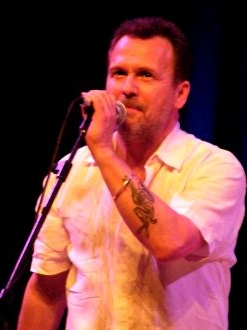
The honour of opening this Folk Meltdown fell to the violinist, guitarist, singer and songwriter Chris Wood. He did an exemplary set, much informed by his Trespasser (2007) album. Collins announced him as “a true English eccentric” (amongst other things). Without stooping to cliché about the reported English penchant for eccentricity, bear in mind that eccentricity is no bad thing. Wood took the stage with his accompanists Rob Jarvis on trombone and Barney Morse Brown on cello. Gently setting aside issues or charges of eccentricity, part of Wood’s take on that currently much discussed word, Englishness might be explained by one of his song introductions. In his preamble to his third song, he cautioned, “Just because it’s English, you don’t have to understand it.” Aspects of Wood’s English worldview were revealed bit by bit. We got tales of the Lollard proselytiser John Ball – courtesy of Sydney Carter’s song of the same name – and England’s so-called ‘peasant poet’ John Clare. We got tales of Wood’s daughter not so much nutting a-going as nutter (in Hard from his The Lark Descending), the second home syndrome, Agincourt and Peterloo, the impact of enclosures, “the old trap-door of English law” (love that line in Wood’s Mad John) and Mummers’ plays yanked kicking and screaming into the present (in his and Hugh Lupton’s tour-de-force England In Ribbons buoyed along by Woods’ distinctly Carthy-style Morris guitaristics). Rob Jarvis and Barney Morse Brown returned for the set’s conclusion, a neat musical bookend. A couple of observations to close. Maybe it was QEH nerves but Wood’s natural speaking voice seemed to diverge further from his singing voice than usual. Last, his treatment of social issues through songs set in the past and the present, notably Mad John, reveals him to be a worthy carrier of Sydney Carter’s baton.
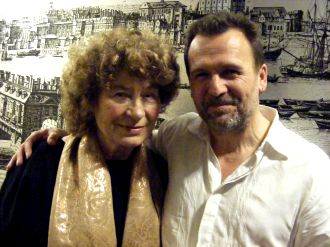 Martin Simpson’s solo set concentrated on his most recent repertoire – notably from his Prodigal Son (2007). Predictably the set included his newly anointed BBC Radio 2 Folk Awards ‘Best Original Song’ – Never Any Good (With Money) – a flick through the family photograph album and a fine tale of fatherly foibles. (Prodigal Son won the BBC Radio 2 Folk Awards’ ‘Best Album of the Year’ in February 2008 too.) Martin Simpson is an instrumentalist of consummate power. Somewhere down the line he found his singing voices a few years back, found in the sense when singing goes from just singing to another level. Voices because he has two singing voices. Having lived in the USA, maybe he has a semi-excuse. You could hear one voice on Little Musgrave and Never Any Good – the English one – and the American one on Duncan & Brady and Randy Newman’s Louisiana 1927. Duncan & Brady came with a good anecdote about playing it super-fast on the Later television show and being hugged afterwards by Ronnie Wood. (In order not to spoil its telling in case it is part of the current introduction to the song, the anecdote is herewith truncated.) Louisiana 1927 is a song that, given Louisiana’s hopeless history of natural disasters compounded by political apathy, continues to gather added meaning and relevance as it rolls along.
At the concert’s end, a small sadness was planted. Sooner or later this particular repertoire of Martin Simpson’s will be history as a performance repertoire. It was a wonderfully rounded repertoire but repertoires, by necessity, must move on or atrophy – even though individual pieces move on to the next concert repertoire. Others, slivers of them at least, have begun new or parallel lives as incidental music on radio and television. As ‘this’ night’s Batchelors Hall and Duncan & Brady already have in a sequence on smallholding on BBC television’s magazine programme Countryfile attest. The concert was a reminder of why we must grab opportunities to experience the magic of live performance when we can. Concerts like this evening of adrenalin and light-hearted bonhomie.
6. 4. 2008 |
read more...
« Later articles
Older articles »