Articles
[by Ken Hunt, London] In 2000 Česká Televize (Czech Television) celebrated Egon Bondy’s life and times with the documentary Fišer alias Bondy. The poet-lyricist, writer, philosopher and political commentator’s achievements could have filled a whole series of television programmes. One of Czechoslovakia’s most prominent and prolific men-of-letters, he railed against his homeland’s politicians and politics throughout his life. Outside his homeland however, he was primarily known as the era-defining lyricist for Czechoslovakia’s best-known beat group, The Plastic People of the Universe.
20. 4. 2007 |
read more...
Rachid Taha, Diwan 2 (La Voix des Lilas; Barclay/Universal, 2006)
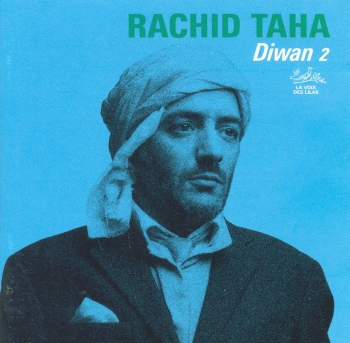 Last time, with album Tekitoi two years ago, Rachid Taha was Alter, this time, with second Diwan, he is foremost Different, thus basically not Indifferent, conditionally more rootsy, rough, acoustic, with less electricity and electronicity, not only in comparison with regular author albums, but also with first Diwan (1998), which has in common with Rachid’s nondivanic opus at least sound, which pretty radically changed with Tekitoi (not necessarily for worse, not necessarily for better, only elsewhere), all the while producer remains the very same Steve Hillage (yet the sound engineer did change). According to Rachid in concept of Diwans he -as restorer of old paintings- restores old songs, giving them new lustre and sparkle. Yet this time lustre is smothered and less sparkling, as perhaps revealed already by the comparison of covers: on numberless one all is in joyous motion (Rachid with flying hair, camel, biker), on numbered two all is in motionless melancholy (Rachid with covered head, palm trees, horizon), sealed with bird La Voix des Lilas ((arche)typical label sign of ancient singles, albums, cassettes too). In sum, this time Rachid Taha, browsing among dusty collections on shelves, attics and in memories in fight against oblivion, looked also at covers and remade them, even if my modest knowledge of this imagery reminds me more of 20’s and 30’s, less of 60’s and partially 70’s (80’s) from which he tapped this time for his poetry collection.
Mainly Rachid remains truly faithful to originals and original sonority, nevertheless he does add few of own features. If not other the very powerful and unmistakably author trait on the refreshed sound canvas is Rachid’s unique voice that some love in all its potential asperity and bluntness and some hate despite all its inherent possibility of ardent warmth, velvety crackling, smiling, baiting sardonicism. Although Taha does take effort on Diwans to imitate the singing style of originals and also essentially succeeds, this time even better than I thought possible, he remains in this segment inevitably personal, in sum the author signature of Rachid’s own voice can’t be missed. Rachid Taha – as the wind, the bird, the doorstep and the dim chill of the eve know already – is foremost an expressive rock singer with poetic in his voice and not a technician of demanding Arabic vocalisations, yet for his Diwan covers he must become also a technician of a variety of genres he tackles – and some are severely demanding. This time too Rachid reaches for approximately similar repertory as when he covered Farid el Atrache’s Habina, in sum vocally demanding repertory, requesting classically formed singer with classically formed voice and capacity. Well, the hard rock of Egyptian 20th century classical music is this time at least once (Gana el Hawa), conditionally twice (Mataouel dellil) if not the third time (Ghanni li shwaya) successfully and convincingly cracked.
That Rachid is vocally quite capable of singing techniques of algerian chaabi (at least Amrani’s) and traditional rai of the ancients, also called gasba & guellal (drum’n’flute), we knew already after previous Diwan and some author tributes to cheikhates and cheikhs. In truth this time Rachid Taha didn’t cover any of the cheikhs of “old rai”, both songs of this genre are his own author compositions among the wreath of covers, winding the songs Écoute moi camarade (Listen To Me Pal) of Algerian ye-ye musician and rebel Mohamed Mazouni, in which the cruel mistress is parable of France, Rani (I’m So Tormented) of Oran popularmusical elders Missoum Abdillah and Blaoui Houari, afrophonique song about love and tolerance Agatha of Camerounian all-rounded author Francis Bebey, lament Kifache rah (How Did It Pass By) of chaabi author Dahman el Harrachi and Souliman Ahmed, Josephine of Cheikh Taha, majestic Gana el hawa (The Love Met Us) written by Mohamed Hamza and Baligh Hamdi for Egyptian classic Abdelhalim Hafez, Ah mon amour of Cheikh Rachid, Mataouel delil (The Night Is Getting Long) of Oran master of orientals and oranie Ahmed Wahby, Maydoum of Dahman el Harrachi alias Amrani again and Ghanni li shwaya (Play A Little Song For Me) written by Bayram el Tunsi and Ahmed Zakaria for the great Umm Kalthum.
It should be told that all songs are accompanied by motley and quality crew of musicians and that in each and any song there plays also the master of oriental percussion Hossam Ramzy who also directed The Cairo String Ensemble, participating in all songs but three, besides we often hear also oud, qanun, nay, mandoluth and choruses and when necessary kora and gasba, while the electrical instrumentation is at minimum, with rare el. bass, standard drum set only in Ecoute moi Camarade and only three songs with elelctric guitar. After this year’s sequel to Diwan from 1998, promised a long ago, now Rachid promises also Diwans No 3, 4, 5 etc., thus we’ll still discover with him the treasures of Algerian, Arabic, African and who-knows-what-all music, yet he is also claiming, that there will be each time an author album at least between Diwans. Up to now in 16 years of solo career there were 5 of those and 2 lives, with only 2 Diwans – does it mean that we’ll have the chance to hear the five in year 2030, when Cheikh Taha will be counting over 70 springs, perhaps legitimately remaking himself?
– TC Lejla Bin Nur
Lejla lives in Ljubljana, Slovenia, where she is a respected specialist on Maghrebi music. Check her programmes on Radio Student:
http://www.radiostudent.si/article.php?sid=10411
http://www.radiostudent.si/user.php?op=userinfo&bypass=1&uname=TCLejla
9. 12. 2006 |
read more...
 Bush Hall, Shepherd’s Bush, London 6 October 2006
[by Ken Hunt, London] Bush Hall’s entrance on the Uxbridge Road doesn’t prepare you for what you find inside. Rather like the Tardis in BBC television’s Dr. Who, the interior is so much bigger than you are prepared for. The album artwork for Burlesque, Bellowhead’s début long-player (as opposed to their recorded début, E.P.Onymous and you’ve guessed what size that was), shows the interior of a balconied hall. Bush Hall felt a little like a bleached out echo of the Burlesque photo shoot. Maybe it helped Bellowhead’s decision to launch Burlesque there. It worked in ways that, if such a thing exists, unfaithful replicas of the cover artwork seldom do.
The octet musters an impressive instrumentation. Over the course of the evening people turned their hands to fiddles, percussion of many sorts (kitchen and pantry utensils included), sousaphone, tuba, saxophones, bass clarinet, guitar, bouzouki, mandolin, banjo, bagpipes, cello, trumpet, flugelhorn, oboe, free-reed instruments and trombone. Their sound and presence was mighty with performances and arrangements sticking tightly to the material on Burlesque with a sprinkle from E.P.Onymous for good measure. One of the things that impresses me most about Bellowhead the quality of the music aside is that they take the music seriously without seeming to take themselves seriously. They played their big songs Rigs of the Time, Fire Marengo and Flash Company with admirable playfulness and, when necessary, circus wit, However, their souped-up, trad-style instrumentals, like the funk and soul horn interjections juxtaposed with the fiddlistics of Sloe Gin, similarly hit the bull’s-eye. It’s the balance that creates their dynamics.

What set the launch concert apart and made it an event was the ambiance created by the band’s coming in costume. The range of hats was impressive. From cloth cap to pith helmet, topper to one that looked as if it had been stolen from the set of Oliver, Bellowhead’s headwear and costumes enacted a small-scale class war on stage. Costumes were not restricted to those puffing, blowing, thrashing or wailing on stage. Tasmin, the cover pin-up, reprised her black-and-red corset costume and feathered mask for anyone into vaudevillian corsetry. (Alas, I must have averted my eyes and missed the cover’s stunt dove.) What’s more, a coterie of audience members who had been tipped off had dug into the fancy dress chest and pulled out family heirlooms or charity shop bargains. During the intermission Bellowhead came down to mingle with punters and their lowly kind. Funnily enough, Bush Hall’s rectangularity must make it ideal for revivalist meetings. Certainly, it was a very different sort of revivalist meeting that Bellowhead convened. Bellowhead successfully zigzagged their way through the minefield we laughingly call folk music in the twenty-first century. All in all it was a very special night.
30. 10. 2006 |
read more...
Rudolstadt, Germany, 7-9 July 2006
[by Ken Hunt, London] Much has changed. Much remains the same since 1991, the year of the Rudolstadt’s first capitalist-swine-era folk festival. Post-reunification investment, the festival’s monetary and publicity injections and the media coverage generated by the festival have contributed to the town’s tell-tale affluence, so evident when comparing photographs of then with now. What looked shabby, potholed or ramshackle in 1991 has largely vanished. Shops now merely nod to yesteryear with displays of the odd Ostalgie board game, GDR-era children’s storybook favourites or accounts of ‘wie wir waren’ (the way we were) as Barbra von Streisand sang in the old film hit.
The 2006 TFF RU had France as its country or national theme with the likes of Les Primatifs du Futur, Françoiz Breant and umpteen others flying the tricolour in the hours before Zidane’s petit contretemps in the world cup final. Festival art and graphics director Jürgen Wolff’s essay in the weighty festival paperback cum programme dealt with the nearby Battle of Saalefeld during the Napoleonic wars. Alas for Prinz Louis Ferdinand of Prussia, he got more than a head butt and no Blücher arrived to tip the balance and inspire a song of the toe-tapping quality of Abba’s “Waterloo”. Tango was the dance of choice for those who do more than tap their feet at the dance (Tanz) part of the festival and, I seriously hope, get to exert themselves in even more tangoistically contorted fashion afterwards. The instrument of 2006 for those who got past its caterwauling clichés was the bagpipes.

The film critic Duane Byrge once remarked along the lines of the only problem with film festivals was the films. TFF RU is enough to make the cynic-critic re-yoke that beastly remark with a new harness. With 16 stages listed in the 2006 programme, the problem with TFF RU is the sheer scale of what is on offer. Clashes were inevitable, as happened on the midnight shift on Saturday night with Suzanne Vega atop the Heidecksburg, Rudolstadt’s castle on the hill, and Jimmy Cliff in the park named after Heinrich Heine. (Both acts were both excellent and crowd-pleasing, but to see Cliff meant leaving Vega.) To wax impressionistic therefore, amid interviewing and being interviewed, hanging out and hanging clothes out to dry, and leaving out performances that triggered only mild applause in my mind or ones that were mere pauses whilst walking somewhere else, here are my personal highlights.
The special concert (charged on top of the festival proper tickets) on Thursday, 6 July, was an Italian spectacular, “La Notte della Taranta” fronted by Stewart Copeland. To give a flavour of the festival’s vibe, before the evening’s performance the former Police drummer and film composer sat alfresco (merited on this occasion, I feel), often animatedly, at a table on the market square, untroubled by the public. “La Notte della Taranta” lived up to its tag of spectacular on the big stage at the Heidecksburg. The blend of voices and stringed, wind, keyboard and percussion instruments transplanted well, if temporarily, on German soil and the overall performance, albeit slightly overlong or unfocussed to my mind at times, was seductive. Traditional and modernistic elements were woven together exceptionally well. One highlight was the call and response between frame-drum and kit drums. It was the voices that carried the day for me. Magic.
On the Friday afternoon the festival proper kicked off. The day’s highlight, without a shadow of jingoism creeping in, was Britain’s Bellowhead. Another big band, ten strong, though mini on the scale of the very big band that delivered “La Notte della Taranta”, they were raucous and refined, disciplined and loose. A band of their size mixing brass, woodwinds, bagpipes, strings, free-reed, percussion and vocals is primarily destined for festivals and million-rupee big bashes. Therefore the opportunity to see them live was not to be missed. Their “Rigs Of The Time”, a trad. arr. exposition of corruption and scam worthy of Gay and Brecht’s poison pens, bottled the genie beautifully. Their forceful set also managed to gobsmack the local branch of junior festival-goers who were transfixed by where what sound was coming from. Strange percussion gestures and rude noises coming from the brass section hath strange powers. (Any gratuitous Shakespeare quotation from The Tempest has been omitted because this is another age’s popular culture.) Afterwards, Jürgen Wolff, in music as satirical and trenchant as his festival-related artwork, applauded Bellowhead’s “folk comedy” in such material as “Flash Company”. He never said it but it is nothing less than some sort of Hogarthian “Rake’s Progress” illustration given a lyric and musical accompaniment from East Anglia, England’s sticky-out arse into the sea.
An event in Konstantin Wecker’s off-stage life overshadows his music in the popular imagination, leastways as far as the general public in Germany is concerned, it would appear. The Konstantin Wecker: Bagdad-Kabul-Projekt warrants the public revising their attitude because of the power of the project. It consisted of a band of brothers from Iraq, Afghanistan, Turkey and Germany and, on the strength of their Saturday evening performance at the castle, it ranks as the greatest East-West divan bands, to corrupt Goethe’s line for modern purposes, arguably to come out of Germany in 50 years and certainly this century.
The Mexican Indian (Mixtec)-American singer Lila Downs bestrode the Heidecksburg big stage in bright sunshine on the Sunday afternoon like a cougar. The temperatures were in the 30s and she and her band responded accordingly, putting on a truly eye- and ear-catching show that revealed many layers of her performance artistry denied the audio – and probably the DVD – medium. Not least of these were the sheer physicality of her performance and the degree of the eye contact between the musicians. She coiled and uncoiled on stage, responded wide-eyed to an unexpected flurry of bass notes or an impromptu variation on a harp run (I love Mexican harp but lack the vocabulary to discuss it with authority), albeit on a melodic theme that she knew inside-out (therein lies the real deal). She hugged and tugged at the microphone. Above all, she sang as if this could be the last performance of her life. And afterwards, drained yet high from her high-energy exertions she took time to sign posters and CDs, talk to and have photos taken with beaming members of her audience, in the full knowledge that she was going straight into a television interview backstage. A super-trouper of the highest order.
Coming down from Lila Downs’ concert, only Geneva’s deadpan best would do. And not simply because the terrace stage is a slacker’s short stagger across the cobbles from the Heidecksburg main stage. A downpour had prevented hearing the Dead Brothers on the Neumarkt stage on Saturday. (Rain stopped audience participation rather than play on this occasion, another tokenist sports reference.) The Dead Brothers’ droll songs sung in American English, with Swiss German intros and a bit of High German to placate the locals, with images of crows, folk and country were just the thing to follow up afterwards. Much like every festival should do. Festivals are what you take away.
8. 8. 2006 |
read more...
July 2006
How was the Ostrava concert, compared to the other gigs you did with Värttinä?
 Ostrava concert was great. Audience knew the band and they were ready from the first minute. People were singing and dancing whit us, so whatelse can you ask.
I never heard your recordings, but I suspect they are very different from Värttinä’s: blues, soul, English? So, what are the things you have in common, which led to your production job?
Common thing is music, singing. I’m specialised in different kind of vocal sounds and techniques and that is the reason Värttinä asked me to produce the Miero album. And after that they thought that i might be good choice to take Mari’s place for awhile. If music is the thing and not one musicstyle, if you are openminded then you can join any production and still have your own artistical style..
I liked your pictue sitting on a piano in a Finnish interview . The picture has almost punk attitude. What is your musical background, were you originally a punk grrrrl?
I’ve never been punk girl. I have classical background. I have gratuated from Sibelius Academy. I compose litlle classical music and rock/oio music with ethnic flavor.
“My Finnish translation of Peter Guralnick’s great book Sweet Soul Music is scheduled to be released in July by Johnny Kniga Publishing,” That says a lot.. What are you other favourite books, both music and general?
I didnďt translate that book in finnish, Honey B.&T-bones guitarplayer did. And actually it was released last weekend in Pori Jazz festival. But I do like books that tells about music.
Scandinavia seems to be blues oasis, maybe because blues is about suffering and keeping your strenght?
Scandinavia is also rock and especially heavyrock oasis. Bluesbased music is alternative music. Not very big thing. But bands can do pretty much gigs if they want. Nowdays I do only festival and concerts, not that much small clubs.
Honey B. & T-Bones is your only project?
As I told earlier I compose and visit other bands occationally. I start to work wit one finnish world music band called Outo Voima. They used to be insrumental band, but they asked me to join as a vocalist. Sometimes I work with Symphony orchestras, free jazz bands and modern rock grupes. I also teach pop/hazz singing in Sibelius Academy. (Johanna from Värttinä is my student)
After 23 years on the road, how do you avoid doing the same thing again?
Of cource every artist do some same thing all the time. Audience would be dissapointed if they donďt hear some older hits with old licks. But my philosofy is to create something new all the time. As much it is possible. Maybe thatďs the reason I have survived in this heavy business. At that moment on stage or at studio or when you are composing you have to have a feeling that “this thing” is the only thing you want to do. Live just that moment. Give what you have. Show and express feelings.
22. 7. 2006 |
read more...
His playing is everchanging and full twists like an imaginary landscape. No wonder, the chamamé accordion style is a “mestizo music”, rooted both in European polkas and Guaraní Indians culture. When Spasiuk played at Womex in 2001, many people wondered: “This music makes me dance, but also opens the gates of imagination. I never thought you can do this with an accordion!” This hard to define spirit is fully captured on Spasiuk’s last CD, Tarefero de mis pagos, produced by Ben Mandelson. I talked to Chango at the BBC World Music Awards Ceremony in Gateshead in January 2005, where he performed as a winner in the Newcomers category.

Chamamé is often explained as meeting of two cultures: Indian and European. Is it really as simple as that?
First I have to say that Guaraní have their own music, different from chamamé. The chamamé development took several centuries. First the Spanish Jesuit monks came to the area now called Misiones in the North East of Argentina. During the 1600’s, they were teaching European music and religion to Guaraní. And the final step was taken by the immigrants from Europe who took their accordions with them.
When the Jesuit monks imposed Catholic religion on the Guaraní Indians, did some conglomerate faith like Candomblé in Brazil developed in Argentina?
They tried to impose, but with no success. The Jesuits were surprised to find people of that advanced and sophisticated spiritual world in the jungle. The only people who took up Catholic religion were the Creoles of partly European descent. The Jesuits taught Indians to build violins and other instruments. They became musically highly accomplished, but when the Jesuits left, some of them went back to the jungle. And some became music teachers.
Contrary to Brasilian forro or the Celtic reels and jigs, chamamé is not just a dance music?
Even if chamamé was music for dance at the village square, there is also another level. In chamamé you find mystery, higher power, things from the other side. That goes along with the Jesuit music, who played baroque composers for the Indians.
Books by Julio Cortázar, Gabriel García Márquez and other South American writers are often referred to as Magic Realism. When I’ve heard Chango Spasiuk for the first time, my impression was: This music is transcending the traditional musical cliches in the same way, as Cortázar transcends the stereotypes in literature.
That’s a nice thing to hear – thank you. There are several levels in what I do: I try to make chamamé, as well as the daily life of people living there better known, but I do also express my own feelings, my inner world. I’m not trying to do any fabrication, and if someone finds truth in my music, I appreciate that. And I don’t think I’m something important in the history of chamamé. That’s the way it is: Chamamé is using me, and I’m using chamamé…
Was there a Robert Johnson or Muddy Waters of chamamé?
Of course. 5 people helped to develop the music, living between 1930’s and 1980’s. All of them were playing button accordions and/or bandoneon: Transito Cocomarola, Isaco Abitbol bandoneon, Tarragó Ros, Ernesto Montiel, Blas Martinez Riera. Their work was recorded, not written down. This is very different from tango, when compositions are written in notation. As a result of this, there is not any strict definition of chamamé.
When talking about chamamé, most Europeans would think of Raúl Barboza. How would you classify him?
Barboza is my friend. But these 5 people mentioned were the classics, Barboza was born later. He left Argentina and transmitted chamamé in Europe.
Where did you ancestors come to Argentina from?
My grandparents were from Ukraine, I still know a few words in that language. The biggest migration wave started in 1897 from the Ukraine region close to the Polish border. In early 20th century Russians, Basks, Volga Germans, and other immigrants came to Argentina and all of them brought their music with them.
On your last album, there’s one special song, Starosta, very Slavic, related to polkas, but with some changes in the rhythm. How did that develop?
My father was a carpenter, but he was playing violin. People were playing these polkas inaccurately, they were changing the structure on the run. Imagine somebody who walks on foot to a neighbor village in the time of a wedding. When he gets close, he hides behind a tree so nobody bothers him, and stays there listening. All night, and then he hears a song he really likes, he learns it by heart, goes back home, grabs his instrument, and plays what he remembers. The song goes through transformation.
25. 1. 2005 |
read more...
Your “Secrets of the Rocks ” booklet is really very secretive. You mention places like R…, G.., and E., For the foreign travellers to Greece, could you explain what these places mean to you? And are there still some deserted islands in Aegean or Ionian seas?

Kristi– In my first album, back in 1986, there was a song that was speaking about one secret beach near Athens, where no cars could arrive. People had to climb for one hour inside a rocky pine forest in order to reach this natural sea paradise, where there were no umbrellas, no bars and lights and of course no… bathing suits. Few people knew Ramnunda then. But that song of mine became a radio hit. And next summer, the beach was filled with people. Unfortunately some of them would leave their garbage there. Others were bringing their loud cassette recorders. Others were wearing bathing suits and maybe looking at the nude naturalists with a bad glance. I didn’t feel good with what had happened to that secret beach due to my song. I felt responsible. This is the reason why both Stathis and I didn’t want to put on the cover of our album the whole names of those few secret, remote beaches of those faraway, not yet exploited by tourism islands, where we often like to live for some days with our tend or even without a tend, just with our sleeping bags and where The Secrets of The Rocks were written.
Yes, one can still find some such places on some small, remote Greek islands. I suggest to those who may be interested, to travel south and search for them. It’s much nicer when you discover a beautiful, hidden place by your self, than when you are told by someone else or have read about it.
Stathis-I’m sure there must be in the Czech Republic too some similar “secret” places near rivers or lakes or whatever , where people can go and enjoy nature.
In your concerts, you explained baglamas was prohibited in the 20’s. Could you tell more? Were musicians put into prison? Did the prohibition also included other instruments, like saz or bouzouki? 
Kristi– It was in the mid 30’s when the string instrument bouzouki and the vocal improvisations on eastern scales, called amanes, were prohibited by a new law of the dictator of the times called Metaxas (nothing to do with the famous Greek Metaxa drink!). In 1922 many Greek refuges from Minor Asia had come to Greece in terrible condition. They would gather in those small private places, backyards or taverns, that were called tekes and smoke hush and play their rembetika songs of sorrow and pain with their bouzouki. But at that time the dictator Metaxas didn’t like this eastern atmosphere and mentality. He kept saying and he was also trying to impose this to the rest of the people, that Greece belonged to the west and not to the east. So he made this law and the rembetes were often captured and put in jail. It was then that they started to use baglamas, which is like a bouzouki, but much smaller. Because of it’s small size they could keep this instrument hidden inside the jail and under their coat when on the road. I really cannot tell how they were able to “hide” it’s ear piercing, crying sound when they were “secretly” playing it.
And by the way, hash smoking was also important part of the rembetika tradition. You mentioned this habit during your Prague concert, in a different context. Does the connection between herbs and music have different level/meaning in Greece, than in the hippies and rasta culture?
Kristi– It has exactly the same meaning in certain kinds of Greek music, like in rembetika, and in some of the laika songs, which is a continuity of rembetika. I wouldn’t say hash smoking has much to do with other kinds of Greek music, like with dimotika, which means the traditional songs of the rural areas of Greece. Remember that rembetika were songs of the city.
Stathis– Rembetika has to do more with the Blues culture.
Ross Daly once told me about a lira player who catches bees, puts them into plastic bag and then plays their “music” on his instrument. On you Prague concert, you mentioned a bouzouki player who learns music from imitating nature. Could you explain more about this method?
Kristi -It’s funny because in our previous album Echotropia, we have a song called Beehives, in which Stathis has recorded bees in a field and then turned their recorded buzz into a rhythm loop.
In the show I was talking about Giorgos Zambetas, a very famous songwriter of laika songs who has passed away.
He was a very interesting figure and some of his sayings and lots of stories about him are often mentioned. One of these, was that when once he was asked in an interview, how he had learned to play his bouzouki, he had answered, “by listening to the frogs”. It’s not a method of learning. It’s just to have open ears and listen to the environment around you. There is music everywhere. And as Aristotle had said, art is an imitation of nature. If you listen to the sounds of a jungle, all those birds bubbling rhythmically, you can tell why music from Africa and from South America is so rhythmical. Listen to the wind which never stops for days on some Greek islands and you will feel why in traditional Greek and in Byzantine music there is always one monotone sound backing up the main melody, giving that psychedelic feeling of dizziness. Rock music is also the music of the environment of it’s era of cars and loud machines. And nowadays, isn’t it electronica, what we are listening to all day? Mobiles ringing everywhere and little computer sounds all around us?
A sailor’s question: When you told the story behind Calima, you talked about all this humidity and headache coming from this southern wind. The same situation is explained in the Visconti’s film Death in Venice, when scirocco comes and makes the main hero suffers even more than you suffered at Canaries. So, is Calima more like scirocco or like Livas?
Kristi- I love this talk about the winds and their names! So in Venice it is the scirocco wind that bothers them. I didn’t remember this interesting detail from that beautiful film. Scirocco in Greece we call specifically the wind that comes from south east. They say that it can sometimes become dangerous for boats because when the night falls it becomes very strong. Livas is a very hot, burning wind that comes from the south and brings to the Greek peninsula the sand of the Sahara desert. This creates headaches to people. You wake up some mornings and there may be sand on your car, your balcony, the streets. In the Canary island the wind which is creating similar effects comes from the east, because these islands are on the Atlantic ocean opposite the west coast of Africa, so the wind of the Sahara is travelling from the east to the west to arrive on top of them and blur the atmosphere of Santa Cruz de Tenerife, where I learned about all these.
Czech people are not familiar of Greek music. What you would recommend from past? Do you have any personal heroes on the Greek scene?
Kristi– I would recommend albums of rembetes Vassilis Tsitsanis and Marcos Vamvakaris, to mention 2 of the most wellknown and goodquality, authentic rembetes, and of the songwriter Manolis Chiotis, who innovated the style of bouzouki playing and somehow started the scene of laika songs. I would also recommend albums of authentic, traditional, rural Greek music. All the albums of Mrs. Domna Samiou, the lady of Greek traditional music, a very impressive singer herself. Travelling around Greece for years, she has gathered and put in albums some of the nicest songs of various areas of Greece, performed mostly by herself and by some of the best traditional musicians of Greece. I would also recommend the songwriter, lyra player from the island of Crete, Psarantonis. In his own magical way, he is the living tradition of Cretan music. I would also recommend the 2 famous Greek composers that have become classic, Manos Chadzidakis and Mikis Theodorakis. Their songs and music is a somehow more sophisticated approach to the tradition of rembetika and laika songs.
Stathis– Other personal heroes are Anestis Delias from the rembetika era.He was Keith Richards of the rembetes but he was not that lucky and died young.

Dionysis Savopoulos also is a figure that especially between 1970 to 1980 was my hero. He was the first Greek songwriter who combined rock music with Greek and Balkan traditional music and created a new sound.
What kind of “formal” musical education did you get? Conservatory, Byzantine music school?
Kristi– I went to both and learned a little of both kinds of music. But I am not a very much formally educated musician, mainly because I am lazy. As Stathis is often telling me, I became lazy, just because I am able to any time open my mouth and sing, which needs less practise than to learn an instrument and anyway you can make music just with this.
Stathis– I ‘m learning music mostly by myself. Listening to music, playing with others, imitating my hero musicians! I also studied in a Conservatory at the 90’s.
And how did you develop your art of writing lyrics? Do you have any favourite poets, drama writers, novelists?
Kristi- Writing comes out of me very naturally since I was a child. I never say to myself you have to sit down and write a lyric, it’s the lyric itself which is violently waking me up and makes me get out of bed, go find a pencil and put it down, so as to get rid of it and relax and be able to sleep again. By the way, the same thing is happening to Stathis with most of the melodies he has written. As for readings, I very much like one Greek contemporary poet by the name Iannis Ifantis. I love and I would recommend to a foreigner the classical novels of Alexandros Papadiamantis, the “Greek Dostoyefski”, who lived in the beginning of the 20th century. I know some of them have been translated at least in German. In German there is also a translation of a long novel of Zirana Zateli, a very magical, contemporary Greek woman writer.
From abroad I love Tom Robins! I also enjoy Clive Barker’s fantasy fiction. But I don’t read much fiction anymore. I mostly like to read theoretical books about various subjects that interest me, like Yoga, Nature, Eastern and ancient Religions and rituals, mysticism, history, travelling.
There seem to be a newly found understanding between Turkish and Greek musicians and audiences. How the Greeks see Turks now? And how do they enjoy Turkish music?
Kristi– Greek and Turkish music have always been interacting with each other. Greeks and Turks are neighbours, so of coarse they get influenced by each other and nowadays they often play music together. You often find Turkish songs with Greek lyrics in the Greek music market and Greek songs with Turkish lyrics in the Turkish market. I think Turks and Greeks have become friends finally. We have so many things in common and in some cases, our music resembles very much.
Stathis– Turkish and Greek musicians where always cooperating. We are lucky that politicians and generals from both sides, have finally decided to keep on a peace process , so the audiences are positive now . There are no frontiers between musicians . And between all artists I presume.
Do you have any projects besides your band?
Kristi- I must admit that I don’t feel the need to mix with any other musical project, at least not now. I enjoy very much what we are doing together with Stathis: Writing songs in various places and then recording them in our home studio. Bringing our band to play on top and then edit and change things and try this and try that and argue and then come up with an album and then with rehearsals with the band and live concerts and more new songs etc etc. This whole thing is very fulfilling for me, because through our own songs and our own productions we are able to express our own truths, our own secrets, ideas feelings, in our own, personal way.
Stathis– I agree
The setup of your band changed since Echotropia times. What did make you to switch the setup?
Stathis– We have switched the set-up a lot of times. We don’t want to be a replica of ourselves.
Kristi- We got tired of our previous folk-rock sound of our live shows and wanted to experiment more with live made loops and percussions instead of drums. We like the way Stathis’s traditional string instrument and the electric guitar are mixed with these loops and with the bagpipes. This is how this “folktronic” sound came out. We often also use a lyra player together with the bagpipe, the string instruments, the percussions and the electronics. This last year, whenever we had the chance, Stathis and I also experimented on performances with just the two of us on stage, emphasizing mostly on the electronic part, with a lot of improvisation, live sampling etc.
And why you choose the Indian harmonium?
Kristi- Because from the first moment that I had seen and heard this instrument, played live by my “hero” Nico, I mean the singer of the Velvet Underground, who had come to Athens for a concert back in the mid 80ies, I fell in love with it and wanted to find one and buy it. Then of coarse years later Indian harmonium became more common as an Indian instrument, due to the rise of World Music. I bought this one in India this year and it makes me crazy how it breaths like a real person when you play it. Being a lazy musician, as I already admitted, I don’t play any complicated things on it, but I love to make it breath, coordinating it with my own breath when I sing and I feel like as if this is giving me a kind of a strange, double power when singing. My small, portable Indian harmonium has become a good friend of mine and I have named it Sitaram.
Stathis– In our live performances we need a “warm” sound, “pads” as they call them in music terms. But we really hate those huge sounds created by most of the synthesizers. So the Indian harmonium and the use of my set of filters and samples create the sound we want.
Did you have chance to perform in Turkey, Middle East, India? Could the Eastern audiences understand more deeply songs like Majoun than Europeans?
Kristi- We have only played in Tel Aviv in two festivals in 1998, when the political situation was different there. People were enthusiastic.
In Prague, the Saal Schick Brass band played the same festival as you, but one day earlier. Do you still have any common projects?
Kristi- Probably you didn’t hear that their concert was cancelled. They didn’t to come to Prague (there were no tickets I think) and didn’t play. But anyway I answer the question. From time to time the SSBB invite me and Stathis and we play with them in concerts. We enjoy very much doing this. When I sing with them, I love to hear their huge brass band’s sound in my ears. They are very good musicians and performers and they are very good friends!
Kristi and Stathis’ home page
9. 5. 2004 |
read more...
The real “problem” is that for the last 50 years bands have been getting smaller and smaller in size till now you have 1 DJ spinning records through very loud PAs. This is all very modern but it means that it is harder for live musicians to “learn” an audience, and vice-versa. Also, as radio & TV has got worse or at least more limited over the last few years (with a few notable exceptions), this does not help… So people have to keep playing, and doing interesting things.
9. 11. 2001 |
read more...
Czech music on the turn of century
(written in 2001)
 If you want to hear some genuine Czech world music, listen to Antonin Dvorak or Leos Janacek. These guys knew well how important are the folk tunes for the healthy musical growth and development. But elaborating folk melodies into symphonic setting and bringing them into monumental opera houses inevitably prompts the overkill effect. The folk music looses its spark and appeal, the young generation searches for undiscovered pleasures until somebody reinvents the old time dances and ballads and brings them back into spotlight. The great folk revival that naturally evolved in Ireland, later caught a fire in Scandinavia and now is bearing its fruits in Spain and Hungary, has still a long time to go in the Czech lands. The coals are just starting to glow now – and opera is not the only thing to blame for the late start.
Give me back my enemy!
In former Czechoslovakia, communist era was as fatal to folk music as it was to rock – but in a different way. The long history of repression against rockers in East countries, prison sentences for bands like The Plastic People and activists like The Jazz Section are well known. The suffering and survival of folk scene was even more complex. Contrary to USA, where folk music is considered to be one single entity, the Czech audiences (maybe like their European neighbors) recognize two separate branches: singer songwriter style, and the legitimate roots music, played in local villages. During the past 40 years, both branches developed in a very uneven manner.
 The singer songwriter tradition reached Czechoslovakia in late 60s and became part of an underground culture. The public was eager to hear songs with hidden meanings, and this inspired writers to use rich allegory and metaphors. Some folk singers were forced to exile or prohibited from performing – but on the other hand, they enjoyed strong public support and inspiration to keep on writing. This lasted until early days of the Velvet Revolution in November 1989, when Jiri Dedecek performed for the first time his new song, which proved to be prophetic. It was titled Give me back my enemy. This signaled an end of an era, when musicians and listeners were united, because they had to resist to one common evil. Ironically, the departure of the Common Enemy changed the musical scene deeply: songwriters returned from the exile, but after the first wave of euphoria they discovered there is no work for them anymore in the free country.
In the village folk music tradition, things developed differently. The Communists did not call it roots music, but folklore: fully autonomous entity disconnected from real life, which should be practiced in national costumes for socialist workers. As in other East Block countries, folklore ensembles were getting substantial donations from the State, and they paid for this benefit heavily: musicians had to perform at official party meetings and no wonder their art lost its excitement and freshness – qualities, which make traditional music so interesting now.
In recent interview, cymbalom player Zuzana Lapcikova told me: “While distinction and individual style are prime factors in folk music, all this was denied by Communists. All the spiritual background was ignored, and only the skin-deep splendor was used. When my uncle was forced to perform on May Day celebrations, snow was falling and he was ordered to walk on stage dressed only in national costume with a light shirt. That day he decided he will never do this again and completely abandoned folk music.”
Zuzana Lapcikova and most of the creative folk musicians like the cymbalom band Hradistan, improvising violinist Iva Bittova or mandolin player and producer Jiri Plocek are not from Prague, not even from Bohemiaen, but from the eastern part of the Czech Republic – Moravia, a historic region between Austria in the South, Silesia in the North and Slovakia in the East. In both Bohemia and Moravia Czech is spoken, but the musical heritage differs. According to ethnographers, the great European musical divide, which separates the Western family of traditional styles from the Eastern, runs exactly along the border between Bohemiaand Moravia. In today’s Bohemia, the folk heritage is almost dead, the remaining debris being recycled by the unimaginative brass bands, playing to the beer drinking audiences.
 On the other hand, Moravia is a region well known for rich, stimulating folk tradition, which is directly linked to music of Hungary, Romania and Ukraine. The Moravians keep much closer links to the nature than the more urban population of Bohemia. In past centuries, east Moravia was a wild frontier, the furthest point to which the Turkish invaders penetrated the European continent. The best music is still played on the rolling hills of the White Carpathian range, close to the Slovak border. The local wedding bands combine violins and “kontras” – violas used for efficient rhythm accompaniment. Other instruments, like clarinets and cymbalom, were added as late as early 20th century.
What is so special about the Moravian music? “If you spend two days on the highlanders’ music feast, from every house you will hear this basic rhythm pattern and you will never forget it. You will get addicted – it works like a drug. The trick is that two beats divide the basic measure into two non equal parts,” says Jiri Pavlica.
 Blasts from the past
Unlike writers or folksingers, the Moravian musicians had no “samizdat” recordings – so after the state folklore era ended, it was a natural to fill the gap by archive recordings. Some of the best 90’s CDs are compilations: Dalekonosne husle, Long Range Violin, (Cesky rozhlas Brno-Gnosis, 1998) pays justice to violin player and bandleader Jozka Kubik (1907-78), an innovator who was the first to use cymbalom in Moravian wedding bands. As a Gypsy he had to struggle much harder for recognition – and today he is the only Roma, who possesses a monument erected in his honor (in Kuzelov close to Velka nad Velickou, near Uherske Hradiste).  The Oldest Recordings of Moravian and Slovak Folk Singing (Gnosis, 1997) is a collection of field recordings made by Leos Janacek and his colleagues 90 years ago. On Straznice Folklore Festival 1946 – 1995) (Supraphon, 1994) you will find some very raw performers, while Primasi BROLN (Cesky rozhlas Brno, 1997) portrays one of the biggest professional ensembles, the Radio Brno Folk Instruments Orchestra – where Iva Bittova’s gypsy father Koloman Bitto worked as a double bass player and arranger. The CD includes one of Bittova’s first recordings she made when she was 20 – but also folkloric side-step by the bel-canto singer Karel Gott, or highly polished, almost musical-like versions of Romanian hora and sirba dances which 30 years later were made world famous by Taraf de Haidouks.
Breaking the ice
Even today you will hear a slightly updated versions of traditional Romanian tunes by bands like Varmuzovci, but the Moravian musicians are still more familiar with the classical-inclined Gheorghe Zamfir or Tony Iordache, then with the mighty and mean Taraf – unlike the urban Gypsy players, who absorb from every visiting gypsy band an immense gulp of inspiration and self confidence.
Nevertheless, even now there are some gritty voices in the countryside, predominantly in women choirs who could be described as the Moravian “Buena Vista” generation. Dosli sme k vam (Indies, 1997) is pure acapella, Zpivani z Hornacka (Indies, 1998) brings together the oldest male and female singers with local cymbalom and fiddle bands, and Vanoce v Roznove (Barny, 1996) features some honest female voices with young professional band Cimbal Classic, led by Dalibor Strunc. His own solo album, Prameny (Gnosis, 2000) fuses Strunc’s impressive playing with guest appearances by top Czech acoustic musicians.
 One of the most prolific Moravian musicians is violin player Jiri Pavlica, leader of the outstanding cymbalom band Hradistan. The band is based (and named after) the Moravian regional cultural metropolis Uherske Hradiste; Pavlica’s projects include early music, sung poetry and multicultural fusion, and one of his most satisfying albums is Hradistan + AG Flek (BMG, 1994), a collaboration with another Moravian artist, singer-songwriter Vlasta Redl.
Iva Bittova also reaches far beyond the folk horizon; one of her boldest achievements is Bela Bartok’s 44 duets for two violins (Rachot, 1997) recorded with her colleague from violin studies, Dorothea Kellerova; even though they completely changed the structure and sometimes use voice instead of violin, this is a serious and legitimate piece of work. In her home village of Lelekovice Bittova assembled a 4-piece schoolgirl choir which is now part of her stage act, along with guitarist Vladimir Vaclavek, and other musicians including trumpet and double bass. This setup recorded a double LP under name of Bile Inferno (Indies, 1997), and now is occasionally performing as Chicory.
 Singer and cymbalom player Zuzana Lapcikova emerged as a 19-year-old bandleader of Vcelaran. Their debut song cycle Ballad of Veruna (Bonton, 1991) gave a clear message: look how fresh these Moravian tunes can be, if you do not spoil them with artificial coloring! Lapcikova’s solo album Moravian Love Songs (Lotos, 1999) ranges from beautiful and modest piano arrangements to uneasy semi-classical experiments.
The Gypsy Feeling
Like in Germany, it is the minorities who make most interesting music. You see the evidence everywhere: last September (2000), the biggest surprise of Jiri Plocek’s Music in Motion festival was the Hungarian band Ghymes from Slovakia. But the most quickly emerging style of the past decade was gypsy music. The oldest gypsy band Tockolotoc recently went electric and made its comeback with Gypsy Bohemians – Kale bala, kale jakha (Carousel 1999), Vera Bila was selected to perform on last year’s (2000) Womad festivals, her CD Kale Kalore (BMG 1998) is probably the only Czech record played internationally on radio. Many songs from Bila’s songbook are covered by Ida Kelarova (Iva Bittova’s older sister), who leads her own band Romano Rat (CD Cikanska krev, Lotos, 1999) and is a renowned voice teacher.
The new band to watch is Alom, led by charismatic and high-powered young violin player Vojta Lavicka, who claims to play “raw music without artificial arrangements”. On their CD Romani Muzika (Rachot 1999) they do things no Czech Gypsy dared to do before them: they combine words in Czech and Romany languages or take a slow gypsy ballad and play it fast rhythm.
 Walking The Bridges of Prague
After the fall of the Iron Curtain in 1989, Prague acquired a strong international community: migrant English language teachers, nomads with bank account, student orchestra players, art loving businessmen – all these people started their bands in Prague. The most advanced Prague multicultural band Deep Sweden was led by female art designer Alex Marculewicz; their last CD Chemistry Lab (Rachot 1998) offers a large dose of post-punk playfulness. Fortunately, Prague’s cosmopolitan climate has also a positive effect on local musicians. Zuzana Navarova, once leader of folk band Nerez, later producer of Vera Bila and herself gifted writer and singer, combines Latino and Gypsy sources with her band Koa (CD Sklenena vrba, Indies, 1999). Another Prague band Gothart recently switched from medieval music to songs from Kosovo and Bulgaria. Like many others, they started as street musicians busking on the Charles Bridge in early 90’s, when it was still legal. “It was the best place to learn how to play,” remembers Gothart’s flute player. “You could jam there with street musicians from all over Europe.” One of the most open minded folk bands, Ceskomoravska, mix Moravian tunes with a Celtic touch on Cechomor (Wenkov/Universal, 2000) – and they have best qualification: while the members come from the Czech-Moravian border, their violin player worked with Alan Stivell.
The Bluegrass from Danube
Bohemia has a decades long history of homemade country and bluegrass music – and the fruits of this movement are showing up. Druha trava (Second Grass), led by guitarist Robert Krestan, established themselves in the v USA and records with prominent players – Davey Spillane on Pohlednice (Universal, 1997), Peter Rowan on New Freedom Bell (Universal, 1999). Another bluegrass disciple, Jiri Plocek mixes with his band Teagrass klezmer violin with banjo and mandolin. Besides performing, he is very efficient organizer: he does festivals, and produced and released on his own Gnosis label many of the CDs mentioned above. Be sure to check Wide is the Danube (CCn’C-Erdenklang 2000), Teagrass’ latest album with Iren Lovasz, a premium Hungarian singer who until now – contrary to Marta Sebestyen – lacked a reasonable backing band. You will find Plocek’s comments on this project in the following interview.
 Jiri Plocek about Iren Lovasz:
What did you gain, when you worked together on Wide is the Danube?
Iren shows how the ballads were sung in past: with rich ornamentation. This approach disappeared long ago, when folk music broke away from the intimity of peoples homes and made its way on stage.
How did she learn this?
When she was collecting songs in Romania she traveled to places where folk music is still in the same phase of development as in the Czech lands 100 years ago. In Romania people still sing when they work or on family celebrations.
You mentioned rich ornamentation. Is this the same approach we can hear from Natacha Atlas or Iarla O Lionaird?
In Eastern music ornamentation is the key element of style, while in Europe this is a declaration of intimity and confidence.
Who caused this change?
Ambition. If you try to change folk music into art, the form corrupts its contents. If a folk singer leaves his backyard and climbs on a stage, things change dramatically – you get an artist executing his work.
�
8. 10. 2001 |
read more...
« Later articles