Articles
 [by Ken Hunt, London] These are five influential LPs of Indian classical music that captured the imagination of listeners in the early years of the post-war boom.
Ali Akbar Khan Music of India – Morning And Evening Râgas (His Master’s Voice ALPC 2, stereo, 1955)
Brother-in-law to Ravi Shankar, the musician Yehudi Menuhin considered the greatest on the planet, Ali Akbar Khan played sarod. In his celebrated jugalbandis (duets) with Shankar, this short-necked lute played the male role in conversations with the sitar’s female voice. Menuhin had met them in 1952 and was so enraptured that he finagled this album’s New York session – the first microgroove long-player dedicated to a principal Indian soloist. Menuhin is literally its master of ceremonies. With it a musical consciousness-raising began.
 Bismillah Khan Raga Todi and Mishra Thumri (EALP 1254, 1961, reissued as Saregama CDNF 150647, 2005)
George Harrison’s love of India’s musical traditions never abated. In the 1960s he attended Rory McEwen’s invitation-only mehfil (cushion) concerts in London’s Tregunter Road and he was still turning up at recitals, some very small, more or less till the end of his life. One artist’s London recitals you could be pretty sure to see him at were Bismillah Khan’s. Khan played the shehnai, the double-reeded ’emperor’s flute’ (shehnai). This was his debut long-player.
M.S. Subbulakshmi The Sounds Of Subbulakshmi (World Pacific WP 1440 mono and WPS 21440 stereo, 1967, out-of-print)
The majority of musicians and listeners stuck to the northern or Hindustani music system. One who embraced the wonders of the Karnatic system was Jimi Hendrix. At the time of his death alongside the standard Ravi Shankars in his record collection he had this sublime female vocalist – most probably this, her World Pacific debut. M.S. Subbulakshmi was, is and shall ever remain a prime benchmark of the Karnatic vocal artistry.
Various artists The Anthology Of Indian Music Volume One (World Pacific WD 6200 mono, WDS 26200 stereo, 1967, out-of-print)
The Californian World Pacific label was the launch pad for many of the era’s greatest Indian musicians and was the mother-lode for Byrds and Beatles alike. This arm-and-a-leg expensive triple-LP package straddles the north-south divide with performances by Ravi Shankar, Ali Akbar Khan, the southern vina (fretted stringed instrument) maverick Balachander and others. After Ravi Shankar, the critics’ crush and the hippies’ craze, this boxed set formed of vital part of the upgrading of people’s education.
Various artists Drums Of North And South India (World Pacific WP 1437 mono, WPS 21437, 1966, out-of-print)
“The most comprehensive record of traditional Indian drumming ever recorded” included Alla Rakha, Chatur Lal, Ramabhadran and Sivaraman (the southern representatives) and Kanai Dutta. The Grateful Dead’s Tom Constanten and Phil Lesh turned the band’s drummers Mickey Hart and Bill Kreutzmann onto this crash course in five-, ten-, eleven-, twelve- and sixteen-matra (beat) tâlas (rhythm cycles). Both studied with Shankar’s tabla player, Alla Rakha. On the sublime Fillmore West 1969 – The Complete Recordings (Grateful Dead Productions DECD291, 2005, out-of-print) Hart and Kreutzmann even recite bols (rhythm mnemonics) as route maps during one drum duet.
29. 8. 2017 |
read more...
 [by Ken Hunt, London] Regardless which of the nine Mousai (Greek mythology’s Muses of the arts), their descendants or their modern-day mutant offspring anyone evokes, the ways of presenting Art remain ever-changing and ever-evolving. That’s the nerve the German Jewish philosopher and cultural critic Walter Benjamin exposed. It is in live performance and especially ones with extemporisation that a special kind of magic can occur. A cultural and multi-media extravaganza, „I Exist“ – nach Rajasthan (‘to(wards) Rajasthan’), as the cliché goes, it ticks many boxes.
Two days before Berlin, „I Exist“ had premiered at Dresden’s Festspielhaus Hellerau. Like any good touring production, straightaway a process of assessment and fine-tuning started. Dresden was different to Berlin, as Berlin would be to Munich. In Berlin – in the Ostbahnhof district – the first element of the production each audience saw was the UK-based Delaine & Damian Le Bas’s set design. It had static central and side panel art. Of British-based Traveller and Gypsy stock, the husband-wife team’s visuals were outsider art in orientation. In part it was heavily calligraphic, yet, most critically, it drew on Rajasthani folk and religious art motifs. Curtain up, the overhead video installation started ‘rolling’. With gong chimes from the production’s red-clad percussionist Maria Schneider, the music began.
The northern Indian state of Rajasthan flanks Pakistan’s Sind province and conceptually „I Exist“ is the product of the principals visiting the fabled ancestral home of the Gypsies in 2016, and their responses to the region’s history, culture and colours. Their experiences shape and form the work’s focus. Musically speaking, „I Exist“ blends contemporary and traditional music elements, whether fixed compositions or improvised sections. Complementing the music, the dual-screen video installation above the musicians captured elements of Rajasthan’s distinctive folkways, its pre-eminent hereditary musician clans – the Langas and Manganiars (or Manganihars) – and tribal peoples, and the foreign participants’ reactions to Rajasthan’s eye-opening cultural otherness. Anyone who has spent time there, even on a casual level, will attest to the sheer vibrancy of its lambent light and shimmering colours.
Above all, „I Exist“ is the product of teamwork. Marc Sinan is its artistic director, composer and electric guitarist-conductor. The western musical element is provided by the Marc Sinan Company in co-operation with the Dresden Symphony Orchestra and the No Borders Orchestra (an assembly of percussion, violin, viola, cello, double-bass, western flutes, trumpet, accordion). Musically, the all-important otherness came from the scene-stealingly good violin-vocal virtuosa Iva Bittová, a Czech musician of part-Roma bloodlines. In the video, as she referenced, without naming, the Roma survivor of Auschwitz-Birkenau, Růžena Danielová, the hairs on the back of my neck rose. She had movingly performed Danielová’s concentration camp composition in James Kent’s Holocaust: A Music Memorial Film from Auschwitz, televised by BBC2 in early 2005. The utterly, truly desi or down-home Rajasthani element was provided by three musicians. Under the musical direction of Vinod Joshi, „I Exist“ also had the brilliancy of female vocalist Raju Bhopa and male vocalist and harmonium player Dayam Khan and the dholak drummer Papamir. These three Rajasthani musicians’ contributions grounded the whole production in a Rajasthani sensibility and earthiness while their colourful traditional costumes – and Bittová’s complementing scarlet stage outfit – gave off something of the saturated-colour vibrancy of the place.
 In one section of one song the Rajasthani musicians evoked the memory of a figurative bridge builder of a most singular kind. Namely Baba Ramdev. He could stand as emblematic for the entire project. (And the purpose of music.) Raju Bhopa sang about the legendary, medieval Hindu sant and Islamic pir who shared multi-religious sainthood, so to speak, much like the later mystic poet and sant (saint) Kabir. To this day, worshipping Baba Ramdev crosses the Hindu-Muslim divide and bridges caste divisions. His followers can be caste Hindus, tribal people or the casteless. In the last case that applies to Dalits and the supposedly castefree Muslims alike. Baba Ramdev could be the project’s patron saint. Well, that’s one interpretation.
At times it was nigh-impossible in a very good way to decide what to concentrate on. (This image captures that with its combination of overhead video and live music.) At times the video footage was irresistible. For example, one segment had Kathodi scheduled tribal people playing a folk instrument like nothing on the planet. The thalisar is an upright rod with a base plate which the musician stroked in a milking motion with both hands. Otherworldliness. I like that.
All images © Ken Hunt/Swing 51 Archives.
Top Iva Bittová in Berlin-Kreuzberg before the concert.
Below: A composite shot to give a feel of Delaine & Damian Le Bas’s visual presentation. Top left is Delaine Le Bas; top right Damian and Delaine & Le Bas. The live concert ‘part’ is left to right: Iva Bittová, Raju Bhopa, Dayam Khan and Papamir (plus unknown other).
http://www.bittova.com/
http://www.artexchange.org.uk/exhibition/safe-european-home-damian-and-delaine-le-bas
Update December 2017. Damian Le Bas died on 9 December 2017, aged 54.
25. 8. 2017 |
read more...
 [by Ken Hunt, London] This interview with David Harrington of the Kronos Quartet took place on 11 July 2014 – long before Folk Songs (released by Nonesuch Records in June 2017) was even conceived. It is published for the historian-minded. This sliver ends with talking about Ukrainian composer-musician Mariana Sadovska.
So, 40th Anniversary. There’s a venerable history of string quartets lasting a long time whether in Moravia or Budapest or wherever. What do you think worked for Kronos to last these decades?
You know, I think it’s probably the energy that the members of Kronos have received from the music that we play and from the relationships that we have composers and other performers. And the fact that the music that has come our way has been so interesting, exciting, and fun and challenging. For me, that’s what’s kept me going for sure.
Do you look at all to some of the old string quartets that survived the buffets of time and history, for instance, surviving communism in the case of Eastern European ones?
You mean, look at them for like inspiration?
Yeah.
I’m sure every quartet has its own dynamic and internal energy.
I would look at somebody like Pete Seeger for inspiration probably more than I would a lot of other people. I heard he was out chopping wood ten days before he died. And I’m sure he was singing, too. For me, I feel like the string quartet is my instrument, more than the violin is my instrument. I’m sure I play the violin and deal with all the things you have to deal with to play the violin in order to have the quartet as my instrument.
Part of the programme you’ve got scheduled for London [note: it took place on 18 May 2014 as Explorations: The Sound of Nonesuch Records – Session Four at Milton Court, Guildhall School of Music & Drama] has a folk music connection. Is it a one-off or is that programme going to appear elsewhere?
Well, I think elements of our programmes end up appearing all over in many of our concerts. For example, the other night [15 February 2014] in Burlington, Vermont we played a [Mary Kouyoumdjian] piece called Bombs in Beirut that was just written for us. It deals with the Civil War in Lebanon. Later on the programme we played Steve Reich’s WTC 9/11. After intermission we played Black Angels by George Crumb. Now, we’d never done anything quite like that but all of those pieces have figured, and will figure into the future. Once you find something that is gripping and exciting to play and has many angles to it that can be appreciated in various settings, when you find that kind of material then it will end up in other settings definitely.
I was just wondering whether you have future plans already pencilled in, for instance, to work with Natalie Merchant or Rhiannon Giddens.
Not right at the moment. I’ve got an idea for Rhiannon Giddens that I can’t wait to talk to her about.
I had an email from Peggy Seeger this morning. She was talking about how Rhiannon is so phenomenal. I’ve seen [Giddens] live a few times and I’m just spellbound by her.
Yeah. She’s great.
I can imagine how she might fit in with the Kronos. I’ll come back to the folk stuff. There is a long history of folksong being slipped into classical composition.
I was interested that you singled out Pete Seeger. What sort of material do you have planned – if you have it planned yet – for the London concert?
We’re exploring that right now. That’s why it’s a little too early to talk about that right now specifically.
I don’t know if you’ve heard yet but we have an album coming out as part of the 40th Anniversary celebration. Nonesuch is re-releasing five of our albums: Pieces of Africa, Nuevo, Floodplain, Caravan and Night Prayers. [Note: Ken Hunt wrote the CD booklet notes for Pieces of Africa and Caravan.]
Also we’ll be playing with [Ukrainian composer-musician] Mariana Sadovska in London.
When’s that? Is it part of the same programme?
We have two different visits to London.
There’s the Nonesuch visit and then there’s the other one. During that time is when we’ll also be doing [Sadovska’s] Chernobyl. The Harvest.
That’ll be interesting. I saw her last year [2013] at Rudolstadt. She did a really powerful piece about the Ukraine and basically people’s perceptions of the country – it just being a huge brothel and stuff like that. A really powerful piece.
Well, the songs that make up Chernobyl. The Harvest are absolutely amazing and really, really beautiful. She’s really done a great work for us. It’s one of our favourite collaborations.
It’ll be the first time in England.
I’ve never seen her perform in England. That’s going to be interesting. I’ve only ever seen her perform in Germany. I’ve seen her perform a couple of times in Germany.
http://www.kronosquartet.org/
19. 6. 2017 |
read more...
 [by Ken Hunt, London and Jalandhar] Visiting Nek Chand’s life’s work known as the Rock Garden of Chandigar – the union capital of the Indian states of Haryana and Punjab – must have once felt like being somewhere in a gigantic a work in progress. Since his death on 12 June 2015 at the age of 90 – and speaking more romantically – his Rock Garden of Chandigarh entered another phase.
It will now be a tourist attraction forever in a state of maintenance – and not in a bad sense. Even though it had long been in a state of constant maintenance – with major and minor repairs, cleaning and polishing occurring day in, day out – that won’t finish as long as people appreciate it. The English gardener Monty Don describes as “the best garden story in the history of the world” in his television series Around the World in 80 Gardens. Nek Chand’s creation is a place to make anyone re-calibrate their head.
 Nek Chand built it quietly, surreptitiously in a quiet corner of Chandigarh using discarded and dumped stuff. Stuff is the operative word. He used broken crockery, broken bangles, electrical components, vitreous china, weather-beaten rocks and leftover masonry and miscellaneous junk to create something both otherworldly and nearly of this world. The gardens are populated with figures in human and animal form going about their everyday activities, gawking at visitors or ignoring them.
Nek Chand Saini was born on 15 December 1924 in Barian Kalan, a village which became Pakistan after Partition and which he trekked on foot to escape from in 1947. He became a government road inspector in due course but on the quiet he began building something unique, in the true sense of the word, squirreled away in what is regularly described as the Chandigarh jungle
That is one very good reason for including it on a predominantly music website. For me, Chand’s found-art is a visual parallel of Bollywood music.
His obituary appeared in The Times of 17 July 2015, page 54. John Maizels’ obituary in the Guardian appears here https://www.theguardian.com/artanddesign/2015/jun/15/nek-chand
All images © 2017 Ken Hunt/Swing 51 Archives
11. 3. 2017 |
read more...
 [by Ken Hunt, London] 2016 proved to be, to soundbite Elvis Costello, a particularly good year for the roses. Well, the artistic ones at least. (Brexit notwithstanding, in England the garden roses and the garden as a whole suffered somewhat thanks to the English climate’s vagaries of rain and sunshine.) Nevertheless, it truly was a year to remember musically. That was assisted by chance musical encounters that made me stop and stare and listen. The busker playing chromatic harmonica down below at Waterloo underground station one day in September was utterly spellbinding. A party bash outside the National Theatre in Prague celebrating a Czech national holiday was uplifting. A few days later hanging out with Czech friends and my son in a pizza parlour in Malá Strana in Prague 1 I was listening to a slice of tramping (Czech and Slovak uses the same word as English) that I had fondly associated with Czechoslovakia’s communist-era (and before) outdoors movement. It was something I had only ever read about. It sounded like a singalong joy and was an unfettered hoot. And one dank, dismal day towards the end of 2016 there was a Roma accordion duo performing in Kingsland in London to brighten things up. They caused me to stop and stare. If ever you have a little money to spare, put some into a street musician’s collection box, hat or case.
 In the year that included the deaths of David Bowie and George Michael amongst others, the illness and death of Dave Swarbrick aged 75 on 3 June 2016 in Aberystwyth, Ceredigion in Wales overshadowed the first half of the year. In Dave’s obituary in the autumn 2016 issue of Canada’s folk magazine of record, Penguin Eggs I wrote, “Arguably no single folk musician ever had a greater impact across Europe.” I meant it. I could have expanded massively with examples but that is the nature of word counts. In actual fact it was to be a year of losses. The German singer-songwriter and guitarist Werner Lämmerhirt died on 14 October, aged 67. Amongst others, he had worked with Wizz Jones, Tom Paxton and Hannes Wader. On 7 November Leonard Cohen died at the age of 82 with his troubling (in a good way) end-of-life You Want It Darker already on the year’s playlist. On 15 November musician-composer Mose Allison died at the age of 89, followed a week later by arguably the most influential male vocalist of the South Indian classical tradition in Dr Balamurali Krishna. He died on 22 November in Chennai aged 86 The US experimental composer, electronic music pioneer and wayward spirit Pauline Oliveros died on 25 November, aged 84. And Martin Stone of, amongst other bands, Mighty Baby and Chilli Willi and the Red Hot Peppers died on 9 November 2016 on Versailles in France. Reading his anonymously written obituary in The Daily Telegraph introduced me to a part of his life about which I had had no idea: his book hunting and dealing exploits.
To two events in music that made me the happiest. The first was the re-emergence of Shirley Collins with her Lodestar album and, similarly important, her limited live performance before an audience for BBC Radio 4’s Mastertapes series at the end of the year. The other was Aruna Sairam receiving the Bharat Ratna Dr. M.S. Subbulakshmi Centenary Commemoration Special Award on 13 September 2016. It was conferred on her by the Shanmukhananda Sangeetha Sabha, Mumbai. (To clarify the Bharat Ratna at the front refers to M.S. Subbulakshmi as the recipient, not to Aruna Sairam receiving India’s highest civilian award.) I like positivity. Furthermore, three big anniversaries happened in 2016. In the Celtic realm Eire’s Tulla Céilí Band turned 70 and the Welsh folk group Ar Log turned 40. And fRoots produced its 400th issue with Lucy Farrell on the cover (she of various Emily Portman band permutations, including, see below, the Coracle Band, and the Furrow Collective). I must have written in most of those, even if many times my byline didn’t and doesn’t appear beside the contribution. My article about Aruna Sairam appears in its January/February 2017 issue.
 In other artistic, non-musical news, after years of being thwarting I finally got to see Alfons Mucha’s cycle of monumental paintings fittingly called the Slovanská epopej (Slav Epic). When I first started cooking up plans to view it, it was on exhibition in Moravský Krumlov in southern Moravia. Iva Bittová and I even discussed finding time to visit when we were both in Moravia but it never happened. Then in 2012 amid some very strange goings-on the 20 canvasses were shipped to Prague. Even then temporary closures and annoyingly non-updated web information thwarted me when I was in the city. Veletržní palác was where I finally tracked it down. It is one of the galleries forming the so-called National Gallery in Prague (Národní galerie v Praze) over multiple sites. (I mention this merely to save readers future aggravation because the National Gallery is not only in one place.) The sheer scale of the paintings bowled me over. Having my son, Tom with me, ramped up the experience. And, thanks to Bożena Szota, working at the Ethno Port Poznań Festival in Poland set me on several paths. Dr Wojciech Mania of the Poznań Tourist Organisation’s guided tour of the city fed my head with ideas and planted thoughts about how two kindred Slav cultures – the Polish and the Czech – have assimilated their pre-Christian pasts. In the Czech Republic – and Mucha’s Slav Epic – the pagan deities appear. For example, bottles of Radegast beer carry an image of its eponymous Slav deity. In Poland and talking to Polish friends in Britain, it seems as if the country’s pre-Christian past was not taught beyond alluding to conversion and Christianisation.
And to conclude on a Banksy note (incidentally name-checked in the first episode of that marvellous television drama, The Young Pope), the Banksy near Hounslow railway station gets defaced periodically. What happened to it in 2015 is another of this year’s images. Banksy’s gal got hijabed. That got cleaned off. Came a clean, came a new bunch of idiots, came a new bunch of spray tags and halfwit defacings.
Sorry to be garrulous.
New releases
 Leonard Cohen / You Want It Darker / Columbia
Furrow Collective / Wild Hog / Hudson Records
Home Service / A New Ground / Dotted Line
Karl Jenkins / Cantata memoria – For the Children/Er mwyny plant / Deutsche Grammophon
Kayhan Kalhor, Aynur, Salman Gambarov & Cemîl Qoçgirî / Hawniyaz / Harmonia Mundi
Alana & Leigh Cline / Alana & Leigh Cline / Scimitar Records
Kitty Macfarlane / Tide & Time / TCR Music
Leyla McCalla / A Day For The Hunter, A Day For The Prey / Jazz Village
Amira Medunjanin / Damar / World Village
Christy Moore / Lily / Columbia
Polkaholix / Sex & Drugs & Sauerkraut / Monopol Records
Anoushka Shankar / Land of Gold / Deutsche Grammophon
Mr Martin Simpson & Mr Don Flemons / Proudly Present A Selection of Ever Popular Favourites / Fledg’ling
Strom & Wasser / Reykjavík / Traumton Records
Simon Thacker & Justyna Jablonska / Karmana / Slap The Moon Records
Three Cane Whale / Live At The Old Barn, Kelston Roundhill / Kelson Records
Trio Dhoore / Momentum / Appel Records
Värttinä / Viena / Westpark
Bob Weir / Blue Mountain / Columbia Legacy
Jason Wilson / Perennials / Wheel Records
 Historic releases, reissues and anthologies
Anne Briggs / Four Songs / Fledg’ling [forgive the plug: this vinyl EP release includes my liner notes in the style of Bert Lloyd’s Hazards of Love Topic EP notes]
Grateful Dead / Dave’s Picks Volume 19 / Grateful Dead/Rhino
Pentangle / Finale / Topic
Pete Seeger / In England / Lake Records
Various / Indus Raag 2 / Tehzeeb
Various / laut yodeln / Trikont
Various / Magic Flute / NoEthno
Various / Refugees For Refugees / Muziekpublique
Various / Rudolstadt Festival 2016 / heideck
 Events of 2016
In some cases a stronger performance ousted another by the same act
Oysters3 / The Stables, Milton Keynes / 22 January 2016
Imagining Ireland / Royal Festival Hall / 29 April 2016
Kronos Quartet / Barbican Hall, London / 9 May 2016
Zakir Hussain’s tabla concerto Peshkarwith the BBC Concert Orchestra / Alchemy Festival, Royal Festival Hall, London / 20 May 2016
Eliza Carthy’s Generations / The Sage, Gateshead / 4 June 2016
Vardan Hovanissian & Emre Gültekin Adana / Great Hall, Ethno Port Poznań Festival / 17 June 2016
Karolina Cicha & Shafqat Ali Khan / Castle Courtyard, Ethno Port Poznań Festival / 17 June 2016
Debashish Bhattacharya and Sanju Sahai / Castle Courtyard, Ethno Port Poznań Festival / 18 June 2016
Lo Còr de la Plana / Castle Courtyard, Ethno Port Poznań Festival / 18 June 2016
Moh! Kouyaté / Scene on the grass, Ethno Port Poznań Festival / 19 June 2016
MeNaiset / Neumarkt, Rudolstadt Festival / 8 July 2016
Anoushka Shankar, Land of Gold / Größe Bühne, Heinepark, Rudolstadt Festival / 9 July 2016
 MeNaiset, Gottesdienst (church service), Stadtkirche St Andreas, Rudolstadt Festival / 10 July 2016
Emily Portman & The Coracle Band / Heidecksburg, Rudolstadt Festival, / 10 July 2016
Gangstagrass / Markt, Rudolstadt Festival / 10 July 2016
Vishwa Mohan Bhatt & Desert Slide / Union Chapel, London / 29 July 2016
Peggy Seeger and Sam Greaves / Cecil Sharp House, London / 16 September 2016
Aruna Sairam & Jayanthi Kumaresh / Darbar Festival, Royal Festival Hall, London, 17 September 2016
Parissa + the Meshk Ensemble / Royal Festival Hall, London / 1 October 2016
Anoushka Shankar, Land of Gold / Royal Festival Hall, London / 13 October 2016
Furrow Collective / Cecil Sharp House, London / 1 November 2016
Ar Log / Community Hall, Dinas Mawddwy / 4 November 2016
Shirley Collins with Ian Kearey, Dave Arthur and Pete Cooper / Mastertapes radio recording session about Love, Death & the Lady / BBC Maida Vale, London / 26 November 2016
Iva Bittová and Abraham Brody / Vortex Jazz Club, London / 6 December 2016
 A baker’s dozen of past music projects, released in 2015 or earlier. Either they were newly introduced journeys of exploration or ones which returned to inspire over the course of writing in 2016
Ar Log / Goreuon Ar Log/The Best Of Ar Log / Sain Records, 2007
Lautari / vol. 67 – live 2014 / Wodzirej, 2015
MeNaiset / Kelu / Aania, 2010
Fairport Convention / Live At The BBC / Island/Universal, 1996
Peter Graham / Wabi / Rosa s.r.o., 2014
Muzykanci / a na onej górze… / Wydawnictwo Jana Słowińskiego, 2002
Nawa / Ancient Sufi Invocations & Forgotten Songs from Aleppo, Sacred Voices of Syria, Vol. 1 / Lost Origin Sound Series/Electric Cowbell Records, undated [2014]
Pauline Oliveros / Accordion & Voice / Lovely Music, 1982
Projekt.Kolberg / In Fidelis / Karrot, 2014 https://pl-pl.facebook.com/projekt.kolberg/
Paul Robeson / Freedom Train and the Welsh Transatlantic Concert / Folk Era Records, 1998
Aruna Sairam, Noureddine Tahiri and Dominique Vellard / Trialogue / Glossa, 2012
Dave Swarbrick / raison d’être / Shirty, 2010
Swarb’s Lazarus / Live & Kicking / Squiggle, 2006
From top to bottom the images are Iva Bittová and Abraham Brody; street musicians in Kingsland; in the year of Bob Dylan being awarded the Nobel Prize for Literature the image of previous Nobel Literature winner Rabindranath Tagore used to advertise Kājal-Kāli ink from a 1945 Indian almanac (© lost in the mists of time); the Furrow Collective’s Alasdair Roberts; Anne Briggs (© Al Atkinson/Fledg’ling Records); Ar Log’s Dafydd Roberts playing telyn deires, the Welsh triple harp; and the Furrow Collective’s Emily Portman. Concluding, the Banksy with a burqa. Unless otherwise stated, images are © Ken Hunt/Swing 51 Archives.
A biography of the author is regularly updated here: https://www.linkedin.com/in/ken-hunt-261b7bb
31. 12. 2016 |
read more...
 [by Ken Hunt, London] One of the most life-changing discoveries of my life was being handed a linguistic skeleton key in the spring of 1971. Turning 20 working in the print on the German-Danish border, every day it was Hochdeutsch to management and Plattdütsch or Low German to nearly everybody else. Plattdütsch is a working-class language that straddles the Schleswig-Holstein boundary between Germany and Denmark. It enables its speakers to hold a form of bilingual conversation as far west as Flanders and into Scots-speaking Scotland. It represents a whole world of cultural intergrades rarely spoken of. Koen, Hartwin and Ward Dhoore, collectively the brothers Trio Dhoore (sometimes with Elene Leibbrand calling at festivals), epitomise that in their music-making, too.
Belgium’s Trio Dhoore has a sound palette picked from the colours from the bigger Low Countries, so to speak. They draw on tradition-based musical strands from Brabant (by which I understand Flemish Brabant or Vlaams-Brabant), Flanders and Central France. Their rise has been heartening. By 2015 their outreach had extended to the Rudolstadt Festival (where I first wrote about them) and festivals in Canada and on to Sidmouth Folk Week and English Folk Expo in 2016.
 Their instrumentation is hurdy-gurdy (Koen D.), diatonic accordion (Hartwin D.) and guitar and mandolin (Ward D.) and instrumental dance music is their strong suit. This album contains three Flemish-language songs. Notably Wat Voorafging (What went before) – a kind of travellers’ tale – and Eb & Vloed (Ebb and flood) – about the abandoned, now-archaeological fishing community of Walraversijde in West Flanders, close to Ostend. Good additions to their canon, they function as more than time-out interludes during dance sets. At the risk of typecasting them, Trio Dhoore is a simply marvellous Western European folk dance band.
Trio Dhoore Momentum Appel Records tv2
http://triodhoore.com
13. 12. 2016 |
read more...
 [by Ken Hunt, London] The Sage is the hub of so much arts-related activity on Tyneside and the wider north-east England region. It was meet and right for the venue to host this much anticipated project. Its promotional literature described Eliza Carthy bringing together second-generation folk artists, like herself, from across Europe. Her accomplices were the genre-stretching Czech vocalist-violinist Iva Bittová, the Greek singer and lute player Martha Mavroidi, the frame drum player and violinist Mauro Durante from Italy’s Canzoniere Grecanico Salentino, and the Finnish group Värttinä’s core vocal trio of Susan Aho, Mari Kaasinen and Karoliina Kantelinen. A scaled-back Wayward Band acted as house musicians. Keeping the second-generation premise further alive, its Barn Stradling is the son of the folk musicians Rod and Danny Stradling.
Expanding on the basic premise, the advance information said, “The unique idea behind this project is to discover what makes these family musicians tick, whether as musicians they have continued pursuing traditional music or whether than have ‘branched out’ into other genres, whether their musical communities in their own countries are pre-existing or self-made, how those countries view what they do.”
 Commitments prevented me attending the pre-concert talk. For anyone who hadn’t attended, the first half might have appeared diffuse. It acted as an introduction to the collaborators. With material in a state of flux into the afternoon rehearsals, it would have been impossible to produce a set list in advance for the public. Nevertheless, a sheet with biographical portraits could have helped the members of the audience to get their heads around what the general generational and cultural contexts were. This was a unique concert but it was also a stage on the project’s journey as there are plans to expand and consolidate it, including recording it in 2017.
 It fell to Iva Bittová to open. Her solo slot started with an audience walkabout, a sung poem in English and climaxed with an exhilarating full-tilt rendition of a signature song of hers, Strange Young Lady – or Divná Slečinka for the Czech-enabled. Martha Mavroidi performed alone, with a second song blighted by technical gremlins. Her triumph over adversity clearly won her a place in the audience’s heart. She followed with a duo performance of Aremu (Who knows.) with Mauro Durante. It made manifest a Greek and Griko connection. (Griko is an Italiot Greek dialect and minority culture, recognised by Italian law, from Italy’s ‘boot heel’ region of Salento.) Last, Värttinä swept in, completing their set with an exuberant joik.
What brought so much together so well was the Fife-based sound engineer Ben Seal’s ‘stage domain’. Its especially clear sound meant the audience could concentrate on, or home in on individual voices, even during, for example, the Remarkable Finale (as I shall dub it). The second half provided both the meat of the programme and portents aplenty of what might materialise at some point in the future.
 The second set opened with a Bittová/Carthy violin and vocal duet. Given the geographical location on Tyneside, it was fittingly adapted from the Northumbrian Minstrelsy. O I Hae Seen The Roses Blaw became O I Have Seen The Roses Blow that afternoon. A violin exchange began it and Carthy carried it forward. On the last verse Bittová sang a game-raising, complementary vocal part. Next came a partnership brought together by Ian Anderson for the Queen Elizabeth Hall’s Bridges – Celebrating 35 Years Of fRoots Magazine celebration in March 2014. Carthy and Mavroidi performed Thalassaki and Bushes And Briars together, both bringing umpteen latent possibilities to life. A roll of the dice added an untoward factor as the concert progressed. Carthy’s voice was a stopgap Vocalzone pastille and blackcurrant lozenge realm. After performing the project’s absentee Orcadian sojourner Kris Drever’s The Light of Other Days with the stripped-back ‘Wayward Quintet’, they switched to vocal recovery territory with some instrumental wizardry. Mauro Durante augmented the Wayward Band for Pizzica Indiavolata. It proved a rhapsodic pointer to a bright future (and one shorn of the word indiavolata‘s diabolic or devilish underlying meanings). The penultimate barnstormer with the Wayward Band and Värttinä brought together Three Drunken Maidens and Kanaset (Chicks, as in little Finnish chickens). The Remarkable Finale took them through Roma, Finnish and English trad. arr. territory – with Fe labu mange, Oi da and The Sportsman’s Hornpipe. Worked up over the afternoon’s rehearsals, like much of Generations, it was seat-of-the-pants, extemporised stuff drawing on ideas laced together over the previous 48 hours.
 Generations is a mouth-watering work in progress. They came prospecting for gold and found nuggets. Its potential as “an album at some point next year” (as Carthy put it) shone. With Bittová, Durante and Mavroidi on board, the assembly probably won’t need the full Wayward Band. With this concert’s core house band – guitarist Dave Delarre, drummer Laurence Hunt, melodeon player Saul Rose, bassist Barn Stradling and fiddle player Sam Sweeney – it would be foolish not to counsel a less-is-more approach.
All images © Ken Hunt/Swing 51 Archives.
From top to bottom (and, so to speak, left to right) the images capture the rehearsals. The first is Värttinä, Mauro Durante, Eliza Carthy and Iva Bittová. The second is unidentified crew member, Värttinä, Martha Mavroidi, Mauro Durante, Eliza Carthy, Iva Bittová and the back of Saul Rose. The Sage stage rehearsal shot is of members of the Wayward Band and Värttinä. The concert images are of Martha Mavroidi and Värttinä.
9. 11. 2016 |
read more...
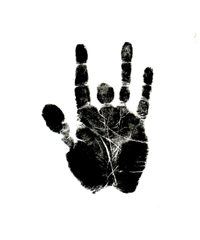 [by Ken Hunt, London] In April 1981 I walked into the anteroom of hotel round the corner from Green Park tube station in Central London to do the first of a series of booked interviews with members of the Grateful Dead. A hirsute gentleman, actually an aureole of hair with a splash of face, eyed me up and crossed the room to talk to me. We shook by way of opening pleasantries (his handshake was like the Dave Allen crack: “Am I the Irish comedian with half a finger? No, I’m the Irish comedian with nine and a half fingers.”). We fell into conversation straightaway.
His interview had failed to show on time. My interview was still running in the park. All around us a low-frequency mêlée of voices was in full swell. Noise, like indolence, has its time and place, so we elected to go somewhere quieter. And that was how an overdue, towel-wrapped drummer with the Grateful Dead called Mickey Hart first met me. I was already doing an impromptu interview with his band mate Jerry Garcia, whom I was due to interview the next day. And the following day when the interview proper was under way, Bob Weir for reasons I cannot fathom joined us in the same room. He got so intrigued with the conversation that we beckoned him over to join in the conversation.
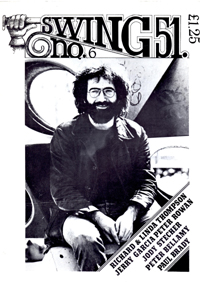 Garcia was San Francisco-born and very much bred in the Californian bone. He breathed his first breath on 1 August 1942, the second of two sons born to Ruth and José ‘Joe’ Garcia. His father had been a swing clarinettist and bandleader before falling foul of his local cock-of-the-midden musicians’ union. Jerome John Garcia was named after Jerome Kern. It is no exaggeration to say that Garcia became a walking musical encyclopaedia, cross-referenced in the bizarrest of ways. He made connections the whole time. They ranged from the country music and opera he heard in his boyhood home to his brother Tiff’s early love of rock ‘n’ roll and rhythm ‘n’ blues. And beyond. At the age of 15 he got his first guitar, though this involved him pestering his mother to return the accordion that she had substituted for the birthday present he really wanted. The loss of part of a finger in a boyhood accident just helped shape his style, like it did Reinhardt. Style is an expression of limitations.
Ultimately, Jerry Garcia was a rock guitarist for people who outgrew rock guitar. His playing started out full of folk, bluegrass and rock’n’roll, but was always imbued with a tincture of other elements, like avant-garde, Western and non-Western classical music, show tunes, soundtrack material (including, famously, Close Encounters of the Third Kind) and, naturally, jazz. The jazz elements that flowed through his work were various and multilayered. Miles Davis and John Coltrane were givens. Ornette Coleman represented a torch being carried forward and held aloft. But like any acoustic guitar player with diligent research tendencies, Django Reinhardt and his largely forgotten Argentinean counterpart Oscar Alemán were influences. (His take on Alemán’s version of Irving Berlin’s Russian Lullaby, on 1974’s Compliments of Garcia, is priceless, with strong violin from Richard Greene, Amos Garrett on trombone and Joel Tepp on clarinet.) And given San Francisco’s importance on the beat and bohemian barometer the crypto-significant jazz-rap of Lord Buckley and Ken Nordine never flew south. The twin keys to so many of the elements in his musical universe were improvisation and discipline.
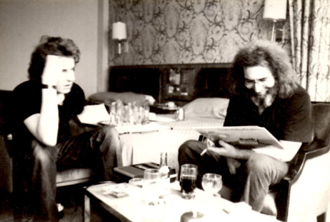 On 9 August 1995 Jerry Garcia began the next stage on the wrong side of the grass. When he died aged 53 in Forest Knolls, California, it was more awaited than unexpected. Yet still a shock. The news shockwaves of his death travelled ultra-fast. And despite the time difference, the morning after, UK time, I wrote the day off to sit beside the Thames at Kingston. Outside The Bishop Out Of Residence I nursed a couple of beers and reflected on Garcia’s life and works and particularly the man as I knew him. It was not a time for music.
Much like the Indian actress Karuna Banerjee expressed it of Chhabi Biswas, I shall never be able to say, “I had known him well.” Garcia and I met to do interviews three times over two decades. The rest was bumping into him backstage. He was unfailingly courteous, widely read and an indefatigable conversationalist. I declined to interview him later, though offered him as an interviewee. I never regretted that. Norma Waterson, who later covered the Garcia/Hunter song Black Muddy River, asked me what he was like. I told her truthfully that he was one of the best conversationalists on the planet that I had ever met.
The closing words go to or mutual friend, the former Grateful Dead keyboardist Tom Constanten. “What I miss most about Jerry, aside from and in addition to his playing and his musicality, is how he was backstage and at the hotel, his takes on things, the quickness of his wit, the new things he was reading, discovering, into.” That was Garcia all over and it showed in his music.
The image of Ken Hunt and Jerry Garcia is © Roy Wilbrahamt/Swing 51 Archives
9. 8. 2016 |
read more...
 J P Bean
Faber & Faber
ISBN 978-0-572-30545-2
[by Ken Hunt, London] Britain’s folk clubs must seem strange to anyone visiting them for the first time. They are an exceedingly British institution, only found on English, Northern Irish, Scottish and Welsh soil – or, allowing for poetic licence, on foreign soils as British forces’ transplants, such as RAF Luqa’s Malta Folk Club and the British Army on the Rhine. To interject a personal observation, the folk club equivalents in Eire, Germany, the Netherlands, Germany and the USA all have altogether different characters.
It was only in the second half of the 1950s that Britain’s folk clubs started and a coherent folk scene began coalescing. Ironically the English Folk Song & Dance Society had been frantically dance-orientated. Yet before the term ‘folk club’ was coined there were gatherings like Harry and Lesley ;Boardman’s ‘folk circle’ founded around 1954 in Manchester and Alex Eaton’s roughly contemporaneous Workers’ Music Association-inspired gatherings in Bradford. Often overlooked, there were university-based folk societies such as Cambridge’s St. Lawrence Folk Song Society, founded in 1950, and Oxford’s Heritage Society, operating by 1956. Aside from their own such as Stan Kelly and Rory McEwen they also booked occasional guests like Ramblin’ Jack Elliott and Shirley Collins.
Arguably the first big stone flung into the pond was the establishment of Ballads & Blues in London. Hosted by Ewan MacColl, with strong support from Bert Lloyd, Isla Cameron, Fitzroy Coleman and Peggy Seeger, it met, most memorably, at the Princess Louise in High Holborn. Re-launched as a club in November 1957 after the Ballads & Blues ensemble returned from Moscow, the ensemble had lent its name to the club. It set so many standards. For example, Jimmie Macgregor, then teaching in Glasgow, would hitchhike from Scotland to London (over 700 miles there and back) to attend the club at weekends. By 1960 Robin Hall and Jimmie Macgregor’s duo would be the television face of folk.
Bearing in mind the importance of folk clubs to the vitality and longevity of the British folk scene it may seem peculiar that J P Bean’s absorbing oral history Singing From The Floor is the first major account devoted to the folk club institution. They were – and remain – the bedrock of the folk scene, the places where many people learned stagecraft and how to hone material or just to have a good evening out and a sing. Before camera-phones and YouTube folk clubs were where musicians unselfconsciously tweaked and road-tested material. J P Bean’s voyage began in 1966 when as a teenager he visited the folk club “above the Three Cranes pub” in his hometown, Sheffield.
 You started researching this book in 1966 by going to your first club. What was your reason for going to one?
I’d seen a bit on television. I’d seen Alex Campbell and Martin Carthy. I’d heard some pieces on the radio. I was only just 16 and I wanted to know more. I read a snippet in the local [Sheffield] paper about the Barley Mow folk club, so I went along and found this heaving, sweaty, oozy but cheerful Saturday night scene. And like I say in the intro it was like Christmas Eve every Saturday night. I saw people there, the impressions of whom would stay with me all these years.
More specifically, what attracted you?
What it was really that attracted me – it wasn’t just the Saturday night atmosphere or whatever – it was the characters. You know, there were some great characters in the folk clubs. There were people that made a big impression on you. People like Bob Davenport with the way he could hold the audience without any instrumental accompaniment all night long. Alex Campbell was a great character and a comedian but people like [Diz] Disley, Tony Capstick and Billy Connolly I would say I have a fondness for. They were wonderful times and I hope that comes across in the book.
When did you start interviewing people?
I started in April 2010. From the very first interviews with Louis Killen in Gateshead and Martin Carthy in Robin Hood’s Bay, from then to publication was almost exactly four years. The last year there wasn’t much happening because it was pre-production. I spent a good eighteen months roaming up and down the land just interviewing people, chasing them on the phone, getting numbers and networking. Then it slackened off as I started to put it together.
It was a wonderful social time. People welcomed you to their homes or you met them in pubs or you met them wherever. And heard the stories. I heard the stories of people who I’d only sat and marvelled at when I was young.
When looking back over that scene I know in my case I have semi-regrets I didn’t get to talk to certain people. Are there any people you would have dearly loved to have captured?
I would have loved to have interviewed Ewan MacColl. I would have liked to have interviewed Bert Jansch. I missed him by a very short span.
This is the dream. I’d have liked to have talked to Bob Dylan about London ’62/’63. And possibly Paul Simon. I wrote to Paul Simon’s management three times but didn’t get a reply. And I wrote to Dylan’s. But there are so many people who knew them at that time and presented a different angle or a different view on how they saw them – Dylan and Simon – that I think it really works out alright.
Did you ever go to any folk clubs outside of the British Isles?
Only Jersey [one of the Channel Islands between England and France]. And I don’t think that would count.
No, I didn’t and I would always have liked to have done. In those days when I was younger I would have loved to have gone to America or Canada. I didn’t get to American until ’94 and that was through doing the Joe Cocker book [Joe Cocker – The Authorised Biography, 1990, revised 2003].
Did you get any sense of impermanence at the end of the book you know, the way things have changed in the folk club scene?
How do you mean?
Well for instance, you talked about going along to the Barley Mow at the Three Cranes. Is the Three Cranes pub still there?
Yeah.
See, where I live [in southern England] pubs have just disappeared and most of the clubs were in pubs.
Most of the pubs in the Sheffield/South Yorkshire area where the folk clubs were held are still standing. They don’t all bear the ;same name. One of the big ones was the Highcliffe that is a very thriving gig now called the Greystones. The Highcliffe Folk Club was the first place in England where Billy Connolly, Barbara Dickson and John Martyn played, brought down by Hamish Imlach.
Years ago I went for a walk, as I used to do quite regularly, with Gill Cook [the doyen of Collet’s folk emporium in New Oxford Street] and I remember we did this walk – it was a ‘research pub crawl’. She talked about all the folk clubs in this little area of Soho in London. There were some in cellars and some in the top rooms of pubs. It was fascinating.
As you describe that this is exactly the reason I did Singing From The Floor. I wanted to get as many of those stories as I could. Gill Cook had died by that time. I was aware when Alex Campbell went that he must have had so many great stories because he’d played so many clubs, busked on the streets.
The one interview that sticks in my mind and it does pertain to Transatlanticness was sitting in a pub in Islington with Tom Paley. He was in his 80s at the time. He was talking about playing union hall gigs with Woody Guthrie and how Woody used to take him round to Leadbelly’s house on a Sunday afternoon. That was like touching history.
A lot of it was with a lot of people in England and Scotland but that with Tom Paley, for me, was quite amazing.
Julian Broadhead alias J P Bean died in late 2015. His obituary is here http://www.thestar.co.uk/news/sheffield-writer-j-p-bean-dies-aged-66-1-7560561#axzz3r5FvhJ4Z
Ken Hunt’s obituary of Gill Cook is here:
http://www.independent.co.uk/news/obituaries/gill-cook-341453.html
19. 2. 2016 |
read more...
Scott Barretta (editor)
Scarecrow Press
ISBN 978-0-8108-8308-6
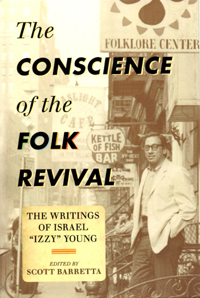
[by Ken Hunt, Berlin] This fascinating gathering of writings from Israel G. Young appeared in 2013. The elder of two sons born to Polish Jewish parents in March 1928 on Manhattan’s Lower East Side, he reveals himself as a clear-sighted and sometimes curmudgeonly commentator, catalyst and chronicler of the New York folk scene. (California and Europe barely get walk-on parts.) Izzy Young gravitated to New York’s nascent folk music scene via the square dances of the left-leaning American Dance Group. He attended his first dance during the winter of 1944/45 and soon joined
the American Square Dance Group under the sway of its leader Margot Mayo. In February 1957 he obtained the lease on a property at 110 MacDougal Street in Greenwich Village that not long after opened as the Folklore Center. Later it moved to 321 Sixth Avenue.
The accounts here reveal the Folklore Center as a marvellous abode of folk music and deeply flawed finances. Part store and bigger part folk drop-in centre, Bob Dylan’s (unrecorded) Talking Folklore Center (its manuscript looks like it barely survived Gettysburg) described its unique non-selling proposition: “You don’t have to buy anything/Do what everybody else does/Walk in, walk around, walk out.” Soon Izzy Young was putting on gigs there by the likes of local talents Oscar Brand, Sonny Terry and Brownie McGhee and the New Lost City Ramblers. Later, under the aegis of the Friends of Old Time Music, the Folklore Center put on a welter of blues, bluegrass and folk acts. (One rationed-to-one list might opt for Mississippi Fred McDowell, Bill Monroe and Clarence Ashley.). Still later he put on bubbling-under talents of the calibre of Tim Buckley, Joni Mitchell and Patti Smith. In May 1973 Young relocated to Sweden and founded the Folklore Centrum (“dedicated to Swedish folk music and dance”) in Stockholm – a subject outside this anthology’s orbit.

Scott Barretta’s selections gather together a body of little-known published materials. This category includes Young’s writings for short-life periodicals such as Caravan, the Folklore Center-Fretted Instruments Newsletter and the Philadelphia and Newport folk festivals. Naturally, his influential Frets and Frails column in Sing Out! figures prominently (Frets and Frails superseded his newsletter Folk Music Guide * USA in 1959 before petering out in 1969). Alongside this material is an assortment of hitherto unpublished writings from diaries, notebooks, interviews and sundry drum-bangings. Some content is newsy, freeze-framing points in time. Some insights and observations about Joan Baez, Bob Dylan, part-hero, part-b©te noire Alan Lomax, Ewan MacColl and Peggy Seeger and the New Lost City Ramblers might well blow you away. Some targets remain as pertinent today as the day he delivered them. One recurring theme is rights-grabs to do with song copyrights. Try the unpublished 1997 paper, Folk Music and Copyright, Lomax and Leadbelly for size. There are occasions when the absence of a sic or an editorial aside or intervention throws up twitches. Nevertheless, Izzy Young’s writings also nail a number of floating folk quotes that long ago lost their attributions.
A romp of a read, as the lost-for-words reviewers say when reviewing popular fiction.
PS And one he made earlier: Autobiography – The Bronx.
6. 1. 2016 |
read more...
« Later articles
Older articles »