Articles

[by Ken Hunt, London] As years go, 2015 was one of the finest. Over and over again it plucked some remarkable rabbits out the magician’s hat. It’s stuff like that that keeps me keeping on.
A note on the process when it comes to these decisions. Part of it is to do with whittling. Some ‘holding entries’ logged were gone by the end of the year. Some albums remain here because even though they did not necessarily overwhelm, in the long run they stayed on the play list. An example might be Los Lobos’ Gates of Gold. In their canon it may be a “a fair to middling album” (according to my fRoots review) but I played it so much without making that special connection with the majority of its tracks.
The festival season brought further discoveries, consolidations and winnowings. It is no coincidence that live performances outnumber all the other entries combined. A special year for music.
2015 also brought a number of deaths in music circles that affected me. To name but a significant few, these included J P Bean (author of Singing From The Floor: A History Of British Folk Clubs), Bill Keith, Sabri Khan, John Renbourn, Bruce Rowland, Christof Stählin and Andy M. Stewart. Thankfully it was the year in which the fewest really close musician friends died in several years. Lemmy’s death reminded me of interviewing Steve Reich slightly confused by being in the same hotel as a whole lotta Motörhead fans.

New releases
The Casey Sisters / Sibling Rivalry / Old Bridge Music
Eviyan / Nayive / Animal Music
Archie Fisher / A Silent Song Greentrax
Ghazalaw / Ghazalaw / Marvels of the Universe
Rhiannon Giddens / Tomorrow Is My Turn / Nonesuch
Jahnavi Harrison / Like A River To The Sea / Mantrology

Zakir Hussain / Distant Kin / Moment
Los Lobos / Gates of Gold / Proper
Mahsa Vahdat / Traces of An Old Vineyard / Kirkelig Kulturverksted
Plainsong [Iain Matthews • Andy Roberts • Mark Griffiths] Reinventing Richard / Fledg’ling
Emily Portman / Coracle / Furrow
Tom Russell / The Rose of Roscrae – A Ballad of the West / Proper
Buffy Sainte Marie / Power In The Blood / True North Records
Simpson • Cutting • Kerr / Murmurs / Topic
Jyotsna Srikanth / Bangalore Dreams / Theme Music
Stick In The Wheel / From Here / From Here
Richard Thompson / Still / Proper
Steve Tilston / Truth To Tell / Hubris
Trembling Bells / The Sovereign Self / Tin Angel Records
Tritonus / urbanus / Zytglogge
Marry Waterson and David A. Jaycock / Two Wolves / One Little Indian

Historic releases, reissues and anthologies
Bob and Ron Copper / Traditional Songs from Rottingdean / Fledg’ling
Bonnie Dobson / She’s Like A Swallow and Other Folk Songs / Big Beat
Incredible String Band / Wee Tam & The Big Huge / BGO
Kronos Quartet / One Earth, One People, One Love – Kronos Plays Terry Riley / Nonesuch
Lead Belly / The Smithsonian Folkways Collection / Smithsonian Folkways
John Renbourn / The Attic Tapes / Riverboat
Buffy Sainte Marie / Many A Mile / Ace/Vanguard Masters
Various / Don’t Panic! We’re from Poland (promotional CD) / dontpanic.culture.pl
Various / Rudolstadt 2015 / heideck

Events of 2015
Martin Simpson / Kings Place, London, 20 February 2015
Ashok Pathak • Ravikiran & Shashank (Shashank Subramanyam) • Nishat Khan Journée Inde – Fête de Holi (‘India Journey – Festival of Holi’) / Théâtre de la Ville, Paris / 22 March 2015
Iva Bittová / Fiddles on Fire, The Sage, Gateshead / 3 May 2015
Peggy Seeger with Calum MacColl & Neill MacColl / The Stables, Waverdon, Milton Keynes / 10 June 2015
Emily Portman Trio / Riverhouse Arts Centre, Walton-on-Thames, Surrey / 21 June 2015
Simpson, Cutting & Kerr / The Stables, Wavendon, Milton Keynes / 23 June 2015
9Bach / TFF Rudolstadt, Heidecksburg / 3 July 2015
Rojda Şenses / TFF Rudolstadt, Heidecksburg / 3 July 2015

Rhiannon Giddens / TFF Rudolstadt, Große Bühne, Heinepark / 3 July 2015
Trollmusikken (Silje Hegg, Geir Egil Larsen, Ingvild Lie and Tom Willy Rustad) / TFF Rudolstadt, Neumarkt / 5 July 2015
Peppe Voltarelli Band / Jazz Dock, Prague / 6 July 2015
Bahauddin Dagar – Morning Bliss / Darbar Festival, The Front Row at Queen Elizabeth Hall, Southbank, London / 20 September 2015
Martin Carthy & Dave Swarbrick / Folk at the Foundling, The Foundling Museum, London / 9 October 2015
Emily Portman Sextet / Folk at the Foundling, The Foundling Museum, London / 6 November 2015
Blood & Roses: The Songs of Ewan MacColl / Barbican, London / 9 November 2015
David Dorůžka Trio / Jazz Dock, Prague / 16 November 2015
Iva Bittová a PKP [Iva Bittová and the Prague Philharmonia] / Forum Karlín, Prague / 17 November 2015
Marry Waterson and David A. Jaycock / Green Note, London / 26 November 2015
Come Together with Barb Jungr & John McDaniel / Studio, St. James Theatre, London / 27 November 2015
Herzberg60 – André Herzberg, Pankow and others / Kesselhaus, Berlin / 28 December 2015
Past music projects that returned to haunt

Ornette Coleman / Dancing In Your Head Verve/A&M
k d lang and the BBC Concert Orchestra / Live In London / Universal
Kronos Quartet with Asha Bhosle / You’ve Stolen My Heart / Nonesuch
Kronos Quartet and Terry Riley / Requiem For Adam / Nonesuch
Scotty Stoneman with the Kentucky Colonels / Live in L.A. / Sierra/Rural Rhythm Records
Grateful Dead / Workingman’s Dead / Warner Brothers
The image at top of 9Bach at TFF Rudolstadt is © Santosh Hunt/Swing 51 Archives. The images of Iva Bittová rehearsing before Fiddles on Fire and Carthy, Swarbrick & Handel coming down after their Foundling gig are © Ken Hunt/Swing 51 Archives. Otherwise the images are © their image-makers, photographers and designers.
In memory of Fred McCormick (18 November 1946-15 November 2015)
31. 12. 2015 |
read more...
 [by Ken Hunt, London] This month’s collection is a mixture of project-related listening and music listened to just for pleasure. In the latter case that doesn’t happen too often. On 5 July 2015 Shirley Collins celebrated her 80th birthday in London as All in the Downs but I was working in Germany on that date (see below). The assortment includes The 31st of February, Shirley Collins, Bert Jansch, Led Zeppelin, Mita Nag, Brian McNeill, Samira, Scotty Stoneman, Trollmusikken and Rhiannon Giddens
An occasional reminder. Giant Donut Discs is a bequest column. The singer Pete Bellamy granted Ken Hunt, the author’s Swing 51 magazine the concept and column. It was a variation on an idea by the UK-based radio broadcaster, Roy Plomley (pronounced Plum’lee). The BBC Home Service first broadcast Desert Island Discs in January 1942 and it is now hosted by BBC Radio 4. The essence is that each programme a guest (usually
one) is stranded on an imaginary desert island. They choose eight pieces of music, originally gramophone records, to take with them. Since several libations were involved in our discussion – and it was after a gig – Pete and I went for two over the eight.
Bonny Cuckoo – Shirley Collins
This vinyl EP containing two versions of The Bonny Cuckoo and Bonny Labouring Boy (one each unaccompanied, one each with her banjo accompaniment) was “commercially released for the first time to celebrate her 80th birthday”. They come from a BBC transcription disc acetate dated 20 October 1957 in David Tibet’s possession.
Although I had heard and sung English folksongs in, I imagine, Cecil Sharp arrangements for schools before I was eleven, Shirley Collins was the Masonic handshake, my introduction to the mysteries of England’s folkways with her EP Heroes in love. Dated 1963 I bought my own copy in 1967, having been listening to a friend’s copy. Her music has irrigated my musical and political consciousness down the decades ever since. From The Bonny Cuckoo EP (Fledg’ling WING 1003, 2015)
Robin Denselow’s review of the bash, ‘All in the Downs review – a memorable Shirley Collins celebration’ is at
http://www.theguardian.com/music/2015/jul/06/all-in-the-downs-rev iew-a-memorable-shirley-collins-celebration
To discover more, do go to shirleycollins.co.uk.
A Nickel’s Worth of Benny’s Help – The 31st of February
This track comes from a most exceptional collection of Vanguard obscurities. Most of the groups on it were little more than names in the index of rock for me. The 31st of February made one album for the label. After the event, they are perhaps best known as a footnote in the Allman Brothers
story. From Follow Me Down – Vanguard’s Lost Psychedelic Era 1966-1970 (Ace/Vanguard VCD 78149, 2015)

 Trollmusikken
It was a blazingly hot Sunday afternoon when Trollmusikken took the stage at the Neumarkt at Tanz&FolkFest 2015. For the record it was 5 July 2015. For the festival programme I had already written about them and there was a genuine frisson about their two appearances as part of the Norway selection of musicians attending the festival. Perhaps, a frisson only in my noggin.
I had written, “Trollmusikken … is not a consort but the name for a concert of four individual artists from Norway. Rare musical instruments from the Nordic lands provide the common ground, one which for centuries – until some 50 years ago – had led solitary lives. Silje Hegg presents the sea flute (sjøfløyte) and the willow flute (seljefløyte) [Note: she would also play the ‘snow flute’ as she announced it in English but there are too many snø variations to bluff the fløyte suffix] Geir Egil Larsen’s instrument is the bukkehorn (goat or ram horn), but also various flutes and the meråkerklarinett (the reeded shepherd’s clarinet from Meråker, a parish situated ;north-east of Trondheim and close to the Swedish border) Ingvild Lie plays the Norwegian dulcimer, the langeleik; and Tom Willy Rustad is a one-man orkestret playing jew’s harp, cister (cittern), guitar, double-bass, seljefløyte and an accordion of his own design. An impossibly brilliant musical alliance quite unlike anything all but very few will ever have seen or heard.”
It was the kind of concert of ethnic music instruments as I have seldom seen in my life. That it was a collection of instruments from Norway helped. It was the epitome of why live music goes to places that recordings never can. It is music in the moment.
Black Water Side – Bert Jansch
Bert Jansch first made real sense for me with his Jack Orion album, his third LP for Transatlantic. This particular track has coloured my mind for a long time. When the time came around for the album to be reissued I was able to claim first dibs on writing its CD booklet notes.
The album brought back memories galore. It was the
first time Bert Jansch made complete sense to me. That was in 1966. It especially brought back memories linking Bert Jansch and Annie Briggs. That was how I approached writing the notes, given that I was asked to write in a personal vein. From Jack Orion (Sanctuary TRACD 143, 2015)
Marwa – Mita Nag
Mita Nag, the notes to this release explain, is “the sixth generation musician of the Nag Family of instrumentalists hailing from the Vishnupur School of Music, Bengal”. This isn’t the best recorded album of anybody’s career but it captures the sitarist playing like a dream. Her
playing is expressive and is richly rounded with nuances. Sandip Banerjee accompanies on tabla on this live recording. No specific recording information is provided for this excellent performance but it was the only recording I had in the collection. I was already researching for the Darbar Festival
in September because listening properly takes time. From Twilight (Bihaan Music, 2004)
No Gods And Precious Few Heroes – Brian McNeill
Part of a longer-term, seemingly never-ending listening project. This song of Brian McNeill’s context is a favourite. “To hell with the heather and the glen.” he wrote in 1995. And with the Neverendum that masquerades as the Scottish Referendum, this is song to make the listener think. No bad thing. Till Death us do part. From No Gods (Greentrax CDTRAX 098, 1995)
 Ouine Roh: longue version – Samira
In November 2003 David Harrington and I worked in Paris on what became a short list for Kronos Quartet’s You’ve Stolen My Heart album. We spent many a happy hour over a few days doing some truly intense listening to dozens of R.D. Burman compositions. The album it grew into was a joint Kronos and Asha Bhosle project. Kronos was also rehearsing for a concert at Théâtre de la Ville.
One day Alexandra du Bois (whose string quartet An eye for an eye makes the whole world blind was on the bill) joined us to walk along the Seine to the Institut du monde arabe. The conversation touched on R.D. Burman periodically but it was more about bouncing off and firing off one another’s ideas. At other times I strolled across the bridge to Latin Quarter alone, nipping into somewhere to sit and write when the need arose. Aside from Burman, Arab music of various sorts was running through my head and fingers. I picked up a second-hand copy of Ysabel Saïah’s biography Oum Kalsoum (Éditions Denoël, 1985) in Gibert Jeune at Place Saint-Michel and then this chance find of Samira’s in the basement of a shop along the Boulevard Saint-Michel.
The skimpy biographical notes said that Samira was an Algerian-born singer, aged 19 at the time of this maxi-single’s release in 2001. At the age of three she had first seen Parisian skies – it said ‘sun’ but that’s the French and poetic licence for you. She had grown up in the 19th Arrondissement and had started writing songs while still at school. This particular version – one of three on the EP – supplies all sorts of suggestions about ingredients that fed into the song, including Maghrebi music and perhaps Egyptian film music and TLC’s Waterfalls. It is a wonderful take on contemporary French music, though not necessarily typical of the 19th Arrondissement. Between the Théâtre de la Ville in the 3rd Arrondissement and that arrondissement (district) there is short distance that belongs to a sliver of the tenth. What happened to her? From long version of Ouine Roh (Warners 0927 43948 2 – WE 1101, 2001)
White Summer/Black Mountain Side – Led Zeppelin
A radio broadcast of an instrumental piece, apparently recorded and broadcast live “for the Playhouse Theatre over Radio One show” on 27 June 1969. A piece of listening for research purposes – see above – and a reminder of Jimmy Page’s listening habits back in the day, back when Davey Graham and Bert Jansch were influencing him. From the four-CD Led Zeppelin (Atlantic 7567 82144-5, 1990)
 Listen To The Mockingbird – Scotty Stoneman
If there ever was a fiddler even approximating Scotty Stoneman then their playing never came to my attention. Raw, intense and extreme. This album originally appeared on Sierra Briar. The editors of Folkscene, Marsha Necheles and Vicki Nadsady, organised a review copy of this album to be sent to me. It was transformative. Its music gave me chances to recalibrate fiddle playing. And Stoneman’s music had gone to places which informed so many other musicians’ sensibilities. Musicians such as Jerry Garcia, Richard Greene and Peter Rowan to name but three.
Scotty Stoneman was in a class of one. Madcap inventions. It was recorded at the Cobblestone Club in North Hollywood and the Ash Grove in Hollywood. The Kentucky Colonels accompany him – they being Clarence While, Roland White, Billy Ray Lathum and Roger Bush.
For anyone interested in ornithological matters, during this piece the ensemble dives headlong into the thicket and shows that a bird in the bush is worth two in the hand. Little wren, whippoorwill and a woodpecker is just part of their avian trophies. Love this performance to bits. From Live In L.A.! (Rural Rhythm RHY 1017, 2002)
 Tomorrow Is My Turn – Rhiannon Giddens
I have seen Rhiannon Giddens on stage in various contexts and concert situations. But the disparate nature of her Tomorrow Is My Turn threw me. I couldn’t work out its unifying themes or master plan. Seeing her perform this Charles Aznavour/Marcel Stellman/Yves Stéphane song live in Rudolstadt’s Heine-Park swung open the door to the album.
The song was part of the Philips (record label) phase of Nina Simone’s recording career. Giddens writes in the notes, “I saw a video from 1968 of Nina Simone’s performance in London and it became the linchpin of this entire project.” The original is called L’amour C’est Comme Un Jour’ (Life’s like a day). But it was seeing her perform this song live that cracked the album’s code after listening to the album umpteen times, persevering in the knowledge that my time hadn’t come, rather than the oft-touted premise that if you listen to something frequently enough [continued page 77]. From Tomorrow Is My Turn (Nonesuch 7559-79563-1, 2015)
The copyright of all images lies with the respective photographers, companies and image-makers. The images of Rhiannon Giddens and Trollmusikken are © Ken Hunt/Swing 51 Archives.
15. 12. 2015 |
read more...
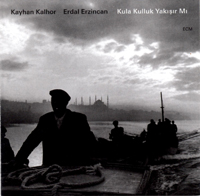
[by Ken Hunt, London] “How unseemly it is to follow anyone slavishly,” was ECM’s press release’s free (one suspects) translation for the title track in 2013. Performing Muhlis Akarsu’s Kula Kulluk Yakýîir Mı therefore could be perceived as a pointed choice since he died in a firebombing in 1993 aged 45 or so. He belonged to the Alevćlik (Alevi) sect. Within Islam, Alevism is seen as a Turkish- slash Turkish-diaspora-based Shia sect retaining Sufi colourings. Furthermore, Alevism espouses poetry, music and dance.
Erdal Erzincan plays the bağlama – the long-necked lute or saz anglicised as baglama while Kayhan Kalhor is the project’s kamancheh (spike fiddle) player. As sometimes occurs with ECM releases in my specific areas of expertise or experience, this album misses the
trick of failing to contextualise such magnificent music. Exhibit 1 for the prosecution is the lack of information about the four-section medley of “traditionals” called Intertwining Melodies, given that the musicians are Iranian (Kalhor) and Anatolian (Erzincan).
Further suspicions might be fed by ECM’s seemingly slavish art-direction house style. It extols image over text and here it sidesteps a deliberate cultural positioning. For example, the sleeve artwork is a monochrome Bosporus (by photographer: Ara Güler) in full ECM art-direction conformity. Here design does a disservice to a remarkable improvised music.
This duo’s drawing attention to what many Muslims would perceive as unorthodoxy is a testimony of the duo’s musical nonconformity and philosophical surefootedness.
Captured live by Bursa Uğur Mumcu Sahnesi in February 2011, what these two musicians achieve on their joint flight paths of the kemancheh and baglama, with the rise and fall of the melodic lines, is nothing short of stupendous. Quibbles aside, musically it is one of the finest collaborations ECM has ever brought together. Masterful stuff. Kula Kulluk Yakışir Mı (ECM Records ECM 2181, 2013)
This is an expanded version of a review that appeared in the December 2013 issue of UK-based monthly magazine Jazzwise.
30. 11. 2015 |
read more...
 [by Ken Hunt, London] In 1955 North America’s modern-era fascination with Hindustani music began with the advent of jet travel and the arrival of the sarod maestro Ali Akbar Khan in New York. By then, Shamin Ahmed Khan, born in Baroda, Baroda State (modern-day Gujarat) on 10 September 1938, had already met the musician who would transform his life.
In 1951 he met Ali Akbar Khan’s brother-in-law, Ravi Shankar. Shamim Ahmed belonged to a family of hereditary musicians of the Agra Gharana. A gharana is a school and style of Hindustani classical music historically rooted in a specific place – Agra is in modern-day India’s northern state of Uttar Pradesh. A boyhood bout of typhoid destroyed his singing range. He switched to sitar.
In December 1955 he met Shankar again in Delhi while attending an All India Radio music competition. Shankar was the Music Director of AIR’s Vadya Vrind Chamber Orchestra and invited Shamim Ahmed and his father, the classical vocalist Ghulam Rasool Khan to his Delhi residence. The 17-year-old’s playing impressed him so much that that month they formally ‘tied the thread’ – ganda bandan – that symbolically connected them as guru and shishya (disciple-pupil).
 As one of Shankar’s first shishyas, he ‘commuted’ the 1000 km between Baroda and his guru’s home. When he moved to Bombay in 1960, Shamim Ahmed relocated to fill a teaching position at Shankar’s Kinnara School of Music. In 1968 Shankar invited him to California to be one of the young lions on what became immortalized as Ravi Shankar’s Festival From India (World Pacific, 1968; BGO Records [reissue], 1996) – the sitar and sarod duet on rāg Kirwani with Ali Akbar Khan’s eldest son, Aashish Khan is one of the double-LP’s highlights.
The same period saw him guest on the Indo-jazz fusion project Rich á la Rakha (World Pacific, 1968; BGO Records [reissue], 2001), fronted by Shankar’s tabla virtuoso Alla Rakha and the US jazz drummer Buddy Rich. He also recorded his US solo debut Monitor Presents India’s Great Shamim Khan: Three Ragas (Monitor, undated; Smithsonian Folkways Archival, 2007) with the student prince of tabla Zakir Hussain accompanying.
As a senior Shankar shishya, he graced the triple-CD ShankaRagamala – A Celebration of the Maestro’s Music by his Disciples (Music Today, 2005) superbly interpreting his guru’s raga composition Janasanmodini. That December 1955 ceremony in Delhi created a life-long, mutual commitment and steered a superlative, sweet-voiced sitarist’s seven-decade career in music. He died in Mumbai, Maharashtra on 14 February 2012.
 Shamim Ahmed Khan holds a special place in my heart. I took my young son Tom to one of his recitals, organised by the promoter Jay Viswa-Deva. Afterwards Shamim and I talked at length and he entreated me to pass my opinion of his performance to his guru. The recital was memorable for another reason. Tom and I fell into conversation with a charming woman. She was friendly and so attentive when it came to my lad. When I got home I related what had happened to my wife, Dagmar. The kind woman was the actress Vanessa Redgrave. Tom was aged under ten and had no idea who was talking to him so attentively.
Ken Hunt’s obituary of Shamim Ahmed Khan appeared in The Independent of Tuesday 6 March 2012.
All images are courtesy of Swing 51 Archives.
31. 10. 2015 |
read more...
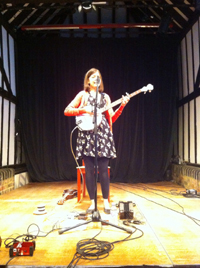 [by Ken Hunt, London] One day before her third album Coracle‘s official release the Emily Portman Trio performed much of it a good number of songs at a Sunday lunchtime concert at the Riverhouse Arts Centre in Walton-on-Thames. A splendid, characterful venue yards away from the Thames, its barn-like interior is all wooden beams and half-timbered decorations.
It made for a stark backdrop for the Trio. Even with the sun shining outside, it suited Portman’s songs from the womb to the tomb and their proclivity for seeking out dark spaces. In a real sense rather than touring the new album they were touring a triptych of The Glamoury (2010), Hatchling (2012) and Coracle.
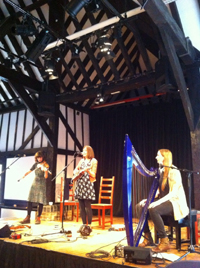 The Summer 2015 touring trio comprised Emily Portman on vocals, concertina, banjo and ukulele, Rachel Newton on vocals, harp (a Camac electric with, amongst other tricks, guitar effects which had replaced the acoustic harp two days before) and viola, and Lucy Farrell on vocals, viola, violin and on High Tide (a setting of an Eleanor Rees poem) musical saw. The sound palette was considerably scaled back from the arrangements on Coracle and consequently gained a distinctive tautness.
In fact, the opener turned out to be Hollin (a dialect name for the holly tree) from Hatchling and for a good way into the first set the repertoire stuck close to the first two albums. Portman has a skill at reimagining the signs and wonders of traditional folk tales. Introducing Tongue-Tied she admitted her debt to Angela Carter (and Carter’s adaptation of The Twelve Wild Ducks, a folk tale from Norway). Stick Stock, another example, draws on the German folk tale The Juniper Tree. (One anthology edition drawing on the tale, The Juniper Tree And Other Tales from Grimm benefited from Maurice Sendak’s illustrations.)
Part-way through the concert the thought struck that the cultural wherewithal in Angela Carter’s Book of Fairy Tales (2005) or its Virago predecessors from the early 1990s might be postulated as 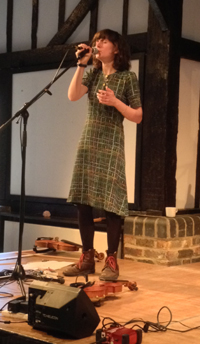 Portman’s handbook. It could have been that it cracked open a vein of tradition-based imagination and creativity. Carter had an appreciation of folksong, for example, taking part in the Centre 42 project. Furthermore, her then-husband Paul Carter figured in several important recordings’ credits. To name but one – however invidious one may sound – he is credited as recording supervisor on Anne Briggs’ The Hazards of Love EP. More than read and appreciated, Angela Carter may well have helped to provision Portman’s fantastical expeditions with a blueprint for reworking traditional folk tales into quasi-folksong settings. In the case of Bones And Feathers she told how a she-wolf tale got relocated to Fenham, a district in Newcastle upon Tyne – the city in which she studied.
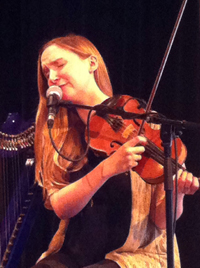 The second set opened with Nightjar (the word refers to a bird, Caprimulgus europaeus, more heard than seen). They concluded with When You’re Weary which ends Hatchling. Their unaccompanied encore of this part-song lullaby sent the sensible not off up the wooden hill to Bedfordshire but more like round the corner to The Swan on the banks of the Thames for Sunday lunch. Over the course of their set, Emily Portman touched on truths and myths, verities and lies. When Lucy Farrell played musical saw it set off a train of thoughts that led to to playing again Tine Kindermann’s 2008 Oriente album Schamlos schön. For which I thank the Emily Portman Trio.
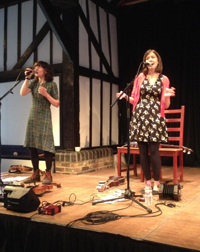 I don’t want to even to begin trying to imagine the British folk scene without Emily Portman. She has made a place for herself there. She is brainfood and the Riverhouse Barn’s brooding backdrop was made for the black and white of Portman’s morality tales and the dark spaces that oral folk literature can lurk in and occupy. A Sunday lunchtime concert on the longest day of the year. What could go amiss? One of the concerts of the year.
riverhousebarn.co.uk/
www.emilyportman.co.uk
19. 8. 2015 |
read more...
 [by Ken Hunt, London] At the time of the inspirational illustrator Maurice Sendak’s death, obituaries concentrated on his connections with Mozart, Prokofiev, Janáček and suchlike. On the occasion of the death of the US folksinger Jean Ritchie (1922-2015), it is time to remind about his bigger sound palette connections, notably one that coloured his early art. One commission revealed other musical tastes.
Sendak illustrated one of the most important, early books of the US Folk Revival, Jean Ritchie’s Singing Family of the Cumberlands (1955). Ritchie, the book reminds, “born in Viper, Kentucky, in the Cumberland Mountains” in 1922, was an authentic voice whose repertoire like ‘The Cuckoo She’s A Pretty Bird’ traversed folk into rock – to Janis Joplin, for example – and maybe even into R&B with Inez & Charlie Foxx’s Mockingbird – a take on the traditional Hush Little Baby. Shady Grove? A version appeared in Ritchie’s book.
Sendak provided line illustrations for each of the book’s 13 chapters. They capture an emergent style. Some are flimsy-flitty.
Others prefigure a style to which he would return with The Juniper Tree and Other Tales from Grimm (1973). Singing Family of the Cumberlands provided him with a pictorial realm blurring folk song and folk tale and opportunities to use quasi-psychological imagery – notably face-to-the-wall oddness – and depictions of marriage juxtaposed with constrained livestock, square dancing and rocking the cradle. Many of the book’s illustrations are dry runs for what came later. We must hope that when art historians get their teeth into his legacy, his folk legacy will be better appreciated.
Jean Ritchie’s Singing Family of the Cumberlands illuminates so much. In 1955 folk music carried so many proletariat and radical associations. Hard to imagine after so many decades but Singing Family of the Cumberlands is still in print, most recently with the University Press of Kentucky in 1988, though that may now be outdated. That edition is still around.
The author’s obituary of Jean Ritchie published in the ‘paper’ edition of The Independent of 5 June 2015 is at: http://www.independent.co.uk/news/obituaries/jean-ritchie-served-as-inspiration-for-bob-dylan-shirley-collins-and-joni-mitchell-10298307.html
8. 6. 2015 |
read more...
 [by Martha Hawley, Amsterdam] Roberto Fonseca and Fatoumata Diawara passed through the Netherlands in May 2015, in the company of musicians from Mali and Cuba, stopping at the Music Meeting in Nijmegen, and in Amsterdam’s North Sea Jazz Club, where I heard them. The North Sea Jazz Club is licensed to use the name of the sprawling North Sea Jazz Festival – both maintain a programming policy of jazz with a broad range, including Latin, African, funk, soul and more. The Club prides itself on giving big names the opportunity to perform in a small venue.
Roberto Fonseca and Fatoumata Diawara are well-matched to carry their musical roots forward, both having played with hometown greats. After doing some acting and performing in musicals, Diawara first toured the world as a back-up singer for Oumou Sangare. Fonseca has been
on stage for longer, and earned a name for himself as back-up pianist for Ruben Gonzalez in the Buena Vista Social Club. This is not their first encounter – Diawara was one of 15 guest artists on Fonseca’s album YO in 2010 – but in this project they share the lead.
At the North Sea Jazz Club in Amsterdam, the crowd is enthralled when Fonseca, the band and Diawara appear. She is a striking figure, smiling and colorful from head to toe, wielding an acoustic guitar. To give as many people as possible the chance to share this intimate setting, tables and chairs have been removed. For me, the 450 people in the room somewhat diminish the feeling of intimacy, but I go with the flow and station myself on the front lines. Necks are craned – including those of many tall Dutch people – as the buzz carries the observation that the evening’s star vocalist is pregnant. The mother-to-be certainly seems to have enough energy for at least two.
The melodies and rhythms of Mali and Cuba sustain their seduction throughout the evening, but it is Diawara on stage who offers us the best moments, the moments crowds long to experience, when she looks out at us and holds her arms up high, exhorting all women to fly away and be free, to fly wherever they want to go. She describes running, running, and looking back to see if her parents are coming after her, on her trail to force her to marry her cousin. Women must keep running towards the destinations of their dreams, she tells us.
Diawara has had to cover some distance to be where she is now; her parents were not in favour of the artist’s life for their daughter. At work as a back-up singer, she started playing guitar and then released an album: Fatou. She never looked back. The project with Fonseca is not her first collaboration with jazz musicians. One such gig involved working with Herbie Hancock on The Imagine Project in 2010. More recently she wrote (and co-composed with Amine Bouhafa) the ode to Timbuktu for the film by Abderrahmane Sissako.
Fonseca, on the other hand, grew up in a musical family. At some point, a jazz cassette of Keith Jarrett and Bill Evans came into his life and got him started as a jazz musician. After Rubén González died, Fonseca became the accompanist for Ibrahim Ferrer, who told him: jazz is beautiful, but you must never forget your roots. At school he was told: urban music is terrific, but never forget your classical Cuban background.
There’s little chance of that happening: Bolero had always been a familiar sound to him, thanks to his mother, a classical singer. Before he sat down at the piano he had performed as a drummer – his father was a drummer in the Afro-Cuban tradition – and Fonseca’s first professional gig apparently featured him as Ringo Starr in a Beatles cover band. I’m sorry I missed that phase in his career – there was a time when listening to the Beatles in Cuba was not done.
In Amsterdam, Fonseca is pleased and proud to introduce and reintroduce Diawara, and his piano stayed dynamic, but he seemed to be very tired that evening and for much of the set his focus seems to be away from the crowd. The piano rings true and clear, but it is Diawara’s presence that creates the connection and makes the concert a success. People are already on their feet in this standing room only event, and there is no let up in their enthusiasm. The crowd claps and responds to Diawara’s call for vocal participation. She is hard to refuse, but at times the audience appreciation seemed more a form of encouragement and a call for more, as if waiting for the fireworks to really begin.
Meanwhile, the musicians are grooving: Yandy Martínez, Bah Sekou, Sidibé Drissa and Ramsés Rodríguez, introduced by Fonseca as the band’s ‘pretty boy’. They are not featured, however, in the number with the most intensity: with Fonseca and Diawara alone on stage. No clapping or dancing, just voice and piano. All 450 listeners in the room are drawn in; the performers embrace at the end of the number.
It’s hard to tell how much further this combination could go, but for the time being, it’s an intriguing combination of traditions, old and new. The tones of Fonseca wafted into our lives via his work with Ferrer and the Bolero. It could be argued that staggering numbers of Latin Americans alive today are ‘bolero babies’, the fruit of romantic unions brought about by the poetry of classical ballads introduced to a younger generation by Ibrahim Ferrer and Omara Portuondo. Fonseca learned that well and it carries into his affinity with contemporary sounds: jazz, funk, soul.
Diawara builds on the Wassoulou tradition brought to us by powerful female griots including Kandia Kouyate and Oumou Sangare. Diawara sings about the most pressing themes in the society where she was raised: women’s independence, and children who are not raised by their parents, as in her own case. She sings speaks out against arranged marriage, against female genital mutilation. Not the romantic appeal of the bolero, just very real. She also sings to those on the move, the younger generation of Africans, male and female, who are not able to travel freely and gain a global perspective. Girls come to her in Bamako and tell her how happy they are with what she is doing. The audience in Amsterdam is clearly comprised of music-loving girl-supporting globe-trotters on the Diawara band-wagon. When the concert is truly over, a young African man elbows me to display his very own selfie with Fatoumata Diawara. He is thrilled, and the phone is flashed for all passersby to see.
I was close to the stage at the start, but the exuberant opening blasts sent me seeking better sound towards the back, where I could stand at the bar, taking notes by candlelight. As I edged towards the back, I passed several African women edging their way towards the front. I’m sure they made it within the radiant reach of Diawara’s smile.
Photo courtesy of Kartel Music Group
8. 6. 2015 |
read more...
 [by Ken Hunt, London] This month’s collection is a mixture of project-related listening and, that luxury, music listened to just for pleasure. In the latter case that doesn’t happen too often. Rojda, Little Feat, Martin Simpson, Andy Cutting & Nancy Kerr, Peggy Seeger, Scarlett O’ & ‘the little big band’, Jackson Browne & David Lindley, Jyotsna Srikanth, The Young Tradition, Kirsty MacColl and Tritonus.
Saliho Û Nûrê – Rojda
 It is part of my life plan at least once a year to be introduced to new musical epiphanies, not just musical experiences – true, life-changing epiphanies. It doesn’t happen every year. 2015 seems as if potentially it has already produced one. I listened – as in really, really listened – to Rojda as part of research for a project, TFF Rudolstadt 2015. She was a completely blank canvas, an unknown musical quantity to me. Nevertheless, her music immediately intrigued immensely. Immensely. Her combination of passion, emotional delivery and technique blew me away.
Rojda Aykoç is a Kurdish singer from Turkey’s South-eastern Anatolia Region. Born in 1978, she sings Kurdish art music with a remarkable gift for melismatic richness, tempo and intonation. I had never encountered her before. But, as it were, willed to find. I first touched upon Kurdish music through its German diaspora while writing my entry for the Germany chapter for the final Rough Guide to World Music (2009) and in 2014 in a little Austrian town on the banks of the Danube called Krems an der Donau at the annual Festival Glatt&Verkehrt I encountered Nishtiman. They caused me to recalibrate Kurdish art music. When does one’s musical education ever end? Well, personally I hope never.
After studying music in Istanbul and making music in public, professional capacities (for example, with the band, Koma Gulen Xerzan), Rojda Aykoç turned solo in 2006. In February 2010 she fell foul of the Turkish authorities. They arrested and sentenced her for singing a Kurdish folk song, holding her as having spread “propaganda for an illegal organisation”. Saliho Û Nûrêthough appears here purely on musical grounds. The English counterpart of the Kurdish and Turkish notes is eccentric or idiomatic and I feel as if I would be walking on quicksand too much were I drawing on them. Above all else it was the singing and music on Kezî to which I responded. And Saliho Û Nûrê (Saliho and Nûrê [two names]) in particular. From Kezî (MIR no number, no barcode, undated [2014])
More at http://www.rojda.biz and kommuzik.net, www.mirmultimedia.de
Spanish Moon – Little Feat
Reading my good mate Joel McIvor’s obituary of the bass player and songwriter Louis Johnson got me thinking. Johnson was one of the finest and most heard bass players in popular music. His playing can be heard on recordings by the Brothers Johnson, George Benson, Paul McCartney, Aretha Franklin and, most particularly of all, Michael Jackson. It got me thinking about Little Feat’s Spanish Moon. On that song how Kenny Gradney set – and sets up – the sinewy-ness and underlying menace of that song so brilliantly from the get-go and the remains throughout the song’s unfolding.
Kenny Gradney explained its origins to me in an interview in June 2012 for the McIvor-edited Bass Player. “[Little Feat percussionist] Sam Clayton, myself and Freddie [White] [youngest son of Maurice White and Verdine White from Earth, Wind & Fire] were in the rehearsal room that we had on Cahuenga [Boulevard] and we were jamming. We were jamming this groove and in walked [Little Feat guitarist] Lowell [George] and [says] ‘Don’t stop!’ [Little Feat keyboardist] Billy [Payne] walks in and turns on a tape recorder and Lowell started singing that song verbatim while we were just grooving along. That’s where that song came from.”
For me, Spanish Moon is a little bit of Brecht/Weill with funk. If you only want to listen to one Lowell George-era Little Feat album, try this one, From Feats Don’t Fail Me Now (Warner Brothers 7599-27284-2, 1974)
Joel McIvor’s obituary of Louis Johnson from The Guardian of Monday, 25 May 2015 is here: http://www.theguardian.com/music/2015/may/24/louis-johnson
Toy Soldiers – Simpson • Cutting • Kerr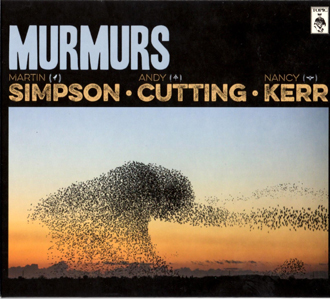
The buzz preceding Murmurs from the UK-based trio of Martin Simpson, Andy Cutting & Nancy Kerr made it one of the most eagerly awaited releases of 2015 in the Hunt household. One of the themes that occurs is that of wildlife and the natural world. Both are long-lived passions of Martin Simpson’s. The album title is a cross-reference to Graham Catley’s cover photograph of a murmuration of starlings. Starling flocks in flight have the appearance of solid air in motion, weaving and swooping in their many thousands.
Martin Simpson and I have had dozens of conversations about birds over the thirty years-plus that we have known each other. Toy Soldiers dwells on a subject dear to our hearts. Namely, the whole slaughter of birds reared specifically for sport in the British Isles. There are not merely the game birds that are beaten and driven out of cover in order to be blasted out of the skies but also the so-called vermin corvids and raptors, the carcasses of which used to be hung as warning trophies using fences as makeshirt or semi-permanent gibbets all over the British countryside in the good old days This was before the warnings in Rachel Carson’s Silent Spring (1962) bit home and agriculturists did want they liked in and to the countryside. In a lovely turn of phrase in Toy Soldiers, Simpson dubs this practice “gamekeeper’s Calvary”. The song’s title refers to pheasants. The notes widen the subject to bring in the Tory government’s increased subsidy for maintaining grouse moors. From Murmurs (Topic TSCD591, 2015)
More about Andy Cutting at http://www.andy-cutting.co.uk/, about Nancy Kerr at http://nancykerr.co.uk/and about Martin Simpson at http://www.martinsimpson.com/
Do You Believe in Me? – Peggy Seeger
This song by Peter Berryman & Lou Berryman was as if made for Peggy Seeger’s mouth. The lyric is full of twists and bubbles along at a fair old pace. It has sequences when it becomes a bugger of a tongue-twister and a test of breath control techniques. Peggy negotiates its intricacies brilliantly. From Everything Changes (Signet Music SM1, 2015)
More at http://www.peggyseeger.com/
Das muß ein Stück vom Himmel sein – Scarlett O’ & ‘the little big band’
This is a song by Werner Richard Heymann (1896-1961). It was Scarlett O’, formerly Scarlett Seeboldt of the East German folk group Wacholder, who introduced me to his writing and life what seems like a very long time ago. She has one of the most lustrous, most limber voices ever to have come out of Germany, whether either side or reunified.
This song appeared in the 1931 Ufa film Der Kongreß tanzt (the English-language title of which is The Congress Dances). Ufa was the Potsdam-based Universum Film AG film company. (Potsdam is situated to the west of Berlin and is the site of a museum dedicated to Ufa’s film-making legacy and history.) The film was made in three versions – a German, English and French one – with Ufa playing for high stakes in a deliberate drive to counter the supremacy of Hollywood on the international market.
Just love this song. That must be a little bit of heaven, as the song sings. Couldn’t get it out of my head. I spontaneously wrote the title line in a guest book in an idyllic place in Hohenwarte in East Germany. One of those communities in a valley miles away from anywhere of any size. A place where you wake up and maybe twenty species of birds are singing, where slowworms are basking in the early morning sun when you do the morning’s composting, and you click your ruby slippers and hope there are a few of the last Knupperkirschen (Germany’s to-die-for cherries) ripe and within reach. Das muß echt [genuinely] ein Stück vom Himmel sein. From Das muß ein Stück vom Himmel sein (Duophon 01 89 3, 2000)
More in German and English at http://www.scarlett-o.de/
Love Is Strange/Stay – Jackson Browne & David Lindley
There are a small number of musicians I am willing to cross continents to see perform. Naming them would be churlish. Without question is David Lindley. Lindley has never failed to bowl me over. I have seen him sound check as a guest and in two run-throughs nail a style. (In the case in mind he needed one, the band needed two.) I have seen him turn a major technological mishap into an opportunity for a display of prestidigitation while a complete desk reboot went on. I’ve known David Lindley since the early 1980s as a friend. His music only continues to inspire me on varying levels.
It was through David that I got to meet Jackson. Each meeting, always a rare thing. A rare thing in another sense of rare. Just love this performance. Jackson: “Hey, David.” “Yeah, mon?’ “How d’you call your lover?” Dave: “My what?” […] “Hey momma, cumovahere/Say hallo to Elvis./Like to meet Elvis? I know Elvis/A friend of mine.” It gets more complicated.
I want this blasting out at my funeral. I want it to bring smiles to faces the way it was with John B. Spencer’s coffin. When it was brought in for his humanist service, atop it was rhubarb and sundry allotment produce. When ‘he’ arrived, it prompted me to cry out Goonishly, ‘Rhubarb, rhubarb!’ John and I had talked at length about funereal generalities but the rhubarb was a surprise sprung and one I loved. People burst spontaneously into laughter. Which would have tickled John. Hard to imagine a funeral without a stick or two of rhubarb on a coffin now. From Love Is Strange (Inside Recordings INR5111-0, 2010)
Ecstasy – Jyotsna Srikanth
It was a beautiful early summer’s day in May around noon. Warm in an early English summer’s way – a pleasant 18-20 Centigrade. Driving along beside the Mogador sewage treatment plant with the window down (not something recommended during high summer with the wind in the wrong direction), a nightingale burst into song. A few seconds later a second one started singing and its song fit marvellously well into Karnatic violinist Jyotsna Srikanth’s Ecstasy. It’s a moment I shall treasure. Maybe it should have been a bulbul but a nightingale can do as a substitute in Britain. The bulbul is popularly viewed as the nightingale of India. And, yes, it is a cliché. Still in that moment it was more than a mismatch or a fleeting connect between a nightingale, a kinda take on Ewan MacColl’s Dirty Old Town and Jyotsna Srikanth’s South Indian violin. From Bangalore Dreams (Theme Music USR0006, 2015)
More at http://www.indianviolin.eu/Jyotsna.html
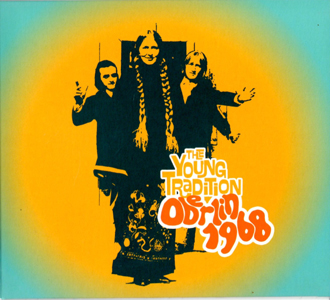 Byker Hill – The Young Tradition
Peter Bellamy, Heather Wood and Royston Wood were the Young Tradition. They were a force of nature and quite unlike any other unaccompanied folk harmony group of the late 1960s. (And, yes, I saw them live.) One of the underreported aspects of their music-making was the concision of their songs. The Oberlin College, Ohio recordings ram that home.
In the studio it was generally a case of brace and deliver. On stage a song might barely fluctuate in length within a narrow range of seconds. Self-indulgence lasted very few bars. One of the side-performance issues here is how little the Young Tradition deviated from that norm. This song reinforces that. Byker Hill was a song that Martin Carthy with Dave Swarbrick also earmarked as theirs. Byker Hill was perhaps the song when I realised that utterly different arrangements made complete and utter sense when it came to the English folk canon. No preference, one over the other. This song was a major part of my folk education. This album pinpoints how they communicated. Heather Wood adds a neat Janis Joplin shanty aside in the CD booklet notes. From Oberlin 1968 (Fledg’ling FLED3094, 2013)
More at http://www.thebeesknees.com/category/the-young-tradition/
In These Shoes? – Kirsty MacColl
I was just sitting there, minding my own business, writing and proofing copy in The Angel & Crown on that pedestrian side-lane leading up to church – whatever it’s called – in Richmond Upon Thames. (“Built in 1547, our building has been part of the Richmond landscape for centuries. Once a Post Office, then a sweet shop, it’s been a Fuller’s pub since 1876.”) All of a sudden, this song swamped my consciousness and I had to stop work and start listening. It made me feel hyper-alive. I stopped writing.
During her time Kirsty MacColl (1959-2000) was one of the truly most memorable singers ever to emerge from the UK’s fractured music scenes. Listening to song, as if out of the blue, floored me. From Tropical Brainstorm (Instinct Records INS557-2, 2001)
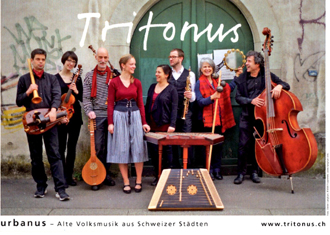 Zur blawen Entten – Tritonus
Across Europe there is a myriad of musical realms in which contemporary takes on tradition-based folk musics are commonplace. Many are barely known outside their home patches, their regional cultural borders or national boundaries. Many acts – part-time or semi-professional – stay local by choice. Through decades of working at Tanz&FolkFest Rudolstadt, it has been a privilege to experience at first hand scores of regional folk acts from Belgium to Ukraine, Sardinia to Sweden that never reached British shores.
Yet despite coming with a family tree stretching back to the mid-1970s, to my shame neither hide nor hair of the Swiss folk group, Tritonus ever registered. On the strength of the genuinely exciting urbanus they are a force to be reckoned with. Zur blawen Entten (‘At the blue ducks’) derives from a Zurich inn name and the prospect of drinking in a place by that name is like a glass brimming over. It is a Zwiefacher, a dance from the Alpine Lands that switches between 3/4 and 2/4. From urbanus (Zytglogge ZYT 4966, 2015)
More at http://www.tritonus.ch// in German, English, French and Italian.
The copyright of all images lies with the respective photographers, companies and image-makers.
30. 5. 2015 |
read more...
[by Ken Hunt, London] It is a knee-jerk reaction when evoking Belgian song to extol Jacques Brel and his impact on Francophone chanson. But Belgium is a composite nation, with Walloon, Flemish and German populations. When it comes to articulating what it means to be Flemish, one of the giants of contemporary Flemish song and poetry was Wannes van de Velde, who for more than 40 years defined Flemish culture and defied cultural laziness.
5. 4. 2015 |
read more...
 [by Ken Hunt, London] John Mayer’s impact on hyphenated fusion exceeds calculability. Though the Jazz Café’s ‘Events Brochure’ rebirthed him as Bombayite, Mayer is Calcutta-born. In the 1960s when he and the Jamaican-born saxophonist Joe Harriott combi-doubled their quintets, even more than Don Ellis, they were the defining ensemble shaking (up) the raag and jazz cocktail. Frankly, today’s Indo-Jazz Fusions excels its Sixties namesake – undoubtably helped by today’s availability of information but also because Harriott’s ensemble probably never got raag. Chez Jazz Café, IJF numbered nine with Simon Colam (piano), Mayer (violin/tanpura), Dave Foster (basses), Andy Bratt (kit drums), James McDowall (flute), David Smith (trumpet/flugelhorn), Carlos Lopez-Real (saxes), Sandip Chakravarty (tabla) and Jonathan Mayer (sitar).
Then as now, most fusion forms in jazz or ‘world music’ were simply musicians having a blow and someone thinking up a spiritual-sounding or mellifluous-unpronounceable title. Indo-Jazz Fusions’ approach, as now, was to launch from compositions. Mayer, a classically trained musician, slipped between the interstices of the Hindustani and western classical imaginations and their irreconcilable music business ‘realities’. From the 1950s onwards, he meticulously logged his compositions, East-West or otherwise, through the medium of music publishing. Which is
why he can prove that so often he anticipated movements. This IJF incarnation likewise uses a sliding scale of Injun to jazz, as Khamaj, Mela, Jyoti and Indigo illustrated, and anyone could have found a place to board somewhere on its musical graph.
In four decades of journalism ‘adorable’ is a word I have never used. Why use it now? Mayer nurtures new talent in a way that is remarkable for someone of his seniority. As this gig showed, he is so encouraging and ego-free as to be adorable. At one point he halted a piece not because there was some chatter in the audience but, he announced, because they were chattering over one of Lopez-Real’s compositions. At 71 Mayer is remarkable, relevant and rejuvenating. Qualify each with ‘musically’ and ‘adorably’.
Note: John Mayer (1929/30-2004) died at the North Middlesex Hospital, Edmonton, London, on 10 March 2004. He died of injuries sustained in a road traffic accident crossing the main road near his home two days earlier. We were good friends.
14. 3. 2015 |
read more...
« Later articles
Older articles »