Articles
 [by Ken Hunt, London] Back in New York, Seeger enthused about what he had seen and heard. Broadside, a publication with a tiny circulation – using, as Cunningham recalled, a hand-cranked mimeo machine “we had inherited when the American Labor Party branch closed in our neighbourhood” – became a vital conduit for song. Originally published fortnightly, very soon monthly, topicality was a major goal. It published its first issue in February 1962 and folded in 1988. By comparison Sing was launched on May Day 1954 and Sing Out! had first appeared in 1950. Unlike Sing Out! or Sing, Broadside did not interleaf traditional songs with its songs of struggle, diatribes on themes of social justice or political squibs. However imprecisely or colloquially some dubbed this latter category ‘folksongs’ – much to the exasperation of the folklorists and the outrage of armchair scholars who took the fight to numerous letters columns – Broadside‘s first issue carried the slogan “A handful of songs about our times” beneath its name.
Many froze not only the fleeting moment but the urgency of the search for the three-chord trick or, in some cases, that elusive third chord. Many strove to out-Dylan Dylan too. Union solidarity songs figured prominently, such as Hazard, Kentucky which appears on Phil Ochs’ The Broadside Tapes 1 and El Teatro Campesino’s El Picket Sign on The Best of Broadside. There again Ochs also sang the gloriously throwaway and irreverent Christine Keeler based on the Profumo episode – as was Matt McGinn’s Christine delivered by the Broadside Singers with Tom Paxton and Pete Seeger. Yet sprinkled through the pages of those early issues were songs that got a life, so to speak, and took on lives of their own. Songs like Janis Ian’s Society’s Child, Seeger’s Waist Deep In The Big Muddy, Bonnie Dobson’s Morning Dew and Nina Simone’s Mississippi Goddam spread like wildfire. “These songs were springing from the Civil Rights movement and from the burgeoning opposition to the Vietnam War,” Cunningham wrote.
Broadside was known in Britain by repute at least even if few ever saw a copy over its entire lifespan. Like Sing Out! and Little Sandy Review, it had a reputation way beyond the meagre quantities that got into Collet’s or elsewhere. Pete Frame, later the co-founder of Zigzag, picked up Broadside “as assiduously as [he] could” but Martin Carthy, for example, has no memory of ever seeing a copy. “What happened,” remembers Frame, “was that the record shop – Collet’s – at 70 New Oxford Street used to get them in sporadically but not on a regular basis. They used to get all these various folk music magazines from various places. Such as Sing Out!, Broadside and a different Broadside that was published from Boston. I used to buy them when and as I could find them. Broadside never got there that regularly. I also had those Broadside records. I certainly got the original of the one with Blind Boy Grunt.”
Frame hits it on the head. The main reason why people remember Broadside was that farcical alias. Blind Boy Grunt was Bob Dylan. Bell-wether or scapegoat by turn, completists collected Dylan’s every fart, belch and stomach grumble, as perhaps only jazz zealots had ever pursued their quarry before him. Blind Boy Grunt had three tracks on the Broadside Ballads, Vol. 1, released in 1963. The Broadside link would soon stretch to Dylan’s singing on Vanguard’s Newport Broadside (Topical Songs) – a wily remora of a title – and Broadside’s We Shall Overcome and the much later Broadside Reunion.
Less difficult to get hold of than the magazine itself was Oak Publications’ “songs of our time from the pages of Broadside magazine” anthology. “I also got an omnibus edition of Broadside,” Frame recollects. “It was pages from the magazine with something like 88 different songs. That came out in 1964, with illustrations by Suze Rotolo – Dylan’s girlfriend – and people like that. You would have a song per page. Or a song every two pages, like Train A-Travelin’ by Bob Dylan that came out of Broadside #23 – that had an illustration by Suze Rotolo. It was a typical early song by Dylan. It’s got Paths of Victory by Dylan, Mississippi Goddam by Nina Simone, With God On Our Side, and stuff by Phil Ochs, Tom Paxton and so on. It also had a long introduction with pictures of these guys and little notes about them.” Unbelievably by today’s information overload standards, back then the sum of the knowledge about many American performers was little more than the potted biog or puff on the back of an EP or LP.
Broadside was primarily a domestic phenomenon. Songs such as Thom Parrott’s Pinkville Helicopter, Matt Jones and Elaine Laron’s Hell, No, I Ain’t Gonna Go and Seeger’s Ballad of the Fort Hood Three remind how Vietnam overshadowed American society. Seeger’s Waist Deep In The Big Muddy on the other hand transcends the period and the particular to become a timeless anti-militarist song, up there with John B. Spencer’s Acceptable Losses and Robert Wyatt’s Shipbuilding. Quite reasonably, Broadside mostly saw life through an American prism. Yet commonalities abounded. The characters on the identity parade looked similar when Malvina Reynolds sang The Faucets Are Dripping about decaying properties and exploitative landlords in New York and Stan Kelly sang Fred Dallas’ Greedy Landlord about slum landlords in Rachman’s London or Paddy Ryan’s The Man That Waters The Workers’ Beer about short-measuring and exploitation. Exchanges occurred freely. The Glasgow Song Guild’s Ding Dong Dollar on the Broadside set was also printed in a C.N.D. songbook. Songs by Woody Guthrie, Lee Hays and Pete Seeger, Irwin Silber and Jim Garland appeared in the Y.C.N.D.’s Songs of Hope and Survival songbook.
Even though Broadside published a smattering of topical songs from European and Canadian songwriters, songs such as Wolf Biermann’s Soldat and Das Familienbad, Buffy Sainte-Marie’s Welcome, Welcome Emigrante and Matt McGinn’s Go Limp, it never meant as much in Britain, Europe or, a hunch, Canada as it did at home. “I don’t think Broadside had the same sort of meaning over here,” Rosselson concedes. “There was a very strong British equivalent over here, which was clearly much more interesting to British songwriters than the American version. My memory is that it didn’t have that big an impact here but over there Broadside was, in a way, the beginning of the protest movement over there.”
Seeger with trademark perspicacity, though he would probably pooh-pooh such a ‘compliment’, saw something important in 1961. It was the power of song, a vision at variance with what became the cult of the songwriter. He wanted songs put into circulation, maybe that one good that is in everybody, maybe more, and he wanted songs sung and shared. In the liner notes to his 1964 album I Can See A New Day Henrietta Yurchenco wrote, “About fifteen years ago, Les Rice, a shy farmer and ironwork craftsman from Newburgh, New York, wrote the Banks of Marble, a song which was taken up quickly throughout the English-speaking world. For many years he was silent. When Broadside began publication in 1962, Pete Seeger urged his friend and neighbour to start composing again. I Can See A New Day was Rice’s contribution to the new topical folk-song periodical.” Typical Seeger. “I really urge singers,” he told me in 1993, “to think of themselves not as a singer whose business it is to make people listen and applaud. Think of yourself as a singer who will show people what a great song you have and encourage them that they can sing it too – long after you’re gone. Not to say, ‘Oh, I must get them to buy my record.’ Or get them to buy this or that.”
They say in their lifetime the average citizen gets to make fifteen or so crosses on the ballot paper. The Best of Broadside contains scores of blueprints about how to register other sorts of vote. There are still countless themes of social justice waiting to be turned into song. How could the Labour Party’s ho-ho-ho ‘freedom of information’ proposals not incite a new batch of sceptics and their songs so long as fears about the absolute basics – food, water, air and health – are secondary to profit. As long as the boa constrictor of multinational business can pleasantly massage and lull so many people into a false feeling of security about genetically modified food and other environmental issues, warning bells must ring.
Once upon a time, small, cheaply produced folk rags like Broadside and Sing informed through song, reminded people about the benefits of solidarity. Nowadays when so much that is politically radical or looking to alternatives, whether in China, Britain or wherever, has switched to the Internet, there might be the suspicion that topical song’s time is past. During February and March 2001 under the collective title of The Magnificent 7, Robb Johnson, Attila the Stockbroker, Barb Jungr, Des De Moor, Tom Robinson, Phillip Jeays and Leon Rosselson did a seven-week season of “contemporary English chanson”. So called because, as Leon Rosselson explains, “it’s a broader category and these songs are definitely not American and may have a European influence, particularly French, and like the French chanson they are word-based, literate, intelligent and that sort of thing.” It would have thrilled Pete Seeger. Chronicling the march of political and topical song, the centre for political song at the Glasgow Caledonian University is archiving the past. The need still remains for new topical songs. The need remains to chronicle the past. Song remains one of the most effective ways yet devised by the human mind to express opinions. The Best of Broadside is more than American history.
In 1963 when Phil Ochs wrote the Ballad of William Worthy about a reporter whose U.S. passport was revoked after going to Cuba, would he have imagined the Cuban embargo still going on in 2013 and what should have been history still retaining its point and pertinence?
12. 5. 2013 |
read more...
 [by Ken Hunt, London] Another month filled with a bunch of work-related listening patterns. Catherine Ennis and Liam O’Flynn, Country Joe and the Fish, The Who, Any Old Time, Cyminology, Chumbawamba, Uncle John’s Band, Bisserov Sisters, Rais Khan and The Home Service
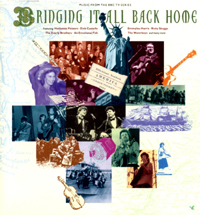 Easter Snow – Catherine Ennis and Liam O’Flynn
This piece of music is a piece of passion. It is a duet that connives to bring together two remarkable musicians performing a composition that is a piece of common ground. Catherine Ennis, here playing organ, is the daughter of the superlative uilleann piper (and much, so very much more) Séamus Ennis (1919-1982). Liam O’Flynn, a musician deeply affected by her father, here is playing uilleann pipes.
Easter Snow was one of Séamus Ennis’ favourite traditional airs. This particular performance just send chills it is so good. The combination of organ and pipes is not one that people would immediately think of. The recording itself starts out with O’Flynn stating the melody. Then Ennis comes in underneath him. There is a passage with the organ’s bass register that adds new meaning to drone. Then they flip the coin and the pipes support the organ. It’s just such an unexpected piece of music. Above all else, it honours the tune. From Bringing It All Back Home (BBC CD 844, 1991)
I Made A Big Mistake – Any Old Time
Any Old Time has remained one of all-time favourite string bands since first hearing their LPs on Arhoolie and Bay back in the day. This is an English-language version of a song called Gros Erreur (‘Big mistake’) from the singing of Iry LeJeune. When Sue Draheim died on 11 April 2013, the LPs came out to be played. Genny Haley sings lead, with Draheim on fiddle, Mayne Smith on pedal steel, Barbara Montoro on bass and Don Slovin on drums. From “I Bid You Goodnight” (Arhoolie 433, 1996)
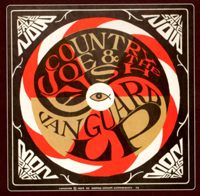 Bass Strings – Country Joe and the Fish
This studio album was a rite of passage for what I believe modern young people call stoners. It speaks of the time – 1967 – but also to an always when people opt for, or go searching for altered states. Joe McDonald (lead vocals and rhythm guitar), Barry Melton (lead guitar), David Cohen (organ) Bruce Barthol (electric bass) and Chicken Hirsch (drums) turned this into one of finest morsels ever to emerge from the San Francisco Bay Area.
This track is a-swirl with explicit references and, spatially, the air is dense. Its opening statement is, “Hey partner, won’t you pass that reefer round?” Alec Paleo’s notes include, Joe McDonald’s admission, “At a certain point in 1966, when we performed ‘Bass Strings’, I thought we were gonna get busted for singing a song about smoking marijuana. Those really were times that are unimaginable in 2013.”
A historical digression. Its spoken outro was already kitsch by the time this album came out in Europe in 1967 or so – on Fontana in Britain. Intoning “LSD” was destined for pretty much instant obsolescence. The Who did something similar with rather more wit on their third LP, The Who Sell Out, roughly contemporaneous with Electric Music for the Mind and Body and their second LP. In similar fashion The Who included commercials, radio jingles and an upside-down version of ‘product endorsement’ with, for example, Roger Daltrey dallying in a tub of baked beans on the cover of The Who Sell Out.
This double-CD reissue includes both the mono and stereo mixes. Paleo’s exceptional booklet notes and the tales accompanying the song-by-song notes (with lyrics) remind about the value of the physical artefact in an era of digital downloads. Still one of my all-time 20 Desert Island Discs. From Electric Music for the Mind and Body (Vanguard VMD2 79244, 2013)
Pictures of Lily – The Who
Then flaming well one thing leads to another… In this case it led to one of The Who’s most imagination-fired narratives. It concerns conjuring memories, through photographic assistance, to banish sleeplessness. The narrator gets help from his dad. He produces pictures of Lily who solves his insomnia. Things turn out badly, dashing hopes for meeting his “pin-up”. (Such a marvellous expression.) The rub is that Lily has been dead for a fair few years, as his father explains, since 1929. It is one of the performances that reminds why John Entwistle was such an inspiration as a bass player – and the power of storytelling. A 1967 single anthologised on… The Who – Thirty Years of Maximum R&B, Polydor 521 751-2, 1994)
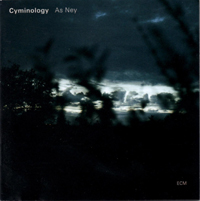 As Ney – Cyminology
This particular piece of writing by Rumi, the Persian mystic poet was the first poem of his to enter my consciousness, thanks to Richard & Linda Thompson. It is ‘The song of reed flute’ – ney meaning flute – and it set me off on a voyage of Sufi discovery. Linda Thompson gave enough of a steer for the next stage of the voyage. The main public library in Sutton had some books that contained writings about Jalāl ad-Dīn Muhammad Rūmī (1207-1273) and Rumi’s writings in translation. Thanks to Kavi Alexander, the head and body of Water Lily Acoustics, I was pointed to Coleman Barks’ interpretations.
Cyminology is a jazz quartet based in Germany, led by Cymin Samawatie, a German-born, bilingual singer of Iranian blood. The group was founded in Berlin in February 2002. The band’s recorded projects have included settings in non-traditional arrangements of medieval Persian mystical poets – not only Rumi but also Hafiz – through to the Farsi-language poetess Forugh Farrokhzād (1935-67) whose work was banned after the Islamic Revolution of the 1970s. Cyminology recontexualises As Ney beautifully. From An Ney (ECM 2084, 2009)
The Story That The Crow Told Me – Uncle John’s Band
This song originates from the Carolina Buddies and was later covered by the New Lost City Ramblers. The band here is John Cohen (vocal, banjo), Sue Draheim (fiddle), David Grisman (crow call) and Jody Stecher (guitar). After Draheim died, I listened to a lot of her recordings. This particular recording captures the silliness of life. And something about Sue Draheim’s fun side. From Stories The Crow Told Me (Acoustic Disc ACD-34, 1998)
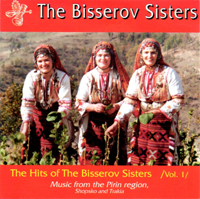
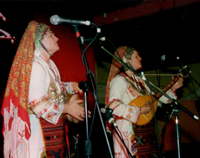 Elenko Mome Malenko – Bisserov Sisters
Of all the Bulgarian folk acts that it has been my unalloyed pleasure to see perform live, the Bisserov Sisters were the most inspiring. That may sound slightly heretic because there were acts with far bigger names, as far as most listeners would be concerned.
There was something about these three sisters – Lyubimka, Neda and Mitra – singing together that transfixed from the time they first crossed my path in the summer of 1991. Their vocal blend on this album is still chilling. From The Hits of The Bisserov Sisters/ Volume 1 (Bisserov Sisters & Co, no number, 1998)
Folk Dhun – Rais Khan
This recording of an unidentified folk air (dhun) performed by Rais Khan and his son Farhan Khan, each playing sitar, with Bashir Khan accompanying on tabla, is the final track on the sixth CD of a 12-CD boxed set of music from Pakistan’s art music community, a much neglected and undervalued segment of Pakistan’s arts. To a large extent, that strand of Pakistani art music has been almost totally overwhelmed by people’s fixation on qawwali as representing the nation’s art music.
This boxed set is an eye-opener. Even though this performance is folk-flavoured and is cut short (after two rāg performances), it captures Rais Khan, one of the greatest, most mellifluous sitarists of our age going strong and tastefully. From Indus Raag (Tehzeeb Foundation of Pakistan ISBN 978-969-97-46-00-0, 2012)
For more about the Tehzeeb Fundation visit http://tehzeebfoundation.org/
Snow Falls – The Home Service
This is one of the songs that I shall take to my grave. Its tune is a saucy steal – a glorious take on a variant of Dives and Lazarus – and its lyrics capture eras and generations of connections. It happened that back in 2012 I had to think really, really hard about this song overnight and what its lyrics and tune meant. I wrote a translation, but not just a translation but a singable translation of the song into German.
In doing that it meant not only translating the words and the sentiments but also trying to capture the folkloric associations that John Tams captured in his original lyrics. It is astonishing how the sharp-focussing by way of translation could heighten the impact of a song I had known for decades.
This is a recording made at the Cambridge Folk Festival in 1986. The Home Service was Jonathan Davie (electric bass and vocals), Howard Evans (trumpet and band glue), Andy Findon (saxophone, clarinet and flute), Michael Gregory (kit drums and percussion), Steve King (keyboards), John Tams (lead vocals, guitar strumming), Graeme Taylor (lead guitar, vocals) and Roger Williams (trombone). They made the most uplifting racket, though Snow Falls captures the silence of snow falling and Tams’ reflections about his grandmother. From Live 1986 (Fled’gling Records FLED3085, 2011)
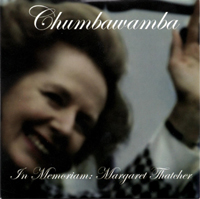 So Long, So Long – Chumbawamba
Made long ago, hence its vagueness in discographical terms, this seven-track piece of mischief was a prepaid subscription release that we bought as an act of blind faith, but bought as an act of hope. Frankly, it’s not the best song in the Chumbawamba canon, but it warmed the cockles of my heart.
This subscription release was sent out on the day that Margaret Thatcher died – 8 April 2013 – and arrived as an antidote to Creep Street and Parliament’s mealy-mouthed gushings about her. Let’s remember her this way.
In the meanwhile the Chumbas folded their hand (as mentioned in the March 2013 Giant Donut Discs)… From In Memoriam: Margaret Thatcher (No label, no number, undated [2013])
The copyright of all images lies with the respective photographers, companies and image-makers. The second Bisserov Sisters’ photograph is from their 1996 concert at The Spitz (1996-2007), near Old Spitalfields Market in London © Ken Hunt/Swing 51 Archives.
30. 4. 2013 |
read more...
 [by Kate Hickson, Powys, Wales] These remembrances remain in a state of flux as news comes in, details get corrected, information emerges and useful weblinks appear. Last expanded 1 May 2013.
7 March – Born 5 February 1923, in Keithville, Louisiana, the country singer and songwriter Claude King died at the age of 90 in Shreeveport, Louisiana. He was a member of the Louisiana Hayride radio and television show and was famed for his song, Wolverton Mountain, co-written with Merle Kilgore.
Further reading from the Los Angeles Times is here: http://www.latimes.com/news/obituaries/la-me-passings-20130308,0,3695361.story
20 March – The animator Jack Stokes died. Born in Leigh-on-Sea on the Essex coast on 2 April 1920, he was instrumental in animating the Beatles’ Yellow Submarine (1968), a film the stature of which has grown with deeper appreciation of what the film achieved. Stokes also worked on the film Wonderwall of that same year – the visual counterpart of George Harrison’s album of the same name. Click on Spencer Leigh’s obituary entitled ‘Jack Stokes: Animation director behind Yellow Submarine’ from The Independent of 12 April 2013 here: http://www.independent.co.uk/news/obituaries/jack-stokes-animation-director-behind-yellow-submarine-8569201.html
27 March – The US magazine publisher, writer and author Paul Williams died in Encinatas, San Diego, California. He founded the magazine Crawdaddy. Pierre Perrone’s obituary ‘Paul Williams: Founder of the hugely influential Crawdaddy! magazine’ from The Independent of 15 April 2013 is here: http://www.independent.co.uk/news/obituaries/paul-williams-founder-of-the-hugely-influential-crawdaddy-magazine-8572481.html
27 March – Singer and pianist Gordon Stoker of The Jordanaires died. Named after Jordan Creek near Springfield in Missouri (rather than as often assumed the river in the Holy Land), this white gospel quartet became mainstays at the Grand Ol’ Opry and sang with a tally of artists tallied to number over 2000 in number. After a jicky start, when Stoker was picked to sing, at producer Chet Atkins’ direction, over the whole group, the Jordanaires backed Elvis Presley for 14 years.
28 March – Robert Zildjian died at the age of 89. His name was synonymous with cymbals and things that go crash in the night. ‘Robert Zildjian – Cymbal-maker whose hi-hats, rides and sizzles are used by rock’s top drummers’ (that is, a different title to the internet) appeared in The Daily Telegraphof 3 April 2013. Read it here: http://www.telegraph.co.uk/news/obituaries/culture-obituaries/music-obituaries/9967693/Robert-Zildjian.html
30 March 2013 – Phil Ramone died in Manhattan at the age of 79. Born on 5 January 1934, the South African-born, US American recording engineer, record producer, composer and musician. Over the course of a phenomenal career, he produced records by, to give but an incomplete list, Burt Bacharach, The Band, Ray Charles, Chicago, Bob Dylan, Aretha Franklin, Billy Joel, Elton John, B.B. King, Madonna, Barry Manilow, Liza Minnelli, Sinéad O’Connor, Peter Paul and Mary, Carly Simon, Paul Simon (receiving his first production Grammy for the 1975 album Still Crazy After All These Years), Rod Stewart, James Taylor and Stevie Wonder.
15. 4. 2013 |
read more...
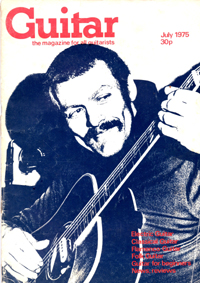 [by Ken Hunt, London] Another month filled with bunch of work-related listening patterns.
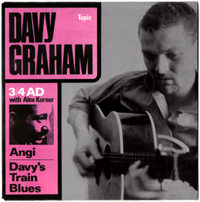 Angi – Davy Graham
Frequently the circumstances of hearing a particular piece of music are burned into our craniums, with a heavy dressing of associations. Angi (as it is spelled here) is an important piece of music in my life and yet I have not the foggiest notion of when I first heard Davy Graham’s performance. Almost certainly I heard it in a record shop and most likely it would have been either Collet’s or Dobell’s in London, the former an immense part of my musical education both in terms of what I fetched away from Collet’s both physically and intellectually. Where else was I going to get a chance to listen to Harry Cox or Anne Briggs or the Pinder Family? No high-street record shop stocked that stuff.
The vinyl EP 3/4 A.D. was still around for much of the 1960s. Indeed, it was re-pressed several times and, uniquely, for Topic issued with three different sleeves. All are reproduced in this EP’s inner artwork, though the only person I ever met (and I include Davey Graham himself here) who had all three was Gill Cook, the manageress of Collet’s folk department. Graham’s rite of passage for guitar was covered by Bert Jansch and Paul Simon. It’s probable that I heard their versions first. Angi launched many versions from many guitarists out to prove their prowess.
The limited edition vinyl reissue of Alexis Korner and Davy Graham’s 3/4 A.D. EP (originally Topic TOP 70, 1962) celebrates Record Store Day on 20 April 2013. Founded in 2007 in the States, the UK version of Record Store Daywas launched in 2013. It concentrates on the Britain’s independent record companies. This is one of the one-off vinyl and CD releases made exclusively for the day. In addition the celebration includes musicians making personal appearances and performances and other activities. More information at http://www.recordstoreday.co.uk
From 3/4 A.D. (Topic STOP2013, 2013)
Raga Marwa – Pannalal Ghosh
This is a studio recording from 1968 from Pannalal Ghosh, the flute player that transformed the place of the bansuri or transverse bamboo flute in Hindustani classical music. Put at its most simple, he recalibrated people’s appreciation of what the instrument could do and its consequent standing. And this Marwa interpretation of his gives of the raga’s essence so sweetly.
This particular recording originally appeared on the Odeon imprint of the Gramophone Company of India’s The Magic Flute of Pannalal Ghosh (MOAE 5006, 1968). From Greatest Flute Maestro (Saregama CDNF 150607, 2005)
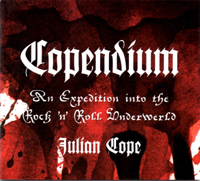 Einladung – A.R. & Machines
Julian Cope kicks off this triple-CD compilation with a piece by Lord Buckley (Supermarket from Way Out Humour, recorded in 1959) and that designates him immediately as a citizen of the Land of the Good Egg.
The same first disc includes a sequence of tracks under the suite name Einladung (‘Invitation’ or, more colloquially, ‘invite’). The “A.R.” of the title is Achim Reichel, a Hamburg-based musician whose music is totally to be admired. He is known to those of the Beatle-ish disposition as a major character in the tale of the Rattles, one of Hamburg’s great red-light district, the Reeperbahn’s beat combos, and a contemporary of the Beatles in their Hamburg daze..
This particular stream of tracks is a different sort of testimony to Hamburg and what goes on there. It is a stream of psychedelicised consciousness from 1972 that passed me by. It has a flow and energy to it that bespeaks its time at the beginning of the early 1970s. The suite has six sections, each with a title in German. Their titles here have English translations, some of which bear scant resemblance to the German. Those paraphrases may have been on the LP, Echo (1972) on which they originally appeared.
I met Achim Reichel only once – back in 2007. It was at a do after he was awarded a RUTH – der deutsche Weltmusikpreis (the German world-music prize, where Ruth is a ‘root’ soundalike) at Tanz&FolkFest Rudolstadt. His music director Frank Wulff blagged me in. He and I had collaborated on the booklet notes for the reissue of four of his previous folk band Ougenweide’s LPs for Bear Family and had been corresponding and fact-checking. Frank was aware of my Hamburg connections, introduced us and having lit the blue touch-paper gracefully retired.
Hamburgerisch is a strange concoction. It is not even a dialect in any usual sense of the word being a regional variant of a language. It is a language, the bedrock of which is Low German (Plattdeutsch), over which is laid High German (Hochdeutsch) – a philologically related yet different German language. These combine to make one of Germany’s major dialects but unusually they are born out of two separate languages. As Achim Reichel and I spoke, Hamburgerisch flecked with Platt swam to the surface. Some things or thoughts are, for example, easier to say and/or express in Platt. Others in Hochdeutsch... Hamburgerisch is particularly good after a skinful. Musically Einladung strikes me the same way, though that may sound silly or fanciful because there are no words here. It sounds Hamburg. I digress… Cope’s choice here is inspirational.
This is from triple-CD, organised – that should be the word – and marketed by Ace Records. Not sure about this release’s precise status, but I sincerely thank Julian Cope for introducing me to A.R. & Machines, a branch of Reichel’s musical back pages previously unknown to me. Warning: Drugs may have been consumed in creating this music and flying this plane… From Copendium (Faber and Faber, COPE 001, 2012)
Who Knows What Tomorrow May Bring? – Traffic
Not intentionally work avoidance while penning an article about The Watersons, but Disc II of the album’s expanded edition stayed playing in the background while writing. Before ‘anyone’ knew it this, live version, recorded at the Fillmore East, in November 1970 was playing. It would have been rude to stop it. From John Barleycorn Must Die (Universal-Island 533 241-1, 2011)
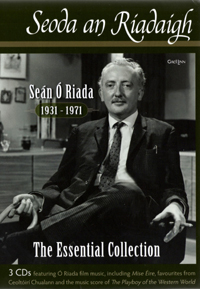 Mná na hÉireann – Ceoltóirí Chualann
This is arguably Seán Ó Riada’s best-known composition. Ó Riada (1931-1971) reinvigorated perceptions of what Ireland’s music could represent in an art music. Through the Chieftains this composition, the title of which translates as ‘Women of Ireland’, grew wings. This is an earlier interpretation with words. Seán Ó Sé sings. Research for another article under way… From Seoda an Ríadaígh (Gael Linn oriadacc06, 2011)
The Day The Nazi Died – Chumbawamba
This is a performance from one of Chumbawamba’s final performances, just before they called time on the endeavour. This is a cautionary tale about the slow-creep of the ultra-right. It was particularly well received by the audience in the Heine Park in Rudolstadt. It was an open-air venue and this song was particularly well received. As they sang, the connection between the Nazis suppression of Heine’s of Heine (rendering his poetry ‘Anon’) and the sentiments of this song were overpowering for me.
In the queue for watching is the Chumbas’ Going Gone (No Masters NMDVD01, 2013), filmed at Leeds City Varieties on Hallowe’en Night 2012 – “the last ever UK show”.
From TFF Rudolstadt 2012 (heideck HD20121, 2012)
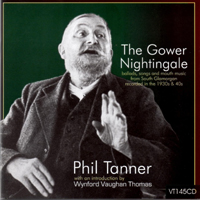 The Gower Wassail – Phil Tanner
This is a piece of music to which to return to recharge the glass. The clarity and clear-sightedness of Phil Tanner’s singing remains a source of wonderment and is a perennial reminder of how astonishing traditional songsters could be.
As an aside, the words “Within sound…” from The Gower Wassail supplied the title for the Shirley Collins’ boxed set of the same name released by Fledg’ling, released in 2002 and long since unavailable. From The Gower Nightingale (Veteran VT145CD, 2003)
To read more, the reprint of Doug Fraser’s appreciation of Phil Tanner, ‘Gower Garland – Phil Tanner, 1862-1950’ from the February/March 2000 edition of Taplas, the Voice of Folk in Wales go to http://www.folkwales.org.uk/arcgopt.html – that link links to further, er, links.
Oobe – The Orb
One of two pieces recorded in May 1992 (the other being titled No Fun). Listening to this ambient music was brought on by listening to Einladung, thinking about woodland birdcall along the Thames and that Lark In The Clear Air. It includes birdsong samples, too… (Rounding off this trawling from John Peel’s BBC archives are Montagne D’Or and Valley from February 1995.) From The Peel Sessions (Strange Fruit SFRCD138, 1996)
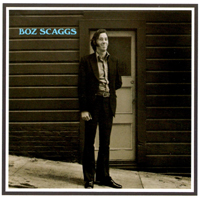 I’ll Be Long Gone – The Boz Scaggs
Boz Scaggs was not long out of the Steve Miller Band when this solo album emerged in 1969. It was recorded at Muscle Shoals Sound Studio in Sheffield, Alabama. Boz Scaggs predates his better-known, slicker hit albums such as Moments. Of which Charlie Burnham wrote when concluding its review in Rolling Stone in April 1971: “At any rate, since Moments, it is now my firm belief that when I die and go to heaven, floating on a cloud somewhere between Jimmie Rodgers and Mississippi John Hurt will be Boz Scaggs, singing the blues.”
Boz Scaggs slumbered, so to speak.
Purple prose to the rear, it was on this album that Boz Scaggs whipped the top off the tin. The accompanists were the cream of the crop. On this particular track, the background vocals of Jeannie Greene, Mary Holiday and Donna Thatcher (later Godchaux) were bolstered by Joyce Dunn, Tracy Nelson, Irma Routen. The album’s basic crew included Duane Allman on guitar, dobro and slide guitar, Barry Beckett on keyboards, Roger Hawkins on drums, and David Hood on electric bass. This particular song, a Scaggs original, is lyrically simple but the swell that they create caresses the heart strings. Beckett’s keyboard playing is majestic. (Like several members of the Muscle Shoals team he later did time in Traffic, but that is a story for another time.) From Boz Scaggs (Atlantic 19166-2, 1978)
The Lads In Their Hundreds – Quercus
Quercus – the Linnaean name for the oak genus – is the trio of June Tabor (vocals), Iain Ballamy (saxes) and Huw Warren (piano). This gem was recorded in concert in March 2006 and sat unreleased for years. This particular track leapt out at me. It is Ballamy’s arrangement of George Butterworth’s setting of A.E. Housman’s poem A Shropshire Lad (1887). It was a poem in my second-hand copy of Collected Poems (1939) and the rendition I knew was Benjamin Luxon’s from Six Songs from A Shropshire Lad… (Decca 468 802-2, 2001) with Sir Neville Marriner and Academy of St. Martin-in-the-Fields.
I chose The Lads In Their Hundreds for my political song column RPM for the March 2011 issue of R2. That short essay was written over the turn of the year in winter sunshine by the Thames. Part of the research entailed walking, as Butterworth had done, downriver from Richmond to Kew along the Thames. Just downstream from Isleworth Ait by Old Deer Park there are still the remnants of the medieval tidal and flood defences. On the opposite bank in what is Syon Park there are still some of the last unspoilt reed beds alongside the Thames with streams and rivulets that are more like leaks emptying into the river. Looking across, it felt much as it would have when Butterworth walked that stretch to Kew with a head full of Housman.
In the same period the Irish musician Christy Moore and I were doing one of our periodic interviews, on this occasion for an article that also appeared in that magazine’s same issue. In a sort of ‘what-you-been-up-to?’ way, I talked about Butterworth, dead at 31 in 1916, and Housman and tree creepers, nuthatches and ring-necked parakeets in the woodland along the Thames. Later in the interview proper, he spoke of rambling near to where he had grown up with a friend. “We were well into the heart of the bog and we lay down. We had a flask of tea and some sandwiches. We lay there in the gorse and we heard lark song. A lark was singing and it was the first time I’d ever heard a lark.”
All this was going through my head while listening to this most poignant interpretation. Quercus’ version is the icing on the cake and the first occasion of listening to it is already mentally logged and catalogued (unlike Angi). But it is a piece of music that later this year will be taking the same walk between Richmond and Kew along the Thames with a battered copy of Collected Poems that somebody probably loved before me. There will be a stop at Richmond Green and tanother at Kew Green for refreshment and some reflections about other lads “that will never be old”. And sundry associations. You get my drift. From Quercus (ECM 2276, 2013)
The copyright of all images lies with the respective photographers, companies and image-makers.
31. 3. 2013 |
read more...
 [by Kate Hickson, Powys, Wales] These remembrances remain in a state of flux as news comes in, details get corrected, information emerges and useful weblinks appear. Latest update: 12 April 2013.
4 February – Pat Halcox died at the age of 82. He born on 18 March 1930 in the London district Chelsea. Trumpet player with the Chris Barber Jazz Band from 1954, he replaced trumpet and band leader Ken Colyer of the Ken Colyer Jazz Band when the band rebranded itself on Colyer’s departure.
His obituary from The Daily Telegraph of 7 February 2013 is here: http://www.telegraph.co.uk/news/obituaries/9853652/Pat-Halcox.html
4 February – The Jamaican musician Alva Lewis died. Born on 16 April 1949, he worked with Bob Marley and the Hippy Boys amongst others.
His obituary, anonymous as ever from The Daily Telegraph, appears here: http://www.telegraph.co.uk/news/obituaries/culture-obituaries/music-obituaries/9972648/Alva-Lewis.html
11 February – Trevor Grills, singer with Port Isaac’s Fisherman’s Friends – purveyors of shanties and sea song – and builder died at St George’s Hospital in Tooting, South London after an on-stage accident at Guilford, G Live. Two days earlier their manager Paul McMullen had died in the same accident. Grills was 54.
Robin Denselow’s obituary from The Guardian is here: http://www.guardian.co.uk/music/2013/feb/12/trevor-grills
21 February – US blues singer and guitarist Magic Slim (1937-2013), born Morris Holt, died.
25 February – Dan Toler (1948-2013) died. He had been a member of Dickey Betts & Great Southern, the Gregg Allman Band and the Allman Brothers Band.
26 February – Bob Frídl (born Josef Frídl), the Czech singer-songwriter and “Czech Bob Dylan”, died aged 66.
8. 3. 2013 |
read more...
 [by Ken Hunt, London] Another month filled with a musical diet of work-related listening with a smidgeon of lateral listening ideas and needs, preparation for future writings.
Happiness Is Drumming – Diga Rhythm Band
 February’s entire listening could easily have tilted into a rhythmic extravaganza. A great deal of related listening was done while writing an article about Pandit Kamalesh Maitra and wallowing in the beauty of tabla tarang.
This particular performance is an instrumental, wordless version of a song that the Grateful Dead made into Fire On The Mountain. From Diga Rhythm Band (Rykodisc RCD 10101, 1988)
Raga Charukeshi- Kamalesh Maitra
This live recording was made at the Haus der Kulturen der Welt (House of the Cultures of the World) on John-Foster-Dulles Allee in Berlin on 5 November 1993. On a visit to that arts centre’s shop, this album just sat winking at me from the music rack. Kamalesh Maitra (1924-2005) was a master musician. It is no disservice to either him or the man who employed him at critical stages in his development to say that he came out of the Uday Shankar school of playing.
Uday Shankar was one of the people who wrenched Indian dance and Indian music into the Twentieth century. He painted the backdrops against which many trained musicians learned to deliver traditional music in a new age for people with no grounding or appreciation of traditional styles of dance or music. A Bengali classical item might be programmed one away from a Rajasthani folk dance or melody. That slightly pan-Indian approach wasn’t taboo. Yet many would have believed it was athwart approved ways. This is an adopted South Indian ragam performed in the northern manner on tuned percussion in a melodic style. Kamalesh Maitra was phenomenal.
This was listening material while writing an article about Kamalesh Maitra and the tabla tarang – ‘wave of tabla’ – for the Spring 2013 issue of Pulse. From Tarang (Kamalesh Productions CD 9802, 1998)
Rusty – The Bonzo Dog Band
This hommage – a Frenchification any Bonzo Dog-ist would delight in pronouncing – to this song’s eponymous hero first appeared on Let’s Make Up And Be Friendly – never waste a pun – which was the Bonzos’ reunion/last throes. That album forms a substantial part of their retrospective collection Cornology on the album known as Dog Ends (dittoly punning). Enough of history.
Listening to this again was brought on by belatedly discovering that their guitarist Anthony White, known as Bubbles, truncated to Bubs, had died on 19 January 2013 in Coventry. A send-off from Coventry is something few would wish – being sent to Coventry is bad enough. One is reminded of Dave Swarbrick waking up to learn of his obituary in the Daily Telegraph and his quip – pretty good for a dead man – that “It’s not the first time I’ve died in Coventry.”
Lest this appear a gratuitous name-dropping or simply Telegraph-baiting, it was Swarbrick, one of musicians in Stinkfoot at the Bloomsbury Theatre in London – one of Viv Stanshall’s later stage scampers – who introduced me to the Blessed St. Viv. Swarb had vanished before the sweat of our handshake – Stanshall’s and mine – had had a chance to evaporate. Enough of perspiration.
Fabbo CD booklet notes from Brian Hogg. From Cornology (EMI 0777 7995952 5/CD DOG 1, 1992)
And not forgetting Neil Innes of the Bonzos: http://www.neilinnes.org/bonzo.htm
In the spirit of the Bonzos, please remember the annual festival of the beloved Father Ted: http://www.tedfest.org/
 Yār Pōi in rāgam Tōdi – T. Brinda
The South Indian classical vocalist T. Brinda is perhaps best known for her pupils such as the vocalist Aruna Sairam and the chitravina (or gottuvadyam) maestro Chitravina Ravikiran. That was recommendation enough to explore her recorded artistry. The search was not easy. This is one of several volumes of T. Brinda’s recorded legacy that eventually came to light on the internet.
This particular piece is a padam. The form is pretty austere. It is quite unlike most Karnatic performances that you will ever listen to. The first time I consciously can recall hearing the form in was on Aruna Sairam’s Inde du Sud: Padam, le Chant de Tanjore/South India: Padam, Tanjore Style of Singing (Ocora, 2000, reissued 2007). Padams are a form perfected in the Seventeenth Century CE by Kshetragna and are rather like slowed down kritis.
This music is back-listening after delivering an article about Chitravina Ravikiran and the chitravina for the Winter 2012 issue of Pulse. It’s a hangover of the recommendable kind. From Padams & Javalis (Swati Soft Solutions SA385, 2008)
Wooly Bully – Ry Cooder
A choice from a review in progress for fRoots. You review five, bordering on five-and-a-half hours of music at a trot and you may well have the expression ‘review in progress’ ringing round your head. That was then reinforced by watching the film Made In Degenham in which the original film.
Ry Cooder’s performance is from his 4 February 2011 performance at the Freight & Salvage Coffeehouse in Berkeley, CA. It was the first of three nights celebrating the 50th anniversary of Arhoolie Records – one of the great, great labels when it came to firing people’s imaginations and opening their heads.
It’s a crowd-pleaser, the sort of morsel that David Lindley, a long-time Cooder cohort, made his own after Sam The Sham And The Pharaohs had done with the song. From They All Played For Us (Arhoolie CD 540, 2012)
 The Partisan – Leonard Cohen
If not from the Sham ridiculous to the sublime, then to the political. This particular choice is a huge conflation of singer and song identities. It is a song that Cohen learned from a songbook on his second LP. It was one of the songs in The People’s Song Book (Boni and Gaer, New York, 1948), one of the primary texts in the blossoming of the North American political song movement.
One of the reasons for this choice of song was reading Sylvie Simmons’ I’m Your Man – The Life of Leonard Cohen (Jonathan Cape, London, 2012) for review. She adds an anecdote about producer Bob Johnston sloping off at one point in the recording sessions, only to reappear with the French-sounding vocalists and accordion section in the can. Cohen was impressed. It turned out that Johnston had gone to Paris. Cohen was sore that he hadn’t gone, too. Who would not have been cross?
Neither the album’s reissue nor I’m Your Man give personnel credits for the French musicians on this track. From Songs From A Room (Columbia/Legacy 88697 04740 2, 2007)
Comfort of Strangers – Beth Orton
Beth Orton was a discovery from following a trail from Bert Jansch. I’m not yet ready to write about, as in expound upon her. That time will come. This particular release includes another take of this song on the bonus five-track supplement called Comfort of Strangers # 9. I’m still dithering between the two. And that’s no bad thing. From Comfort of Strangers (EMI 353 401 2/094601 2 9, 2006) http://beth-orton.net/
 Zapiskej – Iva Bittová
Naturally, I’m biased. This is part of catching up with Iva Bittová’s 2012 releases. This particular track wraps up one of her performance pieces in a different setting with the Prague Philharmonic. The translation of the title is given as ‘Play My Pipe’. From Zvon (Animal Music ANI 032-2, 2012) http://www.bittova.com/
The Future – Leonard Cohen
Who wants to break the spell that music sometimes conjures? No over-thinking. No analysis. Surf the lines and revel in the Webb Sisters’ backing vocals and one of those arrangements that’s so natural and uncluttered. “When they said, ‘repent, repent,’ I wonder what they meant.” From Live In London Sony Music 88697405022, 2009)
 Rawlinson End – The Bonzo Dog Band
One thing leads to another. One of those remarkably obvious remarks sent to plague the living and keep the dead from moving on. Of all Viv Stanshall’s many comic creations nothing beat that which was to follow from this track. It grew and grew into the shades of Sir Henry at Rawlinson End. From a track on Let’s Make Up And Be Friendly and a nurturing by the broadcaster John Peel and an LP record and a film in 1980 starring the actor Trevor Howard as Sir Henry it just blooming well grew and blooming well grew. This is where it was born and weaned.
Stanshall’s tone and timing is to die for. “A livid ivy of broken veins stretched autumnal on his cheeks…” That is the over-proof poetry of parody.
Years ago, my old friend Michael Moser sent me a privately compiled set of the Rawlinson radio adventures from the BBC broadcasts. It is one of the greatest tragedies imaginable in this head of mine that Stanshall’s inspired idiocy has never been commercially released to my knowledge. It is the recipe for laughter of a strength to render a driver incapable of driving safely and to make other passengers on a train to move away.
I probably forgot to mention Brian Hogg’s fabbo CD booklet notes for Cornology whence this cometh. Hogg Minor credits our mutual friend John Platt (1952-2001) and his article about Stanshall in Comstock Lode as a source. Platt reckoned it was one of the finest interviews he ever did. But he was so full of blarney that he had to leave England for foreign shores the year after Cornology as released. He fetched up a migrant worker in the Untitled States. Now read on… From Cornology (EMI 0777 7995952 5/CD DOG 1, 1992)
…More reading in Lucian Randall and Chris Welch’s Ginger Geezer – The Life of Vivian Stanshall (Fourth Estate, London, 2001).
Roy Kelly’s obituary of John Platt from the Guardian of Friday, 18 May 2001 is at http://www.guardian.co.uk/news/2001/may/18/guardianobituaries
The copyright of all images lies with the respective photographers, companies and image-makers.
27. 2. 2013 |
read more...
 [by Kate Hickson, Powys, Wales] These remembrances remain in a state of flux as news comes in, details get corrected, information emerges and weblinks appear. This month’s includes the centenary of the birth of Indo-Hungarian artist Amrita Sher-Gil.
Last updated: 27 February 2013
3 January – The Karnatic violinist M.S. Gopalakrishnan died, aged 81, in Chennai.
Ken Hunt’s obituary ‘MS Gopalakrishnan: Revered Southern Indian violinist ‘ from The Independent of 20 February 2013 is here: http://www.independent.co.uk/news/obituaries/ms-gopalakrishnan-revered-southern-indian-violinist-8501679.html
15 January – The singer and guitarist Shirley Douglas died, aged 73, in Benissa, Spain. She sang with the Chas MvDevitt Skiffle Group, replacing Nancy Whiskey (who left for personal reasons) in 1957 at the height of the skiffle boom. She would work extensivelt with McDevitt whom she married in 1959. Spencer Leigh’s obituary ‘Shirley Douglas: Singer and guitarist who helped lead the skiffle boom’from The Independent of 2 February 2013 is here: http://www.independent.co.uk/news/obituaries/shirley-douglas-singer-and-guitarist-who-helped-lead-the-skiffle-boom-8477876.html
17 January – the Iranian classical violin soloist, highly respected accompanist (for, amongst others, Marzieh, Hayedeh, Mohammad-Reza Shajarian) and composer-songwriter Homayoun Khorram died, aged 72.
19 January – the Pakistani light classical and playback singer Mehnaz Begum, died aged 55 in Bahrain.
On the same date Anthony ‘Bubs’ White died, aged 68, in Coventry in England’s Midlands region. He was the guitarist with the Bonzos (Let’s Make Up and Be Friendly period), Big Grunt, Quite Riot and more. Of his first brush with adulation and worship with the Bonzos, he recalled, “I was playing a big guitar solo, and suddenly a massive cheer went up. I remember thinking; this is what it’s like to be famous then. That was until I turned around and spotted The Who’s iconic drummer Keith Moon who had come on stage!” Andy Roberts’ memories entitled ‘Anthony ‘Bubs’ White – a tribute’ from his website: http://www.andyrobertsmusic.com/news-bubs-white.html
27 January – The Irish film-maker, broadcaster, writer and musician Éamon de Buitléar (pictured) died at the family home in Delgany, Co Wicklow at the age of 83. He was already involved with Irish traditional music before he met Seán Ó Riada and in 1960 became a founding member of the breakthrough Irish traditional music group Ceoltóirí Chualann, the immediate forerunner of the Chieftains. In the 1970s he founded Ceoltóirí Laighean (Musicians of Leinster), a folk-orchestra for different times.
He will be most remembered for his film work and the massive contributions he made to awakening Ireland to its natural history and the conservation of its countryside and coastal waters. The, as ever, uncredited obituary ‘Film-maker, musician and conservationist’ from The Irish Times of 2 February 2013 is here: http://www.irishtimes.com/newspaper/obituaries/2013/0202/1224329560546.html
30 January – The painter Amrita Sher-Gil was born in Budapest to to Umrao Singh Sher-Gil Majithia, an aristocrat and scholar from Amritsar in Punjab, and Marie Antoniette Gottesmann of Jewish Hungarian stock. The trajectory of her paintings and their subject matter reflects her travels and where she settled. Her images of women are beyond superb. She died in disputed circumstances on on 6 December 1941 in Lahore, then part of British India and today part of Pakistan.
15. 2. 2013 |
read more...
 [by Ken Hunt, London] Once again it is that time of the year when thoughts of Robert Burns o’erflow, when conflations of memories evoking Cilla Fisher, Ray Fisher, Hamish Imlach, Dick Gaughan, Eddi Reader, Ewan MacColl and their kind flood in. Some of these choices have nothing to do with Burns or Burns Night on 25 January but all have a great deal to do with love, fond memory, the touch of the little death, ongoing work and work preparation and what survives.
 The Russian Jew – Elizabeth Stewart
An introduction from the singer Sam Lee during one of our conversations, the choice of this particular piece was nudged along by attending Tate Britain’s exhibition Pre-Raphaelites: Victorian Avant-Garde in January with an old friend (and occasional contributor to this website) Phil Wilson. One item in the exhibition, not the Jimmy Page loan of wall tapestries, was a piece of furniture painted with scenes from the Chaucer tale mentioned below.
This double CD by Elizabeth Stewart is full-proof Scots Traveller culture. Elizabeth Stewart, according to Alison McMorland’s extensive CD booklet notes, was born in May 1939 in Aberdeenshire in Scotland. She was raised in a hothouse environment for lore and music. She has a commanding voice, full of drive and energy.
This particular song is an upbeat one and in the grand old tradition of mishearing or misunderstanding something that has been sung instead of the less attractive and grand old tradition of anti-Jewish sentiment typified by The Prioress’s Tale in Chaucer’s Canterbury Tales or accounts involving Little Saint Hugh of Lincoln, such as Sam Lee’s singing of The Jew’s Garden on his notable Ground of its Own (2012).
The Russian Jew veers onto different tracks based on a mishearing of a mixed English and Scots Gaelic line. “Says I, ‘Ciamar a tha sibh an diugh?'”(“Says I, ‘How are you today?'”) got turned into “Says, ‘Here come a Russian Jew’.” Elizabeth Stewart’s is a lovely rendition.
Part of the initial research for an article to be written for publication later in 2013, itself feeding into a still longer-term project. From Binnorrie (Elphinstone Institute/University of Aberdeen EICD002, 2004)
Jamie Come Try Me – Eddi Reader
After a bit of introductory chinwaggery, Eddi Reader launched a fair few gigs around 2003 with this song. The particular rhetorical device in this song is that Burns is a little monkey speaking through the voice of a woman essentially asking for a male lover to enjoy her treats. As dissembling tricks go, it is rather good. As a song it is a phenomenal piece of theatre for a female singer and Eddi Reader gives it her very all. Her interpretation remains my most favourite. Plus I have never met a woman who did not enjoy the subterfuge and complicity of Burns’ song. It is great literature in a microcosm.
Eddi Reader improvises around these lyrics:
“Jamie, come try me,
Jamie, come try me!
If thou would be my love, Jamie
If thou would kiss me, love,
Wha [who] could espy thee?
If thou would be my love
Oh Jamie, Jamie, Jamie…”
And that is not even the end of the amorous musings.
The ensemble on this album is Reader on vocals and guitar, Christine Hanson on cello and vocals, Graham Henderson on accordion, whistle, mandolin, guitar and vocals, Boo Hewardine on guitar and vocals, John McCusker on fiddle and whistle and Colin Reid on guitar. From Live: London, UK 05.06.03 (Kufala KUF 3039, 2003)
Reading Liz Lochhead’s piece My Hero – Robert Burns might help to condense much about Burns: http://www.guardian.co.uk/books/2013/jan/25/my-hero-robert-burns-lochhead Aside from being appointed Scots Makar – the national poet for Scotland, she also worked with Mike Marra, one of those knotty Scots songwriters of the best sort. Her tribute appeared in the printed newspaper’s Review section on 26 January 2013 on page 5 if you wish to be pernickity.
La Muerte Chiquita – Kronos Quartet
From Burns to the ‘little death’.
David Harrington: “La Muerte Chiquita was something we recorded during the sessions for Kronos Caravan not intending that it would be on the album at all. Café Tacuba, the Mexican band, was releasing an album and asked us to be a part of it. So Osvaldo [Golijov] made an arrangement. We loved that piece so much and thought the sound of the arrangement and the melody line were so great. John [Sherba] and I were driving home from the recording session and we had this tape of some of the things that were going to be on the album. We took a tape of a run-through of La Muerte Chiquita and inserted it and it just worked perfectly. That’s how that ended up on the album.” – interview with Ken Hunt, 19 February 2000.
Of all the Kronos albums I never wrote CD booklet notes for, Nuevo remains the one I would most have loved to write them for. Just for the ride, for the education. From Nuevo (Nonesuch 7559 79649-2, 2002)
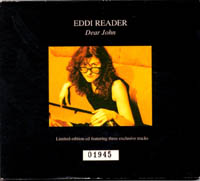 What You Do With What You’ve Got – Eddi Reader
This particular choice is a huge conflation of singer and song identities. Dick Gaughan performed this song of Si Kahn’s at a folk club gig in Twickenham in November 2012. His performance summoned floods of memories.
The song articulates so much about how we view our fellows, how we treat them, and the unspoken how they view us. Si Kahn’s song has the strength, wisdom, humility and humanity of Burns. Wordy, yes, but not something said lightly. From the Dear John single (Blanco Y Negro 4509-98200-2, 1994)
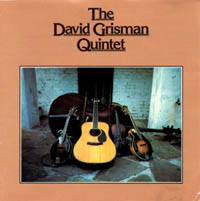
Swing 51 – The David Grisman Quintet
The David Grisman Quintet at this point – circa 1977 – was Bill Amatneek (string bass), Darol Anger (violin), David Grisman (mandolin), Todd Phillips (mandolin) and Tony Rice (guitar). Tony Rice composed this tune and it affected me so much that I named a magazine after it. That magazine lasted for ten years. This tune has lasted far longer.
This particular version of the tune was one of the tracks cut between October and December 1976. Listening to the album wafts me back to other times and other people, especially Artie Traum who composed its Fish Scale. Swing 51’s title reconnects with Django Reinhardt compositions with titles such as Swing 39. The music of the David Grisman Quintet connected with so many acoustic music traditions. From The David Grisman Quintet (Kaleidoscope Records K-5, 1977, 1986)
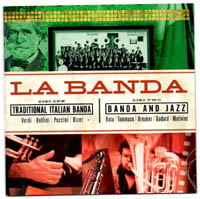 La Gitana – Banda Citta Ruvo Di Puglia
This CD has survived house moves, house clearances, deaths, freelance poverty and scratching to pay supermarket bills. I reviewed it at the time of its release for a now-defunct monthly called Classical CD. La Gitana (The Gypsy) is from Verdi’s Il Trovatore and it is a demotic instrumental interpretation of the aria. The album had preyed on my mind for a long while. Reading Alex Ross’ essay ‘Verdi’s Grip: Opera as Popular Art’ in Listen To This (Fourth Estate, 2010) was the catalyst for finally plucking this magnificent piece of Italian musical literature from the shelf. It still inspires. From La Banda (Enja ENJ 9326 22, 1997)
La Noviola – La Còr de la Plana
This magnificent band re-entered my life in 2011. They sing in Occitan – a language with ancient roots and a terroir that takes in the modern-day nations of France, Spain, Italy and Monaco. The band’s name – Lo Còr De La Plana – I take to mean ‘the heart of [Marselha’s] La Plaine [neighbourhood or quarter]’. ‘Heart’ rather than ‘choir’ – more cour than chour, if you wish. Marselha is Marseilles.
A knowledge of Occitan is not necessary. Or no more necessary than Les Charbonniers de l’enfer from Canada. Both are two of the finest practitioners of vocal interweavings and booted rhythmicality. From Tant Deman (Buda 3017530, 2007)
 The Spawn of Tony Blair – Robb Johnson
Robb Johnson sang this song, the opening blast from this album, at the Twickfolk folk club in Twickenham on 13 January 2013. In the time between cutting the song (at some unspecified date in 2012) and performing it live, it had grown far more muscular and assured. But this version from a limited edition release will have to do for now. Until a better one comes along.
Many people expected it of the Conservative Party. What Tony Blair and his island of Dr Moreau misbegottens did and do remains a stain on generations. The spawn of Tony Blair indeed. From Bah! Humbug! (Irregular Records, no number, 2012)
Love Is Strange/Stay – Jackson Browne & David Lindley
This pairing was a highlight of the concert tours that Jackson Browne and David Lindley with Tino on percussion. From Love Is Strange (Inside Recordings INRS111-0, 2010)
 Gonna Be An Engineer – Peggy Seeger
Peggy Seeger calls this arch little dart her “albatross” but that’s nobody’s fault but her own. (The chorus in the minor key is “No sympathy…”) After all, she made this song so good. This particular recording eluded me to the extent that I didn’t know of its existence. Generally I pride myself that I stay on track about what Peggy Seeger is doing. But 2012 was one of those strange years. The fact that it was in the air and flying about went way under my radar.
Gonna Be An Engineer remains the sort of statement that only a woman can deliver with true feeling. It’s about the Pigeon-hole Principle (distant relation to the Peter Principle). It’s about men dictating what women can do – though, if someone buys into the lie, it can no doubt be a self-inflicted wound. It is not inconceivable that a woman can wield the wounding instrument as well. Quite when this song entered my consciousness is long gone. Writing a feature article about her brought many things back into focus. By then we had had many conversations. Maybe the resultant article for R2 shows that. Maybe not. That’s for the readers eventually to judge.
This recording is from a fund-raiser for the Nelson Women’s Centre in Nelson, New Zealand on 27 February 2010 on the occasion of my mother’s birthday – though I suspect that was not planned. It was for a worthy cause. Fire and smoke had damaged the centre. From Live (Appleseed Recordings APR CD 1129, 2012)
More information at http://www.nelsonwomenscentre.org.nz/ and www.AppleseedMusic.com
The copyright of all images lies with the respective photographers, companies and image-makers.
31. 1. 2013 |
read more...
 [by Kate Hickson, Powys, Wales] As ever these remembrances are fluid and will get changed as news and information comes in and weblinks emerge. Please feel free to send links pertinent to this website’s continent for possible inclusion. Death is a state in flux.
5 December – The US jazz pioneer and early incorporator of world music and non-western classical elements Dave Brubeck died aged 92 in Norwalk, Connecticut. Steve Voce’s obituary ‘Dave Brubeck: Pianist and composer hailed as a major figure of 20th century jazz’ from The Independent of 5 December 2012 is here: http://www.independent.co.uk/news/obituaries/dave-brubeck-pianist-and-composer-hailed-as-a-major-figure-of-20th-century-jazz-8386994.html
9 December – the “Diva de la Banda” and antidote to the male posturing prevalent in many Mexican and Mexican-American music forms, Jenni Rivera died aged 43 in a plane crash.
10 December – the Bohemian Czech dudy (Czech bagpipes) musician and folklorist Josef Režný died aged 87.
11 December – Ravi Shankar died aged 92 in La Jolla, San Diego, California. Of all the many tributes and obituaries, Andrew Robinson’s in The Independent of 12 December remains the front-runner: ‘Ravi Shankar: Sitar virtuoso and composer whose work introduced Indian music to Western audiences’ is at http://www.independent.co.uk/news/obituaries/ravi-shankar-sitar-virtuoso-and-composer-whose-work-introduced-indian-music-to-western-audiences-8412002.html
20 December – The blues singer and songwriter Jimmy McCracklin died aged 91. Tony Russell’s ‘Jimmy McCracklin obituary – Versatile blues singer and songwriter whose compositions included Tramp, recorded by Otis Redding and Carla Thomas’ from The Guardian is at http://www.guardian.co.uk/music/2012/dec/28/jimmy-mccracklin
26 December – Fontella Bass, soul and gospel singer and songwriter, died St Louis, Missouri aged 72. Pierre Perrone’s obituary ‘Fontella Bass: Singer famed for her powerful interpretation of the million-seller ‘Rescue Me” from The Independent of 28 November 2012 is here: http://www.independent.co.uk/news/obituaries/fontella-bass-singer-famed-for-her-powerful-interpretation-of-the-millionseller-rescue-me-8432763.html
27 December – the Bangladeshi Nazrul Sangeet specialist, master vocalist and teacher Sohrab Hossain, aged 91, in Dhaka.
28 December – the US jazz poet Jayne Cortez, aged 78, in Manhattan. Alongside Amiri Baraka, Charles Bukowski, John Cage and Allen Ginsberg, she appeared in Ron Mann’s documentary film, Poetry in Motion (1982).
30 December – the Vienna-born US arts director associated with the Japan Society and Asia Society Beate Sirota Gordon, aged 89, in Manhattan. Ken Hunt’s obituary ‘Beate Sirota Gordon: Human rights reformer who helped draft Japan’s constitution’ from The Independent published on paper on 18 January 2013 is here: http://www.independent.co.uk/news/obituaries/beate-sirota-gordon-human-rights-reformer-who-helped-draft-japans-constitution-8456493.html
15. 1. 2013 |
read more...
 [by Ken Hunt, London] Another fine year for music. The evidence of this list to the contrary, much of 2012 flashed by in a blur owing to illness in the family that wiped out most of the year’s listening hours. As to recorded music, the pile of unlistened to music grew, thanks to having to prioritise paid reviewing work. Yes, strange though it may seem, if one’s livelihood depends on paid writing, it is astonishing how a paying commission focuses the mind.
 New releases
Al Andaluz Project / Live In München 2011 / Galileo
Carolina Chocolate Drops / Leaving Eden / Nonesuch
Eva Quartet & Hector Zazou / The Arch / Elen Music
Getatchew Mekuria & The Ex & Friends / Y’Anbessaw Tezeta / Terp Records
Maria Doyle Kennedy / Sing / Mermaid Productions
Sam Lee / Ground of its Own / The Nest Collective
Little Feat / Rooster Rag / Rounder
The Owl Service / Garland Sessions / Stone Tape Recordings
Tom Paley’s Old-Time Moonshine Revue / Roll On, Roll On / Hornbeam Recordings
Emily Portman / Hatchling / Furrow Records
Abdulkarim Raas & Kuljit Bhamra / Somali Party Southall / Keda Records
Kala Ramnath / Aavartan: A Musical Odyssey – 1 Dawn to Dusk / Kalashree
Kala Ramnath / Aavartan: A Musical Odyssey – 2 Dusk to Dawn / Kalashree
Ravi Shankar / Living Room Sessions Part 1 / East Meets West Music Inc
Jenny M Thomas And The System / Bush Gothic / Fydle Records
Wu Man and Master Musicians from the Silk Route / Borderlands / Smithsonian Folkways
Neil Young With Crazy Horse / Psychedelic Pill / Reprise
 Historic releases, reissues and anthologies
Peter Bellamy / Barrack-Room Ballads of Rudyard Kipling / Fellside Recordings
Dorota Barová / feat. Dorota Barová / Indies
Sandy Denny / The Notes And The Words – A Collection of Demos And Rarities / Island Records
Grateful Dead / Dave’s Picks Volume Three – Auditorium Theatre, Chicago, IL 10/22/71 / Grateful Dead Productions
A L Lloyd / Bramble Briars and Beams o the Sun / Fellside Recordings
Sarah Makem / As I Roved Out / Musical Traditions
Sarah Makem / The Heart Is True / Topic
Gil Scott-Heron / The Revolution Begins – The Flying Dutchman Masters / Ace
Various Artists / Antologie moravské lidové hudby/Traditional Folk Music in Moravia – Dolňácko II / Indies
Various Artists / Antologie moravské lidové hudby/Traditional Folk Music in Moravia – Valašsko, Lašsko / Indies
Various Artists / Celebrating Subversion – The Anti-Capitalist Roadshow / Fuse Records
Various Artists / Copendium – An Expedition into the Rock ‘n’ Roll Underworld / Ace Records
Various Artists / I’m A Romany Rai – Songs by Southern English Gypsy Traditional Singers / Topic
Various Artists / Jail House Bound / WVU Press Sound Archive
Various Artists / Make it your sound, make it your scene – Vanguard Records & the 1960s musical revolution / Vanguard/Ace
Various Artists / You Never Heard So Sweet – Songs by Southern English Traditional Singers / Topic
Hedy West / Hedy West/Volume 2 / Vanguard/Ace
Dominique Vellard – Ken Zuckerman / Indian Ragas & Medieval Song / Glossa
 Events of 2012
Iva Bittová and the Nederlands Blazers Ensemble / Groete Zaal, Muziekgebouw aan ‘t IJ, Amsterdam / 25 January 2012
Aruna Sayeeram/Aruna Sairam / Théâtre de la Ville, Paris / 12 April 2012
Brass Monkey / The Goose Is Out, East Dulwich, London / 27 April 2012
Andy Irvine / The Ram Club, Thames Ditton, Surrey / 4 May 2012
Little Feat / Islington Assembly Hall, London / 2 July 2012
Oumou Sangare & Béla Fleck / Tanz&FolkFest Rudolstadt, Heinepark / 6 July 2012
Hannes Wader / Tanz&FolkFest Rudolstadt, RUTH-Verleihung, Heidecksburg / 7 July 2012
Alistair Anderson / Tanz&FolkFest Rudolstadt, Stadtkirche / 8 July 2012
Chumbawamba / Tanz&FolkFest Rudolstadt, Heinepark / 8 July 2012
Jyotsna Srikanth Project / London International Arts Festival, Redbridge Town Hall, Ilford / 11 August 2012
Dr M. Balamuralikrishna / London International Arts Festival, Redbridge Town Hall, Ilford / 11 August 2012
Chitraveena Ravikiran / Darbar Festival, Purcell Room, London / 29 September 2012
Shujaat Khan & Swapan Chaudhuri / Darbar Festival, Purcell Room, London / 30 September 2012
Carolina Chocolate Drops / O2 Shepherd’s Bush Empire / 9 October 2012
Dick Gaughan / Twickfolk, Twickers, Middlesex / 25 November 2012
One additional live act sounded more than promising from catching them doing a support spot at The Goose Is Out and that was Kit & Cutter. The close-of-festival cameo performance by Strom & Wasser featuring The Refugees at TFF Rudolstadt was also really impressive.
Images: Iva Bittová botanising with an improvised palm tree hat (from bark donated by staff) at De Hortus Botanicus Amsterdam – Amsterdam’s Botanical Gardens – taken 25 January 2012 © Ken Hunt/Swing 51 Archives. Otherwise the images are © their image-makers, photographers and designers.
31. 12. 2012 |
read more...
« Later articles
Older articles »