Giant Donut Discs ® – April 2013
30. 4. 2013 | Rubriky: Articles,Giant Donut Discs
 [by Ken Hunt, London] Another month filled with a bunch of work-related listening patterns. Catherine Ennis and Liam O’Flynn, Country Joe and the Fish, The Who, Any Old Time, Cyminology, Chumbawamba, Uncle John’s Band, Bisserov Sisters, Rais Khan and The Home Service
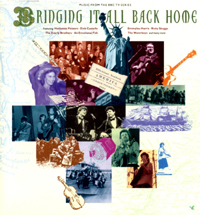 Easter Snow – Catherine Ennis and Liam O’Flynn
This piece of music is a piece of passion. It is a duet that connives to bring together two remarkable musicians performing a composition that is a piece of common ground. Catherine Ennis, here playing organ, is the daughter of the superlative uilleann piper (and much, so very much more) Séamus Ennis (1919-1982). Liam O’Flynn, a musician deeply affected by her father, here is playing uilleann pipes.
Easter Snow was one of Séamus Ennis’ favourite traditional airs. This particular performance just send chills it is so good. The combination of organ and pipes is not one that people would immediately think of. The recording itself starts out with O’Flynn stating the melody. Then Ennis comes in underneath him. There is a passage with the organ’s bass register that adds new meaning to drone. Then they flip the coin and the pipes support the organ. It’s just such an unexpected piece of music. Above all else, it honours the tune. From Bringing It All Back Home (BBC CD 844, 1991)
I Made A Big Mistake – Any Old Time
Any Old Time has remained one of all-time favourite string bands since first hearing their LPs on Arhoolie and Bay back in the day. This is an English-language version of a song called Gros Erreur (‘Big mistake’) from the singing of Iry LeJeune. When Sue Draheim died on 11 April 2013, the LPs came out to be played. Genny Haley sings lead, with Draheim on fiddle, Mayne Smith on pedal steel, Barbara Montoro on bass and Don Slovin on drums. From “I Bid You Goodnight” (Arhoolie 433, 1996)
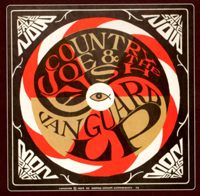 Bass Strings – Country Joe and the Fish
This studio album was a rite of passage for what I believe modern young people call stoners. It speaks of the time – 1967 – but also to an always when people opt for, or go searching for altered states. Joe McDonald (lead vocals and rhythm guitar), Barry Melton (lead guitar), David Cohen (organ) Bruce Barthol (electric bass) and Chicken Hirsch (drums) turned this into one of finest morsels ever to emerge from the San Francisco Bay Area.
This track is a-swirl with explicit references and, spatially, the air is dense. Its opening statement is, “Hey partner, won’t you pass that reefer round?” Alec Paleo’s notes include, Joe McDonald’s admission, “At a certain point in 1966, when we performed ‘Bass Strings’, I thought we were gonna get busted for singing a song about smoking marijuana. Those really were times that are unimaginable in 2013.”
A historical digression. Its spoken outro was already kitsch by the time this album came out in Europe in 1967 or so – on Fontana in Britain. Intoning “LSD” was destined for pretty much instant obsolescence. The Who did something similar with rather more wit on their third LP, The Who Sell Out, roughly contemporaneous with Electric Music for the Mind and Body and their second LP. In similar fashion The Who included commercials, radio jingles and an upside-down version of ‘product endorsement’ with, for example, Roger Daltrey dallying in a tub of baked beans on the cover of The Who Sell Out.
This double-CD reissue includes both the mono and stereo mixes. Paleo’s exceptional booklet notes and the tales accompanying the song-by-song notes (with lyrics) remind about the value of the physical artefact in an era of digital downloads. Still one of my all-time 20 Desert Island Discs. From Electric Music for the Mind and Body (Vanguard VMD2 79244, 2013)
Pictures of Lily – The Who
Then flaming well one thing leads to another… In this case it led to one of The Who’s most imagination-fired narratives. It concerns conjuring memories, through photographic assistance, to banish sleeplessness. The narrator gets help from his dad. He produces pictures of Lily who solves his insomnia. Things turn out badly, dashing hopes for meeting his “pin-up”. (Such a marvellous expression.) The rub is that Lily has been dead for a fair few years, as his father explains, since 1929. It is one of the performances that reminds why John Entwistle was such an inspiration as a bass player – and the power of storytelling. A 1967 single anthologised on… The Who – Thirty Years of Maximum R&B, Polydor 521 751-2, 1994)
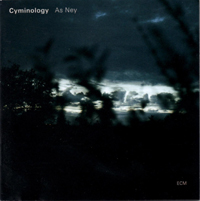 As Ney – Cyminology
This particular piece of writing by Rumi, the Persian mystic poet was the first poem of his to enter my consciousness, thanks to Richard & Linda Thompson. It is ‘The song of reed flute’ – ney meaning flute – and it set me off on a voyage of Sufi discovery. Linda Thompson gave enough of a steer for the next stage of the voyage. The main public library in Sutton had some books that contained writings about Jalāl ad-Dīn Muhammad Rūmī (1207-1273) and Rumi’s writings in translation. Thanks to Kavi Alexander, the head and body of Water Lily Acoustics, I was pointed to Coleman Barks’ interpretations.
Cyminology is a jazz quartet based in Germany, led by Cymin Samawatie, a German-born, bilingual singer of Iranian blood. The group was founded in Berlin in February 2002. The band’s recorded projects have included settings in non-traditional arrangements of medieval Persian mystical poets – not only Rumi but also Hafiz – through to the Farsi-language poetess Forugh Farrokhzād (1935-67) whose work was banned after the Islamic Revolution of the 1970s. Cyminology recontexualises As Ney beautifully. From An Ney (ECM 2084, 2009)
The Story That The Crow Told Me – Uncle John’s Band
This song originates from the Carolina Buddies and was later covered by the New Lost City Ramblers. The band here is John Cohen (vocal, banjo), Sue Draheim (fiddle), David Grisman (crow call) and Jody Stecher (guitar). After Draheim died, I listened to a lot of her recordings. This particular recording captures the silliness of life. And something about Sue Draheim’s fun side. From Stories The Crow Told Me (Acoustic Disc ACD-34, 1998)
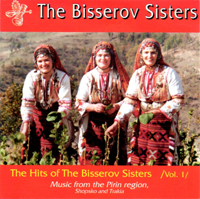
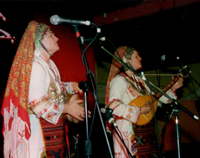 Elenko Mome Malenko – Bisserov Sisters
Of all the Bulgarian folk acts that it has been my unalloyed pleasure to see perform live, the Bisserov Sisters were the most inspiring. That may sound slightly heretic because there were acts with far bigger names, as far as most listeners would be concerned.
There was something about these three sisters – Lyubimka, Neda and Mitra – singing together that transfixed from the time they first crossed my path in the summer of 1991. Their vocal blend on this album is still chilling. From The Hits of The Bisserov Sisters/ Volume 1 (Bisserov Sisters & Co, no number, 1998)
Folk Dhun – Rais Khan
This recording of an unidentified folk air (dhun) performed by Rais Khan and his son Farhan Khan, each playing sitar, with Bashir Khan accompanying on tabla, is the final track on the sixth CD of a 12-CD boxed set of music from Pakistan’s art music community, a much neglected and undervalued segment of Pakistan’s arts. To a large extent, that strand of Pakistani art music has been almost totally overwhelmed by people’s fixation on qawwali as representing the nation’s art music.
This boxed set is an eye-opener. Even though this performance is folk-flavoured and is cut short (after two rāg performances), it captures Rais Khan, one of the greatest, most mellifluous sitarists of our age going strong and tastefully. From Indus Raag (Tehzeeb Foundation of Pakistan ISBN 978-969-97-46-00-0, 2012)
For more about the Tehzeeb Fundation visit http://tehzeebfoundation.org/
Snow Falls – The Home Service
This is one of the songs that I shall take to my grave. Its tune is a saucy steal – a glorious take on a variant of Dives and Lazarus – and its lyrics capture eras and generations of connections. It happened that back in 2012 I had to think really, really hard about this song overnight and what its lyrics and tune meant. I wrote a translation, but not just a translation but a singable translation of the song into German.
In doing that it meant not only translating the words and the sentiments but also trying to capture the folkloric associations that John Tams captured in his original lyrics. It is astonishing how the sharp-focussing by way of translation could heighten the impact of a song I had known for decades.
This is a recording made at the Cambridge Folk Festival in 1986. The Home Service was Jonathan Davie (electric bass and vocals), Howard Evans (trumpet and band glue), Andy Findon (saxophone, clarinet and flute), Michael Gregory (kit drums and percussion), Steve King (keyboards), John Tams (lead vocals, guitar strumming), Graeme Taylor (lead guitar, vocals) and Roger Williams (trombone). They made the most uplifting racket, though Snow Falls captures the silence of snow falling and Tams’ reflections about his grandmother. From Live 1986 (Fled’gling Records FLED3085, 2011)
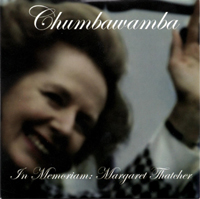 So Long, So Long – Chumbawamba
Made long ago, hence its vagueness in discographical terms, this seven-track piece of mischief was a prepaid subscription release that we bought as an act of blind faith, but bought as an act of hope. Frankly, it’s not the best song in the Chumbawamba canon, but it warmed the cockles of my heart.
This subscription release was sent out on the day that Margaret Thatcher died – 8 April 2013 – and arrived as an antidote to Creep Street and Parliament’s mealy-mouthed gushings about her. Let’s remember her this way.
In the meanwhile the Chumbas folded their hand (as mentioned in the March 2013 Giant Donut Discs)… From In Memoriam: Margaret Thatcher (No label, no number, undated [2013])
The copyright of all images lies with the respective photographers, companies and image-makers. The second Bisserov Sisters’ photograph is from their 1996 concert at The Spitz (1996-2007), near Old Spitalfields Market in London © Ken Hunt/Swing 51 Archives.