Giant Donut Discs® – February 2010
11. 2. 2010 | Rubriky: Articles,Giant Donut Discs
[by Ken Hunt, London] This month’s prime quality stuff offers up some seriously magnificent music. This time round on the Banquet Isle with the hole in the middle, Joseph Spence and the Pinder Family, Steeleye Span, Emily Portman, Chumbawamba, Jenny Crook and Henry Sears, Eddi Reader, Lennie Tristano, Kate & Anna McGarrigle, Incredible String Band and KK are serving up the goodies.
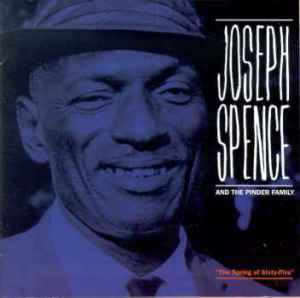 I Bid You Goodnight – Joseph Spence and the Pinder Family
Manumission is a ‘big’ word in several senses. It means a release from slavery. (The Shorter Oxford Dictionary finesses its meaning better if more wordily.) The day I first heard I Bid You Goodnight, a piece of musical magnificence if ever, upstairs in Collet’s folk department in New Oxford Street in London was a day my life changed forever. It was nothing less than a musical manumission. That Nonesuch album, The Real Bahamas, was mind-blowing.
I Bid You Goodnight was more blues, more gospel than I had ever heard from anyone in my life. The weaving voices were revelatory, a similar sort of impossibility to The Watersons. It was the stuff of dreams that necessitates re-calibrating and re-tuning your ears. (All the while delighting in so doing.) I Bid You Goodnight is a performance that needs repeated doses – not to get the gist of, but to imbibe over and over the better to appreciate it.
Later, I met Jody Stecher and Peter Siegel who had recorded Joseph Spence and the Pinder Family in the Bahamas in 1965 for that Nonesuch LP. (The credits were misspelled ‘Pindar’ on the original vinyl Polydor Special edition of the LP that I tracked down in Woolworth’s at Tooting Broadway for twenty-five pence, as they had been on the US Nonesuch edition.) Still later, Peter took me and my daughter to the exact spot near the Brooklyn Bridge where he had taken Joseph Spence. A hallowed place, one might say.
When I interviewed Jody Stecher, he told me about a second take of I Bid You Goodnight that had never been issued because of a glitch because of people pressing in too close to the microphone. That second version, the one here, now cleaned up, eventually appeared in 1992. It differs from the Nonesuch ‘original’ the way folk music should differ. (If you want something pretty much replicated exactly from performance to performance, opt for the Eagles.) For Giant Donut Discs I am taking the Rounder version.
For reasons of the heart, mind and body, the Nonesuch version, however, would be one of my all-time Desert Island Discs. From The Spring of Sixty-Five (Rounder CD 2114, 1992)
Who’s The Fool Now? – Steeleye Span
Around 1968-69 I seem to remember hearing this song sung by The Home Brew (Michael Clifton, John Fordham and Ray Worman) on the wireless. Maybe I’m conflating events but in my memory the session also had Shirley Collins singing. I placed plastic against Bakelite and recorded the broadcast on a Phillips open-reel. I have no idea what happened to that tape but Steeleye Span’s rendition brought memories flooding back.
The song is a lustrous commentary on the state of inebriation – or altered states. Or maybe merely an observation on absurdity and a world in which a hare chases a hound, a mouse chases a cat, cheese eats a rat and so on. It opens disc one of the CD and DVD. From Live at a distance (Park Records PRKCD104, 2009)
More information at: www.parkrecords.com
Fine Silica – Emily Portman
Emily Portman’s reaching for notes on Fine Silica evokes in me memories of Annie Briggs and Lal Waterson. Exquisite. From The Glamoury (Furrow Records FUR002, 2010)
More information at: www.emilyportman.co.uk
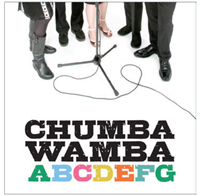 Pickle – Chumbawamba
I was writing some lines about the first time I heard Anne Briggs’ Hazards of Love in a record shop and the way the information on the back of an LP or an EP was a whole world of information to be lapped up in those pre-internet days. The following day Chumbawamba’s newie landed on the doorstep and rather than plopping ABCDEFG on the digital Dansette and listening to it, I deliberately took the package down the Nelson to read the notes before playing the CD. Much as I had done with Hazards of Love back when.
Loads of the stories in the notes were ones I knew but I’d never seen them assembled in such wantonly redolent order. Reading them felt like it used to do when one was spinning the dial on the radio and slipping and sliding between domestic radio stations, static and faraway signals. The tales embrace Brecht, Metallica, the Devil’s Interval and Shostakovich. Good company, eh?
Pickle is inspired by a retort of Martin Simpson’s about “people who want to keep music faithfully traditional, want to preserve it and not alter it.” Martin’s reply: “That’s not music” – pause – “that’s a pickle.”
Coda. Since these are my donuts, the Chumbas’ Hammer, Stirrup & Anvil about Shostakovich’s ear and what we get to hear gets shoehorned in here as a Bonus Donut. From ABCDEFG (No Masters NMCD33 and Westpark WP87186, 2010)
More information at: www.chumba.com
Kwela Ceilidh – Jenny Crook and Henry Sears
Certain things do not transplant well. The new soil they attempt to grow in changes them. British folk clubs, Irish pub sessions and Hungarian táncház usually become different elsewhere once uprooted from their native habitat. The Herschell Arms is a freehouse in Park Street, Slough (as in the sly Robb Johnson song, She Lives In Slough, concerning a certain Slough-based royal). Let me contradict myself. The Herschell Arms was an Irish pub on in British soil that bust clichés, at least at the time that The Herschel Sessions was cut.
It includes live session recordings by Broderick (Luke Daniels, Clare Garrard, Colm Murphy and Don Oeters), Jenny Crook and Henry Sears, Cunásc (Paul Curran, Eric Faithful, Brian Hurst and Roger Philby), Herschel Street (Alan Burton, James Fagan, Steve Hunt and Nancy Kerr) and Don Mescall.
Kwela Ceilidh is a string duet for harp and mandolin by Jenny Crook and Henry Sears. Crook was apparently a finalist for the BBC’s Young Tradition Award in 1992 and contributed music to David Attenborough’s The Private Life of Plants while Sears has done sessions for Alison Moyet and the BBC. The tune just jumps out at the listener. I cannot comment on the continued availability of The Herschel Sessions CD but I found a reference to a version of the same tune (that I haven’t heard) as being on their Chasing the Dawn. This, however, would appear to have the tune’s first recorded excursion – happy to be contradicted – and highly effective it is too. From The Herschel Sessions (OSCD003, 2000)
More information at: www.jennifercrook.com
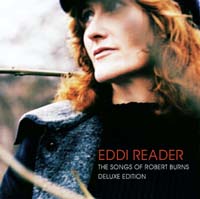 Ae Fond Kiss – Eddi Reader
Adding to a month’s listening on Burns Night in January 2010 without adding something from the Scots Bard would be remiss. Eddi Reader’s rendition of Ae Fond Kiss (‘One Fond Kiss’ in Scots) is sublime, the way pain can be. But especially the pain of parting.
“Ae fond kiss, and then we sever/Ae fareweel [farewell], alas, for ever” – Burns’ opening lines are so simple and yet so telling. As songs of separation go, it knows few rivals in any language to my ken. Ae Fond Kiss, take it to your bosom and it will mean different things at different times in your life. Ae Fond Kiss is a love song of the profoundest ilk. Its line “For to see her was to love her” communicates a sense of loss and unconditional love and exerts a pull as few songs or pieces of poetry ever achieve. A song of love and parting for all seasons. From The Songs of Robert Burns (Rough Trade RTRADCDX097, 2008)
C Minor Complex – Lennie Tristano
Lennie Tristano (1919-1978) made piano solos maybe the like of which nobody had ever heard before. Here he is flying and delivering new lessons not only in how to play but in how to listen to jazz in 1962. I would imagine The New Tristano has lost not one jot of immediacy and impact down the years. Listening to what each hand is doing is a lesson in itself. This is the sort of music that parallels what was happening with the marvellous Jacques Loussier and his explorations of jazz from an alternative perspective on his trio’s Play Bach albums. (Remember how Play Bach No. 3 (Decca SSL 40 507, 1959) and Play Bach No. 5 (Decca SSL 40.205 S, 1964) felt?) From The New Tristano (Atlantic Masters 8122-77676-2 – the CD edition gives 1962 again)
Matapedia – Kate & Anna McGarrigle
Kate McGarrigle wrote songs. Anna McGarrigle wrote songs. Matapedia’s wonderful lyrics leave you guessing which sister wrote which bit of the song. Matapedia, the album, is one of their masterpieces. Whether individually or collectively Kate & Anna McGarrigle wrote some of the finest songs in the English and French languages and bequeathed them to posterity. Too close to Kate McGarrigle’s death to write anything more analytical. From Matapedia (Hannibal HNCD 1394, 1996)
Ken Hunt’s obituary of Kate McGarrigle in The Scotsman of 23 January 2010 is at http://news.scotsman.com/obituaries/Kate-McGarrigle.6007824.jp
The First Girl I Loved – The Incredible String Band
January 2010 saw me delivering an article about the Incredible String Band’s first five LPs. None of the re-mastered albums were available as I wrote that piece for R2. The day I was due to ping the article off, The Incredible String Band and 5000 Spirits landed on the doormat. 5000 Spirits played while doing the last-minute tweaks. Joe Boyd and John Wood – respectively, the producer and sound engineer on the original Elektra sessions – have done wonders with its master. First Girl I Loved, the last track on the album, left its mark yet again.
The remastered Robin Williamson was singing very clearly, “Well, I never slept with you/Though we must have made love a thousand times” a few days later when my daughter rang, prompting a startled “What are you listening to?” Strange the power of words and song. The song is eely and ends as an epistle. Robin was 23, coming on 24, when the album on which this appeared came out.
He took the song to new places subsequently, expanding it into an astonishing performance piece. Him doing the song with its spoken word section at Stagfolk, the folk club in Shackleford, off the Hog’s Back in Surrey, around 1980 still lingers as a memory. Annoyingly Southern Rag commissioned me but never ran the review. From The 5000 Spirits or The Layers of The Onion, Fledg’ling FLED 3077, 2010)
Look out for more information about the Incredible String Band reissue programme at The Bees Knees, “a music information archive and the home of Fledg’ling records”: www.thebeesknees.com
Ajab Si – KK
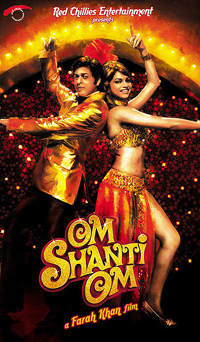 As a film Om Shanti Om is an exceptional mishmash/mash-up on a Bollywood pile-up scale, both cinematically and musically. It flips between past and present lives, past and present movies with lashings of the supernatural and rebirth, revenge and disco beats. The music is from Vishal & Shekhar and the lyrics are from Javed Akhtar.
The film itself is tongue-in-cheek referential with allusions to Karz and a red carpet of Bollywood cameos, including the bow-down-and-be-so-very-humble-in-her-presence Rekha (Bhanurekha Ganesan) and that what’s-his-name? fellow from Sholay. This is maybe the least obvious track to pick from the soundtrack, much of which is decidedly upbeat and comes ringing with kitsch lines like “My heart is filled with the pain of disco”. That said, who gives a flying flip? Because it’s Bollywood, innit? From Om Shanti Om (T-Series/Super Cassettes Industries Limited SFCD 1-1261, 2007)