Giant Donut Discs® – February 2011
6. 2. 2011 | Rubriky: Articles,Giant Donut Discs
[by Ken Hunt, London] More travellers’ tales, aka GDDs, from the faraway island – this time from Bryan MacLean, June Tabor, The Everly Brothers, June Tabor, The United States of America, Eddie Reader, The McPeake Family, Clara Rockmore, Shujaat Khan, Artie Shaw and Christy Moore with Declan Sinnott. The strangest thing happened this month. Just like the S.S. Politician going down off Eriskay in the Outer Hebrides in 1941 and the 1949 Ealing comedy Whisky Galore, all these bottles of single malt whisky washed ashore in time for Burns’ Night. Nobody was more surprised than me…
Old Man – Bryan MacLean
Bryan MacLean’s songs were one of the multifarious delights that made up Love’s Forever Changes, one of the great visionary albums of 1967. It is a work that I have never stopped revisiting. MacLean’s solo version of the song was recorded the year before. There is so much air in his version and not only because it is just voice and acoustic guitar or because it lacks the orchestrations of Love’s take on the song. MacLean (1946-1998) was not a hugely prolific songwriter, it seemed at the time. But what emerged was quality.
A post-Love solo contract with Elektra Records fell through, though he carried on writing and went on to produce a whole canon of Christian devotional songs; apparently only one recording project was of studio quality and this was issued posthumously. The ifyoubelievein anthology of music recorded between 1966 and 1982 has notes from MacLean himself and David Fricke. From ifyoubelievein (Sundazed SC 11051, 1997) More at http://www.bryanmaclean.us/
 Finisterre – June Tabor
This sea-themed programme, then lacking its final title, debuted as part of the seventieth anniversary celebrations of Topic Records at the Queen Elizabeth Hall (QEH) on 18 September 2009. It was clearly going to undergo change. For a start, its suite of songs and recitations was too long for a single CD. Ian Telfer’s Finisterre is one of the pieces that survived the transitions and repertoire re-balancings. On Ashore, as at the concert, June Tabor is joined by Andy Cutting on diatonic accordion, Mark Emerson on violin and viola, Tim Harries on double-bass and Huw Warren on piano.
She first recorded Finisterre on her and the Oyster Band’s jointly billed Freedom and Rain (1990). It was the valedictory piece at the QEH concert. It is now ‘promoted’ to both the suite’s opener and song and performance. It’s strong enough to merit its new position. Its slow rolling arrangement conjuring the rise and fall of waves in motion sets the suite up marvellously. The strength of her rendition says everything about why she is one of the finest song interpreters ever to have emerged from England’s Folk Revival.
PS Quite why the men from the ministry scuppered Finisterre and replaced it with FitzRoy in 2002 baffles me. Finisterre has a Land’s End mystery to it. To rename it with something that looks like a literal (typo for our US readers) or a character from a ropey novel by Walter Scott is bureaucratic folly. It does now mean that the song’s opening declaration “Farewell Finisterre…” has an added poignancy. From Ashore (Topic TSCD577, 2011)
More information at www.topicrecords.co.uk
I Wonder If I Care As Much – The Everly Brothers
The first time popular music became mine made and made any real sense to me was when I heard my older cousins’ Everly Brothers singles. Hitherto pop music was all Doris Day, Max Bygraves, Sputniks or Bachelors patterned wallpaper. A great deal to do with clicking with the Everlys was the way Don and Phil Everly’s voices blended and interwove. Roots is my all-time favourite album of theirs. Lenny Waronker’s production brought out something which I hadn’t heard in their earlier material like Wake Up Little Susie, All I Have To Do Is Dream or Bye Bye Love.
This song, credited to Don Everly, is the only original on the album. It sits beside material from, amongst others, Glen Campbell, Merle Haggard, Ron Elliott and Randy Newman. The piece starts with an attention-grabbing whooshing electric guitar over a simple but effective rhythm line on electric bass. There were no musician credits on the original LP in 1968 or on the undated Warner Archives CD reissue; it could possibly be Ron Elliott of the Beau Brummels on electric guitar. The song lasts for less than three minutes but they cram a lot into its elegant minimalist arrangement. From Roots (Warner Brothers 7599 26927-2, undated CD reissue)
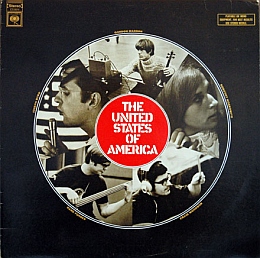 Love Song For The Dead Ché – The United States of America
Reading Pat Long’s mention of The United States of America in the Guardian‘s obituary of Broadcast’s Trish Keenan prompted this Giant Donut Disc. The United States of America were Joseph Byrd on electronic gizmos, electric harpsichord, organ, calliope and piano, lead vocalist Dorothy Moskowitz, Gordon Marron on electric violin and ring modulator, Rand Forbes on electric bass and Craig Woodson on electric drums and percussion. In 1968 the music they made was unlike anything I had heard.
 Love Song For The Dead Ché is under three-and-a-half minutes in length. In mood and style it contrasted with the album’s other material like their cheeky sound-collage The American Way of Love, harder driving material like The Garden of Earthly Delights or the social satire of I Won’t Leave My Wooden Wife For You, Sugar. Love Song For The Dead Ché is quieter, more meditative. At the time there was only one Ché in the news but this song’s wistfulness maintains an ambiguity.
Moskowitz, it struck me, was unfairly underrated in an underrated band best-known in western Europe for I Won’t Leave My Wooden Wife For You, Sugar’s appearance on CBS’ seemingly ubiquitous, budget-priced sampler The Rock Machine Turns You On, released in Britain and the Netherlands (at least) in 1968. Sundazed’s expanded edition of the original album reinforces how innovative the band was. It also includes hitherto unreleased material. For example, the gagaku-inspired Osamu’s Birthday and the Columbia audition recording of The Garden of Earthly Delights. The Sundazed edition has notes by Joseph Byrd and includes an interview with Dorothy Moskowitz. Still, the gentle threnody of Love Song For The Dead Ché is the one I plumped for.
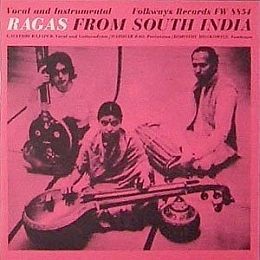
After the United States of America, Moskowitz worked with Joe McDonald on his Paris Sessions. Much, much later I discovered in my exploration of the gottuvadyam or chitra vina that she had played tanpura (string drone) on Gayathri Rajapur’s Ragas from South India (Folkways FW 8854, 1967). There is always so much more to learn. From The United States of America (Sundazed 11114, 2004)
Perfect and Ae Fond Kiss – Eddie Reader
As I dip the quill into the container of octopus ink, it is Burns Night 2011 – 25 January 2011. Tonight, when I have finished the day’s writing, I shall raise a dram in memory of Robert Burns (1759-1796). It has been a custom every Burns Night to savour his words and to reflect on the blessings of friendship, love and loss. I generally conjoin Burns and a line from Hilaire Belloc in that finest of causes. His aphoristic line rings down the years: “There’s nothing worth the wear of winning, but laughter and the love of friends.” For many years I believed it was a line of Burns’ in fact.
Of all the many recorded interpretations of Burns’ material that I have listened to, none has given me greater pleasure or cause to imbibe his poetry than Eddie Reader Sings The Songs The Songs of Robert Burns (2003). However, tonight, with the spirit of Burns loitering and accosting, something less studio, something looser and a little more rowdy is called for. This one fit the bill. Eddi Reader sings and plays guitar, Boo Hewerdine dittos, Graham Henderson is on things squeezed, blown and strummed and sings, Christine Hanson is on cello and vocals, Colin Reid is on guitar and John McCusker plays fiddle and whistle on this live album.
This performance captures the exuberance of Reader’s old Fairground Attraction hit, contrasted with Burns’ hymn to unrequited love. Her introduction to Perfect, placing it in a Glasgow setting, is lovely. After she’s sung it she goes into a spoken introduction for Ae Fond Kiss (Scots for One Fond Kiss). It is literary history told in an amusing way and it grants an impossible new stratum of meaning to the word unrequited. The object of Burns’ unconsummated longings warded off his pleas for a naughty though by way of compensation Burns did manage to get her maid doubly with child. Twins were in the poet’s genes. The great joy with these two songs is Reader’s acrobatic voice. Oh what a voice! On Burns Night it’s within the spirit of the rules to cheat and pick two performances. From Live: London, UK 05.06.03 (Kufala KUF 0039, 2003)
McLeod’s Reel – The McPeake Family
This was first released in 1963. The great Bill Leader recorded this album the previous year. For me, it bottles the essence of home-made music, music made when a family is sitting around and ‘having a play’. The tune may now be familiar as hell but Bill captured something rough, ready and, most importantly, perfect with this performance. From Wild Mountain Thyme (Topic Records TSCD583, 2009)
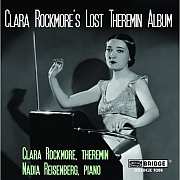 Kaddish – Clara Rockmore
Lev Sergeyevich Termen, better known as Leon Theremin in the West, has a fascinatingly complex story I shall leave to others to tell. The instrument named after him that he bequeathed the world is as simple as its voice is rich. If he ever had a finer acolyte than Clara Rockmore (1911-98) to carry forward his musical message, please disabuse me. During the early 1990s, there was talk and budget to work on a project with her. I volunteered to write the notes on the spot. It never happened, unfortunately. This recording with Nadia Reisenberg on piano is of a piece by Ravel. It reveals a wondrous command of slow-tempo theremin. Plus the piano is like a light shower of raindrops through which the theremin shines. She bent soundwaves so deliciously. From Clara Rockmore’s Lost Theremin Album (Bridge 9208, 2006)
You can watch a rare video of Ravel’s Habanera with Clara Rockmore and Nadia Reisenberg here: www.youtube.com
Bilaskhani Todi – Shujaat Khan
This is a sprawling canvas of a performance, a full-scale depiction of Bilas Khan’s variant of the morning raga Todi. Shujaat Khan’s brushwork teems with detail. Bilas Khan, to whom this piece is attributed (hence the name), was the son of the myth-draped master musician Miyan Tansen of the court of the Mughal emperor Akbar (ruled 1556 to 1605). Bilas Khan had certain difficulties when succeeding his father. He won the position of successor to his father’s musical lineage through the simple expedient of playing music so poignant that his father’s corpse moved. Or so the legend goes. Shujaat Khan also had a hard act to follow. His father, with whom he sometimes had a fraught relationship, was the sitar maestro Vilayat Khan. An unenviable task for a sitarist. Let’s not go down the leafy lane to the Land of Comparative Cod Psychology, however.
This performance, assisted by Samir Chatterjee on tabla, lasts over an hour. It is definitely a canvas to return to periodically. Mainly because it is one that you know you haven’t taken in completely and viewing it from a different perspective in time always pays dividends. It was recorded in June 1995 in New York City with Lyle Wachovsky producing. It is one of my absolute favourite Shujaat Khan interpretations. From Shujaat Khan – Sitar (India Archive Music IAM CD 1046, 2001)
Concerto For Clarinet – Artie Shaw
Recorded in December 1940, this is one of the five to ten pieces of music that I have listened to the most in my life. I grew up with it. Its presence dominated my childhood as no other piece of music did. We had it on a 78 rpm single and I played it on the wind-up gramophone over and over. Johnny Guarnieri’s boogie-woogie piano and Nick Fatool’s drumming were buzzes. But best of all was Artie Shaw’s high-soaring clarinet. Clarinet was a constant in my childhood and youth because my father played clarinet and alto. Before going out to gig he would warm up in front of the mirror. He would routine some current hit from the radio or sight-read something from the pile of sheet music on alto sax and clarinet. He’d adjust the reeds, perhaps shave a sliver off the Selmer reed and when he was satisfied with his embouchure and the reeds, he would turn to Concerto For Clarinet. At some stage he had transposed it for his instrument but he never bothered with the sheet music. He would play the clarinet solo from the last minute and ten seconds of the record. Artie Shaw scales the heights with some serious harmonics by the end, all of which my father negotiated adroitly. All and all, a very reinforcing experience for a young mind.
When my friend Bernhard Hanneken was compiling the outstanding collection of single-reed instrument music from which this comes – an anthology going from A.K.C. Natarajan and Naftule Brandwein to Benny Goodman (since you ask, Verbunkos from Bartók’s Contrasts) and Eugène Delouch – Artie Shaw’s name came up. I was enough of a zealot to have Shaw’s autobiography, The Trouble With Cinderella – An Outline of Identity (1955) and with a headful of childhood memories, which other piece was I going to argue for? It was a foregone conclusion. Bernhard’s anthology is simply amazing, a work of extraordinary disquisition groaning like a treasure galleon with unexpected riches. From Magic Clarinet – The Single-Reed Instruments I, Disc 2 (NoEthno 1005/6/7, 2010)
More information at www.noethno.de
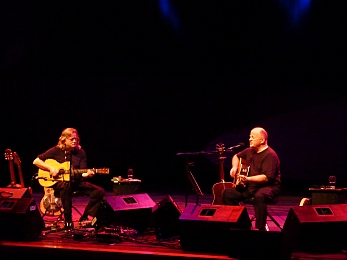 No Time For Love
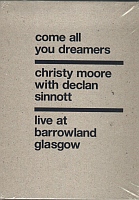 – Christy Moore with Declan Sinnott
Just to prove that it is possible to adapt to modern times this version of Jack Warshaw’s song is from one of those new filmmabobs. Roy Bailey brought the song to a wider audience on his 1982 album Hard Times on Fuse. However, No Time For Love entered my life that same year with its appearance on Moving Hearts’ self-titled debut album.
It’s not a tidy song. It is a jumble of ideas. Some of the ideas work. Some lines don’t sing well and could ‘wrong-throat’ a singer. Sometimes the lyrics change, as here. “The sound of the siren’s the cry of the morning.” is a fine rock’n’roll exit line for this energy-filled song. With sirens going off in Cairo’s Tahrir Square as I write, it is very much a time for love.
The song suited Moving Hearts – which both Christy Moore and Declan Sinnott were members of – on many levels. But what sends this particular rendition into a different space is Declan Sinnott. His electric guitar playing is nimble, sinuous and altogether splendid. He soars away, leaving Christy Moore to perspire and thrash and bash the living bejesus out of the old acoustic. From the DVD Come All You Dreamers – Live at Barrowland, Glasgow (no number, 2009)
For more about the lads go to www.christymoore.com
There is also an interesting piece on the Dublin-based graphic design studio Swollen’s website concerning the spec and design of the DVD’s packaging at www.swollen.ie/index.php?/christy-moore-live-at-barrowland/
The image of Declan Sinnott (left) and Christy Moore is © Santosh Sidhu/Swing 51 Archives. The copyright of all other images lies with the respective photographers, companies and image-makers.