Giant Donut Discs® – July 2010
17. 7. 2010 | Rubriky: Articles,Giant Donut Discs
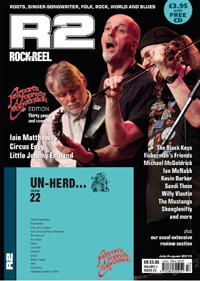 [by Ken Hunt, London] This time around on the desert island’s solar powered phonogram we have Trembling Bells, Buddhadev Das Gupta, Andy Cutting, Maggie Holland, Polkaholix, Jackson Browne, Shirley & Dolly Collins, Eliza Carthy and Norma Waterson and The Bells of St. Margaret’s, Westminster (under Tower Captain George Doughty). Plus for a limited period on the internet, July 2010’s special offer, a bonus donut from David Lindley and Wally Ingram.
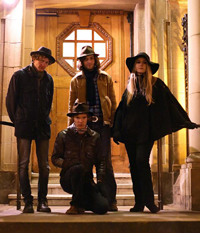 I Listed All Your Velvet Lessons – Trembling Bells
Trembling Bells are the most refreshing and impactful band of a folk hue that I can recall since Last Forever and Bellowhead. Listening to them can be like having a flicker book of boldly worn musical influences and resonances riffling in front of your ears. The Glasgow-based quartet uses the studio and the mixing desk really well. And the mixes and Alex Neilson’s songs give up their secrets reluctantly.
That might entail fresh discoveries nearly every pass. It helps to concentrate on one ‘voice’. Maybe Lavinia Blackwell’s keyboard lines running through When I Was Young or I Listed All Of The Velvet Lessons on their debut album Carbeth. Or on this particular track, I Listed All Of The Velvet Lessons, the use of brass. The song has a touch of the Blakes and Dolly Collinses about it. OK, I’m exaggerating there. But it really is memorable. From Carbeth (Honest Jon’s HJRCD43, 2009)
Chhaya – Buddhadev Das Gupta
There is no point in trying to choose any sliver or stage of this notable 77-minute performance over another. This is not the interpretation to single out some aria-like passage or the big finale from. This Donut is the entire performance of this seldom heard raga. One of the reasons it’s rare is because it is devilishly difficult to establish its clear identity from ‘neighbouring’ ragas. Like pesky neighbours, they can be intrusive.
Buddhadev Das Gupta is not a member of any hereditary musician family (although his brother, Dilshad Khan, also became a professional classical musician). His livelihood was in engineering for much of his life. But while working as an engineer, he was studying music with Radhika Mohan Maitra and developing a phenomenally empathetic style as a sarod player. He calls himself an “old style” sarod player and there is everything to embrace in that description.
Chhaya is proof aplenty of that attitude of his and his application of mind. And, if Radhika Mohan Maitra schooled him so ably, so beauteously, it is a tragedy that few will have heard his guru play. Lyle Wachovsky’s India Archive Music recorded this mighty performance in November 1994. Everything about this CD from the quality of the recording to the quality of the booklet notes sings the India Archive Music approach with its lavish attention applied to this release. Samir Chatterjee accompanies on tabla. From Sarod (India Archive Music IAM CD 1038, 1999)
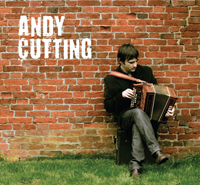 Uphill Way – Andy Cutting
The squeezebox maestro Andy Cutting’s talent first blossomed in these ears in the late 1980s during his time with Blowzabella (a dance band that helped shape many talents). He later spent time with Chris Wood, Nigel Eaton and as a mainspring with the bands of June Tabor and Martin Simpson, with Fernhill, Kate Rusby, John McCusker, Chumbawamba and Pete Morton. If judging someone by the company they keep counts, Andy Cutting moves in exalted English folk circles.
Andy Cutting’s first solo album, from which this track comes, took from 2001 to 2008 to make and that seems about right. You can knock out cheap and cheerful wine but the more rounded ones, maybe even the ones that might turn out to be vintage, take time and time to get to know them.
Uphill Way is from the opening sessions, captured by Oliver Knight in May 2001.It gets its name from Cutting looking out of the car on London’s A406 or North Circular Road whilst stuck in traffic on a crammed driving course. Looking out, he clocked a street by the same name. The tune is a wonderful piece of Englishness. Those with time on their hands can test their googling skills to guess exactly where inspiration struck. From Andy Cutting (Lane Records LANECD01, 2010)
More information at www.andy-cutting.co.uk
S.C.H.E.I.D.U.N.G. – Polkaholix
Polkaholix spell out Scheidung (‘divorce’) in a sort of warped take on the Bobby Braddock and Curly Putman song D-I-V-O-R-C-E, made gold by Tammy Wynette. They do it in much the same fond manner as Andrew Lloyd Webber and lyrics by Richard Stilgoe’s U.N.C.O.U.P.L.E.D. in Starlight Express. It’s about the division of property and chattels and the fall-out after the end of a marriage. Dance to a the pain of d.i.v.o.r.c.e. Auf deutsch that’s S.C.H.E.I.D.U.N.G. From Polkaface (Monopol Records 940833, 2010)
Take it Easy/Our Lady of the Well – Jackson Browne
The last few years Jackson Browne has introduced a twitchy cuteness before playing Take It Easy on stage. It was one of the early hits that propelled The Eagles into whatever tier of freezing hell they propelled themselves into. Browne’s version of the song that he co-wrote with The Eagles’ Glenn Frey has the added bonus of segueing into one of his ‘lost’ songs, Our Lady of the Well.
Its artistic unity is made all the more manifest by Sneaky Pete’s trippy pedal steel. Micky McGee’s drum part on Take It Easy is slinky while Jim Keltner’s drums are something to dream about. David Lindley is all over both tracks, as is Doug Heywood on electric bass.
Basically though, this is a plea for and to Our Lady of the Well. In the last verse he sings,
“If you look for me, Maria
You will find me in the shade
Wide awake or in a dream
It’s hard to tell –
If you come to me, Maria
I will show you what I’ve made
It’s a picture for our Lady of the Well.”
(c) Jackson Browne, Swallow Turn Music
Our Lady of the Well adds the cool and shade of an enclosed courtyard with a well in its middle, probably set somewhere in colonial California. Or the setting could just as well be a well in Jaipur or Jalandhar. If you think that sounds fanciful, listen to the lyrics. Find and replace Maria with Durga Ma or Devi Talaab to get a measure of the song’s transferability. From For Everyman (Asylum 243 003, 1973) And yes, For Everyman, as of 2010, is overdue a proper re-mastered edition.
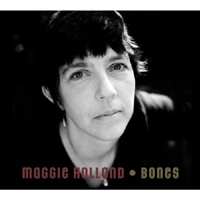 A Place Called England – Maggie Holland
Maggie Holland distils so much about England in this song. She isn’t a hugely productive songwriter but since she wrote A Place Called England, Perfumes of Arabia and Change In The Air plus A Proper Sort of Gardener and Living A Lie with Jon Moore that does not matter one iota.
This version of A Place Called England is a re-recording and an album bonus track. In the notes she writes how it was first recorded on Irregular’s Getting There in 1999. “It had taken 5 years worth of journeys up and down between Scotland and England staring out of train windows to write.” It is such an outstanding piece of Englishness out to remind what a mongrel race the British are. That was probably part of its appeal when it came to June Tabor covering it. From Bones (The Weekend Beatnik WEBE 9044, 2007)
www.weekendbeatnik.com and www.maggieholland.co.uk
Death and the Lady – Shirley & Dolly Collins
You just do not get the quality of songs at funerals nowadays. All that “Wish me luck as you wave me goodbye” jolliness and “Always look on the bright side of life” irony. Shirley and Dolly Collins originally nailed down the coffin lid with this one in 1970. Try to bribe Death in order to get an extension on the blessed mortal coil. It’s that same deal going down the tube that Oh Death conjures when Ralph Stanley sang it. Only his take manages a jauntiness absent in the Collins Sisters’ bone-cold song.
Shirley Collins’ delivery is perfect. Dolly Collins’ arrangement is bare bones. This is a Seventh Seal beach party song. As Shirley Collins told me in a recent interview: “It’s so fascinating when people think they can challenge Death.” From Love, Death & the Lady Fledg’ling Records FLED 3039, 2003)
May Morning Dew/The Snows They Melt The Soonest – Garcia
Notions of purist authenticity have blighted many a chap’s appreciation of folk music. Certainly that applies, mea culpa, to periods of my time in folk music. Garcia, the Hispanic resonances of their name notwithstanding, is a Czech band and Katerina Garcia is their lead vocalist on this recording.
To go Czech, the band’s core line-up is Kateřina Garcia on vocals, whistle and acoustic guitar, Luboš Malina on banjos, whistle, tárogató and kaval, Petr Košumberský on acoustic guitar and Adam Stivín on bass. If this fine performance is typical of the calibre of their music-making, batten down the hatches because they serve up lashings of the Irish tradition superbly. And more delicately than more acts than I dare think of. A real poke in the eye for purists. But better still, a real treat for anyone enamoured of Irish music. PS The performance is followed by a cover of Donal Lunny’s Tribute To Peadar O’Donnell. From Woven Ways (Supraphon SU 5827-2, 2007)
www.myspace.com/katerinagarcia and www.facebook.com/pages/Garcia-cz/103944399638948?filter=1
Ukulele Lady/(If Paradise Is) Half As Nice – Eliza Carthy and Norma Waterson
I have no problems with silliness, especially if it’s dressed up in a hula gal grass frock like Ukulele Lady. What’s more, marvels like this Hawaiian-paradisiacal pairing come along all too rarely. Eliza Carthy and her mother Norma Waterson sing, Martin Carthy (respectively father and husband to the aforementioned) and Aidan Curran play guitars, Danny Thompson throbs along on double-bass and Roger Williams pulls out something special around 3:10 from his magic sack of trombone mutes. From Gift (Topic TSCD579, 2010)
Stedman Caters – The Bells of St. Margaret’s, Westminster under Tower Captain George Doughty
For the July/August issue of R2 (issue 22) Fairport’s Simon Nicol and I talked about church bells. In 2007 the parish church near to the Fairport Cropredy Convention festival in Cropredy, Oxfordshire – Saint Mary’s – gained two new bells bringing the tower’s total to eight. Hitherto, its tower had never been fully equipped, because bells cost a lot and, at the risk of stating the obvious, the village was and is small.
“Because the village has gained from the association with the festival over the previous thirty years,” Simon told me, “the two bells were made and they were named for two separate dedications. We were chosen as one of the recipients of this honour. There is a ‘Fairport Festival Bell’ – that’s what it has got written on it – hanging in the church tower now alongside its 400-year-old predecessors/brothers. It’s an amazing thought that that bell will be there, whether the festival survives or not. It will certainly be there as long as the building stands.”
As I was writing about the bells of Saint Mary’s, bellish associations and memories kept pouring in unbidden. Like the Sunday sounds of church bells from childhood and church bells from communities in India. And then, with thoughts of the blessed Saint Vivian (Stanshall) and bellish thoughts in mind, well, tie me to a tree and call me Brenda, Ring Forth! Westminster arrived. The narration of the stage, television and film actor Nicholas Smith (Royal Shakespeare Company, The Avengers, Dr Who, Are You Being Served?, Wallace & Gromit: The Curse of the Were-Rabbit amongst others) binds the story of the Bells of the Abbey and Palace of Westminster together. (For details of order, hundredweights and quarters for the bells, the booklet notes are to be recommended.)
Track 11 here gives Smith’s redolently voiced history of the Bells of St. Margaret’s, Westminster – sometimes known as the parish church of the House of Commons – before it leads into the ten bells being rung out. For me, the complexity of the way they interlock melodically and rhythmically over nine minutes is as eye-opening as when I first listened to Ravi Shankar and Alla Rakha. With thanks to Stephen Mitchell, bell-ringer of that parish. From Ring Forth! Westminster (Cantate Music CBC032, 2005)
For more about Simon Nicol and bells, go to: www.fairportconvention.com and/or www.rock-n-reel.co.uk
July 2010’s Special Bonus Donut
Bonus Track – David Lindley Y Wally Ingram
The cover proclaims “Studio Album! Overdubs! Special Guests!” Were a listener so disposed, well, Bonus Track, an alternative taksim-opening Turkish take on National Holiday (the album’s fourth track) might be supposed to have Jimmy Stewart on lead vocals. It is, however, but one of Lindley’s many voices. And, yes, Lindley did meet the Hero of Harvey. Would that nice Jimmy Stewart really have turned “aftershave” (National Holiday version) into “leather slave” (Bonus Track version)? Thrice nay! From David Lindley Y Wally Ingram’s Twango Bango II (no label, no number, no date)