Giant Donut Discs ® – July 2013
31. 7. 2013 | Rubriky: Articles,Giant Donut Discs
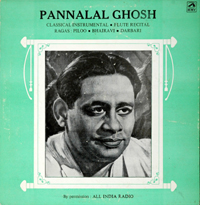 [by Ken Hunt, London] M.S. Gopalakrishnan, Barbra Streisand, The Byrds, Barbara Dickson, Martin Simpson, The Ex & Brass Unbound, Paul Horn, Duncan Wood & Guests, Pannalal Ghosh and the Grateful Dead provide the work- and life-related materials this month. Updated 21 October 2013.
Janani Ninnuvina – M.S. Gopalakrishnan
This is a composition by Subaraya Sastri. His pedigree as a composer-musician is unmatched as far as I know. (More informed readers than I, please correct if wrong.) He was the son of Syama Sastri (1762-1827), one of the Holy Trinity of Karnatic saint-composers and he also studied with the Trinity’s other two saint-composer Muthuswami Dikshitar (1776-1835) and Tyagaraja (1767-1847). This kriti or Hindu devotional hymn seeks the protection of the mother goddess.
A recording from 1978 taken from the NCPA Archives – the National Centre of Performing Arts in Bombay in July 1978. Kutralam Visvanatha Iyer accompanies on mridangam, the preeminent South Indian double-headed barrel hand drum. From M S Gopalakrishnan From The NCPA Archives (Sony Music (India) 88697 95855 2, 2011)
Ken Hunt’s obituary entitled ‘MS Gopalakrishnan: Revered Southern Indian violinist’ of 29 July 2012 in The Independent is at http://www.independent.co.uk/news/obituaries/ms-gopalakrishnan-revered-southern-indian-violinist-8501679.html
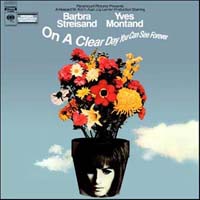 On A Clear Day (You Can See Forever) – Barbra Streisand
In this 1970 film Barbra Streisand plays the role of a young woman called Daisy Gamble. She has powers. The film’s opening sequence while the credits roll includes time-lapse film of flowers coming into bloom. You may well start thinking that this is all very good in a sub-David Attenborough sort of way. It emerges that Daisy can accelerate plant growth. She has other powers, including foreseeing when a telephone is going to ring, as Dr. Marc Chabot, played by Yves Montand, discovers when she goes to him in an attempt to break her nicotine habit through hypnosis.
Never having seen the film before, the notion had never crossed my mind that the title song feeds into the undercurrent about rebirth that emerges. It was a case of being too accustomed to this Alan Jay Lerner/Burton Lane song. Without any specific context, it had just washed over me. All that lodged was the central consolidation: “On a clear day/Rise and look around you/And you’ll see who you are/On a clear day/How it will astound you/That the glow of your being outshines ev’ry star.”
That and the ending lyrics: “On that clear day…You can see forever…And ever… And ever…And ever more!” ending, that whole context and drive of the song had never occurred to me. Getting disabused and having to reconsider a position (however tenuous, entrenched, pukka or inaccurate) once further context is supplied is one of life’s great joys and blessings. As much as anything, this is about reconsidering, re-evaluating or re-contextualising something that you thought you knew. From On A Clear Day You Can See Forever (1970)
Tribal Gathering – The Byrds
In January 1967 Golden Gate Park in San Francisco had its Gathering of the Tribes, something celebrated in this song by David Crosby and Chris Hillman. The song, recorded in August 1967, is of the moment, yet transcends its immediate birthplace and circumstances of its birth. It combines a West Coast jazz feel and a West Coast folk sound.
Over June and July I was doing interviews and writing an article about Rory McEwen for R2 and its September/October 2013 issue. The subject of the 1965 Keele Folk Festival, organised by Rory McEwen, had to be part of the narrative. It was a turning-point. McEwen fashioned a festival that truly was a gathering of the tribes, bringing together British traditional and revivalist musicians. The ‘gathering of tribes’ image had been in the article from before the day the article was commissioned.
Then two things happened.
A bunch of music critics were jawing about songs about childhood. The Notorious Byrd Brothers had this Goffin/King song on it, supposedly cut in solidarity with Dusty Springfield and her anti-apartheid stance. It is one of the most evocative songs about childhood. Then sitting in a pub proofreading the day’s copy and escaping the tyranny of the word machine Wasn’t Born To Follow from the same album came on. Out of this triad of connections came Tribal Gathering. From The Notorious Byrd Brothers (Columbia/Legacy 486751 2, 1997)
Baker Street – Barbara Dickson
This is the opening cut on Barbara Dickson’s 13-track project dedicated to the songs of Gerry Rafferty. The Scottish singer-songwriter Gerry Rafferty (1947-2011) came to a kind of prominence – in a low-key folk sort of way – as a member of The Humblebums with Billy Connolly between 1969 and 1971. Although I saw The Humblebums perform in 1970, no memory of their set whatsoever remains.
Between 1972 and 1975 Rafferty was one half of Stealers Wheel with Joe Egan. Thereafter his career came to a standstill temporarily, stranded in a legal desert with litigation vultures circulating. The breakout came in 1978 with City to City, produced by his old cohort Hugh Murphy. Its major song was Baker Street. It was an enormous hit and a staple of a certain kind of radio programming.
Barbara Dickson ran into Rafferty, she writes, “in the late 1960s, one Saturday, in the Scotia Bar in Glasgow”. Produced by Troy Donockley, the arrangement ingeniously replaces Raphael Ravenscroft’s distinctive alto saxophone solo on Rafferty’s original with low whistle – not that any saxophonist would attempt to replicate that solo. Barbara Dickson’s take on the song is a gem and really quite, quite original. From To Each & Everyone (Greentrax CDTRAX378, 2013)
Will Atkinson – Martin Simpson
This song of Martin Simpson’s tells the story of Will Atkinson (1908-2003), a remarkable traditional music-maker from the North-east of England. He put his stamp on Northumbrian music. In the notes to the song, Simpson reminds that he was still playing whilst he was in hospital two days away from dying. Atkinson also added to the tradition. One composition was Alistair Anderson’s Fancy, a reel named after one of the region’s finest.
Simpson’s songs were very much on my mind and casting my eyes across his albums, True Stories sprang to the forefront. Will Atkinson is one of Simpson’s finest songs musically; it is very English and lyrically a marvellous tribute to an inspirational musician who, for much of his life, music was a hobby and passion before it was a secondary income, however marginal. From True Stories (Topic Records TSCD578, 2009)
Further Simpsoniana at http://www.martinsimpson.com/
 Last Famous Words – The Ex & Brass Unbound
If I had to propose a list of the ten rhythmists that most keep me engaged and thinking, then, no sweat (on my behalf), Katherina Bornefeld would be in there like a shot. Her solutions to rhythm keep me on my toes. She challenges – please excuse that swelling cliché of a word. Her abilities to infuse songs with drum patterns are just extraordinary. She is a one-off. This, the first track on The Ex’s Enormous Door album, does it for me.
Last Famous Words – nice inversion – is one of those marvellously perfect pieces of music with the sort of wartiness which The Ex specialise in. The Ex are Kath Bornefeld (drums, vocals), Arnold de Boer (vocals, guitar, sampler), Terrie Hessels (guitar, baritone guitar) and Andy Moor (guitar, baritone guitar). Mats Gustafsson (baritone saxophone), Roy Paci (trumpet), Ken Vandermark (tenor and baritone saxophones, clarinet) and Wolter Wierbos (trombone) are Brass Unbound. This album was recorded in Posada Negro Studios in Lecce, Italy in June 2012. One of my most played albums of 2013 thus far. From Enormous Door (Ex Records EX138D, 2013)
More information at www.theex.nl
Raga Tilang – Paul Horn
Born in 1930 in New York, the flautist Paul Horn was one of the musicians that came together to play with Ravi Shankar on his Portrait of Genius (1964). This take on Tilang appeared on Paul Horn in India, subtitled “Ragas for flute, veena and violin”. From In India/Cosmic Consciousness – Paul Horn In Kashmir (BGO Records BGOCD1104, 2013)
More information at http://www.bgo-records.com/
Passchendaele/The Crow Steps Reel – Duncan Wood & Guests
Dave Swarbrick produced many of these new compositions in a flurry of creative energy. He had done a gig at the Edinburgh folk Club with Duncan Wood and Cathal McConnell and it led to a compositional jag. The 17 tracks and 36 compositions on this album are all tradition-based.
This particular composition opens with a 2/4 military march in a Scottish pipe vein. The title of the second piece, a reel, refers to the Scottish architectural feature called crow-stepped gables. This is a stair-step-like design at the triangular gable-end of a building, also known as a stepped gable or corbie step. (Corbie is Scots for crow.) From Swarbtricks – A Collection of New Melodies Purposely Composed for the Violin & Mandolin by David Swarbrick (Beechwood SWB121117, 2013)
October 2013 Coda: Dave Swarbrick asked me about this album after the Martin Carthy & Dave Swarbrick concert at Turner Sims Hall in Southampton on 19 October 2013. I started rabbiting and I cited this track. He looked blank when I mentioned the title. I thought I had fumbled it and went into apologies. Then he explained he was crap at titles – he cited one working title for a tune of this album as “Droopy Drawers” – and that Wood had weaved magic of another kind.
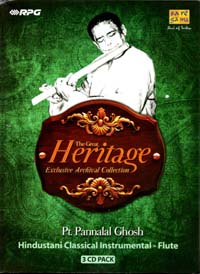 Kajri – Pannalal Ghosh
Pannalal Ghosh (1911-1960) is the Hindustani flautist who transformed the appreciation and status of the bansuri or bamboo flute. Kajri is the name of a folk form from the Indian region of Uttar Pradesh and is particularly associated with the city of Varanasi or Benares. This short piece closes the first disc of this triple set. This triple-CD set is the soundtrack to my article in Autumn 2013 issue of Pulse. From The Great Heritage (Saregama CDNF 150997-999, 2011)
Ken Hunt’s article about Pannalal Ghosh is in the Autumn 2013 issue of Pulse. More information at http://www.pulseconnects.com/
Turn On Your Lovelight – Grateful Dead
“And leave it on!” In memoriam: Bobby ‘Blue’ Bland (1930-2013). From Live/Dead (Warners, 1969)
The copyright of all images lies with the respective photographers, companies and image-makers.
PS Thank you for the feedback. Whatever else you may think – and what the troll-ridden comment corners that several newspaper propagate like Petrie dish cultures – many music critics in my experience operate in a response-free zone.