Giant Donut Discs ® – June 2012
18. 6. 2012 | Rubriky: Articles,Giant Donut Discs
[by Ken Hunt, London] No blurb, just straight into this month’s music. This month summons Mahsa & Marjan Vahdat, Al Andaluz Project, Hedy West, The Ex, Scissor Sisters, George Mraz and Iva Bittová, Fairport Convention, Big Mama Thornton, Bill Monroe with Pete Rowan and Little Feat. As usual, loads of work-related currents. There’s a greater element of noise than usual this month. That’s down to other currents flowing around the fictitious island.
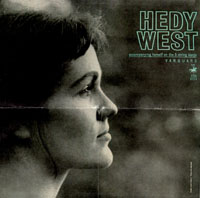 The Brown Girl – Hedy West
Hedy West was one of the most impressive musicians to emerge from the US folk scene in the early 1960s. For me, it is a marvel that so few people are aware of her massive contribution. The first album of her I heard was Ballads (Topic, 1967) and I bought a white-label test-pressing of the album at a folk record shop on New Oxford Street in London that I used to frequent.
It was the sort of place that a parade of folkies slouched towards as if it was Folk Bethlehem. The slouchers included Sydney Carter and the Young Tradition, Anne Briggs and Bert Jansch and later Jerry Garcia and Allen Ginsberg. I digress. Hans Fried who used to work at Collet’s – the afore-mentioned New Oxford Street record shop – joined us at Dave Arthur’s book launch do for his Bert – The Life and Times of A.L. Lloyd (Pluto Press, ISBN 978 0 7453 3252 9).
This particular song is from her pre-Topic days when she was recording for the New York-based Vanguard label. It is a supurb reading from her first full-length solo album for that label. Hans and I jawed about her Vanguard Years in the intermission. He is still a hero of mine. In the 1960s he helped me to focus my mind and put my feet on other paths – ones that perhaps determined where I am now. From Hedy West accompanying herself on the 5 string banjo (Vanguard VRS 9124, 1964)
Crane – Mahsa & Marjan Vahdat
Mahsa & Marjan Vahdat are sisters. The instrumentation is setar (the Persian long-necked lute many believe evolved into the sitar in the South Asian subcontinent), ney (end-blown flute) and daf (frame drum), supplied, respectively by Atabak Elyasi, Pasha Nanjani (whose overture to Crane is exquisite) and Ali Rahimi (also credited with the other percussion).
This track is a poem by the painter-poet Mohammad Ebrahim Jafari and it is set to a melody from Iran’s Khorasan Province. From Twinklings of Hope (Kirkelig Kulturverksted FXCD 376, 2012)
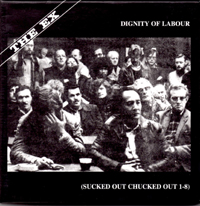 Sucked Out Chucked Out #3 – The Ex
“In 1960 the paper company Van Gelder decided to expand its product range with plastic. Van Gelder formed together with the US compagny [sic] Crown Zellerbach a joint venture Crown van Gelder PFI (Plastic Film Industry) for coating of paper with polyethylene and cast co-extrusion films. In 1980 the compagny [sic] became a 100% sister company of Van Gelder Papier and the name changed into Van Gelder PFI.
“In 1982 the American multinational Borden Inc. acquired the company and it continued under the name Borden PFI (Plastic Film Industry). During that period the product range and the capacity grew…” From www.afpholland.com/history-afp.html
There is something about the industrial nature – pun intended – of this particular Ex project “recorded at the Van Gelder ruins” that scratches the spot. It originally appeared as one of four 7-inch singles on VGZ Records in March 1983. Very agitprop. Magnificent noise as protest and socially engaged utterance. From Dignity of Labour (Sucked Out Chucked Out 1-8) (EX 010/013D, 1995)
Meet On The Ledge – Fairport Convention
“We used to say…,” wrote Richard Thompson in this magnificent vision of youthful writing, “That come the day/We’d all be making songs/Or finding better words…” before deflating optimism or pomposity with, “These ideas never lasted long…” Still haunting after all these years. From By Popular Request (Matty Grooves MGCD051, 2012)
Hijaz – Al Andaluz Project/Abuab Al Andalus
This track concludes the CD part of this CD/DVD release. The Andaluz Project/Abuab Al Andalus project is an examination of Moorish-era Iberian emancipation and tolerance. Three female vocalists front this band – namely, Morocco’s Iman al Kandoussi, Spain’s Mara Aranda and Germany’s Sigrid Hausen. The Project has at its core, those members of, respectively, Aman Aman, L’Ham de Foc and Estampie. I’m not sure where they are going but I am enjoying the ride and, no doubt, the ride will make more sense after seeing them live. From Live In München (Galileo GMC050, 2012)
http://www.galileo-mc.de
http://www.ojo-musica.com
Fire With Fire – Scissor Sisters
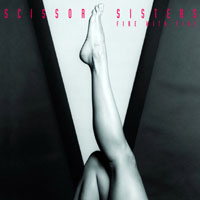 The death of Donna Summer caused me to think beyond the music she had made and beyond the music I generally listened to. Disco meant zilch to me musically but it was there. After her death, a number of commentators said that it had the important ability to unite people of different skin colours, sexualities and politics. I hadn’t done that before.
In September 2010, Scissor Sisters – an outfit that wears its disco colours on its sleeve – appeared on BBC’s Later with Jools Holland. My son hadn’t been able to get to any of concert venues. Thanks to a journo pal of mine – Ian Wade, credit where credit is due – who was doing press for Later, my son and I got to go to the filming. Scissor Sisters were toured out or hadn’t rested enough. Whatever it was, it was something that I recognised. The band or the director’s booth called for a re-take. Nearly everybody bar film crew left but we stayed to watch them do another take. Their lead vocalist Jake Shears’ professionalism was taxing to watch. It was another view from the other side of this life – to cue Fred Neil. A side of performing that few punters get to see or don’t get in the sense of realising what it takes to go out on stage and do it in public. From Night Work (2010)
Polajko – George Mraz and Iva Bittová
Polajko, the Czech name for the pennyroyal plant, popped into my head during a conversation with Sam Lee about folksong and herblore. He has an interest in both.
It is a Czech folksong that hinges on the unsaid, something that I like a great deal. No matter that it is a song-story of fine tunefulness, its better appreciation hinges on one element. Polajko is a plant, an infusion of which was used in traditional medicine to promote menstrual flow and therefore to induce a natural abortion.
This version has jazz lacings. Emil Viklicky (piano) and Laco Tropp (drums) shine. For me, Moravian Gems has a heightened poignancy, one that only five years on, I can express. At the time when Petr Dorůžka and I were working on the CD booklet notes, it was also a time when my mother was dying and I had moved back to become her carer. Moravian Gems was one of the albums I associate with that period. Only now can I listen to it again. And enjoy it in ways other than I did then. Only now it is stripped of pain. From Moravian Gems (Cube-Metier MJCD2736, 2007)
 The Walls of Time – Bill Monroe with Pete Rowan
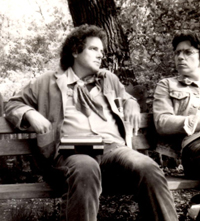
Before I met Hans Fried at the Bert – The Life and Times of A.L. Lloyd launch, I had wandered up the road to Cecil Sharp House with the writers Tony Russell and Phil Wilson. My hitherto unpublished photograph captures an unguarded moment between Pete Rowan and Tony Russell during the course of the first interview with Pete Rowan for Swing 51 that began in issue 4. Neither of them will have ever seen the shot before.
It reminds me not so much of a period of scratching together money in order to put out a small magazine – Tony was publishing Old Time Music and I was publishing Swing 51 – than the egoless desire to write for the ‘competition’. We were all part of the same cause.
Peter Rowan had a similar mindset. He knew Gill Cook who was working at Collet’s at that point and Tony had also done time behind the Collet’s counter… The Walls of Time reminds me of that period in an eidetic way. It represents something else starting to happen to bluegrass… In linear development terms, from this song you can arrive at Old And In The Way. From Make it your sound, make it your scene – Vanguard Records & the 1960s musical revolution (Vanguard VANBOX 14, 2012)
Ball And Chain – Big Mama Thornton
This track also comes from the John Crosby-compiled and -annotated 4-CD boxed set that Ace released in 2012. This is the song popularised by Janis Joplin, to whom Thornton pays tribute in her opening remarks. It first appeared on Willie Mae Thornton’s album Jail (1975). Tracks from this marvellous, five-outta-five-star compilation of Vanguard recordings compilation will figure for as Giant Donut Discs for a long time. Make it your sound, make it your scene was long, long in the making and will not be going away. This is the sort of project that Ace does so peerlessly. One of the anthologies of 2012. Ah! Big Mama Thornton. From Make it your sound, make it your scene – Vanguard Records & the 1960s musical revolution (Vanguard VANBOX 14, 2012)
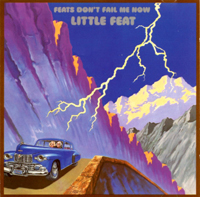 Spanish Moon – Little Feat
This woebegone tale of Lowell George’s is one of the bestest things that Little Feat ever committed to vinyl back in the day. It first emerged on their album Feats Don’t Fail Me Now (1974) where it appears almost like a wraith sketch at three minutes and one paltry second in length. It remains a song with hugest potential, both musically and lyrically. The lyrics place it in Brecht/Weill territory but for me the one element that holds it together is Kenny Gradney’s bass playing. It adds a storytelling dimension, the like of which few bassists will ever come close to delivering during their careers. The sinuous, sinewy elasticity of his bass line is a joy. Writing a piece about him for Bass Guitar Magazine gave me the financial incentive to distil many of my ideas about this song and, importantly, Kenny Gradney’s contribution to Little Feat into words. From Waiting For Columbus (Warner Brothers R2 78274, 1978)
The copyright of all images lies with the respective photographers, companies and image-makers.