Giant Donut Discs ® – March 2011
7. 3. 2011 | Rubriky: Articles,Giant Donut Discs
 [by Ken Hunt, London] Life is rarely dull on the treasured island. More travellers’ tales, aka GDDs, from the faraway island – about love and deception, wading birds, coming on and vamoosing, work, tall trees in Kashmir, church bells and science fiction-inspired escapes. Bert Jansch, Lo Cor De La Plana, Carolina Chocolate Drops/Luminescent Orchestrii, Paul Kantner, Drewo, Gayathri Rajapur, Fairport and Shivkumar Sharma supply the music this month. By the way, the tally is not a miscount. Bert Jansch supplies two tracks.
 Jack Orion – Bert Jansch
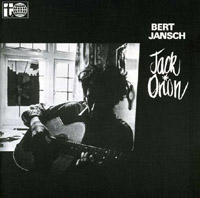
The LP jacket for Jack Orion, Bert Jansch’s third solo album for Transatlantic, had a simple elegance. The front cover had a shadowy portrait of Jansch playing his acoustic guitar taken by Brian Shuel, the folk photographer of the period. In 1966 the norm was for UK record sleeves to be laminated. Instead of the beetle-back sheen that lamination brought, Jack Orion‘s finish was matt black. Like a blackboard. On the rear of the sleeve there was a reversed out, white out of black image of the eponymous hero-fiddler of the title song.
On went the album and for the first time Bert Jansch made total sense. The first two albums – Bert Jansch and It Don’t Bother Me had been very good in parts but this time the album worked as a coherent whole. Jack Orion is a tale of seduction and deception and Jansch and John Renbourn’s guitars combine magically to propel it along. Jack Orion is a fiddler who can fiddle fish from salt water. He is also a bit of a charmer. The lady of high renown certainly falls for him and asks him to visit her at daybreak. Naturally, he needs to build up his strength with a little rest and is ably assisted in this by his servant Tom who sings and fiddles him to sleep, promising to wake him in time for his tryst. Tom then pops along to the countess while his master sleeps. Things start unravelling when the lady asks Jack Orion if he is returning to taste more of her love. Well, you’d be confused, too. Gripping stuff then and gripping stuff still. From Jack Orion (Castle Music CMRCD304, 2001)
Hit ‘Em Up Style – Carolina Chocolate Drops/Luminescent Orchestrii
According to the press release, at the Folk Alliance bash in Memphis, Tennessee, Sxip Shirey of the New York-based Romanian punk Gypsy band, the Luminescent Orchestrii spotted the Carolina Chocolate Drops’ Rhiannon Giddens clocking them and called her over. This is the more permanent upshot of the invitation. What a combination for this line-up of the Drops to go out on a parting gift! There is a wide-cast wit and a humour to this performance. Plus any recording that goes out on almost an Earl Okin-style mouth trumpet flourish is deserving of your ear time. Such a shame it’s only an EP. A version of the song appeared on the Drops’ Genuine Negro Jig (2010). From Carolina Chocolate Drops/Luminescent Orchestrii (Nonesuch 7559 79779-9, 2011)
 Have You Seen The Stars Tonite – Paul Kantner/Jefferson Starship
Have You Seen The Stars Tonite is full-throttle science fiction set to the San Francisco Sound of 1970. The performance is fantabulous, one of those budget-no-option, let’s-roll-tape parties that bottled a fragrance of the Bay Area music scene for posterity. David Crosby (who gets the compositional co-credit with Paul Kantner), Jerry Garcia and Mickey Hart throw in musical shapes to enhance and nudge on Paul Kantner and Grace Slick’s vision.
What got me on its vinyl release was its sound and that still remains. The piano is especially important in the mix. It should have been Nicky Hopkins: it sure sounds like him. It is Grace Slick. And her playing still sends me. Have You Seen The Stars Tonite – still no question mark – is a mini-SF saga all on its own. Pun intended. From the expanded Blows Against The Empire (RCA/Legacy 82876 67974 2, 2005)
Oj zajdy, zajdy ty misiacu na tu poru – Drewo
It wasn’t the best interview I’ve ever done. Petr Dorůžka and I did it as a double-hander. We were both mesmerised by this wonderful, traditional Ukrainian polyphony that had come to TFF Rudolstadt. It was village music with extraordinary potency with wonderful upsweeps at the end of a line – much in, say, the Bulgarian style from the Pirin Mountains. But when experiencing it in the flesh it was its own thing and it sounded heady. Their unaccompanied singing was transfixing. Petr and I met several of the Drewo ladies for an interview. It soon became apparent that no matter which language their profundities about Ukrainian folksong were going to be translated into, all the nuances were going to be lost in a sea of blandness. In that Slav language pivot sort of way that Czech can be, Petr began offering suggestions for translating Ukrainian words.
This song, the CD booklet notes explain, translates as ‘Oh moon hide your light’. Its tiered vocals are high-ringing. At times, they have the fluency of the Watersons – a comparison not lightly given – in the ways the voices interlock and interweave. Even though the Drewo was slightly short of this album’s line-up, recorded at Hendrix Studio, Lublin in Poland in July 2001, the ensemble still flew. Mariana Sadovska, a major facilitator of this recording, be praised. From Budemo wesnu spiwaty/Song Tree (SEiAK 001, 2003)
 Kruti: Hatna Raga – Gayathri Rajapur
The gottuvadyam is a South Indian vina – in this context, a vina of stick zither-style construction (rather than the generic word for ‘stringed instrument’) – played with a slide. At the time of this recording’s release in 1967 it was indomitably obscure and, as with many Folkways releases, I have no recollection of encountering it in either Collet’s or Dobell’s – the two London record shops that might just have occasionally stocked it. Besides, Folkways albums came at a premium price beyond my pocket.
In fact, outside the subcontinent, Budalur Krishnamurti Shastri (Śastri) had introduced the gottuvadyam with a performance of Ganesha Kumara on Alain Daniélou’s Anthologie de la Musique Classique de L’Inde as early as 1955. Supported by UNESCO and the International Music Council, this, the world’s first microgroove long-playing anthology of the subcontinent’s two classical systems, was a 3-LP set originally issued in France. Even its UK edition had long gone by the time I was in a position to explore its contents. The first complete set I saw was at the beginning of the CD era when record collectors began dumping their vinyl, enabling me to pick up the original Ducretet Thomson trilogy for a few pounds. It is currently available on CD as Auvidis D 8270 (1997).
But all this is after the event. It was only seeing the instrument played that revelations came. The musician that supplied the epiphanies was was Ravikiran and he used the term chitra vina (‘beautiful vina’) in preference to gottuvadyam. Chitra vina was later adopted as its official name. The South Indian vocal virtuoso M.S. Subbulakshmi, Ravikiran told me, gave her blessing to the change.
Gayathri Rajapur’s performance here is a lengthy instrumental examination (within the constraints of one half of one side of an LP) of an unspecified kriti (now the standardised spelling, rather than kruti) by Muttuswami Dikshitar, one of the Holy trinity of saint-composers of South India. Joseph Byrd’s booklet notes state her to be 25 at the time and that she had studied with Krishnamurti Shastri. Bingo! The Budalur part of the name is a Karnatic musician naming convention. It is a prefix adding a place name – in his case a village in Thanjavur District, Tamil Nadu. Apart from the inherent quality of her performance, Gayathri Rajapur joined up further dots in the chitra vina picture. Incidentally, 1967 was also the year of Chitravina Ravikiran’s birth. (Chitravina Ravikiran is an example of another naming convention with the addition of the musician’s instrument.)
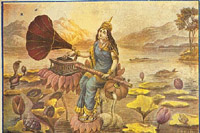
Whether you call it chitra vina or gottuvadyam, believe you me it is one of the instruments that you really must listen to before you die. The charming image is of Saraswati, the Hindu Goddess of learning, music and the arts, from the era of the gramophone and retrievable sound. From Ragas from South India (Folkways FW 8854, 1967)
Ragas from South India is currently available from www.folkways.si.edu
The Festival Bell – Fairport
Festival Bell, Fairport’s first studio album since 2007, takes its name from the Fairport Convention Festival Bell that hangs in the parish church of Saint Mary’s in the Oxfordshire village of Cropredy, the home of Fairport’s annual festival held each August. This song is by the band’s Chris Leslie and it tells the story of the church tower and how it and a new sister bell completed the tower’s peal, tied in with local history and the festival now named Fairport’s Cropredy Convention.
“A church is one of those places which is a centre of its community – like a pub or post office – so, to me, the Fairport Festival Bell celebrates the special relationship between we in Fairport and the whole of Cropredy village,” says their violinist Ric Sanders of the bell’s significance.
“The Festival Bell is such an honour,” continues Chris Leslie. To have the festival and the band celebrated in something that will be around for hundreds of years into the future is indeed a lovely thing. As I wrote in the song –
‘Every act that takes the stage,
All the music that is played
Is cast into a symbol in the old church tower.'”
[Lyrics quoted courtesy of Chris Leslie/Westbury Music Ltd]
Talking to Little Feat’s Bill Payne back-stage at the 2010 festival, he found the whole Festival Bell tale something more than special. My sentiments exactly. The wait for this album has been totally worthwhile. From Festival Bell (Matty Grooves MGCD050, 2011)
Mi parletz pas de trabalhar – Lo Còr De La Plana
 Lo Còr De La Plana sing close harmony. They are a sextet from Marseille’s La Plaine district (hence La Plana), are intent in perpetuating the Occitan tradition, and they are the most exciting, tradition-based polyphonic ensemble to come my way, like the old Carlsberg beer adverts used to say, probably since Les Charbonniers de l’Enfer – the Coalminers from Hell – from Quebec in 2003. They are one of those acts that you get within twenty seconds or they will never get you. They have a similar foot-stomping rhythmicality to Satan’s little shovelers but they augment that with frame drums – bendir and tamburello. Mi parletz pas de trabalhar is layered Occitan rap with a bass drum kick and handclaps. In theory, it is simplicity itself. In practice, it transcends. It reminds me of the elation experienced when first listening to Genoese trallalero singing. The title translates as ‘Don’t tell me about working’. To upend that, don’t tell me how many hours they had to put in since their founding in 2001 to make this sound so intricate and natural.
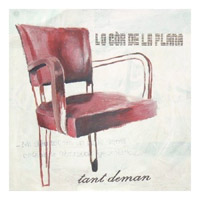
The album cover is of a chair short of a couple of legs. It links with the Occitan-language album title. ‘Tant deman’ is an idiom, meaning ‘maybe tomorrow’. It is a bit like the Spanish mañana but vaguer still, as in stalling the rent payment. From Tant Deman (Buda Musique 3017530, 2007)
Hear this piece of delightfulness at www.myspace.com/locordelaplana
Santoor 2 and Santoor 1 – Shivkumar Sharma
Shivkumar Sharma’s Santoor 2 and Santoor 1 opens the first disc of this 18-CD boxed set encompassing his career with HMV India and its successors from 1955 to 1998. I had no expectation of ever listening to much of this material. Most especially these two tracks from the 1955 film Jhanak Jhanak Payal Baje, originally released on 78 rpm back in the days of shellac. There is a marvellous redolence about Shivji‘s performances. Musically, they sound Kashmiri to me. They evoke images of the chinar – the plane tree species linked with the Hindu Goddess, Bhawani, a deity worshipped in, and particularly associated with Kashmir. There is a stirring rhythmicality to Shivkumar Sharma’s santoor playing summoning folk dance rhythms on Santoor 2 while Santoor 1 (the order in which they appear in the programming) is more complex, more inspired by folk melody. A revelation, musically and historically. From My Music – The Saregama Years (Saregama CDNF 150932-949, 2009)
Avocet – Bert Jansch
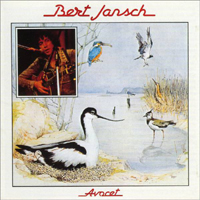
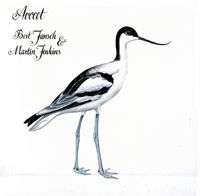 Bert Jansch’s studio album Avocet first appeared in Denmark in 1978, co-credited to Martin Jenkins. Ex-Libris’s classy image of the black-and-white wading bird had an elegiac quality – unlike the somewhat cluttered artwork for the UK imprint that appeared the next year on Charisma. The Pied Avocet, to give it its fuller name, had been adopted as the emblem of Britain’s Royal Society for the Protection of Birds. It symbolised the return of an endangered species and the effectiveness of conservation. Jansch constructed a cycle of instrumental compositions named after native bird species. For the record, the others were the lapwing, bittern, kingfisher, osprey and kittiwake. The cycle sounds more like a titular one than any attempt to capture the attributes of the birds themselves.
The album was a major return while Avocet the composition is one of Bert’s major artistic statement – major in terms of length (at almost 18 minutes) and, more tellingly, in terms of the sweep of its vision. Here Bert is accompanied by the remarkable Martin Jenkins on mandocello and violin and Danny Thompson on bass. The piece flows beautifully. According to Colin Harper’s first-rate CD booklet notes, the piece, under the working title of The Cuckoo (its launch-pad was the traditional song of the same name), had been in development and in Bert’s repertoire since 1977 at least. Peter Abrahamsen of Ex-Libris heard The Cuckoo and heard its potential, duly organising studio time for Bert. It granted him time to refine and develop an album’s worth of material. Avocet was recorded in Copenhagen in February 1978. Incidentally, phrases within the recorded version of Avocet echo melodic phrases in Jack Orion‘s short instrumental The Gardener.
Bert Jansch had been somewhat erratic as a performer. To put it delicately, it was impossible to predict what state he could be in on stage. With Avocet he bounced back. It remains one of his finest albums. It augared a return to form. From Avocet (Castle Music CMQCD763, 2003)
The image of Paul Kantner from November 2009 is © Santosh Sidhu/Swing 51 Archives. The copyright of all other images lies with the respective photographers, companies and image-makers.
Small print
Unless otherwise stated, all interview material is original and copyright Ken Hunt. The interviews with Ric Sanders and Chris Leslie were done in February 2011.