Giant Donut Discs ® – March 2013
31. 3. 2013 | Rubriky: Articles,Giant Donut Discs
 [by Ken Hunt, London] Another month filled with bunch of work-related listening patterns.
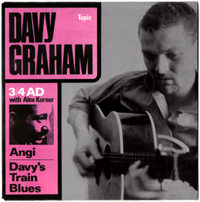 Angi – Davy Graham
Frequently the circumstances of hearing a particular piece of music are burned into our craniums, with a heavy dressing of associations. Angi (as it is spelled here) is an important piece of music in my life and yet I have not the foggiest notion of when I first heard Davy Graham’s performance. Almost certainly I heard it in a record shop and most likely it would have been either Collet’s or Dobell’s in London, the former an immense part of my musical education both in terms of what I fetched away from Collet’s both physically and intellectually. Where else was I going to get a chance to listen to Harry Cox or Anne Briggs or the Pinder Family? No high-street record shop stocked that stuff.
The vinyl EP 3/4 A.D. was still around for much of the 1960s. Indeed, it was re-pressed several times and, uniquely, for Topic issued with three different sleeves. All are reproduced in this EP’s inner artwork, though the only person I ever met (and I include Davey Graham himself here) who had all three was Gill Cook, the manageress of Collet’s folk department. Graham’s rite of passage for guitar was covered by Bert Jansch and Paul Simon. It’s probable that I heard their versions first. Angi launched many versions from many guitarists out to prove their prowess.
The limited edition vinyl reissue of Alexis Korner and Davy Graham’s 3/4 A.D. EP (originally Topic TOP 70, 1962) celebrates Record Store Day on 20 April 2013. Founded in 2007 in the States, the UK version of Record Store Daywas launched in 2013. It concentrates on the Britain’s independent record companies. This is one of the one-off vinyl and CD releases made exclusively for the day. In addition the celebration includes musicians making personal appearances and performances and other activities. More information at http://www.recordstoreday.co.uk
From 3/4 A.D. (Topic STOP2013, 2013)
Raga Marwa – Pannalal Ghosh
This is a studio recording from 1968 from Pannalal Ghosh, the flute player that transformed the place of the bansuri or transverse bamboo flute in Hindustani classical music. Put at its most simple, he recalibrated people’s appreciation of what the instrument could do and its consequent standing. And this Marwa interpretation of his gives of the raga’s essence so sweetly.
This particular recording originally appeared on the Odeon imprint of the Gramophone Company of India’s The Magic Flute of Pannalal Ghosh (MOAE 5006, 1968). From Greatest Flute Maestro (Saregama CDNF 150607, 2005)
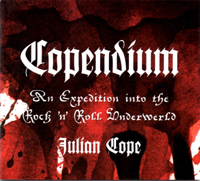 Einladung – A.R. & Machines
Julian Cope kicks off this triple-CD compilation with a piece by Lord Buckley (Supermarket from Way Out Humour, recorded in 1959) and that designates him immediately as a citizen of the Land of the Good Egg.
The same first disc includes a sequence of tracks under the suite name Einladung (‘Invitation’ or, more colloquially, ‘invite’). The “A.R.” of the title is Achim Reichel, a Hamburg-based musician whose music is totally to be admired. He is known to those of the Beatle-ish disposition as a major character in the tale of the Rattles, one of Hamburg’s great red-light district, the Reeperbahn’s beat combos, and a contemporary of the Beatles in their Hamburg daze..
This particular stream of tracks is a different sort of testimony to Hamburg and what goes on there. It is a stream of psychedelicised consciousness from 1972 that passed me by. It has a flow and energy to it that bespeaks its time at the beginning of the early 1970s. The suite has six sections, each with a title in German. Their titles here have English translations, some of which bear scant resemblance to the German. Those paraphrases may have been on the LP, Echo (1972) on which they originally appeared.
I met Achim Reichel only once – back in 2007. It was at a do after he was awarded a RUTH – der deutsche Weltmusikpreis (the German world-music prize, where Ruth is a ‘root’ soundalike) at Tanz&FolkFest Rudolstadt. His music director Frank Wulff blagged me in. He and I had collaborated on the booklet notes for the reissue of four of his previous folk band Ougenweide’s LPs for Bear Family and had been corresponding and fact-checking. Frank was aware of my Hamburg connections, introduced us and having lit the blue touch-paper gracefully retired.
Hamburgerisch is a strange concoction. It is not even a dialect in any usual sense of the word being a regional variant of a language. It is a language, the bedrock of which is Low German (Plattdeutsch), over which is laid High German (Hochdeutsch) – a philologically related yet different German language. These combine to make one of Germany’s major dialects but unusually they are born out of two separate languages. As Achim Reichel and I spoke, Hamburgerisch flecked with Platt swam to the surface. Some things or thoughts are, for example, easier to say and/or express in Platt. Others in Hochdeutsch... Hamburgerisch is particularly good after a skinful. Musically Einladung strikes me the same way, though that may sound silly or fanciful because there are no words here. It sounds Hamburg. I digress… Cope’s choice here is inspirational.
This is from triple-CD, organised – that should be the word – and marketed by Ace Records. Not sure about this release’s precise status, but I sincerely thank Julian Cope for introducing me to A.R. & Machines, a branch of Reichel’s musical back pages previously unknown to me. Warning: Drugs may have been consumed in creating this music and flying this plane… From Copendium (Faber and Faber, COPE 001, 2012)
Who Knows What Tomorrow May Bring? – Traffic
Not intentionally work avoidance while penning an article about The Watersons, but Disc II of the album’s expanded edition stayed playing in the background while writing. Before ‘anyone’ knew it this, live version, recorded at the Fillmore East, in November 1970 was playing. It would have been rude to stop it. From John Barleycorn Must Die (Universal-Island 533 241-1, 2011)
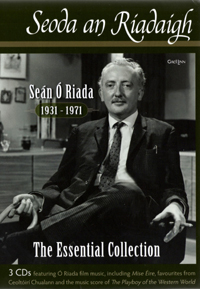 Mná na hÉireann – Ceoltóirí Chualann
This is arguably Seán Ó Riada’s best-known composition. Ó Riada (1931-1971) reinvigorated perceptions of what Ireland’s music could represent in an art music. Through the Chieftains this composition, the title of which translates as ‘Women of Ireland’, grew wings. This is an earlier interpretation with words. Seán Ó Sé sings. Research for another article under way… From Seoda an Ríadaígh (Gael Linn oriadacc06, 2011)
The Day The Nazi Died – Chumbawamba
This is a performance from one of Chumbawamba’s final performances, just before they called time on the endeavour. This is a cautionary tale about the slow-creep of the ultra-right. It was particularly well received by the audience in the Heine Park in Rudolstadt. It was an open-air venue and this song was particularly well received. As they sang, the connection between the Nazis suppression of Heine’s of Heine (rendering his poetry ‘Anon’) and the sentiments of this song were overpowering for me.
In the queue for watching is the Chumbas’ Going Gone (No Masters NMDVD01, 2013), filmed at Leeds City Varieties on Hallowe’en Night 2012 – “the last ever UK show”.
From TFF Rudolstadt 2012 (heideck HD20121, 2012)
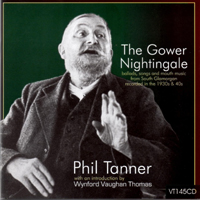 The Gower Wassail – Phil Tanner
This is a piece of music to which to return to recharge the glass. The clarity and clear-sightedness of Phil Tanner’s singing remains a source of wonderment and is a perennial reminder of how astonishing traditional songsters could be.
As an aside, the words “Within sound…” from The Gower Wassail supplied the title for the Shirley Collins’ boxed set of the same name released by Fledg’ling, released in 2002 and long since unavailable. From The Gower Nightingale (Veteran VT145CD, 2003)
To read more, the reprint of Doug Fraser’s appreciation of Phil Tanner, ‘Gower Garland – Phil Tanner, 1862-1950’ from the February/March 2000 edition of Taplas, the Voice of Folk in Wales go to http://www.folkwales.org.uk/arcgopt.html – that link links to further, er, links.
Oobe – The Orb
One of two pieces recorded in May 1992 (the other being titled No Fun). Listening to this ambient music was brought on by listening to Einladung, thinking about woodland birdcall along the Thames and that Lark In The Clear Air. It includes birdsong samples, too… (Rounding off this trawling from John Peel’s BBC archives are Montagne D’Or and Valley from February 1995.) From The Peel Sessions (Strange Fruit SFRCD138, 1996)
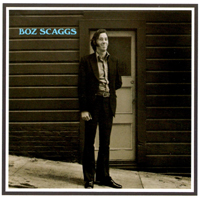 I’ll Be Long Gone – The Boz Scaggs
Boz Scaggs was not long out of the Steve Miller Band when this solo album emerged in 1969. It was recorded at Muscle Shoals Sound Studio in Sheffield, Alabama. Boz Scaggs predates his better-known, slicker hit albums such as Moments. Of which Charlie Burnham wrote when concluding its review in Rolling Stone in April 1971: “At any rate, since Moments, it is now my firm belief that when I die and go to heaven, floating on a cloud somewhere between Jimmie Rodgers and Mississippi John Hurt will be Boz Scaggs, singing the blues.”
Boz Scaggs slumbered, so to speak.
Purple prose to the rear, it was on this album that Boz Scaggs whipped the top off the tin. The accompanists were the cream of the crop. On this particular track, the background vocals of Jeannie Greene, Mary Holiday and Donna Thatcher (later Godchaux) were bolstered by Joyce Dunn, Tracy Nelson, Irma Routen. The album’s basic crew included Duane Allman on guitar, dobro and slide guitar, Barry Beckett on keyboards, Roger Hawkins on drums, and David Hood on electric bass. This particular song, a Scaggs original, is lyrically simple but the swell that they create caresses the heart strings. Beckett’s keyboard playing is majestic. (Like several members of the Muscle Shoals team he later did time in Traffic, but that is a story for another time.) From Boz Scaggs (Atlantic 19166-2, 1978)
The Lads In Their Hundreds – Quercus
Quercus – the Linnaean name for the oak genus – is the trio of June Tabor (vocals), Iain Ballamy (saxes) and Huw Warren (piano). This gem was recorded in concert in March 2006 and sat unreleased for years. This particular track leapt out at me. It is Ballamy’s arrangement of George Butterworth’s setting of A.E. Housman’s poem A Shropshire Lad (1887). It was a poem in my second-hand copy of Collected Poems (1939) and the rendition I knew was Benjamin Luxon’s from Six Songs from A Shropshire Lad… (Decca 468 802-2, 2001) with Sir Neville Marriner and Academy of St. Martin-in-the-Fields.
I chose The Lads In Their Hundreds for my political song column RPM for the March 2011 issue of R2. That short essay was written over the turn of the year in winter sunshine by the Thames. Part of the research entailed walking, as Butterworth had done, downriver from Richmond to Kew along the Thames. Just downstream from Isleworth Ait by Old Deer Park there are still the remnants of the medieval tidal and flood defences. On the opposite bank in what is Syon Park there are still some of the last unspoilt reed beds alongside the Thames with streams and rivulets that are more like leaks emptying into the river. Looking across, it felt much as it would have when Butterworth walked that stretch to Kew with a head full of Housman.
In the same period the Irish musician Christy Moore and I were doing one of our periodic interviews, on this occasion for an article that also appeared in that magazine’s same issue. In a sort of ‘what-you-been-up-to?’ way, I talked about Butterworth, dead at 31 in 1916, and Housman and tree creepers, nuthatches and ring-necked parakeets in the woodland along the Thames. Later in the interview proper, he spoke of rambling near to where he had grown up with a friend. “We were well into the heart of the bog and we lay down. We had a flask of tea and some sandwiches. We lay there in the gorse and we heard lark song. A lark was singing and it was the first time I’d ever heard a lark.”
All this was going through my head while listening to this most poignant interpretation. Quercus’ version is the icing on the cake and the first occasion of listening to it is already mentally logged and catalogued (unlike Angi). But it is a piece of music that later this year will be taking the same walk between Richmond and Kew along the Thames with a battered copy of Collected Poems that somebody probably loved before me. There will be a stop at Richmond Green and tanother at Kew Green for refreshment and some reflections about other lads “that will never be old”. And sundry associations. You get my drift. From Quercus (ECM 2276, 2013)
The copyright of all images lies with the respective photographers, companies and image-makers.