Giant Donut Discs® – May 2010
7. 5. 2010 | Rubriky: Articles,Giant Donut Discs
 [by Ken Hunt, London] Even though this month’s choices are skewed and heavily informed by volumes 7-9 in Smithsonian Folkways’ Music of Central Asia series, in terms of preference, as usual, there is no order implied and no order to be inferred. As ever, the common link to May 2010’s GDDs is that this is music that stuck around. This month we meet, greet and embrace Jackson Browne David Lindley, Barb Jungr, the Kronos Quartet with Alim & Fargana Qasimov, Asha Bhosle, Les Byrds, Sirojiddin Juraev, Homayun Sakhi and Rahul Sharma, Jiři Kleňha and Neneh Cherry and Youssou N’Dour.
 The Crow On The Cradle – Jackson Browne David Lindley
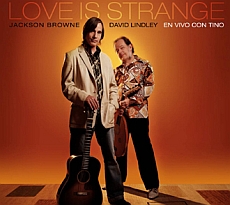
This is the sort of musical tastiness that prompts the unwary to say that if there is a tastier track released in [gentle reader, add the year you’re reading this], they will eat polyester garments, assisted only by their hot sauce or condiment of choice and a couple of lubricating Pacificos to fend off the odd rictus. Personally, not being of a polyester-chomping bent, I would not enjoy the experience, even though wise men have said one can cram several portions of the aforementioned stuff into one’s mouth in one go. So, it is with deep regret that I inform you that Browne y Lindley deliver a lorryload of taunting temptations on their superlative 2010 offering, recorded on their Spanish tour in March 2006.
By London, with each gig impromptu and rehearsals deliberately avoided, their performances were full of spontaneous touches and ripples. The Crow On The Cradle is one of Sydney Carter’s finest songs. This version is prime quality stuff. The performance has an immediacy that is startling while its lyrical content is the stuff of timelessness. Sydney Carter must have known that when he wrote the song. Unhappily he had not foreseen what would happen when Browne and Graham Nash (con Lindley) covered it at a 1979 MUSE concert and it appeared on the set, No Nukes – sales of which were assisted by contributions from James Taylor, Tom Petty and the Heartbreakers, Bruce Springsteen & The E Street Band, Crosby, Stills & Nash. (The presence of Sweet Honey In The Rock and Gill Scott-Heron cannot be gainsaid either.) Carter told me that the unexpected influx of royalty money caused him all manner of grief. For years he had to explain to the tax people that it was an aberration. He wasn’t complaining too loudly. Last, there is the no ampersand or ‘and’ between their names. This is music made on an equal footing. As Sydney Carter’s song so eloquently demonstrates. From Love Is Strange (Inside Recordings INR5111-0, 2010)
www.jacksonbrowne.com
www.davidlindley.com
www.insiderecordings.com
Once In A Lifetime – Barb Jungr
This is the opening track of an outstanding collection that Barb Jungr calls ‘The New American Songbook’. While other interpreters add retreads to the old American Songbook – or in the case of Tony Bennett continues to do it his way, in his own signature style – she demonstrates that the Songbook is expanding rather than its girth is expanding. On Once In A Lifetime she is not fumbling for life-signs from stricken old songs: she is fingering the pulse on a new intake of songs. Apologies if the metaphor doesn’t do it for you. Why? Because Barb Jungr knows how to quicken a pulse and how to breathe new breath into a song.
Her decision to cover this David Byrne and Brian Eno song is a bold one. The first time I heard Barb Jungr sing this song was on the BBC Radio 4 programme Woman’s Hour with accompaniment stripped back to piano. It seemed that she had hit upon a different way to do justice to this Talking Heads mainstay. The album version, produced by Barb Jungr & Simon Wallace, has the touch of a jeweller or watchmaker. She cuts and turns the facets in the song in ways that cast, reflect and refract new light. The inclusion of Clive Bell’s shakuhachi and flute is inspired and Simon Wallace’s piano watery and flowing. An interpretion to linger in the memory. From The Men I Love (Naim Label naimcd 144, 2009)
 Köhlen Atim – Kronos Quartet with Alim & Fargana Qasimov
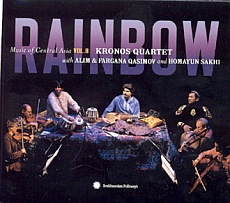
When they debuted this composition at the Barbican’s Ramadan Nights festival celebrating Ramadan and the start of Eid ul-Fitr on 26 September 2008, nobody needed, cue Sting, to be an illegal or legal Azeri-speaking alien in London to get what Köhlen Atim (‘My Spirited Horse’) was all about. It is a horsey song that goes from a trot to a canter to a gallop. All bets are off when it comes to this performance. It is a clear winner. From Music of Central Asia Vol. 8 – Rainbow (Smithsonian Folkways SFW CD 40527, 2010)
Log Cabin Home In The Sky – The Incredible String Band
Log Cabin Home In The Sky is one of those songs that enlivened 1968, the stuff to sing after last orders on the way home from the pub. Mike Heron’s lyrics are amusing. Robin Williamson’s sawing fiddle is a beautifully vague stylistically speaking (which was the point) but atmospheric as if straight out of Old Nick’s Fiddle Triangle – Cape Breton, Berkeley Old Time Fiddler’s Convention (immortalised on the Folkways’ album Berkeley Farms) and the Fake-Appalachians. Cultural thievery from two of the best. Chutzpah and a hoot to boot. “Now is the time to slip away from the California sun/To a place where a man can be as free as the wind” etc. From Wee Tam & The Big Huge (Fledg’ling FLED 3079, 2010)
Fledg’ling is at www.thebeesknees.com
Rishte Bante Hain – Asha Bhosle
Rahul Dev Burman composed the music: Gulzar wrote the lyrics: Asha Bhosle sang. Rishte Bante Hain means ‘Relationships Grow Slowly’. It is one of R.D. Burman’s most lilting melodies that he ever magicked out of his imagination. Even before factoring in its lyrical content, the magic is clear in the detail of the arrangement and is filigree touches. Finger-pop percussion, sarod and Ashaji‘s voice of sailing over everything, with only of a spot of multi-tracking as assistance. Eloquence on so many levels.
A song to go to the grave with. From Dil Padosi Hai (1987) available on The Rough Guide to Bollywood Legends: Asha Bhosle (RGNET 1131 CD, 2003)
 Lady Friend – Les Byrds
Mike Ledgerwood’s review on page 15 of the Disc and Music Echo of 2 September 1967 enthused, “The Byrds are back! With that crashing, full-blooded guitar sound and haunting voice harmony built around David Crosby’s ‘Lady Friend’ (CBS). A vast improvement on their recent offerings. Deserves to be a hit.” But who could afford Disc and Music Echo?
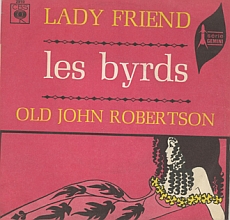
One baking hot summer’s afternoon in 1968 in a small town somewhere on the Cherbourg peninsula, the light was so bright it was dazzling. The French town was undergoing a collective siesta. All the cafés and bistros were as shut as an early-closing Sunday in Britain. In that small town whose name nobody will ever recall, a Francoise Hardy-inspired, aching-loined adolescent ducked into a little record shop that, in denial about sunshine and siesta, was stoically open and trading. It was like an oasis of life in a mirage of inertia without a diablo de menthe in sight. Adjusting his fetchingly blue eyes to the darkness whilst flicking through the picture-sleeved 45s, one caught his attention. It was Les Byrds.
Maybe it was the confidence of callow youth or just not knowing he was a junior polyglot in the making, but reading Les Byrds did not throw him. As somebody sang, life was much simpler then. One went into a record booth in some foreign country clutching a record and, 2:30 minutes later, maybe one emerged happier and francs and centimes lighter.
Lady Friend, with its welling harmonies, pounding drums, stabbing brass and chiming guitars, is one of those David Crosby songs that allegedly helped split the band. Supposedly, Triad, Crosby’s hymn to troilism – not a word heard much back in England – had proved too rich, too rum for Les Byrds (so Crosby got Jefferson Airplane to cover his beastliness) and Lady Friend probably sounded like a loose cannon going off. It never made an album but in that small corner of Cherbourg that lad located a treasure.
Three decades later he spoke to Crosby about that encounter. Crosby had no notion that the Lady Friend had ever be released in France – with or without a picture sleeve. “Man, that’s a collector’s item!” he laughed. From Les Byrds – Lady Friend b/w Old John Robertson (7-inch single, France, CBS Série Gemini 2910, undated and/or The Byrds (Columbia/Legacy C4K 46773, 1990)
Qushtar – Sirojiddin Juraev
A piece comparable to Davey Graham’s Anji for acoustic guitarists. Qushtar apparently means ‘double strings’. Juraev’s technique involves tuning strings in unison and fretting and plucking the dutar – the Uzbeki long-necked, fretted lute – at the same time. This is also combined with a tapping effect reminiscent of flamenco guitar. A tour-de-force. From Music of Central Asia Vol. 7 – In The Shrine of the Heart – Popular Classics from Bukhara and Beyond (Smithsonian Folkways SFW CD 40526, 2010)
 Dhun in Misra Kirwani – Homayun Sakhi and Rahul Sharma
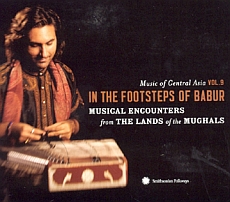
In Hindustani music a dhun is a folk air or sometimes a piece played in a folk idiom. ‘Misra’ or ‘Mishra’ signifies ‘mixed’ and indicates that the composition does not follow strict râg rules. Kirwani is a South Indian râg that has gained great popularity in Northern Indian musical circles. However, Misra Kirwani is hardly a commonplace morsel. (Ali Akbar Khan released a 1985 recording of it on his In Concert at St. John’s, on which Zakir Hussain accompanied on tabla.) This rendition is an Afghani-Jammu-Kashmiri one. Sakhi plays the rubab – a kindred instrument to sarod – while Sharma plays the santoor, the instrument that his father, Shivkumar Sharma turned new worlds of music-lovers on to.
Sharma came up with the opening composition in Misra Kirwani, Sakhi followed suit and then they flew. This spontaneous composition’s variations are a one-off and the next time who knows where the next logical conclusion might lead them? This rendition is better than good enough for the present. From Music of Central Asia Vol. 9 – In The Footsteps of Babur – Musical Encounters from The Lands of the Mughals (Smithsonian Folkways SFW CD 40528, 2010)
Poslechněte, lidé – Jiři Kleňha
It is peculiar how people forget to stop assuming that things won’t change. Me included. We riff on life and forget to remember. Jiři Kleňha is somebody I associate with Prague. He was another of the street musicians that played on Charles Bridge but unlike the guitar-playing buskers and the jazz band he did something only found in Prague. Jiři’s pitch was at the Karlova, Old Town end of the bridge and he played a hammer chord zither called the Fischer’s Mandolinette. Apparently the instrument had been part of a family of chord zithers whose stronghold in the first decades of the twentieth century had been on the Saxony side of the German border and the Sudeten in Czechoslovakia. In German the instrument was also known delightfully as Fischer’s Lieblings-Klänge, meaning ‘Fischer’s Favourite Sounds’, though it has also been translated more freely as ‘Fischer’s Lovely Sounds’.
Over many’s the year, I stood and watched Jiři Kleňha play. He rarely played for more than a few minutes – two or three – at a time before invariably somebody would approach him and ask him about the unfamiliar instrument that he was playing. Down the years, admirers of his artistry had translated his giveaway sheet in Czech into various languages. He would courteously enquire where somebody came from before fishing out the appropriate variant of his leaflet from his bag. One early evening a few years back, I waltzed David Harrington of the Kronos Quartet across the bridge from the hilly castle side, hopeful that Kleňha would still be there. Getting closer, the bright ringing tones of the Fischer’s Mandolinette confirmed he was. Entranced, we stood and listened.
The longest piece of the 37 tracks on this Yuletide CD is under three minutes in length. Each is a miniature, an exquisite Czech miniature, a distillation of melody. The last time I was in Prague in September 2009, Kleňha wasn’t there the whole week. I do hope he was somewhere nice on holiday. The title track from Poslechněte, lidé (no number, 1995)
More information in Czech, Russian and English at www.aa.cz/citera
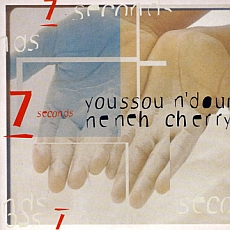 7 Seconds – Neneh Cherry and Youssou N’Dour
The weekend of 17-18 April 2010, as Werner Richard Heymann (1896-1961) wrote all those years ago, had to be a piece of heaven. In Whitton, Middlesex in any case. The skies were clear and blue. More betterer, thanks to the Icelandic volcanic eruptions at (the eminently copy-and-pastable and equally unpronounceable) Eyjafjallajökull, the skies were clear of planes over London until 21 April. Bliss. Sitting in the Admiral Nelson on a writing jag/break, Neneh Cherry’s 1994 record came on. As she and Youssou N’Dour sang, Whitton and the world became a still more harmonious, an even still more betterer place.
Co-credited to Cherry, N’Dour, Cameron McVey and Jonathan Sharp, 7 Seconds (though in my head until checking it was always 7 Seconds Away) appeared on N’Dour’s album The Guide (Wommat) and became the performance that didn’t really fit or sit comfortably on her solo album, Man. The spring sunshine, the drone of bees, the silence of hoverflies, a couple of days of listening to songbirds in the garden adjusting their volume controls not having to compete with the growl and revving back of incoming, Heathrow-bound planes, led to an epiphany or three. And 7 Seconds with its lyrics in Wolof, French and English became the theme song for a new springtime of peace and communication, however hippy that sounds.