Giant Donut Discs ® – May 2012
18. 5. 2012 | Rubriky: Articles,Giant Donut Discs
 [by Ken Hunt, London] No blurb, just straight into this month’s music. This month summons the shades of The Band, Julie London, John B. Spencer, Andy Irvine & Dónal Lunny’s Mozaik, Khameesu Khan, Judy Collins, the Kronos Quartet, Emily Portman, Andy Irvine and the Bonzo Dog (Doo Dah) Band.
Tears of Rage – The Band
Dwelling on Levon Helm’s death on 19 April 2012 threw me into the kind of reflective mood that rarely occurs to me at least. The music that he played had been part of my growing. Like you do, I played a number of recordings that he appeared on while re-reading slabs of his autobiography, This Wheel’s on Fire: Levon Helm and the Story of the Band, co-written with the esteemed Stephen Davis. In it Helm fulminates about the divisions that occurred, prompted by the Band’s business affairs. He is also keen to credit the contributions of fellow band members Rick Danko, Garth Hudson and Richard Manuel – like himself overshadowed somewhat by Robbie Robertson.
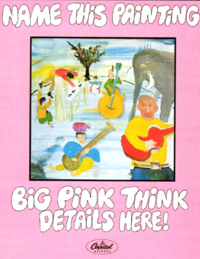
After a death it is frequently the right time to consider burying hatchets. This song sung by Richard Manuel and written by Manuel and Bob Dylan opened their debut LP in 1968. Dylan’s cover painting graced the front cover and on a European hitchhiking trip with stop-offs in Amsterdam I bought the US import version of album with the Klappcover – the double sleeve – which meant that Dylan’s painting had no text on it, though that wasn’t the point. (The figure in the foreground playing sitar with a red hot water bottle on his head did tickle my fancy.) Tears of Rage remains one of the finest opening tracks on any album ever made. From Music From Big Pink (Capitol 7243 5 25390 2 4, 2000)
Phil Shaw’s obituary in The Independent of 21 April 2012 is here: http://www.independent.co.uk/news/obituaries/levon-helm-drummer-and-soulful-singer-at-the-heart-of-the-band-7665825.html
Cry Me A River – Julie London
This track is the final track of the two dozen tracks on Trikont’s collection celebrating emancipated or less than emancipated women. It picks selected songs by Pearl Bailey (You Can Be Replaced), the Boswell Sisters (Everybody Loves My Baby), Mae West (A Guy What Takes His Time), Josephine Baker (C’est lui), Mitzi Gaynor (The Thrill Is Gone) and Marlene Dietrich (Hot Voodoo). The credit for this superlative anthology’s “compilation and concept” goes to Renate Heilmeier.
Renate Heilmeier writes of this track: “Not only the recording is legendary, but the scene in the movie The Girl Can’t Help It as well. Artistic agent Tom (Tom Evell) comes home drunk at night, puts on a record and opens a beer. Julie London appears to him as a singing version of the embodied sadness. The fifties cult movie by Frank Tashlin is set in the music scene of its day, and lots of guest stars show up: Little Richard, Fats Domino, Eddie Cochran, Gene Vincent and Julie London as herself. The leading female part is performed by Jayne Mansfield, one more strong woman.”
For me, this song is less about Jayne Mansfield and 1954 as something that wafts me back to Davey Graham and him playing it in Ken Russell’s 1959 documentary Hound Dogs and Bach Addicts: The Guitar Craze. From Head Over High Heels – Strong & Female 1927-1959 (Trikont US-0401, 2010)
 Forgotten The Blues – John B. Spencer
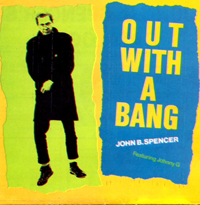
As part of my RPM column about political song/music in R2 I listened to this album by John Spencer and this track sang out. It had nothing to do with the task at hand. It’s just a superlative piece of writing. Forgotten The Blues was also taken up by Martin Simpson. From Out With A Bang (Round Tower Music RTMCD 36, 1993)
O’Donoghue’s – Andy Irvine & Dónal Lunny’s Mozaik
For me, writing any musician’s obituary involves periods of complete silence, apart from the sound of a keyboard or the sound of me reading aloud what I’ve written and blasts of music. While writing Barney McKenna’s obituary for Sing Out! and Penguin Eggs, this song of Andy Irvine blew through my mind, enhanced by recordings by the Dubliners and some Pogues. O’Donoghue’s is a song set in the bar of the same name in Dublin’s Merrion Row and involves a cast of characters associated with that pub between 1962 and 1968 (with a note of apology in the CD booklet to those who didn’t make it into the song). Most prominent among its cast of musicians is Barney McKenna.
When Andy Irvine played The Ram Club in Thames Ditton in Surrey on 4 May 2012, we chatted during the intermission and I mentioned including different references to O’Donoghue’s in the two obituaries I had written. He concurred that that was important. I corrected him that I meant his song – he had played it in the first half – and a surprised look crossed his eyes. It is a superb song from one of the finest musicians to have ever emerged from the Irish folk scene. One of those ‘we are custodians of what we love’ songs. From Changing Trains (Compass Records 7 4468 2, 2008)
 Pahari Dhun – Khameesu Khan
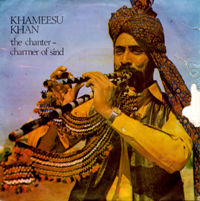
Occasionally it is necessary to remember the wonders of vinyl as in the case of this EMI (Pakistan) subsidiary label’s EP. Khameesu Khan played the alghoza – “a double-fluted blow instrument of the desert regions of Pakistan” as Ikram Azam’s notes described it. Alghoza is a double-ducted folk instrument with one pipe acting as melody pipe and the other as a drone. This recording came with the imprint of the NCA-FRC, the National Council of the Arts, Folklore Research Centre on it. This particular piece is delivered as a folk air.
Long out of print, like the hugest proportion of EMI (Pakistan)’s folk and light classical recordings, it might be as well to point out that, under the variant name Khamisu Khan, he also had a CD released on the French Arion label called L’Art de l’Alghoza du Sind (1999). Alghoza is one of those instruments worth listening to before you die. Any further information about this musician gratefully received. From Khameesu Khan – The Chanter – Charmer of Sind (Columbia EKCE 20024, 1973)
The Blizzard – Judy Collins
Perhaps not the most obvious recording of this song of hers. It is, however, closer to the way she is doing it in her live show of 2012, even if this particular variant first came out in 1995. It is a reflection on a breakdown of a relationship set in a snowy Colorado landscape. Stories need settings, well, usually if particularising an image is the intention. She comes off the road to stop for coffee as the weather deteriorates. Looks like there might be a blizzard tonight…” The song uses the theatrical device of talking to a stranger – somewhere between baring her soul and spilling the beans – about the relationship. It works brilliantly. She sang The Blizzard as part of a suite of songs for her solo piano at this From Voices (Delta Deluxe 4724041, 2003)
 Loving – Kronos Quartet
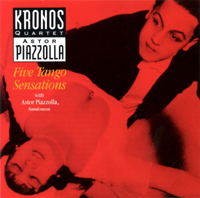
It really does not seem like this mini-album came out in 1991. The music on it still sounds timeless and yet taking tango somewhere else. The Kronos Quartet – back then David Harrington and John Sherba on violins, Hank Dutt on viola and Joan Jeanrenard on cello – was a different beast. It was no less a curious beast as it rootled out new music to tackle but its antennae were taking it in new flavoursome directions. One of those directions was world music.
One time in London David Harrington and I got into another of our serious discussions about what music was turning us on. In the grand manner of the forgetful, I slipped a date (November 1990) into my booklet notes to this five-movement suite composed by Astor Piazzolla (1921-1992). Piazzolla also plays bandoneon on this recording. It was the second piece that Piazzolla wrote for the Kronies (the first being Four, For Tango), but talking to him for the notes was never on the cards because his health was declining.
In order he titled the ‘Sensations’ Asleep, Loving, Anxiety, Despertar and Fear. He roils the waters with undercurrents of all sorts. It was a period of seeking in my life and Piazzolla’s suite connected so much and this became a soundtrack to my life. It still abides. From Five Tango Sensations (Elektra Nonesuch 7559-79254-2, 1991)
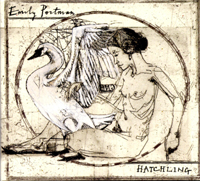 Hollin – Emily Portman
Hollin is the second track on Emily Portman’s Hatchling. She describes it as “An ode to the joys of wild living.” The wild living is more to do with “green leaves” before misjudgements set root. The arrangement makes excellent use of Lucy Farrell’s viola, Rachel Newton’s harp and Lucy Deakin’s cello.
Parenthetically, it is so refreshing to see Portman sparking off the likes of Angela Carter, Orlando Gibbons, sundry belief systems, Tim Van Eyken and Sandra Kerr on this album. The artwork on this album is by Olivia Lømenech Gill – the cover illustration is to do with the Leda legend, the subject matter of the album’s opening track Hatchlings. From Hatchling (Furrow Records FURR006, 2012)
More information at www.emilyportman.co.uk
The Close Shave/East At Glendart – Andy Irvine
This first of these two pieces is a song by Bob Bickerton with the clear and unambiguous intention to out-do the tradition. The beloved tradition has a legion of songs on the subject of the happy man on shore leave, furlough and so on who gets separated from his money. In them the tinker, tailor, sailor, soldier and maybe spy wakes to find himself – always a him – distanced from their purse. Vile trickery is involved of the Cherchez la femme type. We smile and/or yawn along at the gullible folk of olden days. No doubt though, somewhere over the internet rainbow, a tale is brewing about an internet scam along modernistic lines – that urgent bank transfer to get over some mishap abroad and so on.
Bob Bickerton’s song adds a twist to the tale and relocates the action to a New Zealand gold strike. One verse begins, “When I awoke next morning no trousers could I find…” and what was left behind was, the verse ends, “a woman’s dress, a yellow wig and a shaving kit not mine…” It’s a great example of storytelling in song. But that is what so much of Andy Irvine’s live repertoire is about. He engages you with his folk and worse tales.
This particular version with Irvine singing and on mandola and harmonica, Dónal Lunny on bouzouki and Máirtín O’Connor on accordion concludes with an instrumental outro. From Abocurragh (AK-3, 2010)
More information at www.andyirvine.com
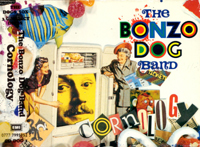 Mickey’s Son And Daughter – Bonzo Dog (Doo Dah) Band
A couple of years ago, Tom Constanten, a chap who once tinkled the ivories with the Grateful Dead, and I enjoyed a conversation over an extended and leisurely peregrination in the fair city of London. We caught up and chatted a day away on a day off in London whilst touring with Jefferson Starship. Our walk took in a variety of culturally intriguing landmarks, amongst them Ewan MacColl’s memorial tree in Russell Square, sundry blue plaques commemorating where people had once lived, and a pleasant selection of pubs with musical, literary, political, lexicographical and courtesan histories.
At one point I asked if there had been an act on a billing that had really caught his fancy and with the old time machine revved up which one would it be if he could go back and really concentrate on that act. Without hesitation he declared it to be the Bonzos who had opened for the Dead in San Francisco.
Jack-in-the-box thoughts sprung, an intense period of memories of the Bonzos and Viv Stanshall’s Rawlinson’s End scripts followed – the latter with its lovable cast of characters including Scrotum the Wrinkled Retainer. Mickey’s Son And Daughter is a different kind of Disneyfication. It first appeared on Gorilla in 1968 and this little piece of heaven’s nostalgia still makes me smile. From Cornology (EMI 0777 7995952 5/CD DOG 1, 1992)
The copyright of all images lies with the respective photographers, companies and image-makers.