Giant Donut Discs ® – October 2012
30. 10. 2012 | Rubriky: Articles,Giant Donut Discs
 [by Ken Hunt, London] Miya Masaoka, The Chieftains, Getatchew Mekuria & The Ex & Friends, Harpo Marx, Gee En Tong, Barb Jungr, the Carolina Chocolate Drops, Josef Režný, Serafina Steer and Kala Ramnath are the musicians who conjure and provide the fun this month, as ever much of it work-related or work avoidance-related.
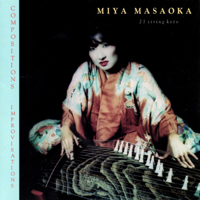
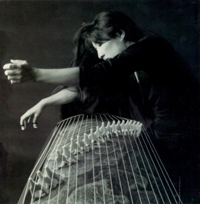 Come Sunday – Miya Masaoka
Her website biography begins: “Miya Masaoka, musician, composer, performance artist, has created works for koto, laser interfaces, laptop and video and written scores for ensembles, chamber orchestras and mixed choirs. In her performance pieces she has investigated the sound and movement of insects, as well as the physiological responses of plants, the human brain, and her own body. Within these varied contexts of sound, music and nature, her performance work emphasizes the interactive, live nature of improvisation, and reflects an individual, contemporary expression of Japanese gagaku aural gesturalism.”
This is Miya Masaoka from a long time ago, interpreting the Duke Ellington composition Come Sunday “written for Mahalia Jackson inspired by the twenty-third Psalm”. For non-Christians, that is the golden oldie beginning “The Lord is my Shepherd I shall not want./He maketh me to lie down in green pastures: He leadeth me beside the still waters.”
Miya Masaoka interprets it for solo koto. The notes explain: “The solo follows the harmonic structure of the piece.” Her interpretation goes deep, like applied gagaku, like wine rolled round the mouth. Visit Miya Masaoka’s website’s homepage for a better mental picture of her instrument’s visual splendour. It is the same instrument as Kim Stringfellow photographed for the album artwork. Miya Masaoka’s music was a tip-off the US guitarist and improviser Henry Kaiser, an introduction for which I thank him most profoundly. From Compositions + Improvisations (Asian Improv Records AIR00014, 1993)
More information about Miya Masaoka at http://www.miyamasaoka.com/
Kim Stringfellow’s evocative imagery of Miya Masaoka and her koto on this album was a really big help – that is not faint praise – in weighing up what was before me then and is before me now. Her website is at http://www.kimstringfellow.com/
The Foxhunt – The Chieftains
When I hopped on the ride between The Chieftains 3 (1971) and The Chieftains 4 (1973), the Chieftains’ merry-go-round had been spinning for a fair few years. This particular track from their pre-Derek Bell line-up is a fantasia on the theme of fox-hunting put together by their uilleann piper and tin-whistle player Paddy Moloney. His suite races across tough terrain in a most marvellous way. From The Chieftains 2 (Claddagh/Atlantic 83322-2, 1969)
Bati – Getatchew Mekuria & The Ex & Friends
This is not the most obvious track to select from this liaison of musical derring-do. (The most obvious one would probably be Tezeta.) Yet Bati captures the coiled musical tensions and strainings at the leash that this marvellous musical collaboration produced.
Getatchew Mekuria plays tenor saxophone in a mid-tempo Ethiopian groove that The Ex support and deliver so sinuously. It is a masterpiece of empathetic playing.
Given the ripples that run through The Ex’s personnel, The Ex on this album are: Arnold de Boer (trumpet), Andy Moor (guitar), Terrie Hessels (guitar) and Katherina Bornefeld (drums).
In December 2012 The Ex celebrates their 33⅓ Anniversary with three bespoke Ex fests in London, Paris and Amsterdam.
From Y’Anbessaw Tezeta (Terp Records AS 21/22, 2012)
More information at www.theex.nl and www.terprecords.nl
Harpo Woogie – Harpo Marx
Yes, the same Harpo Marx, the one in the dubious fright wig, the one who communicated wordlessly with horn honking, harp and bulging eyes in motion pictures! This is a headlong dash of a piece (with added xylophone) from the Mercury album Harpo At Work! long-player. (Or was that Harpo At Work? – it varied.) In his autobiography, Harpo Speaks he wrote, “When I sit down to play the harp in the Marx Brothers films, you are seeing the real Harpo Marx.”
An exhilarating rush of a piece from a marvellous triple-disc anthology of harp music that also includes Germany’s Rüdiger Oppermann, Brazil’s Christa Braga, Burma’s Saw Takah Wah, Ireland’s Paul Dooley, Paraguay’s Félix Pérez Cardozo and Brittany’s Alan Stivell. From Magic Harp (NoEthno 1012-14, 2011)
More information at www.noethno.de
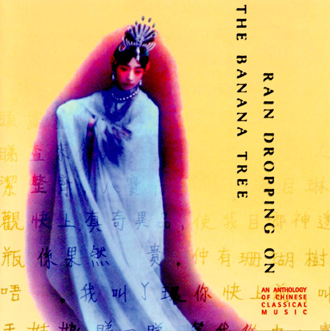 Oo Hoo Yu (Parts 1 and 2) – Gee En Tong
Strange are the paths… Reviewing this album at the time of its release, I loaned its CD booklet and all sorts of artwork to Classic CD, only to have the magazine go down the tube. Consequently, never got any of the artwork back. Without this booklet’s notes, along went the details of what was on this album of recordings made between 1902 and 1930 in China and the United States. Eventually, I located a second copy of the album.
This particular piece of music dates to around 1928. Its title translates as ‘Wandering the five lakes’ and it has a modern classical feel to it. Admittedly that may be down to technological restrictions. The notes do not explain much. Its musicians are from Amoy province (a name borrowed for condiments) to the west of Guangzhou to the northwest of modern-day Hong Kong. (Guangzhou was also known historically as Canton or Kwangchow and is one of China’s largest cities as well as the capital of the Republic’s Guangdong province.)
Part 1 in particular has a processional rather than a pilgrimage feel to it. The instrumental continues in Part 2, picking up in tempo. What is not so much disappointing as intriguing is how the recording simply cuts off. It is in contrast to the British Raj-era recordings of instrumentalists and singers that have come down to us. In them the musicians turn the track – maybe an entire raga exposition – around within the confines and capabilities of 78 rpm technology. Here it simply gets chopped mid-note. Maybe that speaks about the greenness of the performers before the microphone. Maybe that is to do with the recordists or technicians. No matter, it is the music that counts. From Rain Dropping On The Banana Tree (Rounder CD 1125, 1996)
Old Man – Barb Jungr
In his autobiography, Waging Heavy Peace (2012), Neil Young observes that he wrote the song about his ranch foreman Louis Avila on the Broken Arrow Ranch. “…I wrote the song Old Man about Louis. My dad thought it was written for him, and I never told him it wasn’t, because songs are for whoever receives them.” It’s one of those songs that grew wings and flew.
Barb Jungr is a true vocal artist of the kind where the singer does not get in the way of the song. The song’s the thing. This particular interpretation places “keyboard queen” Jenny Carr’s piano well to the fore in the mix. Neville Malcolm’s double-bass and Rod Youngs’ drums (with a good deal of brushwork) provide the understated underpinning. She wears her influences lightly even when she adds harmonica. From Stockport To Memphis (Naim Audio Ltd naimcd179, 2012)
Country Girl – Carolina Chocolate Drops
“Rhiannon wrote this after traveling all over the world with the Chocolate Drops and not finding anything better than her home turf in North Carolina she still lives in the town she was born in, Greensboro.” That was way the track is described in the booklet notes.
It is one of the finest original compositions in the Choc Drops’ current repertoire. (The complete credits are Rhiannon Giddens, Lalenja and Adam Matta.) It’s an evocation and unapologetic celebration of homeways, family and roots. Judging by their performance of it at the Shepherds Bush Empire in October 2012, in concert it is getting ever more muscular and nuanced. From Leaving Eden (Nonesuch 7559-78627-1, 2012)
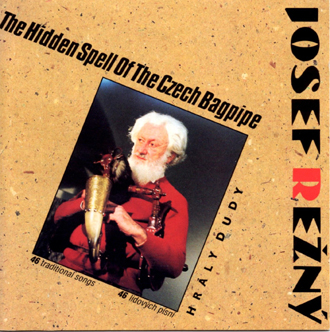 V Strakonicich Za Voltářem – Josef Režný
The Czech bagpipe player Josef Režný was one of many musical introductions effected through Petr Dorůžka. As he handed me the then-new, now out-of-print CD, he redubbed it The Hidden Smell of the Czech Bagpipe. The cut of his jib and his schoolboy humour appealed to me instantly and immensely. We signed a blood pact on the spot that should anyone ever invent the internet that we would co-host a website (whatever that was). And thus it came to pass. Pivo (beer) and toasts may have been involved.
Born in February 1924, Josef Režný is one of the very most important pipers to come out of Europe. He has been a trailblazer not only for dudy – Czech for bagpipes – but the wider dissemination of bagpipe music across Europe. Notably this has been through his work at and for the International Bagpipe Festival – Mezinárodní dudácký festival – held every other year in the Southern Bohemian town of Strakonice. He also appears in the 2007 film Call of Dudy: Bohemian Bagpipes Across Borders, co-directed by Radim Spacek, Jeffrey Brown and Keith Jones.
This particular piece of Strakonice-rooted music finds him accompanying a female choir. His filigree playing is a wonder, especially during the instrumental introduction and valediction. At under two minutes in length it distils so much as I understand it of Bohemian folk music. From The Hidden Spell of the Czech Bagpipe/Hrády Dudy (Bonton 71 0129-2 711, 1993)
 Skinny Dipping – Serafina Steer
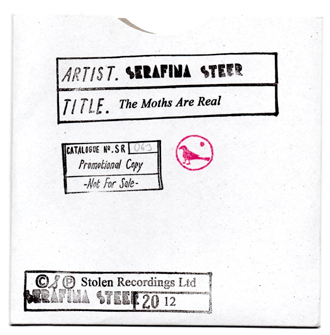
The title track of the upcoming album produced by Jarvis Cocker. Never heard Serafina Steer before. Never heard of her before. No idea if this music will stick around. That’s part of the thrill. She plays harp and sings. Since it is a white label advance copy the bigger picture eludes. So far, so good. Right now it is the combination of voice and harp and lyrics that intrigue. From The Moths Are Real (Stolen Recordings SR 063, 2013)
More information at http://www.serafinasteer.com/
Bhatiyar – Kala Ramnath
This is the ‘concluding’ performance in a two-CD companion set of raga recordings that trace a cycle of dawn to dusk and dusk to dawn. This particular raga concludes the four to six am shift. On it the Hindustani violinist is accompanied by Subhankar on tabla. Kala Ramnath’s is a most spirited performance – enough to wake the dead. From Aavartan – Musical Odyssey- 2 Dusk to Dawn (Kalashree no number, 2012)
More information at http://www.kalaramnath.com/
The copyright of all images lies with the respective photographers, companies and image-makers.