Giant Donut Discs ® – September 2012
30. 9. 2012 | Rubriky: Articles,Giant Donut Discs
 [by Ken Hunt, London] Séamus Ennis, Yasmin Levy, Maria Doyle Kennedy, Peter Bellamy, David Crosby & Graham Nash, Crosby, Stills & Nash, The Everly Brothers, Marty Robbins, the Grateful Dead and Leonard Cohen populate the isle this month.
Reels: The Mountain Lark/The Sligo Maid’s Lament/The Flax In Bloom – Séamus Ennis
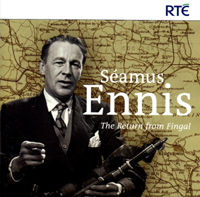 Along with Paddy Moloney of the Chieftains (born 1938) and Willy Clancy (1918-1973), Séamus Ennis (1919-1982) was the musician most instrumental in turning me on to uilleann pipes – Ireland’s elbow pipes or píobaí uilleann so named since an elbow pumps the bellows. They started me on a voyage of discovery that continues to the present day that has involved looking backwards to Leo Rowsome (1903-1970) and forwards to Liam O’Flynn (born 1945).
I chanced upon this album of vintage recordings captured between 1940 and 1978 in December 2005. Wandering around Limerick the day after interviewing Christy Moore and Declan Sinnott, I went into the curiously named Empire Music – well, that’s how it sounded to me. There sat in one of one of racks was The Return from Fingal just smiling at me and bent on beckoning the euros out of my wallet. It was not a bad exchange. Quite the contrary. It brought what I consider the finest album – two CDs’ worth thereof – into my life. This medley is one of those Ennis performances that so typically uplifts the spirits, grabs the attention and haunts the memory. Séamus Ennis died on 5 October 1982. From The Return from Fingal (RTÉ RTED199, 2004)
Firuze – Yasmin Levy
Firuze (a name, possibly Turquoise) is one of the outstanding tracks on Yasmin Levy’s October 2012 release, produced by Ben Mandelson. Much of the album, recorded in Tel Aviv, has big production numbers. Prominent in the mix on this particular track are Yechiel Hasson’s nylon-strung guitar, a post-Egyptian film music-style string section and percussion. It is a gem of a piece. Ben Mandelson produced. From Libertad (World Village 450023, 2012)
More information at http://www.yasminlevy.net/
The Most Beautiful People Are Broken – Maria Doyle Kennedy
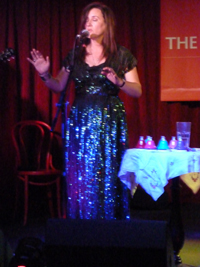
Maria Doyle Kennedy is a singer and actor born, raised and based in Eire. Before seeing her perform at the Half Moon in Putney in south-west London on 4 September 2012 supporting Martin Carthy & Dave Swarbrick, I knew little more than nothing about her acting and singing. Sean McGhee, the editor of R2 had alerted me about her and reeled off a list of acting appearances in The Commitments, Queer as Folk, The Tudors and Downton Abbey. In the spirit of adventure and most especially Father Ted, I deliberately did no research before the gig. It was going to be a blank-canvas concert.
She performed this song at the gig. It has this great opening lyrical gambit, “She was a diamond/He was a miner…” She announced the song with the words, “Life is not perfect but that’s OK.” I have no idea what sparked writing and fashioning this song. Neither did I ask her or her husband Kieran Kennedy – who was accompanying her – afterwards. Yet even on first pass I read several layers of interpretation into this song born out of personal life experiences. May well have been wrong, especially if I misheard words. We all mine songs for personal meaning or sometimes we just let the sound flow over us. Once a song’s sung it’s set free and starts a new life. I like the life in this song.
The photograph of Maria Doyle Kennedy isn’t much, but it captures the concert’s mood. From Sing (Mermaid Productions MPCD23, 2012)
Tommy – Peter Bellamy
Pete Bellamy made the original Barrack Room Ballads in 1977, an album of Rudyard Kipling settings that Bill Leader produced. He recorded this particular song accompanying himself on Anglo-concertina. It was the first of his ‘Rud the Kip’ settings that turned my head. Pete made me think again about Kipling and rethink about how I had pigeon-holed him in some post-imperial box.
This song makes me think about soldiering and soldiers. It is a song about how the members of the public view and, more importantly, treat the armed services that politicians send off to war in our name. Which is, parenthetically, why many will never forgive Tony Bliar who dispatched so many.
One resurrected US soap Dallas made use of a glib platitude: “I don’t believe in the war but I believe in the warrior.” Kipling’s soldier is Tommy Atkins the Cipher. The Tommy of this song is the precursor of Buffy Sainte-Marie’s Universal Soldier. But Kipling’s is a transferrable, sadly ever more transferrable text and truth. It could refer to a veteran from any number of wars. Tommy’s omni-directional sentiments could also stand for those that went out to Algeria, Vietman, the Falklands, Iraq, Afghanistan and ever onwards. Above all, Tommy is about double standards.
Pete Bellamy wrote, “This song highlights the hypocrisy of a society which despised its soldiers in peace-time and would cheer them from the rooftops in time of war. The tune is a combination of folk and music-hall influences.” From Barrack Room Ballads (Fellside Recordings FECD253, 2012)
 What Are Their Names – David Crosby & Graham Nash
It’s an unaccompanied live rendition of the song that originally appeared on If Only I Could Remember My Name (1971). The Occupy This Album album doesn’t specify where its particular recording comes from. It’s short, pared down, fragment-like.
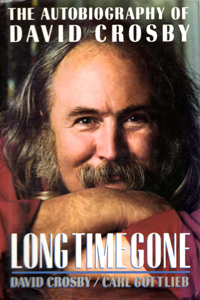
It’s not a pointed song in a European political song sense. It plays on the vagueness of the word ‘they’, an idiom with a vagueness that travels well. David Crosby discusses who the particular they in his mind were in his and Carl Gottlieb’s Long Time Gone – The Autobiography of David Crosby (1988). More about Crosby, Nash, Occupy & Uncle Scam upcoming in R2 issue 37. From Occupy This Album (Music For Occupy 7 93018 33462, 2012)
Déja Vu – Crosby, Stills & Nash
This song originally lent its name to Crosby, Stills, Nash & Young’s album debut in 1970 – CSNY being the successor to the trio’s self-titled album of the previous year with the original core members expanded to four with the inclusion of Neil Young.
This live version recorded at the Performing Arts Center in San Luis Obispo, California on 22 April 2012 is one of DVD/CD set’s highlights. Additional to the trio, there is Todd Caldwell on Hammond B3 organ, Steve DiStanislao on drums, Shane Fontayne on guitars, Kevin McCormick on electric bass and James Raymond on keyboards. From 2012 (CSN Records 409-5, 2012)
Illinois – The Everly Brothers
Roots, the 1968 Lenny Waronker-produced album that this track comes from, opens and closes with Everly Family recordings made in 1952. They were from, the notes said, “a tape made in their home town of Brownie, Kentucky – once a small mining village, now reduced to smokestacks.” The centre image on the back cover was of Don and Phil Everly in country cover outfits franking their parents, Ike and Margaret Everly. The music inside was a revelation. It was a real stepping stone for listeners previously switched off by the irony-free posturing, the rhinestone dandyisms and reactionary conservatism of the Nashville country music industry. Apparently, it sold poorly at the time of its release – not helped by it clocking in at under 40 minutes.
This song is from the pen of Randy Newman. The Everlys spin its facets around as if it were a gem. A miniature, it lasts under two and a half minutes. Its uncredited pianist holds the whole thing together instrumentally with a rhythm section so good in the lightness of its touch it is astonishing. It’s not a hugely well known song in Newman’s canon but it is a vivid travelogue cum portrait with its images of Illinois prairie and grain fields contrasting with the lights, skyline and stockyards of Chicago. Meanwhile, there was the turn of the seasons. From Roots (Warner Brothers 7599 26927-2, 1968)
 El Paso (Full Length Version) – Marty Robbins
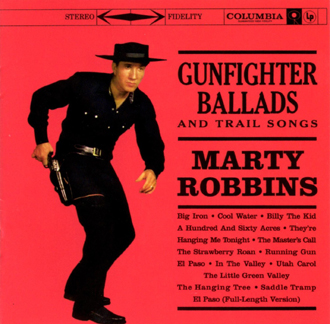
This version recorded in April 1959 is a bonus track on the CD reissue. At over four and a half minutes in length, it wasn’t the one that occasionally got played on the radio in Britain. It is one of Marty Robbins’ country and western songs – and indeed his most famous one. He tells El Paso as a first-person narrative about a moonstruck cowpoke who falls for Feleena (Felina) “out in the West Texas town of El Paso”. She is the Mexican beauty in Rosa’s cantina who casts a spell over the unnamed cowboy. He gets jealous about her paying attention to a “handsome young stranger” and guns him down. He runs and steals a horse and makes off for the Badlands of New Mexico.
But there is a but. Like normal – because this is a movie, right? He still misses Feleena and returns to El Paso (“tonight nothing’s worse than the pain in my heart”).
As he rides in, he spots mounted cowboys and before he knows it, “something is dreadfully wrong for I feel a deep burning pain in my side”. (Bobby Sykes and Jim Glaser of the Glaser Brothers add the lifting harmonies at the end of the line.) I won’t spoil the ending for anyone who doesn’t know the tale… But next time you listen to it, listen to it one time just listening to Grady Martin’s Spanish guitar that runs through the song. A top tip to end on. From Gunfighter Ballads And Trail Songs (Columbia/Legacy OK 65996, 1999)
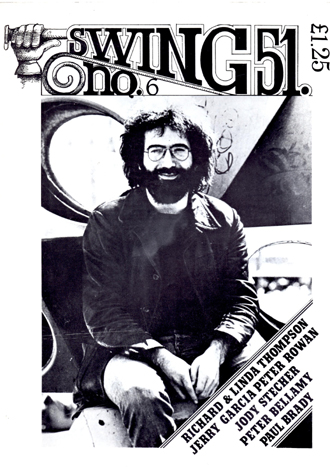 Dark Star – Grateful Dead
This is the 2:45 45 rpm single version. It distils the essence of the song that became the Dead’s most anticipated psychedelic excursion over the course of their voyage into the unknown. So anticipated that it enjoyed periods of retirement.
In one of the interviews that I did with Jerry Garcia, he touched on this single and its inclusion of banjo. “Actually then I used a tape, an old tape I found somewhere, that had me playing banjo for a banjo lesson I think I was giving to somebody. That tape is from ’62 or something like that. So, I found this old tape and threw it on the end of Dark Star just for the Hell of it, just to bring it up during the fade for the Hell of it. Completely unrelated.” From Live/Dead (Warner Brothers/Rhino R2 74401-E, 2001)
Hey, That’s No Way To Say Goodbye – Leonard Cohen
This recording is from the August 1970 IOW Festival. It was the first time that I saw him in concert. Looking at the accompanying photos in the Live At The Isle of Wight 1970 CD/DVD package is transporting. In the period shots, he has tousled hair. It is not the hairstyle on the almost passport or identity card likeness of Songs of Leonard Cohen of 1967 (he is not staring straight enough into the camera for that). Neither is it the neat grey trim and jaunty titfer of Live In London from 2009. It is another time…
Cohen’s songs were borderline Edna O’Brien. Like her writings, his songs were more than the pangs, the naughty bits and the traps that he laid in his lyrics. (Or his poems or prose.) They shared similar energies and levels of energy. This particular song is a slow dance for the minutes leading up to midnight. It is a pulling song as much as it is a valediction. From Live At The Isle of Wight 1970 (Columbia/Legacy 8697-57916-2, 2009)
The copyright of all images lies with the respective photographers, companies and image-makers.