Giant Donut Discs ® – Woody Guthrie on his 100th birth anniversary
14. 7. 2012 | Rubriky: Articles,Giant Donut Discs
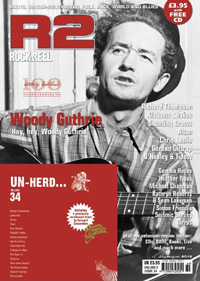 [by Ken Hunt, London] Woodrow Wilson ‘Woody’ Guthrie (1912-1967) was born the day before my father. He was born on 14 July 1912 and Leslie Hunt wasn’t, so to speak. Both of them were hugely influential figures in my musical, creative and political development. Here’s a celebration of Guthrie’s work, with a little help Cisco Houston, Neil Young with Crazy Horse, Madeleine Peyroux, Billy Bragg and Utah Phillips.
How much? How long? – Woody Guthrie
Rather than fling ourselves into the Woody Guthrie song collection, let’s get familiar with his speaking voice and his anecdotage. This wire recording from 1949 was made in front of an audience at the Jewish Community Center in Newark, New Jersey. You get a feel for his accent, his spoken voice, his voice’s cadences and how he sounded. And how given a question or two he could yak.
Wrote his daughter Nora Guthrie, “In 2001, the Woody Guthrie Archives received two antique wire recordings documenting a 1949 performance […] moderated by his wife, my mother, Marjorie Mazia.” He talks for a quarter of an hour, could clearly talk the hind legs off a donkey. From The Live Wire (Woody Guthrie Foundation, 2007)
Ingrid Bergman – Billy Bragg
This was one of the pieces of left-over wordery that Billy Bragg set to music. He performs the song straight to acoustic guitar accompaniment. The lyric is saucy and it could have been done in any number of ways. It is that kind of song. Bragg’s approach and delivery invest the lyrics with something that I hesitate to say that Guthrie himself would have done. There is neither Leer, nor Lurkio here – not the merest hint of Frankie Howerd, so to speak.
I consider this to be one Billy Bragg’s absolutely finest creations. If you listen to it, you will realise how easy it could have tipped into something else, though not parody. Bragg’s far better than that. From Mermaid Avenue – The Complete Sessions (Nonesuch 7559-79628-0, 2012)
Tom Joad – Woody Guthrie
One of Woody Guthrie’s great pieces of re-writing, it condenses John Steinbeck’s Grapes of Wrath character, Tom Joad into 16 or so verses. This particular version is from a 1949 live performance made at the Jewish Community Centre in Newark, New Jersey and captures his speaking voice in all its anecdotal charm – and that of his then-wife Marjorie, a dancer with the Martha Graham Dance Company.
Tom Joad is a song that I also associate with Joe McDonald. He included it on his album Country Joe McDonald thinking of Woody Guthrie (reissued in the UK as Vanguard VMD 6546 in 2011). It was an album originally released in 1969 and it was an important one because McDonald gave new validation to Guthrie’s songs in a way that sounds impossible now. Back then, relatively little of Woody Guthrie’s work was available in Britain. In 1969 it would have been impossible to imagine how much in the way of Guthrie recordings could have been around… From The Live Wire (Woody Guthrie Foundation, 2007)
Ship In The Sky – Cisco Houston
Cisco Houston (1918-1961) was one of the great popularisers of Guthrie’s songs. His early death meant that he is less remembered than he should be in the Guthrie narrative. He was close to Guthrie and shipped with him in the merchant marine on Atlantic convoy duties once the United States entered the Second World War. Jimmy Longhi’s Woody, Cisco & Me (1997) describes those times.
Talking in July 2011, Arlo Guthrie praised that book as nailing his father as he remembered him. This is an exclusive extract from that interview: “There were tie-ins to things I had remembered at home. My Dad had created these things called ‘hoodises’. A ‘hoodis’ was a contraption made up of junk that he either glued or nailed or stapled or somehow tied together that was like a sculpture. Like a modern art sculpture. He had made one on the ship that they were on during the Second World War. He had put it on the back of this ship and all the sailors were saying, ‘What’s that?’ He was, ‘Ahhh, it’s goin’ to make the ship go faster.’ They said, ‘Well, it can’t possibly make the ship go faster.’ And yet while it was up, the ship was making another two to three knots faster than they’d ever been able to go before. Now, I’d not saying that Woody is a scientific inventor: I’m only pointing out that maybe somehow or other… Somebody took it down and the ship went back to its normal speed. Is that real? I don’t know. But that’s Jimmy Longhi telling his story.” Read the book. From The Folkways Years 1944-1961 (Smithsonian Folkways SFCD 40059, 1994)
This Land Is Your Land – Woody Guthrie
A glass acetate recording and an alternative take made in April 1944 for Asch Records. Track 14 on The Asch Recordings Vol. 1 (Smithsonian Folkways SFW CD 40112, 1999)
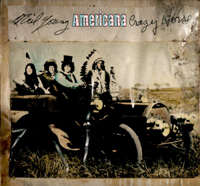 This Land Is Your Land – Neil Young with Crazy Horse
And then there is Neil Young and Crazy Horse’s version.
Incidentally, the Woody Guthrie cover article in R2 examines the background to, and context of This Land Is Your Land as you are unlikely ever to have realised it might be. From Americana (Reprise 9362-49508-5, 2012)
Going Down The Road Feeling Bad – Woody Guthrie, Cisco Houston and Sonny Terry
A much travelled song. This version was cut in April 1944.
Madeleine Peyroux: “I heard my father [actor and teacher Rip Peyroux] sing it and it’s one of the few songs he would sing. He was not a singer by any means, but he would sing when he was especially emotional. It always brought him to tears. My father grew up down in Texarkana, born in New Orleans, and he had a rough childhood down there with a lot of alcoholism in the family. He grew up to be a rough kind of guy. He could get pretty mean, so hearing him sing a song like that meant a lot – not only because he could be a mean old man [laughter] but also because he grew up in the Jim Crow South.
“It was Woody Guthrie’s presence in the world, the singing of this kind of song – and probably other songs that were anti-fascist – that made my Dad sympathise and helped express feelings that my Dad had as a young boy in the South. My Dad hated the racism of the South and grew up fearing that the world was an unfair place. It turned him into a mean old man [laughter] but he did cry when he sang that lyric, ‘I ain’t gonna be a-treated this-a way…’ I think he knew it meant more than just one person’s problem. Somebody like Woody Guthrie could sing a song like this and make you understand that it was about poor white men’s rights and black people’s rights and everybody’s human rights. To make you feel that in however few words you have in that one verse. ‘I ain’t gonna be a-treated this-a way…’ That meant a lot.”
Track 11 on The Asch Recordings Vol. 1 (Smithsonian Folkways SFW CD 40112, 1999)
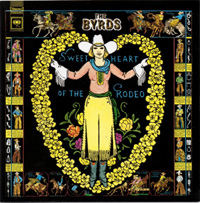 Pretty Boy Floyd – The Byrds
Had to choose this particular performance. It ushered in a whole new appreciation of Guthrie’s work – and country music – for many people, even though Sweetheart was much maligned at the time of its release in 1968 as not being Byrds enough, at least in Britain, and far too country.
Like Happy Traum tells it so well in R2 issue 34 (July/August 2012), it distils the story of the good guy outlaw fiction beautifully. From Sweetheart of the Rodeo (Columbia/Legacy CK 65490, 1998)
Snow Deer – Woody Guthrie
Recorded in April 1944, this song also known as My Pretty Snow-Deer, captures another side of Guthrie. It is an unabashed piece of romanticism or plain old hokum. This isn’t the political agitator putting the world to rights. This is a man making music to pay for the next hamburger or whisky or something towards next month’s alimony.
The excellent notes explain that Ernest Thompson had first recorded it in 1924 and recorded it as a voice, guitar and harmonica cut – contender for the first commercial recording using a harmonica rack – as popularised by Bob Dylan and Neil Young. Track 22 on The Asch Recordings Vol. 4 (Smithsonian Folkways SFW CD 40112, 1999)
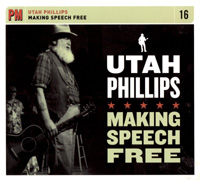 This Land Is Not Our Land – Utah Phillips
Utah Phillips (1935-2008) was one of a kind and also one of many. “The lost verses to This Land Is Your Land…”, as he begins his introduction to this performance, is a piece of rewriting very much in the spirit of Woody Guthrie. His rethink about This Land Is Your Land – a song that Guthrie himself rejigged to fit prevailing situations and circumstances and recorded in varying forms – is just a tiddler of a text but it captures the presence and the wit of the man.
I interviewed Utah once for an article. The interview was very, very good. Afterwards, the periodical got cold feet about its political content. Imagine! Utah Phillips talking about politics! Well, I never! The piece got shunted in the sidings. I’ll get that interview run someday somewhere. (Offers on a postcard to this address.)
This Land Is Not Our Land was recorded in May 1999 “as part of a Free Speech Teach-In. “Don’t mourn: organise!” From Utah Phillips’ Making Speech Free (PM Audio Series PMA 0016-2/DIRT-CD-0063, 2011)
Ken Hunt’s obituary of Utah Phillips ‘U. Utah Phillips: Folk singer-songwriter’ appeared in The Independent long ago in Bethlehem: http://www.independent.co.uk/news/obituaries/u-utah-phillips-folk-singersongwriter-841357.html
Ken Hunt’s article Universal truth – Woody Guthrie remembered appears in the July/August 2012 issue of R2 magazine. It is based on a conversation with Arlo and Nora Guthrie. Its companion piece has a cast of notables picking a song of Guthrie’s and reminiscing about, or responding to it. The cast comprises Wizz Jones, Robb Johnson, Rhiannon Giddens, Dave Goulder, Eliza Carthy, Judy Collins, Happy Traum, Christy Moore, Cerys Matthews, Anne Briggs, Barb Jungr and Madeleine Peyroux.
All interview material is © Ken Hunt. Usual permissions and attribution rules apply. The copyright for the images lies with the respective photographers, companies and image-makers.
Lots more information about Woody Guthrie at: