23. 1. 2012 |
Categories: Articles,Lives

[by Ken Hunt, London] The mridangam virtuoso Palghat T.S. Mani Iyer, born 100 years ago in Palghat (the anglicised version of Palakkad) in Kerala, was one of the musical giants of the Twentieth Century. Prior to him, the mridangam had filled the subordinate time- and tempo-supporting role – the usual role of drums in both of the subcontinent's art music systems and folk traditions. He was one of a generation of musicians that changed the complexion of South Indian music.
His vision and innovation was to shift the balance, so that, in his hands, the mridangam attained a greater melodic role with phrasing that reflected the words, whether sung or unsung. He redefined the artistry of the South's principal barrel drum and rewrote the figurative book, inspiring such mridangists as Palghat R. [...]
read more...
9. 1. 2012 |
Categories: Articles,Giant Donut Discs

[by Ken Hunt, London] The batch of donuts has a great deal, on one hand, to do with current commissions; and on the other, choosing music that had nothing to do with work. The music is courtesy of Bessie Smith, The Kossoy Sisters with Erik Darling, Damien Barber & Mike Wilson, Rosa Imhof, Ida Schmidig-Imhof and Frieda Imhof-Betschart, Nusrat Fateh Ali Khan & Party, Martin Hrbáč, The Notting Hillbillies, Mobarak and Molabakhsh Nuri, Vishwa Mohan Bhatt & Musicians of Rajasthan and Peter Case.
Frosty Morning Blues - Bessie Smith
This performance from January 1924 has a bare-bones accompaniment. Jimmy Jones (piano) and Harry Reser (guitar) do the honours. E. Brown's slow blues starts out lyrically as a quite predictable tale, the sort of blues terrain where you can see the rhymes coming. [...]
read more...
31. 12. 2011 |
Categories: Articles,Best of Year,Feature

[by Ken Hunt, London] What a year for music! The number of events of 2011 on this list is greedy by most annual polls' standards. One of the continual difficulties for me is that, because I am writing in a variety of periodicals and newspapers across a variety of musical genres for a number of territories, wonderful stuff just gets continually squeezed out. I mean, in this brave new world of world music, nobody wants ten roots-based Czech or Hungarian albums or Indian classical or English or even European folk albums...
2011 was marked by losses in the world of music. It started off with the deaths of the singers Bhimsen Joshi and Suchitra Mitra. Keeping to that subcontinental frame of mind, as the year crunched on, the rudra vina virtuoso Asad Ali Khan, the film-maker Mani Kaul, the [...]
read more...
19. 12. 2011 |
Categories: Articles
[by Ken Hunt, London] Back in New York, Seeger enthused about what he had seen and heard. Broadside, a publication with a tiny circulation - using, as Sis Cunningham recalled, a hand-cranked mimeo machine "we had inherited when the American Labor Party branch closed in our neighbourhood" - became a vital conduit for song. Originally published fortnightly, very soon monthly, topicality was a major goal. It published its first issue in February 1962 and folded in 1988. By comparison Sing was launched on May Day 1954 and Sing Out! had first appeared in 1950. Unlike Sing Out! or Sing, Broadside did not interleaf traditional songs with its songs of struggle, diatribes on themes of social justice or political squibs. However imprecisely or colloquially some dubbed this latter category [...]
read more...
5. 12. 2011 |
Categories: Articles,Giant Donut Discs

[by Ken Hunt, London] The one has a lot to do with thinking about loss and renewal, life and the end of life. The music is provided by Anoushka Shankar, David Crosby, Jayanti Kumaresh, Judy Collins, Chumbawamba, Franz Josef Degenhardt, Sultan Khan and Manju Mehta, Ági Szalóki and Gergő Borlai, Davy Graham and Federico García Lorca.
Bulería con Ricardo - Anoushka Shankar
This comes from Anoushka Shankar's debut for Deutsche Grammophon, a fusion affair that travels the continents from modern-day north-west of the Indo-Pakistani subcontinent to the Iberian peninsula. Anoushka Shankar plays sitar, Pedro Ricardo Mieo piano, Juan Ruiz adds unspecified "Spanish percussion" and Bobote and El Eléctrico palmas (hand claps). It's a feast of fun and should Anoushka Shanka, also a trained pianist, [...]
read more...
4. 12. 2011 |
Categories: Articles,CD reviews

[by Ken Hunt, London] It's 2001. You open the paper at an article about the underground strike. Par for the course, the same old politicians are lip-synching the party line. Substitute the specific till the capitalist or metropolitanist becomes local to you. The London Underground is being turned into another public-private partnership. The workers are striking about compulsory redundancies, fears over safety, etc. You get incensed. Another sodding disruption. Another sodding protest. Another sodding privatisation gussied up, as London's transport commissioner Bob Kiley - remember him, New Yorkers? - decries, to generate "the least expensive product or service at the highest price." Wasn't that a time when songs would have flowed about the Tory Party ripping apart the national rail system [...]
read more...
14. 11. 2011 |
Categories: Articles,Live reviews

[by Ken Hunt, Prague] Rabindranath Tagore (1861-1941, Rabindranath Thákur for my Czech readers) was the all-original singer-songwriter - before the term existed - with the folk poetry touch, a poet-bard who in Scots would be called a makar. He had melody purloining skills to make Woody Guthrie blush. In an era of luxury liners and Pullman trains, he travelled probably about as widely as was possible in that pre-David Attenborough era. He set lyrics to ragas, traditional airs, Baul songs, Ganges boatmen's work songs and melodies, like Auld Lang Syne (!), heard on his travels. Where he differs from most song-makers is the enduring popularity, relevance and cultural penetration of his work. An unlettered field worker in Bangladesh and a Kolkata university professor are equally likely to have [...]
read more...
1. 11. 2011 |
Categories: Articles,Giant Donut Discs

[by Ken Hunt, London] This month's batch has a lot to do with thinking about rhymes, rhythms, mythologies and conversations. Bert Jansch, Hedy West, La Piva Dal Carner, Grateful Dead, Jagjit Singh & Chitra Singh, Laura Marling, Marvin Gaye, Rapunzel & Sedayne, David Lindley y Wally Ingram, and Ali Akbar Khan supply this month's inspirations.
Nottamun Town - Bert Jansch
No apologies for returning to Bert Jansch's 1966 album once again. It was playing as the news broke on the morning of 5 October 2011 that he had died in the wee small hours. I have known and extolled Jack Orion since the year of its release. It had depths and darknesses unlike any of his two previous solo releases, in part because of his embracing of traditional material. Even the LP's design signalled a bleakness or [...]
read more...
17. 10. 2011 |
Categories: Articles,DVD reviews

[by Ken Hunt, London] There are many reasons for pulling faces and putting on accents. And Dudley Moore excelled in doing both. In this hour-long, black-and-white, Australian Broadcasting Corporation show, first shown in 1971, Moore runs through a gamut of facial contortions and thespian gazes and a range of 'his voices'. He brings his Pete & Dud voice - reminding that even when continents separated them physically, Peter Cook was beside him in spirit - to the piano.
He subjects material such as his own hamming-about novelty Madrigal, the souped-up Lieder duet of Die Flabbergast and, naturally, his and Cook's valedictory song Goodbyee to various forms of falsetto screech. Revealingly (for cub psychoanalysts in the readership) he adopts somebody else's voice in the spoken introduction to [...]
read more...
17. 10. 2011 |
Categories: Articles
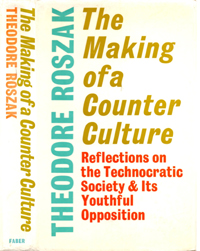
[by Ken Hunt, London] Let's start metaphorical. Maybe poetical and ecological too. Counter-culture in the 1960s was like alternative now, like spring-water welling to the surface and forming rivulets. Streams and rivers form, few with fixed shapes. Currents change unpredictably. Some silt or dry up or form ox-bow lakes. Others keep on flowing and joining up. Counter-culture and alternative have something else going for them. Without getting rheumy-eyed, it's like great river junction at Prayaga - Hinduism's Allahabad - where the Ganges and Jamuna meet the invisible Sarasvati. Like Prayaga, they are where the seen and the spiritual meet in a great confluence.
Theodore Roszak's 1969 book The Making of a Counter Culture - Reflections on the Technocratic Society & Its Youthful Opposition was [...]
read more...
« Later articles
Older articles »