Balkan Beats
28. 4. 2026 | Rubriky: Articles,Book reviews
An Oral History
written by Robert Šoko & Robert Rigney
published by Piranha Records, Berlin, 2025
ISBN 978-3000826009
458 pages
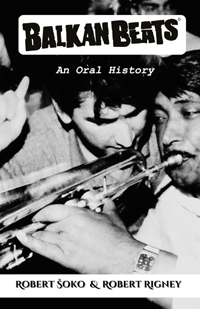 Balkan brass bands, hitmaker Goran Bregović, nostalgia for Yugoslavia, the Roma music of Eastern Europe, the Serbian mega-festival Guča, Bosnian sevdalinka ballads, and nationalist-tinged turbofolk-all of these are partial streams of a complex trend that has lasted for over 30 years.
The starting point is considered to be the film Underground by director Emir Kusturica with soundtrack by Goran Bregović, inspired by the Yugoslav war. This list alone suggests that this is more than a musical phenomenon, and that a whole team of well-founded authors will be needed to map it. And that is exactly what the book that was presented at the Womex trade fair last year is about.
The book does not provide a detailed chronology, which is implicitly indicated by the subtitles Oral History and This is a Real Story. Both co-authors, originally Bosnian DJ Robert Šoko and American music writer Robert Rigney, live in Berlin, together with a very large ex-Yugoslav diaspora. They compiled the book from 130 interviews, articles and personal memoirs. The authors of the cited texts include university professors, journalists with international reputation, as well as musicians from bands such as Dubioza Kolektiv, Gogol Bordello, Balkan Beat Box, Mr. Žarko and Laibach. The result is a diverse but readable chain of observations, memories, controversial opinions, from which the authors often managed to build surprising counterpoints. A specific part is the confrontation of the ex-Yugoslav diaspora with the German mentality.
This is a very complex story, including both wartime destinies and the imprint of ex-Yugoslav culture on the European, and especially Berlin, diaspora. While nationalist cultural trends flourished in the post-war divided Yugoslav territory, interactions flourished in Berlin discos, both with each other and with the German audience, for whom Balkan music, temperament and rakija had the status of paradise, and therefore risky fruits. The fabric of the memoirs intertwines private, often very intimate statements of both co-authors, partnership relationships hard grafted onto immigrant solutions to passport problems.
In the internet era, this is an ideal text for the volatile reader. Open the book to any page and you will immediately enter the plot. The authors claim that they were inspired by the book Please Kill Me – Uncensored Oral History of Punk by Legs McNeil and Gillian McCain from 1996, also compiled from archive interviews
However, punk is actually our Western home culture, while in the Balkans we find ourselves in a territory without limits. The Montenegrin musician-provocateur known as Rambo Amadeus just casually coined the term turbofolk, which he adopted for Serbian nationalist pop, a concept close to other styles that Rambo could just as elegantly classify under the umbrella term “taxi porn”: Tecnobrega from Brazil, čalga from Bulgaria, Romanian manele or Indo-Pakistani bhangra. In other words, “incompetent use of technology”, as Rambo explains.
The book colorfully depicts the confrontation of Balkan rhythms with audiences in Japan, New York or South America. Co-author Robert Šoko compares: “What Mexico is for Americans, the Balkans is for Europeans. Mexicans are insanely emotional. So are we. And sometimes dangerous too. I feel almost at home in Mexico.” He also specifies the risks of the DJ profession: “Alcohol is part of our job, but if you choose rakija, it will knock you out in a flash. Beer is the solution. The problem, however, is crossing the dance floor to reach the restroom. I always had a plastic bottle under the DJ counter. I waved my other, free hand over my head to assure the unsuspecting crowd that the party was going on.”
Among the book’s gems is Laibach’s response to the question of whether they influenced Rammstein: “Rammstein are Laibach for the masses and Laibach are Rammstein for gourmets. The fact that they borrowed a few ideas from us is not important, we also borrow from elsewhere. But, Slovenians have always been better at playing the role of Germans than the Germans themselves, if circumstances required it.”
Goran Bregović made an interesting comparison: “Roma brass bands are not just about music. To me, they seem, at least aesthetically, close to punk. Because punk brings madness to music. The same goes for Roma brass bands. They don’t just play music. They create madness. In the Balkans, it’s not enough to just play music. There has to be a touch of madness in it. I put a motto on one of my records: If it doesn’t make you crazy, you’re not normal.”