14. 9. 2007 |
Categories: Articles,CD reviews

[by Ken Hunt, London] Their marital relationship hitting the buffers by the beginning of the next decade was years away when Richard and Linda Thompson made these live recordings. Hindsight of that nature adds nothing to the frissons that In Concert 1975 delivers. After all, living a year of your life in no way compares to the way a year or three gets 'telescoped' for the purposes of biography. And in any case between 1974 and 1982 the couple released a sequence of jointly credited duo albums that count amongst the finest to come out of Britain during the period in terms of songcraft and performance. This is them at their peak, though they were soon to duck out of this life to pursue other, non-musical paths in a Sufi community
read more...
13. 8. 2007 |
Categories: Articles,Live reviews

Queen Elizabeth Hall, London 22 July 2007
[by Ken Hunt, London] Transformative is probably the most appropriate word to describe the influential Northern Indian rhythmist, composer and teacher, Alla Rakha Qureshi, and how his music affected people. Ustad in the concert's title is the Muslim counterpart of Hinduism´s more familiar words pandit and guru. Certainly, Alla Rakha educated many, many people. The default-standard tale is that the West turned on to Indian music through the sitar. There is no denying the inherent truth, if hackneyed, of that proposition. But it was never the whole story, never the truth, the whole truth.
read more...
12. 8. 2007 |
Categories: Articles,Live reviews

15-29 July 2007, Krems, Austria
Krems is a beautiful and peaceful town on the river Danube in Austria, known for its Riesling wines and - in past years - also for the Glatt und Verkehrt festival. The name literally means a knitting style that changes between two types of stitches, the "smooth" and "inverted". This is actually a good definition of the programming, which includes some well known local traditions in an unusual setting, like the Indian guitarist extraordinaire Amit Chatterjee performing with the Austrian yodelers Broadlahn, an idea which dates back to times when Amit was a regular member of Joe Zawinul's syndicate.
Or imagine a "voices triangle" from three very different corners of world
read more...
12. 8. 2007 |
Categories: Articles,CD reviews

[by Ken Hunt, London] The Stephen Stills who put down this session on 26 April 1968 was hardly between jobs - even if he was between Buffalo Springfield and Crosby, Stills & Nash. On the album's skimpy notes, Stills writes, "I was at a Judy Collins session in New York in 1968, and when she was finished, I peeled off a few hundreds for the engineer so I could make a tape of my new songs." Which Judy Collins session? Not the Who Knows Where The Time Goes surely, because it would be churlish beyond belief not to be explicit about that.
1968 was the year that Judy Collins put out Who Knows Where The Time Goes, one of the finest albums she ever made. Stills contributed acoustic and electric guitar or electric bass to all but one of its nine tracks
read more...
23. 7. 2007 |
Categories: Articles,Lives
[by Ken Hunt, London] In June 1960 a beat group called The Jets hit the St. Pauli district of Hansastadt Hamburg. With their arrival the British music invasion began. Rick Hardy was one of the original five-piece Jets, the first British group to perform in the clubs on the Reeperbahn, a district famed for ultra-violence, cameraderie and the richness of its lexicon of sexual services. Many other groups followed them to St. Pauli, notably a group that grew wings and became The Beatles. Hardy was more than a footnote in the history of rock music. He linked skiffle and rock, linked Soho and Hamburg and linked Joe Brown, Cliff Richard, The Shadows and The Beatles
read more...
23. 7. 2007 |
Categories: Articles,Live reviews
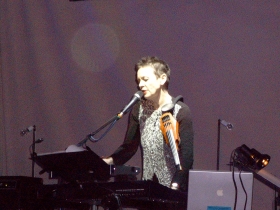
Rudolstadt, Germany, 6-8 July 2007
[by Ken Hunt, London] As far as Germany is concerned, the sovereignty of TFF Rudolstadt must now be taken more or less as a given. It is a model of how to revitalise a local economy too. The 2007 festival reasserted such contentions many times over. Like nearly every festival I've ever attended, the knack lay in out-balancing longueurs with high points. That said, this year TFF RU unwound a new strand of adventurousness with part of its US-themed programming. Philip Glass' setting of Allen Ginsberg's poetry, Hydrogen Jukebox (in a performance from Ensemble Creativ), the Degenerate Art Ensemble and, most notably, Laurie Anderson raised the bar in that respect
read more...
16. 7. 2007 |
Categories: Articles,Lives
[by Ken Hunt, London] The merest mention of the bandoneon conjures images of Argentina, a sub-culture of disadvantage and disaffection, and people expressing themselves through a once sleazy dance called tango. For decades the bandoneon and tango combined to figure as the lingua franca for Carlos Gardel, were refashioned as the nuevo tango (new tango) of Astor Piazzolla and lurked in the automatic writing of Jorge Luis Borges. In Argentina the bandoneon and tango have became expressways to the nation's soul, shorthand for longing and loss, passion and pain. The bandoneon's tones evoke a muscular sort of heartache
read more...
9. 7. 2007 |
Categories: Articles,Live reviews

Music International Exposure,
March 2007
Tel Aviv, Jerusalem, Israel
In the world-music-jargon of melting-pots and cultural crossroads Israel holds a prominent place. This March, the Israeli ministery of culture invited several dozens of festival organisers and journalists for a marathon series of showcases in Tel Aviv and Jerusalem. Surprisingly, the opening night was focused on klezmer, a style considered by many Israelis to be a dying phenomenon of past - along with the yiddish language. Yet it was refreshing to hear this originally East European music being revived by local young players. Contrary to their western parallels, the opening band Oy Division replaced shyness and caution of ethno-researchers by raw confidence and feeling
read more...
9. 7. 2007 |
Categories: Articles,Interviews

Transparente uses a richer accompaniment then the traditional fado setup. Which musicians will you bring on tour?
Transparente is closer to what I've been looking for as my sound, my Fado.
My main goal is to pass to the live performances the general sonority of this record so I'll be adding to the traditional Fado combo (Portuguese guitar, classic guitar and acoustic bass), cello and percussion.
Luis Guerreiro on Portuguese Guitar, Antonio Neto on classical guitar, Vasco Sousa on acoustic bass, Paulo Moreira on Cello and Joao Pedro Ruela on percussion.
Where Fado was born? Only in Lisboa or are there Brasilian influences?
Fado's history is kind of mysterious
read more...
3. 7. 2007 |
Categories: Articles,Lives
[by Ken Hunt, London] At first glance, Anna Marly's name may ring no bells. Her original name was transliterated as Anna Betoulinsky and she was born in the Russian city of St. Petersburg on 30 October 1917 - a stormy time in Russian history, the very month of the Bolshevik uprising. Of mixed Russian and Greek parentage, her father was identified as a counter-revolutionary, was arrested and executed in 1918
read more...
« Later articles
Older articles »